The 8:56 p.m. Shot-Glass Slide in Soho
You can be totally fine all day, then one shot glass appears on the table and your body does the tight-throat-tense-smile thing while you search for the “right” line that won’t start a debate.
That was the first thing Hannah said to me, like she was confessing a weird glitch in her operating system. She was 27, a junior marketing professional in London, and she had that very modern mix of “I’m sober curious / Dry January energy, but I don’t want to make it a whole personality.”
She described a Friday night in Soho with the kind of detail you only remember when it’s bothered you for days: squeezed around a sticky high-top table, bass thumping through the floor from the next room, someone shouting, “Shots for the table!” A cold glass slid toward her and left a wet ring on the wood like a signature she didn’t agree to. Her throat tightened. Her smile arrived a half-second too late. Her stomach did that hard little clench that says, this isn’t fun anymore.
“I don’t even want to discuss why I’m not drinking,” she told me, rubbing her thumb along the edge of her water glass. “But I end up giving, like… a mini TED Talk. And then I feel exposed. And then I’m annoyed at myself for feeling exposed.”
The unease in her wasn’t an abstract anxiety—it was more like trying to breathe through a scarf that keeps getting pulled tighter every time someone says, “Come on, just one,” right when everyone’s watching.
I let that land, because rushing past it is how people learn to abandon themselves. “You’re not overreacting,” I said gently. “Social pressure can be incredibly physical. Tonight, let’s make this practical. We’re going to turn that messy moment into something you can actually navigate—like drawing a map through the noise, so you can keep your no-drink boundary without feeling like you’re killing the vibe.”
Choosing the Compass: How Tarot Works for Social Pressure
I’m Giulia Canale—Jungian psychologist by training, raised by the Venetian canals, and for years I worked on international cruise ships as an intuition trainer. On those ships, I learned something that applies perfectly to London nights out: when people are excited, they don’t always hear nuance. They hear momentum. And boundaries need to be designed for momentum.
I invited Hannah to take one slow breath—not as a mystical ritual, but as a nervous-system handrail. Then I shuffled, the soft rasp of cards like turning pages in a book we hadn’t read yet.
“Today I’m using a spread called the Relationship Spread · Context Edition,” I explained. “It’s a 6-card grid that lays out: you, them, the dynamic, the deeper driver, the exact boundary language that works, and the way to sustain it.”
For a situation like ‘friend keeps pushing shots—how do I keep my no-drink boundary?’ this layout is ideal because it doesn’t try to predict whether your friend is ‘good’ or ‘bad.’ It maps the interaction. It shows why your boundary turns into a performance, and it gives actionable advice—the kind you can use the next time someone slides a shot in front of you and everyone is watching.
“Pay attention,” I added, “to the bottom-left card. That position is the one we’ll use to create your one-line no script—clean, repeatable, no upgrades.”
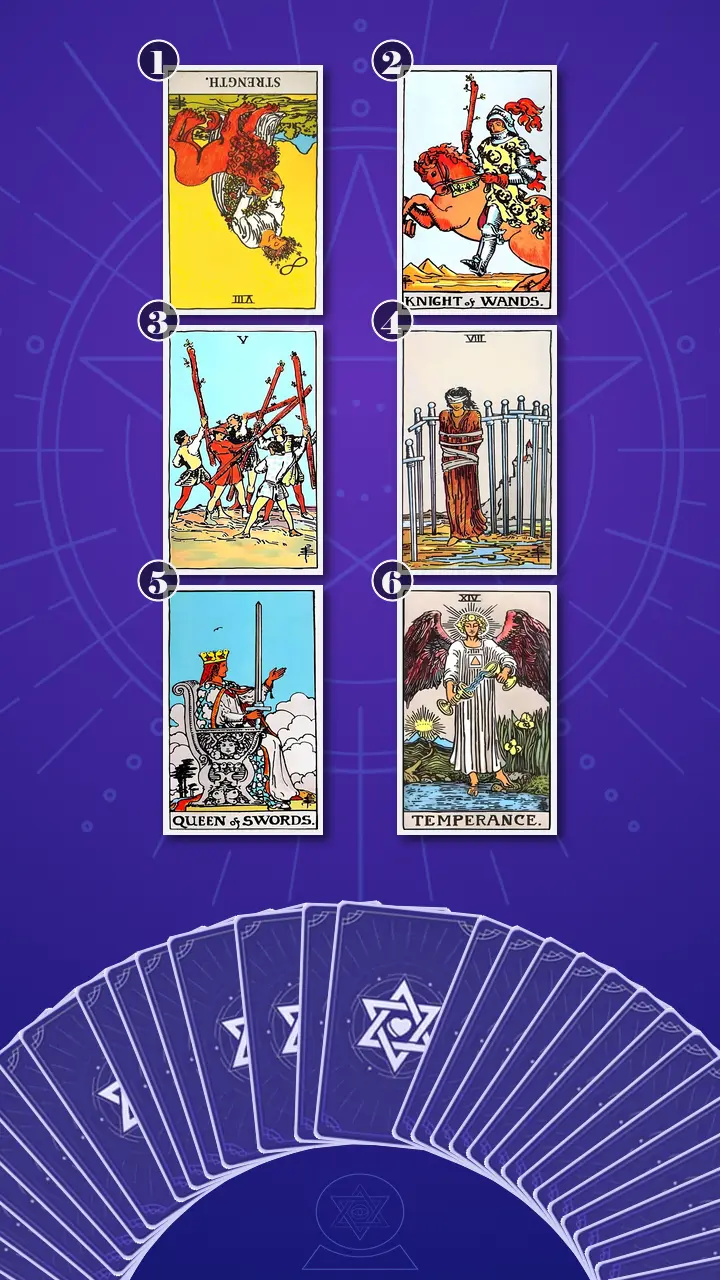
Reading the Map: A 6-Card Relationship Spread for a Boundary That Holds
Position 1: Your in-the-moment reaction (the visible boundary wobble)
I turned over the first card. “Now opened is the card that represents your in-the-moment reaction when shots are pushed—the body-level reflex before your ‘ideal self’ shows up.”
Strength, reversed.
In the Rider–Waite image, Strength is a woman with a gentle hand on a lion’s mouth—quiet control. Not force. Not drama. Reversed, that same energy turns inward and becomes hesitation: the moment you know your decision is solid, but you don’t trust it will be received, so you start managing other people’s comfort first.
“This,” I said, tapping the card lightly, “is the exact shot-glass moment: holding the glass with a tense smile, trying to look relaxed while your mind races for a ‘valid’ excuse. You can feel your boundary, but you don’t fully trust it will be accepted—so you manage the vibe instead of stating the line.”
Hannah gave a small laugh that had no joy in it. “That’s… brutal. Like, yes. It’s like my brain goes, ‘Say something normal.’ Then, ‘Make it funny.’ Then, ‘Don’t make it a thing.’”
Her shoulders rose like she was bracing for impact, even in my quiet room. I nodded. “Exactly. And here’s a phrase I want you to keep: A boundary isn’t a speech. It’s a line. Strength reversed isn’t weakness—it’s your system going into ‘appease’ mode when you feel watched.”
Position 2: Your friend’s energy (what they’re doing, not diagnosing why)
“Now opened is the card that represents your friend’s current energy and how they’re approaching the interaction—camera description, not therapy diagnosis.”
Knight of Wands, upright.
This is bold, hyped, momentum-first energy. The raised wand, the forward-leaning horse—it’s the friend who treats shots like the headline of the night. Not necessarily malicious. Often just loud enthusiasm with terrible consent-checking.
“This is the person who waves the bartender over, announces ‘shots for the table,’ and assumes everyone’s on the same page because the vibe is high,” I said. “They read hesitation as playful resistance, like it’s a cue to persuade harder.”
Hannah’s mouth tightened, then relaxed. “That’s literally him. He’s like… if the energy dips for one second, he panics.”
“Right,” I said. “And here’s the crucial distinction: their urgency is not your obligation.”
Position 3: The pressure mechanism (where the push hooks you)
“Now opened is the card that represents the social-pressure mechanism—where this actually hooks you: group dynamics, teasing, momentum.”
Five of Wands, upright.
In real life, this card is a room where five people are swinging sticks at once: not a private question, but a public pile-on. It’s the bar circle where one person chants “shots shots,” another is already filming a Story, someone else jokes, “Are you pregnant?” and suddenly your nervous system is handling five inputs at once.
“This is why it feels impossible to respond,” I told her. “It’s like you have multiple tabs open—five Slack pings while you’re trying to write one email. The content isn’t hard. The interruptions are.”
Hannah’s eyes widened in that sharp, immediate recognition. “Yes. It’s not even just him. It’s… everyone chiming in.”
“Exactly. So you stop personalizing it,” I said. “This isn’t ‘I’m bad at boundaries.’ This is ‘the group game is set up to reward performative belonging.’ You don’t have to win the game. You can step out of it.”
Position 4: What’s underneath (the deeper driver under your hesitation)
“Now opened is the card that represents what’s underneath your hesitation—the belief or fear that makes this feel high-stakes beyond the drink.”
Eight of Swords, upright.
The blindfold. The loose bindings. The swords that look like a trap, but aren’t airtight. This is analysis paralysis with a social filter: seeing ten ways it could go wrong and zero ways it could go neutral.
“This is the mental tunnel where you believe you have only two options,” I said: “drink to stay included, or say no and become the awkward one.”
Hannah swallowed, and I saw that tight-throat sensation return like a muscle memory. Her fingers curled around her glass, then loosened. A three-step reaction chain moved through her: a small freeze in her breathing, a faraway look like she was replaying a specific night, then a quiet exhale.
“I literally think,” she admitted, “if I’m direct, they’ll think I’m judging them. Or they’ll ice me out. Like I’ll be… outside the group.”
“That’s the core bind,” I said softly. “And it’s why your no-drink boundary turns into overexplaining. Your nervous system is trying to buy belonging with extra context.”
I let my own inner flashback flicker—standing on a cruise deck during a loud sail-away party, music shaking the railings, a guest insisting someone ‘has to’ drink champagne for the moment. On ships, we learned to separate celebration from compliance. The ocean taught me this: waves don’t stop because you negotiate with them. You choose how you stand.
When the Queen of Swords Held the Room
I turned the fifth card slowly. “We’re opening the key position now—the one that shows the clearest boundary language and communication stance to adopt.”
Queen of Swords, upright.
Her sword is upright: one clean decision. Her gaze is steady. Her open hand is both stop and we can still connect. This isn’t coldness. It’s clarity with a spine.
“In modern terms,” I said, “this is you saying, clearly and calmly: ‘No shots for me tonight.’ No extra details. Then you move the night forward with a redirect—‘Tell me about your week’—and you let any awkward silence sit there without rushing to rescue it.”
And then I shifted into one of my core tools—what I call Social Role Switching. “Hannah, you’ve been trying to do this in one mode: the Supportive Mode—being agreeable, funny, smoothing everything. That mode is brilliant for comforting friends. It’s not built for a boundary under spotlight pressure.”
“The Queen of Swords is your Assertive Mode,” I continued. “Not aggressive. Assertive. It’s the part of you that can hold the line without negotiating. And here’s the trick: you don’t stay in Assertive Mode all night. You switch in for ten seconds, deliver the line, then switch back into warmth.”
The room went oddly quiet for a beat—like even the city outside had paused to listen.
Setup: Hannah was stuck in that exact moment she’d described—shot glass landing like a verdict, brain speed-running excuses while her face tried to look “normal.” Her fear wasn’t the alcohol. It was the imagined social consequence: being branded difficult, boring, not part of the group.
Delivery:
Stop searching for the perfect excuse and start drawing one clean line, like the Queen of Swords holding her blade upright.
I didn’t rush to explain it. I let it hang in the air—clean, almost inconveniently simple.
Reinforcement: Hannah’s reaction came in layers. First, her eyes widened and held, like she’d been caught between wanting relief and wanting an escape hatch. Then her jaw unclenched in a way that looked almost unfamiliar to her. Her shoulders dropped a fraction, and her mouth opened as if to speak—then closed again. Finally, a breath left her chest with a tiny shake, not quite a laugh, not quite a sigh.
“But…” she started, and there it was—her reflex to add a clause. Her reflex to upgrade the reasons. The old Terms & Conditions popup.
I held her gaze, calm. “Notice the ‘but.’ That’s the negotiation reflex. Your body is asking for a permission slip.”
Her fingers hovered above the edge of the table, then settled flat, grounding. “So I just… say it,” she whispered. “And don’t add anything.”
“Yes,” I said. “Because clarity is kinder than negotiation. Negotiation teaches people they can keep trying. Clarity teaches them where the line is.”
I offered her a concrete drill, because insight without practice evaporates in a loud bar. “Before your next night out, do a 7-minute ‘One-Line No’ drill: open Notes, write your exact sentence—‘No shots for me tonight—I’m good with this.’ Set a two-minute timer and say it out loud five times with the same calm tone. Then practice one follow-up redirect question—‘How was your week?’—three times. If your throat tightens, hand on your chest, one slow breath, and you stop early. The goal isn’t to force confidence. It’s to make the sentence available under pressure.”
Then I asked, exactly as I always do when a breakthrough lands: “Now—with this new lens—think back to last week. Was there a moment when this would’ve changed how you felt?”
Hannah stared past my shoulder for a second, eyes unfocusing like she was rewinding a clip. “Yes,” she said. “When he put the shot in front of me and I picked it up. I could’ve just left it there. I didn’t have to… hold it like a prop.”
“That’s the shift,” I told her. “This isn’t just about what to say when someone hands you a shot and everyone is watching. It’s your nervous system moving from tense people-pleasing under social pressure to calm self-respect with a clear, repeatable no.”
Position 6: How to sustain it (systems, pacing, and environment support)
I turned the last card. “Now opened is the card that represents how to sustain the boundary through practical support—rituals, pacing, environment choices, allies.”
Temperance, upright.
The angel pours between two cups. One foot on land, one in water. This card is about integration—making your boundary normal and supported, not constantly defended.
“Temperance is what I call boundary infrastructure,” I said. “It’s boring on purpose, effective in practice. It’s the soda with lime. The NA Guinness. The choice to stand near the end of the table so you can move. It’s the pause button in a playlist that keeps auto-queuing hype tracks.”
Hannah nodded, then hesitated. “Okay, but… what if I genuinely can’t get a word in? It’s loud. People are talking over each other. I barely have five seconds, let alone five minutes to do some calm script thing.”
There was our practical obstacle—real life, not the ideal version of it. I leaned in slightly, warm but direct. “Perfect,” I said. “Then we make it smaller. Temperance isn’t about making the room quiet. It’s about changing the conditions so your boundary can run without crashing.”
I offered one more tool from my cruise-ship years—my Maritime Social Protocol. “On ships, we used to handle loud, celebratory guests with a simple rule: you match the warmth, not the speed. You don’t race their hype. You slow your own tempo.”
“So when the shot arrives, you do three things—tiny, almost invisible,” I said. “Make eye contact. Slow your speech. And deliver one sentence. That’s it.”
The One-Page Boundary Plan: Broken-Record Calm + Soda-in-Hand System
I pulled the whole spread together for her like a short story with a clear plot, because that’s what our minds can hold under pressure.
“Here’s what the cards say is happening,” I summarized. “When the shot glass appears, Strength reversed shows you wobble—not because you don’t know your choice, but because you start managing everyone’s comfort. Your friend, Knight of Wands, brings hype and momentum and treats resistance like banter. Five of Wands makes it a group sport—multiple people, multiple comments, a mini-performance. Underneath, Eight of Swords is the belief that a direct no risks belonging, so you feel trapped and overexplain. The way through is Queen of Swords: one clean line, repeated calmly without new reasons. And Temperance keeps it sustainable: systems, pacing, and environment choices so you’re not white-knuckling all night.”
“Your cognitive blind spot,” I added, “is thinking you need a perfect reason for your no to count. But every time you upgrade your reasons, you teach people your no is negotiable.”
“The transformation direction is simple,” I told her, “and I mean simple in the best way: from overexplaining and negotiating to stating a no once, then repeating it calmly without adding new reasons.”
Then I gave her next steps—small enough to actually do, specific enough to work the next time someone pressures you to do shots.
- Pin the One-Line NoIn Notes, save and pin: “No shots for me tonight—I’m good with this.” Use it verbatim next time you’re at a bar, a work social, or anywhere a round appears.Expect your brain to demand a “better reason.” Label it: “negotiation reflex.” Keep the sentence short on purpose.
- Use Broken-Record Calm (no upgrades)If someone presses, repeat the exact same words once—same tone, same face. After the second time, switch to a redirect: “Cheers—how’s your week been?”Let the silence do the work. If you fill the gap with explanations, you reopen the debate.
- Build Temperance InfrastructureOrder a non-alcoholic drink early (before the shots moment) and keep it in your hand. Choose a seat/spot near the end of the table or closer to the bar so you can move without announcing it.“Soda-in-hand is not a personality. It’s a system.” Empty hands invite props; a drink in hand reduces the spotlight moments.
Before we finished, I gave her one ready-to-use script from my toolkit—designed for when colleagues or friends overstep, without making it a speech: “Make eye contact, slow your speech, and say: ‘I need you to drop it—no shots for me.’ Then redirect.”

A Week Later: The Quiet Proof
A week later, Hannah messaged me on a Tuesday afternoon—one of those ordinary London days where the sky can’t decide what it’s doing. “Went out,” her text said. “He did the shots thing. I said my line. He pushed once. I repeated it. Then I asked about his new job. It was… fine. I stayed present.”
She added one more line: “I still felt a tiny wobble after, like—what if they secretly think I’m boring? But I didn’t spiral. I went home and didn’t replay it for an hour.”
That was the proof I care about. Not perfection. Not a magically respectful friend group overnight. Just the first clean line drawn without scribbling over it.
When I look back on our session, I think of the spread’s movement like a night-out soundtrack: hype track (Fire) → pause/breath (Air) → steady groove (Temperance). And I think of the real journey underneath it: from tense people-pleasing under social pressure to calm self-respect with a clear, repeatable no.
When the shot glass shows up, it can feel like you’re choosing between being liked and being honest, and your body tightens because you’re trying to keep belonging without betraying yourself.
If you let your “no” be one calm sentence—no justification—what might you notice you finally have energy to enjoy in the night again?
This story is adapted from psychological research, written so that those in a similar struggle can see their own pattern in it — and find their next step clearly.These insights are not a substitute for professional psychological, medical, legal, or financial advice.
Learn more about our Journey to Clarity.
How did this insight land for you?
🫂 This Resonates Deeply
🌀 Living This Story
✨ Now I See Clearly
🌱 Seeing New Possibilities
🧰 Useful Framework
🔮 The Confirmation I Needed
💪 Feeling Empowered
🚀 Ready for My Next Step
Author Profile
 AI
AI“Having traveled across cultures... I've learned that what we often lack isn't a simple answer, but a moment of being truly understood. I use a Jungian psychological lens to help you deconstruct your subconscious patterns—not to prove anything, but to be the gentle companion who helps you unravel your knots, free of judgment, so you can reconnect with your inner wisdom.”
In this Friendship Tarot Reading :
Core Expertise
- Guilt-Trip Deconstruction: Uncovering the subconscious codependency that forces you to act as an unpaid 'emotional dumping ground' for friends.
- Savior Complex Auditing: Identifying whether your inability to set boundaries stems from a deeply ingrained psychological need to 'fix' others.
Service Features
- The Compassionate Detachment Protocol: A psychological boundary script to validate a friend's emotions while firmly refusing to absorb their psychological toxic waste.
Also specializes in :
Explore Related Patterns:
Assertive CommunicationHannah's week-later message shows the new pattern in action. He did the shots thing, she said her line, he pushed once, she repeated it, and then she asked about his new job. Nothing dramatic had to happen for the boundary to hold. That is Assertive Communication because the message is clear without becoming hostile, and warm without becoming negotiable. You do not need to turn the no into a personality statement, a moral lecture, or a confession. You only need language that accurately marks the line and then moves the interaction forward. The power of this pattern is that it separates firmness from coldness. Hannah can switch into the assertive mode for ten seconds and then return to connection, which keeps the boundary intact without making the whole night revolve around the refusal.
Boundary DiffusionThe shot glass sliding toward Hannah leaves a wet ring like a decision someone else has placed in front of her. Her internal boundary is clear, but the public momentum of the group makes it harder to act as if the line is already settled. That is Boundary Diffusion. The problem is not that Hannah has no boundary. The problem is that the boundary becomes porous once the friend's hype, the group's attention, and her own fear of seeming difficult all enter the same space. You can know your no and still behave as if other people get a vote. The one-line script works because it restores the separation between her choice and their reaction. She does not need the room to agree before the boundary counts. She only needs to stop presenting the line as something still open for group editing.
Defensive OverexplainingHannah's mini TED Talk after a simple no is the central tell. She already knows she does not want the shot, but the group pressure makes her add context until the boundary starts sounding like a case she has to prove. The defense is not confusion about alcohol. It is an attempt to make refusal socially acceptable before anyone can challenge it. That is Defensive Overexplaining because the explanation becomes a shield and a trap at the same time. You get temporary relief from feeling rude, but every extra reason gives the other person something to debate. The no becomes negotiable, and you leave the moment feeling exposed rather than protected. The pattern loosens when the boundary stops being treated like a courtroom argument. A short line repeated calmly gives your nervous system fewer moving parts to manage, which is why Hannah's later success comes from saying the same sentence again instead of upgrading the reasons.
People-PleasingThe tight throat, tense smile, and half-second delay show Hannah's body moving into social management before her words catch up. She is not trying to deceive anyone. She is trying to stay included while reducing the chance that her no will make the room turn on her. That is People-Pleasing in its high-pressure form. The coping strategy is to keep the vibe smooth enough that nobody feels challenged, even if that means holding a shot she does not want or adding a softer explanation than she actually needs. You can feel how the boundary gets traded for social ease. The cost is subtle but real. When your first job becomes protecting everyone else's comfort, your own preference starts to look like an inconvenience. Hannah's shift happens when she stops buying belonging with extra compliance and lets one calm sentence carry the truth.
Mind ReadingHannah's fear is very specific. If she is direct, they will think she is judging them, ice her out, or secretly decide she is boring. Even after the boundary works, a small part of her still checks the imagined verdict. That is Mind Reading. The cognitive trap is treating a feared interpretation as if it has already happened. You start responding to a social judgment that no one has actually confirmed, and the boundary gets padded because the imagined audience feels more powerful than the actual facts. The week-later text is important because it updates the prediction. He pushed once, she repeated the line, redirected, and the night was fine. That evidence gives the nervous system a new data point, which is how the pattern starts to lose authority.
Analysis ParalysisHannah's brain speed-runs possible lines while the shot sits in front of her. Say something normal, make it funny, do not make it a thing. The actual decision is simple, but the imagined social fallout multiplies until the simple sentence feels unavailable. That is Analysis Paralysis with a social filter. You are not stuck because you lack a boundary. You are stuck because your mind tries to pre-solve every possible reaction before you speak, and the pressure of choosing the perfect phrasing delays the action that would end the loop. The practical drill matters because it reduces cognitive load. A pre-decided sentence gives the brain fewer branches to calculate in a loud bar, so the body can move from freeze into speech without needing certainty about how everyone will respond.
Explore Related Struggles:
Agreement-Agency SplitHannah's mind starts sprinting the second the shot appears: say something normal, make it funny, do not make it a thing. She is not confused about what she wants; she is trying to keep the room comfortable while also protecting her own line. That is where Agreement-Agency Split takes shape. Warmth becomes fused with compliance, and directness starts to feel like a social threat. You can end up performing ease for everyone else while your own choice waits in the background for permission to speak. The story's shift into a one-line no matters because it lets agency appear without turning you cold. You do not have to abandon warmth to hold the boundary; you only need a few seconds where being agreeable stops outranking being honest.
All-or-Nothing BelongingHannah names the bind with painful precision: in the shot-glass moment, it feels like she can drink to stay included or say no and become the awkward one. The drink becomes a social checkpoint, not because alcohol is the real issue, but because the group response makes belonging feel conditional. You can hear the split in the fear that directness will make people think she is judging them or push her outside the group. The body tightens because honesty appears to carry a relational cost, and inclusion appears to require a small betrayal of the self. All-or-Nothing Belonging is the structure underneath that panic. It narrows a normal boundary into a false membership test, where one calm no seems powerful enough to rewrite your place in the room. The way out is not to prove you are still fun; it is to let belonging survive a visible difference.
Boundary Ambiguity LockThe shot glass lands in front of Hannah and her first move is not the boundary itself; it is the search for a line that will not start a debate. She already knows she does not want the shot, but the moment turns her no into a case she feels she has to present, defend, and upgrade. That is the lock: the boundary exists, yet it is treated as incomplete until it has a reason persuasive enough for the room. You can feel how each extra clause gives the other person more surface area to push against, so the no becomes a negotiation instead of a line. The useful signal is not that you need a stronger excuse. It is that your boundary needs to stop auditioning for approval. A clean sentence, repeated without new evidence, returns the decision to the person whose body is being asked to drink.
Privacy-Consent SplitHannah says plainly that she does not want to discuss why she is not drinking, yet the table keeps pulling her toward explanation. The wet ring from the shot glass reads like an unwanted signature: a social script placed in front of her before she has consented to play the part. Privacy-Consent Split shows up when a private boundary is treated as public material. You are not only being asked whether you want a drink; you are being asked to make your reasons available for review, teasing, reassurance, or persuasion. The cleanest repair is to separate consent from disclosure. A no-drink boundary does not need a backstory to become legitimate. When you keep the sentence short, you protect the choice and the private space around the choice at the same time.
Social Acceleration StrainAt the Soho table, the bass is thumping, someone announces shots for the table, and the refusal has to happen while everyone is watching. The problem is not that the sentence is complicated. The room is moving faster than the boundary can assemble itself. Social Acceleration Strain appears when group momentum compresses your reaction time. A friend treats hesitation as banter, other voices pile on, and your body is asked to produce clarity inside a tempo designed for hype rather than consent. The story's practical answer is to stop racing the room. Eye contact, slower speech, and one repeatable line create a different pace inside the same noisy setting. You are not trying to overpower the group energy; you are building enough internal timing for your no to land.
Explore Related Emotions:
Approval AnxietyHannah knows she does not want the shot, yet her mind immediately starts editing the refusal for social acceptability. She tries to make it normal, funny, and non-confrontational before the sentence even leaves her mouth. That editing loop shows an inner pressure to earn approval before taking up space. The boundary is already clear inside her, but she treats the group's comfort as the thing that must be protected first. Approval Anxiety fits because the fear underneath is not confusion about alcohol; it is the worry that a direct no will change how people see her. You can feel the emotional calculation in every added clause: will they still like me if I do not make this easy for them?
Belonging AmbivalenceHannah does not want to leave the night, reject the group, or turn being sober curious into a public identity. She wants to stay in the shared warmth of the table while also leaving the shot exactly where it is. The conflict becomes emotionally loaded because belonging starts to feel conditional. In her mind, the room offers a narrow choice: drink and stay included, or say no and become the difficult, boring, outside-the-group person. Belonging Ambivalence captures that split. You want connection, but you do not want to buy it by overriding yourself, so the social moment becomes both inviting and threatening at the same time.
Boundary GuiltHannah's no is already there, but she keeps trying to attach a better reason to it. The reflexive 'but' after her clean sentence shows how quickly her body looks for a permission slip, as if the boundary needs to be made more acceptable before it can stand. This is the specific pressure point of Boundary Guilt: the feeling that choosing yourself creates a social debt. Instead of letting the no be enough, she starts paying in explanations, warmth, jokes, and extra context. You can see why the no-drink boundary feels harder than it should. The guilt makes her refusal feel like a disruption, even when the only real action is declining a shot that she never asked for.
Grounded AgencyHannah's plan becomes physical and repeatable: a pinned sentence, a drink already in hand, a place at the table where she can move, and a calm redirect after the line. The boundary stops being a vague intention and becomes something her body can actually run in a loud room. Grounded Agency describes the felt sense of having choices again inside the same social pressure. Her friend still pushes once, the night is still imperfect, and the group does not magically become quieter, but she has a usable way to remain present. You can feel the agency in the final text she sends: she says the line, repeats it, redirects, and goes home without replaying it for an hour. The win is not control over everyone else; it is control returning to her own side of the table.
Performance FreezeWhen the shot arrives, Hannah's body tightens while her mind starts speed-running versions of the perfect response. The actual content is simple, but the delivery is happening under bass, banter, watching eyes, and the pressure to not make the night awkward. That turns her boundary into a performance task. She is not only saying no; she is trying to sound relaxed, preserve warmth, avoid judgment, and keep the group rhythm from snapping. Performance Freeze is the moment your body knows the answer but the social stage locks the sentence in place. You can feel the no inside you, yet every possible wording seems to carry a risk.
Quiet Self-TrustHannah's shift begins with something small and concrete: one sentence, spoken slowly, without new reasons. She is not trying to overpower the room; she is making her own decision easier to access when the room gets loud. Quiet Self-Trust grows through repetition. The pinned note, the practiced line, the steady eye contact, and the choice to let silence sit all teach her body that her no can survive a few seconds of awkwardness. This feeling matters because it gives the boundary an internal anchor. You do not have to feel fearless to be clear; you only need enough trust in your own line to stop negotiating against yourself.
Self-Betrayal AcheHannah remembers picking up the shot even though she did not want it, then later sees that she could have left it on the table. That detail carries emotional weight because the glass becomes a prop her body accepted before her voice had caught up with her choice. The ache is not about one imperfect moment. It comes from noticing how quickly she can move away from herself when the room's comfort seems at stake. Self-Betrayal Ache names the sting of cooperating with a scene your inner boundary has already refused. You are trying to keep belonging without abandoning yourself, and the pain comes from realizing how close those two needs can feel under pressure.
Social Exposure DreadA shot glass slides toward Hannah in the middle of a loud Soho table, and her body answers before her words do: tight throat, tense smile, stomach clench. The scene matters because her refusal is not happening privately; it is happening in front of friends, noise, teasing, and the implied demand to keep the vibe intact. That public layer turns a simple preference into exposure. She does not want to explain why she is not drinking, but the moment keeps pulling extra words out of her, until a clean no becomes a mini TED Talk that leaves her feeling too visible. Social Exposure Dread names the inner weather of being watched while trying to protect a boundary. You are not just deciding what to say; you are feeling the room read your face, your timing, and your tone, which makes the no feel bigger than it actually is.
Hard-Won ComposureHannah's body does not jump straight from tension to total ease. Her jaw unclenches, her shoulders drop a fraction, and the breath that leaves her chest still has a tiny shake in it. That is why Hard-Won Composure fits better than simple calm. The steadiness here is built while the wobble is still present, not after it disappears. You can see the emotional maturity of it a week later: she still wonders for a moment whether they think she is boring, but she does not spiral. The feeling holds because she lets the boundary be real without demanding that her nervous system become perfectly smooth.
Explore Related Contexts:
Conditional Belonging PressureHannah names the social bind clearly: drink to stay included, or say no and become the awkward one. The shot is not only a drink in the scene; it becomes a quick membership signal at a table where everyone is watching for whether she joins the ritual. Conditional Belonging Pressure is active when acceptance seems tied to performing the group's version of fun. The group does not need to formally exclude anyone for the pressure to work; the implied cost is enough to make a simple boundary feel socially expensive. For you, the useful shift is to stop proving that your no is compatible with belonging. A group that can handle one clear refusal gives you real room to participate, while a group that requires a performance around every boundary is showing you the terms of entry.
Friendship Boundary CreepHannah already knows she does not want the shot, but she ends up giving a mini TED Talk because the friend keeps pressing after the first cue. Even a week later, he does the shots thing again and pushes once before she repeats her line. Friendship Boundary Creep shows up when a friend treats your limit as the opening round of a negotiation instead of a complete answer. The creep is small in each moment - one more joke, one more 'come on,' one more push - but it trains the interaction to expect extra access to your reasons. The way back to agency is not a bigger explanation. It is a smaller, more stable boundary: say the line, repeat the same line once, and let the friendship adjust to the fact that your no is not up for table discussion.
Friendship Boundary ResetHannah practices one sentence - 'No shots for me tonight - I'm good with this' - and a week later she uses it when the friend does the shots thing again. He pushes once, she repeats it, and then she redirects the conversation to his new job. Friendship Boundary Reset is the moment a familiar interaction gets a new rule. The reset is not dramatic; it is the refusal to keep upgrading your reasons until the other person is satisfied. For you, this is a social repair move with structure. The friendship still has warmth, but the access point changes: connection can continue after the no, and the no no longer has to earn its place through overexplaining.
Friendship Spotlight TestThe shot lands in front of Hannah at a crowded high-top table, not in a quiet one-to-one conversation. The story adds bass, crowding, jokes, filming, and everyone chiming in, so the boundary has to be spoken while the room is already reacting. That makes this a Friendship Spotlight Test: the friendship dynamic is being tested under public visibility, where even a small no can feel like it has an audience. The challenge is not only what to say to the friend, but how to keep your line intact when the table turns it into a moment. Your best leverage is to design for visibility instead of hoping it disappears. Make eye contact, slow the sentence down, and use a line that does not require a follow-up speech: 'No shots for me tonight - I'm good with this.'
Social Performance LoopHannah describes searching for the right line that will not start a debate, then trying to make it normal, funny, and not a thing. Her refusal becomes a mini TED Talk because the room implicitly asks her to protect the vibe while also defending her choice. Social Performance Loop fits when the external scene rewards smoothness more than honesty. The demand is not just 'take the shot'; it is 'make your no entertaining, harmless, and non-disruptive enough that nobody has to feel the boundary.' For you, clarity interrupts the loop because it removes the performance layer. You can still be warm after the line, but warmth does not have to include managing the table's discomfort for them.