Saying 'No Rush' While Angry: Setting a Boundary Around Waiting
The 8:47 P.M. 'No Rush' Text
I recognized the pattern before Jordan finished taking off their coat: an early-career UX designer in Toronto who had told a partner there was no rush after another postponed commitment conversation, then spent the TTC ride home editing the angry sentence out of an iMessage. At 8:47 p.m. on Line 1, the fluorescent lights had buzzed overhead, a damp winter coat had smelled faintly of rain, and the phone had warmed Jordan's palm. They had typed 'I understand' while wanting to ask why the relationship kept being put on hold.
After Jordan sat across from me, I heard the sentence that carried the whole problem: 'I keep saying there is no rush, but there is a rush inside me.' They wanted commitment, but each request for more time made their jaw lock, their hands clench, and restless pressure gather in their chest. The calm reply had become an unpaid emotional project, patience on the screen while resentment kept receipts underneath. Some people might search this as relationship commitment anxiety. I heard something more precise: a desire for commitment colliding with the anger created by repeated delays.
Jordan told me that after every postponed conversation, they opened the Notes app, typed what they actually wanted to say, deleted the sharpest sentence, and sent a softened version instead. I could hear the fear beneath the politeness: if they showed anger, perhaps the other person would decide they were too much and stop choosing them. The result was a strange kind of waiting, outwardly reasonable and inwardly as tight as a wire pulled across the chest.
I said, 'You can want commitment and still be angry about how long you have been asked to wait. We do not need to make the anger disappear, and we do not need to turn it into a verdict. We can use it as information, draw a map toward clarity, and keep the decision-making power with you.'

Choosing a Compass for a Relationship in Limbo
I asked Jordan to place both feet on the floor, take one slow breath, and name the question without trying to make it sound more acceptable. Then I shuffled slowly. The preparation was not a supernatural test; it was a small change of rhythm, a way to move from the message spiral into focused observation.
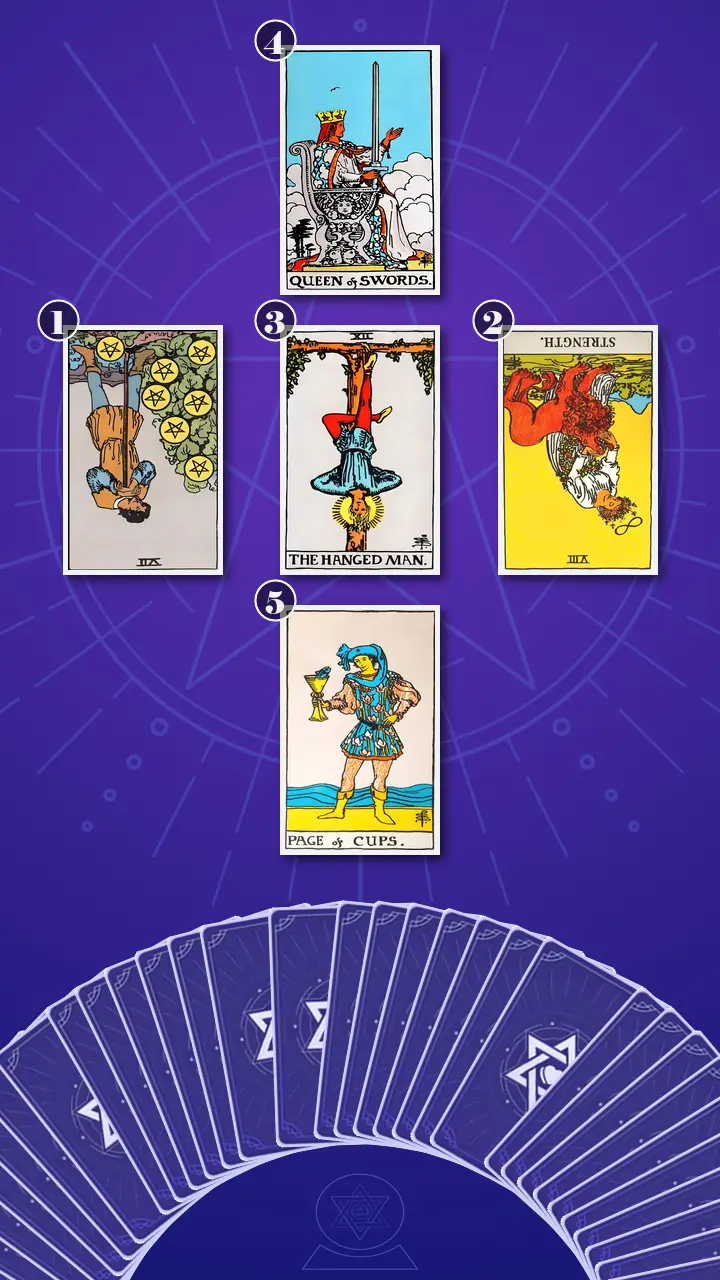
For anyone reading this and wondering how tarot works in a relationship question, I chose a five-card Relationship Spread · Context Edition. It is the smallest structure that could hold the whole mechanism in view: the visible stance, the fear beneath it, the relational dynamic created by the delay, the communication challenge, and a self-directed next step. This is tarot as a reflective tool, where card meanings in context help clarify choices rather than predict what another person will do.
I explained the layout to Jordan and to the reader I imagined beyond the room. The first card would show the presenting stance, the way patience and anger were appearing in daily life. The second would reveal the unspoken emotional driver. The centre card would describe the suspension between them. Above it, the Queen of Swords would ask what truth-telling required, and below it, the Page of Cups would offer a grounded communication experiment. I would read the cards as prompts, then return the interpretation to Jordan's own judgment.
The Garden of Delayed Returns
Position 1: The Patience That Kept Receipts
I turned over the card representing the presenting stance, the observable pattern of acting patient while commitment delays accumulated into anger. It was the Seven of Pentacles, in reversed position.
In the traditional image, a figure leans on a hoe and studies the seven pentacles growing on a living vine. In Jordan's life, I saw the same figure closing their laptop after another postponed conversation, checking the shared calendar, and counting previous promises in the message thread. They said, 'I can wait,' while privately feeling that the relationship had become an unpaid emotional project. The cultivated vine was the connection they kept tending. The pentacles were the weeks, softened messages, emotional labour, and promised conversations being measured against the clarity that never arrived.
The reversed energy was not a moral failure or a prediction of loss. It showed an excess of measurement and a blockage in feeling any return from the investment. Patience had stopped being a conscious choice. It had become a performance maintained by checking timestamps, rereading replies, and telling friends that everything was fine. I asked, 'When you say you can wait, what are you privately counting?'
Jordan did not nod. They gave a short laugh with no joy in it, glanced at the card, and said, 'That is too accurate. It is almost rude.' Their thumb pressed hard into the edge of their phone case before releasing it.
I answered, 'The card is not judging the waiting. It is showing you the cost of pretending the waiting feels neutral. You do not have to send an ultimatum. You only need to notice whether your patience is still something you freely choose.'
The Loading Screen We Had Been Calling Patience
Position 2: The Lion Behind 'No Pressure'
I turned over the card representing the unspoken emotional driver, the fear that showing anger about delayed commitment could threaten belonging. The card was Strength, in reversed position.
The image showed a woman resting one gentle hand on a lion's muzzle, with an infinity symbol above her head and red roses winding around her white robe. Upright, the image can speak of calm courage and humane self-regulation. Reversed in this position, the hand was no longer simply tending the lion. It was trying to make the lion invisible.
I connected it to the kitchen scene Jordan had described. At 10:12 p.m. near Queen West, after a close Saturday night, their partner had asked for more time on Sunday morning. Jordan had typed, 'I am really upset and need clarity,' then deleted it and replaced it with, 'I understand, no pressure.' Their hands had clenched beneath the table while heat moved through their chest. The lion was not uncontrolled rage. It was the honest anger being edited out so the relationship would remain easy to choose.
I could hear the high note that my Reactive De-escalation Mapping is designed to locate. It was not a shouted insult. It was the moment a soft phrase arrived with a body braced for impact, when 'whenever you are ready' carried the emotional frequency of 'please do not leave me because I need something.' That mismatch can make a connection feel less safe, because the feeling has nowhere truthful to go.
Jordan looked down at their hands. I heard the private sentence they had been protecting: 'If I let them see this feeling, I might lose my place here.' Their breathing became shallow, and then they pressed both palms flat against their thighs.
I said, 'Anger is information, not an auto-send button. You can hear what it is flagging without forwarding it as an attack, and you can acknowledge it without forcing yourself to erase it for the sake of appearing easygoing.'
The Pause That Needed a Name
Position 3: The Relationship on a Loading Screen
I turned over the card representing the relational suspension, the dynamic created when repeated commitment delays and unspoken anger keep the relationship paused. It was The Hanged Man, in upright position.
The figure hung calmly by one foot from a living tree, hands behind his back, a halo around his head. The unusual position suggested a changed perspective, but it did not promise that waiting would solve anything. I connected it to Jordan in a coffee shop near Kensington Market on a rainy Monday, scrolling through three messages that each promised a future conversation. The espresso machine had hissed, wet coats had filled the room with a damp smell, and their shoulders had risen toward their ears as they wondered whether waiting was thoughtful or simply the only way they knew to remain welcome.
The relationship had become a loading screen. Waiting longer was not the same as receiving new information. Jordan had been treating each postponement as a temporary phase, keeping an evening open for a conversation with no confirmed time, while calling the suspension patience. The Hanged Man asked a sharper question: what does this pause make possible to avoid, and what does it prevent Jordan from asking clearly?
I said, 'Surrendering control over another person's decision is different from surrendering your own ability to decide what waiting is workable for you. Patient silence does not create clarity; it only makes the delay harder to see.'
Jordan's eyes moved to the shared calendar on their phone. They traced the three rescheduled entries with one finger, then turned the screen face down. The pause had not disappeared, but it had become visible as something they were participating in, not an atmosphere they were powerless to leave.
When the Queen of Swords Raised a Sentence
Position 4: The Sword and the Open Hand
The room seemed to quiet around the faint refrigerator hum as I turned over the card representing the truth-telling challenge, the communication quality needed to turn anger into a clear boundary. It was the key card, the Queen of Swords, in upright position, carrying the antidote of clear discernment, self-respect, and direct communication without punishment.
The raised sword gave Jordan a precise sentence. The open hand kept that sentence from becoming a threat. Together, they suggested: 'I care about us, and the repeated delay is making me angry. What does commitment mean to each of us?' This was not the same as saying, 'You need to decide now.' One statement described lived impact and opened a question. The other attempted to control the outcome.
At this point, I used my Communication Dissonance Audit. I do not diagnose an argument by counting only the words spoken. I listen for the fundamental mismatch in emotional tempo and frequency. Jordan's words had been moving at a polite, low volume while their body was playing a much louder track: tight jaw, clenched hands, repeated message checks, and a chest that never quite settled. After ten years of studying sound energy, I know that contracted rhythm firsthand, the frustrating helplessness of wanting to move forward while every internal beat seems to arrive late.
The Queen of Swords did not ask Jordan to become cold. She asked them to let lived experience sharpen the language. A boundary could describe their own time, emotional capacity, and continued participation without trying to make the other person choose commitment on command.
Jordan had already explained the partner's perspective, already offered another week, and was still watching the message thread. From the outside, the pause looked considerate. Inside, Jordan was counting its cost and wondering whether telling the truth would prove they were too much to keep choosing.
Patient silence will not create clarity; speak what the delay costs you and let the Queen of Swords separate a self-respecting boundary from an attempt to control another person.
Jordan's breath stopped first; their fingers hovered over the phone as if the next sentence might burn through it. Then their pupils widened and their eyes moved past the card, replaying the Sunday morning when they had deleted 'I am angry' and sent 'no pressure' instead. Their jaw worked once, their shoulders rose, and a flash of anger crossed their face. 'But doesn't this mean I should have said something weeks ago?' they asked. I waited. A third movement came slowly: their clenched hands opened on their knees, their shoulders dropped, and a shaky exhale loosened the room. Their eyes went bright, not with a magical answer, but with the grief of realizing that silence had been a strategy, not proof of peace. They saved the sentence in Notes and read it again in a quieter voice. The relief was real, and so was the small, dizzying blankness of having responsibility back.
I said, 'Now, use this new perspective to think back over last week. Was there a moment when this insight might have let you feel or respond differently?'
I named the shift plainly. This was a movement from performed patience and private resentment toward self-respecting clarity, emotionally honest communication, and grounded self-trust. The Queen could not decide whether the relationship would continue or whether the other person would commit. She gave Jordan a precise place from which to decide.
The Message That Left Room for an Answer
Position 5: The Question Inside the Cup
I turned over the card representing the self-directed next step, the small communication experiment that could combine clear truth with emotional openness without predicting another person's behaviour. It was the Page of Cups, in upright position.
A fish emerged unexpectedly from the Page's cup. The Page looked toward it with curiosity rather than immediate defence, blue clothing meeting the shoreline behind them. I connected the image to the sentence Jordan could send after naming the anger: 'I care about this relationship, and the repeated delay is making me angry. What does commitment mean to you, and what are you actually available for right now?'
The Page softened the Queen's precision without weakening it. Jordan did not need to deliver a courtroom argument or prepare the entire conclusion in advance. They could state the impact, ask one real question, and receive whatever information the answer contained. The fish was the possibility of new information, not a guarantee that the information would be comfortable.
I said, 'You do not have to sound unbothered to be worthy of an honest answer. Emotional openness does not cancel the boundary. It lets you stay present while you learn what is actually possible.'
Jordan's mouth tightened as they read the draft, then softened. They looked afraid, but the fear no longer seemed to be driving the keyboard. They asked, 'What if I do not like the answer?' I told them that this was precisely why the question had to belong to them. A reading could help them hear their own voice; it could not remove the other person's freedom or make the next choice for them.
The Boundary That Did Not Need to Become a Threat
When I placed all five cards together, the story became clear. The Seven of Pentacles reversed showed an invested person measuring every delayed return. Strength reversed showed why the anger stayed hidden: the fear of losing belonging turned self-regulation into self-silencing. The Hanged Man showed the relationship held in suspension, a pause that Jordan had been enduring automatically. The Queen of Swords supplied the structural hinge, and the Page of Cups brought the truth back into a human conversation with room for curiosity.
The cognitive blind spot was not wanting too much. It was assuming that silence could earn belonging, and that directness could only threaten it. Jordan had been trying to preserve the relationship by making their own experience harmless. That strategy created temporary calm, but it also made the resentment less visible and the real decision harder to approach.
The transformation direction was a shift from performing patience to naming the delay, its emotional impact, and the boundary that would make continued participation workable. This did not mean deciding the whole relationship in one message. It meant separating feeling, observable fact, request, and personal choice. That is the practical path from acting patient while resentment builds to emotionally honest communication and grounded self-trust.
I gave Jordan three small next steps. They were actionable advice, not a test of courage, and each one could be paused, revised, or abandoned if their body became overwhelmed.
- Hear the anger before editing itFor the next three days, set a two-minute timer in the Notes app and write one uncensored sentence beginning with 'I am angry because...' Under it, add 'What this anger may be protecting or asking for is...' and choose one word such as clarity, reciprocity, security, or choice.Keep the exercise private and descriptive rather than prosecutorial. Two minutes is enough. The goal is to hear your own information before deciding what belongs in the relationship conversation.
- Choose the pause instead of disappearing into itOn Sunday, make two columns in a calendar or paper note, 'Waiting I am choosing' and 'Waiting I am automatically doing.' Put one real example in each, then choose a one-week observation window and one limit around your own time, such as not holding an entire evening open for an unconfirmed conversation.A boundary about your availability is not an ultimatum. Keep it connected to your capacity and participation, not to forcing another person to produce a particular commitment.
- Write the Delay-Cost SentenceAfter the next postponement, use my Syncopation Pause: place both feet on the floor, take a three-second acoustic grounding pause, and let the emotional BPM lower before replying. Then write exactly two sentences in Notes, one beginning with 'I feel...' and one beginning with 'I need clarity about...'. If a conversation feels possible, ask for one specific twenty-minute time to talk.Draft first, leave it for ten minutes, and remove blame without removing the truth. You may save, revise, send, or pause the message. You do not have to send it today or accept an answer on the spot.
A Quiet Proof, Not a Perfect Ending
Four days later, I received a message from Jordan: 'I used the three-second pause. I asked for twenty minutes instead of saying no rush.' They had sent it from a Queen West café, then sat alone with their coffee, pleased and slightly sick with uncertainty. The answer was still unknown, but the self-erasure was no longer the only available response.
Jordan's first proof was not a promised commitment. It was a direct sentence, an observable request, and the willingness to let another person's answer be information rather than a verdict on their worth. The old thought, 'What if I am wrong?' still appeared the next morning. This time, Jordan noticed it, breathed, and kept their own calendar open for their own life.
For me, that was the Journey to Clarity. The five-card Relationship Spread: Context Edition had not chosen a future for Jordan. It had helped them hear the difference between patience they consciously chose and silence they used to protect belonging. The next steps belonged to Jordan, and that ownership was the beginning of the harmony they had been waiting for someone else to provide.
When you say 'no rush' after the third postponed commitment talk, your jaw can be tight and your chest restless while one part of you waits patiently and another part wonders whether staying quiet is the price of being chosen.
If you let your anger be information rather than evidence that you are too much, what is one small, honest question you might want to ask in your own words?