The TTC Ping That Ate Your Weekend
You text “Sure!” to a friend’s last-minute moving request before you even check your calendar—then spend the next hour rearranging your weekend and feeling weirdly judged by every “ride-or-die” friendship post you scroll past.
Jordan said it like a confession, but their laugh didn’t have any air in it. They were 28, based in Toronto, and the kind of person who could juggle a hybrid marketing job, a Notion to-do list, and a friend group that plans everything in DMs—until one tiny text turned their whole body into an alarm system.
They described the exact moment: 8:52 p.m. on the TTC Line 1, heading home. The car smelled faintly like wet jackets and hand sanitizer. Their phone was warm from doom-scrolling when the group chat lit up: “Can you help me move this weekend?” Their stomach dropped like an elevator missing a floor. Their shoulders climbed. Their thumb opened Google Calendar like it was a life raft.
“I said yes,” Jordan told me, eyes flicking to the side as if the words were embarrassing, “and now I’m mad at myself for saying yes.”
The guilt wasn’t abstract. It sat in their chest like a tight strap, the kind you only notice once it’s already cutting off your breath. The pressure had that buzzing-restless quality—like their nervous system was an “always-on notifications” setting that couldn’t find the off switch.
I kept my voice soft, steady. “We’re not here to make you a different kind of friend,” I said. “We’re here to figure out why this feels like a loyalty test, and how to respond in a way you can respect tomorrow. Let’s draw a map through the fog—something that actually gives you clarity and next steps.”

Choosing the Compass: The Four-Layer Insight Ladder
I asked Jordan to take one slow breath in through the nose, out through the mouth—not as a ritual, just as a gear shift. Then I shuffled until the pace of my hands matched the pace of the room: quieter, less reactive.
“For this,” I told them, “I want to use a spread I call the Four-Layer Insight Ladder · Context Edition.”
Here’s why it works—especially if you’ve been googling things like why do I feel guilty saying no to friends or how to set boundaries without over explaining and nothing sticks. This isn’t a single yes/no decision. It’s a repeating reflex with a past-based engine. So instead of predicting the future, this spread climbs through layers: observable behavior → the inner pressure that locks it in → the past script → the core belief → a boundary experiment → integration (so it’s sustainable).
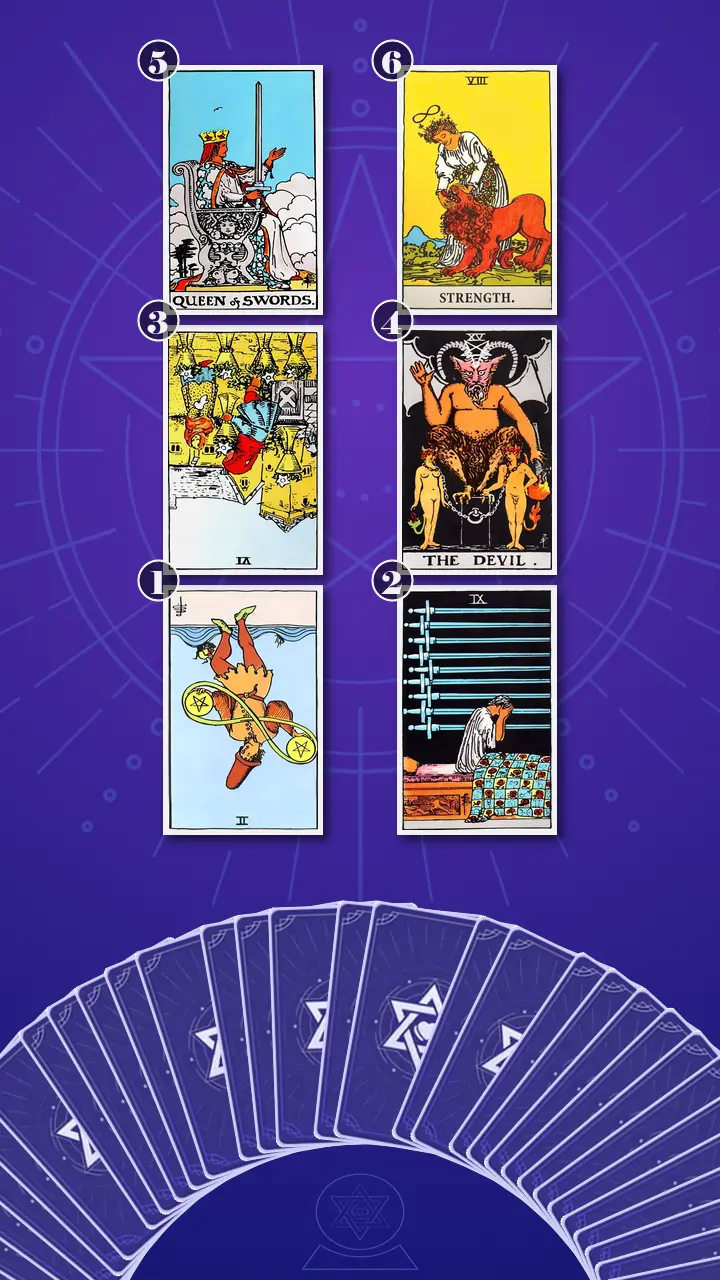
I pointed to the “ladder” layout. “Card one shows what you do in the first sixty seconds—the auto-yes. Card four is the knot: the belief that makes boundaries feel dangerous. And the top rung—card six—shows what it looks like when your body can actually hold a limit without collapsing into compliance.”
Reading the Ladder: From Calendar Chaos to Old Scripts
Position 1 — The Auto-Yes in the First 60 Seconds
“Now flipping over,” I said, “is the card that represents the immediate trigger behavior: what you do in the moment you’re asked.”
Two of Pentacles, reversed.
I tapped the image lightly. “This is the calendar-Tetris card. A friend drops a last-minute moving request, and you instantly open your calendar app—work deadlines, errands, the one recovery window you were counting on—while telling yourself you’ll ‘make it work somehow.’ Reversed, it’s committing before you’ve checked what you’re sacrificing, because juggling feels safer than choosing.”
Energetically, reversed Two of Pentacles is a blockage: not a lack of capability, but an overload that pretends it’s fine. The infinity loop around the coins is the tell—your mind toggles between your life and everyone else’s needs like you’ve got two mental tabs permanently running.
I added one line I’ve learned people need to hear early, before they shame themselves for wanting time: “A pause is not a rejection. It’s a capacity check.”
Jordan let out a small, bitter laugh. “That’s… brutal,” they said. “Because I literally don’t even think. I just… send it.” Their fingers mimed typing, quick and automatic, then they rubbed their palm as if it still held the phone’s heat.
Position 2 — The Pressure That Locks It In
“Now flipping over,” I said, “is the card that represents the felt experience that locks the pattern in—what your mind and body do right after the request.”
Nine of Swords, upright.
“This is the after-hours mental trial,” I said. “It’s late, you’re in bed, and your brain is still in the text thread. You replay your wording, worry about tone, imagine disappointment, and quietly put yourself on trial for being ‘selfish’—even if you already said yes. The request isn’t what’s keeping you up; it’s the fear-story about what boundaries could cause.”
In terms of energy, this is excess Air—too much thinking, too much forecasting. I’ve seen this pattern in finance and in friendships: when uncertainty spikes, the mind starts trying to ‘hedge’ with more data. But in relationships, there’s no perfect spreadsheet that guarantees nobody feels disappointed.
Jordan’s jaw tightened as they nodded. Their foot bounced once, twice, like their body wanted to run while their face tried to look composed.
“Guilt is loud,” I said, careful not to dismiss it. “That doesn’t make it true.”
Position 3 — Past Fuel: The Role You Learned to Play
“Now flipping over,” I said, “is the card that represents past fuel—earlier conditioning that this request activates.”
Six of Cups, reversed.
“This favor doesn’t just feel like a favor,” I told them. “It feels like proving you’re safe to keep. Six of Cups reversed is the old script activating: being easy, helpful, and low-maintenance was how you stayed liked—or stayed out of trouble. So adult friendship requests hit the same old button: ‘Be good. Be useful. Don’t disappoint.’”
Reversed, the energy is a misplaced loyalty. Not loyalty to your friend—loyalty to an outdated survival role. And it explains why a simple boundary text starts to feel like breaking a rule you never consciously agreed to.
Jordan went quiet. Their shoulders dropped a fraction, not from relief—more like something heavy finally got named.
Position 4 — The Core Bind: “I Have To”
“Now flipping over,” I said, “is the card that represents the core bind—the belief that makes boundaries feel dangerous.”
The Devil, upright.
I didn’t lean into drama. I never do with this card, because people-pleasing already comes with enough shame.
“You tell yourself, ‘I can’t say no,’ and it feels true—like there’s a social price tag you can’t afford,” I said. “The Devil is that bind where approval equals safety, so compliance feels like protection. Your self-worth gets quietly chained to being needed, and a simple boundary turns into a fear of distance, rejection, or losing your place in the group.”
In my head, I flashed to my old Wall Street life—risk limits, hard lines, contracts where the language wasn’t emotional, just clear. Fairness wasn’t a vibe; it was a structure. Jordan never got that structure around their time and energy. They were negotiating belonging with their weekends.
I mirrored the card’s loose chains with something painfully modern: “It’s like the unread message sitting on your lock screen like a tiny collar. Not heavy enough to kill you. Heavy enough to steer you.”
And I asked, “Finish this fast, no polishing: ‘If I say no, it means I am ____.’”
Jordan swallowed. “Selfish,” they said, like they hated the word. Then, softer: “Replaceable.”
That was the real engine. Not the move. Not the box. Belonging.
Position 5 — The Boundary Experiment: Clean Words, No Essay
“Now flipping over,” I said, “is the card that represents the boundary experiment—what you can practice in a real conversation this week.”
Queen of Swords, upright.
“This is the medicine,” I said. “You write one clear message that doesn’t audition for approval: ‘I can’t do Saturday, but I can do 1–3 on Sunday,’ or ‘I can’t help this weekend.’ Then you stop. No paragraphs. No life story. Queen of Swords is you separating compassion from compliance—being respectful without being negotiable.”
I described the moment like a screenshot because that’s how it shows up in real life: the glow of the phone screen, the cursor blinking, the three-paragraph apology draft you keep trying to perfect.
“You’re going to feel the urge to add ‘sorry sorry’ or explain your entire week,” I warned. “That urge is just the old system trying to keep you safe.”
Jordan exhaled—an actual, audible release. “A one-sentence text sounds… impossible,” they said, then smirked. “But also kind of hot.”
When Strength Held the Lion of Guilt
Position 6 — Integration: The New Normal You’re Building
Before I turned the final card, the room got very still. Even the city noise outside my window felt like it backed up a step, like it was listening too.
“Now flipping over,” I said, “is the card that represents integration—the inner capacity you’re building so boundaries become sustainable rather than reactive.”
Strength, upright.
“This is what it looks like when guilt spikes and you don’t immediately obey it,” I said. “Strength isn’t force. It’s meeting the ‘lion’ of guilt with steadiness and breath. Hand on chest, slow exhale, shoulders down. You choose the response you can live with tomorrow—yes, no, or limited help—and you let the friendship hold a normal amount of disappointment.”
Jordan’s face had that familiar trapped look—the one that says, Okay, but if I don’t fix it right now, something bad happens. They were still caught in the moment from the TTC: the ping, the stomach drop, the thumb typing “Of course!” before Saturday even existed.
Not “prove you’re a good friend by carrying the whole load,” but “practice calm courage—like Strength—by holding the lion of guilt gently and choosing a sustainable yes or no.”
Jordan froze—breath caught, hand hovering above their own phone like they were back on the train. Their eyes unfocused for a second, as if a memory buffered on-screen. Then their shoulders lowered in a slow, almost reluctant release. A flush climbed their neck, and their mouth opened like they were going to argue… but instead they whispered, “Oh.”
The reaction came in three beats: first the body (a tight inhale, knee going still), then the mind (their gaze drifting to the side, replaying a dozen moments they’d called “being nice”), then the emotion (a shaky exhale that sounded like grief and relief sharing the same lungs).
I let the silence do its job. Then I asked, gently but directly, “Now, with this new lens—can you remember a moment last week when guilt rushed in, and this idea could’ve changed what you did? Just one moment. Even a small one.”
Jordan blinked fast. “Yesterday,” they said. “A friend asked if I could review their resume ‘real quick.’ I had dinner plans. I said yes anyway, then stared at the doc and hated myself.” They pressed their palm to their chest without being prompted, like their body finally understood the assignment. “It wasn’t that I wanted to help. It was that I thought I had to. Like… my place in the group depended on it.”
“Exactly,” I said. “This is the shift—from guilt-driven automatic yeses and quiet resentment to regulated self-trust and kind, sustainable boundaries. Not because you care less. Because you’re finally choosing.”
The On-Call Friend Reset: Actionable Next Steps That Don’t Feel Like a Personality Transplant
I pulled the whole ladder together for them in plain language. “Here’s the story your cards told,” I said. “When a request hits, you juggle first (Two of Pentacles reversed). Then your brain runs a reaction simulation and puts you on trial (Nine of Swords). Under it is an old role—helpful equals good equals belonging (Six of Cups reversed). The deepest knot is the belief that a boundary means you’re selfish or replaceable (The Devil). The turning point is clean language (Queen of Swords). And the new normal is learning to ride the guilt wave without letting it steer (Strength).”
The blind spot was sharp: Jordan kept trying to solve a belonging fear with logistics and perfect wording. That’s why the calendar checks and apology drafts never delivered peace.
“The transformation direction,” I said, “is pause-and-choose. Not automatic agreement. Not dramatic confrontation. Just a deliberate pause, a capacity check, and one clean sentence.”
I also offered something from my old professional toolkit—because sometimes people need a framework that feels concrete. “On Wall Street, we’d never take a position without knowing our downside and our alternative. In friendships, that’s not cold—it’s healthy. I call it Negotiation Alchemy: you pair a human signal (‘I care’) with a clear BATNA—your best alternative to a negotiated agreement—which, here, is your time, rest, and self-respect. If you don’t know your BATNA, guilt will negotiate for you.”
Then I gave Jordan a structure they could actually use the next time someone asked, ‘Can you help me move?’
- The 10-minute reply pauseWhen the next favor text lands, don’t answer in the same minute. Set a 10-minute timer. In your Notes app, write: “My capacity this weekend is: ____.” Then reply with either a clear yes, a clear no, or a limited counteroffer.If pausing feels “dramatic,” remember: a pause is not a no—it’s capacity-checking. If 10 minutes feels too long socially, do 5. It still counts.
- One clean sentence (Queen of Swords script)Send one clean limit text: “I can’t do Saturday.” or “I can do 1–3 PM, not the full day.” or “I can’t lift furniture, but I can bring coffee and help pack one room.” Stop after the sentence.Expect the urge to justify to spike after you hit send. That discomfort is practice, not proof you were wrong. Put your phone face-down for 2 minutes and do something physical (fill your water bottle, stand at the window).
- The Cocktail Party Algorithm (3-phase boundary template)Use this three-part text format: (1) Warmth: “Thanks for thinking of me.” (2) Limit: “I can’t help Saturday.” (3) Option: “I can do one hour Sunday” or “I’m cheering you on—hope it goes smoothly.”If they push back, repeat the limit without expanding. You don’t need to disclose your whole schedule to make your boundary valid.

A Week Later: The Quiet Proof
Six days later, Jordan messaged me a screenshot—not of a perfect friendship moment, just a real one. Their friend had asked, last-minute again. Jordan’s reply was one clean sentence: “I can’t do Saturday, but I can do 1–3 on Sunday.” Under it, a second message from the friend: “Totally! That helps a lot.”
Jordan added, “I felt shaky after I sent it. Like I wanted to write a whole TED Talk apology. I didn’t. I took a shower and went for a walk. I still feel… weirdly proud.”
It wasn’t fireworks. It was quieter than that: a firm choice, followed by a few minutes of loneliness in the pause, followed by the first real evidence that mutual connection can survive a normal amount of disappointment.
That’s the Journey to Clarity I trust most—the kind that turns “I have to” into “I’m choosing,” without making you hard or shut down.
When a simple “no” makes your stomach drop, it’s not because you’re selfish—it’s because some part of you learned that belonging had to be earned in real time, one exhausted yes at a time.
If you let yourself pause for just ten minutes next time, what would a “kind but chosen” answer sound like in your own words?
This story is adapted from psychological research, written so that those in a similar struggle can see their own pattern in it — and find their next step clearly.These insights are not a substitute for professional psychological, medical, legal, or financial advice.
Learn more about our Journey to Clarity.
How did this insight land for you?
🫂 This Resonates Deeply
🌀 Living This Story
✨ Now I See Clearly
🌱 Seeing New Possibilities
🧰 Useful Framework
🔮 The Confirmation I Needed
💪 Feeling Empowered
🚀 Ready for My Next Step
Author Profile
 AI
AI“I spent years in the intense, high-stakes world of Wall Street. I know exactly how isolating and heavy the weight of uncertainty can feel in the dead of night. I use strategic, commercial logic not to be cold, but to protect you from unnecessary friction. Think of me as a fellow traveler who has walked the same rocky path—offering sharp but deeply supportive wisdom to help you clear the fog and confidently win your narrative back.”
In this Friendship Tarot Reading :
Core Expertise
- Reciprocity ROI Analysis: Objectively measuring the emotional give-and-take in your core friendships to identify asymmetrical, high-drain relationships.
- Sunk-Cost Decoupling in Loyalty: Separating the 'ten years of history' from the current reality of a one-sided, demanding friendship.
Service Features
- The Friendship Downgrade Strategy: A calculated tactical approach to gradually and decently de-escalate a toxic friendship into a low-maintenance acquaintance without triggering dramatic conflict.
Also specializes in :
Explore Related Patterns:
Boundary DiffusionJordan’s calendar becomes a negotiation table before Jordan has even decided whether they want to help. Work deadlines, errands, recovery time, and dinner plans all get treated as flexible the moment a friend’s need appears. Boundary Diffusion shows up when the line between "I care about you" and "I must make myself available" gets blurred. Jordan is not only considering the friend’s request; they are absorbing it as if the request automatically has authority over their time. You can care about a friend’s move without letting your entire weekend become collateral. The pattern becomes visible because the story keeps returning to the same boundary confusion: Jordan’s body says alarm, their calendar says overloaded, but the old relational script says availability is the price of belonging.
Guilt-Driven People-PleasingJordan texts "Sure!" before checking the calendar, then spends the next hour rearranging the weekend and feeling angry at themself for agreeing. The behavior is not just being generous; it is a fast compliance reflex that quiets guilt before Jordan has time to assess capacity. That reflex is powered by an older rule: be easy, be helpful, do not disappoint. When guilt shows up as a tight strap in the chest, Jordan treats it like evidence that a yes is morally required, even though the resentment afterward shows the choice was not fully owned. You can see the pattern most clearly in the resume example: Jordan already had dinner plans, said yes anyway, then hated themself while staring at the document. Guilt-Driven People-Pleasing names the mechanism where belonging feels protected by immediate usefulness, even when the cost is your own time, rest, and self-respect.
Friendship Role RegressionJordan’s present-day group chat activates an older social role: the easy, helpful, low-maintenance person who stays liked by not becoming difficult. The moving request is happening now, but the pressure behind it feels older than the request itself. Friendship Role Regression names the moment adult friendship starts running on an outdated relational script. Jordan is not consciously choosing a mature yes; their nervous system is slipping back into the role that once made connection feel safer. That is why the question of "what past fuels my people-pleasing" lands so directly here. The past fuel is not a detailed memory the story has to prove; it is the learned role that keeps repeating in the present: be useful enough, agreeable enough, and low-maintenance enough to keep your place.
Rejection SensitivityJordan feels judged by "ride-or-die" friendship posts even after they have already said yes. A normal request starts carrying extra social meaning, as if the friendship is quietly asking them to prove loyalty in real time. Rejection Sensitivity appears in the way Jordan’s mind fills in consequences before the friend has actually reacted. Disappointment, distance, selfishness, replaceability, and losing their place in the group all become part of the same fear-story. You are not looking at simple nervousness here; the story shows a threat filter. When a boundary feels like it could turn you from valued to replaceable, the safest move seems to be over-giving before anyone has a chance to be upset.
Self-AbandonmentJordan rearranges the weekend around a last-minute move before fully checking what is being sacrificed. The same pattern repeats with the resume review: dinner plans exist, but someone else’s need takes priority first. Self-Abandonment is the inner move where your own capacity gets dropped in order to preserve connection. In Jordan’s case, the abandoned parts are concrete: rest, dinner plans, recovery time, and the right to pause before answering. The resentment afterward matters because it reveals the hidden cost of the yes. Jordan is not only helping a friend; they are overriding their own body, schedule, and preferences to avoid the fear of being seen as selfish or replaceable.
Boundary DiscernmentJordan’s later text is simple: "I can’t do Saturday, but I can do 1–3 on Sunday." The message keeps warmth and care in the relationship without handing over the entire weekend. Boundary Discernment is the emerging corrective pattern. Instead of treating every request as a loyalty test, Jordan pauses long enough to check capacity, choose a sustainable offer, and let the friendship hold a normal amount of disappointment. You can see why this matters psychologically: the goal is not to become cold or unavailable. The goal is to know the difference between a chosen yes, a clear no, and a limited offer that respects both the relationship and your own nervous system.
Defensive OverexplainingJordan’s boundary does not only feel hard to send; it feels like it needs a whole defense brief attached to it. The story keeps returning to apology drafts, extra context, "sorry sorry," and the urge to explain the entire week. Defensive Overexplaining works as a safety behavior. The explanation is trying to soften the boundary enough that nobody can be disappointed, judge the tone, or decide Jordan is selfish. You can see the shift when Jordan sends one clean sentence and still wants to write a TED Talk apology afterward. The urge to overexplain is the old protection system firing, but the successful pause shows that a boundary does not need to be wrapped in a performance to be valid.
Explore Related Struggles:
Agreement-Agency SplitJordan says yes, then immediately feels mad at themselves for saying yes. Their thumb has already typed "Of course!" before Saturday has been checked, while the rest of them is left trying to catch up with a decision they did not fully choose. You can feel Agreement-Agency Split in that delay between the sent message and the self that has to live with it. The struggle is that agreement is happening as a reflex, while agency only arrives later as resentment, overthinking, or the wish to rewrite the answer.
Approval-Safety FusionJordan says the favor feels like proving they are safe to keep, and the core sentence lands as "If I say no, it means I am selfish" and then "replaceable." A moving request becomes a social price tag, where approval is treated as evidence that their place in the group is still secure. You can feel Approval-Safety Fusion when the body treats a normal boundary as a threat to belonging. The struggle is the chain between being liked and being safe: compliance starts to feel protective, even when it costs the weekend, because disappointing someone seems bigger than a single disappointed moment.
Autonomy Guilt BindStrength shows Jordan holding the spike of guilt without immediately obeying it: hand on chest, slow exhale, shoulders down, choosing yes, no, or limited help. The friendship is allowed to hold a normal amount of disappointment instead of making Jordan carry the whole load to prevent it. You can feel Autonomy Guilt Bind when a chosen limit and a caring identity pull on the same nerve. The struggle is learning that your autonomy does not cancel your care, even though guilt makes the first few moments of choosing yourself feel socially dangerous.
Boundary CollapseJordan answers the moving request with "Sure!" before checking the calendar, then spends the next hour rearranging the weekend around a commitment their body was already resisting. The stomach drop, raised shoulders, and instant calendar scramble show the limit arriving after the yes, not before it. You can feel Boundary Collapse in the gap between the automatic reply and the later resentment. The struggle is not that you do not care about your friend; it is that care gets converted into immediate access, so your time, rest, and capacity have to fight their way back into the conversation after the decision has already been made.
Low-Maintenance Worth LockSix of Cups reversed names the earlier role: being easy, helpful, and low-maintenance was how Jordan stayed liked or stayed out of trouble. In adulthood, the same role gets triggered by a group chat ping, so a simple limit text feels like breaking a rule they never consciously agreed to. You can feel Low-Maintenance Worth Lock when taking up space feels more dangerous than losing your own time. The struggle is the quiet bargain that says you remain valued by needing less, asking less, and making every request easier for everyone else than it is for you.
Utility-Belonging FusionThe old script in the reading is blunt: "Be good. Be useful. Don't disappoint." Jordan does not only say yes to moving; they also say yes to a resume review before dinner plans, then sit with the feeling that their place in the group depends on it. You can feel Utility-Belonging Fusion when usefulness becomes the membership card. The struggle is not a lack of generosity; it is that helping stops being chosen care and starts functioning like proof that you deserve to stay connected.
Inner Tribunal LockAfter the request, Jordan's mind stays in the text thread: replaying wording, worrying about tone, imagining disappointment, and putting them on trial for being selfish even after they already agreed. The "ride-or-die" posts on the feed become extra witnesses for a verdict the body is already bracing for. You can feel Inner Tribunal Lock when the real conversation gets replaced by an internal courtroom. The struggle is not simply thinking too much; it is that every possible boundary is prosecuted before it is even sent, so clarity has to pass through judgment before it can become action.
Explore Related Emotions:
Approval AnxietyJordan texts “Sure!” before checking the calendar, then rearranges the weekend while the phone still feels like it has heat in their hand. The ask does not land as neutral information; it lands as a social alarm, with the body moving faster than the part of them that could choose. That speed matters. The stomach drop, the shoulders climbing, and the immediate calendar scramble show a system trying to secure approval before there is any real evidence of disapproval. You can see the emotional logic clearly: agreement becomes a way to lower the perceived social risk. Approval Anxiety fits because the pressure is not simply about helping a friend move. It is the fear that a delayed answer, a smaller offer, or a clean no might change how safely you belong in the group.
Boundary GuiltJordan is not only deciding whether to help with boxes. They are sitting with a text that makes a pause feel almost illegal, as if taking ten minutes to check capacity already counts as letting someone down. The guilt has a physical shape in the story: a tight strap across the chest, a buzzing restlessness, a nervous system stuck on “always-on notifications.” That makes the boundary feel morally charged before anyone has accused them of anything. Boundary Guilt names the inner weather created when having a limit feels like failing a test of goodness. You are not seeing ordinary reluctance here; you are seeing the learned discomfort of protecting your own time while still wanting to be loving and reliable.
Cautious Self-TrustJordan’s new practice is small on purpose: a ten-minute reply pause, one clean sentence, and no essay-length apology. The story treats that pause as the first place where self-trust can get a foothold. The trust is cautious because the old system still makes the body shake after the message is sent. Jordan still wants to explain, soften, and earn approval, but they also begin to believe their own capacity check is legitimate. Cautious Self-Trust fits the integration arc because the goal is not instant confidence. It is the first real evidence that you can choose a limit, survive the discomfort after it, and remain connected without abandoning yourself.
Conditional Belonging FearJordan says the word “replaceable” after being asked to finish the sentence, “If I say no, it means I am ____.” That one answer pulls the moving request out of logistics and into the deeper fear underneath the reflex. The story repeatedly frames friendship as something that must be re-earned through usefulness: be easy, be helpful, do not disappoint, do not take up too much room. When that old script is active, a normal favor request starts to feel like a referendum on whether you are still safe to keep. Conditional Belonging Fear captures the past fuel behind the people-pleasing. You are not just afraid of a friend being mildly inconvenienced; you are afraid that connection depends on staying agreeable enough to deserve your place.
Low-Maintenance ShameJordan describes the automatic yes almost like a confession, and the story names the older role directly: easy, helpful, low-maintenance. That role was not presented as a personality quirk; it was how they learned to stay liked or stay out of trouble. When that script is still running, needing time can feel embarrassing. Wanting dinner plans, rest, or a smaller offer starts to sound internally like being selfish, even when the actual request is ordinary and negotiable. Low-Maintenance Shame names the sting of believing your needs make you less lovable. You are watching a person feel exposed not because they did something cruel, but because they briefly considered being less endlessly convenient.
Regulated CourageJordan’s shoulders lower after imagining a one-sentence boundary, and later they actually send one: “I can’t do Saturday, but I can do 1–3 on Sunday.” The body is still shaky, but the choice stays intact. This is courage with regulation, not force. Jordan does not shut down care, punish the friend, or perform toughness; they let guilt spike while choosing a response that respects both the relationship and their capacity. Regulated Courage belongs to the story because the emotional movement is about staying present under pressure. You are watching the beginning of a steadier self that can feel the old alarm without handing it the steering wheel.
Replaceability DreadJordan’s answer lands softly but sharply: “Replaceable.” The fear is named in the exact place where the story asks what a no would mean, and it shows why the weekend request feels bigger than the weekend. The phone message becomes heavy because it seems to carry a hidden threat: if you are not useful right now, someone might stop needing you. That dread turns ordinary distance into possible disappearance, and it makes immediate compliance feel like a way to stay visible. Replaceability Dread fits because the emotional center is not convenience, laziness, or even conflict avoidance. It is the cold drop of imagining that your role in the group can be lost the moment you stop being available on demand.
Rulebook ShameJordan experiences a simple boundary text as if it breaks a rule they never consciously agreed to. The story keeps showing this invisible rulebook through phrases like “be good,” “be useful,” and “don’t disappoint.” That rulebook turns a capacity check into a character verdict. Even after saying yes, Jordan’s mind still runs the trial: Was the tone okay, were they selfish, did they do enough to stay in good standing? Rulebook Shame fits because the shame is organized around internalized social rules rather than an actual wrongdoing. You are seeing the pressure of living under standards that were learned early, then mistaken for the only way to be a good friend.
Self-Betrayal AcheJordan gives two versions of the same wound: the moving request that eats the weekend, and the resume review accepted despite dinner plans. In both scenes, the yes arrives before the self has been consulted. That is why the anger turns inward. The pain is not only that someone asked for help; it is that Jordan watches their own plans, recovery, and preferences get pushed aside while they perform willingness. Self-Betrayal Ache belongs here because the story keeps returning to the moment after compliance, when the body knows a boundary was crossed from the inside. You can still care about people and feel the ache of having disappeared from your own decision.
Clarity ReliefJordan goes quiet when the old script is named: helpful equals good equals belonging. The silence matters because something heavy finally has a shape. Relief enters through clarity rather than reassurance. The problem is no longer a messy calendar, an imperfect text, or a failure to be generous enough; it is the old belief that every favor request measures whether they are safe to keep. Clarity Relief fits because the story gives Jordan a usable map. You can feel the fog thin when “I have to” becomes visible as a learned pressure, which makes “I’m choosing” emotionally possible.
Hypervigilant AnxietyOne tiny text turns Jordan’s body into an alarm system: stomach dropping, shoulders climbing, thumb moving toward the calendar like a life raft. The response is immediate, physical, and out of proportion to the practical size of the request. Afterward, the mind keeps scanning. Jordan replays wording, worries about tone, imagines disappointment, and puts themself on trial even when they have already agreed. Hypervigilant Anxiety names that constant monitoring for relational danger. You are seeing a system that learned to treat small signs of possible disapproval as urgent data, so even a friend’s ordinary ask can feel like something that must be managed before it gets unsafe.
Message DreadThe story begins with a ping on the TTC, a warm phone, and a group chat lighting up with one request. Before Jordan has checked the weekend, the message already feels like it has entered the body. That is what gives the phone its emotional charge. The unread ask becomes a small object with outsized power, steering attention, breath, posture, and time before any conversation has actually unfolded. Message Dread fits because the anxiety gathers around the incoming request itself. You are not only reacting to what someone wants; you are bracing for the invisible obligation that seems to arrive with the notification.
Quiet Self-RespectJordan sends the limited offer and then feels the urge to write a whole TED Talk apology. The meaningful part is that they do not obey that urge. Quiet Self-Respect shows up in the restraint. It is the decision to let one clear sentence be enough, to treat time and rest as real, and to stop auditioning for approval through overexplanation. This emotion fits because the story’s healthier endpoint is not becoming cold or unavailable. It is a calmer dignity in which you can care about someone and still refuse to disappear inside their request.
Resentful ExhaustionJordan says yes, then spends the next hour rebuilding the weekend around someone else’s need. The story makes the cost concrete: work deadlines, errands, and the recovery window they were counting on all have to bend. Resentment enters because the care is no longer chosen cleanly. It is dragged through guilt, social pressure, and the old demand to be useful, so helping starts to feel like being consumed. Resentful Exhaustion fits the emotional residue after the automatic yes. You are not looking at a lack of generosity; you are looking at generosity that has been detached from capacity until it turns into quiet anger and fatigue.
Explore Related Contexts:
Conditional Belonging PressureYou do not experience the request as a neutral favor. You experience it as a moment where your place in the group seems to depend on whether you can absorb someone else's need without friction, and that makes the calendar check feel like a status check. The words 'selfish' and 'replaceable' show how high the social price feels. This context is the larger structure underneath the scene: belonging is treated as conditional on quick, low-maintenance usefulness, so a boundary starts to look like a threat to membership.
Friendship Boundary CreepYou say yes before checking your calendar, then spend the next hour rearranging a weekend that had already been spoken for. A week later, the same social dynamic shows up again when another favor request lands on top of dinner plans, which makes the boundary feel less like a line and more like something that keeps getting pushed inward. That repeated encroachment is the point. The pressure is not a single dramatic ask; it is the slow assumption that your time can be reopened whenever someone needs something, until your own plans become the flexible part of the arrangement.
Friendship Loyalty TestYou get the moving request in a group chat before you have even checked your calendar, and the request lands inside a friendship culture already trained to treat availability as proof. The story keeps pairing that ask with the 'ride-or-die' posts in your feed, so the favor is never just about boxes; it is also about whether you show up fast enough to count. That is why the yes feels like a verdict instead of a choice. When the same pattern shows up again with the resume review request, the social logic is still the same: a small favor gets translated into a test of whether you are the kind of friend who keeps their place by complying.