The 11:48 p.m. Shift of the Free Therapy Friend
If a friend says, “You’re the only person who really gets it,” while the message about your own difficult week remains unsent, I know how warm and strangely heavy that praise can feel.
Jordan, a 27-year-old communications coordinator in Toronto, came to me with a question they had already typed into Google in three different ways: “Why do I always become everyone’s therapist friend?” “Why do my friends only contact me when they need help?” Finally, they reduced it to the sentence that mattered: “What am I avoiding by always being the free therapy friend?”
They described the previous Tuesday so precisely that I could see it like raw footage. At 11:48 p.m., Jordan had been sitting on the edge of their bed with one shoe still on, replaying a friend’s third voice note. The phone felt warm in their palm. The radiator clicked against the quiet, and the room smelled faintly of cold takeout while Jordan recorded a careful six-minute response.
When the friend eventually asked how Jordan’s day had been, Jordan typed, “All good here,” added a heart, and put the phone face down. Their shoulders remained raised.
“I usually notice I’m drained only after everyone else feels better,” they told me. “Then I get irritated. Then I feel awful for being irritated.”
I watched Jordan press a thumb into the center of their palm while they spoke. Their guarded loneliness did not look like an empty social calendar. It looked like standing in the middle of a crowded room behind soundproof glass: able to hear every emergency, unable to make their own voice cross the barrier. Resentment sat behind their ribs, guilt tightened their jaw, and apprehension appeared whenever I asked what they might want from a friend.
The contradiction was clear. Jordan wanted closeness, but being reliably useful felt safer than stating a personal need and discovering whether care could move both ways. Usefulness gave them a task, a role, and a reason to belong. Vulnerability offered no such guarantee.
“Being useful can create closeness,” I said, “but it cannot tell you whether you are known. I’m not going to use tarot to declare which friends are good or bad, and I’m not going to predict who will stay. We’re going to use it as an objective mirror. Let’s make a map of the pattern, find the fear underneath it, and give you one small way to gather real evidence.”

Choosing the Ladder Out of the Help-Desk Loop
I asked Jordan to place both feet on the floor, let their shoulders drop as far as they comfortably could, and hold the question in mind while I shuffled. I treat this pause as a change of focus, not a supernatural performance. It gives the nervous system a moment to leave the group chat and enter the room.
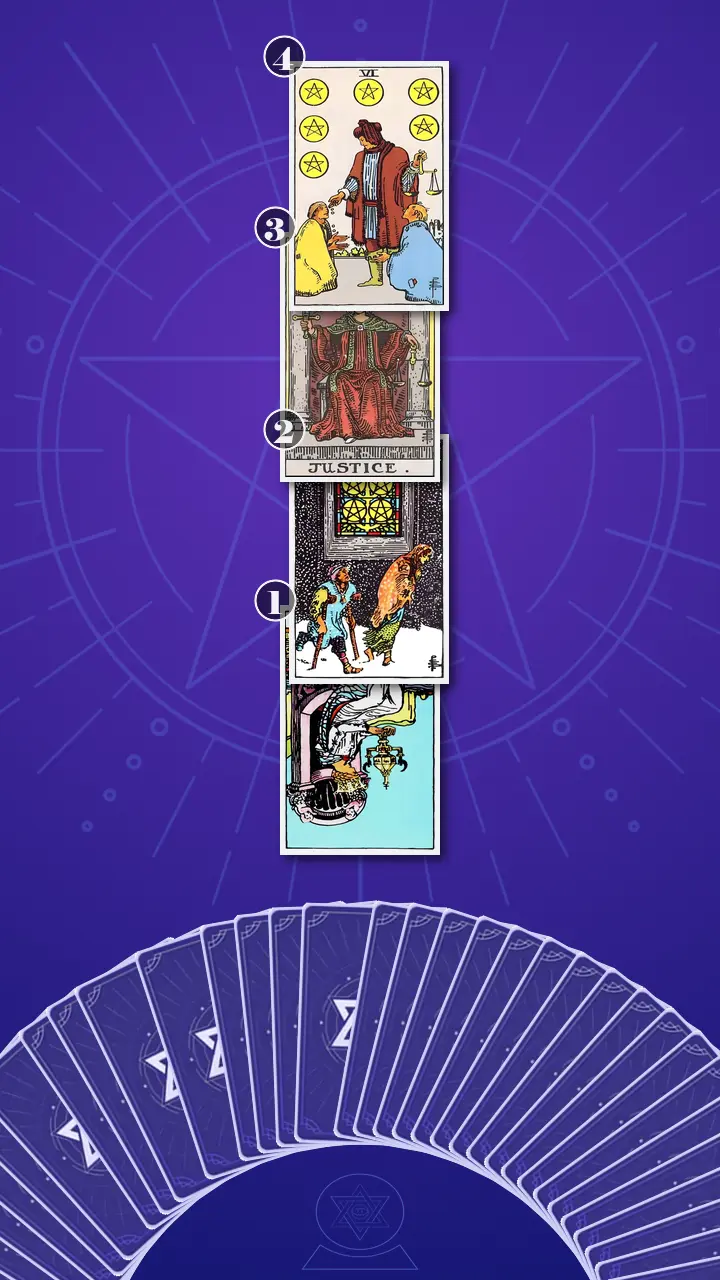
I chose the Four-Layer Insight Ladder, a four-card inner-excavation spread. Jordan was not asking me to predict a particular friend’s behavior. They were asking what internal fear might be concealed by a repeated relationship role. A larger spread such as the Celtic Cross would have added context we did not need; this question called for a clean progression from behavior to root, transformation, and practice.
This is how tarot works in my practice: the cards provide symbolic prompts, but card meanings only become useful in context. The first position would show Jordan’s observable stuck behavior. The second would uncover the fear sustaining it. The third would introduce the principle capable of interrupting the pattern, and the fourth would translate that principle into an action Jordan could test in ordinary messages and conversations.
I arranged the four cards in a vertical column, beginning at the bottom. The layout looked like a small ladder: not an escape from uncertainty, but a structured way to climb through it.
The Closed Cup and the Window in the Snow
The Queen of Cups Reversed: When Empathy Becomes Self-Erasure
Now I turned over the card representing the observable stuck behavior: Jordan’s automatic holding space for friends, concealed personal strain, and emotional overextension. It was the Queen of Cups, reversed.
I pointed to the ornate cup held in both of the Queen’s hands. Unlike an open chalice, it has a lid. Water curls around the edge of her throne while she studies the sealed vessel with complete concentration.
“This is the 11:48 p.m. version of being the emotionally fluent friend,” I said. “You receive the long voice note, listen twice, answer every point, and turn someone else’s pain into useful advice. Meanwhile, your own difficult day stays inside the draft marked ‘All good here.’ The lidded cup is the message you keep deleting. The water reaching the Queen’s feet is every incoming feeling reaching your capacity before you name a limit.”
I read the reversal as an excess of outward receptivity combined with a deficiency of inward attention. Jordan’s empathy was not absent; it was working overtime. The blockage was containment. Care flowed outward so quickly that Jordan rarely had the pause required to ask, “Do I want to listen right now, and what do I need before I begin?”
I returned to the bedroom scene. “I can listen. I can organize this. I can handle my own part later,” I said, voicing the loop Jordan had described. “That is the conflict here: empathy versus self-erasure. The problem is not that you care too much. It is that your care becomes visible while your personhood stays sealed.”
Jordan’s fingers stopped moving against their palm. Their eyes shifted from the card to the untouched water beside them, as though a sequence of deleted drafts had begun replaying. Then they gave one short laugh with a bitter edge.
“That’s painfully accurate,” they said. “Kind of brutal.”
“I can see why it lands that way,” I replied. “But the Queen is not accusing you of being fake or weak. This role has given you genuine connection and a sense of competence. It has also protected you from the much less controllable experience of being seen while unfinished. We’re naming the cost so you can choose differently before exhaustion makes the choice for you.”
I also warned against the reversal’s overcorrection. A person who waits until their capacity is gone may suddenly ignore messages or become sharper than intended, then decide that boundaries always hurt people. I wanted Jordan to see another option: a limit stated before resentment had to speak on their behalf.
“The message you keep deleting may be the part of the relationship that never gets a chance to exist,” I said.
The Five of Pentacles: Predicted Exclusion, Untested Shelter
Now I turned over the card representing the mechanism beneath the helper role, especially Jordan’s fear that requesting care could expose conditional belonging or unavailable support. It was the Five of Pentacles, upright.
Two figures move through falling snow beneath an illuminated stained-glass window. Hardship and possible shelter occupy the same image. I did not read that window as a promise that every friend would respond perfectly. I read it as the untested possibility Jordan had been treating as already closed.
“This is you moving through a difficult Toronto week while a friend’s active group chat glows on your phone,” I said. “You want someone to check in, but you keep walking without writing, ‘Could you call me tonight?’ The fear says, ‘If I ask and they hesitate, I’ll know I never belonged.’ The observable fact is simpler: you have not asked.”
The upright earth of the Five had contracted into a scarcity story. Its energy showed a blockage around accessing support, not proof that support did not exist. Jordan had been trying to avoid the pain of possible refusal by refusing themselves first. That brought immediate relief from exposure, followed by the familiar heavy drop after the conversation ended.
I asked, “Think of the last time you wanted a friend to check in but said nothing. What did you predict would happen, and what evidence did you actually have?”
Jordan’s shoulders rose. Their throat moved around a dry swallow, and their gaze settled somewhere beyond the cards. After several seconds, their hands unclasped.
“A friend asked what I needed last month,” they said. “I laughed and said, ‘Nothing, I’m fine.’ I told myself they were only asking to be polite.”
“Did anything they actually did prove that?” I asked.
Jordan looked back at the illuminated window. “No. I didn’t let the conversation get far enough.”
I nodded. “That distinction matters. Predicted exclusion is not the same as observed refusal. The Five does not ask you to trust everyone blindly. It asks you to stop treating an unanswered question as settled evidence.”
When Justice Gave the Sidekick a Voice
Justice Upright: The Friendship Audit That Changes the Script
The room became unusually still as I reached the third position. Rain traced the studio window, and a streetcar bell sounded outside with one clean metallic note. It echoed the sword waiting in the card.
Now I turned over the card representing the transformation Jordan needed: a fair review of reciprocity, personal responsibility, evidence, and explicit relationship standards. It was Justice, upright.
The figure faced us directly, holding balanced scales in one hand and an upright sword in the other. I read this as balanced energy: compassion held alongside truth, and self-protection held alongside accountable communication. Justice would not let Jordan measure friendship only by how much care they supplied. It would not let them expect friends to infer needs that remained hidden, either.
“In modern life, this card is a Notes app opened after a draining conversation,” I said. “You place ‘care I offered’ beside ‘care I requested’ and ‘what happened after I asked.’ The scales turn vague resentment into observable information. The sword becomes one clear sentence: ‘I can listen for twenty minutes, and I also need ten minutes to tell you about my week.’”
This was where I used my Sidekick Syndrome Diagnosis. I sometimes see a tight-knit group assign one person a restrictive character: the clown who must keep things light, the organizer who prevents every plan from collapsing, or the therapist who absorbs the emotional plot while everyone else gets to have one. The role can become so familiar that the group stops noticing its cost.
I told Jordan that this was not a diagnosis of their identity, nor a verdict that their friends had deliberately conspired against them. It was a way to examine a self-reinforcing script. Each time a friend offered an opening and Jordan answered, “I’m fine, tell me more,” Jordan stepped back into the supporting role before anyone could discover another version of them. The group benefited from the arrangement, but Jordan’s rescue reflex also kept renewing it.
As an artist, I thought of an editing suite where the same reaction shot has been inserted so many times that it starts to look inevitable. A repeated edit can create continuity, but it does not become the only footage available. Jordan’s life was still in production. Justice was placing the pen back in their hand.
I brought Jordan back to the 11:48 p.m. scene: one shoe still on, warm phone in hand, radiator clicking, and the sentence about their own day left unsent. They had been trying to guarantee the right ending by never risking an honest line.
I said, “The thing being avoided may not be your friend’s crisis. It may be the risk of discovering whether closeness still exists when you stop proving your usefulness. Intimacy asks for visibility: one clear need, one honest limit, and enough space to let the response become information rather than a verdict on your worth.”
Constant usefulness is not proof of closeness; place your own needs on Justice's scales and let reciprocity become the measure.
Jordan’s inhale stopped halfway. Their thumb hung above their phone as if an answer were waiting on the screen, and their pupils widened before their gaze went unfocused. I watched recognition move across their face, followed almost immediately by resistance: their brow tightened, their jaw pushed forward, and one hand closed into a fist against their knee.
“But doesn’t that mean I’ve been doing all of this wrong?” they asked. The words came out low and clipped, carrying more anger than relief. “I’ve spent years being there for people. Was I just manipulating them into keeping me around?”
“No,” I said. “It means you developed a strategy that offered real care and protected you from a real fear. A protective strategy is not the same as manipulation. Justice is asking for responsibility without self-punishment. Your friends are responsible for how they respond to a clear need. You are responsible for giving them the information required to respond. Until both happen, the relationship has not actually been tested for reciprocity.”
Jordan held still. Their eyes reddened slightly, and the fist against their knee began to open one finger at a time. Their shoulders lowered, but the release did not look entirely comfortable. They blinked several times, inhaled carefully, and let out a trembling breath that sounded almost like a laugh. I recognized the slight disorientation that can follow a burden being set down: relief, followed by the vulnerable realization that a clearer path now asks something of you.
I gave the silence room before asking, “Now, using this new perspective, think back to last week. Was there a moment when this insight might have made you feel different?”
Jordan stared at Justice’s scales. “At the café, my friend asked how I was. I said, ‘Nothing major,’ and asked another question about their job. I thought I was protecting the vibe.” They paused. “I could have said, ‘Actually, work has been rough. Can I tell you about it for five minutes?’”
“Exactly,” I said. “Not a dramatic confession. One visible need. One chance for the friendship to respond.”
I named the crossing Justice had opened: from guarded loneliness and compulsive usefulness toward evidence-based trust and steadier reciprocal friendship. It was not certainty about every friend. It was the first move from being needed to being known.
Coins, Minutes, and the Right to Receive
The Six of Pentacles Upright: Care as a Shared Resource
Now I turned over the card representing action and integration: giving within capacity, requesting specific support, receiving without immediate repayment, and allowing relationship roles to alternate. It was the Six of Pentacles, upright.
A standing figure distributes coins while holding a small set of scales. The image contains generosity, but it also exposes power. One person controls the resource; the others receive it. The card asks who habitually gives, who habitually receives, and whether those positions can change without shame or punishment.
“For you, the coins are minutes, listening energy, rides, meals, check-ins, and follow-through,” I said. “This is a twenty-minute timer on an emotionally heavy call. It is asking for ten minutes to speak about your own week. It is accepting dinner or a proofreading offer and saying only ‘Thank you,’ instead of immediately generating an emergency invoice you must repay.”
I read the Six as a movement toward balance, but not as proof that every exchange was already equal. The potential was available; the practice still had to be initiated. Emotional attention could become a shared, finite resource rather than an unlimited demonstration of devotion.
I also brought in my Clique Power Dynamics lens. I look for small, repeated moments that establish an implicit hierarchy: the “How are you?” that immediately pivots into someone else’s crisis, the joke that names one person as “our group therapist,” or the assumption that the same friend will always listen, organize, and repair. I told Jordan I would not invent jealousy or bad intent where there was no evidence. The purpose of the lens was to notice who received space, whose limits were treated as inconvenient, and whether direct communication could change the pattern.
“No villain is required for a hierarchy to become real,” I said. “Sometimes everyone simply keeps following the old blocking because nobody has changed the scene.”
Jordan leaned back for the first time that evening. Their mouth pulled into a cautious half-smile.
“I don’t want to become cold,” they said. “I don’t want to turn every friendship into a spreadsheet.”
“You don’t need to,” I replied. “The Six is not asking you to stop caring. It is asking you to stop living out The Giving Tree ending, where generosity is praised while the giver’s personhood disappears. A capacity limit is information, not a rejection. The aim is not perfect accounting. It is enough structure for generosity and receiving to coexist.”
I pointed out one final detail in the spread: there were Cups, Pentacles, and Justice’s sword-like clarity, but no Wands. Jordan already had sensitivity, analysis, and practical awareness. What was missing was initiated fire. Insight would not become change while they waited to feel completely ready. It needed one small message sent with apprehension still present.
The Role Resignation Act and Two Measurable Next Steps
I drew the four cards into a single story. A long-rehearsed belonging bargain had taught Jordan to make care highly visible while keeping need inside the Queen’s closed cup. The Five showed why: if Jordan never requested shelter, they never had to face a possible hesitation at the door. Justice interrupted that bargain by separating feared rejection from observable response. The Six then turned fairness into the practical distribution of time, attention, requests, and receiving.
The cognitive blind spot was not simply, “My friends take too much.” It was the belief that unlimited availability was the safest evidence of love, combined with the assumption that an unspoken need had already been refused. Because Jordan kept proving they could handle everything alone, their friends had little information about what caring for Jordan actually looked like.
The transformation was specific: pause the rescue reflex, name personal capacity, state one need, and observe what happens. Some friendships might respond with care. Some might need practice. Some might reveal limitations. None of those responses would define Jordan’s worth. They would provide information Jordan could use to choose where and how to invest.
This was where the Four-Layer Insight Ladder became actionable advice rather than an interesting interpretation. I gave Jordan two deliberately small experiments:
- Run a ten-minute Justice Scales Reciprocity Review. Within the next 24 hours, choose one close friend and open a private note titled “Reciprocity Review.” Set a ten-minute timer and write three headings: “Care I offered,” “Care I clearly requested,” and “What actually happened after I asked.” Use only recent, observable examples such as messages, calls, offers, and follow-through. Tip: If the exercise feels exposing, review only the most recent interaction. Separate “I fear this means...” from “What I can actually observe is...” Let the response be data, not a verdict.
- Use the Role Resignation Act in the next support conversation. When a long voice note or crisis text arrives from a trusted friend, take three breaths before replying. Then send: “I care about this, and I can listen for twenty minutes tonight. After that, I’d like ten minutes to tell you what has been going on with me.” Set a timer, keep the transition, and allow the friend to listen or help without immediately offering repayment. Tip: Start with a ten-minute version or send the request by text if a live pivot feels too difficult. You are resigning from the permanent therapist character, not from the friendship. If the friend becomes pressuring, dismissive, or ignores your limit, end the exchange and seek support elsewhere.
I asked Jordan to rehearse the second message aloud. The first attempt came out as an apology: “Sorry, I’m kind of exhausted, but I can still...” I stopped them gently.
“Try it without arguing against your own boundary,” I said.
They inhaled and began again. “I care about this, and I can listen for twenty minutes. Then I need to come offline.”
The sentence did not sound dramatic. It sounded usable. Jordan looked almost surprised by that.
A Week Later: Ten Minutes of Being Known
Four days later, I received a message from Jordan. A friend had sent another long voice note after work, and Jordan had used the Role Resignation Act. They offered twenty minutes, asked for ten minutes of their own, and set the timer before the call began.
The friend’s reply had been simple: “Yeah, of course. I didn’t realize you had stuff going on too.” During Jordan’s ten minutes, they spoke about an overloaded project and several nights of poor sleep. At one point the friend asked, “Do you want advice, or do you just want me here?” Jordan chose company.
I treated that response as one useful data point, not proof that every future conversation would be balanced. More importantly, Jordan had done the part that belonged to them. They had made their capacity and need visible without disguising either one as advice for somebody else.
That night, Jordan slept through until morning. Their first thought was, “What if I made it weird?” Then they noticed their shoulders resting lower and smiled. The fear had not vanished; it no longer held the pen.
I did not see this as tarot magically fixing a friendship. The cards had given Jordan a structured view of the scene, but Jordan had written and spoken the new line. That was the quiet proof of their Journey to Clarity: not perfect certainty, but a move from permanent giver to equal participant.
When you are the person everyone calls after midnight, your throat may tighten at the first chance to say you are struggling. Being needed can feel safer than finding out whether you will still be held when you need something back. If you can notice that reflex without judging it, you have already begun to loosen the lid on your own cup.
If you placed one honest capacity statement or ten-minute request beside everyone else’s needs on Justice’s scales this week, what would you be curious to notice about the space that opens between you and that friend?
This story is adapted from psychological research, written so that those in a similar struggle can see their own pattern in it — and find their next step clearly.These insights are not a substitute for professional psychological, medical, legal, or financial advice.
Learn more about our Journey to Clarity.
How did this insight land for you?
🫂 This Resonates Deeply
🌀 Living This Story
✨ Now I See Clearly
🌱 Seeing New Possibilities
🧰 Useful Framework
🔮 The Confirmation I Needed
💪 Feeling Empowered
🚀 Ready for My Next Step
Author Profile
 AI
AI“I’ve always felt our lives are films currently in production. As an artist, I know that when you feel stuck, it’s often because you’ve bravely stayed in a painful scene for just a little too long. I’m not here to coldly analyze you. I want to sit closely with you, look at those difficult moments with profound empathy, and gently hand you the pen so you have the courage to write your next beautiful act.”
In this Friendship Tarot Reading :
Core Expertise
- Clique Power Dynamics: Deconstructing the subtle jealousy, micro-aggressions, and implicit hierarchies hidden within tight-knit friend groups.
- Sidekick Syndrome Diagnosis: Identifying how your friend group has boxed you into a specific, restrictive role (e.g., the clown, the therapist) to maintain their status quo.
Service Features
- The Role Resignation Act: A creative conversational pivot designed to gracefully but firmly refuse your assigned 'character' during your next group interaction.
Also specializes in :
Explore Related Patterns:
Defensive OverfunctioningAt 11:48 p.m., Jordan is still organizing a friend's third voice note into a careful six-minute response while their own difficult week remains trapped behind "All good here." The activity provides competence and control: there is a problem to understand, language to refine, and someone else's emotional state to improve. When you overfunction this way, constant helpfulness can protect you from the less structured task of naming what you need and waiting for another person to respond. The defense keeps you active instead of exposed, but it also delays awareness of your capacity until depletion and irritation have already arrived.
Emotional Self-CensorshipJordan leaves the message about their difficult week unsent, replies "All good here," and later dismisses another opening with "Nothing, I'm fine." These are not isolated wording choices; they repeatedly remove Jordan's strain from the shared reality of the friendship. When you censor your own emotional information, you gain short-term protection from being evaluated, refused, or experienced as inconvenient. The cost is that friends cannot respond to a need they cannot see, and their lack of response may then appear to confirm the belief that the relationship only has room for you as a helper.
Hyper-IndependenceJordan's recurring internal script is "I can handle my own part later," followed by "All good here," "Nothing, I'm fine," or "Nothing major." Other people's needs are handled in real time, while Jordan's own strain is privately deferred. When you use self-sufficiency as protection, carrying everything alone preserves control over when, how, and whether anyone sees your need. It avoids the uncertainty of depending on another person, but it also trains the relationship around the appearance that you require nothing and leaves friends without a practical map for supporting you.
People-Pleasing Resentment CycleJordan identifies the sequence precisely: everyone else feels better, then Jordan notices the drain, then irritation appears, and guilt follows the irritation. At the café, the same mechanism keeps the sequence moving when Jordan says "Nothing major" and asks another question to protect the vibe. When you use accommodation to secure immediate harmony, resentment becomes delayed information about a need or boundary that never entered the conversation. Guilt then recasts that information as evidence that you are unkind, pushing you to compensate with more availability and restarting the cycle before the underlying imbalance can be addressed.
Rescuer IdentityJordan receives the long voice note, listens twice, answers every point, and turns another person's pain into useful guidance. The role offers more than a task: it supplies competence, predictability, and a recognizable reason to belong. When you organize belonging around being the rescuer, stepping out of the role can feel riskier than ordinary boundary setting because it raises the question of who you are in the relationship when you are not solving anything. The avoided experience is being known while unfinished, with no service being performed to secure your place.
Transactional IntimacyJordan repeatedly makes care visible while keeping personal strain sealed, using attentive listening and useful advice to create a dependable form of closeness. The arrangement offers an implicit bargain: if Jordan remains valuable enough to other people, belonging does not have to depend on the uncertain response to a vulnerable request. When you rely on transactional intimacy, the exchange does not need to be conscious or manipulative. It can be a protective strategy that trades emotional labor for relational security, allowing you to feel needed while avoiding the harder test of whether you can receive care without first earning it.
Rejection SensitivityJordan imagines that if they ask for care and a friend hesitates, the hesitation will reveal that they never truly belonged. That predicted meaning is so painful that Jordan says "I'm fine" even when a friend directly asks what they need. When you are highly sensitive to possible rejection, withholding the request can feel safer than risking an imperfect response. This protects you from immediate exposure by refusing your need first, but it also turns an untested fear into the operating rule of the friendship and prevents you from distinguishing limited availability from a verdict on your worth.
Reality TestingJordan is asked to compare the prediction "they were only asking to be polite" with what the friend actually did, and recognizes that no evidence established the prediction. The later reciprocity review continues the same process by separating feared meaning from observable requests, offers, and follow-through. When you reality-test a relationship, you do not replace pessimism with blind optimism. You let a specific request produce data, treat the response as one data point rather than a total verdict, and recover the ability to make relational decisions from evidence instead of from an avoidance-protecting forecast.
Explore Related Struggles:
Evidence DisconnectionWhen a friend asks what Jordan needs, Jordan says "Nothing, I'm fine" and later decides the offer was only polite. Nothing the friend actually did confirms that conclusion because Jordan ends the exchange before the question can become a request. A similar forecast closes the café conversation and leaves the difficult-week message unsent. You may protect yourself from observed refusal by treating predicted exclusion as if it has already happened, but the prediction then becomes the only evidence the relationship is allowed to produce. Evidence Disconnection names the closed circuit between expectation and action. Letting one clear request reach a response reconnects the circuit, so you can judge the friendship by what actually happens rather than by an answer supplied in advance.
Support Access SplitA friend asks what Jordan needs, and Jordan laughs before answering, "Nothing, I'm fine." At the café, another opening appears, but Jordan minimizes a rough week and returns the conversation to the friend's job. The possibility of support is present in both scenes, yet the request is withdrawn before anyone can respond to it. You can avoid the immediate risk of disappointment by keeping your need unspoken, but that protection also places support permanently out of reach. Support Access Split captures this unusual distance: care may be socially nearby while remaining inaccessible because the final step toward it requires you to ask. A small, concrete request creates an opening for observable support without requiring blind trust or a dramatic disclosure.
Utility-Belonging FusionJordan says usefulness provides a task, a role, and a reason to belong. Every detailed reply reinforces that route into friendship, while the unsent message about Jordan's own week leaves a more uncertain question unanswered: whether connection would remain available when Jordan was not actively helping. You can offer genuine care and still become trapped by the belief that your function is your admission ticket. Utility-Belonging Fusion names the structure that forms when being needed becomes the safest available proof that you have a place. Separating care from membership does not require becoming cold; it means allowing availability, need, and rest to vary without treating those changes as threats to your right to belong.
Visibility-Safety SplitAt 11:48 p.m., Jordan sends a careful response to a friend's third voice note, then types "All good here" when the conversation finally opens toward their own difficult week. The exchange advances toward closeness through attentive care and brakes at the exact moment Jordan could become personally visible. You may recognize the safety in having a clear function: listening well gives you something reliable to do, while showing up unfinished leaves the other person's response outside your control. Visibility-Safety Split names the resulting bind, where the wish to be known remains active but the route toward being known feels less secure than staying useful. Seeing both forces allows you to test visibility in small, specific requests without turning any single response into a verdict on your worth.
Control-Reciprocity LockJordan listens twice, answers every point, and turns another person's distress into a manageable six-minute response. Meanwhile, friends receive almost no usable information about Jordan's difficult week because each direct opening is closed with reassurance or another question. Jordan can control the quality of care being given, but not discover the quality of care that might return. When you remain the organizer of every emotional exchange, the relationship can feel stable while reciprocity stays untested. Control-Reciprocity Lock describes the point where predictability depends on keeping the provider and receiver positions fixed. Naming a limit and one specific need loosens that lock by letting the other person participate, giving you evidence about the relationship instead of requiring you to manage its outcome alone.
Self-Erasure ReliabilityJordan adds a heart to "All good here" while their shoulders remain raised, then notices the cost only after everyone else feels better. The same removal happens at the café and when a friend asks what they need: Jordan keeps the caring exchange intact by editing their own difficulty out of it. When your reliability repeatedly depends on making your limits and needs invisible, people can consistently access your care without gaining access to you as a whole person. Self-Erasure Reliability names that hidden construction beneath the dependable-friend role. Bringing one capacity statement or one honest need into the interaction lets reliability include your actual presence instead of requiring your disappearance.
Explore Related Emotions:
Cautious VulnerabilityJordan first rehearses the limit as an apology, then tries again: "I care about this, and I can listen for twenty minutes. Then I need to come offline." Four days later, they make the request during a real call and ask for ten minutes to discuss their own overloaded project and poor sleep. Cautious Vulnerability is visible in the modest scale of that disclosure. You do not have to reveal everything or feel completely ready; you make one need clear enough to be answered while uncertainty remains in the room. The caution preserves choice, and the vulnerability gives the friendship a genuine opportunity to know you.
Exposure DreadWhen Jordan is asked what they might want from a friend, their shoulders rise, their throat tightens, and their gaze moves away from the cards. The feared sentence is small, such as "Could you call me tonight?" or "Can I tell you about work for five minutes?" Yet saying it would expose a need whose reception cannot be controlled. Exposure Dread is the inner alarm attached to being seen while unfinished rather than useful. If you stay in the helper role, you can avoid both refusal and the uncertainty of receiving. The cost is that an unanswered question gets treated as settled evidence, even though the relationship has never been given the information required to respond.
Grounded AgencyJordan changes one ordinary support call by setting a timer, offering twenty minutes, and requesting ten minutes of their own. The action is concrete enough to produce evidence: the friend agrees, listens, and asks what kind of support would help. Grounded Agency comes from acting on what is actually within your control. You cannot guarantee another person's response, but you can stop refusing yourself first, state the terms of your participation, and observe what follows. That shift places the next relationship decision in your hands without making your worth dependent on the outcome.
Guarded LongingA friend asks Jordan what they need, and Jordan laughs before answering, "Nothing, I'm fine." At the café, another opening is closed with "Nothing major" and a question about the friend's job. The desire for closeness is present, but each usable doorway is redirected before anyone can step through it. Guarded Longing is the feeling of wanting to be met while keeping the conditions of being met tightly controlled. You may crave a check-in and still protect yourself by offering no clear need to answer. The longing remains because the helper role creates proximity, while the guard prevents you from learning whether the relationship can hold something more mutual.
Mutuality HungerJordan receives the intimate-sounding praise, "You're the only person who really gets it," while their own difficult week remains outside the exchange. Friends receive long listening, organized advice, and follow-through; Jordan privately waits to be checked on without making the desired form of care visible. Mutuality Hunger is the ache for emotional attention that can travel both ways. You do not necessarily want to stop giving; you want giving and receiving to coexist without your place in the relationship becoming unstable. The hunger persists because usefulness creates contact, but contact alone does not answer whether you can also be held.
Profound LonelinessJordan is not isolated by an empty phone. Their phone is warm with another person's voice, the group chat is active, and friends identify them as the one who truly understands. Yet the message about their own difficult week remains unsent, leaving them in the story's crowded room behind soundproof glass. You can be socially surrounded and still feel profoundly alone when people consistently encounter your listening function rather than your full experience. This loneliness comes from asymmetrical visibility: everyone else's emergencies cross the barrier, while your own voice is stopped before anyone can receive it. The feeling points toward a need to be known, not merely contacted or needed.
Usefulness-Based Belonging FearAt 11:48 p.m., Jordan turns a friend's third voice note into a careful six-minute response while their own difficult week remains behind "All good here." That sequence makes usefulness a reliable way to occupy the friendship: you know exactly what to do, what value to provide, and how to remain needed without exposing an unfinished need of your own. The fear emerges when belonging can no longer be demonstrated through emotional labor. Asking for care would test whether the relationship still has space for you when you are not solving, organizing, or reassuring. Naming Usefulness-Based Belonging Fear separates that untested question from your worth and lets reciprocity become observable rather than privately predicted.
Cautious ReceptivityDuring the ten minutes Jordan requested, they talk about work and several nights of poor sleep. When the friend asks whether they want advice or company, Jordan chooses company and allows the attention to remain with them rather than immediately earning it back. Cautious Receptivity is the willingness to let support enter through a structure that still feels navigable. You name the kind of care you want, receive a limited amount, and keep your ability to evaluate the relationship. This makes receiving an intentional act of participation rather than a debt that must be instantly repaid.
Vulnerability HangoverThe morning after Jordan makes a direct request and receives care, their first thought is, "What if I made it weird?" The call produced no observed rejection, yet their mind continues reviewing the exposure while their shoulders register a quieter outcome. Vulnerability Hangover is the emotional aftershock of letting yourself be more visible than your usual role permits. You may have good evidence and still feel tender, overexposed, or tempted to retract the request. Recognizing that aftershock prevents it from rewriting a workable interaction into proof that speaking was a mistake.
Compassion FatigueJordan replays a third voice note late at night, answers every point, and notices the personal cost only after the friend feels better. Their raised shoulders, delayed awareness of depletion, and careful emotional processing show a body being used as a support system before its available capacity has been checked. When you repeatedly convert another person's distress into clarity while postponing your own internal signals, empathy can begin to feel thinning rather than connecting. Compassion Fatigue names that spent inner weather without treating care itself as the problem. It makes the missed pause visible: the moment when you could ask whether you have enough attention to give and what must remain available for you.
Hidden ResentmentJordan sends the heart, places the phone face down, and remains physically braced after another person has received six careful minutes of attention. Later, irritation appears, a bitter edge enters their laugh, and the reaction is quickly followed by self-reproach. The support exchange looks complete on the screen while the body continues carrying what was never said. Hidden Resentment develops when you keep consenting outwardly after your internal capacity has already changed. It does not erase the sincerity of your care; it records the cost of repeatedly excluding yourself from the exchange. Recognizing it early gives you a chance to state a limit before the unspoken imbalance has to communicate through sharpness or withdrawal.
Boundary GuiltJordan notices they are drained, becomes irritated, and then feels awful for having that reaction. Even the first rehearsal of a capacity statement begins as an apology, and the possibility of changing the role immediately raises the concern that they might become cold. Boundary Guilt makes a limit feel like a moral failure instead of information about available energy. When you are accustomed to proving care through unlimited access, saying "I can listen for twenty minutes" can feel as though you are withdrawing affection. The story shows a different structure: a clear limit can preserve both care and personhood before depletion begins speaking for you.
Cautious ReliefJordan's fist opens one finger at a time after the helper role is separated from manipulation. Later, following the first reciprocal call, they sleep through until morning and notice that their shoulders are resting lower. The body releases some of what constant readiness had been holding. Cautious Relief does not require the fear to vanish or every friendship to be declared balanced. You can feel a burden become lighter while still treating the new response as one data point. The caution keeps the evidence honest; the relief shows what becomes possible when your capacity and need no longer have to remain hidden.
Clarity ShockJordan's inhale stops halfway when the usefulness bargain is named. Their pupils widen, their gaze loses focus, and one hand closes into a fist before the immediate question appears: "Doesn't that mean I've been doing all of this wrong?" The insight arrives faster than their established self-understanding can absorb it. Clarity Shock captures the disorientation of seeing that a caring role has also functioned as protection. You can recognize the pattern and still resist what the recognition seems to imply about your past choices. The clearer view becomes constructive when it distinguishes a once-useful strategy from a fixed identity and turns self-accusation into specific responsibility.
Reciprocal WarmthThe friend answers Jordan's request with, "Yeah, of course. I didn't realize you had stuff going on too." During Jordan's ten minutes, the friend listens and asks whether advice or simple company would feel better. Jordan chooses company and lets that response stand without turning it into another problem to solve. Reciprocal Warmth is the felt texture of care moving in both directions. You remain a caring person while becoming someone who can also be accompanied. The exchange does not prove that every friendship will respond this way, but it provides a concrete experience of closeness that does not require one person to disappear into service.
Accountable Self-CompassionJordan asks whether years of helping amounted to manipulation, and the answer returns to the observable facts: the care was real, the fear was real, and the strategy protected them from an uncertain response. As that distinction is made, the fist against their knee begins to open and their shoulders lower. Accountable Self-Compassion lets you examine your contribution to a relationship pattern without converting the pattern into evidence that you are bad. You remain responsible for making capacity and need visible; friends remain responsible for what they do with that information. Holding both sides creates room for change without self-punishment becoming the price of insight.
Explore Related Contexts:
Free Therapy FriendAt 11:48 p.m., Jordan replayed a friend's third voice note, kept one shoe on, and recorded a careful six-minute response before answering the question about their own day with "All good here." The sequence places you in a recognizable friendship role: you become the reliable after-hours support person while your own week stays outside the visible exchange. The group’s language reinforces that position by naming Jordan "our group therapist," and Jordan repeatedly asks about other people before disclosing anything personal. You can offer genuine care while still being given a narrow function in the relationship, with usefulness becoming the clearest route to belonging. The later twenty-minute limit and ten-minute request show another arrangement: you remain available by choice, while the friendship has room to show whether it can hold you too.
Conditional Belonging PressureJordan said that being useful felt safer than stating a need and finding out whether care moved both ways. When a friend asked what Jordan needed last month, Jordan answered "Nothing, I’m fine" and decided the offer was only politeness without letting the conversation develop into evidence. That choice protects the relationship from an immediate refusal, but it also leaves the terms of belonging unexamined. The practical question for you is whether closeness remains available when you stop proving your value through emotional service. The friend’s later "Yeah, of course" response does not certify every friendship; it shows that a direct request can turn a predicted exclusion into observable information.
Emotional Labor ImbalanceJordan did not simply receive one difficult message; they listened twice, answered every point, and noticed they were drained only after the other person felt better. When their own day came up, the available attention disappeared into "All good here," leaving one person’s emotional work completed and the other person’s experience unspoken. The structure allocates minutes, interpretation, reassurance, and follow-through in one direction while treating your own request as something to defer. The later call, divided into twenty minutes of listening and ten minutes of speaking, creates a concrete way to see whether care can circulate rather than remain concentrated on the person most practiced at giving it.