When Friends Make Plans Without You and the Scroll Begins
If you are a 20-something in a city like Toronto who can type “no worries!!” in the group chat and then spend Friday night zooming into a dinner photo you were not in, this is probably your exact flavor of adult friendship anxiety.
When Maya sat across from me in the back corner of my café, she said it with a laugh that had no real humor in it. “I’m not mad,” she told me, wrapping both hands around a cappuccino she had already forgotten to drink. “I just want to know what happened.”
Then she gave me the scene in one rush. It was 9:18 p.m. on a Friday in her west-end Toronto condo: Netflix throwing blue light across the room, her laptop still warm on her knees, leftover takeout smelling faintly sweet. Instagram lit up with a tagged dinner photo from Ossington. The radiator clicked. Her phone went hot in her palm. Her stomach dropped hard enough that she sat upright before she even had words for why.
She typed “looks so fun” within seconds, shoulders tight, while another part of her was already opening Instagram, iMessage, and the group chat side by side like there had to be one final clue hidden in punctuation, timestamps, or who viewed what first. That was the real conflict: she wanted to feel included and chosen by her friends, but she was terrified that asking about exclusion would make her look needy, dramatic, or easier to reject.
Hurt gets louder when it has to dress up as chill. In Maya’s body, it felt like trying to swim through cold syrup with a tight chest and a thumb that would not stop scrolling.
I nodded. “That makes sense,” I said. “And no, it doesn’t mean you’re petty. It means something landed. Let’s make a map of the sting before your mind turns it into a verdict. That’s our journey to clarity today.”

Choosing the Compass: A Five-Card Cross for Friendship Clarity
I asked her to set her phone face-down, take one slow breath, and hold the question in plain language: why do I act chill when friends leave me out, and then spiral later? I shuffled the cards the same way I reset my café before opening—less mystical theater, more a deliberate shift into focus.
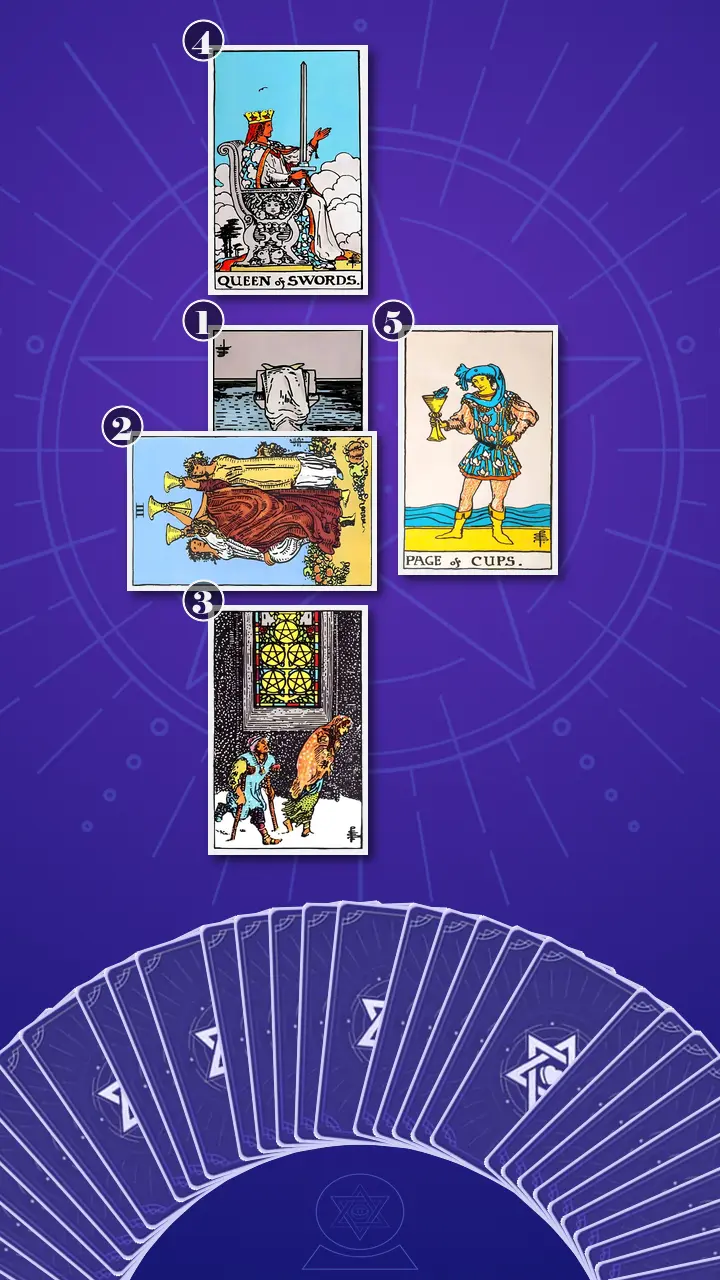
For this reading, I used the Five-Card Cross · Context Edition. When people wonder how tarot works for feeling left out by friends, this is exactly the kind of spread I reach for. We did not need the full weather system of a Celtic Cross. We needed a compact diagnostic: enough room to map the surface symptom, the immediate social trigger, the older wound underneath, the helpful reframe, and the next actionable step.
That is why this particular five-card tarot spread for friendship problems works so well for social overthinking. The center card shows the visible pattern. The crossing card shows what is pressing on it. The card below reveals the root wound. The card above offers the clearest guidance. And the card to the right shows how the insight becomes lived behavior. Tarot, at its best, gives card meanings in context. It turns a vague ache into a readable map.
I told Maya what I was watching for most closely: the surface loop of acting unbothered, the challenge of group dynamics, the buried belonging story, and the one card that would show us how to move from mind-reading to finding clarity.
Reading the Map: From Group-Chat Archaeology to the Root Wound
Position 1: The Chill Text and the Closed Chest
I turned over the first card, the one representing the observable symptom in her pattern: the calm front paired with private spiraling after being left out. It was the Two of Swords, reversed.
The image said everything before I spoke. Blindfold over the eyes. Crossed swords over the chest. Still sea beneath a stone seat. In Maya’s life, this was the exact moment she saw a tagged dinner post, sent a breezy reply before she had named the sting, and then spent the next hour flipping between Instagram, iMessage, and the group chat as if hidden truth lived in timestamps, reactions, or punctuation. It was, as I put it to her, a little Severance-coded: public self sending the polished message, private self doing the after-hours investigation.
Reversed, the energy here is blocked Air cracking under pressure. Not balance. Not peace. Containment that has started to fail. The feeling is not processed; it is postponed. So the mind reroutes the same trip over and over, like having twelve browser tabs open about the same problem and none of them being the actual source document.
I asked her the question beneath the card: “In the first five minutes, what did your body know before your text did?”
She didn’t nod right away. She gave a small bitter laugh instead. First her breath caught. Then her eyes unfocused as if replaying the phone screen. Then she pressed the heel of her hand lightly against the center of her chest. “Okay,” she said. “That’s accurate enough to be rude.”
“Not rude,” I told her gently. “Specific. The blindfold is relying on clues instead of direct information. The crossed swords are the way you keep hurt locked behind a competent tone. You are not calm in that moment. You are bracing.”
Position 2: The Social Math of the Closed Circle
Next I turned over the card showing the immediate social trigger and the inner tug-of-war: wanting inclusion while fearing that asking about it will look needy. It was the Three of Cups, reversed.
Upright, this card is easy shared rhythm—raised cups, bodies turned toward one another, the pleasure of being inside the moment. Reversed, that same image becomes painful. In Maya’s modern life, one missed hangout instantly became social math. She zoomed into the Story, checked who got tagged first, read the phrase “we all” like evidence, and started wondering whether there was now a core trio or inner loop that existed without her.
This is distorted Water. Group feeling turns into comparison. Connection becomes ranking. Her mind stops asking, “What actually happened?” and starts asking, “Where do I stand with everyone?” That is how one dinner becomes a whole algorithm she feels she is losing.
I said, “This is why adult friendship anxiety gets so sharp online. Stories make a single night look like a complete social truth.” Then I asked, “What hooked you most—the photo, the silence beforehand, or the inside jokes after?”
Her jaw shifted to one side. “The phrase ‘we all,’” she said quietly. “That one always gets me.”
I watched her fingers tighten around the mug, then loosen. The defense was starting to soften, but not comfortably. That is often how the real reading begins.
Position 3: The Warm Window and the Older Verdict
The third card, placed below the center, showed the mechanism underneath the spiral: the belonging wound and the fear that exclusion says something final about her worth. It was the Five of Pentacles, upright.
This card always lands in the body first. A lit window. Warmth inside. Figures moving through snow outside. The second I saw it, I thought of how Maya had described standing in her kitchen later under the yellow stove light, tea gone flat, apartment suddenly too quiet after hearing, “We assumed you were busy.” By then it was not even about one plan anymore. The warm restaurant on their Stories had become a glowing room she was never meant to enter.
This is pain turning solid. Earth taking over. A social miss becomes evidence. The internal jump happens fast: not “I wasn’t invited this time,” but “I’m the kind of person people like around, but don’t really choose.” A missed invite is data, not a final verdict on your place in someone’s life. But this card shows exactly how quickly the nervous system tries to make it one.
In that moment, an old instinct from my café life rose in me. In Grounds Divination—the Venetian art of reading the sediment left in a coffee cup—I never mistake the pattern that clings to porcelain for the whole coffee. Grounds show where the swirl settled and what residue remained. They do not get to rewrite the brew itself. Maya’s mind had been treating emotional residue like final truth.
I translated that for her as simply as I could. “You’re reading the stain, not just the sip,” I said. “The hurt is real. But the story attached to it is older than this one dinner.”
She went very still. First her thumb froze against the paper sleeve. Then her gaze dropped to the Five of Pentacles window as if a hundred smaller memories had lined up behind it. Then she exhaled and whispered, “It’s not even about tonight anymore.”
“Exactly,” I said. “That sentence is the hinge.”
When the Queen Lifted Her Sword
Position 4: Not Colder, Clearer
Then I turned over the fourth card, the one naming the transformation lever: the shift from mind-reading and self-silencing toward clear self-respect and reality-testing. The room changed with it. A streetcar rattled past the front window and then the café fell into a rare clean hush between orders. Even the steam wand had gone quiet. The card was the Queen of Swords, upright.
In a friendship reading, the Queen of Swords meaning is never “be harsher.” It is “be more exact.” Upright sword. Open hand. Clear sky with moving clouds. In Maya’s world, that looked like stopping the conspiracy-board energy and switching into editor mode: facts, cuts, clean wording. Instead of building a case in her head, she writes, “What I know: I was not part of this plan. What I am assuming: it means I am unwanted.” From there, one grounded message to one trusted friend. No apology for having feelings. No emotional case file. Just a clean question text.
This is restored Air. The same suit that began with blindfold, crossed arms, and shut-down perception now reappears as direct thought used for discernment instead of armor. Her growth is not about feeling less. It is about using thought to reality-test rather than to punish herself.
She stared at the card for a second too long, like she already knew it was going to ask more of her than the others had.
You are in bed with your phone lighting up your face, replaying who knew first and whether the caption meant something. Your body already feels the answer as a threat before you have any actual answer at all.
You do not need the blindfold of being ‘low-maintenance’; lift the Queen’s sword, name the sting plainly, and let truth, not guesses, cut through the spiral.
I let the sentence rest between us for a beat. Then I added, quietly, “You do not need better detective work; you need cleaner language.”
Her first reaction was not relief. It was resistance. Her inhale stopped halfway. Her brows pulled together. Then her mouth tightened with something close to anger. “But if that’s true,” she said, voice low, “what have I been doing all weekend? Just making up a whole trial in my head?”
“Not making it up,” I said. “Protecting yourself with the safest tool you had. But protection is not the same thing as clarity.”
I watched the realization move through her in three small waves. First her eyes lost focus, as if a row of browser tabs had suddenly closed. Then her shoulders dropped one careful inch. Then a shaky breath left her chest, half relief and half embarrassment. There was that brief dizzy quality that can follow a real insight—the tiny vulnerable blankness that comes when a heavy interpretation lifts and you suddenly have to decide what is true without it.
I slid a napkin toward her. “Now use this lens on last week,” I said. “Was there a moment when facts and assumptions fused so fast you couldn’t tell them apart?”
She nodded slowly. “The second I saw ‘we all,’ I decided it meant there was an inner circle and I wasn’t in it.”
“That,” I told her, “is the step. Not from hurt to never hurt again. From shame-laced exclusion spirals to clear self-respect and reality-tested friendship clarity.”
Position 5: The Soft Check-In
The final card showed the direction of integration if she embodied that guidance: how to reconnect with vulnerability and reciprocity without abandoning self-protection. It was the Page of Cups, upright.
I smiled when I saw it. After all that contracted energy, here was the emotional field shrinking from the whole group to one human-sized exchange. In modern life, this card is not a huge confrontation. It is a two-line check-in. A low-pressure coffee. A short voice note. “I felt a bit thrown when I saw that, and I wanted to check in,” instead of waiting for people to magically notice the bruise.
This is gentler Water coming back online. Not the sour comparison of the reversed Three of Cups, but curiosity, sincerity, and the willingness to say something real before certainty arrives. The fish rising from the cup has always felt like a perfect little truth bomb to me: honest feeling can create connection more often than polished detachment ever does.
“So I don’t have to make a whole case?” she asked.
“Exactly,” I said. “This does not have to be a speech. Belonging gets clearer in one honest check-in than in three hours of story forensics.”
That landed differently. She sat back instead of folding inward. Her hands opened on the table. The question in her face was no longer “How do I stop caring?” It was “Who is safe enough to be honest with first?” That is a much wiser question.
From Story Forensics to Actionable Advice
When I looked at the whole spread together, the story was precise. First came the split on the surface: breezy text outside, stomach-drop hurt inside. Then the group trigger turned that hurt into social ranking and mind-reading. Underneath it all sat the older outsider wound, the part that hears a missed plan as proof of being less chosen. The Queen of Swords interrupted that chain by separating facts from assumptions. And the Page of Cups showed that repair would not come from decoding the whole friend group; it would come from one clear, human exchange with someone capable of reciprocity.
I named the blind spot plainly. “You have been treating the fear of looking needy as more dangerous than the cost of silent guessing.”
Then I named the direction just as plainly. “Clarity is not the same thing as making it weird. Your move is not to become colder. It’s to become clearer, and then smaller and softer in how you test connection.”
When I offered the first practice, Maya grimaced immediately. “Twenty minutes without checking Stories?” she said. “If I’m being honest, I don’t even make it twenty seconds.”
I laughed, not at her, but with the reality of being a person with a phone and a nervous system. “Then we make the doorway smaller,” I said. “In my café I call this the Morning Espresso Ritual. The first brew sets the tone before the internet gets a vote.”
- The Morning Espresso What-I-Know CheckBefore you reopen Instagram or the group chat tomorrow morning, make your coffee or tea and open Notes. Write two headings only: ‘What I know for sure’ and ‘What I am assuming.’ Keep each list to three bullet points max. Five minutes is enough.If your brain says, ‘This is overdramatic,’ treat that as old armor, not truth. If five minutes feels too hard, do the two-line version while the kettle boils.
- The Clean Question TextAfter a 20-minute no-story-check pause—or a 5-minute one if that is more realistic—draft one factual question to one person only. For example: ‘Hey, seeing that dinner caught me off guard. Was it super last-minute, or did I miss the plan somewhere?’ Send it only if your body has come down one notch.Draft first, decide later. You do not owe the whole group an explanation, and you do not have to send it at 11:47 p.m. after three rounds of group-chat archaeology.
- One-Person Reality TestThis week, choose one friend who has responded with care before and either send a two-sentence check-in or invite them for a short coffee or walk. Keep it human-sized: ‘I felt a bit thrown when I saw that plan, and I wanted to check in rather than make up a story.’Curiosity is enough. Two sentences is enough. If texting feels too loaded, make it a low-stakes Thursday coffee after work and bring it up briefly in person.
Then I added one more piece from the way I close my café at night. Energy Cleaning, I call it: the small reset before residue becomes tomorrow’s atmosphere. “If you feel the spiral restarting,” I told her, “mute that specific Story feed or group chat for one evening. Not as punishment. As cleanup. You are allowed to stop feeding the part of your mind that only knows how to guess.”
A Week Later, the Quiet Proof
A week later, just before the lunch rush, I got a message from her. “I did the Notes thing with coffee first,” it read. “Then I texted one friend. It really was last-minute. She said she’d thought about inviting me and assumed I was slammed. I still had the ‘wow, I spiraled hard’ feeling after—but I didn’t reopen the Story once.”
That is what a real journey to clarity looks like most of the time. Not solving your whole friendship life in one conversation. Not becoming immune to the sting. Just one clean question, one interrupted spiral, one small piece of evidence that self-respect can stay in the room even when uncertainty shows up first.
Sometimes the sharpest part is not missing the plan—it is the moment your chest tightens, your phone warms in your hand, and you start wondering whether wanting to be chosen already makes you too much. If that moment finds you again, what is the smallest honest sentence you might want to keep ready in Notes, right under ‘What I know’ and ‘What I am assuming,’ instead of reaching for story forensics?
This story is adapted from psychological research, written so that those in a similar struggle can see their own pattern in it — and find their next step clearly.These insights are not a substitute for professional psychological, medical, legal, or financial advice.
Learn more about our Journey to Clarity.
How did this insight land for you?
🫂 This Resonates Deeply
🌀 Living This Story
✨ Now I See Clearly
🌱 Seeing New Possibilities
🧰 Useful Framework
🔮 The Confirmation I Needed
💪 Feeling Empowered
🚀 Ready for My Next Step
Author Profile
 AI
AI“For twenty years, I’ve listened to stories unfold over the warm aroma of coffee. I don’t believe life’s complexities always require grand theories to be solved; often, we just need a safe place to tidy up our reality. I don’t offer high-minded preaching—just grounded, heartfelt insights to help you regain your sense of control amidst the clutter of daily life.”
In this Personal Growth Tarot Reading :
Core Expertise
Service Features
Also specializes in :
Explore Related Patterns:
Exclusion SpiralFriday night starts with one tagged dinner photo from Ossington, but within minutes the scene expands into Stories, iMessage, group chat, tag order, and the phrase 'we all.' You are no longer reacting only to a missed plan; you are watching your mind turn incomplete social data into a whole verdict about belonging. Exclusion Spiral fits because the trigger is ambiguous enough to invite interpretation and painful enough to demand certainty. The nervous system tries to reduce threat by building a case, but every new clue keeps the wound active instead of resolving it. The spiral is not pettiness; it is a protection strategy that has lost its off switch. Once the dinner becomes evidence that you are outside the warm window, scrolling stops being information gathering and becomes a loop that makes exclusion feel more final than the facts can support.
Mind ReadingMaya reading 'we all' as evidence of a core trio shows the cognitive move at the center of the loop. You can feel how the caption, timestamps, tags, and silence beforehand become treated like access points to other people's private intentions. Mind Reading fits because the mind is trying to answer a real social question without direct information. Instead of asking one person what happened, it fills the gap with projected explanations, usually the most painful one. The pattern feels convincing because it borrows intensity from the body. Your chest tightens before you have an actual answer, and that threat signal can make an assumption feel like proof.
Self-SilencingMaya typing 'looks so fun' within seconds while her shoulders are tight is the cleanest behavioral anchor: the socially acceptable message goes out before the body has been allowed to tell the truth. You can see the defense in the split between the polished group-chat tone and the private chest-tight investigation that follows. Self-Silencing fits because the hurt is not absent; it is being managed through a low-maintenance persona. The fear is that naming exclusion will make you look needy, dramatic, or easier to reject, so the safer move becomes acting chill while your nervous system keeps carrying the question. The pattern becomes costly when silence is mistaken for maturity. You avoid the immediate awkwardness, but the unspoken need has nowhere to go except into scrolling, clue-hunting, and a growing sense that your feelings are too much to bring into the room.
Anxious AttachmentMaya wanting to feel included and chosen while fearing that a direct question will make her look needy captures the attachment-level bind. You can see the desire for closeness and the fear of rejection pulling against each other in the same moment. Anxious Attachment fits because connection is not simply wanted; it has to be monitored for signs of possible withdrawal. The dinner photo, the silence beforehand, and the phrase 'we all' become cues that the bond might be less secure than hoped. The pattern turns uncertainty into urgent relational scanning. Acting chill protects you from seeming too invested, while the private spiral tries to restore closeness without risking the exposure of asking for it.
Rejection SensitivityThe moment Maya moves from 'I wasn't invited this time' to 'I'm the kind of person people like around, but don't really choose' is the deeper hinge. You can see the missed plan stop being an event and become a verdict about desirability, safety, and social worth. Rejection Sensitivity fits because ambiguous distance is processed as a high-stakes rejection cue. The fear of asking then becomes part of the trap: if needing clarity might make you easier to reject, staying silent feels safer even while it intensifies the pain. This pattern does not mean your hurt is irrational. It means the alarm system is reading uncertain friendship data through an older belonging story, so a last-minute plan can feel like confirmation of a much larger fear.
Compulsive CheckingMaya opening Instagram, iMessage, and the group chat side by side gives the spiral a visible motor. You can see the thumb trying to solve the feeling through more data, zooming into photos and scanning punctuation as if the missing piece must be somewhere on the screen. Compulsive Checking fits because the behavior promises relief but extends uncertainty. Each refresh creates the sensation of doing something, while the real question, whether she can ask directly and tolerate the answer, stays untouched. The checking becomes a coping ritual for social ambiguity. It keeps you close to the source of the sting without requiring vulnerability, but the cost is that the feed becomes the room where your nervous system keeps re-entering the same threat.
Assertive CommunicationMaya's clean question text, 'seeing that dinner caught me off guard,' changes the relational move from silent guessing to direct contact. You can see how the story becomes smaller, from decoding an entire group to asking one trusted person for context. Assertive Communication fits because the need is expressed without an emotional case file or an apology for having feelings. It holds both sides at once: your hurt matters, and the other person still gets room to answer with their version of reality. The pattern is not about confrontation for its own sake. It is the skill of making uncertainty relational again, so clarity can come from a human exchange instead of from three hours of story forensics.
Reality TestingThe napkin exercise, 'What I know for sure' versus 'What I am assuming,' gives Maya a way to slow the fuse between fact and story. You can see the mind shift from building a social trial to separating observable data from threat-driven interpretation. Reality Testing fits because the core problem is not that she has feelings; it is that feelings and evidence fuse too quickly under social threat. The practice gives thought a different job, not to punish her with guesses, but to check what is actually known. The week-later message shows the pattern becoming lived behavior. She texts one friend, learns the plan was last-minute, still feels the aftershock, and does not reopen the Story, which is a concrete interruption of the old loop.
Explore Related Struggles:
Chosen-Worth BindThe missed dinner does not stay the size of one plan. In Maya’s kitchen later, after hearing “we assumed you were busy,” the warm restaurant on everyone else’s Stories becomes a room she was never meant to enter. Chosen-Worth Bind appears when being included starts to function as proof of being valued. You can see the bind in the fast internal jump from “I was not invited this time” to “I am the kind of person people like around, but do not really choose.” One social miss becomes heavy because it is asked to answer a much bigger question about whether you matter. That is why the spiral feels so sharp. The visible friendship event carries an invisible verdict, and your system starts treating the group’s choices as the measuring instrument for your worth. The work is not to pretend the exclusion did not sting; it is to stop letting one missed invitation become the court that decides your place in the world.
Clarity-Exposure SplitMaya keeps saying she just wants to know what happened, but the route she takes is not a direct question. She studies timestamps, captions, tags, and group-chat wording because asking a friend plainly would reveal that the dinner actually hurt. Clarity-Exposure Split lives in that exact gap. You want the clean information that would calm the story down, but the act of asking feels like standing in the open with your need visible. The result is a painful workaround: you keep building a case from indirect evidence because direct clarity feels too exposed. The story’s turning point is not about becoming colder or pretending not to care. It is the move from hidden investigation to one honest, human-sized question. You get your agency back when clarity is allowed to be a form of self-respect instead of a confession of neediness.
Low-Maintenance Worth LockMaya sees the tagged dinner photo, feels her stomach drop, and still sends the breezy “looks so fun” message almost immediately. The public version of her response protects the group from friction, while the private version of her body is already bracing around the cost of being left out. Low-Maintenance Worth Lock shows up in the way being easy to include starts to feel safer than being honest about needing inclusion. You can feel the tradeoff: staying chill keeps the door open, but it also teaches the hurt to wait in the hallway until it comes back as scrolling, tight shoulders, and a chest that cannot quite relax. The struggle is not that you care too much. It is that the story makes care feel like something that must be hidden to remain acceptable. The moment clarity becomes tied to the fear of being “too much,” your needs stop being information and start feeling like social risk.
Monitoring-Safety FusionInstagram, iMessage, and the group chat all stay open because Maya is trying to make the screens give her a clean answer. The tagged photo, the caption, the phrase “we all,” and the order of who knew what first become a set of social clues she keeps rereading from her condo couch. Monitoring-Safety Fusion captures the point where checking stops being simple curiosity and starts acting like a substitute for relational security. You are not just looking at a photo; you are trying to stabilize your place in the group through fragments that were never built to hold that much meaning. The trap is that every new check feels like it might finally settle the question, but the loop keeps giving you more material to interpret instead of more reality to stand on. Safety becomes fused with monitoring, so the phone starts to feel like both the threat and the only available tool for surviving the threat.
Explore Related Emotions:
Clarity HungerMaya keeps looking for punctuation, timestamps, and views because underneath the spiral is a real need to know what actually happened. Her method is frantic, but the need itself is clean: she wants reality to separate from assumption. Clarity Hunger is the part of You that cannot live well inside vague social fog. It reaches for evidence because uncertainty feels too charged to simply ignore. When that hunger has no direct channel, it turns into detective work; when it is given structure, it becomes discernment. The reading gives that hunger a better container through the facts-versus-assumptions map and the clean question text. This emotion fits because Maya is not only afraid of exclusion; she is starving for a version of the situation that is specific enough to stop punishing herself with guesses.
Friendship Screenshot AnxietyMaya zooms into a dinner photo she was not in, checks who was tagged, and reads “we all” like it might contain a hidden verdict. The image becomes a document, the caption becomes testimony, and the group chat becomes a place where every small trace can be over-read. Friendship Screenshot Anxiety captures the very modern texture of this spiral. You are not sitting with a single hurt; You are interacting with a feed that keeps the hurt bright, searchable, and refreshable. Screenshots, Stories, timestamps, and tags turn friendship uncertainty into something that looks analyzable but rarely becomes clearer. The emotion matters because Maya's mind is trying to solve belonging through visual evidence. The more she studies the artifacts of the night, the farther she gets from the only thing that could actually answer the question: a grounded exchange with a real person.
Group Chat AnxietyMaya opens Instagram, iMessage, and the group chat side by side, searching punctuation, timestamps, tags, and views as if one tiny detail will explain where she stands. The phone becomes less like a tool and more like a room she cannot leave, with every caption and reaction acting like possible evidence. Group Chat Anxiety grows in that exact digital pressure. You are not only responding to being left out of one plan; You are trying to read an entire friendship structure through fragments that were never designed to carry that much meaning. The more incomplete the information is, the more your mind tries to finish the story for you. This is why the spiral feels so sticky. The question “What happened?” quietly becomes “Where do I rank?” and the group chat starts to feel like a social weather report about your value. The anxiety lives in the gap between what the screen shows and what You need to know directly.
Low-Maintenance ShameMaya wants to ask why she was not included, but the question feels risky before it is even spoken. She imagines that naming the hurt could make her look needy, dramatic, or easier to reject, so she chooses the safer costume: breezy, flexible, low-maintenance. Low-Maintenance Shame is the ache of believing your needs will become a liability the second they are visible. You can want closeness and still feel embarrassed by the wanting. You can be hurt and still judge yourself for not being cooler about it. The story keeps showing how this shame compresses Maya's agency. Instead of asking a clean question, she tries to disappear the feeling into a chill text, then pays for that disappearance later through spiraling. The emotion is not weakness; it is the pressure of trying to earn security by asking for almost nothing.
Performative CalmMaya sends “looks so fun” almost immediately, even though her stomach has dropped, her shoulders are tight, and her phone is heating up in her palm. The message performs ease before her body has had a chance to register the sting, which leaves the feeling trapped behind a tone that sounds more casual than she actually feels. That split creates the pressure system of Performative Calm. You are not pretending because nothing matters; you are trying to keep the social field stable by becoming the version of yourself who cannot be accused of being needy, dramatic, or too affected. The cost is that the hurt has to move somewhere, so it reroutes into private scanning, checking, and replaying. This label fits because the story is built around a polished surface and a pressured interior. The calm is not grounded; it is managed. Underneath it, You are trying to protect belonging by hiding the exact feeling that needs to be understood.
Quiet Self-RespectMaya's repair begins when the question gets smaller and cleaner: one grounded message to one trusted friend, with no apology for having a feeling. She does not need to prosecute the whole group or erase the sting to stay dignified. Quiet Self-Respect shows up as a steady boundary inside vulnerability. You can ask for clarity without making yourself smaller, and You can name hurt without turning it into a case file. The respect is quiet because it does not need to perform strength; it simply refuses to abandon your own reality. The week-later message gives this emotion its proof. Maya still feels the aftershock of having spiraled, but she does not reopen the Story once. That is the inner shift: uncertainty enters the room, and self-respect stays there with it.
Social Exclusion DreadThe dinner photo from Ossington lands as more than a missed plan: it turns into a warm room on the other side of the glass. Maya sees the people, the tags, the phrase “we all,” and the scene starts to imply a circle that formed without her. Social Exclusion Dread names the moment when absence becomes threatening. You are not just disappointed that You missed one dinner; You feel the social map redrawing itself in real time, with some people inside the core and yourself pushed toward the edge. That is why the image feels so much bigger than the event. The dread comes from the jump between fact and verdict. “I was not there” becomes “maybe I am not really chosen,” and the body reacts as if the relationship has already delivered its final answer. The label fits because the story keeps returning to that feared outside position: visible enough to watch the warmth, not secure enough to feel part of it.
Cautious VulnerabilityThe final movement is not a dramatic confrontation with the whole group; it is a two-line check-in, a coffee, or one short voice note. Maya's emotional field shrinks to a human size, where honesty has a better chance of being received. Cautious Vulnerability names the willingness to let a real feeling be seen without throwing the whole self into the open. You are not demanding certainty before speaking, but You are also not handing your softest place to everyone at once. The caution is part of the care. This label fits because the story's healthiest direction is selective openness. Maya moves from “How do I stop caring?” to “Who is safe enough to be honest with first?” That question protects her while still letting connection become possible.
Clarity ReliefA week later, Maya does the Notes exercise, asks one friend directly, and learns the dinner really was last-minute. The relief does not erase the sting, but it interrupts the old loop before the Story can become another courtroom. Clarity Relief is the exhale that comes when a heavy interpretation loosens. You do not need perfect reassurance to feel the shift; You need enough reality to stop treating every unknown as evidence against yourself. The feeling is steadier than instant comfort because it comes from direct contact with the facts. This emotion belongs here because the story ends with one interrupted spiral, not a total friendship makeover. Maya still knows she spiraled hard, but she also has proof that a clean question can bring her back into agency. Relief arrives as a small, credible opening.
Rejection ChillBefore Maya has language for what happened, her stomach drops and she sits upright. The reaction arrives before the explanation, which is why the moment feels so sharp: the body has already registered possible rejection while the mind is still trying to act reasonable. Rejection Chill names that sudden internal coldness when a social cue feels like proof of being unwanted. You can still type a friendly sentence, still look composed, still tell yourself You are not mad, while something underneath has gone rigid and alert. The chill is not dramatic; it is immediate, physical, and hard to talk yourself out of. In this story, the phone glow, the warm dinner photo, and the quiet condo all intensify that contrast. Other people appear inside the warmth, while Maya feels herself outside it. The label fits because the first wound is not the analysis; it is the body-level sting that starts the whole investigation.
Explore Related Contexts:
Algorithmic Comparison LoopThe tagged dinner photo turns one missed plan into a replayable social scene. Maya can zoom into the image, reread the caption, check the Story again, and compare her absence against the visible closeness of everyone who was there. The feed intensifies the exclusion because it packages a single night as a polished social truth. You are not just hearing that friends got dinner; you are watching the algorithm re-serve the group's togetherness in a format built for comparison. The platform makes the moment feel larger, cleaner, and more conclusive than the messy logistics behind it may have been. That loop gives the spiral its fuel. Every revisit to the photo seems like it might reveal the missing answer, but it mostly refreshes the same social contrast: they were inside the scene, and you were outside the frame.
Low-Maintenance Friendship PressureMaya sends "looks so fun" within seconds even though her body has already registered the sting. She is not just choosing a tone; she is obeying a friendship rule that says direct hurt may read as needy, dramatic, or too much. The pressure comes from the social reward system around being easygoing. You can keep the group comfortable by sounding unbothered, but the cost is that the real question has nowhere public to go. The chill text becomes a small performance of acceptability while the unanswered concern gets pushed into private investigation. This context explains the split in the question: the public self protects belonging by staying low-maintenance, while the private self spirals because clarity was never actually obtained.
Receipts CultureMaya opens Instagram, iMessage, and the group chat side by side, looking for hidden truth in timestamps, punctuation, views, and who got tagged first. The friendship field has been converted into a trail of receipts, and every tiny digital mark starts to feel like admissible evidence. The external structure here is not only her reaction; it is the communication environment. Modern group chats and Stories create partial visibility: enough data to investigate, not enough context to understand. You are pushed toward reading traces because the actual conversation has not happened yet. In a receipts culture, spiraling can look like doing responsible research, but it rarely produces grounded clarity. The platform gives you more artifacts to inspect while keeping you away from the one thing that would change the situation: a direct answer from a real person.
Soft ExclusionMaya finds out about the Ossington dinner through a tagged photo, not through an invitation, and the explanation only arrives later as "we assumed you were busy." The social pain is not a clean rejection with a clear boundary; it is a soft, deniable omission that leaves her with enough evidence to feel left out and not enough information to know how to respond. That structure is why the moment gets sticky. You are dealing with an exclusion that can be brushed off as logistics, timing, or assumption, while your place in the friend group suddenly feels negotiable. The external problem is the blurry social event itself: a plan happened, the group visibility was public, and the invitation pathway stayed hidden. In that kind of friendship scene, acting chill is a way to keep access to the group while privately trying to understand whether access has already shifted. The spiral is not random; it grows from a social situation where the door was neither clearly open nor honestly closed.
Unspoken Social RulesMaya is caught between wanting to ask what happened and fearing that the question itself will change how her friends see her. The plan occurred somewhere offscreen, the caption "we all" carried social weight, and nobody had clearly stated what the rules were for being included or for asking about it afterward. The pressure sits in the unspoken code of adult friendship: be available but not demanding, care but do not make it awkward, notice exclusion but do not overreact. You are trying to navigate a social map where the expectations are real enough to constrain you and vague enough that nobody has to own them. That is why the question cannot be solved by simply deciding to care less. The external problem is a rule system without clear signage, where belonging depends on reading cues correctly and direct clarification feels socially risky.