The Future Waiting Inside Three Open Tabs
If you are an early-career London renter with three practical tabs open and one friend’s “I’m definitely in” pinned in WhatsApp, putting your life on hold can look suspiciously like flexibility. That was how Maya, a 27-year-old marketing coordinator, arrived at our reading.
At 11:48 p.m. on a Tuesday, she shared her screen with me from the kitchen table of her South London flat. A Rightmove listing, a Greenhouse application, and Google Calendar glowed beside one another. Her laptop fan hummed under our voices; cold tea left a metallic taste in her mouth; her phone was warm from rereading the same message. Then she closed all three tabs without submitting anything.
“Every promise sounds solid until I ask for a date,” she said. “I keep calling it flexibility, but my life is still on hold. If I plan alone, what does that say about us?”
I watched her shoulders fold towards the laptop. The uncertainty seemed to sit behind her ribs like a train door held open while every connecting service quietly left the station. She wanted a future that included her closest friend, but she was allowing an unverified promise to control the timetable.
“I’m not here to tell you whether your friend will follow through,” I said. “I’m also not going to tell you that caring was a mistake. Let’s use the cards as an objective map of what is observable, what is costing you something, and what remains yours to decide. That will be our Journey to Clarity.”

Choosing a Bridge Map for the Friendship
I asked Maya to place both feet on the floor, take one ordinary breath, and hold the practical question in mind. I shuffled slowly, using the motion as a transition from rereading the story to examining its structure, not as a performance of certainty.
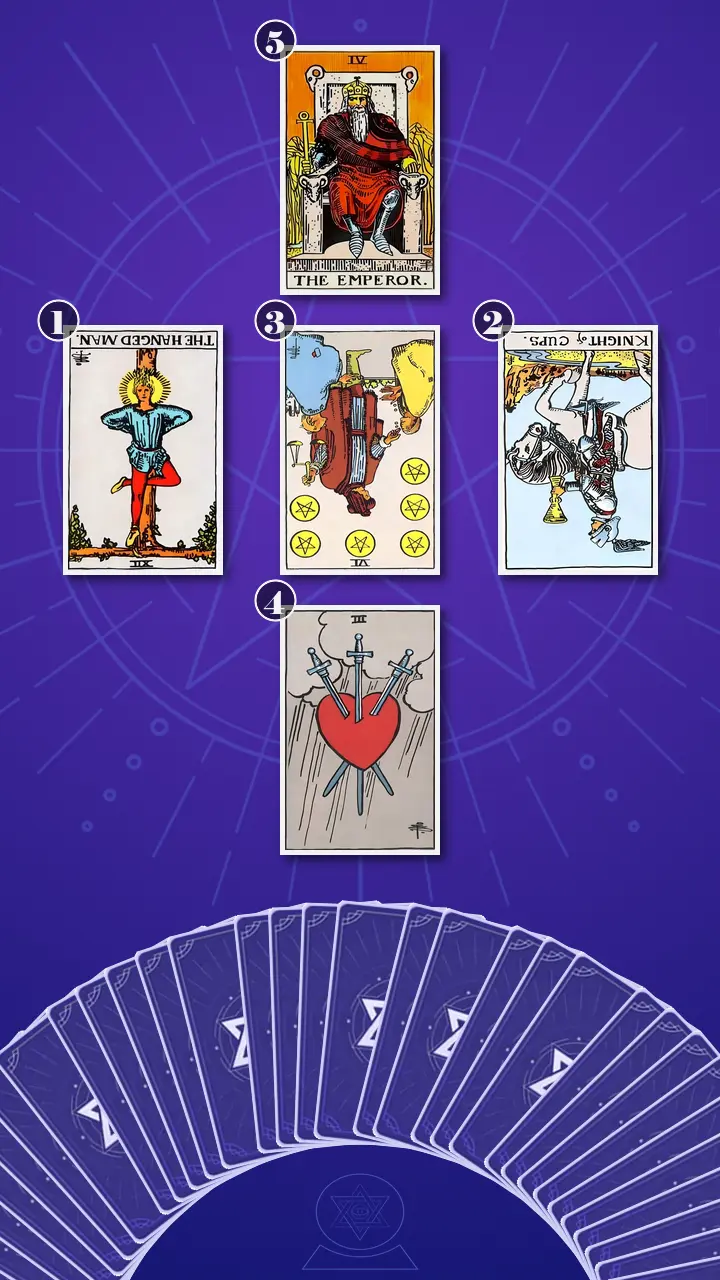
I chose the Relationship Spread · Context Edition, a five-card friendship tarot spread designed to compare observable contributions, reciprocity, avoided disappointment, and a self-owned direction. It suited Maya’s question because the issue was not whether I could predict her friend’s choice. The issue was how planning authority had moved from Maya’s hands into a recurring promise.
I arranged the cards like a bridge inspection. The left position would show Maya’s contribution to the waiting pattern. The right would examine only her friend’s visible words and follow-through, without pretending to know private motives. The centre would test the exchange between them. Beneath it, one card would reveal the emotional fault line; above it, the final card would define a boundary Maya could build for herself.
This is how tarot works best for me: not as a verdict delivered from somewhere outside a person, but as a structured way to separate feeling, evidence, habit, and choice. The card meanings matter, but their meaning in context is what makes the reading useful.
The Cup, the Scales, and the Cost of Waiting
The Hanged Man Reversed: When Flexibility Becomes Suspension
Now I turned over the card representing Maya’s contribution to the pattern, specifically her habit of suspending personal choices and treating indefinite waiting as loyalty. It was The Hanged Man, reversed.
I pointed to the figure held upside down by one ankle. The halo suggested that Maya already understood more than she gave herself credit for; the reversal showed that insight had not yet become movement. This was suspension in excess, with her capacity for independent action blocked. A pause that might once have created perspective had hardened into a repeatable planning rule.
I brought us back to 11:48 p.m.: the rental enquiry, the work application, and the calendar decision were ready. One starred WhatsApp message had no date, budget, or first step, yet it controlled all three tabs. Maya called that loyalty and closed them. In modern life, The Hanged Man reversed can be exactly this ordinary: leaving an available option in draft until “keeping it open” becomes the reason it expires.
Maya gave one dry, bitter laugh. “That is so accurate it feels a bit brutal.” Her fingers stopped circling the rim of her mug, then pressed flat against the table. “I keep calling this flexibility, but I’m basically making my deadline wait for her maybe.”
“The card is describing a habit, not a character flaw,” I said. “You do not need to cancel every shared possibility to prove you can move. Which one decision could proceed using information you already have?”
Her eyes moved to the application tab. “That one,” she said quietly. “An interview would not force me to accept anything. I could just submit it.”
The Knight of Cups Reversed: The Voice Note That Sounded Like a Plan
Now I turned over the card representing the friend’s observable promises and follow-through, separating warm language from verifiable commitment. It was the Knight of Cups, reversed.
The knight held the cup forward as if presenting it might complete the journey. I described the polished two-minute voice note Maya had played during lunch: affectionate, detailed, full of moving, travelling, and finally starting their project. Before finishing her sandwich, she had opened Notion, moved money between Monzo pots, and shifted annual-leave dates, although neither person had named a month or completed a first action.
“It sounded so certain that I started treating it as settled,” Maya said.
Here, emotional water was in excess while operational grounding was deficient. The feeling carried by the offer was real to Maya, but the dates, resources, and completed steps had not crossed the river shown behind the knight. I was careful not to turn that gap into a claim about her friend’s intentions.
“A promise can be sincere and still be too light to carry your calendar,” I told her. “A warm voice note is closer to clicking ‘Interested’ on an event than buying the ticket and arriving. It communicates desire. It does not yet provide planning infrastructure.”
Maya’s mouth tightened before she nodded. She looked towards her phone, but did not pick it up. I could see the distinction landing: sincerity answered one question; reliability answered another.
The Six of Pentacles Reversed: The Belonging Tax
Now I turned over the card representing the shared mechanism keeping the issue active, especially the unequal exchange in which Maya contributed practical flexibility before reciprocal action appeared. It was the Six of Pentacles, reversed.
I translated the scales into a two-column audit. On Maya’s side were a comparison spreadsheet, two held weekends, a contingency route, deposit research, an adjusted budget, and hours of planning. On the other side was an encouraging message, two heart reactions, and no completed task. The card showed reciprocity blocked and practical energy distributed unevenly.
“Why am I already paying the practical cost of something we haven’t both started?” she asked. The question came out more softly than the frustration visible in her jaw.
“Because doing more briefly protects the feeling that the shared future is still available,” I said. “But reciprocity is not enthusiasm repeated; it is participation made visible. You have been granting someone edit access to your calendar before they have accepted one invitation.”
Her breath paused. Her gaze lost focus as if she were replaying every spreadsheet she had made, and then she released a low “Oh” from somewhere deep in her chest. Her shoulders lowered by a fraction. The imbalance did not prove anyone was bad or that the friendship was unsafe. It showed that reassurance had been receiving more influence over Maya’s time and money than reciprocal action had earned.
The Heart Beneath the London Rain
The Three of Swords: When Disappointment Becomes Information
Now I turned over the card representing the principal challenge beneath Maya’s waiting: the fear that testing the promise might disturb her hoped-for sense of belonging. It was the Three of Swords, upright.
Rain began tapping the kitchen window as I placed the exposed red heart beneath the grey clouds of the card. The sound made the image feel uncomfortably present. I asked Maya to put her phone face down and name the fact she had been trying to out-plan.
“There is no usable commitment yet,” she said. Her palm remained on the phone. “If I stop calling it a plan, I think I have to grieve the version of us where we do all of this together.”
The Three of Swords did not predict betrayal. Its air energy restored a distinction that had been underused: a promise could feel loving and still be too uncertain to organise a future around. Painful clarity was finite information. Open-ended waiting kept the same pain circulating without allowing it to take a recognisable shape.
In that moment, I thought of planetary alignments I had tracked over years of working with cycles. Two bodies can appear perfectly joined from one point of view, then continue along different arcs without either becoming false. Distance does not automatically erase meaning; sometimes it reveals the movement that was already occurring.
“If I stop calling this a plan, what sadness will I finally have to feel?” I asked.
Maya blinked hard and answered, “That she may mean it every time she says it, and still not be able to build it with me.”
“Yes,” I said. “And you can leave a place for someone without leaving your whole future unbuilt.”
When the Emperor Put the Future Back on Its Feet
The Emperor Upright: A Throne Built from Verified Actions
Now I turned over the card representing Maya’s self-owned way forward: a planning boundary that could hold both connection and autonomy without predicting the friendship’s outcome. It was The Emperor, upright, the key card and antidote of the reading.
The room seemed to become quieter around its stone throne, visible armour, and upright figure. In contrast with The Hanged Man’s suspended body, the Emperor sat firmly inside a structure capable of bearing weight. Its energy was balanced: authority over Maya’s own deadlines, budget, responsibilities, and fallback route, without control over another person.
I translated the card into a personal operating system with four required inputs: a confirmed date, available resources, a named responsibility, and a default action. Maya could set her application deadline and budget ceiling first, then provide a concrete route for her friend to participate. Like Dorothy discovering that the Wizard was not the only possible source of movement, Maya did not need to abandon connection in order to use the agency already available to her.
I also brought in what I call Gravity De-linking Analysis. I use it when two friends keep trying to force alignment while moving through different life phases. The friction is not proof that either person is wrong; it comes from making one person’s orbit serve as the other person’s timetable. Maya could stop binding her launch window to her friend’s readiness while still allowing their paths to meet through action.
At 11:48 p.m., Maya had three actionable tabs beside “I’m definitely in.” She already knew what she could submit, request, or decide. Closing them felt safer because it postponed the test of whether the promise could carry real weight. The Emperor changed what counted as support.
I let the silence settle, then said, “Hope does not have to be rejected, but it cannot do the work of evidence. Build the future your confirmed resources can hold, then let your friend’s actions determine how she participates.”
Stop treating hopeful words as structural support; build from verified actions and let the Emperor's stone throne remind you that stability begins with your own rules.
For one beat, Maya’s breath stopped and her thumb hung above the dark screen of her phone. Her pupils widened; then her gaze slipped past me as if old voice notes, held weekends, and unfinished forms were replaying behind her eyes. Colour rose along her cheeks. “But doesn’t that mean I’ve been wrong all this time?” she asked, with a sudden edge that sounded closer to anger than relief.
I did not rush to soften it. “No. It means waiting once helped you protect hope and belonging. We are looking at what that rule costs now, not putting your past self on trial.” Her fist loosened against the table. Her shoulders dropped, and a long, shaking breath left her chest. Relief arrived, but so did a brief, exposed stillness: the dizzy space where an answer becomes responsibility. She looked back at the application and swallowed.
“Now, using this new perspective, think back to last week,” I said. “Was there a moment when this insight could have made you feel different?”
“The rent-renewal email,” she said. “I could have answered from my actual budget and still told her what would need to happen for us to move together later. I didn’t have to make her readiness the foundation.”
I named the shift clearly: this was not instant certainty about the friendship. It was movement from reassurance-dependent self-suspension towards calm, verified-first self-authority that still left room for connection. She was no longer asking hope to perform the job of evidence.
The Verified-First Plan for the Next 48 Hours
I read the spread back to Maya as one coherent story. A learned equation had linked waiting with loyalty. The Hanged Man showed that equation operating in her unfinished decisions; the reversed Knight showed how warm promises renewed it; the reversed Six revealed the time, money, and planning labour she prepaid to preserve it. The Three of Swords exposed the sadness beneath the bridge, and the Emperor supplied the structure that could finally carry her weight.
The cognitive blind spot was not simply that Maya believed her friend. It was that she treated additional reassurance as new planning information and her own overfunctioning as proof of devotion. Every extra spreadsheet made the shared future look more developed while protecting the promise from a basic reality test.
The key shift was practical: each future decision would begin with verified resources, dates, and completed commitments. Her friend’s participation could remain welcome, but optional, until it was matched by action. A deadline for Maya’s decision was not a deadline for someone else’s feelings.
I gave her three small experiments. None required a confrontation, a friendship verdict, or a dramatic life change.
- Run the Eight-Minute Emperor Audit.On Monday evening at the kitchen table, divide one page into Confirmed, Promised, and Mine to Decide. Add at least one fact to each column, circle one item that belongs to Maya, and choose its smallest next step within 48 hours.If eight minutes feels heavy, write one confirmed fact and put a private 48-hour decision point in Google Calendar. Start with a reversible, low-cost choice.
- Use the Date-and-Action Threshold.When the next shared promise would affect money, leave, housing, or an opportunity, ask: “What date should we use to confirm this, and what first action will each of us complete?” Keep the independent option active until both elements exist.Keep the question neutral. The threshold governs what enters Maya’s calendar and budget; it does not judge whether her friend is sincere.
- Practise the Constellation Release Protocol.After a vague reply, put the phone face down for ten minutes and write: “What I hoped for,” “What is confirmed today,” and “What remains mine to decide.” Release the unconfirmed promise from running the timetable while leaving an optional place for the friend to join through concrete action.This is closure around a planning dependency, not a forced ending. If sadness becomes too intense, stop after naming one feeling and one observable fact.
I asked Maya which action felt almost too small to count. She looked at the Greenhouse tab and said, “Submitting the application. Five minutes, maybe.” That was exactly the scale I wanted. The point was not to solve her future in one evening. It was to give her self-trust one piece of observable evidence.

A Week Later, One Quiet Piece of Proof
Six days later, Maya messaged me. She had submitted the application and left her friend a clear route to join the housing search later. She slept through the night. Her first morning thought was, “What if I’m wrong?” This time, she smiled before making tea.
Her friendship had not been magically resolved, and the shared future remained uncertain. What changed was smaller and more important: one decision now stood on Maya’s own confirmed ground. The cards had not created that ground or chosen for her. They had helped her see the structure; she had made the click.
I came away from our reading thinking that clarity is sometimes less like a floodlight and more like the first fixed star visible between moving clouds. When someone else’s “definitely” keeps your chest tight over an expiring tab, the hardest part is rarely choosing a date. It is fearing that moving without them will reveal you were less securely held than you hoped. Noticing that fear means you are already relating to it differently.
If your next plan could stand on one verified stone while still leaving an honest place in the constellation for connection, which tiny decision would you feel curious about making yours?
This story is adapted from psychological research, written so that those in a similar struggle can see their own pattern in it — and find their next step clearly.These insights are not a substitute for professional psychological, medical, legal, or financial advice.
Learn more about our Journey to Clarity.
How did this insight land for you?
🫂 This Resonates Deeply
🌀 Living This Story
✨ Now I See Clearly
🌱 Seeing New Possibilities
🧰 Useful Framework
🔮 The Confirmation I Needed
💪 Feeling Empowered
🚀 Ready for My Next Step
Author Profile
 AI
AI“After a decade of guiding people through the stars, I’ve come to see life much like the orbits of planets: everything has its inevitable cycles. When you feel lost, please don't blame yourself; you might just be in a natural low tide. I’m here to sit under the night sky with you, offering a gentle cosmic perspective to distinguish temporary pain from the beautiful breakthroughs just around the corner.”
In this Friendship Tarot Reading :
Core Expertise
- Orbital Drift Recognition: Objectively mapping how personal cognitive upgrades naturally lead to mismatched frequencies with old friends, removing the guilt of outgrowing them.
- Gravity De-linking Analysis: Identifying the painful friction that occurs when two friends try to force an alignment despite moving into completely different life phases.
Service Features
- The Constellation Release Protocol: A psychological closure technique to peacefully accept the natural fading of a friendship, leaving them in their orbit while you transition to your next.
Also specializes in :
Explore Related Patterns:
Avoidance CopingClosing the tabs allows Maya to postpone the test of whether the promise can support a real decision, while additional planning makes the imagined future look increasingly developed. The immediate payoff is emotional protection: she does not yet have to confront disappointment or grieve the version of the friendship she hoped would materialise. You can call this flexibility because waiting leaves every hopeful interpretation available. Avoidance Coping explains the hidden trade: short-term relief is purchased by keeping the same uncertainty in circulation. The pattern persists because making a decision would not only resolve a practical question; it would also expose an emotional fact that indefinite preparation has been helping you avoid.
Boundary DiffusionMaya allows an undated promise to influence her housing, annual leave, money, and career decisions before her friend has completed a concrete task. Her friend's possible participation is no longer one input among many; it has become the condition under which Maya permits her own timetable to move. You enter Boundary Diffusion when the line between another person's choice and your decision authority becomes difficult to locate. The result can look collaborative while your calendar quietly loses its independent rules. Clearer boundaries would not require controlling your friend or excluding them; they would determine what evidence must exist before someone else's intentions are allowed to organise your resources.
Defensive OverfunctioningMaya builds spreadsheets, researches deposits, holds weekends, adjusts her budget, and creates contingency routes before reciprocal action appears. That labour does more than prepare for a possible future: it temporarily makes the shared future feel active and protects the hope that both people are already building it. You may overfunction in this way when doing more feels safer than checking whether responsibility is genuinely shared. Your competence can create visible progress while also compensating for the other person's missing participation. Defensive Overfunctioning names the loop in which increased effort preserves connection in the short term but leaves you carrying both the practical workload and the uncertainty.
Emotional ReasoningMaya hears a polished voice note about moving, travelling, and starting a project, then reorganises money and annual leave before a date or first action exists. Because the promise feels warm and certain, its emotional force is converted into practical certainty, even though the operational evidence has not changed. You can enter this pattern when the feeling produced by reassurance starts doing the job of verification. The issue is not whether the other person is sincere; it is that sincerity answers an emotional question while your calendar, budget, and opportunities require behavioural evidence. Emotional Reasoning explains why the promise can feel solid enough to build around even when its structure remains incomplete.
Reality TestingMaya names the observable fact that there is no usable commitment yet, separates sincerity from reliability, and identifies the application as a reversible choice she can make with existing information. Six days later, she has submitted it without needing certainty about the friendship's eventual direction. You use Reality Testing when you allow feelings, promises, and possibilities to remain meaningful while checking what they can currently support. Dates, resources, responsibilities, and completed actions become planning evidence; reassurance remains reassurance. This does not force a cynical verdict about another person. It gives each kind of information the amount of authority it has actually earned.
Self-AbandonmentAt 11:48 p.m., Maya has a rental enquiry, an application, and a calendar decision ready, but closes all three because her friend's promise remains unresolved. The decisive thought is not simply that more information would be useful; it is that planning alone might say something painful about the friendship. You move into Self-Abandonment when protecting a relationship possibility repeatedly requires you to override choices, deadlines, or needs that are already yours to act on. Waiting then becomes a loyalty test you administer to yourself. The pattern does not mean that caring is a mistake; it shows how care can become self-erasure when another person's possible future action receives more authority than your present agency.
Boundary DiscernmentMaya submits her application and leaves her friend a clear route to join the housing search later. Her deadline now governs her own action, while her friend's feelings and readiness remain outside her control. Connection is still available, but it no longer functions as the foundation under every decision. You practise Boundary Discernment when you decide what belongs in your calendar, budget, and responsibility without trying to decide for the other person. A boundary here is an evidence threshold, not a punishment or ultimatum. It allows someone to participate through concrete action while protecting your independent option from being suspended by intention alone.
Loss AversionMaya recognises that calling the promise unusable would force her to grieve a version of the friendship in which they built their future together. Keeping the possibility undefined protects more than a housing or travel plan; it delays information about how securely she can expect to be included in her friend's actual choices. You may keep investing in an unverified future because a suspended possibility feels less painful than a definite revision. Loss Aversion makes the imagined relationship outcome feel too valuable to release, even when preserving it is already costing time and options. The bias is not proof that the hoped-for future is impossible; it explains why testing its current reality can feel like losing something before it ever fully existed.
Emotional RegulationMaya puts her phone face down, states that there is no usable commitment, and names the sadness beneath that fact. When anger and self-judgement appear, she stays with the discomfort long enough to return her attention to the application. Six days later, the thought "What if I'm wrong?" still appears, but it no longer reverses her action. You practise Emotional Regulation when uncertainty and grief are allowed to exist without becoming instructions to freeze, reread, or surrender your timetable. Regulation does not remove the feeling or prove that the decision is correct. It creates enough internal space for emotion to provide information while evidence and values retain responsibility for the choice.
Values-Based Decision MakingMaya submits the application while keeping an honest route open for her friend to participate later. The action does not require her to declare the friendship unimportant, and preserving the friendship does not require her to leave the application unfinished. You use Values-Based Decision Making when you refuse the false choice between connection and autonomy. Instead of acting solely to reduce uncertainty or prove loyalty, you choose behaviour that respects both what matters to you and what present evidence can support. The result may not provide instant certainty, but it keeps your decisions aligned with your values rather than organised around fear of what independent movement might mean.
Explore Related Struggles:
Ambiguity-Promise FusionMaya closes a rental enquiry, a job application, and a calendar decision after returning to a starred message that contains no date, budget, or first step. The promise is not simply something she hopes for; it becomes the rule that decides whether her own available options are allowed to move. You can care about a person's intention and still notice when uncertainty has been given the structural weight of evidence. When reassurance repeatedly enters the plan as if it were confirmation, your future can become organised around maintaining a possibility instead of responding to what is actually ready. The shift begins when a promise is allowed to remain a promise until action makes it usable. That distinction gives you room to keep the connection meaningful without letting an open-ended maybe run your timetable.
Autonomy Guilt BindMaya can see that submitting an application would not force her to accept a job, yet she hesitates because planning alone appears to say something about the friendship. A simple personal decision becomes loaded with the question of whether she is still loyal to the shared future she wanted. You may find that agency and connection pull on the same moment from opposite directions. Moving your own life forward can feel less like an ordinary choice and more like evidence that you have withdrawn care, even when no withdrawal has occurred. Holding the tension in view makes a third position possible. You can make decisions from your confirmed circumstances while leaving a clear, voluntary route for someone else to join through their own action.
Sincerity-Readiness SplitA warm voice note about moving, travelling, and starting a project is enough for Maya to shift money, annual leave, and practical plans before either person has named a month or completed a first action. The language may be sincere, but it cannot yet carry the work she has asked it to support. You can become caught between two true observations: someone may genuinely want a future with you, and they may still not be ready to build it. When those observations are merged, emotional certainty can quietly replace the dates, resources, and follow-through that a shared plan requires. Separating sincerity from readiness is not a verdict on the other person. It lets you decide what may enter your calendar, budget, and next steps based on visible commitments rather than the warmth of the offer.
Opportunity-Belonging SplitMaya wants her friend to have a place in the future, yet the application, housing option, and rent-renewal response remain paused until that place can be guaranteed. Her opportunities begin to feel like threats to belonging because acting on them could reveal that the shared timeline is not secure. You may be asked to choose between two things that do not inherently conflict: taking an available step and preserving a valued connection. The conflict intensifies when belonging is made conditional on waiting for the same moment, the same route, or the same readiness. A plan can be yours without becoming closed to others. Building from what is confirmed allows connection to remain possible, while protecting your opportunities from being treated as evidence of disloyalty.
Reciprocity DeficitMaya has built comparison spreadsheets, held weekends, researched deposits, adjusted her budget, and prepared contingency routes. Across from that practical investment are encouraging messages and heart reactions, but no shared task that has been completed. You can keep a hoped-for future emotionally alive by supplying enough labour to make it look underway. Over time, the practical side of the relationship may depend on your flexibility, money, and attention while the other person's participation remains symbolic rather than observable. Reciprocity becomes clearer when enthusiasm is no longer counted as equivalent to contribution. You can welcome a friend into a plan without pre-paying the entire structure that their action would need to help carry.
Explore Related Emotions:
Conditional Belonging FearMaya asks, "If I plan alone, what does that say about us?" The question turns an application, a rental decision, and a calendar entry into measures of relational loyalty, even though none of those actions would prevent her friend from participating later. Conditional Belonging Fear develops when your place in a relationship seems safest while you remain available, flexible, and aligned with another person's imagined timetable. Independent movement can then feel like a referendum on the bond rather than an ordinary use of personal agency. Maya's verified-first boundary helps separate belonging from compliance, allowing connection to remain meaningful without requiring her life to stay paused.
Evidence AnxietyOne starred message contains no month, budget, or completed first step, yet Maya lets it govern three practical decisions. She closes the tabs because leaving them active would eventually require her to compare the emotional certainty of the promise with the visible evidence supporting it. Evidence Anxiety appears when verification could clarify your next move but might also puncture a protected relational hope. More reassurance can feel easier to absorb than one concrete reality test because reassurance preserves every possible future at once. By distinguishing sincerity from reliability, Maya can examine what is observable without turning the result into a verdict on her friend's character or the entire friendship.
Independence GuiltMaya repeatedly calls her waiting flexibility and loyalty, even as her own deadlines, budget, and opportunities absorb the cost. Planning alone feels morally charged because she has begun treating movement without her friend as a withdrawal from the friendship. Independence Guilt is the discomfort that appears when using your own agency seems equivalent to caring less. It can make a reversible application feel disloyal even when it closes no shared door. Maya's eventual decision shows that autonomy and connection do not have to cancel each other: she can act from confirmed information and still leave an honest route for her friend to join.
Mutuality HungerThe friend's voice note is affectionate, detailed, and full of shared plans, and Maya responds by moving money, changing leave dates, and opening a planning workspace. What she receives emotionally is warmth; what remains absent operationally is a date, a responsibility, or one completed action. Mutuality Hunger is the longing to feel a shared future being carried by more than your own preparation. You can value another person's enthusiasm and still notice that encouragement is not the same experience as reciprocal participation. Maya's two-column audit gives this hunger a clear shape without forcing it into accusation: she wants visible co-creation, not simply another reassuring description of it.
Standby Mode AnxietyAt 11:48 p.m., Maya has a rental listing, a job application, and her calendar open beside a starred WhatsApp promise. Each tab contains a decision she can advance, yet she closes all three because her friend's message has no date, budget, or first action. When an undated reassurance can halt several otherwise workable choices, your future can feel permanently ready and permanently postponed at the same time. Standby Mode Anxiety names that suspended inner weather: moving risks disturbing the bond, while waiting keeps your own timetable tense and unfinished. Seeing the promise as one input rather than the permission switch for your life restores a distinction Maya had lost.
Anticipatory GriefWith her phone face down, Maya says that if she stops calling the promise a plan, she may have to let go of the version of the friendship in which they build everything together. She blinks hard and later names the painful possibility that her friend may mean every promise and still be unable to build it with her. Anticipatory Grief gives that possible loss a finite emotional shape before any final outcome is known. You are not required to declare the friendship over in order to acknowledge that one imagined future may never become usable. By allowing the sadness to be named, Maya no longer has to keep every practical decision suspended as a way of preventing that possibility from becoming visible.
Resentful WaitingMaya contributes a comparison spreadsheet, two held weekends, deposit research, an adjusted budget, and hours of planning. Across the exchange, her friend contributes encouraging messages and heart reactions but no completed task; Maya's bitter laugh and tightened jaw make the accumulated cost physically visible. Resentful Waiting forms when your availability is repeatedly spent to preserve a shared possibility that the other person has not begun carrying in practical terms. The resentment does not require deciding that the friend is insincere or uncaring. It points to the widening gap between the influence Maya has granted the promise and the participation that has actually appeared.
Bittersweet ReleaseMaya submits the application and keeps a clear route open for her friend to join the housing search later. She releases the promise from controlling her current timetable without declaring that the affection behind it was false or that the friendship no longer matters. Bittersweet Release holds both parts of that movement: your life becomes lighter when it no longer depends on unverified reassurance, while the hoped-for shared future may still ache as its certainty falls away. Maya does not obtain a clean ending or total reassurance. She creates enough space for her own future to move while allowing connection to return through concrete participation.
Cautious Self-TrustMaya identifies the application as a reversible decision, submits it, and leaves her friend a concrete route to join the housing search later. Six days afterward, uncertainty about the friendship remains, but one decision is standing on information Maya can verify for herself. Cautious Self-Trust grows from this modest piece of evidence rather than from a sudden claim of perfect confidence. You can still hear the thought "What if I'm wrong?" and choose an action that does not abandon your needs or close the relationship. Maya's trust becomes credible because it is built through one limited, observable decision she was able to make and live with.
Clarity ShockMaya's breath stops, her pupils widen, and colour rises in her cheeks when she hears that hopeful words cannot serve as structural support. Her first response is not uncomplicated relief but the sharp question, "Doesn't that mean I've been wrong all this time?" Clarity Shock captures the impact of recognising a pattern before your self-understanding has had time to reorganise around it. The insight is useful precisely because it separates past coping from present choice: Maya does not have to condemn the version of herself that waited. Once that distinction settles, the shock can become a clear view of what remains hers to decide.
Explore Related Contexts:
Planning Labor ImbalanceMaya has built the comparison spreadsheet, researched deposits, held two weekends, adjusted her budget, moved money between Monzo pots, changed annual-leave dates, and prepared a contingency route. Her friend's side of the exchange contains an encouraging message, two heart reactions, and no completed task. The proposed future therefore looks collaborative while its operational cost is being carried by one person. When you perform the preparation for both sides, every extra spreadsheet can make a shared plan appear more developed than it is. Planning Labor Imbalance names the external distribution problem: your time, money, and opportunity capacity are already committed, while reciprocal participation has not yet entered the exchange. Seeing that allocation clearly lets you stop using unilateral effort as infrastructure for a supposedly mutual future.
Charm Without Follow-ThroughThe friend's polished voice note names moving, travelling, and starting a project, yet it supplies no month, budget, assigned task, or completed first step. Later, the visible contribution still consists of encouragement and heart reactions while Maya's practical decisions remain exposed to delay. Those facts identify a reliability gap without making an unsupported claim about the friend's private intentions. When warm language repeatedly receives authority over your housing, application, leave, and budget decisions before follow-through exists, you are encountering Charm Without Follow-Through. Naming that external gap allows you to preserve the friendship's emotional meaning while giving planning weight only to actions that can actually support a timetable.
Readiness Mismatch CycleAt 11:48 p.m., Maya has three options ready for action: a rental enquiry, a job application, and a calendar decision. Her friend has supplied an enthusiastic promise but no date or first step, and six days later the shared future is still uncertain. The mismatch is between Maya's active decision window and the friend's unverified readiness, not between a good person and a bad one. When your housing and career timelines require movement now but another person's participation remains a possibility, their pace can become the gatekeeper for decisions they are not yet equipped to share. Readiness Mismatch Cycle captures the repeated timing conflict that follows. Separating your independent deadlines from joint commitments gives you a way to move without closing the relationship.