Chasing Someone Not Ready: Matching the Investment They Show

The 8:47 p.m. TTC Spiral
If you are the Toronto junior communications strategist who can make a client email sound effortless but spends twenty minutes rewriting “Are we still on?” after a warm date, you may recognize the private uncertainty Maya brought to my table.
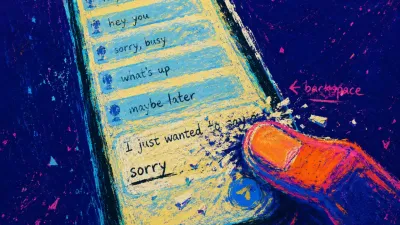
Maya (name changed for privacy) sat across from me in my coffee-warmed reading room and described the previous evening. At 8:47 p.m., she had been riding TTC Line 1 home from downtown while fluorescent lights buzzed overhead and station announcements dissolved into the metallic rattle of the train. Her phone felt warm in her palm. She saw the person active on Instagram, opened their unanswered iMessage thread again, and felt her shoulders rise toward her ears.
“I wanted to put the phone away,” she told me, rubbing her thumb against the edge of her cup. “But I kept thinking one more look might tell me whether this is still alive. If I stop reaching out, will there be anything left?”
At work, Maya could turn messy ideas into polished copy before a deadline. In this connection, she drafted a follow-up, deleted “I feel confused,” replaced it with “no pressure at all,” and added a laughing emoji so her need for consistency would not look like a need. Her question was painfully direct: “Why do I keep chasing someone whose readiness doesn’t match mine?”
I could see the longing in her body before she named it. It was like standing inside a closing subway door with one arm stretched toward the platform—her chest held tight, her hands restless, her whole nervous system convinced that relaxing its grip might make the connection disappear. Anxiety moved underneath it like the buzz of those train lights; frustration clenched her jaw; hope kept her thumb returning to the thread.
“Wanting mutual readiness is not the problem,” I told her. “Making your effort responsible for creating it is what keeps you stuck. A warm exchange and demonstrated reciprocity are not the same thing, and we do not have to shame the first in order to examine the second.”
I also made our purpose clear. I would not use tarot to announce what the other person secretly felt, predict whether they would become ready, or make a relationship decision for Maya. I would use it as an objective recognition tool—a way to place the pattern on the table, separate observable behavior from imagined potential, and find the point where her choices could become her own again.
“Let’s make a map of the fog,” I said. “Not so the cards can own the answer, but so you can see where your own ground begins.”
Choosing the Bridge Through Mixed Signals
I invited Maya to put both feet on the floor, take one unforced breath, and hold the question without rehearsing the next message. I shuffled slowly. The small ritual was not about summoning certainty; it was a deliberate transition from reacting to observing.
I chose the Relationship Spread · Context Edition, a six-card relationship tarot spread designed for mismatched readiness, mixed signals, unequal effort, and boundary confusion. For readers wondering how tarot works in a situation like this, the value lies in structure: each card answers a distinct question, so longing, evidence, fear, and choice do not remain tangled in one emotionally overloaded thought.
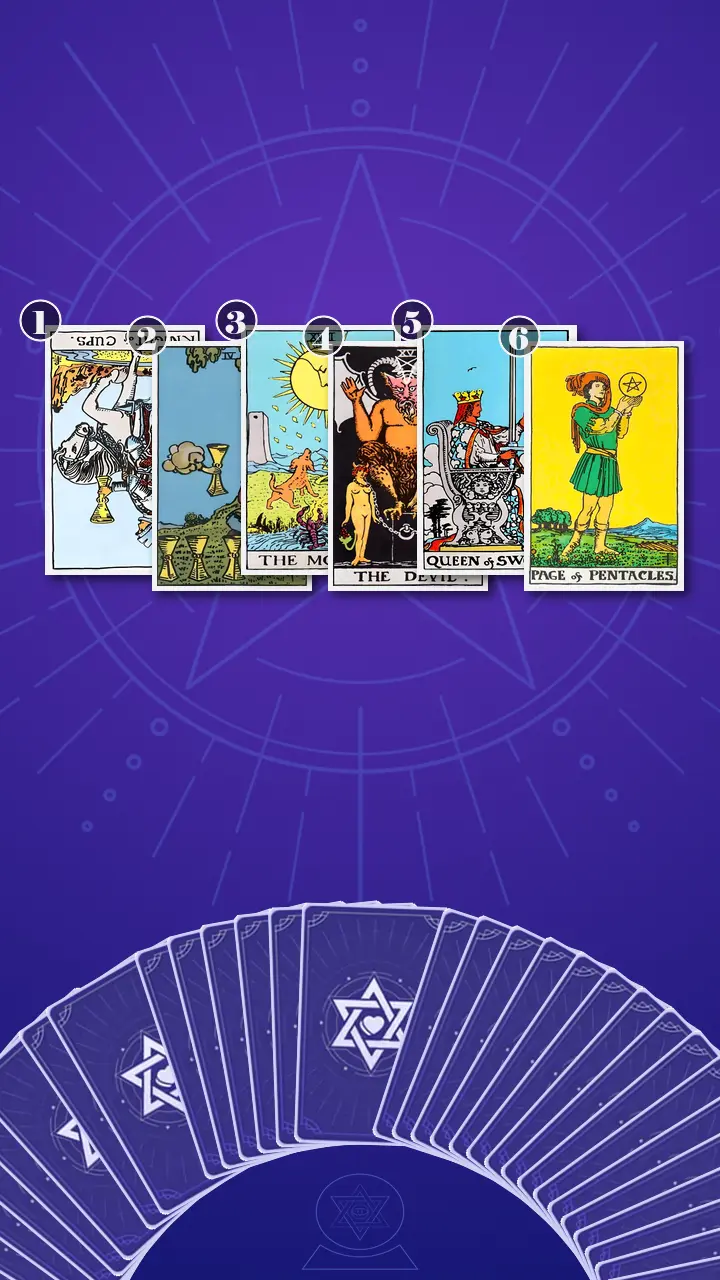
I placed six cards in a horizontal line. The first would show Maya’s present stance and how she was participating in the pursuit. The second would describe only the other person’s visible level of engagement—not their unspoken motives. The third and fourth, set slightly closer together, would expose the relational knot between ambiguity and attachment. The fifth would reveal the clarifying boundary, and the sixth would anchor one self-directed next step.
The layout looked like a bridge: water and uncertainty on the left, a compressed knot in the middle, then a clearing point leading toward solid ground. Its final position was intentionally not “the fate of the relationship.” I wanted the reading to return agency to Maya rather than make her wait for another verdict from outside herself.
Reading the Map from Pursuit to Attachment
Position 1: The Message Carried Across the City
“The card now opening represents your present stance—how you are participating in the pursuit,” I said. I turned over the Knight of Cups, reversed.
I pointed to the knight carrying a single cup beside the river. Even reversed, the feeling in that cup was sincere. The problem was not that Maya cared too much or wanted too much. The problem was that the cup had become attached to an imagined emotional future, while the slow horse beneath the knight remained in almost the same place.
I connected the image to the behavior Maya had already described. After a warm date or voice note, she built the next message around the relationship she hoped to have. She softened every need so it would not sound demanding, carried the message across the city, and treated sending it as forward movement even when the other person’s demonstrated pace had not changed.
“In energy terms, this is an excess of romantic pursuit combined with a blockage in reality-checking,” I explained. “Your emotional intention keeps moving, but it is moving ahead of reciprocal evidence. The intensity of your offer starts feeling like proof that the connection should progress.”
I asked her, “When you send the next low-pressure message, what are you hoping it will create—contact, clarity, reassurance, or proof that the possibility is still alive?”
Maya did not nod politely. She let out a short, bitter laugh, pressed her lips together, and looked down at the card. “That’s so accurate it feels a little brutal,” she said. “I tell myself I’m just being open. But I’m also trying to move the whole thing without admitting that I’m moving it.”
“Then we will keep the distinction precise,” I replied. “The card is not criticizing your openness. It is showing where openness turns into unpaid emotional project management. Abruptly pretending not to care would only be another performance. We are looking for grounded reciprocity, not strategic indifference.”
Position 2: The Cup That Is Not Being Picked Up
“The next card represents the other person’s visible stance—what you can honestly observe about the readiness mismatch without claiming access to their private feelings,” I said. I revealed the Four of Cups, upright.
The seated figure’s crossed arms and the unaccepted fourth cup gave us a simple visual language for limited engagement. Maya had received warm interactions, followed by vague answers, delayed replies, and no concrete plan. She could also see the person active elsewhere online. None of that proved what they felt internally, but it did show what they were currently developing—and what they were not.
I described the card as a deficiency of visible participation relative to Maya’s level of investment. The offered cup might represent an opening, an invitation, or the possibility Maya kept presenting. The crossed posture did not authorize me to diagnose avoidance, secret feelings, or malicious intent. It asked a more ethical and useful question: was the available interaction enough for the amount of emotional energy Maya was placing around it?
“Looking only at the last three interactions,” I said, “what did they concretely offer in time, communication, planning, and follow-through?”
Maya counted on her fingers. One warm voice note. One “Yeah, would be nice sometime.” Two invitations initiated by her. No day, time, or place.
I let the silence sit for a moment before saying, “A warm moment can be real without being a promise. You do not have to erase the warmth. You only have to stop asking it to carry more meaning than the follow-through supports.”
Her hand flattened on the table. I watched a little tension leave her fingers, though her mouth tightened with the sadness of hearing the difference stated aloud.
Position 3: The Moonlit Gap Between a Reply and a Story
“The third card represents the relational field—how longing, ambiguity, and unequal readiness are interacting between you,” I said. I turned over The Moon, upright.
The winding path between two towers immediately changed the atmosphere of the spread. I showed Maya the dog and wolf facing the same moon from different instincts, and the crayfish emerging from dark water. Every reaction in the image was real, but moonlight was still partial light. Feeling something strongly did not establish what the other person was ready to offer.
I asked Maya to return to the 10:56 p.m. apartment scene she had mentioned: city noise thinning outside, the radiator clicking, pale screen light across the room, and the reply “Yeah, would be nice sometime” still open. The person was active on Instagram. Maya had reread the punctuation, checked their Story, and begun composing a message that would test the connection without directly requesting clarity.
“The Moon shows an excess of meaning being generated from incomplete information,” I said. “Not because your intuition is worthless, but because longing and fear can both become aggressive autocomplete. It is like an algorithmic feed filling every blank with the version of the story you are most afraid—or most hopeful—to see.”
I gave her a three-line framework: “This is what happened. This is what I fear it means. This is what I hope it could mean.”
The first line was short: they sent a warm but vague reply. The second expanded into rejection: they were losing interest and Maya had failed to keep the connection easy. The third expanded toward imagined closeness: they were overwhelmed now but might soon become available if she stayed patient enough.
“The winding path is the space between those sentences,” I explained. “The facts, the fear, and the hope all deserve acknowledgment, but they do not deserve equal authority over your next action.”
Maya’s breath caught first. Then her eyes lost focus as if she were replaying several late-night conversations at once. Finally, she released a low exhale and placed her phone farther from her elbow. “I keep calling it intuition,” she said, “but sometimes it’s a full project brief built from one punctuation mark.”
I nodded. “And noticing that does not make you foolish. It gives you a pause. The Moon is not asking you to distrust yourself; it is asking you to distinguish an internal signal from external confirmation.”
Position 4: The Notification Loop with a Loose Chain
“The fourth card represents the attachment loop—the fear and behavior keeping the pursuit active after you have already noticed the mismatch,” I said. I revealed The Devil, upright.
I kept my finger near the loose chains around the figures’ necks rather than turning the Devil into an external villain. This card did not mean the other person was toxic, and it did not define Maya as compulsive or broken. It showed a blockage created when uncertainty recruited a repeating behavior to provide brief relief.
Maya knew the sequence. She promised herself she would stop checking. Five minutes later, she reopened the chat because the next message seemed capable of making the uncertainty disappear. A warm reply loosened her chest for a moment. Then she began interpreting the warmth, waiting for the next gap, and checking harder. The larger question remained untouched.
This was where I used a lens I call Daily Friction Deconstruction. Instead of making dramatic accusations about the relationship or Maya’s character, I stripped the loop down to its ordinary mechanics: a vague reply was the trigger; checking or sending a softened follow-up was the action; a few minutes of relief was the reward; and a slower evening, weaker boundary, and reduced self-trust were the cost.
That mundane sequence mattered. Over twenty years of readings, I have watched people expect The Devil to arrive as a cinematic disaster. I often find it somewhere smaller: a thumb reopening the same chat while coffee goes cold, a Friday left empty for a plan that does not exist, or a shower postponed so someone can remain instantly available. The chain can feel enormous precisely because it is made from tiny repeated movements.
“What do you fear would happen if you did not check or send another message tonight?” I asked.
Maya went still, then folded one hand over the other. “I think I’d have to feel that they might not choose me,” she said. “I know the checking makes me feel worse, but the next message always looks like it might make me feel better.”
“That is the choice point,” I said. “You are not only chasing the person. Part of you is chasing a few minutes of not feeling abandoned. That part deserves compassion, but it does not need control of your phone, your calendar, or your standards.”
I shifted my hand toward the fifth card. “A boundary is not a punishment; it is the point where you stop carrying both sides of the exchange.”
When the Queen of Swords Drew a Clean Line
Position 5: Evidence on One Side, Hope on the Other
The radiator clicked once as I reached for the next card, echoing the sound Maya had described from her apartment. Outside the window, a break in the cloud laid a narrow line of winter light across the table. The cups, moon, and chain seemed to recede around that one clean edge.
“This card represents the clarifying boundary—the distinction or inner standard that can interrupt the chase and restore self-trust,” I said. I turned over the Queen of Swords, upright.
I showed Maya the Queen’s upright sword and her open hand. The sword was discernment; the hand was humane communication. Together, they held balanced air energy: direct without cruelty, receptive without abandoning standards, and clear without pretending that longing had vanished.
I could see the familiar problem still bracing inside Maya: if she named a standard, she might lose the connection; if she kept adapting, she might lose more of her own evenings. She was still trying to solve uncertainty with better wording.
I asked her to picture herself in the Notes app on a Thursday evening, writing two columns. In the first, she would record what had happened: one warm date, two vague replies, three invitations initiated by her, and no specific next plan. In the second, she would record what she imagined could happen: perhaps they were stressed, afraid, overwhelmed, or about to become more available.
This was my second diagnostic lens, Emotional Clutter Sorting. I separated actual evidence from plausible explanations, external life pressure, and the future Maya hoped for. The exercise did not declare the relationship impossible, nor did it prove incompatibility. It simply prevented every possible explanation from being piled on top of the observable mismatch until the mismatch disappeared from view.
“The Queen does not forbid hope,” I said. “She gives hope its own container so it cannot impersonate evidence. She is the edit that removes both the apology and the hidden test from your message, leaving only what you mean.”
You do not need to keep proving your devotion to make someone ready; choose clear boundaries and let the Queen of Swords' clean blade separate evidence from hope.
I stopped speaking. For one beat, Maya did not exhale. Her right thumb froze against the cup, and her pupils widened as if the sentence had arrived louder than my voice. Then her gaze slipped past the cards and settled on nothing in particular. Her eyes shone, but her jaw hardened before her shoulders could relax.
“But doesn’t that mean I’ve been wrong this whole time?” she asked, the words sharper than anything she had said before. Her fingers curled into her palm, loosened, and curled again. Then the anger thinned into a trembling breath. Her shoulders finally dropped, but the release left her looking briefly unsteady—the way someone can feel lightheaded after setting down a bag they have carried so long that its weight became part of their balance.
I did not rush to replace that vulnerability with a cheerful conclusion. “No,” I said. “It means you used a strategy that once helped you feel less powerless. You tried to preserve belonging through careful communication and patience. Now you can see the cost more clearly. New information does not put your past self on trial; it gives your present self more choices.”
I leaned closer to the spread. “The mismatch is information, not a challenge to prove your worth. You can stay open to connection while matching the investment that is actually being shown. The next clear move is not a better performance of patience; it is one choice that keeps you on your own side of the boundary.”
Then I invited her into the reinforcement the Queen was asking for: “Now, with this new perspective, think back—was there a moment last week when this insight could have made you feel different?”
Maya remembered keeping Friday evening open after receiving no actual invitation. A friend had asked her to dinner, and she had replied, “I might be busy later,” even though the only plan was a possibility inside her head.
“If I’d treated the mismatch as information,” she said slowly, “I could have gone to dinner without using it as a statement about whether I cared. I could have let their availability be what it was and still chosen my own evening.”
I offered a ten-minute version of the Queen’s practice. She could write two short columns titled What Happened and What I Added, list three observable actions and three interpretations, then place the phone face down until the timer ended. She could use the remaining minutes for water, a shower, a snack, or one small task belonging entirely to her. If the exercise felt too activating, she could stop after one fact and one feeling. The choice to continue would remain hers.
I named the shift plainly. This was not a leap from caring to indifference. It was one step from longing-driven hypervigilance toward evidence-based discernment, grounded self-respect, and a willingness to let reciprocity—not fear—shape her level of investment.
Position 6: One Pentacle, One Hour, One Life Still Growing
“The final card represents your self-directed next step—one small action that returns attention to your life without making a decision for the other person,” I said. I revealed the Page of Pentacles, upright.
The Page studied one pentacle with steady attention while tilled fields and distant mountains waited in the background. I read this as balanced earth energy: practical, teachable, modest, and sustainable. After the Queen created a clear line, the Page showed Maya how to give that clarity a daily form.
In modern terms, the card looked like Maya putting the phone down after setting a communication limit and giving one hour to something with value regardless of the reply: updating her portfolio, meeting a friend, cooking a meal, walking through High Park, or learning a skill connected to her communications work. The action was not meant to perform indifference or provoke pursuit. It was an investment in a life she could directly cultivate.
“Before you send another message,” I asked, “what small plan could you make that would still matter if they did not reply tonight?”
Maya looked toward the far end of the line rather than back at the Moon. She chose a portfolio case study she had postponed twice and a dinner invitation she could still accept. Her hand rested open beside the Page.
I noticed that no Wands had appeared in the spread. I told her I found that reassuring. The next step did not need to be a dramatic confrontation, a sudden block, or a performance of being completely over it. The spread moved from water-heavy longing, through the Queen’s clear air, and finally into the Page’s earth. It asked for quieter movement.
“You do not have to stop caring to stop outsourcing your evening to a maybe,” I said.
Turning Tarot Insight into a Boundary You Can Keep
I laid the story of the six cards out for Maya one final time. The Knight showed sincere feeling stretched into repeated pursuit. The Four of Cups showed visible hesitation without pretending to know the other person’s inner world. The Moon revealed how incomplete information became a private research project. The Devil exposed the checking-and-pursuit cycle that offered brief relief while eroding trust in her own perceptions. The Queen separated evidence from potential, and the Page redirected one unit of attention toward something Maya could actually grow.
The deeper pattern also made sense beside Maya’s work life. Responsiveness, careful wording, and emotional flexibility helped her succeed in communications. Her old personal algorithm had learned that better copy and one more thoughtful follow-up could move a stalled project. But a relationship is not a client workflow. A perfect subject line cannot create capacity that another person has not offered, and refreshing the status page does not move the deadline.
I identified the cognitive blind spot gently: Maya had been treating the intensity and quality of her own effort as a substitute for mutual participation. She kept knocking on a closed door and interpreted harder knocking as progress. The transformation was not “stop wanting the door to open.” It was “stop using the volume of the knocking as evidence that someone inside is ready.”
Her direction was therefore specific: name the mismatch, match the level of investment actually shown, and make one self-directed choice before reinitiating. She did not need to decide the entire future of the connection during our session. She only needed next steps small enough to test, reverse, and learn from.
The Evidence, Boundary, and Attention Reset
- Run the Evidence, Not Potential Check. Before sending any new message, open a note and record the last three observable acts of reciprocity: who initiated, whether a plan became specific, and whether follow-through happened. Then write one honest sentence about the pace you can participate in, such as: “I’m interested in getting to know you, and I do best with communication that has some consistency.” Keep it in your notes for ten minutes before deciding whether to send it. Tip: record actions only; place explanations and interpretations in a separate column. Writing the sentence does not obligate you to send it.
- Use the 24-Hour Micro-Boundary Reset. For the next twenty-four hours, choose one non-negotiable physical or time boundary in your own space. Maya chose 8:00–9:00 p.m.: the thread would be muted and her phone would charge face down in the kitchen while she used the living room for herself. The boundary governs where her attention goes; it does not control whether or when the other person replies. Tip: if an hour feels impossible, begin with thirty minutes and set a timer. Keep essential safety or work notifications on, and end the experiment whenever you need to.
- Book One Page of Pentacles Appointment. Put one sixty-minute block in Google Calendar this week for a portfolio update, class, gym session, walk, meal, or friend. Choose something you would still value if the person never replied that evening, and give it a clear finish line. Tip: use the ten-minute version if an hour feels too large. One completed checkbox is enough; this is self-investment, not a performance of detachment.
I reminded Maya that these were experiments, not moral tests. If pausing made her chest tighten, that did not prove the boundary was wrong; it showed where the old loop expected immediate relief. She could take five slow breaths, put both feet on the floor, name one fact and one feeling, and decide again. Her consent remained active at every stage.
Most importantly, no card instructed her to accept less than she wanted, force a confrontation, or wait indefinitely. The reading gave her actionable advice about her own participation. The other person retained responsibility for their readiness; Maya regained responsibility for her time, language, attention, and standards.

A Week Later: Ownership, Not Certainty
Six days later, I received a short message from Maya. She had completed the ten-minute evidence check, muted the thread for an evening, accepted dinner with her friend, and spent forty-five minutes finishing the opening slide of her portfolio case study. She had not solved the relationship. She had stopped making her entire evening wait for it.
She slept through the night. In the morning, her first thought was, “What if I got this wrong?” She smiled, made coffee, and opened her portfolio instead of the chat.
I held that small change as the real proof of our Journey to Clarity. The cards had not made Maya powerful, because her power had never belonged to them. They had helped her see the mechanics of the chase, hear the standard she had been editing out, and make one decision from her own side of the boundary.
I do not believe clarity always arrives as certainty about another person. Sometimes it arrives as a phone cooling on the kitchen counter while your own evening becomes visible again. If you are holding your phone warm in your hand tonight, chest tight against another vague reply, I want you to remember this: protecting a connection should not require you to disappear from your own needs first.
So I will leave you with the question I left beside Maya’s six cards: if you let the connection be exactly as available as it has shown itself to be, which small square of your own calendar—one evening, one hour, or even ten minutes—are you curious enough to choose back?