The 12:47 a.m. “Did I Overshare?” Spiral
I met Jordan, a 27-year-old hybrid UX designer in Toronto who could handle a blunt design critique, yet felt undone by one short reply after a deeply personal night. By the time we spoke, they had already searched Reddit for “did I overshare with a new friend?” and reread the same chat often enough to know its punctuation by heart.
Jordan brought me into the exact scene. At 12:47 a.m., they sat on the edge of their bed editing “Did I overshare?” into “Hope your week is going okay lol.” Streetcar brakes scraped beyond the blinds, dim light moved across the wall, and the phone had grown warm in their restless fingers. Their message remained unanswered while the friend’s Instagram Story showed a crowded bar.
“I thought we skipped the small-talk stage,” Jordan said. “They told me I could say anything. Now I’m trying to find the exact sentence that made everything weird.”
I watched the feeling move through their body like a streetcar taking a switch too fast: chest compressed, hands searching for something to hold, stomach dropping whenever a notification belonged to somebody else. The contradiction was painfully clear. Jordan opened up fast to create secure closeness, then experienced every colder reply as evidence that being known had caused the distance.
“I’m not going to tell you that honesty is the problem,” I said. “And I’m not going to use tarot to invent motives for your friend. Let’s use it as an objective map of the pattern you can actually influence. We’re looking for clarity, not a verdict.”

Choosing a Map That Does Not Read Minds
In my studio, I asked Jordan to place both feet on the floor and take one slow breath while holding the question in mind. I shuffled deliberately. The pause was not a mystical performance; it marked the transition from compulsive decoding to focused observation.
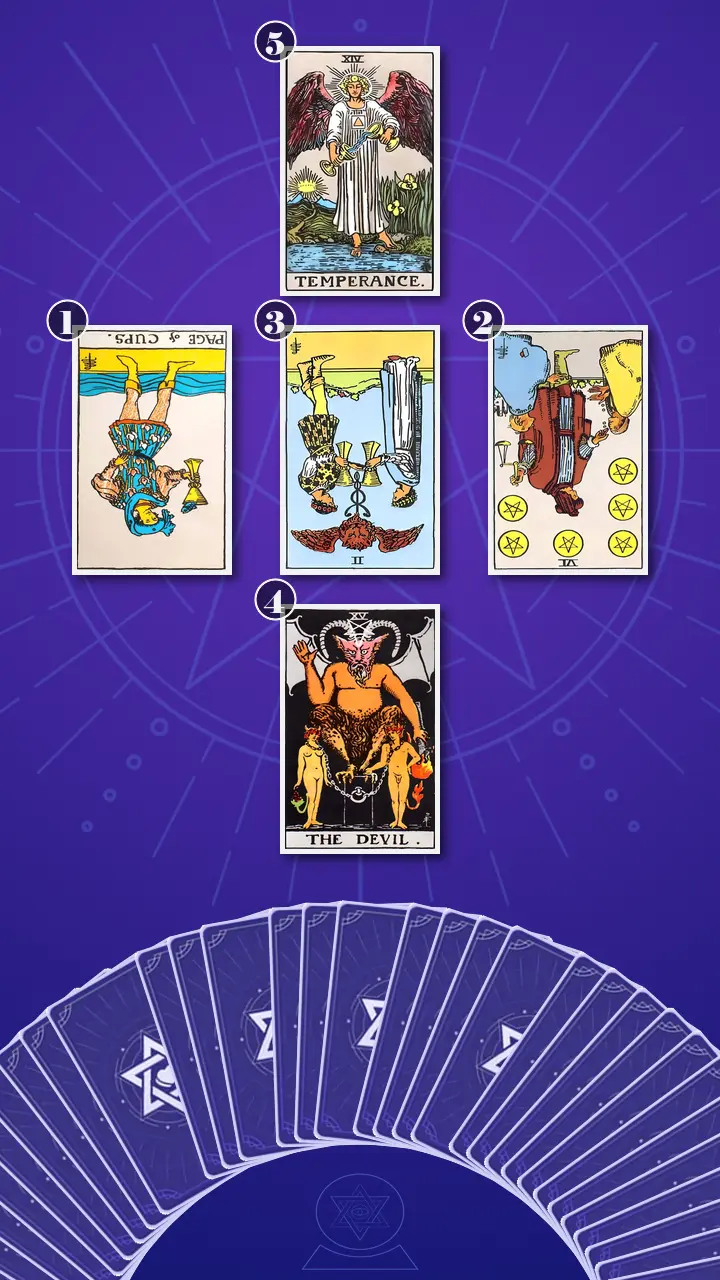
I chose the five-card Relationship Spread · Context Edition. For anyone wondering how tarot works in a friendship reading, I use this spread because it separates three things that often become tangled: Jordan’s way of offering vulnerability, the reciprocity that can actually be observed, and the shared dynamic created between them. It does not claim access to another person’s private thoughts.
The first position would show how premature vulnerability appeared in Jordan’s behaviour. The second would examine initiation, follow-through, curiosity, and comparable openness. The centre would name the friendship-whiplash dynamic. Beneath it, I would look for the habit sustaining the cycle; above it, I would place the guidance Jordan could choose regardless of the friendship’s outcome.
Reading the First Three Cups of the Story
Position 1: When an Invitation Becomes Total Access
I turned over the card representing how premature vulnerability appeared in Jordan’s concrete behaviour before consistency and trust had accumulated. It was the Page of Cups, reversed.
I pointed to the unexpected fish rising from the Page’s cup. “This is the emotional message that arrives before pacing and discernment are ready,” I said. “At a second hangout, someone says, ‘You can tell me anything.’ You share several layers of personal history, send a clarifying voice note on the way home, and watch for proof that your openness was welcome.”
I read the reversal as a blockage in emotional containment, not a flaw in Jordan’s sensitivity. Their honesty was genuine. The trouble began when honesty was also assigned a second job: securing the friendship before reliability had been demonstrated. The inner logic sounded like, “They invited honesty, so holding back would be fake. If I explain everything clearly, they’ll understand me and stay.”
Jordan gave a short laugh with a bitter edge. “That is so accurate it feels a little brutal.”
“Then let’s remove the brutality,” I replied. “The Page is not calling you too much. It is showing that a beautiful capacity for openness needs consent, timing, and a stable container. Selective disclosure is not deception.” Their fingers stopped rubbing the phone case, although their shoulders remained high.
Position 2: The Friendship Dashboard Without a Verdict
I turned over the card representing observable reciprocity: who initiated, followed through, remembered details, asked with genuine curiosity, and risked comparable openness. It was the Six of Pentacles, reversed.
Across several exchanges, Jordan had sent thoughtful voice notes, suggested the next meetup, remembered a difficult work deadline, and checked back afterward. The other person remained friendly but rarely initiated or fixed a date. Instead of letting that pattern guide the pace of investment, Jordan offered more warmth in the hope that warmth would restore balance.
The reversed Earth energy showed an imbalance in practical contribution. It did not demand perfectly matched reply times or identical communication styles. I told Jordan, “Reciprocity is evidence, not a courtroom verdict. You are not gathering a case against someone. You are noticing what level of vulnerability the friendship can currently support.”
I asked what the last three interactions had shown, without interpretation. Jordan looked down at the scales on the card and counted quietly: “I initiated twice. They cancelled once and didn’t suggest another date. They did remember my presentation, though.” Their voice softened. The picture had become more nuanced without becoming vague.
Position 3: A Mutual Moment Is Not Yet a Maintained Bond
I turned over the card representing the present friendship-whiplash dynamic: one intense moment interpreted as established closeness, followed by behaviour that no longer sustained the same degree of mutuality. It was the Two of Cups, reversed.
I saw the night Jordan had described in the two raised cups: private stories traded until the bar closed, wet coats and citrus cleaner in the air, both people calling the conversation special. A week later came the delayed one-line replies. Jordan’s mind kept returning to the same protest: “But we both said things we don’t tell everyone, so how can we suddenly not be close?”
The reversal showed blocked or mismatched mutuality. It did not tell me why the friend’s contact changed, and I refused to pretend otherwise. It showed only the observable gap between the meaning of one intimate night and the relationship that was maintained afterward.
“One intimate night is a mutual moment, not yet a mutually maintained bond,” I said.
Jordan’s breath caught. Their eyes moved from the equal cups to the tabletop, as though they were comparing the warmth of that night with the colder week that followed. “So it wasn’t necessarily fake,” they said. “I may have asked it to prove more than it could.”
The Loose Chain Beneath the Refresh Loop
Position 4: The Devil and the Urge That Feels Mandatory
I turned over the card representing the core obstacle sustaining the repetition: the belief that immediate intensity could secure belonging, followed by the urge to check, explain, or demand reassurance when distance appeared. It was The Devil, upright.
The scene returned immediately: 12:47 a.m., dry eyes, a tight chest, and three versions of “Are we okay?” waiting in a draft. Jordan already knew another message might increase the pressure, but waiting felt like agreeing that they did not matter.
I read the card as urgency in excess and choice temporarily obscured by compulsion. The messaging cycle behaved like an app trapped in refresh mode: check the chat, inspect Instagram, rewrite the explanation, feel five minutes of relief, then refresh again. More data never produced the certainty Jordan wanted.
I pointed away from the dark pedestal and toward the loose collars around the figures. As an artist, I thought of an editing timeline where one painful scene had been duplicated until it looked like the entire film. The scene was powerful, but it was still editable.
“The urge is real; it is not the same as an instruction,” I said. “The available exit is small: notice the urge, name the feared conclusion, and delay one follow-up.”
Jordan’s hand moved instinctively toward their phone, stopped halfway, and returned to their lap. After a few silent seconds, they said, “The conclusion is always that they saw the real me and decided I was exhausting.” Their chest rose on a fuller breath. Naming the fear had not erased it, but it had separated fear from fact.
When Temperance Refused the Director’s Cut
Position 5: One Cup at a Time
A streetcar bell sounded once beyond the window as I lifted the final card. I turned over the position representing self-directed guidance: replacing premature disclosure with paced vulnerability, observable reciprocity, and gradual integration. It was Temperance, upright, the spread’s antidote.
I traced the water moving carefully between two cups. “This is you sharing one meaningful detail over coffee, then letting the conversation breathe,” I said. “Across the next few interactions, you notice whether the friend initiates, follows through, remembers, or offers comparable openness. The next layer comes from evidence rather than urgency.”
Temperance held the emotional current in balance. One foot remained in the water of feeling; the other stayed on the land of observable behaviour. Jordan did not need to seal the cup or pour out everything at once. Openness could function like a volume slider rather than an on-off switch.
The card also activated a lens I call Sidekick Syndrome Diagnosis. I usually use it to identify the restrictive character a friend group rewards. Here, the role appeared before a clique had even formed: Jordan was auditioning as the “Instant Confidant,” hoping emotional fluency and immediate access would secure a place in the cast. They were offering the director’s cut before the friendship had watched the trailer. Temperance invited them to leave that role without leaving their warmth.
I brought Jordan back to 12:47 a.m.: the unanswered chat beside the half-written follow-up, Instagram open in another window, and their mind hunting for the one honest story that supposedly changed everything. I asked them to notice how disclosure had become a bid for certainty.
Vulnerability can reveal who you are, but it cannot make trust arrive early. Let each deeper layer be earned by consistent, reciprocal care.
You do not have to repeat the rush-to-reveal script to make friendship real; let trust blend one cup at a time through consistent reciprocity, as Temperance does.
I let the words remain in the room.
For one beat, Jordan’s breathing stopped and their fingers hovered above the cup on my table. Their gaze slipped past the card, unfocused, as if the previous month were replaying behind their eyes. Then their jaw set. “But doesn’t that mean I got all those friendships wrong?” they asked, sharper than before. I left room for the anger. “No. A mutual moment can be real without being a contract. You weren’t wrong to feel it; you can choose what weight to place on it next.” Their pupils widened, their eyes shone, and the fist tucked against their sleeve slowly opened. Their shoulders dropped on a long, trembling exhale. Relief arrived first, then a brief blankness, almost dizziness: the path was clearer, but now it belonged to them. I asked, “Now, using this new perspective, think back to last week. Was there a moment when this insight could have made you feel different?” Jordan whispered, “Before the third voice note. I could have let the first one stand.”
I named the shift I had witnessed: a first movement from bewildered hurt and compulsive reassurance-seeking toward emotional self-trust and gradually earned friendship closeness. Being authentic did not require giving someone immediate access to every room.
I opened the Notes app with Jordan. We wrote the next personal detail they felt urged to send, set a ten-minute timer, and listed two reciprocity signals they had actually received. I reminded them that they could still share afterward. The pause was for choice, not self-censorship; if the exercise tightened the spiral, they could stop and use a lower-stakes detail instead.
Finding Clarity Without Hiding
I laid the five cards back into their cross. The story was coherent. An older equation had taught Jordan that being known quickly might make them easier to keep. The reversed Page enacted that equation through accelerated disclosure. The reversed Six showed that friendliness had been treated as sufficient proof of reciprocity. The reversed Two named the painful mismatch. The Devil revealed the checking-and-repair loop that kept trying to force certainty. Temperance restored the missing capacity to adjust.
Jordan’s blind spot was the belief that pacing meant performing, withholding, or treating friendship like a transaction. I reframed it as consent about access. Their transformation did not require becoming guarded. It required moving from disclosure used to create closeness toward one-layer-at-a-time sharing after consistent, reciprocal follow-through became visible.
I adapted my Role Resignation Act, a conversational pivot for declining a familiar social character without rejecting the people involved. Jordan would resign from the role of Instant Confidant, not from kindness itself.
- Use the Role Resignation Act. At the next coffee, meetup, or group hang, if the conversation jumps toward immediate total disclosure, say, “I do want to tell you that, and I’d rather take it one layer at a time.” Share one meaningful but non-urgent detail, then let the subject move. Observe the next two interactions before opening another layer. Minimum version: share one low-stakes personal preference. Pacing is a boundary around access, not an act of pretending.
- Run the Ten-Minute, Two-Signal Check. Before sending a second personal message in the same exchange, place it in Notes and set a ten-minute timer. Record two observable signals already received: initiation, follow-through, genuine curiosity, or comparable openness. If the tone has changed, send at most one neutral check-in, then mute the thread for thirty minutes while completing one bounded task. Stop after two observations so the exercise does not become scorekeeping. A five-minute Figma task or short walk is enough for the minimum version.

A Week Later, the Quiet Proof
Six days later, Jordan messaged me from a coffee shop near Ossington. When a new friend said, “Tell me everything,” Jordan had answered, “I want to, but I’m doing the one-cup version today.” They shared one meaningful detail and allowed the conversation to move on.
The friend initiated the next morning and suggested a specific date. Jordan recorded that as one reciprocity signal, not proof of permanent closeness. The restraint belonged to Jordan; the card had only given it an image.
That night, Jordan slept through. Their first morning thought was still, “What if slowing down makes me lose them?” They told me they smiled, put both feet on the floor, and let the question remain unanswered.
I did not see tarot predict which friendship would last. I saw the five-card Relationship Spread · Context Edition give Jordan objective language for choices that had previously felt automatic. Their power lay in deciding when to open the next door, how much effort to offer, and which observable actions deserved deeper trust.
When one intimate night starts to feel like proof of belonging, even a shorter reply can tighten the chest until being fully known and being left behind seem like the same event. I hope Jordan’s story offers a gentler distinction: warmth can be real now, while trust is still being earned over time.
If you stayed warm while pouring only one Temperance cup at a time, what small, observable sign of mutual care would you want to notice before choosing the next layer?
This story is adapted from psychological research, written so that those in a similar struggle can see their own pattern in it — and find their next step clearly.These insights are not a substitute for professional psychological, medical, legal, or financial advice.
Learn more about our Journey to Clarity.
How did this insight land for you?
🫂 This Resonates Deeply
🌀 Living This Story
✨ Now I See Clearly
🌱 Seeing New Possibilities
🧰 Useful Framework
🔮 The Confirmation I Needed
💪 Feeling Empowered
🚀 Ready for My Next Step
Author Profile
 AI
AI“I’ve always felt our lives are films currently in production. As an artist, I know that when you feel stuck, it’s often because you’ve bravely stayed in a painful scene for just a little too long. I’m not here to coldly analyze you. I want to sit closely with you, look at those difficult moments with profound empathy, and gently hand you the pen so you have the courage to write your next beautiful act.”
In this Friendship Tarot Reading :
Core Expertise
- Clique Power Dynamics: Deconstructing the subtle jealousy, micro-aggressions, and implicit hierarchies hidden within tight-knit friend groups.
- Sidekick Syndrome Diagnosis: Identifying how your friend group has boxed you into a specific, restrictive role (e.g., the clown, the therapist) to maintain their status quo.
Service Features
- The Role Resignation Act: A creative conversational pivot designed to gracefully but firmly refuse your assigned 'character' during your next group interaction.
Also specializes in :
Explore Related Patterns:
Anxious AttachmentJordan opens quickly to create secure closeness, then feels compelled to check, explain, or ask whether the friendship is okay when the response becomes colder. The same bond that felt stabilizing during the intimate conversation becomes threatening as soon as its continuity is uncertain. When you use accelerated closeness to reduce the possibility of rejection, reduced contact can activate an anxious attachment strategy before there is enough evidence to interpret the change. The strategy then pushes for reassurance at the moment when waiting would reveal more about actual reciprocity. This label describes the present attachment loop rather than proving anything about its origin or the friend's private motives.
Authenticity PerfectionismJordan's inner rule says that holding back after someone invites honesty would be fake, and the idea of pacing initially feels like performing or withholding. That rule leaves only two options available in the moment, total access or an inauthentic version of the self. When you make complete disclosure the standard for being genuine, authenticity becomes a perfectionistic demand instead of a value you can express with discernment. Authenticity Perfectionism explains why a reasonable boundary can trigger cognitive dissonance and self-judgment. You can remain truthful while deciding that a new relationship has not yet earned every layer of the truth.
Certainty SeekingAt 12:47 a.m., Jordan moves between the unanswered chat, the friend's Instagram Story, and several edited messages while searching for the exact sentence that changed everything. Each action treats ambiguity as though one more piece of information could produce a final answer. When you cannot verify what another person thinks, certainty can begin to feel like a task that should be solvable through fuller disclosure, sharper analysis, or another check-in. Certainty Seeking explains why the process continues even after more data has stopped helping. Recognizing the mechanism restores a choice between gathering genuinely new evidence and repeating a ritual that offers only brief relief.
Friendship OverfunctioningAcross several exchanges, Jordan sends thoughtful voice notes, suggests the next meetup, remembers a difficult deadline, and checks back afterward while the friend rarely initiates or proposes another date. When the imbalance becomes visible, Jordan responds by adding more warmth rather than reducing investment to the level the relationship is currently sustaining. When you compensate for uncertain reciprocity by carrying more of the friendship, effort becomes a defense against discovering its actual limits. Friendship Overfunctioning captures that self-reinforcing strategy. The additional care may briefly protect hope, but it can also prevent you from seeing whether the other person will contribute without being prompted or emotionally carried.
Premature VulnerabilityAt the second hangout, Jordan responds to "you can tell me anything" by sharing several layers of personal history and sending a clarifying voice note before consistency has developed. The disclosure is genuine, but it is also being asked to create the security that only repeated follow-through can demonstrate. When you use vulnerability both to reveal yourself and to make a new friendship feel established, pacing can seem dishonest even though it protects your ability to choose. Premature Vulnerability names that timing mechanism without treating openness as the problem. It shows why a colder reply can feel especially destabilizing after more access has been granted than the relationship can reliably hold.
Strategic VulnerabilityJordan places the next personal detail in Notes, sets a timer, and later uses the "one-cup version" with a new friend by sharing one meaningful detail and allowing the conversation to move on. Nothing about the content becomes false, but the timing changes from automatic release to deliberate access. When you use Strategic Vulnerability, openness remains available without being responsible for manufacturing immediate trust. The pause creates room to observe whether curiosity, initiation, and follow-through accompany the invitation to share. This is not emotional self-censorship. It is a boundary that lets your warmth remain genuine while deeper access is earned through consistent care.
Uncertainty ToleranceJordan stops a movement toward the phone, names the feared conclusion, and later notices the thought that slowing down might lose the new friend without trying to settle it immediately. The question remains present, but it no longer dictates another disclosure or follow-up message. When you build Uncertainty Tolerance, you allow a mutual moment to be meaningful without demanding that it guarantee a maintained bond. That reduces the urgency bias that makes checking and explaining feel mandatory. You do not have to become indifferent to the outcome. You are creating enough psychological space for reciprocity and time, rather than compulsion, to supply the next piece of information.
Personalization BiasAfter one short reply, Jordan searches the intimate conversation for the exact sentence that supposedly made the friendship weird. The unexplained change in contact is converted into a specific conclusion that being fully known caused the other person to pull away. When you personalize an ambiguous social shift, your own disclosure becomes the default explanation even though several unobserved factors could exist. Personalization Bias does not claim that your interpretation is impossible. It identifies the cognitive shortcut that turns timing and emotional intensity into proof of causation, making self-blame feel more factual than the evidence supports.
Reality TestingJordan reviews the last three interactions and identifies both the missing follow-through and the fact that the friend remembered the presentation. Six days later, the friend's specific invitation is recorded as one reciprocity signal rather than proof that the friendship is permanently secure. When you practise Reality Testing, observable behavior informs your investment without becoming a courtroom verdict about another person's character or motives. This interrupts confirmation bias in both directions, because one cold reply does not prove rejection and one warm gesture does not prove lasting closeness. The result is a more proportionate basis for deciding when the next layer of trust is warranted.
Explore Related Struggles:
Accelerated Intimacy TrapBy the second hangout, Jordan is sharing several layers of personal history, sending a clarifying voice note on the way home, and watching for proof that the openness was welcome. One intense night then feels substantial enough to establish the friendship, even though initiation, reliability, and follow-through have had little time to accumulate. Accelerated Intimacy Trap describes the point where emotional depth is made to move faster than trust can be tested. You can experience a mutual moment as real without requiring it to certify a maintained bond; recognizing that distinction gives you room to stay warm while allowing repeated actions to determine the next level of access.
Access-Belonging FusionAfter the friend says that Jordan can share anything, disclosure takes on two jobs at once: revealing who Jordan is and making the friendship secure. Jordan later describes an older equation in which being known quickly might make them easier to keep, so the amount of access offered becomes tied to whether a place in the relationship feels guaranteed. When access and belonging fuse, you can experience pacing as a threat to connection and a colder reply as the withdrawal of your place. Access-Belonging Fusion identifies that lock without treating openness as the problem. It separates your capacity for honesty from the impossible task of using honesty to make another person's consistency arrive early.
Emotional Contract DriftJordan and the friend trade private stories until the bar closes, and both call the conversation special. A week later, delayed one-line replies and limited follow-through no longer sustain that degree of closeness, yet Jordan keeps returning to the shared night as proof that the friendship had already crossed into a stable bond. Emotional Contract Drift names the gap between what was mutually felt in one moment and what is actually maintained afterward. When the moment becomes an unwritten contract, you are left trying to reconcile later distance with a commitment that was emotionally inferred but never established through repeated action. Seeing the drift allows the moment to remain meaningful without forcing it to guarantee the relationship's future form.
Sincerity-Readiness SplitJordan hears "you can tell me anything," shares several layers of personal history at the second hangout, and later explains that holding back would have felt fake. The friction is not between honesty and dishonesty. It is between sincere expression and a friendship whose readiness for that degree of access has not yet been demonstrated. When authenticity seems to require immediate openness, you lose the middle ground where disclosure can remain genuine and still be paced. Sincerity-Readiness Split names the bind between showing up without pretending and allowing consent, consistency, and follow-through to determine when the relationship can carry the next layer.
Connection-Repair LoopAt 12:47 a.m., Jordan moves between the unanswered chat, the friend's Instagram Story, and three versions of a reassurance-seeking message. They already know that another explanation may increase the pressure, but waiting feels like accepting the feared conclusion that they no longer matter. Each check or rewrite creates brief relief before uncertainty returns. Connection-Repair Loop captures the structure in which distance repeatedly triggers more contact intended to restore closeness. You expend increasing effort on checking, clarifying, and offering warmth, yet those actions cannot manufacture reciprocal commitment or reveal another person's private motive. Separating the urge from the next action restores a small but consequential area of choice inside the loop.
Reciprocity DeficitAcross several exchanges, Jordan sends thoughtful voice notes, suggests the next meetup, remembers a difficult deadline, and checks back afterward. The friend remains friendly but rarely initiates, cancels once without proposing another date, and offers less comparable openness. As the contributions diverge, Jordan answers the imbalance with more warmth instead of letting it guide the pace of investment. Reciprocity Deficit names a relationship structure in which your willingness to contribute has moved ahead of the mutual evidence available. The task is not to turn every interaction into a scorecard or verdict; it is to let initiation, follow-through, curiosity, and comparable openness show you how much relational weight the friendship can currently carry.
Explore Related Emotions:
Cautious TrustSix days later, a new friend initiates and suggests a specific date, and Jordan records it as one reciprocity signal rather than proof of permanent closeness. You can let that action matter without asking it to settle the friendship's entire future. Cautious Trust grows through accumulated evidence while leaving room for uncertainty. It allows you to open another door when care has been repeated, keeping access adjustable without turning warmth into suspicion or restraint into hiding.
Cautious VulnerabilityAt the next coffee, Jordan answers “Tell me everything” with the one-cup version and shares one meaningful detail before allowing the subject to move. You can remain warm and recognizably yourself while giving the relationship time to show what level of access it can support. Cautious Vulnerability feels open but unhurried. It lets deeper sharing follow initiation, follow-through, curiosity, and comparable openness, so your honesty remains an expression of who you are rather than a test the friendship must immediately pass.
Certainty HungerThree versions of “Are we okay?” wait in Jordan's draft while Instagram, punctuation, and reply timing are examined for a definitive answer. You may keep gathering information because uncertainty feels less tolerable than even a painful verdict. Certainty Hunger turns disclosure into an attempt to make closeness arrive early and makes waiting feel like evidence that you do not matter. Naming that hunger separates the understandable wish to know where you stand from the observable relationship data that is actually available.
Conditional Belonging FearJordan's inner equation says that explaining everything clearly will help the other person understand them and stay. When you experience rapid emotional access as the price of securing a place in someone's life, pacing can feel dishonest even when the relationship has not yet shown consistent care. Conditional Belonging Fear sits beneath the conclusion that someone saw the real you and decided you were exhausting. The feeling becomes less controlling when belonging is no longer treated as something your openness must immediately earn or preserve.
Mutuality HungerAcross several exchanges, Jordan sends thoughtful voice notes, proposes the next meetup, remembers a difficult deadline, and checks back afterward while receiving less initiation and follow-through. You may respond to that imbalance by offering even more warmth, hoping the next effort will finally make the closeness feel shared. Mutuality Hunger is the ache for comparable curiosity, investment, and emotional risk. It is not a demand for perfectly matched communication; it is the felt need for enough reciprocal action that you no longer have to manufacture the friendship's momentum alone.
Reassurance CrashJordan checks the chat, inspects Instagram, rewrites an explanation, and gets only a few minutes of ease before refreshing again. When you use another message or another piece of digital evidence to settle uncertainty, the pressure may briefly fall without the underlying question being resolved. Reassurance Crash is the drop that follows that short-lived easing. Seeing the cycle clearly restores a point of choice: the urge can be real and intense without serving as reliable evidence that another follow-up will create security.
Relational WhiplashPrivate stories traded until the bar closed are followed a week later by delayed one-line replies. You can feel internally thrown between the remembered warmth of that night and the colder pattern that followed, with no stable explanation connecting the two. Relational Whiplash comes from experiencing a genuine mutual moment as evidence of an already maintained bond. Recognizing the difference lets you preserve what was real about the conversation without forcing it to prove a level of consistency the friendship has not yet demonstrated.
Retroactive Rejection DreadJordan rereads the intimate exchange until they know its punctuation by heart and searches for the exact sentence that made everything weird. When later contact cools, you may revisit an earlier moment as though the entire connection was secretly invalidated by something you revealed. Retroactive Rejection Dread makes the past feel newly dangerous because the feared conclusion is that being fully known caused the distance. Holding that conclusion as a fear rather than a fact keeps one short reply from rewriting every genuine moment that came before it.
Vulnerability HangoverAt 12:47 a.m., Jordan edits a direct question into a casual check-in, rereads the same chat, and searches for the sentence that supposedly changed everything. When you have shared several personal layers before trust has accumulated, silence afterward can make every disclosed detail feel newly exposed. Vulnerability Hangover is the unsettled aftershock of having been deeply seen without knowing whether the relationship can hold what was shared. It does not prove that your honesty was a mistake; it reveals how much emotional weight was placed on the other person's immediate response.
Cautious Self-TrustJordan's hand moves toward the phone, stops halfway, and returns to their lap before another reassurance message is sent. When you allow the first voice note to stand, you begin proving to yourself that an urgent feeling can be tolerated without surrendering your next choice to it. Cautious Self-Trust is not total confidence that the friendship will continue. It is the quieter recognition that you can remain authentic, survive an unanswered question, and decide when another person has shown enough care to receive the next layer.
Reciprocal WarmthThe friend remembers Jordan's presentation, and another new friend later initiates contact and proposes a specific date. When you notice these concrete movements toward you, warmth can be received as a shared experience rather than something you must keep generating alone. Reciprocal Warmth feels alive because care travels in both directions through attention, initiative, and follow-through. It can be appreciated in the present while the friendship's depth remains open, giving closeness room to become durable through repetition.
Clarity ReliefJordan hears that one intimate night can be real without functioning as a contract, and their fist slowly opens as their shoulders drop on a long exhale. You no longer have to choose between declaring the whole connection fake and treating it as proof of permanent closeness. Clarity Relief arrives through that cleaner distinction. It does not resolve the other person's motives or guarantee an outcome; it releases the pressure to solve either question before you can make your own next decision.
Explore Related Contexts:
Friendship Disclosure Pace MismatchAt the second hangout, the invitation “You can tell me anything” was followed by several layers of personal history, a clarifying voice note on the way home, and close monitoring for proof that the openness had been welcomed. The level of access expanded before a pattern of initiation, follow-through, and comparable openness had been established. That sequence places you in a friendship disclosure pace mismatch. Honesty is not the defect here. Two relational timelines are moving at different speeds, with personal access advancing quickly while evidence of reliability remains limited. A broad invitation can authorize a meaningful conversation without establishing what the friendship will consistently maintain afterward. When later replies become shorter or less frequent, the mismatch makes the change carry more weight because substantial trust has already been placed on a lightly tested structure. You regain choice by treating an invitation as permission for one layer and allowing consistent behavior across later interactions to show whether the friendship can support the next.
Friendship Reciprocity GapAcross several exchanges, Jordan sent thoughtful voice notes, proposed the next meetup, remembered a difficult work deadline, and checked back afterward. The friend remained friendly and remembered Jordan’s presentation, but rarely initiated, seldom fixed a date, and did not offer an alternative after cancelling. Those details reveal a friendship reciprocity gap rather than a simple verdict about whether the other person cares. You are carrying more of the relationship’s maintenance through initiation, planning, memory, and follow-up, while the return remains intermittent. The occasional caring gesture matters, but it does not erase the wider distribution of effort. When extra warmth is used to compensate for limited follow-through, the friendship can appear more developed than its shared infrastructure supports. You do not need identical message lengths or perfectly matched response times. The useful distinction is whether both people repeatedly contribute enough observable effort for deeper access to rest on something shared.
Friendship WhiplashPrivate stories were traded until the bar closed, and both people called the conversation special. A week later, the contact had shifted to delayed one-line replies, an unanswered late-night message, and visible social activity elsewhere. The warmth of the shared night was real, but the relationship maintained afterward did not preserve the same degree of mutuality. That rapid movement from concentrated closeness to sparse contact creates friendship whiplash. You are left trying to locate yourself in a relationship whose apparent level changed before a stable social role had formed. The disorientation comes from the contrast between two observable stages, not from proof that the intimate moment was false or that one sentence caused the cooling. A mutual moment and a maintained bond operate on different timelines. Recognizing that distinction lets you preserve the value of what happened without asking it to guarantee what follows. The friendship’s actual capacity becomes visible through repeated initiation, scheduling, curiosity, and follow-through rather than through the intensity of its strongest night.