Jordan Sent a Meme for Reassurance, Then Asked for a Contact Rhythm

When a Friend Texts Less at 11:48 p.m.
Jordan, a 27-year-old junior UX researcher living alone in Toronto, was trained to find patterns in messy evidence. At 11:48 p.m. on a Tuesday, I watched that skill turn against them as they reopened an unanswered iMessage for the sixth time.
A radiator clicked behind them. The blue-white chat lit their face while they scrolled back to compare the friend's latest punctuation with older, warmer messages. Their phone had gone warm in their palm. They typed “Everything okay?”, deleted it, and hovered over a meme that could restart the thread without admitting why they needed it restarted.
“I know one more text might look intense,” Jordan said, pressing a hand to the centre of their chest, “but the silence feels worse. I don't want to control them. I just want to know I still matter.”
That was the real conflict. Jordan wanted a secure connection while respecting a low-contact friend's freedom, but their body read less texting as the possible disappearance of their place in the friendship. The fear of disconnection felt like an elevator dropping one floor beneath their ribs and never quite landing. Their hands kept reaching for the phone as if the next refresh might stop the fall.
On hybrid workdays, the same unanswered chat sat beside Slack and a UX research synthesis board. Every notification pulled Jordan away from their work, even when it came from a colleague. “Maybe the shorter sentence means something,” they told me. “Maybe the full stop was cold. Maybe they saw it and decided not to answer.” They were running a complete research synthesis on one data point, then treating each hour without new data as stronger evidence.
After a decade of watching people move through emotional cycles, I do not treat every low tide as an ending. I also do not tell someone that a friendship is definitely fine when the available facts cannot support that claim. I told Jordan, “The alarm is real; the verdict is not yet written. I won't help you guess what your friend secretly feels, but I can help you separate what is happening from what the silence has come to mean. Let's make a map of the fog.”

Choosing a Map That Refuses to Mind-Read
I asked Jordan to place the phone beyond immediate reach, feel both feet on the floor, and take one ordinary breath. I shuffled slowly while they held a precise question in mind: “What am I afraid less texting proves about my place in this friendship?” The preparation was not a mystical performance. It was a transition from reacting to observing.
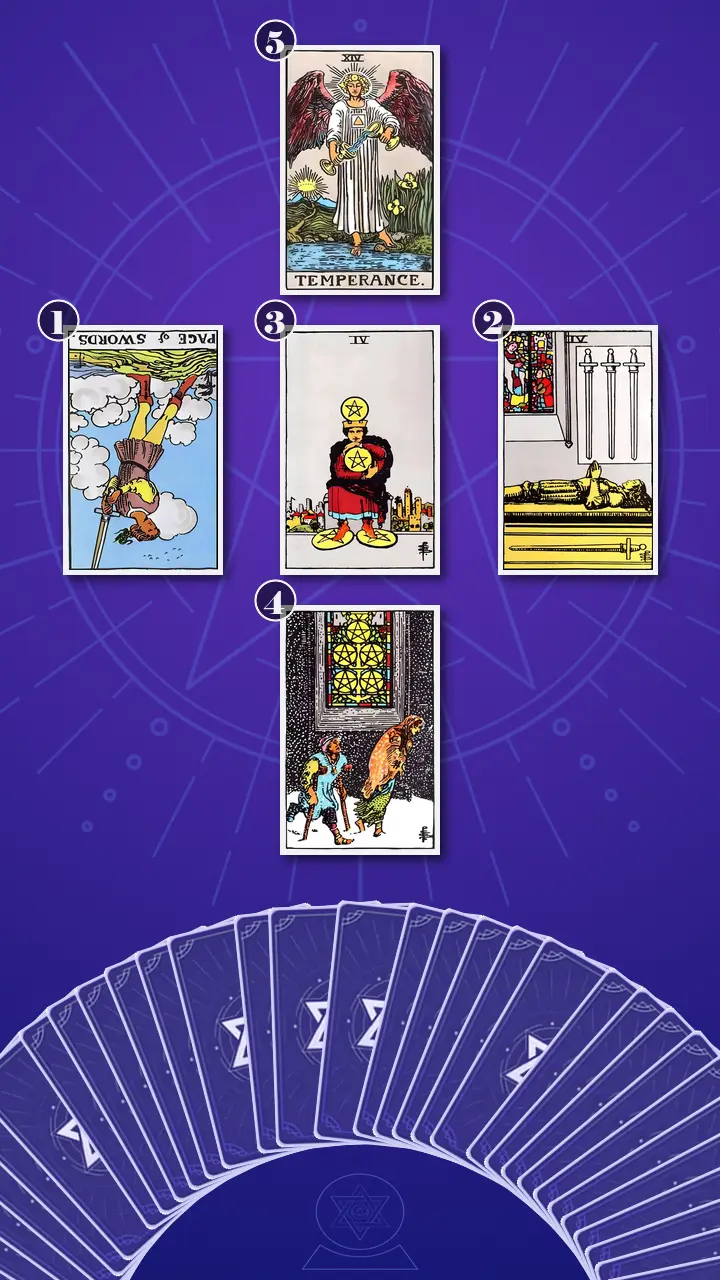
I chose the five-card Relationship Spread · Context Edition, a contextual friendship tarot spread for low-contact friendship and texting anxiety. Its shape resembled a bridge. I placed the shared dynamic in the centre, Jordan's visible response to the left, the observable contact context to the right, the buried fear below, and a self-directed way forward above.
I chose this spread because Jordan's problem involved both a relationship loop and an inner belonging fear. A larger Celtic Cross would have introduced layers we did not need. Five positions were enough to examine the symptom, the facts, the mechanism, the root, and the next step without pretending the cards could access another person's private motives.
The first position would show how Jordan's attachment alarm became visible through checking and follow-up messages. The second would contain only observable facts about the friend's participation. The centre would reveal why texting frequency had become a security metric. The card below would name what Jordan feared losing, while the card above would show what Jordan could practise regardless of the friend's eventual answer.
This is how tarot works at its most useful for me: it does not issue a verdict or replace consent-based communication. It externalises a pattern so I can examine card meanings in context with the person living that pattern. The cards can organise attention, expose assumptions, and make options easier to see. Jordan would still decide what kind of friendship worked for them.
Reading the Quiet-Chat Map
Position One: The Messenger Who Cannot Stop Scanning
I began with the position representing Jordan's present symptom: the repeated checking, interpretation, and reactive messaging that appeared whenever contact decreased. The card was the Page of Swords, reversed.
I pointed to the Page's body turned in one direction while their eyes searched another. The raised sword looked ready before any visible threat had arrived. “This is you trying to continue your evening while your attention stays inside the chat,” I said. “At 11:48, you reopen the thread, compare punctuation with older messages, type a follow-up, delete it, and send a meme. Your body is preparing to act before the available evidence can support a conclusion.”
Reversed, the Page showed an excess of vigilance combined with a blockage in receiving clean information. Jordan's pattern-recognition ability was not defective; it had been recruited by a notification algorithm trained on fear. The algorithm ranked every hour of silence as increasingly relevant even though each hour added no new relational data.
“Which detail hooks you first,” I asked, “the reply interval, punctuation, message length, or active status?”
Jordan gave a short, bitter laugh. “Honestly? All of them. That's so accurate it feels a little brutal.” Their fingers curled around the edge of their sleeve instead of reaching for the phone.
“Accurate does not mean condemning,” I said. “The Page is showing me a protection strategy under strain, not a bad or needy person. Your mind is trying to prevent a painful surprise. We are going to examine why immediate certainty feels necessary, then give you another way to respond.” I watched the defensiveness in their jaw loosen without disappearing entirely.
Position Two: Three Swords Suspended, None of Them Striking
I turned to the position representing the observable contact context, with the friend's hidden thoughts deliberately left outside the reading. The card was the Four of Swords, upright.
The three swords remained present above the resting figure, but none was moving. I translated the image into a scenario Jordan could use: place the phone face-down for thirty minutes and record only what is observable. The friend has not replied since yesterday. The friendship now includes sporadic texts and occasional plans. The friend's motive is unknown. None of those facts proves the bond is safe, and none proves it is lost.
“Known: the chat is quiet,” I said. “Unknown: why.”
I let the two sentences stand on their own before adding, “Silence is information about contact, not automatic proof about care. A quiet chat is like a calendar block marked unavailable. It tells you something about current access, but it does not disclose the person's feelings about you.”
In this upright position, the Four held the air element in balance. Where the reversed Page scattered attention in every direction, this Four created a deliberate pause between an urge and an action. It was not an instruction to suppress legitimate needs or tolerate indefinite silence. It was an information boundary: do not assign a motive before a motive has been communicated.
Jordan's lips parted on a slow exhale. Their hand, which had been angled toward the phone, settled flat on the table. “So the pause isn't proof of anything yet,” they said. “It's uncomfortable, but it's still incomplete.”
“Exactly,” I replied. “Rest does not solve the relationship, but it prevents your first fear from impersonating a finished answer.”
Position Three: When Protecting the Bond Becomes a Grip
I moved to the visual centre, the position representing the shared dynamic: the way texting frequency had become a measure of whether the friendship was secure. The card was the Four of Pentacles, upright.
The figure clasped one pentacle to their chest, balanced another over the head, and pinned two beneath unmoving feet. I asked Jordan about the last follow-up they had sent. They described a Line 2 ride home: damp winter coats, humming carriage lights, an unanswered question above a meme, and the brief relief of seeing “Delivered.” Ten minutes later, their hand was back on the phone because the next response now mattered even more.
That was the Four of Pentacles in modern life. Jordan tried to preserve the friendship by monitoring access and keeping the thread visibly active. The phone became a stored token of belonging. The energy was excessive earth: a reasonable desire for stability hardening into restriction. Every extra attempt to secure visible contact made Jordan's inner safety more dependent on the friend's next notification.
“What if the meme was not only continuing the conversation?” I asked. “What if part of it was trying to prove that your keycard to the friendship still worked?”
I use a diagnostic lens called Gravity De-linking Analysis when two friends seem to be forcing their timing into alignment even though their schedules, capacities, or life phases may be moving differently. I drew two circles on my notepad. One represented the friendship's value; the other represented immediate access. Jordan had placed the circles directly on top of each other, so any change in access looked like a change in value.
“De-linking them does not mean pretending contact is irrelevant,” I explained. “It means recognising the friction created when one rhythm is forced to prove the whole bond. The friendship may be adapting, fading, or simply operating with less messaging. We do not know yet. What we do know is that gripping its visible evidence has stopped you from moving freely through the rest of your life.”
Jordan looked down at both hands. Their fingers were closed around each other, almost mirroring the figure on the card. They opened them slowly. “If I keep the conversation moving, I feel like I can keep my place,” they said. “But the relief never lasts.”
Position Four: The Warm Window Across the Snow
I turned the card below the centre, the position representing the core challenge and deeper root: the fear that reduced access meant exclusion, replacement, or loss of belonging. The card was the Five of Pentacles, upright.
I pointed to the two figures outside in falling snow and the illuminated window glowing above them. Jordan immediately mentioned a café near Ossington. Their friend had posted an Instagram Story while Jordan's message remained unanswered. Milk had steamed behind the counter, cups knocked against the bar, and cold air brushed their ankles whenever the door opened. Jordan had barely registered any of it. The Story looked like a warm room they had not been invited into.
“The observable fact was one unanswered message and one social-media post,” I said. “But your body experienced exclusion. The energy here is blocked by scarcity: the mind narrows around the closed chat and loses sight of every other sign of care, support, or belonging.”
I leaned closer to the spread. “You are not only checking for a reply; you are checking whether you still belong.”
Jordan's breathing paused first. Their eyes moved away from me and rested somewhere beyond the screen, as if they were watching the café memory replay. Then their shoulders folded inward and a quiet “Oh” left their chest.
“I don't need them to text me every minute,” they said. “I need to know I'm not standing outside while everyone else still gets to be close to them.”
“That makes sense of the intensity without making the feared conclusion true,” I replied. “The Five does not tell me that you have been replaced. It tells me replacement is the scene your alarm projects onto missing information. That distinction matters because you can care for the fear without obeying every story it produces.”
When Temperance Opened Both Hands
Position Five: A Connection That Can Move
The radiator, which had punctuated the session with small metallic clicks, went still as I reached for the card above the centre. In the sudden quiet, the painted stream between two cups seemed almost audible. This position represented Jordan's self-directed integration: the boundary and communication practice available without predicting or controlling the friendship's outcome. The card was Temperance, upright.
Temperance stood with one foot on solid land and one in water, pouring a steady stream between open cups. I saw balanced energy rather than passivity: measured self-regulation, relational patience, and the ability to hold closeness and personal space without forcing either need to disappear. In everyday terms, Jordan could settle the first surge, distinguish wanting contact from needing immediate proof, and make one concise request about a workable rhythm.
I returned to the cycle we had already uncovered. “You send the meme, see ‘Delivered,’ and feel your chest loosen for ten minutes. Then the phone is back in your hand, because the extra message did not settle the friendship. It only made the next reply carry more weight.”
I told Jordan that less texting was incomplete information, not a verdict on their place. The shift was not caring less. It was regulating the first alarm, then naming what kind of contact they would actually like.
You do not have to hold tighter to keep the friendship real; make one measured request, and let Temperance's steady pour model a connection that can include both contact and space.
For one beat, Jordan's breath stopped. Their thumb hovered over the edge of the phone as if it had forgotten what to do. Then their focus slid past the screen; I could see them replaying the Line 2 ride, the meme, the ten-minute release, and the renewed checking. Their jaw tightened before anything softened. “But doesn't that mean I was wrong this whole time?” they asked, sharper than before. “That I made it worse?” I kept my voice level. “It means you found a strategy that gave short relief and charged interest later. That is not a character verdict. Once you see the cost, you get to choose another strategy.” Their eyes shone. Their fist uncurled finger by finger, then both shoulders dropped on a long, uneven exhale. Relief arrived, but not as certainty. I also saw the slight blankness that follows when an old explanation falls away and responsibility returns to the person who can act. “So I still have to ask,” they said, “and I might not like the answer.” “Yes,” I replied. “Clarity gives you agency, not control over someone else's answer.”
I invited them back into a real memory. “Now, using this new perspective, think about last week. Was there a moment when this insight could have made you feel different?”
Jordan looked at the reversed Page and then at Temperance. “On the train,” they said. “I could have noticed that I wanted reassurance before I sent the meme. I could have waited long enough to decide whether I actually wanted to share it.” Their voice was softer, with a trace of grief for how much energy the loop had consumed.
The two open cups brought one of my signature tools to mind: Orbital Drift Recognition. I use it to map whether people are truly moving into incompatible life phases or whether one visible rhythm has changed while the wider relationship remains meaningful. I asked Jordan to separate three coordinates: shared values, demonstrated care over time, and texting cadence. Only the cadence was clearly known to have shifted. The other coordinates needed evidence and conversation.
“Orbital drift is not an elegant phrase for declaring a friendship over,” I said. “It asks which part of the orbit has changed. A friend can remain important at a lower contact frequency. A real mismatch can also emerge, and you are allowed to decide that the available rhythm does not meet your needs. What Temperance removes is the demand that you settle that question by compulsively monitoring one chat.”
As I looked at the cross-shaped spread, I remembered long nights spent tracking planets. From one viewing angle, a body can appear to slow or move backward without abandoning its orbit. Apparent distance and disappearance are not the same event. Careful observation requires time, multiple reference points, and respect for what cannot yet be known.
I named the crossing in plain language: Jordan was beginning to move from compulsive reply monitoring and fear of exclusion toward steadier belonging, measured communication, and tolerance for relational space. This was not instant serenity. It was the smaller, more credible shift from “I must get proof now” to “I can pause, name the fear, and choose what I ask.”
I set a ten-minute timer. In Notes, Jordan wrote three headings: “What I know,” “What I fear,” and “What I might ask.” I asked them not to send anything during the timer. I also made the boundary flexible: they could stop if the exercise became uncomfortable, and the minimum version was simply writing the headings.
Under the final heading, Jordan typed, “I can want more contact without demanding immediate proof.” They read it aloud once. Their eyes were still damp, but their phone remained on the far side of the table.
Finding Clarity Without Forcing an Answer
From a Busy Thread to an Honest Choice
I gathered the five cards into one coherent story. The friendship had shifted from frequent texting to sporadic check-ins, leaving Jordan with fewer visible cues of care. The reversed Page tried to solve that uncertainty through analysis and rapid messaging. The Four of Swords showed that a pause could be observed without being assigned a motive. The Four of Pentacles revealed how access had become a possession to protect, and the Five beneath it exposed the feared consequence: being left outside and losing a secure place. Temperance offered Jordan the missing resource, not a prediction, but the capacity to regulate, speak directly, and leave room for mutual choice.
The cognitive blind spot was not Jordan's wish for more contact. That need was valid. The blind spot was reducing a multidimensional friendship to one metric, reply frequency, and then treating that metric as a live keycard to belonging. A bond does not become safer just because its chat stays busy.
The transformation direction was equally specific: stop using response speed as proof of safety; pause long enough to name the feared interpretation; then make one direct, non-demanding request about contact preferences. If the answer revealed a workable rhythm, Jordan could participate in it by choice. If it revealed a mismatch, Jordan could make a different choice without shaming either person.
Jordan frowned when I first suggested a thirty-minute pause. “When I'm already in it, thirty minutes sounds impossible,” they said. I adjusted the plan immediately. “Then your starting point is five minutes. A useful boundary has to be usable. We are creating one freely chosen gap between urge and action, not testing whether you can endure unlimited silence.”
- The Quiet-Chat Reality CheckDuring one delayed reply this week, open the Clock app, set a 30-minute timer, and place the phone in a drawer, bag, or face-down on the table. In Notes, write “What I know” and “What I fear this means,” then add one sentence under each. When the timer ends, read both columns once before deciding whether a follow-up is genuinely needed.Start with five minutes if thirty feels unmanageable. The goal is one intentional pause, not perfect self-control or the suppression of a legitimate message.
- The One-Message Temperance RequestIn a private note, draft one message using an observation, a preference, and an open question: “I've noticed we check in less often lately. I care about staying connected, and occasional planned catch-ups help me. What kind of contact rhythm feels realistic for you?” Read it aloud, remove any demand for immediate proof, and send it before a grocery run or a 20-minute walk rather than late at night.Name the need once; leave room for two honest answers. Send no same-day clarification unless practical logistics genuinely require it.
- The Broader-Care ConstellationFor seven days, record three observed signs of care that are not based on reply speed, such as a plan kept, a detail remembered, warmth in person, or support from someone else. If the friend's stated rhythm is not workable for you, use my Constellation Release Protocol: write “What this friendship was,” “What it can freely be now,” and “Where I will place the energy I used to chase proof.” Let the friendship occupy the orbit its actions support without forcing daily proximity or erasing what mattered.Use this only after a direct request or a consistent pattern, not as punishment for one delayed reply. Peaceful release can mean adjusting investment; it does not require a dramatic cutoff.
I reminded Jordan that this five-card Relationship Spread: Context Edition for low-contact friendship and texting anxiety could clarify the pattern, but it could not choose the relationship for them. The cards did not require Jordan to accept less contact than they wanted, and they did not require the friend to provide constant access. Jordan remained the person who could assess the broader evidence, name a need, hear the answer, and decide what kind of connection was sustainable.
A Week Later: The Phone Left Face-Down
Six days later, Jordan told me the friend could not offer daily texts but suggested a fortnightly Sunday call. Jordan slept through the night. Their first thought on waking was, “What if this still fades?” This time, they smiled, made coffee, and left the phone face-down.
I did not treat the suggested call as proof that Temperance had predicted a happy outcome. I treated Jordan's measured request as the meaningful change. They had replaced guessing with consent-based information and discovered that clarity could contain disappointment, preference, affection, and choice at the same time.
For me, that was the quiet proof of this Journey to Clarity. Jordan had not solved friendship uncertainty forever. They had taken one real step from monitoring toward measured communication, and from needing immediate proof toward a steadier sense of belonging. Tarot supplied the map; Jordan made the move.
When a quiet chat tightens your chest around the phone, giving someone space can feel like watching your own keycard to the friendship stop working. I would want you to remember the distinction Jordan found beneath Temperance's open cups: the alarm is real, but the screen has not written the verdict.
If silence could be an unlabelled point in the friendship's orbit rather than a verdict on your place, what small, honest version of your need could you pour into one measured request while leaving the other person free to answer from their own cup?