Oversharing to Earn Belonging on the 8:47 Ride
I met Jordan, a 27-year-old non-binary junior product designer who had moved to Toronto, after they answered a casual question in a new work Slack with a private family story and then asked me, 'Why do I keep oversharing to earn a place in guarded circles?'
At 8:47 PM on a Tuesday, I imagined Jordan on the TTC Line 1 ride home from a creative meetup, scrolling through the group chat. The phone felt warm against their palm. Fluorescent lights buzzed above them, the carriage trembled beneath their shoes, and their shoulders stayed lifted while the conversation moved on without comment. They had wanted to be understood quickly; instead, the quiet made them feel even farther outside.
Jordan told me, 'If I stay private, they will assume I have nothing to offer. If I tell them the real story, maybe they will finally understand me and let me in.' They described sending a long voice note after a pleasant evening, checking the read receipts, rereading the heart reaction, and drafting a second text to make the first disclosure sound less intense.
The longing in their voice felt like a hand pressed against a locked elevator door, holding the button down long after it had become clear that the lift was not moving. Hope kept the pressure there. Shame made their face hot. Fear hollowed the space beneath their ribs. I could see that this was not a lack of honesty. It was the painful contradiction of wanting entry into an established circle while fearing that ordinary privacy would make them forgettable.
I told Jordan I would not use the cards to declare whether a group would accept them. I would use them as an objective cognitive map, a way to separate the facts of a relationship from the story fear had attached to them. 'We can look at how the pattern starts, what the silence is actually telling you, and what kind of openness protects connection instead of asking your private life to purchase it,' I said. 'This is our journey to clarity, one observable choice at a time.'

Choosing the Compass for a Guarded Circle
I invited Jordan to place both feet on the floor, take one slow breath, and name the question without trying to solve it. I shuffled slowly. The purpose was not to summon a fixed future, but to create a clean pause between the emotional impulse and the interpretation of what had happened.
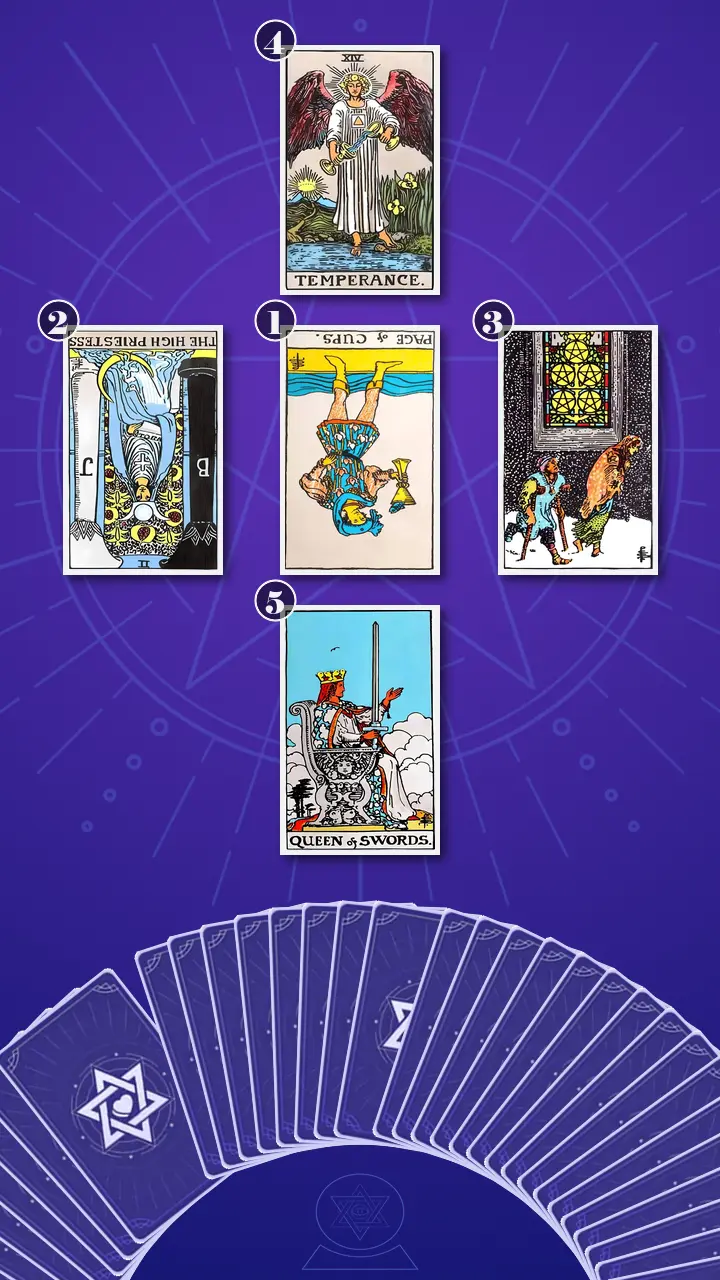
For this reading, I used the Relationship Spread · Context Edition, a five-card contextualized Relationship Spread designed for relational patterns rather than external prediction. It fits Jordan's question because the difficulty is not simply whether a particular group is welcoming. It is the interaction between Jordan's disclosure, the circle's limited context, the fear of standing outside warmth, the repair required, and the practical boundary that can be chosen next.
For readers wondering how tarot works in a situation like this, the spread gives each card a defined psychological job. It lets card meanings in context become a structured conversation about behavior, ambiguity, belonging, and reciprocity. The cards cannot make a guarded group reveal its private history, and they cannot decide whether Jordan should stay. They can help Jordan notice what is happening before the next message is sent.
The center card would show Jordan's observable way of entering the dynamic, specifically the oversharing behavior and chaotic emotional energy in the presenting problem. The card to the left would reveal the guarded circle's visible opacity and unspoken norms without treating silence as proof of rejection. The card to the right would name the shared belonging wound. Above the center would show the boundary repair, and below it would turn that repair into a clear daily practice.
Reading the Map of the Guarded Circle
The Fish in the Casual Question
Now I am turning over the card for Jordan's observable way of entering the dynamic, specifically the oversharing behavior and chaotic emotional energy identified in the presenting problem.
The card is the Page of Cups, reversed position.
In a new Slack channel or Toronto meetup group, Jordan answers a simple question about the week with a story about family conflict, then adds a long voice note when the first reply feels ordinary. The disclosure is emotionally real, but it has become a bid for the group to prove that Jordan belongs. The fish unexpectedly appearing from the Page's cup is the exact image I see here: an intimate detail surfacing in a casual conversation before the relationship has shown that it can hold that level of intimacy.
Reversed, the Page of Cups is emotional Water moving faster than its container. This is an excess of openness and a deficiency of pacing, not a deficiency of character. Jordan shares to secure recognition, then monitors every pause, emoji, and delayed reply as if the response were a grade. The short-term attention may feel like temporary entry, but the exposure afterward makes the next silence louder.
I brought in my Guilt-Trip Deconstruction lens. I was not trying to make Jordan feel guilty for wanting closeness. I was tracing the hidden contract beneath the behavior: if I make myself emotionally useful, unusual, or vulnerable enough, the room should give me a place. That invisible agreement turns personal history into an unpaid emotional offering and makes a normal response feel like a debt that has not been repaid.
I said, 'One honest detail can be connection; three extra explanations can become a request for proof. Before you share, try naming the feeling you hope the detail will secure. Is it reassurance, recognition, inclusion, or something else? The feeling matters, but the group does not have to be made responsible for producing it immediately.'
Jordan gave a quiet, rueful laugh and rubbed the edge of their sleeve between two fingers. 'That is painfully accurate,' they said. Their eyes stayed on the fish, and I could see the familiar thought moving through them: This is the thing that will make me memorable, followed by the colder question, Why did I tell them that?
I told them that the card was describing a pattern, not issuing a verdict. Emotional honesty was still available. The adjustment was to stop using honesty as an admission ticket and allow the relationship to show whether it could meet one proportionate truth.
The Veil Behind the Inside Joke
Now I am turning over the card for the guarded circle's visible opacity, unspoken norms, and limited information as perceived by Jordan, without assuming that silence proves rejection.
The card is The High Priestess, reversed position.
Jordan sees an inside joke in a group chat, notices a delayed reply, and assumes the silence contains a verdict. The black and white pillars and the veiled threshold on this card translate into a group with context Jordan cannot yet access. A Notion workspace can show a page title while keeping the permissions hidden; missing access is not automatically a personal rejection. In the same way, a longer confession cannot reliably reveal a history the group has not explained.
Reversed, The High Priestess shows a blockage in the relationship with ambiguity. Jordan treats an information gap as a demand to disclose. The thought arrives quickly: 'They have information I do not have, therefore I must explain myself.' The card interrupts that chain with a quieter fact: a quiet reply is information to observe, not a verdict to obey.
At 10:12 PM, I asked Jordan to picture the finger hovering over Send, the unsent voice note waveform, the blue read receipt, and the sudden urge to add context. I asked what would be known if they waited through one more ordinary exchange. Their chest tightened first. Their gaze went to the table as if replaying an old message. Then their hand, which had been curled around the phone, opened slightly.
I offered the two-column check I use when a guarded circle feels impossible to read: two observable facts, then one assumption. No reply for three hours is a fact. Two people referring to an event Jordan missed is a fact. They do not want me here is an assumption. I told Jordan that waiting was not emotional withdrawal and that leaving uncertainty unanswered for one exchange could create new evidence.
Jordan nodded slowly. 'I keep trying to force open a door so I can find out whether it was locked,' they said. I answered, 'You are allowed to notice that the door is closed for now without pushing your whole history through the gap.'
The Lit Window at the Edge
Now I am turning over the card for the shared belonging dynamic underneath the behavior, especially the fear of standing outside warmth and the belief that personal disclosure can purchase entry.
The card is the Five of Pentacles, upright position.
At an east-end dinner, Jordan watches three people finish each other's stories while holding a sweating glass of soda. The restaurant window glows beside them. A chair scrapes the floor, an espresso machine hisses behind the counter, and heat rises into their face as they consider turning a private insecurity into a joke. The two figures outside the illuminated stained-glass window make that social experience visible: Jordan is not only seeking attention, but trying to reach warmth and admission.
Upright, the Five of Pentacles brings an Earth-level scarcity into the connection. It shows the bodily fear of being left outside, the belief that one more personal story might function like a key, and the ache that remains when the story receives only a heart reaction. This card names the wound beneath the reversed Page of Cups, but it does not predict that the group will reject Jordan. It asks for a more useful distinction: is this ordinary early-stage privacy, or is there a sustained absence of curiosity, consistency, and respect?
Jordan pressed a palm against their sternum and looked toward the window of my studio. I said, 'Your body may be remembering the cold before the current relationship has shown you what kind of weather it carries. You can assess reciprocity over several interactions instead of asking a single pause to decide your worth.'
For a moment, Jordan looked disappointed. A private story had seemed like a bridge, and the card was asking them to examine whether they had been building the bridge alone. I stayed with the disappointment rather than rushing to make it inspirational. Wanting warmth was not embarrassing. It simply did not mean that exposure was the only route toward it.
When Temperance Made Room in the Cup
The room grew quiet when I reached the card above the center. Rain traced thin lines down the window, and the lamp beside the table made the two empty cups in my spread cloth look almost luminous.
Now I am turning over the card that identifies the boundary and reciprocity adjustment required to replace the limiting cycle with proportionate disclosure followed by observation.
The card is Temperance, upright position, the Antidote in this reading.
Temperance is the corrective of extremes. The angel blends water between two cups, keeps one foot on land and one in water, and faces a path that does not require a dramatic leap. For Jordan, the modern version is simple: answer one personal question honestly, ask one reciprocal question, and return attention to the shared conversation instead of adding three more disclosures to secure a reaction. Openness and privacy can exist in the same exchange.
My Jungian lens brought me back to the hidden either-or beneath Jordan's behavior: either I reveal everything and become worth keeping, or I stay private and disappear. Temperance gives the psyche a third option. A small software release can give a team something real to respond to without shipping the entire private system at once. One proportionate truth can meet the room while the rest of Jordan's history remains under Jordan's control.
I also used my Savior Complex Auditing lens. I was not asking whether Jordan rescued people in some dramatic, heroic way. I was checking whether they were trying to fix the room's lack of intimacy by offering their own history as emotional infrastructure. If Jordan could make everyone feel close quickly, perhaps nobody would have to tolerate the ordinary uncertainty of getting to know one another. Temperance asks Jordan to stop managing the whole emotional atmosphere and let each person contribute.
By then, Jordan had a familiar choice in front of them: stay private and become forgettable, or disclose enough to make the room feel responsible for keeping them. Their fingers rested on the table, but their face held the old question: if they stopped performing intimacy, would anyone have a reason to stay?
You are not required to empty your private life into every guarded cup to prove you belong; let Temperance's two vessels teach you to blend openness with a boundary and allow reciprocity to become visible.
For three seconds, Jordan did not move. Their inhale stopped halfway, their fingers tightened around the mug, and their pupils fixed on the painted cups. Then their gaze went unfocused. I saw the 8:47 TTC carriage, the warm phone, the family message, and the quiet chat replay behind their eyes. Their mouth opened, but no explanation arrived. A breath finally left them in a rough, chest-deep 'ah,' and their shoulders dropped. The release carried a flicker of grief: they had been trying to buy entry with pieces of a life that deserved choice, and no card could promise that every circle would respond well. The grief was followed by a smaller, steadier space. Jordan looked relieved, then briefly dizzy, as if clarity had taken away a familiar task and left responsibility in its place. Rain tapped the window while the room held still. Jordan pressed both feet to the floor, not because the fear had vanished, but because they could feel where they stood.
I said, 'Now, use this new perspective to revisit the last week. Think of one moment when you shared more than the question required. Write down the feeling you hoped the disclosure would secure, then name one lower-stakes truth you could share next time. You do not need to send, delete, explain, or rehearse anything. If the exercise makes you uncomfortable, return your attention to the room around you.'
Jordan closed their eyes, then opened them without reaching for the phone. 'I wanted them to know the real me,' they said. 'I still do. I just do not need to hand over my whole history to make that happen.' That was the emotional transformation in its first visible form: a movement from anxious emotional proof-seeking toward paced openness, reciprocal observation, and clear privacy boundaries. It was not certainty. It was grounded self-trust beginning to occupy the space where urgency had been.
The Queen's Clear Sky
Now I am turning over the card that turns the transformation framework into a self-directed next step: clear language, intact privacy, and a way to notice whether connection can survive a reasonable limit.
The card is the Queen of Swords, upright position.
The Queen of Swords gives Temperance a voice. Her upright sword and open sky translate into a calm sentence that tells the truth without attaching every piece of background context. When someone asks for more detail in a group setting, Jordan can say, 'I am still getting to know everyone here, so I would rather keep that private for now.' They can then remain in the conversation instead of apologizing, adding a second explanation, or disappearing.
This is clear Air, not coldness. The Queen does not tell Jordan to become unreadable. She offers discernment shaped by experience: notice which relationships respect a limit without requiring a performance of intimacy. A respectful response to a boundary is better evidence of belonging than a burst of attention after a vulnerable confession.
I introduced the Compassionate Detachment Protocol, my boundary script for staying emotionally present without absorbing responsibility for everyone else's comfort. First, acknowledge the connection or curiosity. Second, decline access plainly. Third, keep the door to ordinary conversation open. 'I care about being part of this conversation, and I am not ready to share that here. I would rather keep it private for now, but I am happy to hear what you think about the project.' The protocol does not punish the group or abandon warmth. It lets Jordan participate without turning private information into emotional waste that the room must process.
Jordan repeated the sentence once, quietly. Their jaw loosened, though their eyebrows stayed raised as if expecting a consequence. I asked them to observe that expectation without obeying it. The Queen of Swords was not promising that every person would respond perfectly. She was returning the decision about access to the person who owned the information.
From Emotional Proof to Reciprocal Care
When I put the five cards into one story, I could see why the pattern repeated. The reversed Page of Cups showed emotional openness spilling before trust had a chance to develop. The reversed High Priestess showed the guarded circle's missing context becoming difficult to tolerate, so silence was filled with disclosure. The Five of Pentacles made the deeper fear visible: Jordan was trying to cross the cold space outside the lit window with a private story as an admission ticket. Temperance then changed the image from pouring everything into one cup to blending enough for the conversation actually taking place. The Queen of Swords gave that measured exchange a sentence.
The cognitive blind spot was not simply sharing too much. It was treating personal disclosure as evidence that a relationship was safe, then treating an ordinary response as evidence that Jordan was not worth keeping. The spread showed that belonging cannot be purchased through self-erasure. It can be explored through proportionate openness, reciprocal care, and observation over time.
I told Jordan, 'The cards are not asking you to become private forever, and they are not asking you to wait for perfect certainty. They are asking you to replace one emotional performance with a sequence of small observations. You share a little. You notice whether the other person shows curiosity and consistency. You decide whether more access is earned by the relationship, not demanded by your fear.'
The One-Detail Reciprocity Check
- One detail, one question, one pauseAt the next work, university, or creative meetup this week, answer one casual personal question with a low-stakes truth, ask the other person one open question, and wait through their next full exchange before adding context.Write the three steps in your Notes app before the meetup. The detail can be what you are making for dinner or which part of the project has been tiring. If the urge to explain rises, stop after the first step.
- The ten-minute read-receipt pauseAfter sending the first message in a new group chat or after a meetup, put your phone face down for ten minutes and return to the room, the walk home, or the task in front of you. If the circle feels closed, record two observable facts and one assumption before sending anything else.No reply for three hours is a fact; they do not want me here is a guess. You do not have to resolve the guess immediately, interrogate the group, or use another disclosure to force certainty.
- The boundary sentence without apologyOnce this week, if someone asks for more personal detail in a group setting, use the Compassionate Detachment Protocol: say, 'I am still getting to know everyone here, so I would rather keep that private for now.' Then ask a related, less personal question and remain in the conversation for five more minutes or one more exchange.A boundary is not a locked account; it is a permission setting you can adjust as trust develops. Do not add a second explanation just to manage the other person's reaction.
This is actionable advice, not a test Jordan has to pass. The five-card contextualized Relationship Spread gives a map, but Jordan remains the person who chooses what to share, when to stop, and which responses count as reciprocal care. The next steps are deliberately small because belonging becomes steadier through repeated contact, not one perfectly timed confession.

A Small Proof, Not a Perfect Ending
A week later, Jordan sent me a message from a Queen West cafe: 'I used the sentence, stayed for one more exchange, and nobody punished me.' They still woke with the old thought, What if I got it wrong? This time, they smiled at it, made coffee, and waited before checking the chat.
I read the message twice. Nothing about it claimed that the group had become Jordan's forever circle or that every future pause would feel easy. The proof was smaller and more reliable: Jordan had remained present after setting a limit. They had allowed another person's response to become evidence instead of a payment they had to keep increasing.
That was our journey to clarity. The cards did not open the guarded room. They helped Jordan stop handing over the key to the room in exchange for a chance to enter. The shift was from forcing closeness to allowing reciprocity to become visible, with privacy still intact and choice still in Jordan's hands.
The Private Chapter You Can Keep
If the chat goes quiet after you finally tell the real story, and your face gets hot while your stomach drops because one part of you wanted closeness while another feared that even your whole history would not be enough to earn a place, let the pause be something you observe rather than a verdict you obey.
If you could let one honest detail meet the next conversation without asking it to prove your belonging, what would you feel curious enough to leave unsaid for now, perhaps the next private chapter beyond the guarded cup?
This story is adapted from psychological research, written so that those in a similar struggle can see their own pattern in it — and find their next step clearly.These insights are not a substitute for professional psychological, medical, legal, or financial advice.
Learn more about our Journey to Clarity.
How did this insight land for you?
🫂 This Resonates Deeply
🌀 Living This Story
✨ Now I See Clearly
🌱 Seeing New Possibilities
🧰 Useful Framework
🔮 The Confirmation I Needed
💪 Feeling Empowered
🚀 Ready for My Next Step
Author Profile
 AI
AI“Having traveled across cultures... I've learned that what we often lack isn't a simple answer, but a moment of being truly understood. I use a Jungian psychological lens to help you deconstruct your subconscious patterns—not to prove anything, but to be the gentle companion who helps you unravel your knots, free of judgment, so you can reconnect with your inner wisdom.”
In this Friendship Tarot Reading :
Core Expertise
- Guilt-Trip Deconstruction: Uncovering the subconscious codependency that forces you to act as an unpaid 'emotional dumping ground' for friends.
- Savior Complex Auditing: Identifying whether your inability to set boundaries stems from a deeply ingrained psychological need to 'fix' others.
Service Features
- The Compassionate Detachment Protocol: A psychological boundary script to validate a friend's emotions while firmly refusing to absorb their psychological toxic waste.
Also specializes in :
Explore Related Patterns:
Certainty SeekingJordan sees an inside joke, notices a delayed reply, and hovers over another voice note because the group's missing context feels intolerable. Their own description is precise: they keep pushing on the door to find out whether it was locked. Further disclosure offers the promise of an immediate answer, but it cannot reliably reveal norms or history that the group has not shared. When you use explanation to eliminate uncertainty, the short-term action can feel clarifying while actually producing more signals to monitor. The deeper loop is an attempt to replace the slow evidence of reciprocity with a rapid emotional test.
Premature VulnerabilityThe private family story appears inside a casual Slack exchange, and the long voice note arrives after a pleasant evening rather than after established trust. In both situations, the level of disclosure moves ahead of the relationship's demonstrated capacity to receive it. When you reveal something intimate before reciprocity is visible, the disclosure can become a test that the other person never knowingly agreed to take. The resulting exposure makes every pause feel more consequential, so you may disclose again to repair the first risk. The issue is not honesty itself; it is the use of emotional intensity to accelerate a process that normally requires pacing, observation, and mutual choice.
Reassurance SeekingAfter the long voice note, Jordan checks the read receipts, rereads the heart reaction, and drafts another message to make the first one seem less intense. The sequence shows that disclosure does not settle the fear for long; it creates a new round of monitoring and repair. When you look to each reaction for proof that you are still acceptable, no single emoji or reply can carry enough certainty. More context may briefly relieve the tension, but it also raises the emotional stakes of the next response. The repeated checking and explaining are therefore not random habits; they are attempts to regulate belonging through feedback that remains outside your control.
Transactional IntimacyJordan answers a casual work question with a private family story, follows a pleasant evening with a long voice note, and considers turning a private insecurity into a joke at dinner. The disclosures are emotionally real, but each one is assigned a second job: it must create recognition quickly and persuade a guarded circle to provide a place. When you make personal history responsible for producing acceptance, intimacy starts operating like an exchange rather than a relationship that develops through mutual evidence. The pattern becomes self-reinforcing because an ordinary response can feel like an unpaid emotional debt, prompting you to offer more even though the other people have not demonstrated greater curiosity, consistency, or care.
Black-and-White ThinkingJordan repeatedly frames the choice as revealing the real story or becoming forgettable. Later, the same dilemma returns as staying private and disappearing versus disclosing enough to make the room feel responsible for keeping them. This either-or frame removes the middle ground where most trust is actually built. When you see privacy as disappearance and full disclosure as the only route to recognition, proportionate openness can feel emotionally useless even when it is the more accurate test of connection. The distortion keeps the cycle active by making pacing look like self-erasure rather than choice.
Conditional Self-WorthJordan says that staying private may make the group assume they have nothing to offer, while telling the real story might finally make the group understand and admit them. The response to disclosure is then monitored like a grade, connecting social value to how strongly the room reacts. When you make worth conditional on being unusually revealing, memorable, or emotionally useful, ordinary participation can feel insufficient. That belief pressures you to spend more privacy whenever belonging feels uncertain. Separating your value from the room's immediate response restores a crucial distinction: another person's level of engagement is relationship data, not a measurement of what you are worth.
Mind ReadingJordan treats a delayed reply, an inside joke, and the movement of a chat without comment as if each signal contains a settled judgment about their place. The available facts show limited information, but fear supplies the missing conclusion that the group does not want them. When you interpret ambiguity through an anticipated verdict, you begin responding to an assumption as though another person stated it directly. Oversharing then appears necessary because it seems capable of correcting what you imagine the group already believes. The pattern can be interrupted by distinguishing what happened from the motive or judgment you assigned to it.
Boundary DiscernmentJordan practices saying, "I am still getting to know everyone here, so I would rather keep that private for now," and remains in the conversation instead of apologizing or disappearing. A week later, they use the sentence, stay for another exchange, and discover that setting a limit does not automatically end their participation. When you treat privacy as an adjustable permission rather than a wall, you can remain open without surrendering control over your history. The boundary does more than reduce exposure; it creates a test of whether the relationship can respect a reasonable limit. Belonging then becomes visible through reciprocity and continued contact, not through how much of yourself you are willing to hand over at once.
Reality TestingAt 10:12 PM, Jordan pictures the unsent waveform and the blue read receipt, then separates observable facts from the assumption that the group does not want them. A week later, they wait before checking the chat and let the actual response stand without adding another emotional payment. When you hold a social interpretation as a hypothesis rather than a verdict, ambiguity becomes something you can investigate. The pause allows curiosity, consistency, respect, and boundary responses to accumulate as evidence. This gives you a clearer basis for deciding whether to share more while reducing the power of fear to write the group's motives for them.
Explore Related Struggles:
Access-Belonging FusionJordan gives a new work Slack access to a private family story, follows a pleasant meetup with a long voice note, and considers offering another insecurity at dinner. Each disclosure is more than self-expression in that moment; it is being asked to function as evidence that Jordan deserves entry. Access to private material and access to belonging have become fused into one exchange. When you assume people need deeper access before they have a reason to keep you around, withholding any chapter can feel like removing your value from the room. Untangling those terms restores a crucial distinction: a circle can earn access through consistent reciprocity, while your place does not have to be purchased by continually increasing what you surrender.
All-or-Nothing BelongingJordan repeatedly names only two social options: reveal enough to become worth keeping or remain private and disappear from the group's attention. Even while practicing a calm boundary sentence, they brace for a consequence, as though a reasonable limit might remove the basis for connection. This leaves no credible middle position where one honest detail can be enough for the present exchange. When belonging is organized around extremes, measured openness can feel empty even though it preserves the conditions for genuine choice and reciprocal trust. Seeing the missing middle makes it possible to remain present after a boundary instead of treating either total access or total invisibility as the only available outcome.
Clarity-Exposure SplitAn inside joke, a delayed reply, and a quiet group chat leave Jordan without access to the circle's shared context. Their immediate response is to supply more context about themselves, as though a longer explanation could reveal whether the social door is closed or merely unfamiliar. The exposure is real, but the clarity it is meant to purchase remains unavailable because Jordan's history cannot disclose the group's intentions. When you answer missing information with greater vulnerability, you carry more personal risk without gaining a more reliable reading of the relationship. Separating observable facts from assumptions lets uncertainty remain incomplete long enough for the group, rather than your private life, to provide the next piece of evidence.
Emotional Contract DriftAfter Jordan shares something private, they reread the heart reaction, inspect the read receipt, and prepare another explanation when the response feels too ordinary. Beneath that sequence is an unspoken exchange: if Jordan contributes enough vulnerability, the room should return reassurance, recognition, or a secure place. The group has not agreed to that contract, yet its ordinary responses can still register as unpaid relational debt. When you attach an expected return to disclosure without being able to state or negotiate it, both your openness and the other person's response lose their original meaning. Making the contract visible allows you to ask whether care is actually reciprocal before offering more material to settle an agreement that exists only on one side.
Privacy-Belonging SplitJordan says that staying private could make the circle assume they have nothing to offer, while telling the real story might finally make the group understand and admit them. Later, the same conflict appears as a choice between remaining private and becoming forgettable or disclosing enough to give people a reason to stay. Privacy is therefore carrying a social cost that the group has never actually established. When you feel required to choose between keeping your history and having a place, ordinary boundaries can resemble voluntary exclusion, while openness can cease to feel fully chosen. Naming this split returns both needs to view: you can seek connection without treating access to every private chapter as its entry requirement.
Relational Pacing StrainJordan answers a casual Slack question with a private family story, then follows a pleasant evening with a long voice note and begins drafting another message before any new exchange occurs. Their honesty moves rapidly toward intimacy while the relationships around it are still operating with the limited context of new coworkers and meetup acquaintances. The strain comes from asking a developing relationship to receive established-friendship disclosure on an accelerated timeline. When you need to be understood quickly, waiting for reciprocity can feel indistinguishable from being overlooked, so the next disclosure arrives before the previous one has been metabolized. Recognizing the timing mismatch allows openness to remain real while giving the relationship time to demonstrate what it can hold.
Vulnerability Without ContainmentA private family conflict enters a casual Slack conversation, and a long voice note follows an evening that was pleasant but still socially new. At dinner, another private insecurity nearly becomes the next bid for warmth before the circle has shown sustained curiosity, consistency, or respect for a limit. The vulnerable material is genuine, but it is entering a container whose capacity remains unknown. When you disclose beyond what the relationship has demonstrated it can receive, your history leaves your control while the resulting silence becomes louder and harder to interpret. Containment does not require becoming unreadable; it means letting trust and reciprocity establish enough structure before more intimate material is placed inside the connection.
Read Receipt Worth LockOn the TTC ride home, Jordan holds the warm phone, watches the group conversation move on, and keeps returning to the read receipt and heart reaction. A few compressed digital signals are made responsible for answering a much larger question about whether the circle understands, remembers, or values them. Because those indicators contain almost no relational context, monitoring them cannot produce the stable answer Jordan needs. When you let a pause or reaction operate as a grade on your social worth, the next message can become an attempt to improve a score that was never validly measured. Returning each signal to its actual informational limits gives you room to observe patterns across several interactions instead of allowing one screen event to issue a verdict.
Explore Related Emotions:
Ambiguity DreadJordan sees an inside joke, notices a delayed reply, and hovers over another message while trying to determine what the silence means. When you cannot yet read a guarded circle, missing information can feel less like an open question and more like a verdict waiting to be discovered. That makes uncertainty difficult to leave untouched for even one exchange. Ambiguity Dread captures the pressure to force clarity through disclosure, while preserving the crucial distinction between what the group has actually shown and what the information gap has made you anticipate.
Cautious VulnerabilityJordan practices one detail, one question, and one pause, then stays in the conversation after saying they would rather keep something private. You are still allowing yourself to be known, but the disclosure now matches the amount of connection the relationship has actually built. Cautious Vulnerability holds openness and privacy in the same exchange. It lets intimacy develop through proportionate truth and observable reciprocity, with the rest of your history remaining available by choice rather than surrendered under pressure.
Conditional Belonging FearJordan answers a casual Slack question with a private family story, then adds more context when the response feels ordinary. When you make intimate disclosure responsible for earning your entry, every reaction can begin to feel like evidence of whether you have offered enough. Belonging then carries a condition: you must be emotionally useful, unusually open, or memorable before the room will keep you. Conditional Belonging Fear names the inner weather beneath the oversharing, allowing you to separate a valid desire for closeness from the felt demand to trade private history for a place.
Fear of Being ForgottenJordan says that if they stay private, people may assume they have nothing to offer, and later wonders whether anyone would stay if they stopped performing intimacy. When you associate being known with revealing exceptional amounts of yourself, an ordinary boundary can feel dangerously close to disappearing. Fear of Being Forgotten gives precise language to that threat of social erasure. It shows why withholding one private chapter can feel so consequential, while leaving you free to test whether steady presence, shared interests, and reciprocal attention can make you memorable without self-exposure becoming the price.
Grounded Self-TrustJordan presses both feet to the floor, opens their hand around the phone, and later remains present after setting a limit. Instead of asking the next reaction to make the decision for you, you begin using your own pace, observations, and boundaries to determine what access the relationship has earned. Grounded Self-Trust is visible in that shift from urgent proof to deliberate choice. It does not require certainty that every circle will respond well; it rests on knowing that you can notice the response and decide what to share next without abandoning yourself.
Mutuality HungerJordan offers a private story as a bridge, then confronts the possibility that they may have been building that bridge alone. When your disclosures carry nearly all of the emotional weight, attention can arrive without the curiosity, consistency, or shared risk that would make the exchange feel genuinely reciprocal. Mutuality Hunger describes the unmet longing beneath the effort to create closeness quickly. It redirects your attention from how much more you could offer toward whether the relationship is contributing care of its own.
Quiet Self-RespectJordan says, "I would rather keep that private for now," and then remains in the conversation instead of apologizing, explaining again, or disappearing. You protect access to your personal history without withdrawing your warmth or demanding that the room validate the boundary. Quiet Self-Respect lives in that undramatic continuity. The limit does not have to become a wall or a performance; it simply confirms that your private life belongs to you while connection is still allowed to unfold.
Social Exclusion DreadAt the east-end dinner, Jordan watches three people finish one another's stories while holding a sweating glass beside the restaurant's glowing window. When you experience yourself at the edge of an already warm circle, one more private story can begin to resemble a key rather than a freely chosen act of connection. The dread gathers around the possibility of remaining outside, not around any confirmed rejection. Social Exclusion Dread names that anticipatory cold while keeping the evidence clear: a guarded group may still be unfamiliar, and its opacity does not have to decide your social worth.
Shame SpiralJordan's face grows hot after the disclosure, and the thought that made them feel memorable is followed by the colder question of why they shared it. When you try to reduce that exposure by rereading reactions or adding another explanation, the repair attempt can give you even more material to scrutinize. Shame Spiral names the self-conscious descent from disclosure to replay to attempted correction. Seeing the sequence clearly creates room to interrupt it before another message is asked to undo the discomfort produced by the first.
Vulnerability HangoverJordan sends a long voice note, checks the read receipts, rereads the heart reaction, and drafts another text to make the first disclosure sound less intense. Once the private detail is outside your control, the body is left holding the heat of exposure while the mind searches for a way to revise what the room has already received. The colder question, "Why did I tell them that?" arrives after the original bid for closeness. Vulnerability Hangover names this exposed aftermath without treating honesty itself as the problem; it identifies the cost of offering more intimacy than the relationship has yet shown it can carry.
Cautious ReliefJordan's shoulders drop when they realize that they do not need to hand over their whole history to be real, and a week later they report setting a limit without being punished. Your body receives a small piece of evidence that privacy and continued participation can coexist. The old thought still returns, so the easing is neither total nor performative. Cautious Relief names the steadier space that appears when one feared consequence fails to materialize and you no longer have to resolve every uncertainty through immediate disclosure.
Explore Related Contexts:
Conditional Belonging PressureJordan answers a casual work Slack question with a private family story, follows a pleasant evening with a long voice note, and prepares another explanation when the response remains ordinary. The established circles never announce that disclosure is required, but their settled familiarity, limited replies, and inaccessible context leave Jordan without a visible measure of membership. When you cannot see how a group decides who belongs, private information can begin functioning like an informal payment. Conditional Belonging Pressure names that external social bind: you are trying to secure a place inside a circle whose acceptance criteria remain unclear, so every disclosure carries more responsibility than the relationship has actually assigned to it. Recognizing the pressure lets you separate the group's observable behavior from the price you have assumed you must pay. You can allow repeated participation, reciprocal curiosity, and respect for a limit to provide stronger evidence than a single high-exposure bid for entry.
Unspoken Social RulesJordan sees an inside joke, notices a delayed reply, and hears two people refer to an event they missed. Those facts reveal that the circle contains accumulated history and participation norms that are available to established members without being explained to a newcomer. Unspoken Social Rules create an information imbalance: you can observe who moves comfortably through the group, but you cannot yet see the informal sequence by which familiarity, trust, and access were built. Silence therefore carries too little context to function as a reliable verdict, even though it can strongly influence what you send next. You do not have to force the rules into view by disclosing more. Repeated invitations, reciprocal questions, follow-through, and responses to reasonable boundaries can make the social structure more legible while your private history remains under your control.
Friendship Disclosure Pace MismatchAn intimate family story appears in response to a casual Slack question, and a pleasant early social evening is followed by a long voice note carrying far more personal context. The people receiving these disclosures return an ordinary reply, a heart reaction, or no immediate comment, leaving the exchange materially uneven. Friendship Disclosure Pace Mismatch describes a relationship developing at two different speeds. You are supplying information associated with established trust while the friendship is still operating through early-stage contact, limited shared history, and low-context conversation. The truth of what you share is not the problem; the relationship has not yet shown that it can hold the amount, timing, and sensitivity of the disclosure. You regain choice by letting intimacy develop in observable increments. One proportionate detail can test curiosity and care without requiring the entire relationship to prove itself through a response to your most private material.