Feeling Replaceable in a Friendship, Somewhere Between Bloor-Yonge and Home
You’re a 20-something in Toronto with a real job and a real calendar, yet one Instagram Story can still trigger full-body “I’m replaceable” panic.
Alex said it like a confession, like she was sliding a note across a table and hoping I wouldn’t judge her handwriting. She was 28, a junior marketing manager, and she looked exactly like someone who’s been holding her breath in tiny intervals—between meetings, between notifications, between “seen” and “replied.”
She described Tuesday, 8:47 PM on Line 1 heading north: standing near the door, TTC announcements crackling, the air smelling faintly like wet wool and winter. “I open Instagram just for a sec,” she told me, “and I see her clinking glasses with this new person. And my throat—” She touched the base of her neck like the feeling lived there. “It tightens. Then my hands just… do their thing.”
Her “thing” was the spiral: swipe away, scroll back through DMs, compare timestamps, count emojis like they’re market signals. A quick 😂 on her message, a full paragraph for the new friend. Her stomach dropped like an elevator that doesn’t warn you. She’d stop herself from sending anything real, because real felt risky.
“I swear I’m not jealous,” she said, and her laugh came out thin. “I just feel suddenly irrelevant. And I hate that a single Instagram story can ruin my whole evening.”
The contradiction was right there, pulsing under every sentence: she wanted secure closeness and to feel chosen—while fearing that if she asked for reassurance, she’d confirm the worst story in her head: that she was easy to swap out.
It sounded exhausting in a specific way: like trying to read a street sign in a snowstorm you can’t turn off, while your thumb keeps reaching for the phone anyway.
I leaned in a little. “We’re not going to try to ‘win’ against a new bestie,” I said gently. “We’re going to look at what this moment is touching in you—and what one next step could give you actual clarity instead of more receipts. What past ‘swap-out’ story is this moment renting space from?”

Choosing the Compass: The Four-Layer Insight Ladder (Context Edition)
I asked Alex to take one slow breath with me—not as a ritual for the universe, but as a clean handoff from doomscrolling brain to present-moment brain. I shuffled slowly, the sound of the cards soft as paper in a quiet room. On my desk, there was also a strip of blotter paper—habit from my other life as a Paris-trained perfumer. When people are flooded, giving the nervous system something neutral and sensory can help it stop hunting for danger in pixels.
“Today we’ll use a spread I call the Four-Layer Insight Ladder · Context Edition,” I said.
And for you, reading this: the reason this spread works for questions like ‘my best friend found a new best friend—what do I do?’ is that the pain rarely comes from the new person alone. It comes from a layered inner replay: the present reaction, the trigger, the older imprint underneath, and the belief that keeps you stuck in silence. This ladder format is the smallest, clearest map I know that still shows the full mechanism—then gives you a way out.
I pointed to the invisible “steps” we were about to walk down and back up. “Card one shows your most repeatable reaction when that new-bestie moment appears. Card two is the specific cue that flips the switch. Card three goes deeper—the old ‘replaceable’ story. Card four is the shadow belief that traps you in monitoring or going quiet. Then we pivot: card five is the resource that helps you hold the feeling without obeying it, and card six is your next step in real life—what to actually say or do.”
Alex nodded, but her fingers still looked restless, like they were half-dreaming of the refresh button.
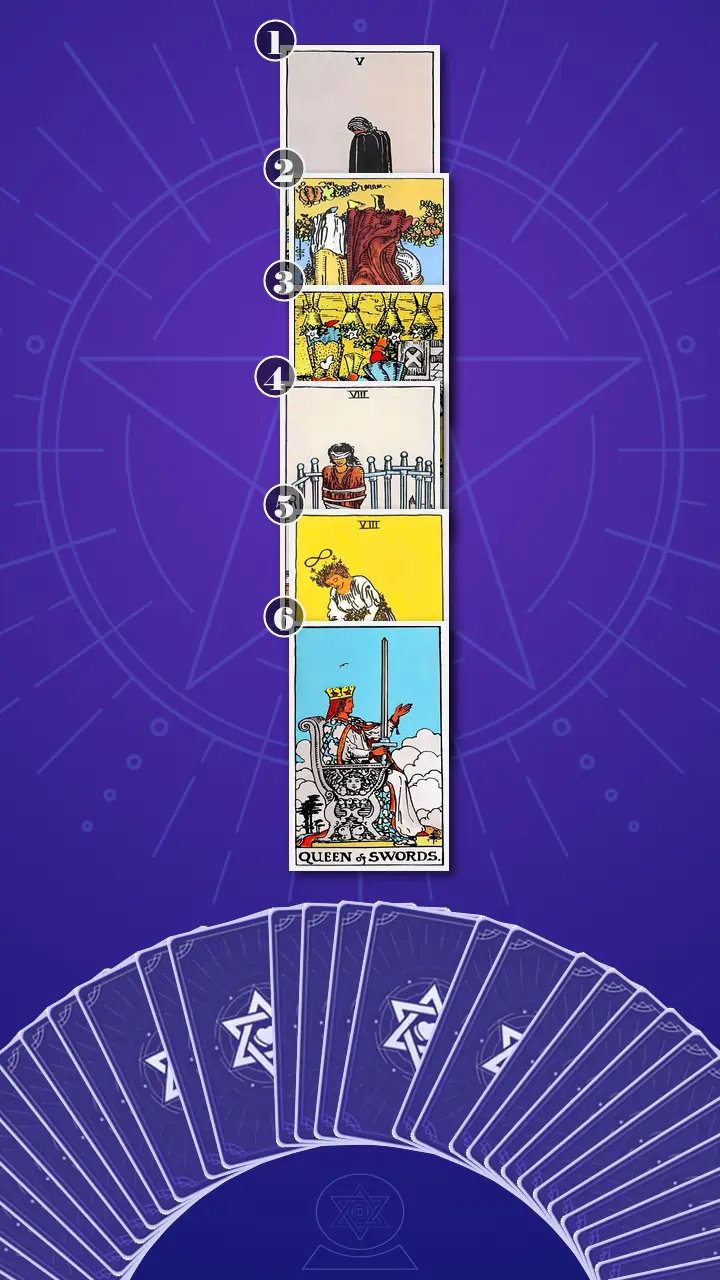
Reading the Map: From the Spilled Cups to the Mental Cage
Position 1 — Present symptom: what shows up first
“Now we turn over the card that represents the present symptom: the most observable current reaction pattern when the friend’s new bestie appears,” I said.
Five of Cups, upright.
In the card, a cloaked figure stares at three spilled cups while two full cups stand behind them, unnoticed. I kept my voice simple. “This is grief plus selective attention,” I told her. “Not dramatic grief—more like your attention becomes a flashlight that can only point at loss.”
And I anchored it in her life the way the card asked me to: “You tell yourself you’re just casually checking Instagram after work, but one Story of your friend with their new bestie hits like a punch. You immediately scan for what’s ‘gone’—less texting, fewer invites, different jokes—and you miss the quieter evidence that the bond still exists. The two upright cups are still there. Your nervous system just can’t see them when it’s activated.”
Energy-wise, Five of Cups is Water that has tipped into excess: feelings flooding the lens until the mind starts calling it truth.
Alex didn’t nod. She let out a short laugh that had a bitter edge. “That’s… rude,” she said. Then softer: “It’s accurate. Like, too accurate.”
“I know,” I said. “Tarot can feel a little too HD. But it helps because it names the pattern without calling you a problem.”
Position 2 — Immediate trigger: the cue that flips the switch
“Now we turn over the card that represents the immediate trigger: the specific social cue that flips the emotional switch into comparison and alarm,” I said.
Three of Cups, reversed.
“This is belonging energy that feels distorted,” I explained. “In reversal, the warm circle becomes a ‘closed circle’ feeling. Triangulation. Exclusion. The third-wheel itch.”
I tied it to her exact sting: “A group photo. A tagged brunch. A string of inside jokes in the comments—suddenly your brain turns friendship into a table you’re not seated at. Instead of ‘they’re having fun,’ it becomes ‘I’m not in the group anymore,’ and you start shrinking yourself to avoid looking like the needy third wheel.”
The energy here is connection turning into competition—blockage in community. Not because community is bad, but because your system reads expansion as replacement.
Alex’s mouth tightened. “I don’t want to compete for my own friend,” she said. “But my brain makes it… a ranking system anyway.”
“That’s the reversal,” I said. “Joy becomes a scoreboard.”
Position 3 — Root story: the past imprint replaying today
“Now we turn over the card that represents the root story: the past ‘replaceable’ imprint being replayed in today’s friendship moment,” I said.
Six of Cups, reversed.
“This one is important,” I told her, and I felt the room get a little quieter, the way it does when someone’s about to recognize a memory before they even name it. “Six of Cups is old attachment. In reversal, it’s the past leaking into the present.”
I used the translation that fit her life: “This doesn’t feel like just a current friend shift—it feels like an old script resurfacing. The same body-feeling you had years ago when you were the ‘backup friend’—or the friend who had to be easy and pleasant to keep a spot—gets activated by one tiny cue today, and you react as if you’re back in that earlier version of you.”
Energy-wise, this is Water memory: not just emotion, but emotion with a timestamp. The reversal shows it’s not resolved—it’s still running in the background like an app you didn’t realize is draining your battery.
Alex’s hands, which had been clasped too tightly, loosened. She looked past the table for a second, eyes unfocusing like she was replaying an older scene on a hidden screen. “Middle school,” she said finally. “My best friend just… upgraded. Like, overnight. And I remember deciding that if I was ‘easy’ and helpful, I’d be harder to drop.”
I let that land. “That makes so much sense,” I said. “If you learned closeness could be withdrawn, your system starts gathering proof before it lets you relax.”
Position 4 — Shadow belief: the thought trap that keeps you stuck
“Now we turn over the card that represents the shadow belief: the constricting interpretation that keeps you stuck in silence, monitoring, or testing,” I said.
Eight of Swords, upright.
“This is the mental bind,” I said. “The feeling of being trapped, judged, powerless—even when there are options. The blindfold and the loose bindings matter: the constraint is real emotionally, but it’s not as absolute as it feels from inside the story.”
I spoke directly into her nightly loop: “You draft a text, delete it, draft it again, then decide the ‘smart’ move is silence. You keep monitoring instead—reading into emojis, response times, Story views—because asking directly feels like stepping into rejection. The result is a lonely limbo where nothing can actually get clarified.”
And then I used my own lens—my Social Pattern Analysis. “Here’s the hidden interaction barrier I see,” I said. “You’re trying to protect the friendship by being low-maintenance. But the pattern you’re sending—without meaning to—is distance. In social dynamics, distance is a loud signal. So the belief becomes self-confirming.”
I paused, then gave her the scene the card was begging for—the late-night evidence folder. “I can almost see it,” I said softly. “Phone glow at 12:13 AM. Notes app open like an evidence log. Timestamps. Unsent drafts. Inner monologue goes: If I say it, I’ll look needy → if I don’t say it, at least I can’t be rejected. That’s safety-through-silence. But it costs you connection-through-clarity.”
Alex froze for a beat—breath held, fingers hovering like they were about to swipe. Then her shoulders dropped a fraction. Then she exhaled, small and surprised. “Oh,” she said. “Yeah. That is… literally what I do.”
“And it’s not because you’re broken,” I told her. “It’s because your brain is trying to keep you from re-living the swap-out moment.”
I added one line, clean as a knife but kind: “If you need receipts to justify your feelings, the relationship will always feel like a trial.”
When Strength Spoke: Taking Your Hand Off the Refresh Button
Position 5 — Transforming resource: what helps you hold the feeling
I took a breath before turning the next card. “We’re flipping the turning point now,” I said. “The resource that changes the whole system.” The air felt different—less frantic, like the room had stopped vibrating with notifications.
“Now we turn over the card that represents the transforming resource: the inner capacity that helps you hold the feeling without acting from fear,” I said.
Strength, upright.
On the card, a woman holds a lion with gentle hands. No wrestling. No domination. Just steadiness. “This is self-compassionate courage,” I said. “Not performative confidence. Not ‘being chill.’ It’s the ability to hold intense feelings without letting them drive the car.”
I translated it into Alex’s exact life: “The jealousy hits, and instead of reacting—scrolling, testing, going quiet—you pause. You breathe until your hands stop twitching for the phone. You remind yourself: feelings can be real without being proof. From that steadier place, you choose one aligned action—not to compete, but to care for your own heart and show up with dignity.”
Setup (the moment you recognize yourself): It was easy to see the loop in her face: 9:41 PM, she opens Instagram “for a second,” sees them laughing with the new bestie, and her stomach drops. Then she’s auditing reply times and inside jokes—like her feelings need receipts before she’s allowed to matter.
Delivery (the sentence that changes the plot):
Stop auditioning for a spot in their life and start gently holding your own ‘inner lion’—then ask for what you need with calm clarity.
I let silence sit for two full breaths. In my work with scent, you learn this quickly: the first second is impact, but the next few seconds are where meaning blooms.
Reinforcement (what it looks like in a body, not a slogan): Alex’s expression shifted in layers. First, her eyes widened slightly, like she’d been called out by name in a crowded room. Then her jaw unclenched—tiny, almost imperceptible. Then her hands, which had been gripping her phone like a railing, loosened and set it down on the table with a soft click. She swallowed, and I saw her throat bob—like the tightness finally had permission to move.
“But if I stop auditioning…” she said, and there was a flash of resistance, almost anger. “Doesn’t that mean I’ve been doing it wrong the whole time?”
I didn’t rush to comfort her out of it. “It means you’ve been trying to survive an old story with the tools you had,” I said. “Strength isn’t shame. Strength is an upgrade.”
I slid a blotter strip toward her—not as a magic trick, but as a cue. “Smell this,” I said. It was a simple citrus I keep for resets: bergamot and grapefruit, clean and bright. “Let it be your ‘pause’ button.”
“Here’s a 10-minute reset I want you to try,” I continued, keeping it practical and small—because Strength is always about what you can do in the moment, not what you can become someday:
10-minute “Lion → Sentence” reset: (1) Put your phone face-down (or in another room) for 2 minutes. (2) One hand on chest, one on belly—take 6 slow breaths. (3) Write one clean sentence you could send: “I’ve been missing our one-on-one time—can we plan something this week?” If your body spikes (tight throat, shaky hands), pause and stop; you can come back later. The goal is clarity, not forcing a conversation today.
Alex nodded slowly, like her nervous system was testing the idea for sharp edges. “That feels…” She searched for the word. “Permission-y.”
“Exactly,” I said. “This is the pivot from proof-seeking insecurity and silent testing to self-respecting clarity and direct connection.”
I asked her the question that makes insight usable: “Now, with this new lens—can you think of one moment last week where your jealousy spiked, and this reset would have changed what you did next?”
She didn’t answer right away. First, she went still. Then her gaze drifted to the side, like she was replaying a memory. Then she exhaled. “Monday,” she said. “She reacted to my message with a 😂, and I opened Instagram to check if she was out with the new friend. I could’ve… just stopped. Just breathed. And then asked for what I wanted instead of punishing myself with the scroll.”
The Queen of Swords and the One Clean Ask
Position 6 — Next-step embodiment: what to do in real life
“Now we turn over the card that represents the next-step embodiment: one practical relational move that turns insight into self-respecting connection,” I said.
Queen of Swords, upright.
“This is clarity with maturity,” I told her. “Boundaries without cruelty. Truth without a courtroom.”
Then I used the exact modern scenario that belongs to her: “You stop hinting and testing and send one clean message that matches your values: clear, kind, and specific. Not a confrontation, not a meltdown—just reality. You name what you value (your friendship) and what you want (time together), and you let the friendship respond to truth instead of your private audit trail.”
Energy-wise, Queen of Swords is Air in balance: thought used as a tool, not a cage.
Alex gave a small nod. “I can picture that,” she said. “But I always… over-explain.”
“That’s where your marketing brain and your heart can work together,” I said. “Right now you’re treating the friendship like a project with infinite status checks. Queen of Swords is one straightforward stakeholder update.”
I held up an imaginary phone. “Draft 12 is where you apologize for having needs, add three disclaimers, and somehow mention you’re ‘totally fine’ five times.”
Alex snorted. “Yep.”
“Draft 1 is this,” I said, and I kept it clean on purpose: “I really value our friendship, and I’ve been missing our one-on-one time. Want to do Thursday at 7:30—coffee and a walk at Bellwoods?”
Then I brought in my other specialty—because communication is also a kind of presence. “In perfumery, we talk about sillage—how far a scent travels. Too much and it overwhelms the room. Too little and it disappears. Your message can have sillage, too.”
This was my First impression calibration through sillage control strategy, translated into words. “Your goal isn’t to flood her with emotion or to vanish into silence,” I said. “It’s to let one honest sentence travel the right distance: far enough to be felt, not so far it turns into a performance.”
Alex’s shoulders dropped again. This time it looked like relief. “That sentence feels doable,” she said. “Like… I could actually send it without a 45-minute draft spiral.”
From Proof to Clarity: Actionable Next Steps You Can Start Tonight
I leaned back and stitched the whole ladder into one simple story, the kind that answers the question, why does this keep happening? “Here’s what your cards say,” I told Alex. “When you feel replaced, Five of Cups narrows your attention to what looks lost. Three of Cups reversed turns someone else’s joy into a closed-circle threat. Six of Cups reversed shows this isn’t only about today—it’s an old ‘backup friend’ imprint resurfacing. Eight of Swords is the belief that if you speak up, you’ll be rejected—so you stay silent and gather proof instead. Strength is the exit ramp: regulate first, hold the inner lion, then move. And Queen of Swords is the move: one clean, respectful check-in.”
“Your cognitive blind spot,” I added gently, “is thinking you need more information—more screenshots, more timestamps—to deserve asking for closeness. But what you actually need is clarity, not more surveillance.”
“The transformation direction is simple, even if it’s uncomfortable,” I said. “Shift from mind-reading and silent testing to one clear, respectful check-in that names what you value and what you need.”
Then I gave her a tiny plan. Not a personality transplant. Just next steps.
- The 2-Minute Lion Reset (before any friendship text)When you feel the urge to check their Stories or over-edit a message, put your phone face-down for 2 minutes. One hand on chest, one on belly. Take 6 slow breaths, then ask: “What do I actually want—connection, reassurance, or information?”If your brain says “this is cringe,” label it as the Eight of Swords talking. Do the smallest version anyway—just 3 breaths counts.
- The 2-Sentence Clean Description (no story, just truth)Pick one stingy moment this week (a photo, an inside joke, a short reply). Write exactly two sentences: (1) what happened with zero interpretation, (2) what you felt in your body (throat, chest, stomach, hands). Stop there.Don’t decide what it “means” the same night. This interrupts the Five of Cups tunnel vision and gives you clean data without spiraling.
- One Clean Ask (Queen of Swords script)Send one direct, non-accusatory ask within 7 days: “I miss our one-on-one time—want to plan something for Thursday at 7:30?” Add a place (coffee/walk at Bellwoods) so it becomes real instead of floating “we should totally do something” energy.Send it as-is—no disclaimers, no “lol I’m being dramatic,” no mention of the new friend. A clean ask beats a silent test.
Before she left, I offered one more tiny tool from my world: “If you’re flooded, use a cleansing citrus spray—literal or metaphorical,” I said. “Citrus is sharp in the best way. It cuts through mental fog. Even a quick rinse of your hands with a lemony soap can signal to your body: we’re not in the trial anymore.”

A Week Later: Clear, Not Perfect
Six days later, I got a message from Alex.
“I did the phone-face-down thing,” she wrote. “My hands were shaking at first. But I sent the text exactly like we wrote it. No disclaimers.”
Then: “She said yes. We’re doing a walk Thursday.”
It wasn’t a movie ending. It was something better: real life shifting one degree toward honesty. Alex told me that the morning after she sent it, she still woke up with the first thought—what if I’m wrong?—but this time she noticed it, breathed once, and didn’t open Instagram to bargain with the feeling. She made coffee, and the day stayed hers.
That’s what I mean when I say a tarot reading can be a Journey to Clarity. Not because it predicts who will choose you, but because it shows you where you’ve been trying to earn belonging through silence—and how to step into self-respect instead.
When you’re trying to be “low-maintenance” so you won’t get left, every inside joke you’re not part of can land in your body like proof you don’t belong—before you’ve even said what you need.
If you didn’t have to earn your place by staying silent, what’s one simple, honest sentence you’d want to send this week—just to invite the connection you actually value?
This story is adapted from psychological research, written so that those in a similar struggle can see their own pattern in it — and find their next step clearly.These insights are not a substitute for professional psychological, medical, legal, or financial advice.
Learn more about our Journey to Clarity.
How did this insight land for you?
🫂 This Resonates Deeply
🌀 Living This Story
✨ Now I See Clearly
🌱 Seeing New Possibilities
🧰 Useful Framework
🔮 The Confirmation I Needed
💪 Feeling Empowered
🚀 Ready for My Next Step
Author Profile
 AI
AI“As a perfumer for fifteen years, I’ve learned to perceive human boundaries through the delicate metaphor of scent. Relationships need the right amount of space to breathe, and I've seen too many kind souls exhaust themselves trying to please everyone. I’m here with warmth and understanding—not to teach you to be guarded, but to help you gently clear the air and rediscover the comforting, safe boundaries that are rightfully yours.”
In this Friendship Tarot Reading :
Core Expertise
- Boundary Permeability Diagnosis: Identifying friends whose lack of limits is metaphorically 'bleeding into your space' and causing emotional suffocation.
- Vibe Contamination Auditing: Recognizing when a highly sensitive or negative friend is unconsciously polluting your personal psychological atmosphere.
Service Features
- The Space Calibration Ritual: A behavioral directive to implement specific 'digital and physical blank spaces', preventing enmeshment and restoring breathable boundaries.
Also specializes in :
Explore Related Patterns:
Anxious AttachmentAlex's hands going straight to the phone after one Instagram Story shows how fast the friendship trigger becomes a nervous-system alarm. She is not simply curious about her friend's new connection; she starts auditing emojis, timestamps, replies, and Story activity as if those small digital cues can prove whether she is still chosen. That is the core movement of Anxious Attachment in this story: closeness feels deeply wanted, but uncertainty makes the bond feel unstable. Asking for reassurance feels dangerous because it might expose the need, so the mind tries to create safety through monitoring instead of contact. The old backup-friend memory gives the present reaction its charge. You can see how the past script turns today's ambiguity into a familiar threat: if someone else gets more attention, you might be swapped out. The pattern is not a character flaw; it is an attachment strategy that once tried to prevent rejection but now keeps connection trapped behind surveillance and silence.
Assertive CommunicationAlex's next step is concrete: put the phone face-down, regulate the body, and send one clean message that names the friendship and asks for time together. The move is direct without becoming a courtroom and vulnerable without turning into overexplanation. Assertive Communication fits because the pattern shifts from private interpretation to clear relational contact. Instead of hinting, testing, or collecting receipts, Alex gives the friendship a specific chance to respond to what she actually values. This is an upright pattern because the defense becomes skillful rather than reactive. You still honor the feeling, but you stop making the feeling argue its case through surveillance. You let one honest sentence travel the right distance: enough to be felt, not so much that it becomes a performance.
Compulsive CheckingAlex's spiral has a visible ritual: swipe away, return to the DMs, compare timestamps, count emojis, check Stories, and build a quiet evidence folder in her head. The behavior looks like information gathering, but it functions more like an anxiety regulation loop. Compulsive Checking fits because the checking is not producing clarity; it is feeding the need for one more receipt. Each new piece of data promises relief, then creates another ambiguous detail to interpret, so the mind stays attached to the phone as if certainty is only one scroll away. The pattern matters because it replaces direct relational contact with private surveillance. You are not wrong for wanting clarity, but the checking keeps clarity external, delayed, and dependent on pixels. The exit begins when the urge to audit becomes the cue to pause, regulate, and choose one honest next move instead.
Friendship Role RegressionAlex's middle-school memory gives the whole present-day reaction its shape: a best friend upgraded overnight, and she learned to become easy, helpful, and less demanding to avoid being dropped. That old role comes back the moment a current friend appears close with someone new. Friendship Role Regression names this return to an earlier social position under present stress. Alex is not only reacting as a 28-year-old looking at Instagram; part of her response is organized around the younger self who learned that friendship could disappear without warning. The pattern becomes visible in how quickly she moves from adult uncertainty into old survival math. You can have a real job, a real calendar, and still feel pulled back into the backup-friend role when the cue is specific enough. Seeing the regression creates choice: the old role can be recognized without being obeyed.
Rejection SensitivityA quick emoji, a tagged brunch, or an inside joke in the comments becomes more than a social cue for Alex. Each one lands like possible evidence that she has been demoted, and her attention immediately narrows around what might be missing from the friendship. Rejection Sensitivity shows up here as a threat-detection filter around belonging. Ambiguous cues get processed as early warning signs of exclusion, so the mind rushes to interpret before reality has had a chance to clarify itself. The painful part is that this pattern can feel like intelligence from the inside. You may think you are simply reading the room, but the old replaceable story is already editing the evidence. The result is a loop where the friendship feels like it is rejecting you before you have actually asked the relationship to respond in real time.
Relational Baggage LoopThe new-bestie moment is explicitly described as borrowing charge from an older swap-out story. Alex is not just reacting to a current friendship shift; she is replaying a template where closeness can be withdrawn suddenly and the safest response is to gather proof before relaxing. Relational Baggage Loop fits because the past does not remain a memory in this case. It becomes a live interpretation system: ambiguous cues today are filtered through an old conclusion about being replaceable, and that conclusion drives the same behaviors that keep the wound active. The loop is subtle because every round feels like fresh evidence. You see a Story, feel the old drop in your stomach, check for receipts, stay quiet, and then the lack of clarity becomes more proof. Naming the loop separates the present friend from the old scene, which is the first step toward responding to today instead of reenacting yesterday.
Self-SilencingAlex drafts the message, deletes it, drafts it again, and then decides silence is the safer move. The silence is not emptiness; it is an active strategy for protecting herself from the imagined cost of having needs. Self-Silencing is the pattern where connection is protected by withholding the very truth that could clarify it. In Alex's case, being low-maintenance becomes a defense against seeming needy, but it also blocks the friend from knowing what she actually misses. The older backup-friend story makes this strategy understandable. If being easy and helpful once felt like the way to keep a spot, then asking directly can feel like risking the spot. The psychological shift is not toward demanding reassurance; it is toward letting a clean, respectful need exist without treating it as evidence that you are too much.
Zero-Sum ThinkingAlex does not experience the new friendship as an addition to her friend's life; she experiences it as a subtraction from her own place. A tagged brunch or a string of inside jokes turns belonging into a table with limited seats. Zero-Sum Thinking is the cognitive trap where someone else's closeness feels like your displacement. In this story, joy becomes a scoreboard, and the friend's social expansion gets translated into Alex's possible demotion. The deeper pressure comes from the old belief that belonging is scarce and must be earned by being easy, helpful, and undemanding. You can see how that belief makes every new person feel like competition. The pattern loosens when connection stops being treated as a ranking system and starts being tested through one clear ask in the actual relationship.
Emotional RegulationAlex's turning point is not pretending she feels fine. It is putting the phone face-down, breathing through the body spike, and letting the feeling exist without letting it choose the behavior. Emotional Regulation appears as the capacity to separate activation from evidence. The throat tightness, shaky hands, and stomach drop are real body signals, but they do not automatically prove that replacement is happening. By the follow-up, the pattern has become practical: the thought still appears, but Alex notices it, breathes once, and does not open Instagram to bargain with the feeling. That is the meaningful shift. You do not need the panic to disappear before you act clearly; you need enough steadiness to stop obeying it.
Secure VulnerabilityAlex's clean ask lets her need become visible without turning the friendship into a trial. She names that she values the friendship, says she misses one-on-one time, and offers a specific plan instead of hiding behind silence or flooding the other person with proof. Secure Vulnerability is the healthier pattern forming underneath that move. It is not performative chillness, and it is not emotional pressure. It is the ability to show a real need in a grounded, proportionate way. The reason this matters is that the friendship can only respond to what is actually expressed. When you stop auditioning for a spot and let one honest sentence stand, you move from earning belonging through invisibility to inviting connection through self-respect.
Deficit FixationAlex immediately scans for what looks gone: less texting, fewer invites, different jokes, shorter replies. The friendship becomes a field of missing pieces, while the quieter signs of continuity drop behind her attention. Deficit Fixation names the cognitive narrowing that happens when the nervous system is activated. The mind locks onto loss cues, then treats that narrowed view as the full truth. This is not the same as being irrational; it is selective attention under threat. In this story, the fixation keeps Alex from seeing the two full cups still standing behind the spilled ones. You can feel how the pattern makes the friendship seem smaller than it may be, because the mind keeps refreshing the evidence of absence instead of checking whether connection is still available through a direct, grounded ask.
Explore Related Struggles:
Chosen-Worth BindAlex wants to feel chosen by her friend, yet asking for reassurance feels like it could prove the exact fear she is trying to avoid. The new bestie does not simply look like another friendship; in her body, it starts to look like evidence that her place can be reassigned. That turns closeness into a verdict. When a quick emoji lands beside a fuller reply to someone else, You are not just comparing messages; You are trying to find out whether being less chosen means being less secure, less valuable, or easier to replace. This bind keeps the friendship loaded with stakes it cannot carry. The way out begins when being chosen stops being treated as the only proof that You matter.
Clarity-Exposure SplitAlex drafts a text, deletes it, drafts again, then chooses silence because a direct ask feels like stepping into rejection. The clean sentence she wants is simple, but the exposure around needing something makes it feel dangerous. That creates a split between clarity and self-protection. You can ask for one-on-one time and let reality answer, or You can stay hidden and keep interpreting fragments; both options carry a cost, so the body freezes between them. The stuck point is not a lack of words. It is the belief that being clear will make You too visible to be kept, so silence starts posing as dignity while quietly starving the bond of truth.
Monitoring-Safety FusionAlex's hands do their thing before she can make a clear relational move: swipe away, return to DMs, compare timestamps, count emojis, check Stories, and build a private case file out of tiny signals. The monitoring promises safety because it feels active. You get the sensation of doing something, gathering enough receipts to justify the ache, yet the loop cannot give the one thing it keeps seeking: direct clarity from the actual friendship. The struggle locks in when surveillance starts replacing contact. The more You audit the friendship for proof, the less room there is to experience it as a living connection.
Triangulated BelongingThe friend's new person enters the story through group photos, tagged brunches, clinking glasses, and inside jokes in comments. What could be an expanding circle starts to feel like a table where Alex no longer has a seat. The third presence changes the geometry of the friendship. You are no longer relating only to the bond itself; You are relating to a ranking system that appears around the bond, where every public sign of closeness seems to place someone higher and You lower. This is why the new bestie hurts beyond ordinary comparison. The pain comes from belonging being triangulated, so connection starts to feel like a contest instead of a shared space.
Utility-Belonging FusionAlex names the older rule with painful precision: after being replaced in middle school, she decided that being easy and helpful would make her harder to drop. In adulthood, that rule shows up as being low-maintenance, not asking directly, and trying not to take up relational space. Utility becomes a substitute for secure belonging. You try to remain useful, pleasant, or undemanding enough that nobody has a reason to leave, but the cost is that the friendship never gets to meet the real size of Your needs. This struggle is especially sticky because it can look mature from the outside. Inside, though, it teaches You to earn a place by minimizing Yourself, which turns connection into a quiet performance of not needing too much.
Social Collapse ImprintAlex does not react to the Instagram Story as a standalone Tuesday-night update. Her body goes back to an older scene: middle school, a best friend who upgraded overnight, and the decision that being easy and helpful might make her harder to drop. That old social loss becomes a hidden reference point for the present. A tagged brunch or a short reply is no longer just social data; it becomes a replay cue that makes You scan the friendship as if the old replacement is happening again. The struggle is not that You care too much about a friend. It is that a past swap-out script is renting space inside a current bond, so You start responding to today's ambiguity with yesterday's survival rules.
Explore Related Emotions:
Friendship Drift GriefAfter seeing the Story, Alex immediately scans for what feels gone: less texting, fewer invites, different jokes, a tone that seems to have moved somewhere else. The friendship has not ended in the story, but the felt shape of it starts to look altered. That is why the grief is so specific. You can grieve a drift before there is a rupture, especially when small changes seem to confirm an older memory of being upgraded away from without warning. Friendship Drift Grief names the sadness inside that uncertainty. It is the mourning of a closeness that may still exist, but no longer feels reliably visible from where you are standing.
Low-Maintenance ShameAlex stops herself from sending anything real because direct need feels risky. She wants reassurance, but the old rule says that being easy, pleasant, and low-maintenance is how she keeps a place in the friendship. The middle school memory gives this shame its shape. You can see a younger version of her deciding that having fewer needs might make her harder to drop, and that old strategy still tries to run the current friendship from behind the scenes. Low-Maintenance Shame names the ache underneath the silence. It is the feeling that wanting closeness is somehow too much, so you shrink the ask, edit the message, and pretend to be fine while privately longing to be chosen without having to perform ease.
Replaceability DreadAlex sees one Instagram Story of her friend clinking glasses with someone new, and her body responds before her mind can organize the scene. The throat tightness, stomach drop, and evening-long spiral show that the image is not being processed as neutral social information; it is being read as a possible replacement notice. The story sharpens when the current cue links back to the earlier backup-friend memory from middle school. You are watching a present friendship moment borrow emotional force from an older scene where closeness seemed to be withdrawn quickly, and the body learned to scan for signs before it felt safe to relax. Replaceability Dread fits because the core pain is not simple jealousy. It is the fear that your place in someone’s life can be quietly reassigned, and that asking for reassurance might make the feared disposability feel confirmed.
Social Exclusion DreadA group photo, a tagged brunch, or a string of inside jokes in the comments becomes more than evidence that her friend had fun. For Alex, the scene turns into a closed circle, a table where the seats have already been assigned and hers may no longer be there. That shift matters because the friendship field stops feeling spacious. You can see how expansion gets translated into exclusion: someone else being included starts to feel like you are being moved to the edge, and the body reacts as if belonging is being decided without you in the room. Social Exclusion Dread names the specific inner weather of that moment. It is the alarm that rises when visible closeness between other people makes your own connection feel suddenly unstable, unconfirmed, and socially exposed.
Hypervigilant AnxietyHer hands keep reaching for the phone after the Story lands, even when the checking is making her feel worse. The late-night scene of timestamps, Story views, unsent drafts, and a Notes app evidence log shows a nervous system trying to stay ahead of rejection by monitoring every available signal. That monitoring creates the illusion of control while quietly taking over the room. You can feel how the phone stops being a tool and becomes an alarm panel, with every pixel treated as possible proof that the friendship is changing. Hypervigilant Anxiety fits because the emotional centre is constant threat-scanning. The anxiety does not wait for a direct conversation; it keeps hunting for danger in reply times and public posts, trying to protect you from being blindsided by another swap-out moment.
Guarded LongingAlex wants secure closeness and wants to feel chosen, yet the moment she considers asking for reassurance, the message becomes dangerous. She drafts, deletes, and goes quiet because the need is real, but letting it be seen feels like stepping into rejection. The longing is visible in how much the friendship still matters. You can feel her reaching toward warmth and then pulling her hand back, trying to keep the bond safe by not testing whether it can hold her honesty. Guarded Longing captures that suspended emotional state. It is not indifference and it is not pure panic; it is wanting connection badly enough to protect it with silence, even when that silence leaves you lonelier.
Cautious Self-TrustAlex puts the phone face-down, breathes, and waits for her hands to stop chasing the refresh button. That pause matters because it gives her body a chance to separate the feeling from the conclusion she usually attaches to it. From there, she sends one clean message instead of building another evidence folder. You can see self-trust forming in a practical way: not as instant confidence, but as the ability to believe her need for connection is valid without turning it into proof of disaster. Cautious Self-Trust fits because the steadiness is still new. The old alarm remains, but she can notice it, breathe once, and choose a direct ask that respects both her dignity and the friendship.
Comparative JealousyAlex scrolls back through DMs, compares timestamps, and starts counting emojis as if every tiny signal can reveal where she ranks. A quick laughing reaction on her message and a full paragraph to the new friend become emotionally loaded data points, not casual differences in texting style. The comparison is painful because it turns friendship into measurement. You can feel her trying to locate her value through response length, speed, and public warmth, which makes someone else’s closeness look like evidence of her own demotion. Comparative Jealousy is the right label because the jealousy is filtered through scoring. It is not only wanting what the new friend has; it is the sharp, restless feeling of watching affection become quantifiable and fearing the numbers are no longer in your favour.
Self-Audit AnxietyAlex compares timestamps, counts emojis, checks Story views, and keeps building a private record of whether she still matters. The details are small, but the emotional labour is huge because every cue gets pulled into an internal audit. The painful part is that her feelings start needing documentation before they feel legitimate. You can see how the relationship becomes a trial in her mind, with the phone supplying exhibits and silence acting like the courtroom door. Self-Audit Anxiety fits because the anxious charge is directed inward as much as outward. It is the feeling that you must prove your hurt to yourself before you are allowed to ask for closeness in a simple, human way.
Clarity ReliefAlex sends the message exactly as written, without disclaimers, over-explaining, or turning the new friend into the subject. The shift is small on the outside, but internally it moves her from surveillance to contact. When her friend says yes to the walk, the relief is not a perfect ending. You can still see the old thought appear the next morning, but this time Alex notices it and does not open Instagram to bargain with the feeling. Clarity Relief belongs here because the emotional release comes from making one clean move in reality. The friendship is allowed to respond to truth, and the day becomes hers again instead of being handed over to the scroll.
Explore Related Contexts:
Conditional Belonging PressureAlex does not simply want more texts; she wants to know that her place is not conditional on being effortless. The story shows her comparing a quick emoji on her message with a fuller response to the new friend, then holding back anything direct because asking for reassurance might make her seem too needy. That turns belonging into a performance contract. You stay easy, useful, low-friction, and quiet so the other person has no reason to move away. The pressure is social, not just internal: visible attention, public closeness, and uneven reply patterns all become cues about whether your place is secure or probationary. This is why the new bestie lands so hard. The external friendship field starts to look like a conditional access system, where being chosen depends on never creating friction. Once that structure is visible, the next move is not to compete harder; it is to test whether the friendship can hold a direct, reasonable need.
Friend Group TriangulationAlex sees the friend clinking glasses with the new person, then later describes group photos, tagged brunches, and inside jokes in the comments as the cues that flip the switch. The friendship is no longer experienced as a simple one-to-one bond; it becomes a three-person social field where every visible sign of closeness can be ranked. You are not dealing with a confirmed betrayal in the facts of the story. The sharper external structure is triangulation: one important relationship is now being interpreted through a third person's presence, and the platform keeps making that third point visible. That matters because triangulation changes the available moves. Competing with the new bestie keeps you trapped inside the triangle. Asking for one-on-one time steps outside the ranking system and gives the original friendship a direct channel again.
Low-Maintenance Friendship PressureAlex keeps drafting and deleting the message because the clean ask feels more dangerous than the private audit trail. She misses one-on-one time, but the social rule she is obeying says that a good friend should not need reassurance, should not ask for a spot, and should not create friction when a new person enters the circle. You can see the pressure in the way she tries to protect the friendship by becoming smaller. She does not confront the new bestie, but she also does not name what she wants. The result is a friendship stage where low-maintenance behavior is treated as the price of continued access. The practical risk is that silence starts sending the opposite signal. When you hide every need to avoid being dropped, the other person may only see distance. This context points to the real task: not demanding priority, but letting the friendship meet one clear, adult request.
Old Friend Role Lock-InAlex names the older scene herself: in middle school, her best friend upgraded overnight, and she decided that being easy and helpful might make her harder to drop. That is not just a memory in the background. It becomes a social role she keeps stepping back into whenever a close friend builds visible intimacy with someone new. You can see the role replay in the present friendship when one Instagram Story makes the current new bestie look like proof of replacement. Instead of treating the current situation as a conversation that can be clarified, the old backup-friend position takes over the room: stay pleasant, do not ask for too much, gather evidence before you risk wanting anything. This context matters because the question is not only whether the friend has changed. It is whether you are being pulled into an old slot where belonging has to be earned through usefulness, silence, and low demands. Naming that role gives you a cleaner choice point: you can respond to the present friendship instead of performing for the past one.
Algorithmic Comparison LoopAlex opens Instagram on the TTC for just a second, sees the new bestie moment, and immediately starts comparing digital traces: DMs, timestamps, emojis, reply length, comments, and Story views. The platform does not create the old replaceable story, but it gives that story a constant feed of material to work with. You can see how the loop works. A public Story becomes a private ranking system, then the ranking system demands more evidence, and the evidence never delivers closure. Every extra check creates another cue to interpret, so the friendship becomes more searchable but less clear. This context is important because the problem is not solved by finding the perfect screenshot. The external design of the platform keeps turning social ambiguity into measurable fragments. Stepping out of the comparison loop means moving from feed-based inference to one real-world ask.
Digital Snooping SpiralAlex's phone becomes an evidence room: DMs reopened, timestamps checked, emojis counted, Story views reviewed, and drafts written without being sent. By 12:13 AM, the Notes app is functioning like a case file for a conversation that has not happened. You can understand why this feels productive from inside the loop. Digital traces look objective, and objective-looking signals can seem safer than asking directly. But the external setup keeps you in a one-person investigation where the other person never gets a chance to clarify the relationship in real time. The spiral is not about moral failure; it is about a platform environment that makes monitoring easy and clean conversation feel high-risk. Naming it helps separate the need for closeness from the habit of collecting receipts.