Why Carry Messages Between Friends? Returning Them to Their Owners

The Human Routing System at 11:47 p.m.
The first thing I understood about Alex was that they spent their workday untangling user flows, then became the human routing system for their friend group after hours. By the time they joined my video session from a small Toronto bedroom, two WhatsApp chats were still open on the phone in their hand. The screen had gone warm against their palm. Behind them, the radiator clicked and hissed while they deleted one friend's sentence for the fourth time, trying to make it safe enough to send to the other.
Each new typing bubble lifted their shoulders a little higher. Their jaw looked braced against an impact that had not happened yet, and every breath stopped near the top of their chest. The relational anxiety felt less like a thought than a notification tone wired directly into their sternum.
“I hate being in the middle,” Alex told me. “But stepping out feels cruel. If I refuse to pass something on, they might think I don't care. And if the group falls apart, everyone will remember that I could have helped.”
That was the contradiction at the center of the session: Alex wanted to preserve intimacy by carrying their friends' messages, yet doing so meant surrendering their evenings, controlling information neither friend would communicate directly, and becoming responsible for reactions no wording could guarantee. This was friendship triangulation, but from the inside it did not feel like a neat psychological term. It felt like two private chats, one apparently normal group chat, and an unpaid emotional on-call shift that never quite ended.
I told Alex, “I don't hear someone who wants power over the group. I hear someone trying so hard to protect closeness that being useful has started to feel like the price of belonging. We are not going to use tarot to decide who is right or predict whether anyone will leave. We are going to use it as a relationship map, so you can see which parts of this situation are yours to choose and which parts were never yours to carry.”

Choosing a Map for the Side Channels
I asked Alex to place both feet on the floor and take one slower breath before turning the phone face down. I shuffled while they held one precise question in mind: “Why do I keep carrying messages between friends in conflict?” The pause was not a mystical performance. I use it as a psychological threshold, a way to stop reacting long enough to observe the pattern.
I chose the Relationship Spread · Context Edition, a focused five-card relationship tarot spread. For anyone wondering how tarot works in a situation like this, I treat the cards as structured prompts. Their symbols make roles, assumptions, emotional labor, and feedback loops visible. Card meanings in context matter more than generic predictions.
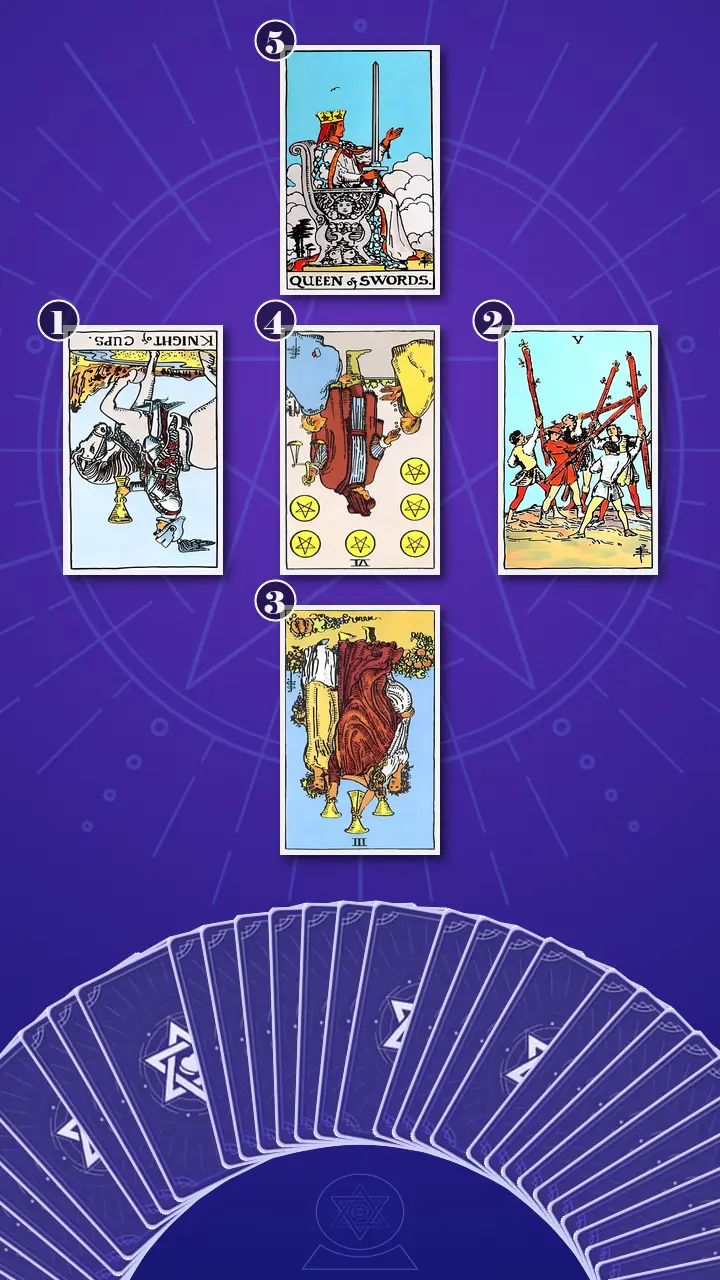
A larger Celtic Cross could have widened the reading into unrelated areas of Alex's life. This spread was more economical. The first position would show Alex's self-assigned mediator role. The second would reveal how the two friends' competing accounts recruited them. The third would uncover the belonging need beneath the behavior. At the center, the fourth card would expose the exchange keeping the triangulation active. The final card, placed above the others, would offer an integration practice rather than a fixed outcome.
I arranged the cards like a relationship system diagram: Alex on the left, the conflict field on the right, the group bond underneath, the hidden economy in the center, and a clearer role above. I wanted the eye to travel through the structure before the mind rushed toward a solution. Tarot could provide the map, but Alex would remain the person deciding how, when, and whether to move.
Reading the Friendship's Hidden Backend
Position 1: The Cup Carrying Someone Else's Words
I began with the card representing Alex's self-assigned mediator role, including the editing, relaying, and monitoring that had become almost automatic. I turned over the Knight of Cups, reversed.
In the Rider-Waite-Smith image, the Knight advances carefully while holding a cup out in front of him. Upright, that emotional offering can move with purpose. Reversed here, the Water energy was blocked and overextended. Alex had sensitivity, tact, and a genuine willingness to approach difficult feelings, but those qualities had been diverted into transporting emotions that were not theirs to express.
The modern scene was already glowing in Alex's hand. At 11:47 p.m., one friend had sent a raw voice note ending with, “Can you explain that to them?” Alex had removed the sharpest sentence, rewritten the complaint as a gentler text, sent the edited meaning into the other chat, and then watched both typing indicators as though perfect delivery could control the emotional outcome.
I said, “The Knight is holding out a cup, but the message inside it is not yours. Your compassion says, 'I want to support my friend.' The blockage begins when that becomes, 'I must own the delivery, the interpretation, and whatever happens next.' Your inner script sounds like: 'If I can make this gentle enough, maybe nobody will leave and nobody will blame me.'”
Alex gave a short laugh that landed with more bitterness than humor. “That's so accurate it feels a little cruel.”
I kept my voice steady. “Then let's slow down there. The card is not accusing you of causing the conflict. It is separating your intention from the job you have taken on. Caring for both people does not make their conversation yours to carry.”
The laugh disappeared. Alex rubbed their thumb along the edge of the phone, then placed it farther away. Their shoulders were still raised, but the motion had interrupted the reflex to check the screen.
Position 2: Five Voices Without a Shared Conversation
I moved to the card representing the two conflicted friends and the ways their competing bids for interpretation recruited Alex into the middle. I turned over the Five of Wands, upright.
The five figures raise their staffs in different directions. There is abundant Fire, but no shared target, agreed process, or coordinated conversation. The energy was active to the point of excess: screenshots, voice notes, Instagram Notes, cropped context, and follow-up explanations kept arriving, yet the people with the disagreement were not testing their claims with each other.
Alex recognized the scene from a northbound Line 1 train after work. Within three minutes, one friend had sent a screenshot captioned, “See what I mean?” while the other asked, “What did they tell you?” The brakes had shrieked against the track, damp winter coats had pressed in from both sides, and Alex's brain had opened an unofficial investigation board before they reached the next station.
“They are both giving me evidence,” I said, naming the logic I could hear underneath the behavior, “so you assume you must work out what really happened. But receiving multiple urgent accounts does not appoint you as the fact-checker, translator, and referee. You can witness disagreement without adjudicating it.”
I asked, “What did each person ask you to do that they could have done directly with the other?”
Alex looked away from the camera and counted silently on two fingers. “One wanted me to explain their intention. The other wanted me to confirm that they weren't overreacting.”
“Those are two different requests,” I replied, “but neither becomes your assignment simply because it arrived in your inbox.”
Their next breath reached lower. I watched the first distinction settle in: noise could be real without being theirs to resolve.
Position 3: The Cheerful Group Chat and the Hidden DMs
I turned to the card representing the underlying group bond, especially the need that made mediation feel emotionally necessary. It was the Three of Cups, reversed.
Upright, the three raised cups form a circle of mutual celebration. Reversed, the shared Water was obstructed by side conversations, selective disclosure, and loyalty tests. The visible friendship still looked intact enough to discuss brunch, birthdays, restaurant links, and Friday plans. Underneath that cheerful front end, the actual grievances moved through Alex's private channels.
Through a Jungian lens, I saw the group chat holding the friendship's social persona while the disowned anger traveled through its shadow channels. That did not make the feelings bad or dishonest. It meant the group had found a way to display normality without creating a direct container for conflict.
I thought briefly of the information circulation in Mean Girls, not because Alex shared anyone's malicious motives, but because private access can create temporary proximity and influence while direct trust becomes less secure. Alex was central to both stories, yet unable to relax inside the friendship itself.
I said, “Being the safest inbox is not the same as being securely included. Access to both stories can feel like intimacy while direct trust is thinning.”
Alex's fingers stopped moving. Their gaze lost focus as if they were replaying several months of DMs at once, and then their stomach visibly contracted beneath a long exhale. “If they both keep confiding in me, I know I still have a place with each of them,” they said. “I don't like admitting that.”
“Wanting a secure place is not shameful,” I told them. “The question is whether this role actually gives you the belonging you want. If you are monitoring every pause, seating plan, and facial expression, you have access to the friendship, but very little room to inhabit it as an equal.”
Position 4: The Cost Hidden Inside the Scales
I returned to the central card, the one representing the present Power-Intimacy Split: Alex's informational influence and emotional workload increased while direct trust between the friends decreased. I turned over the Six of Pentacles, reversed.
The scales made Alex's constant fairness calculations visible. The coins dispensed from one hand became selected facts, softened phrases, reassurance, and access distributed between two waiting chats. Reversed Earth showed an imbalanced exchange. Alex was giving time, attention, and emotional labor beyond a sustainable limit, while also holding the uncomfortable power to decide what each friend would hear.
I connected it to a Saturday afternoon at a crowded Queen Street cafe. Alex had a Resy page open beside both message threads. One friend wanted confirmation that the other would not “start anything” at dinner; the other wanted to know what had been said about them. While the espresso machine hissed, Alex decided what to soften, withhold, or send before confirming the booking.
“Because you know both stories, you feel like the only person who can distribute the information fairly,” I said. “But temporary influence is not the same as reciprocal support. You get control over the flow, and you pay for it with your Saturday, your concentration, your confidentiality, and the risk of being blamed for either too much disclosure or too little.”
Having traveled across cultures, I have learned that directness does not have one universal tone. Ownership is more consistent. People can communicate softly, bluntly, slowly, in writing, or after taking space, but their words still need to belong to them.
I asked Alex to replace the question “How do I distribute this fairly?” with a more useful one: “Whose communication task is this?” The card turned an emotional fog into a division-of-responsibility problem. A request could be mine, theirs, or shared; urgency did not change its owner.
Alex paused, pressed both feet into the floor, and exhaled through their nose. “Most of the last five messages were theirs,” they said. “I treated all of them like mine.”
When the Queen Kept Her Sword Upright
Position 5: An Open Hand That Carries Nothing
The radiator behind Alex fell quiet as I reached the card above the center, representing the integration practice: caring contact paired with a consistent refusal to carry messages. I turned over the Queen of Swords, upright.
Her Air energy was clear and balanced. The sword stood upright as a visible, repeatable limit. Her other hand remained extended and open. Together, those gestures rejected the false choice between total involvement and total withdrawal. Alex could remain receptive without holding a cup, coin, screenshot, or grievance for someone else.
The modern meaning was direct: when a friend next asked Alex to pass something on, they could reply, “I care about both of you, but I will not pass messages between you. Please send that directly.” They could still listen briefly or help someone draft a message that person would send in their own name. The crucial practice was allowing guilt and silence to exist without adding five explanatory texts to recover the familiar feeling of usefulness.
This was where I used my Guilt-Trip Deconstruction framework. I treated the guilt like subconscious code rather than a verdict. The trigger was, “Can you tell them?” The hidden command was, “If I care, I carry.” The predicted penalty was blame, exclusion, or losing a place in the group. The automatic output was to rewrite, relay, and monitor. Once that sequence was visible, guilt could be understood as an old alarm responding to a changed boundary, not proof that the boundary was harmful.
At 11:47 p.m., Alex had been watching two typing bubbles, rewriting a sentence neither friend would send directly, their jaw braced around the belief that one imperfect reply could cost them the group. The Queen made that belief visible rather than inevitable.
You do not preserve closeness by becoming the group's mouthpiece; you protect it by offering the Queen's open hand while keeping her sword upright.
Being needed can imitate belonging. Caring becomes more honest when the message returns to its owner and your hand stays open without carrying it.
I let the words sit without rushing to soften them. Alex's inhale stopped halfway. Their thumb hovered over the dark phone screen, and for several seconds their eyes looked past me, replaying every late-night edit and post-dinner debrief. Then their jaw shifted and their eyebrows drew together.
“But doesn't that mean I've been doing this wrong the whole time?” they asked. Anger arrived before relief, low and sharp. “I've lost so many evenings trying to help.”
“It means the strategy protected something important until its cost became too high,” I replied. “You do not need to condemn the version of you who learned it. You only need to stop giving that strategy jobs it cannot complete.”
The anger stayed for one more breath, then changed shape. Alex's eyes reddened. Their fist loosened against their knee, one finger at a time, and their shoulders dropped so suddenly that they looked briefly unsteady, as if setting down the load had revealed how heavy it had been. Their next exhale carried a small tremor. Relief was there, but so was the vulnerable realization that clarity would require them to tolerate the silence they had always rushed to fill.
“Now, using this new perspective,” I asked, “can you think of one moment last week when this insight might have changed how you felt?”
Alex returned to the Queen Street cafe. “When they both asked what the other had said, I could have cared about the dinner without becoming the person who approved what everyone was allowed to know. I could have made the booking and left their conversation with them.”
I named the crossing plainly: this was a step from relational hypervigilance and belonging-through-usefulness to compassionate discernment and steady friendship without mediation. It did not promise that the friends would respond perfectly. It gave Alex something more durable than a prediction: the right to define their own participation.
Returning Every Message to Its Owner
When I read the five cards as one system, the pattern became coherent. The reversed Knight showed Alex transporting feelings that were not theirs. The Five of Wands showed the friends' competing accounts generating heat without direct conversation. The reversed Three of Cups revealed the belonging fear underneath the side channels. The reversed Six of Pentacles exposed the hidden economy: both friends received temporary relief while Alex carried the time, confidentiality pressure, and responsibility. The Queen of Swords supplied the unused resource, which was precise language joined to continued care.
For a UX designer, the core metaphor was almost painfully apt. Two people had stopped using their own interface, so Alex had become the middleware between them. Every compassionate patch reduced immediate friction, but it also taught the system to route the next conflict through the same unpaid service. The solution was not to delete the friendship. It was to disable automatic forwarding.
The cognitive blind spot was the belief that receiving an urgent message created ownership of the task, and that guilt after declining it would prove Alex had abandoned someone. The reading pointed in the opposite direction. The first awkward silence after Alex stopped relaying would be responsibility changing hands. Discomfort could accompany a sound boundary without invalidating it.
The Compassionate Detachment Protocol
I translated the Queen's open hand and upright sword into my Compassionate Detachment Protocol: validate the person, decline the proxy task, and return the message to its owner. The same wording would be used with both friends, so Alex would not need to improvise a new defense each time. Support would remain available, but message delivery would not.
- Save the One-Sentence RedirectWithin the next ten minutes, open Notes or your phone's text replacement settings and save: “I care about both of you, but I will not pass messages between you. Please send that directly.” The next time either friend asks you to relay something, send it once without paraphrasing the grievance or explaining your neutrality.If the full script feels too sharp at first, draft only the opening sentence tonight. Use identical wording with both friends. You are declining a task, not withdrawing care or choosing a side.
- Run the Mine-Theirs-Shared SortThis week, label the latest three conflict requests in Notes as “mine,” “theirs,” or “shared” according to who owns the words, decision, and consequence. Before answering the next request, set a ten-minute timer, place the phone face down, and ask whether it requires your own decision or recruits you to deliver someone else's.Choose the first reasonable label and stop after three requests. For a “theirs” request, offer either ten minutes of listening or help drafting a message they send themselves. If anyone becomes insulting, coercive, or relentless, mute the exchange and prioritize distance or outside support.
I reminded Alex that a boundary was an experiment in clearer participation, not a spell for controlling the group's response. Their friends might feel disappointed. One might send a follow-up explanation. The group could remain awkward for a while. None of those reactions would automatically make Alex responsible for resuming the courier role.

A Week Later, the Quiet Proof
Five days later, I received a message from Alex. One friend had asked, “Can you please just tell them what I meant?” Alex had opened the saved statement, read it twice, and sent it without adding a paragraph underneath. Then they had muted both conflict-related chats for thirty minutes and made dinner.
The reply was only “okay,” and the other chat stayed silent. Alex's stomach still dropped. They made noodles, let the quiet remain awkward, and resisted reopening WhatsApp to repair a reaction nobody had asked them to manage.
Nothing about the friend group had been magically solved. The next morning, Alex's first thought was still, “What if this makes everything worse?” But the thought no longer moved their hand automatically. They noticed it, smiled at how familiar it sounded, and left the phone on the nightstand while they showered.
That was the quiet proof of this Journey to Clarity. The cards had not rescued Alex or dictated a future. They had made an invisible relational structure easier to see. Alex created the change by choosing one sentence, allowing one uncomfortable silence, and returning one message to its owner.
I wrote back with the image I wanted them to remember: “Keep the hand open; take the message out of it.”
When two names light up and your shoulders rise, it can feel as if finding the perfect reply is the price of keeping your seat in the group. Noticing that bargain already gives you a moment in which another choice can exist.
If one message stayed with its owner tonight, what kind of care could your open hand still offer without becoming its courier?