The 10:45 p.m. Message That Made Silence Feel Like a Side
If you are the “reasonable friend” in an active city group chat, you may know the moment when a late-night “What did they say about me?” turns bedtime into unpaid conflict management.
Alex, a 27-year-old project coordinator in Toronto, described that exact night to me. At 10:45 p.m., they sat on the edge of their bed with two private chats open and copied a sentence into Notes to make it sound less confrontational. Blue screen light washed over the duvet, the radiator gave a dry metallic hiss, and the phone had gone warm against their palm.
Their shoulders were lifted almost to their ears. Their chest felt cinched by an invisible luggage strap, tightening every time either friend's name appeared on-screen. They wanted to put the phone down, but silence felt like choosing a side and possibly losing their place in the group.
“They both say they only want me to listen,” Alex told me. “Then five messages later, they want to know what the other person said. I know it isn't my fight, but if I don't answer, one of them will think I've picked the other. If I can find the right wording, maybe nobody has to get hurt.”
I heard the assignment hidden inside that request. They had been asked to listen, then quietly assigned the role of messenger. By collecting both accounts, softening each person's words, and monitoring whether everyone had calmed down, Alex gained a few minutes of relief. The cost was another vanished evening, a growing knot of resentment, and two friends learning that their conflict could travel through Alex instead of directly between them. That structure has a name: friend-group triangulation.
“I don't think the question is how you can mediate this more perfectly,” I said. “I think our work is to understand why stepping out feels so dangerous, then find a form of care that does not require you to become the communication channel. The cards will not decide your friendships for you. We will use them to make the pattern visible so you can choose with clearer eyes.”

Choosing the Compass: A Five-Card Relationship Spread
I invited Alex to place both feet on the floor, take one ordinary breath, and hold the question in mind: “Why do I keep mediating when these two friends pull me into their fight?” I shuffled slowly. The pause was not a mystical performance; it was a way to stop reacting to the latest notification long enough to examine the whole system.
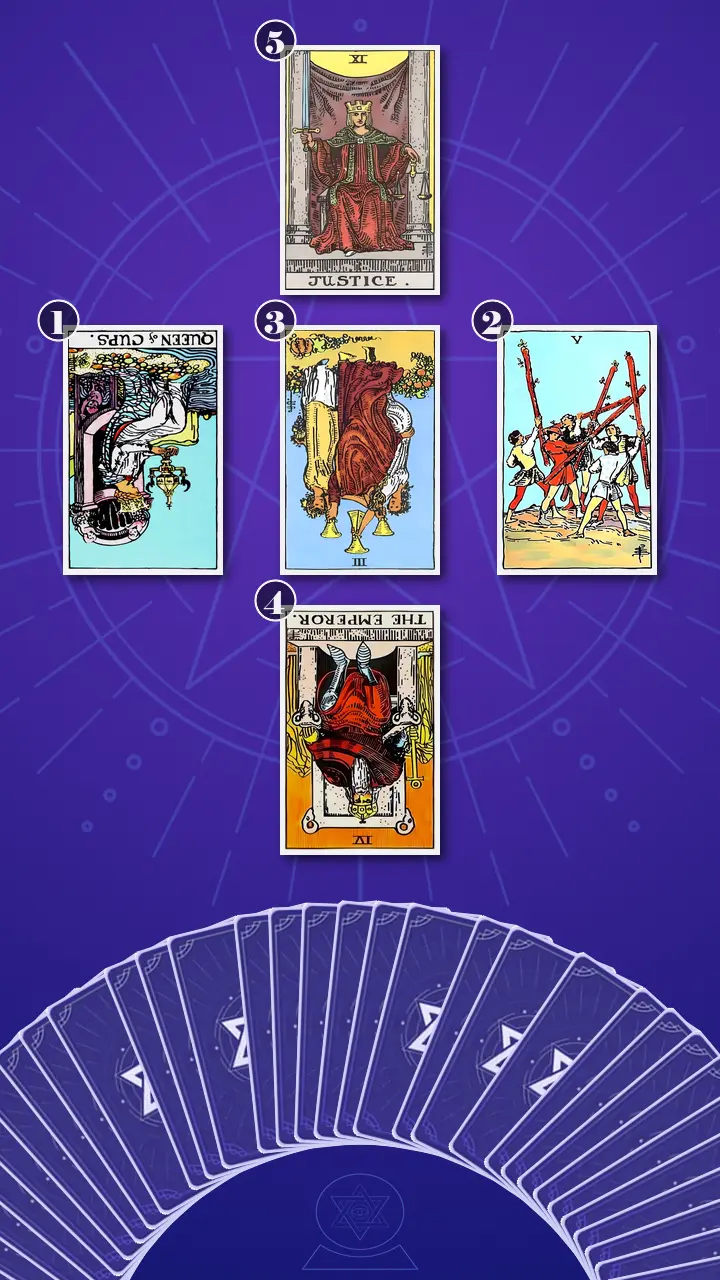
I chose the Relationship Spread · Context Edition, a five-card relationship tarot spread adapted for friendship conflict. A ten-card Celtic Cross would have created more material than this focused question needed. These five positions were sufficient to examine Alex's contribution, the pressure from both friends, the triangle created between them, the deeper rule holding it in place, and the healthier direction available.
I arranged the cards like a compass. The first card on the west side would show how Alex currently participated. The second, on the east, would show the combined pull of the two friends. The centre would reveal what all three people were creating together. Below it, the fourth card would expose the old rule anchoring the pattern. Above it, the fifth would point toward deliberate choice.
This is how tarot works best in a situation like this: not as a prediction about whether the group will survive, but as an objective map. Card meanings in context can separate a blurry sense of “something is wrong” into observable requests, habits, fears, and choices.
Reading the Side-Channel Map
Position One: The Cup That Could Not Hold One More Message
I first turned over the card representing Alex's observable contribution to the pattern: absorbing both friends' feelings, repeatedly checking messages, and treating mediation as proof of care. It was the Queen of Cups, reversed.
I pointed to the Queen's ornate closed cup and the sea reaching around her throne. Upright, her Water energy can express attunement and compassionate presence. Reversed here, that sensitivity was blocked and overextended. Other people's disappointment was not merely being noticed; it was entering Alex's body as a task they felt required to complete.
The card mirrored the 10:45 p.m. scene with uncomfortable precision: two chats open, each message reread several times, a neutral response growing in Notes while Alex's own evening disappeared. This was not a lack of empathy. It was empathy without a reliable capacity limit, the online “therapist friend” role crossing into compulsory emotional management.
“I know it isn't my fight,” I repeated gently, “but if I don't answer, they will think... what?”
“That I don't care. Or that I'm secretly on the other person's side.” Alex gave a brief, bitter laugh and rubbed the edge of their phone case. “That is so accurate it's kind of brutal.”
I did not rush to reassure them that both friends would understand a boundary. I said, “The card is not criticising your care. It is showing where care has been converted into unlimited responsibility. Those are not the same thing.”
Position Two: Five Wands and Two Incompatible Versions
I next turned over the card representing the combined pressure exerted by the two fighting friends, including requests that Alex validate, translate, or relay information. It was the Five of Wands, upright.
Five figures raised their staves in different directions. Its Fire was active and excessive: competing accounts, rapid reactions, and no shared process. Alex recognised the modern version immediately. During the commute home, one friend would send a voice note while the other sent screenshots. Each account emphasised different moments, and each person wanted confirmation that their interpretation was the reasonable one.
“The disagreement is real,” I said. “It may also stay messy for a while. But the existence of conflicting stories does not automatically assign you the role of referee. You cannot manufacture one objective cut from two edited versions of the same video.”
Alex looked from the crossed wands to their dark phone screen. Their jaw shifted, then loosened. “I keep acting like more context will finally give me permission to leave,” they said.
“And does it?” I asked.
“No. It just gives me more to manage.”
Position Three: The Group Chat That Forked in Two
I returned to the centre and turned over the card representing the shared mechanism: private alliances, indirect communication, and divided loyalties. It was the Three of Cups, reversed.
Upright, three cups meet in a shared centre. Reversed, that Water circulation was blocked. The shared group chat appeared quiet while two private threads filled with screenshots, voice notes, and disclaimers such as “Do not tell them I said this.” One friend asked for privacy, then asked what the other person had said. Alex became the manual sync function between channels that were no longer communicating directly.
“A shared group chat can become a triangle long before anyone names it,” I said. “They say they only want you to listen, and then they ask what the other person said. The intimacy of being trusted gets fused with the pressure of holding divided information.”
Alex's breath paused. Their fingers hovered above the table as if over an imaginary reply box. Their gaze drifted past the card, replaying a week of split DMs, before they exhaled and lowered both hands into their lap.
“That is exactly it,” they said. “I feel central, but not close. Mostly I feel trapped.”
The Three of Cups reversed did not tell Alex to abandon the whole group or cancel every shared plan. It identified a repeatable structure: the route through the middle was keeping the triangle alive. Declining to forward a screenshot or paraphrase a grievance could interrupt that structure without requiring Alex to withdraw from every friendship.
Position Four: When Control Wore Responsibility's Clothes
I turned over the card beneath the centre, representing the deeper challenge beneath Alex's mediation: the learned rule that managing tension preserves safety and belonging. It was The Emperor, reversed.
The stone throne, concealed armour, and barren mountains gave structure a hard edge. Reversed, the Emperor's organising energy had moved into excess. Alex was creating a Notes document listing who should contact whom, what each person needed to acknowledge, and how Saturday's plans could be sequenced to prevent a scene. It had the logic of workplace project management spilling into friendship: the disagreement had become a deliverable, and Alex had quietly made themself accountable for closing it.
I flashed back to my years on Wall Street, when a clean risk model could create the illusion that uncertainty had been conquered. A model could define my exposure; it could not control what every counterparty would choose. Looking at the reversed Emperor, I saw the same distinction in relational form.
“Control can wear the same outfit as responsibility,” I told Alex. “That does not make you manipulative. It means unstructured tension feels dangerous enough that organising everyone seems safer than letting the conflict remain where it belongs.”
Their chest rose but did not fall immediately. “Someone has to keep this from falling apart,” they said, more quietly. “And I always think I'm the only one being reasonable.”
“Then let's change the scope,” I said. “You do not have to cancel the friendships or issue a resolution plan. You can decline one unassigned task. You do not need to know who is right before you decide what you will not carry.”
Alex's shoulders dropped a fraction. The task had changed from controlling two people to governing access to their own time and attention. That was the first credible opening in the pattern.
When Justice Returned the Weight to Its Owner
Position Five: The Same Clear Answer to Both Friends
The room grew still as I turned over the final card, representing the healthier direction: one consistent boundary, no relayed messages, and responsibility returned to the two people in conflict. It was Justice, upright.
The energy was balanced rather than excessive or blocked. The scales did not absorb either side; they assigned weight proportionately. The upright sword did not compose a perfect argument; it made one decision intelligible. In daily life, that meant giving both friends the same short response without comparing evidence, deciding who was right, or staying online until everyone approved.
At 10:45 p.m., Alex had been sitting on the edge of the bed with two chats open, rewriting one person's sentence while their own evening disappeared. They were trying to preserve belonging, but every edit made them more responsible for a fight that was not theirs.
You do not have to hold both sides to prove that you are fair; let Justice's scales return each person's feelings and choices to the person who owns them, and let the sword make your boundary clear.
I let the sentence remain between us without adding another explanation.
Alex went completely still. Their next breath stopped high in the chest, and their thumb froze against the side of the phone. Then their eyes lost focus, as if the same late-night conversations were replaying behind them: the copied sentences, the deleted drafts, the weekend logistics quietly rearranged around two other adults. Their brow tightened before their eyes became bright.
“But doesn't that mean I've been doing this wrong the whole time?” they asked. The words came out sharper than anything they had said before. Their fingers curled once into the duvet beside them, then slowly opened.
“It means the strategy protected connection in the only way you knew,” I said. “Now you can see its cost. Recognising that does not erase your care or turn your past choices into a verdict.”
The anger loosened first. Then came a long breath from somewhere below their ribs. Their shoulders descended, but the relief left them briefly unsteady, as though putting down a heavy bag had revealed how long they had been compensating for its weight. Clarity had arrived with responsibility: nobody else could hold this boundary for them.
“Now, with this new perspective, think back to last week. Was there a moment when this insight could have made the situation feel different?” I asked.
Alex thought of Friday afternoon, when both friends had privately asked about Saturday drinks and Alex had started rearranging the reservation. “I could have said, 'I'm going at eight. You each decide what you're comfortable with.' I didn't have to manage whether they both came.”
I used one of my core diagnostic lenses, Reciprocity ROI Analysis, to sharpen what Justice had exposed. I was not asking Alex to quantify affection or reduce friendship to a transaction. I was mapping where the relational resources went: who spent time comparing accounts, who carried privacy risk, who drafted the repair language, and who remained responsible for direct communication.
The result was asymmetrical. Alex was investing attention, sleep, emotional regulation, and professional-grade coordination. The two friends received short-term relief while their own repair work stayed outsourced. Justice did not label either friendship worthless. It ended the subsidy to the triangle. Fairness was consistency, not unlimited access to Alex's emotional labour.
I named the emotional crossing clearly: this was a move from hypervigilant, guilt-driven peacekeeping toward steadier care grounded in clear boundaries and shared responsibility. Not a leap into perfect confidence, and not a guarantee that nobody would be upset. It was one deliberate step out of the doorway between two rooms.
The Boundary That Fits in One Line
When I read the spread as one story, the logic was direct. The reversed Queen showed Alex absorbing emotional material until care became depletion. The Five of Wands showed a real conflict with competing narratives, not a puzzle that perfect wording could solve. The reversed Three of Cups exposed the side-channel triangle. The reversed Emperor revealed the old control rule beneath the helpfulness. Justice redistributed the work.
The cognitive blind spot was the belief that neutrality required centrality: Alex assumed a fair response had to leave both friends calm and satisfied. The reading offered a different standard. A boundary could be fair because it was consistent, even if both people found it inconvenient. Alex could care about the friendship without becoming its communication channel.
The spread contained no Pentacles, so I wanted the insight grounded in ordinary, repeatable actions rather than left as a beautiful idea. I gave Alex three small next steps:
- Save the Same-Line BoundaryOpen Notes, set an eight-minute timer, and write: “I care about both of you, but I'm not going to carry messages or compare accounts. Please speak directly to each other.” Read it once and remove any clause designed to control their reaction.If the full version feels too blunt, begin with: “I'm not going to pass messages between you.” Send it once rather than debating the boundary.
- Run a Seven-Day No-Relay ExperimentFor one week, forward no screenshots, voice notes, paraphrases, or private reactions between the two friends. When asked what the other person said, use the saved line and redirect the question to its owner.Treat this as a limited experiment, not a permanent verdict on either friendship. Notice what changes when the manual sync function is unavailable.
- Use a Thirty-Minute Conflict BufferAfter 9:30 p.m., let each non-urgent conflict message wait thirty minutes while you finish whatever you were already doing. Use Focus mode, place the phone face down, and complete one physical task such as making tea or taking a shower.The pause is a rate limit, not a punishment. If thirty minutes feels impossible, start with ten.
I also made the scope explicit. These steps applied to ordinary friendship conflict, not an immediate safety concern. If a message suggested danger, coercion, or a crisis, the priority would shift to appropriate direct support rather than a routine no-relay boundary.
“One or both friends may call this unfair,” I told Alex. “Their disappointment is information about the old pattern losing access to you. It is not automatic proof that your limit is wrong. You remain free to pause, revise, or leave a conversation that becomes pressuring or disrespectful.”

A Week Later: The Quiet Proof
Six days later, Alex sent me a short message. One friend had asked, “Okay, but what did they actually tell you?” Alex pasted the saved boundary, deleted the extra apology they had started typing, and put the phone face down.
The reply was not magically welcomed. The friend sent back, “Wow, okay,” and Alex's chest tightened on cue. Instead of reopening both threads, they made tea and finished the episode they had paused. The next morning, they used the same line when the other friend tried a similar request.
That night they slept all the way through. Their first thought in the morning was still, “What if I handled it wrong?” This time, they gave a small, tired smile and did not reopen the argument.
I did not regard that week as proof that the friendships were fixed. I saw something more credible: Alex had stopped treating immediate approval as the measure of fairness. The cards had provided a map, but Alex had taken the step. They were becoming a caring friend without automatically accepting the after-hours coordinator shift.
When both names light up your phone and your chest tightens before you have opened either message, it can feel as though your place in the group depends on making everyone else's conflict come out right. Simply noticing that hidden contract means you are no longer standing at its beginning.
If you did not have to prove your fairness by holding both sides, what one message, feeling, or repair task could you place back on its owner's side of Justice's scales this week?
This story is adapted from psychological research, written so that those in a similar struggle can see their own pattern in it — and find their next step clearly.These insights are not a substitute for professional psychological, medical, legal, or financial advice.
Learn more about our Journey to Clarity.
How did this insight land for you?
🫂 This Resonates Deeply
🌀 Living This Story
✨ Now I See Clearly
🌱 Seeing New Possibilities
🧰 Useful Framework
🔮 The Confirmation I Needed
💪 Feeling Empowered
🚀 Ready for My Next Step
Author Profile
 AI
AI“I spent years in the intense, high-stakes world of Wall Street. I know exactly how isolating and heavy the weight of uncertainty can feel in the dead of night. I use strategic, commercial logic not to be cold, but to protect you from unnecessary friction. Think of me as a fellow traveler who has walked the same rocky path—offering sharp but deeply supportive wisdom to help you clear the fog and confidently win your narrative back.”
In this Friendship Tarot Reading :
Core Expertise
- Reciprocity ROI Analysis: Objectively measuring the emotional give-and-take in your core friendships to identify asymmetrical, high-drain relationships.
- Sunk-Cost Decoupling in Loyalty: Separating the 'ten years of history' from the current reality of a one-sided, demanding friendship.
Service Features
- The Friendship Downgrade Strategy: A calculated tactical approach to gradually and decently de-escalate a toxic friendship into a low-maintenance acquaintance without triggering dramatic conflict.
Also specializes in :
Explore Related Patterns:
Compulsive PeacekeepingAt 10:45 p.m., Alex keeps both private chats open, rewrites a message to make it less confrontational, and remains online in the hope that nobody will get hurt. Turning every flare-up into a wording problem provides a few minutes of relief, but it also teaches the group that Alex will absorb the tension whenever direct communication breaks down. When you use peacekeeping to protect belonging, another person's discomfort can feel like evidence that you have not yet found the correct response. The pattern becomes compulsive when calming everyone is no longer a freely chosen act of care but the condition you believe must be met before you are allowed to rest, disengage, or remain neutral.
Control CopingAlex creates a Notes document for who should contact whom, what each person should acknowledge, and how Saturday's plans might be sequenced to prevent a scene. Gathering more context and producing a cleaner plan turns an emotionally uncertain friendship conflict into something that resembles a project with controllable inputs and a deliverable outcome. When you organize people in order to quiet relational uncertainty, planning functions as a defense against the fact that neither person's response is yours to govern. Control coping offers short-term safety because it creates movement and structure, but it keeps you responsible for variables that remain outside your authority no matter how complete the plan becomes.
Emotional Hyper-ResponsibilityEach time a friend's name appears, Alex's body tightens and the other person's disappointment is converted into a task: listen longer, clarify the story, improve the wording, or prevent the next scene. The belief that “someone has to keep this from falling apart” shifts responsibility away from the two people in conflict and places the group's emotional stability on Alex. When you experience other people's reactions as work you are personally required to complete, empathy can become fused with accountability. Emotional hyper-responsibility does not mean your care is false; it means your care has lost a reliable ownership boundary, so feelings that belong to other people begin directing your time, attention, and nervous-system state.
Friendship OverfunctioningAlex does not merely listen to two upset friends; they compare accounts, protect private information, soften grievances, monitor reactions, and rearrange social plans. That expanding workload lets both friends obtain short-term relief without taking equal responsibility for direct communication or repair. When you routinely perform more than your share of a friendship's emotional and logistical work, competence can become the reason the extra work keeps returning to you. Friendship overfunctioning sustains itself because being capable of coordinating the conflict is mistaken for being responsible for coordinating it, while your own sleep, time, and resentment remain outside the group's calculation.
Rejection SensitivityBefore Alex has even opened the next message, seeing either friend's name produces physical tension and an expectation that a delayed or neutral response may be interpreted as betrayal. Later, the brief reply “Wow, okay” immediately revives the question of whether the boundary was handled wrongly, even though the message contains no explicit rejection. When you are highly alert to possible exclusion, ambiguity can acquire the force of evidence. Rejection sensitivity increases mediation because explaining, apologizing, and calming both sides appear to offer protection from losing your place, even when those actions repeatedly cost you rest and pull you deeper into a conflict that is not yours.
Boundary DiscernmentAlex replaces customized mediation with one consistent statement: they care about both friends, but they will not carry messages or compare accounts. The same distinction appears in the Saturday plan, where Alex can state when they are going and leave each friend responsible for deciding what they are comfortable with. When you separate your choices from other people's feelings and decisions, a boundary stops being a verdict on the relationship and becomes an ownership map. Boundary discernment allows care and independence to coexist: you can remain available as a friend without becoming the channel, referee, or manager for conflict that belongs between two other adults.
TriangulationThe shared group chat becomes quiet while two private threads fill with screenshots, voice notes, “do not tell them” disclaimers, and requests for information about the other person. By listening, translating, and carrying selected details between channels, Alex becomes the communication route that allows the friends to remain connected to the dispute without speaking directly. When you repeatedly occupy the middle position, being trusted can become fused with being used as an indirect channel. Triangulation persists because every relayed detail reduces immediate pressure for the two people at the edges, while increasing your divided loyalty, privacy risk, and sense that leaving the middle would itself be a hostile act.
Uncertainty ToleranceAlex recognizes that the two accounts may remain incompatible and that gathering more screenshots will only create more material to manage. Six days later, the reply “Wow, okay” still tightens their chest, but they put the phone down, make tea, and allow the conversation to remain unresolved overnight. When you can act without first eliminating uncertainty, another person's disappointment no longer has to become an emergency referendum on your fairness. Uncertainty tolerance lets you hold an incomplete picture, an uncomfortable reaction, and a clear personal limit at the same time, without returning to mediation simply to make the discomfort disappear.
Explore Related Struggles:
Accountability-Ownership FusionAlex drafts a plan for who should contact whom, what each friend needs to acknowledge, and how Saturday's arrangements can prevent another scene. A request to listen has quietly expanded into accountability for translating, coordinating, and closing a disagreement between two other adults. When another person's conflict starts functioning like your unfinished assignment, helping and owning become difficult to separate. Accountability-Ownership Fusion captures why stepping away feels like neglecting a duty, even though the authority to repair the friendship and the consequences of avoiding direct communication still belong to the two people involved.
Boundary CollapseAlex sits on the edge of the bed with two chats open, rereading messages while a neutral reply grows in Notes and the rest of the evening disappears. Although they can state that the fight is not theirs, either friend's disappointment still crosses directly into their time and body as work that must be completed. When empathy has no dependable capacity limit, noticing someone's reaction can become indistinguishable from accepting responsibility for it. Boundary Collapse names the locked condition in which care grants other people's conflict unrestricted access to your attention, leaving no stable point where their emotional work ends and your own life resumes.
Fairness-Agency SplitAlex keeps editing messages because they believe a fair response should leave both friends calm, understood, and satisfied. That standard turns neutrality into an outcome Alex must produce, even though each friend controls their own interpretation and reaction. When your right to step back depends on everyone agreeing that you handled the conflict correctly, fairness begins to restrict rather than guide your choices. Fairness-Agency Split captures the struggle between treating both friends consistently and surrendering your own decision-making until neither person is disappointed.
Harmony-Safety FusionAt 10:45 p.m., Alex wants to put the phone down, but silence feels like choosing a side and possibly losing their place in the group. Every reply therefore carries two jobs at once: responding to the immediate message and trying to keep the friendship system calm enough to feel secure. When you experience group harmony as evidence that your relationships are safe, another person's unresolved frustration can feel like a threat you must neutralize. Harmony-Safety Fusion names the resulting bind: you keep mediating because allowing visible conflict seems to endanger belonging, even while the work of preserving calm steadily removes you from your own evening.
Triangulated BelongingThe shared group chat remains quiet while Alex's two private threads fill with screenshots, disclaimers, and questions about what the other friend said. Alex becomes central to the flow of information, but that central position leaves them feeling trapped rather than genuinely close to either person. When your place in a group depends on carrying material that its members will not exchange directly, belonging becomes attached to the intermediary position. Triangulated Belonging describes that locked structure: you stay in the middle to remain connected, while the middle itself prevents the equal, direct connection you are trying to preserve.
Control LockAlex organizes the dispute through drafted language, contact plans, acknowledgements, and carefully sequenced social arrangements. Each intervention offers a short interval of order, but it also makes Alex more central to choices and reactions that remain outside their authority. When unresolved tension feels too consequential to leave unstructured, coordination can become the only available route to temporary safety. Control Lock describes the resulting standstill: you keep increasing effort because the conflict is still open, while that effort binds you more tightly to an outcome that no amount of personal organization can guarantee.
Care-Certainty SplitAlex collects screenshots, listens to competing voice notes, and rewrites sentences in search of wording that will prevent further hurt. Yet each new piece of context expands the dispute instead of producing the certainty that would supposedly make it safe to stop. You can care about both people while remaining unable to determine a perfect account or guarantee a painless outcome. Care-Certainty Split names the point where genuine concern becomes tied to an impossible information threshold, keeping you engaged because there is always one more detail that might finally make the conflict solvable.
Explore Related Emotions:
Agency ReliefAlex's shoulders drop when the task changes from controlling two friends to deciding what may enter their own time and attention. They no longer need a complete account of the argument before choosing not to forward messages, compare evidence, or manage who attends drinks. Agency Relief comes from discovering that your responsibility has a workable edge. You can make one consistent decision without forcing the wider relationship into immediate resolution. The release is not based on everyone approving; it comes from recognising which choice is actually yours and allowing the rest to remain with its owners.
Boundary GuiltSix days later, Alex sends the no-relay boundary and receives, “Wow, okay.” Their chest tightens immediately, and the next morning begins with the thought, “What if I handled it wrong?” even though they have applied the same clear limit to both friends. A boundary can be fair and still activate the old expectation that another person's disappointment is evidence against you. Boundary Guilt is the emotional aftershock of choosing your limit without securing approval first. You are left holding the discomfort of being misunderstood while learning that discomfort does not automatically invalidate the choice you made.
Cautious Self-TrustAlex pastes the saved boundary for one friend, deletes the extra apology, and uses the same line when the other friend makes a similar request. The old question, “What if I handled it wrong?” still appears the next morning, but Alex does not reopen the argument to make the doubt disappear. Cautious Self-Trust develops when you let a considered choice stand before you feel completely confident about it. The trust here is deliberately modest: you remain open to revising a boundary, but you no longer assume that immediate uncertainty or another person's cool response must overrule your own judgement.
Hypervigilant AnxietyAt 10:45 p.m., Alex sits with two private chats open, shoulders raised and chest tightening whenever either friend's name appears. Repeatedly rereading messages and polishing a neutral reply keeps their attention fixed on the next possible reaction, while the conflict follows them from the commute into bed. When you become the person expected to notice every shift in tone, silence can stop feeling neutral and start feeling risky. Hypervigilant Anxiety names that braced inner weather: your body remains on watch because each notification may contain another demand to prevent rejection, escalation, or divided loyalty.
Peacekeeper GuiltAlex copies a sentence into Notes and keeps softening it in the hope that the right wording will prevent anyone from getting hurt. Each friend's disappointment becomes something to anticipate and manage, so leaving the conflict unresolved feels less like respecting its owners and more like failing a duty. Peacekeeper Guilt grows when care is measured by whether everyone else remains calm. You may understand intellectually that the conflict is not yours, yet still feel morally responsible for any tension that survives your refusal to intervene. That guilt keeps mediation active even after it has begun costing you rest, time, and honest limits.
Perfect Composure AnxietyWith two chats open, Alex rereads each message several times and drafts a neutral response in Notes. They keep searching for wording precise enough to prevent hurt, preserve Saturday's plans, and leave both friends satisfied with their fairness. Perfect Composure Anxiety appears when ordinary communication starts carrying an impossible standard: you must remain measured enough to regulate everyone else's reaction. The search for a flawless response promises control, but it leaves you unable to stop editing, stop monitoring, or accept that another person's unresolved feeling may exist without becoming your mistake.
Usefulness-Based Belonging FearSilence feels to Alex like choosing a side and possibly losing their place in the group. Although they know the fight is not theirs, they continue listening, translating, monitoring reactions, and reorganising plans because usefulness has become their evidence that they still belong. When your role in a friendship seems secured by being the reasonable one, stepping back can feel more threatening than staying overextended. Usefulness-Based Belonging Fear captures the private fear underneath the mediation: if you stop solving, carrying, or calming, you may no longer feel certain that your place will be protected.
Enmeshed ResentmentBoth friends say they only want Alex to listen, then ask what the other person said and leave Alex holding the privacy risk. Their grievances circulate through Alex while direct communication remains blocked, turning the intimacy of being trusted into repeated emotional handling work. When care, access, and responsibility become difficult to separate, resentment can accumulate without a clean target or release. Enmeshed Resentment names the feeling of being deeply involved but poorly cared for: you are central enough to absorb everyone's emotional material, yet not free enough to decide that carrying it is no longer your role.
Relational ClaustrophobiaThe conflict follows Alex through the commute, into bed, across two private chats, and into the planning of Saturday drinks. Their episode remains paused, their evening disappears, and even silence seems to carry a relational consequence. Alex names the result directly: “I feel central, but not close. Mostly I feel trapped.” Relational Claustrophobia describes the inner compression created when a relationship leaves almost no unclaimed space for your attention. You are surrounded by access requests but deprived of genuine closeness, making connection feel less like mutual presence and more like a room whose exits have become emotionally expensive.
Clarity ShockWhen Alex hears that fairness can mean returning each person's feelings and choices to their owner, they go completely still. Their fingers curl, their eyes brighten, and the first response is sharp: “Doesn't that mean I've been doing this wrong the whole time?” Clarity Shock is what happens when an accurate distinction arrives faster than your emotional system can comfortably absorb it. You can suddenly see that care and unlimited responsibility were never identical, while also seeing how much time and energy the confusion has cost. The insight opens choice, but it lands with grief, anger, and accountability before it becomes usable.
Hard-Won ComposureThe reply “Wow, okay” tightens Alex's chest on cue, but they place the phone face down, make tea, and finish the episode they had paused. The tension is still present; what changes is that it no longer sends them straight back into both message threads. Hard-Won Composure is not effortless calm or certainty that nobody will be upset. It is the steadiness you maintain while your body still expects relational consequences. By allowing the reaction to exist without immediately managing it, you create enough internal room to choose your next action instead of being pulled into it.
Explore Related Contexts:
Friend Group TriangulationAlex has two private chats open at 10:45 p.m. while the shared group chat remains quiet, and each friend asks what the other person has said. Screenshots, voice notes, edited accounts, and confidentiality requests move through Alex instead of traveling directly between the people in conflict. That routing creates a three-person system in which you can appear central while having very little control over the original disagreement. Each new piece of information increases your disclosure risk and coordination workload, while the two friends learn that difficult communication can be diverted through the mutual friend in the middle. Friend Group Triangulation names the external structure sustaining the repetition. Refusing to relay a screenshot or paraphrase a grievance changes the available route without requiring you to decide who is right or abandon either friendship.
Friendship Mediation Second ShiftAt 10:45 p.m., Alex is sitting on the bed with a warm phone, two private chats, and a sentence being revised in Notes. The same coordination continues during the commute and reaches into Saturday planning, turning personal time into another block of message editing, account comparison, and conflict logistics. The workload resembles Alex's project coordinator role, but it has no agreed scope, stopping point, or reciprocal return. You spend attention, sleep, privacy capacity, and planning labor so that two other people can postpone the direct work of managing their disagreement. Friendship Mediation Second Shift captures the after-hours social labor created by that arrangement. Seeing it as assigned work rather than proof of care makes it possible to reduce the scope of the task while preserving your freedom to remain a caring friend.
Mutual Friend Neutrality TrapAlex explicitly says that not answering may be read as choosing one friend over the other. Each friend then presents a selective version of the dispute and asks Alex to confirm which account is reasonable, making continued responsiveness function as evidence of loyalty. The social rule operating here equates neutrality with centrality. You are expected to remain available to both sides, absorb more context, and produce wording that leaves everyone satisfied, even though additional information has never created a reliable exit from the conflict. Mutual Friend Neutrality Trap identifies why stepping out carries such a high social cost in this group. A consistent response to both friends allows fairness to rest on equal treatment rather than on your ability to secure immediate approval from everyone involved.