The 11:47 p.m. Voice Note
If you are the 20-something hybrid worker everyone calls “the safe person,” but a midnight voice note can cancel your sleep plans in seconds, I have learned to recognize confidant burnout rather than dismiss it as a simple time-management problem.
At 11:47 p.m. on a Wednesday, I watched Jordan (name changed for privacy) lie under the duvet in her small Toronto apartment. Her phone was warm against her palm, the radiator clicked in the dark, and three private voice notes waited beneath the blue light of her screen. She opened Do Not Disturb, left the toggle off, and moved tomorrow’s morning walk to another day while her jaw tightened.
The latest message began, “Can I tell you something, but you cannot tell anyone?” Jordan pressed play. She wanted to sleep, but being unavailable felt dangerously close to being disloyal. Nobody had demanded an answer, yet her body responded as though the friendship might disappear if the typing bubble went unanswered.
“Why do I keep protecting every friend’s secret instead of resting?” she asked me. “I can rest after everyone is okay. But I do not even know which feelings are mine by Sunday.”
I could see the contradiction in the way she held the phone: protecting every friend’s secret on one side, allowing herself to rest on the other. Her exhaustion was not an abstract feeling. It was a tight jaw, shoulders lifted toward her ears, and a tired body that remained on alert whenever the screen lit up, like a night watchperson guarding a locked archive long after the building had emptied.
“Being trusted should not feel this heavy,” she said.
“I do not hear a lack of caring,” I told her. “I hear a role that has expanded past your actual capacity. Keeping the secret does not require keeping yourself awake. Let us make a map of the difference between confidentiality, availability, emotional labour, and belonging. That is our Journey to Clarity today.”

The Compass Between Trust and Rest
I asked Jordan to put both feet on the floor, take one slow breath, and name the question she wanted the cards to examine. I shuffled only after the room had become quiet. To me, this is how tarot works at its most useful: the ritual marks a transition from reacting to observing. It does not summon a verdict. It gives the mind a structured surface on which hidden assumptions can become visible.
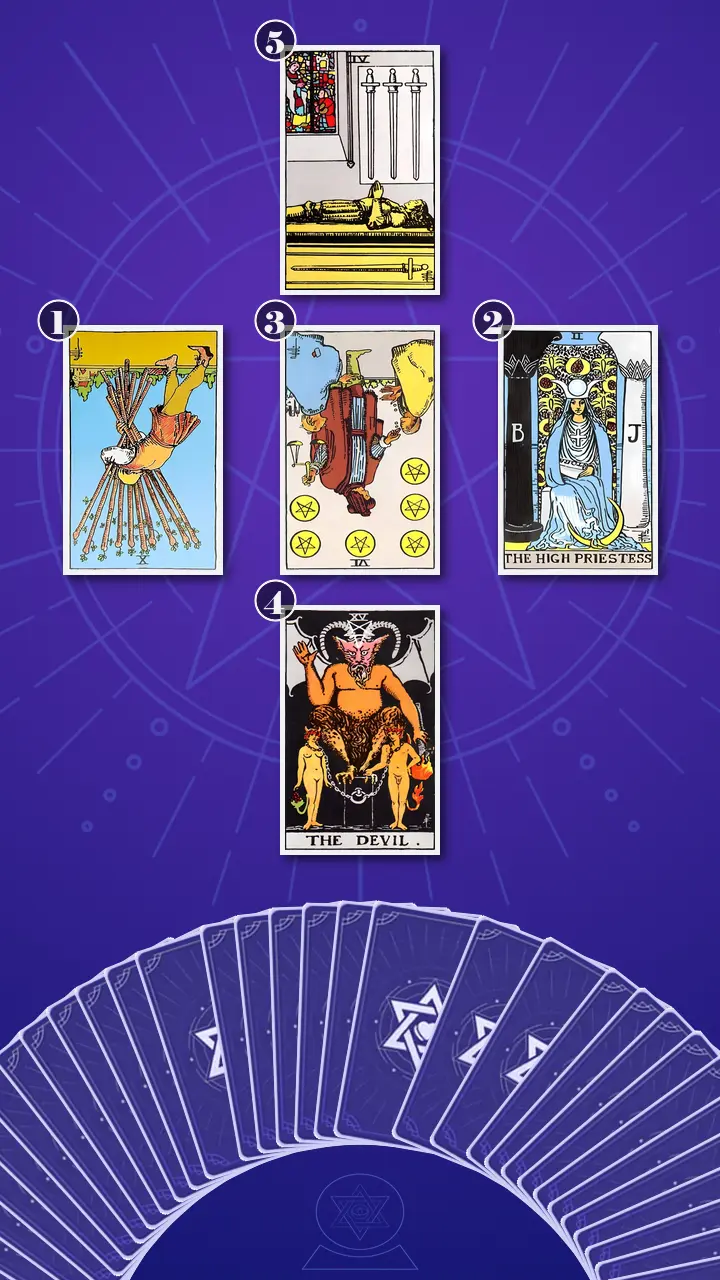
I chose the Relationship Spread · Context Edition. The reason was practical. Jordan’s decisive tension was relational: friendship trust, confidentiality, access, and personal boundaries. A five-card relationship spread was the smallest sufficient structure for separating her role from the group’s expectations, the actual exchange of time and attention, the fear underneath the pattern, and a healthier direction for care.
For anyone searching for tarot reading for friendship boundaries or wondering how card meanings work in context, the positions matter as much as the cards. The first position would show the diagnosis-level behaviour she was carrying. The second would show how her friends collectively related to her as a trusted keeper. The third would expose the shared exchange that turned privacy into one-sided emotional labour. The fourth would reveal the hidden bind beneath her guilt. The fifth would offer an integrating direction: discretion with protected recovery.
I placed the third card in the centre, the first to its left, the second to its right, the fourth below, and the fifth above. The shape looked like a small compass. The horizontal line mapped the relationship. The lower card showed what kept the pattern anchored. The upper card pointed toward a way of caring that did not require Jordan to remain permanently logged in.
The Bundle That Hid Her Own Body
The Ten of Wands, Reversed
I turned over the first card, representing the diagnosis-level behaviour of carrying confidential responsibility beyond Jordan’s actual capacity and refusing to put the role down during recovery time.
It was the Ten of Wands, in reversed position. In its standard meaning, the Ten of Wands speaks of accumulated responsibility and the strain of carrying too much. Reversed, the fire has become excessive and blocked: effort continues, but release and renewal have stopped.
The image showed a figure bent beneath ten staves, the bundle blocking the view of the town ahead. I connected it directly to Jordan’s 11:47 p.m. scene: the workday, several private conversations, tomorrow’s schedule, and a mental permissions map of who knew which detail were all being carried at once. She was listening to one more voice note from bed while her own fatigue, walk, and need for sleep disappeared behind the load.
“One more message, then I will sleep,” I said, following the loop I could hear in her story. “One more check, then I will put it down. The card is not questioning whether you can carry it. It is asking whether carrying it has erased your ability to notice your body and your schedule as equally real responsibilities.”
Jordan did not nod. She gave a small, bitter laugh and rubbed the hinge of her jaw. “That is almost rude,” she said. “I am very good at handling things.”
“I believe you,” I replied. “Competence and capacity are not the same thing. You can carry a responsibility skillfully and still be carrying one responsibility too many.”
Her fingers moved from her jaw to the phone, then stopped. I saw the first small separation between being the reliable person and being available every minute. The Ten of Wands reversed did not ask her to care less. It asked her to stop using exhaustion as evidence that her care was real.
The Veil Between Privacy and Access
The High Priestess, Upright
I turned to the second card, representing how Jordan’s friends collectively related to her discretion, what they assumed the trusted role provided, and which kinds of access had never been explicitly negotiated.
The card was The High Priestess, upright. She sat between contrasting pillars, holding a partially concealed scroll with a patterned veil behind her. Her standard meaning includes privacy, silence, hidden knowledge, and inward awareness. Upright, the energy was balanced receptivity: Jordan genuinely knew how to protect what people shared with her.
I brought the card into the modern life scenario I had heard from her. Her friends knew she would not screenshot a private message, turn someone’s pain into group-chat content, or gossip at a Queen Street restaurant. The trust was real. But “You are the only person I can tell” often arrived before anyone asked whether she had room to receive it.
“The veil is a permissions boundary,” I explained. “It protects information, but it does not require the administrator to stay logged in all night. You can be safe with what was shared without becoming a permanently open container.”
I asked Jordan to picture the packed restaurant where she had filtered every sentence through overlapping confidential information. Cutlery had clinked around her, bass had vibrated through the booth, and she had silently edited ordinary replies because one careless sentence felt capable of costing her everyone’s trust.
“Two things can be true,” I said. “I am good at protecting what was shared. I was never asked whether I had room to receive it. Those are not contradictory statements.”
Jordan’s eyes moved from the veil to the dark pillar. Her mouth softened, but she stayed quiet for several seconds. “I thought saying I was at capacity would mean I was no longer the safe friend,” she said.
“It may mean the safe friend is becoming a truthful one,” I answered. “The High Priestess protects the hidden information, and she also knows when to close the veil.”
The Sunday Afternoon on the Scales
The Six of Pentacles, Reversed
I turned over the third card, representing the shared exchange pattern that repeatedly turns friendship confidentiality into one-sided emotional labour.
It was the Six of Pentacles, in reversed position. Traditionally, this card concerns giving, receiving, resources, and balance. Reversed, the scales show resources flowing without an honest measure of what the giver can sustain.
I took Jordan to the Sunday scene she had described: at 3:12 p.m., she paused a grocery order when a friend asked for “ten minutes.” Forty-eight minutes later, rain tapped the window, her tea had gone cold, and hunger had made her stomach feel hollow. She was still writing a follow-up message because ending the call felt like proof that she did not care.
“What did you actually agree to give?” I asked. “Ten minutes of listening, or an hour of listening, analysis, reassurance, follow-up, and the quiet part of your Sunday?”
The reversed scales did not make the friend a villain. Jordan’s friends might care about her deeply. The imbalance was in the structure of the exchange: her clearest attention was repeatedly distributed after a workday full of coordination, while her recovery remained invisible. A request labelled quick chat could expand across the whole window because no end time had been set.
I offered her a simple capacity check: “Is this urgent? Are you looking for ten minutes of listening, practical advice, or help finding another kind of support? And do I actually have that capacity tonight?”
Jordan looked down at her hands. I watched her silently reconstruct a recent call, then count the things she had given beyond the original request. Her shoulders lowered by a fraction. “I gave much more than I said yes to,” she murmured.
“That is the first piece of room,” I said. “Generosity becomes sustainable when its size and timing are visible before you offer it.”
The Loose Chain Called Belonging
The Devil, Upright
I turned over the fourth card, representing the underlying fear and martyr attachment that equate usefulness, constant access, and silent endurance with belonging.
The card was The Devil, upright. I told Jordan immediately that I was not reading it as a prediction or a threat. In a psychological reading, The Devil can show attachment, compulsion, shame, and a role that feels more absolute than it really is. The figures’ chains were visibly loose, yet the central presence made them feel fixed.
The modern scene was 12:06 a.m. Jordan had placed her phone face down after telling a friend she would reply tomorrow. No friend had imposed a twenty-four-hour access rule. Still, her heart had sped up, her hands had become restless, and the quiet bedroom had started to feel unsafe. Her mind had supplied its own verdict: unavailable tonight equals unreliable forever.
“No one has to demand permanent access for you to feel trapped by it,” I said. “The chain is being maintained by guilt, fear of exclusion, and the short-term relief of feeling indispensable. That does not make the fear silly. It means fear is not the same as evidence.”
Here I used my Guilt-Trip Deconstruction lens. I separated the subconscious sequence into three parts: the trigger, the prediction, and the payoff. The trigger was a notification. The prediction was that a delayed reply would expose Jordan as disloyal and cost her belonging. The payoff of replying immediately was a brief drop in guilt. The long-term cost was lost sleep, hypervigilance, and resentment.
I also ran a gentle Savior Complex Audit, not as a diagnosis and not as an accusation. I asked whether Jordan was responding to an actual request or trying to prevent another person from ever feeling disappointed, distressed, or alone. “Protecting a friend’s privacy is one responsibility,” I said. “Rescuing every friend from every uncomfortable feeling is a different role.”
Jordan’s breath paused. Her eyes went unfocused as if a familiar scene were replaying behind them. Her fingers tightened around the edge of her sleeve, then slowly released. “If I am unavailable, they might realise I am not actually the safe one,” she said, so quietly that I almost missed it.
“Let us compare that prediction with the evidence,” I replied. “Has anyone told you that your friendship depends on overnight access, or has your nervous system learned to treat guilt as an instruction?”
She stared at the loose chains. After a long silence, she exhaled through her nose. The release was not complete, but it was honest. The card had located the hidden contract: Jordan had mistaken a repeated role for an unbreakable promise.
When the Four of Swords Let the Archive Close
The Resting Figure Above the Three Swords
I slowed down before turning to the fifth card. The room seemed to narrow around the small spread, and even the radiator fell quiet.
I turned over the card representing how Jordan could integrate discretion with protected recovery through explicit limits and temporary unavailability.
It was the Four of Swords, upright. The reclining figure rested in a protected chamber beneath three suspended swords, with one sword placed below and a stained-glass window marking the boundary between inner and outer space. In its standard meaning, this is deliberate rest, retreat, recuperation, and mental integration after strain. Upright, the air was clear and balanced. The concerns had not vanished; they had simply been held out of immediate action.
I connected it to a practical scene: Jordan activates Do Not Disturb for a defined overnight window, leaves a confidential message unopened until the time she has consciously offered, and goes to sleep without drafting an apology. The High Priestess’s veil and the Four of Swords’ chamber protected two different interiors. One guarded other people’s information. The other guarded Jordan’s depleted mind and body.
At 11:47 p.m., the warm phone, the moved walk, and the old fear were still present in the image. She was still caught between the urge to answer and the belief that silence might cost her belonging.
You do not prove loyalty by staying mentally on guard; choose a protected pause, like the resting figure beneath the three suspended swords.
I let the sentence settle before adding, “Keeping the secret does not require keeping yourself awake; rest is the boundary that lets care remain a choice.”
Jordan’s breath stopped, and her thumb stayed suspended above the screen. For a moment, her face went blank. Then her eyes lost focus as she replayed the moved morning walk, the unopened grocery order, and every ordinary evening she had surrendered to someone else’s urgency. The radiator clicked once and went silent, making the room feel briefly larger. Her fingers tightened around her sleeve, then loosened. A small, shaky “Oh” came from the centre of her chest. Her shoulders dropped, but the release brought a faint dizziness, the strange emptiness that can follow setting down a weight carried for too long. She looked relieved, then suddenly vulnerable, as though clarity had handed her a choice she could no longer outsource to guilt.
“Now use this new view to remember last week,” I said. “Was there a moment when protecting the information did not actually require you to keep receiving it? What might have felt different if you had allowed the pause?”
Jordan looked at the upper card again. “I would still have cared,” she said. “I just might not have made care prove itself through exhaustion.”
This was the first step from exhausted vigilance toward sustainable care: not the promise that guilt would disappear, but the recognition that guilt could be present without becoming the decision-maker. The card returned ownership to Jordan. The pause was hers to choose, adjust, and protect.
From Carrying Everything to Choosing What Is Mine
When I placed the cards together, the story became clear. The Ten of Wands showed effort continuing without renewal. The High Priestess showed why Jordan had become the group’s trusted keeper, while also showing that a veil controls access rather than requiring endless availability. The reversed Six of Pentacles revealed the invisible charges she kept paying: time, follow-up, lost sleep, and careful social filtering. The Devil turned that unequal exchange into an identity-level contract, where usefulness seemed to purchase belonging. The Four of Swords changed the architecture entirely. It did not ask her to expose anyone’s secret. It asked her to close the archive for a defined period and return with real capacity.
Jordan’s blind spot was treating the guilt after a boundary as proof that the boundary was wrong. The deeper shift was from automatic twenty-four-hour confidentiality labour to explicit agreements about when she could listen, what she could hold, and when she needed to pause. That is the heart of loyalty versus boundaries in friendship: trust can include discretion without requiring permanent access.
“The cards are not deciding who you must be,” I told her. “They are showing the rule you have been obeying. You are the person who can revise it. A pause turns care from an automatic duty back into a voluntary act.”
I gave Jordan three small experiments. They were actionable next steps, not tests of whether she was a good friend.
- The Closed Archive WindowChoose one evening this week, such as Thursday from 9:30 p.m. to 7:30 a.m., and schedule Do Not Disturb or Focus mode. Allow calls from genuine emergency contacts if that feels right, then place the phone outside arm’s reach for the first ten minutes after getting into bed.Start with ten minutes if a whole evening feels too large. The first urge to check is a body response, not an obligation to reopen access.
- The Confidant Capacity CheckBefore accepting the next serious conversation, open Notes and write three lines: energy out of 10, time genuinely available, and what I am willing to offer. Then ask, “Is this urgent, and are you looking for ten minutes of listening, advice, or practical help?” If the request exceeds the available space, offer a specific reply window instead.Use less than you think you can promise. A warm limit such as “I care about this and can listen tomorrow after 6” is more honest than an exhausted yes.
- The Compassionate Detachment ProtocolSave a reply in the phone’s text replacement settings: “You can tell me, but I may not be able to respond until tomorrow. Is that okay?” When needed, validate the feeling, name your limit, and return responsibility without absorbing the whole crisis: “I hear that this is heavy. I cannot take it in tonight. I will not share what you told me, and I am going offline now.”Keep the script short and do not disclose someone else’s information to justify your boundary. Privacy can remain intact while your attention becomes unavailable.
I reminded her that these were experiments, not commandments. She could shorten the window, revise the script, or stop if a situation felt unsafe. The goal was not perfect boundary-setting. It was to create enough space for a choice to exist before guilt made it for her.

A Quiet Proof, Not a Perfect Ending
A week later, I received a message from Jordan while I was making tea. She had used the capacity check before a late-night voice note and sent a reply window instead of answering immediately. The friendship had not transformed into a flawless system, and she still felt a flicker of guilt. But she had stopped treating that flicker as evidence.
She wrote, “I told her I could listen tomorrow after 6. I slept. I woke up wondering if I had been selfish, but the message was still there and so was the friendship.”
She had not solved every secret, repaired every pattern, or become permanently calm. She had created one protected pause and discovered that trust could survive the quiet. That was the small proof I wanted her to have: not certainty, but a little more room around her next decision.
When I think back to our Journey to Clarity, I do not remember the cards as magical instructions. I remember Jordan looking at the loose chain, then at the resting figure, and realising that the person who protects a confidence is still allowed to protect her own recovery. She remains the author of what she offers, when she offers it, and what she needs before offering it again.
When the phone lights up after midnight and your tired body becomes alert before you have even read the message, it can feel as though one unanswered notification might cost you the belonging you have worked so hard to protect. But that feeling is a signal to pause, not a sentence about your worth.
If your care did not need to be proved tonight, what small piece of quiet, perhaps one Closed Archive Window beneath the Four of Swords, might you let yourself keep?
Every reading at AceTarot is a journey to connect with inner wisdom and empower the path ahead. This reading shared here is a psychological mirror, not a private record—crafted to reflect universal emotional loops and help restore personal clarity. Please note that these insights do not replace professional psychological, medical, legal, or financial advice, and should not serve as the sole basis for major life decisions.
Learn more about our Journey to Clarity.
How did this insight land for you?
🫂 This Resonates Deeply
🌀 Living This Story
✨ Now I See Clearly
🌱 Seeing New Possibilities
🧰 Useful Framework
🔮 The Confirmation I Needed
💪 Feeling Empowered
🚀 Ready for My Next Step
Author Profile
 AI
AI Giulia Canale
956 readings | 527 reviews
“Having traveled across cultures... I've learned that what we often lack isn't a simple answer, but a moment of being truly understood. I use a Jungian psychological lens to help you deconstruct your subconscious patterns—not to prove anything, but to be the gentle companion who helps you unravel your knots, free of judgment, so you can reconnect with your inner wisdom.”
In this Friendship Tarot Reading :
Core Expertise
- Guilt-Trip Deconstruction: Uncovering the subconscious codependency that forces you to act as an unpaid 'emotional dumping ground' for friends.
- Savior Complex Auditing: Identifying whether your inability to set boundaries stems from a deeply ingrained psychological need to 'fix' others.
Service Features
- The Compassionate Detachment Protocol: A psychological boundary script to validate a friend's emotions while firmly refusing to absorb their psychological toxic waste.
Also specializes in :
Explore Related Patterns:
Boundary DiffusionJordan protects every confidential detail, yet by Sunday she cannot identify which feelings are hers. A friend's permission to disclose has become fused with permission to access her time, attention, analysis, and recovery, even though those are separate relational agreements. You may recognize Boundary Diffusion when caring about another person's privacy makes their emotional material feel as though it must remain active inside you. The boundary around information stays rigid while the boundary around your availability dissolves, creating the paradox of being highly discreet but poorly protected. Separating what you will keep private from when you will listen restores a clear distinction between another person's confidence and your own psychological space.
Emotional Hyper-ResponsibilityJordan's statement that she can rest after everyone is okay turns each confidential disclosure into more than information to protect. The late-night listening, postponed walk, interrupted groceries, and continued follow-up show responsibility expanding from keeping a secret to managing another person's emotional state. You may recognize this pattern when someone else's unresolved feeling starts functioning like a task you are not allowed to put down. Emotional Hyper-Responsibility uses constant availability to prevent guilt and relational uncertainty, but it also gives other people's emotions control over your sleep, attention, and recovery. The useful distinction is that you can respect what someone shared without becoming responsible for making them okay before you rest.
Emotional ReasoningJordan treats the guilt that follows a boundary as evidence that the boundary was wrong, and the feeling of disloyalty becomes more persuasive than the fact that nobody demanded an immediate answer. Her emotional state is allowed to decide what the relationship requires before the available evidence is checked. You may recognize Emotional Reasoning when feeling selfish becomes equivalent to being selfish, or when feeling relational danger becomes proof that a friendship is in danger. Immediate replying then works as a form of short-term self-soothing because it lowers guilt, even while reinforcing the belief that guilt must be obeyed. Jordan's later experiment shows a different interpretation: the feeling can be real without its conclusion being accurate.
Friendship OverfunctioningJordan pauses her grocery order for a promised ten-minute conversation, stays for forty-eight minutes, and then continues the emotional work through a follow-up message. The original request quietly expands from listening into analysis, reassurance, monitoring, and the surrender of the rest of her afternoon. You may recognize Friendship Overfunctioning when you repeatedly contribute more attention and regulation than was requested, discussed, or sustainable. The extra work can create a temporary sense of control and usefulness, but it also prevents the relationship from revealing what would happen if you offered only what you actually agreed to give. Naming the amount, purpose, and end time of support makes care measurable enough to remain a choice.
Guilt-Driven People-PleasingJordan continues a forty-eight-minute call because ending it feels like proof that she does not care, and she leaves Do Not Disturb off because unavailability feels dangerously close to disloyalty. These are not neutral scheduling choices; guilt converts a friend's possible disappointment into a command to remain accessible. You may experience Guilt-Driven People-Pleasing when saying yes offers immediate relief from the fear of seeming selfish, cold, or unreliable. The defense protects belonging in the short term by hiding your actual capacity, while the long-term costs appear as lost sleep, resentment, and boundaries that keep expanding. Feeling guilty after a limit does not establish that the limit was harmful; it can simply mark the moment an established accommodation loop is being interrupted.
Boundary DiscernmentJordan maps the difference between confidentiality, availability, emotional labour, and belonging, then tests that distinction by offering to listen tomorrow after 6. She keeps the information private while closing access to her attention for the night, demonstrating that those boundaries can operate independently. You practice Boundary Discernment when you identify exactly what you are agreeing to instead of treating every form of care as one unlimited package. This is more than saying no; it is the cognitive ability to separate privacy from access, compassion from rescue, and a friend's need from your available capacity. The clearer those categories become, the less guilt can expand a limited offer into permanent responsibility.
Earned Rest TrapJordan tells herself that she will sleep after one more message and that she can rest after everyone is okay. Her morning walk, hunger, cold tea, and fatigue are repeatedly deferred because recovery has been placed behind a condition that may never be fully satisfied. You may recognize the Earned Rest Trap when rest feels legitimate only after every interpersonal concern has been resolved. The rule disguises self-denial as responsibility and creates a sunk-cost loop: the more exhausted you become, the more stopping can seem to invalidate everything you have already carried. Rest is not a reward for completing another person's emotional process; it is one of the capacities that allows future care to remain deliberate rather than compulsive.
Usefulness-Based Self-WorthJordan fears that saying she is at capacity will mean she is no longer the safe friend, and she experiences immediate responding as reassurance that she remains indispensable. Her role is therefore doing identity work: usefulness is not merely something she offers, but evidence that she still belongs. You may recognize Usefulness-Based Self-Worth when reducing what you provide feels like reducing your value as a person. This schema makes a delayed reply feel like an identity threat rather than a capacity decision, so exhaustion becomes easier to tolerate than uncertainty about whether you are still wanted. The friendship surviving Jordan's overnight pause supplies a corrective fact: your place in a relationship does not have to be purchased through permanent access.
Relational HypervigilanceJordan's jaw tightens and her shoulders rise whenever the screen lights up, while ordinary restaurant conversation requires constant monitoring of who knows which confidential detail. Her attention stays organized around preventing a possible relational mistake even after the immediate conversation has ended. You may recognize Relational Hypervigilance when neutral signals such as a notification, silence, or a delayed response are scanned for evidence that belonging is at risk. Remaining mentally logged in can feel protective because it promises early control over disappointment or rupture, but it keeps the body responding to hypothetical consequences as though they are already happening. A defined reply window replaces continuous threat monitoring with evidence-based availability.
Cognitive FlexibilityJordan begins holding two facts together: she is good at protecting what friends share, and she may not have room to receive it tonight. After sending a reply window, she also holds guilt beside the evidence that the message and friendship are still there the next morning. You use Cognitive Flexibility when you stop forcing care and self-protection into an either-or choice. The mind can then revise the rigid rule that a safe friend must always be available and replace it with a more accurate formulation: trust can include discretion, limits, and delayed attention. This flexibility does not erase discomfort; it prevents discomfort from narrowing the available interpretation to a single catastrophic conclusion.
Self-AbandonmentJordan moves tomorrow's walk, pauses her grocery order, leaves her tea to go cold, and stays awake while her jaw and shoulders signal strain. Each act is small enough to rationalize, but together they show her body and schedule being removed from the calculation whenever a friend needs support. You may recognize Self-Abandonment when preserving connection repeatedly requires you to act as though your own needs are less real. The defense avoids the immediate guilt of disappointing someone, while the cumulative cost appears as exhaustion, resentment, and difficulty knowing what you feel. Restoring yourself to the decision does not cancel care; it corrects an exchange in which your capacity has been treated as invisible.
CatastrophizingJordan's mind turns one unanswered typing bubble into the possibility that the friendship will disappear, then converts being unavailable tonight into being unreliable forever. The prediction leaps from a temporary delay to a permanent relational verdict without evidence of a twenty-four-hour access rule. You may recognize Catastrophizing when a small boundary is mentally fast-forwarded into rejection, exclusion, or irreversible damage. That forecast makes the safest short-term action appear to be immediate compliance, even when the body needs rest and no actual emergency has been established. Comparing the prediction with what happened after Jordan slept exposes the distortion: the message remained, the friend remained, and the feared outcome did not become fact.
Emotional RegulationJordan pauses with her feet on the floor, uses a slow breath, sends a defined reply window, and goes to sleep while some guilt remains. She does not wait to feel completely calm before protecting the overnight boundary, and the friendship is still present when she wakes. You practice Emotional Regulation when an uncomfortable feeling is allowed to exist without being appointed as the decision-maker. Immediate replying had previously reduced guilt and reinforced the availability loop; tolerating the first wave creates room for a different action. The protected pause therefore regulates emotion without denying it, allowing capacity and evidence to guide the response while care remains intact.
Reflective DistanceJordan puts both feet on the floor, slows her breathing, and reconstructs what happened between the ten-minute request and the forty-eight-minute call. She then separates the notification, the prediction of disloyalty, the immediate relief of replying, and the longer-term cost. You create Reflective Distance when you observe a coping sequence before automatically completing it. That pause weakens the fusion between feeling guilt and obeying guilt because the trigger, interpretation, action, and payoff become separately visible. The point is not to intellectualize away care; it is to recover enough perspective to ask whether the old response still fits the actual situation.
Explore Related Struggles:
Access-Belonging FusionAt 11:47 p.m., Jordan left Do Not Disturb off, moved her morning walk, and listened to another private voice note even though no one had required an answer. You can see access becoming a silent proof of loyalty, with unavailability treated as a possible threat to the friendship rather than as a normal limit on one evening. By 12:06 a.m., the phone was face down but the rule was still active: unavailable tonight meant unreliable forever. The bind is not whether you value privacy; it is that belonging has become attached to remaining reachable, so rest feels like a social risk instead of a legitimate part of the relationship. A delayed reply the following week did not end the friendship, but it gave Jordan evidence that guilt was not an instruction. You can protect what was shared while keeping a closed archive window, allowing belonging to rest on the relationship itself rather than on permanent access.
Self-Erasure ReliabilityAt 11:47 p.m., Jordan's jaw tightened, her shoulders lifted, and she moved her morning walk while listening from bed. By Sunday she could not tell which feelings were hers, because the reliable confidant role had covered the signals from her own body. She later named the rule plainly: she might have cared without making care prove itself through exhaustion. When reliability is measured by how much sleep, hunger, and ordinary space you surrender, being dependable starts requiring you to disappear from the account. You can keep confidential information private without using fatigue as evidence of loyalty. The protected pause in the final scene returns your body and schedule to the same ledger as everyone else's needs, making reliability compatible with caring for yourself.
Boundary Ambiguity LockJordan's friends trusted her with private messages, but "You are the only person I can tell" arrived before anyone asked how much room she had to receive it. You can see the boundary blur in the way confidentiality quietly expands into overnight access, follow-up, and social filtering. At the restaurant, Jordan edited ordinary sentences around overlapping secrets, and in bed she kept the channel open even when the task was only to protect information. The tension sits between a real capacity for discretion and an unmarked edge around when listening ends, leaving you to treat every request as a continuing permission. Naming a time, scope, and return point does not expose anyone's secret. It gives privacy a defined container, so you can remain trustworthy without making your body the place where every unspoken access rule is stored.
Capacity-Obligation FusionAt 3:12 p.m., Jordan paused a grocery order for a "ten-minute" conversation; forty-eight minutes later her tea was cold, she was hungry, and she was still writing a follow-up. You can see the original request becoming a larger obligation before she consciously agreed to its size. The same expansion appears at night, when "one more message" becomes listening, analysis, reassurance, and checking. The issue is not that you care in a simple or measurable amount; it is that the amount you feel required to give becomes fused to the fact that someone asked. A capacity check separates the request from the extra work that may follow it. You can let a friend name whether they want ten minutes, advice, or practical help, then protect the amount of time you actually offered. Care becomes a choice with a visible edge rather than an obligation that grows while you are already depleted.
Explore Related Emotions:
Boundary GuiltAfter you tell a friend that you will reply tomorrow, the message remains unanswered but the discomfort arrives immediately. Your mind treats the feeling after the limit as evidence that the limit itself was wrong, even though nobody asked you to stay awake. This turns a boundary into a moral test. You are not exposing the secret or withdrawing care, yet the act of protecting your time feels like a betrayal of the safe-friend role. Boundary Guilt names the pressure that makes a reasonable limit feel personally disloyal.
Rest GuiltAt 11:47 p.m., you leave Do Not Disturb off, move your morning walk, and press play on another private voice note even though you want to sleep. Your attention has learned to treat rest as a delay in care, so becoming unavailable makes the role of reliable confidant feel unfinished. The moved walk, tightened jaw, and promise of one more message show recovery being made to carry the burden of proving that you care. Rest Guilt names the pressure that turns a legitimate need for sleep into something you feel you must earn after everyone else is okay.
Usefulness-Based Belonging FearWhen you place the phone face down and tell a friend that you will reply tomorrow, no one has imposed a twenty-four-hour access rule, yet your mind supplies the verdict that unavailable tonight means unreliable forever. The friendship role has become fused with constant usefulness, so a pause feels like a threat to belonging rather than a limit on timing. That fear keeps the hidden contract in place. You do not need to keep every person comfortable in order to remain worthy of friendship, but the immediate relief of feeling indispensable can make the old rule feel like evidence. Usefulness-Based Belonging Fear captures the dread that your place with others depends on staying perpetually available.
Standby Mode AnxietyYour phone is warm against your palm, your shoulders lift toward your ears, and your body stays ready whenever the screen lights up. Even under the duvet, part of you remains stationed at the threshold of the next disclosure, as though sleep would mean abandoning a post. The problem is not simply that you receive messages late. The deeper feeling is that you are never fully off duty, so quiet becomes something your body monitors instead of inhabits. Standby Mode Anxiety names the strain of being psychologically logged in while your actual schedule is asking for recovery.
Compassion FatigueBy Sunday, you can list what other people have needed from you, but you cannot easily tell which feelings belong to you. Listening, analyzing, reassuring, and following up have consumed the same inner space that should have held your own rest and emotional processing. The difficulty is not a lack of compassion. It is the gradual thinning of your ability to keep meeting private disclosures with fresh attention when your own reserves have not been restored. Compassion Fatigue names the worn-down feeling created by caring continuously without enough room to return to yourself.
Receptivity GuiltEach time someone says you are the only person they can tell, the disclosure arrives before you have checked whether there is room in you to receive it. The request may be intimate and sincere, but your capacity is treated as available before you have had a chance to name it. You do not appear to feel guilty about protecting privacy. You feel guilty about closing the container. Receptivity Guilt describes the discomfort of needing to stop taking in another person's feelings, even when you have already given more attention than you consciously agreed to offer.
Resentful ExhaustionAt 3:12 p.m., you agree to ten minutes, but forty-eight minutes later the tea is cold, the grocery order is paused, and your body is registering hunger. The exchange has quietly grown to include listening, analysis, reassurance, and follow-up, while the time you needed to recover remains uncounted. The resentment does not erase your care for the friend. It shows what happens when generosity keeps expanding without a visible limit and your own recovery is treated as leftover time. Resentful Exhaustion names the tired bitterness that can accumulate when you keep giving beyond the size of the yes you actually made.
Privacy AnxietyIn the packed restaurant, you filter ordinary sentences through overlapping private details while cutlery and music continue around you. A normal conversation becomes a permissions map, and one careless phrase feels large enough to cost you everyone's trust. Protecting confidentiality has therefore expanded into constant monitoring of your own speech. Privacy Anxiety names the pressure of guarding other people's information so carefully that ordinary connection starts to feel like a field of possible mistakes.
Explore Related Contexts:
Always On AvailabilityAt 11:47 p.m., Jordan had three private voice notes waiting, left Do Not Disturb off, and moved her morning walk after the latest message arrived. The access channel stayed open while sleep and ordinary plans were treated as negotiable, even though no friend had imposed an overnight reply rule. By 12:06 a.m., she had put the phone face down but was still treating delayed access as a possible loss of loyalty, and later she slept after sending a reply window while the friendship remained. When you keep protecting secrets instead of resting, the external problem is not confidentiality by itself; it is a friendship access arrangement that has made immediate availability part of the role. A defined pause gives you a concrete way to keep information private without leaving the archive open all night.
Emotional Labor ImbalanceAt 3:12 p.m. on Sunday, a friend asked Jordan for ten minutes, but the call lasted forty-eight minutes while her grocery order was paused, her tea went cold, and hunger set in. She kept writing a follow-up because ending the call had become evidence, in the moment, that she did not care. That exchange puts time, attention, practical advice, reassurance, and recovery on different sides of the same scale. When you keep giving beyond the original yes, rest is not missing because you lack a better schedule; it has been omitted from the terms of the social exchange. Naming the time and type of support before accepting it makes care measurable enough to remain voluntary.
Friendship Role Lock-InJordan is introduced as the person everyone calls the safe person, and the role expands from keeping information private to receiving, analysing, reassuring, and following up beyond her capacity. She says that naming capacity might mean she is no longer safe, which shows how a social position can harden into a condition of belonging. At the end, the repeated role is described as a hidden contract rather than an explicit rule. You can be trusted with a secret without accepting permanent access; the story makes the role negotiable by separating reliable discretion from being available every minute.
Friendship Secrets GatekeepingFriends tell Jordan she is the only person they can tell, and she has earned that access by not screenshotting, gossiping, or carrying private messages into group-chat content. In the restaurant scene, overlapping disclosures make her filter ordinary sentences, showing that confidential information has become a continuing social management task rather than a single promise. That task protects other people's privacy but also places her in charge of the archive's boundaries. When you protect every secret, the key distinction is whether you are preserving confidentiality or continuing to receive more information than your life can hold. The story supports a closed archive window where discretion remains intact while access is paused.