When “I’m Outside” Feels Like a Tiny Emergency
If you can handle a Figma critique but still read “I’m outside,” lock your phone, and wonder why do I panic when a friend says I’m outside, I hear your question in my café all the time. That specific jolt has a name in my mind: surprise-contact boundary panic.
Casey sat across from me after the lunch rush, hands around an untouched cappuccino, and said, “I know it should be a normal text, but my whole body acts like I did something wrong.”
She told me about 8:47 p.m. on a Tuesday in her Toronto condo kitchen: phone face-up on the counter, kettle clicking off, streetcar brakes hissing through the window, overhead light buzzing like it had opinions. The screen lit with “I’m outside.” She picked up the phone, locked it again, and just stood there in socks staring at a cabinet handle while the tea bag went bitter.
One short text, and her body became a condo intercom wired inside her chest before her mind could even form a sentence. Her chest cinched tight, her stomach dropped, and beneath the panic sat something quieter and meaner: guilt, because she did want the friend in her life—just not through a doorway that made choice feel already gone.
“If you’re already outside,” she said, looking down at the foam ring in her cup, “I feel like I’m already late to a decision.”
I nodded. “That makes sense. We’re not here to judge the alarm. We’re here to see what set it off, and then give your adult self the map back. Let’s do a journey to clarity—one that helps you answer from choice instead of from the adrenaline spike.”

Choosing the Ladder for Surprise-Visit Anxiety
I asked Casey to take one slow breath, keep the exact text in mind, and shuffle while the espresso machine cooled behind us. In my practice, that pause isn’t theatre; it’s the moment the body stops chasing the notification long enough for the mind to catch up.
For her, I chose the Four-Layer Insight Ladder · Context Edition. When someone asks what old fear got activated by one tiny trigger, I don’t need prediction or a sprawling Celtic Cross. I need the smallest spread that can hold symptom, root fear, inner shift, and response without dramatizing the situation.
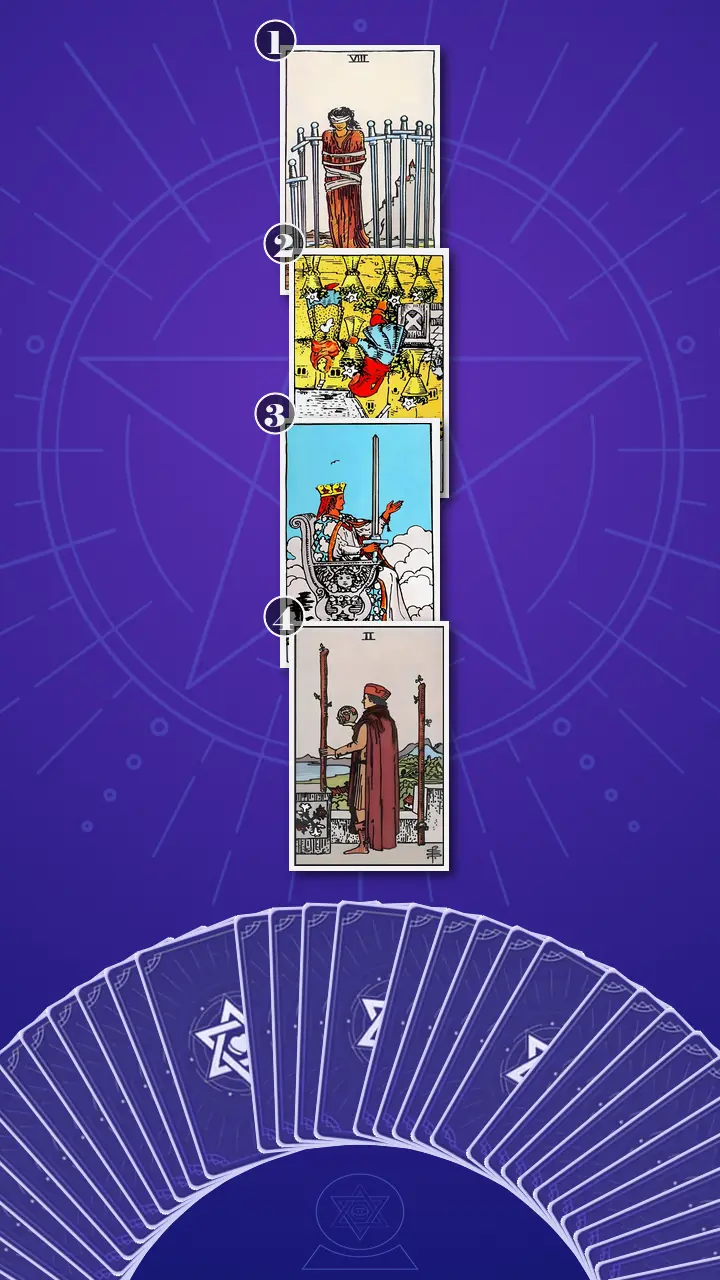
The first card would show the immediate freeze—the part of the night where choice seemed to vanish. The second would reveal the older relational imprint underneath it. The third, the key card, would name the inner shift that restores adult boundary-making in real time. The fourth would turn that insight into a grounded next step: how to reply to surprise contact without self-betrayal or over-explaining.
Reading the No-Choice Story
The Text That Pretends Choice Is Gone
Now I turned over the card representing the immediate freeze response triggered by “I’m outside,” including the sense that choice has vanished. It was the Eight of Swords, upright.
I told Casey this card is almost painfully literal for unexpected-text panic. In her modern life, it looks exactly like standing in her apartment after work, still half in decompression mode, and reading one short message as if the case is already closed: someone is here, therefore a decision has already been made, therefore I am behind. It is the brain turning a casual text into a Black Mirror-style push-notification crisis.
Energetically, this is blocked Air. Thought stops being a tool and becomes a cage. The blindfold on the figure is the single meaning panic gives the text—obligation. The loose bindings and the gap between the swords are the options still available in real life: reply later, say no, ask for notice next time, or simply take ninety seconds before doing anything.
As I spoke, I brought in the apartment-threshold image on purpose: deadbolt, peephole, elevator ding, unread message, phone locked and unlocked again. “The spiral says, ‘They’re here. I’m late. I owe a reply,’” I told her. “But presence is not permission. Your body can panic without getting the final vote.”
Casey’s reaction came in three quick beats. First her breath paused. Then her eyes drifted past me to the dark café window, as if replaying every time she’d checked the lock for no real reason. Then she gave a short laugh with bitterness under it. “Wow,” she said. “That’s accurate enough to be a little rude.”
I smiled. “Only because the card is naming the trap cleanly. The feeling of being trapped is real. The total lack of options is not.”
Adult Phone, Younger Body
Next I turned over the card that reveals the older fear or relational imprint making an ordinary surprise feel emotionally bigger than it is in the present. It was the Six of Cups, reversed.
This is the part people miss when they ask why an unannounced visit or a simple “you home?” text makes them freeze. The friend may be casual, but the body is not reacting to only the friend. In Casey’s life, this card looked like the adult apartment getting overlaid with an older house rule: if someone wants something from you, be available fast, be agreeable first, and do not make disappointment visible.
Reversed, the card shows Water pulled backward. Instead of feeling her current age, she drops into a younger posture—speed-cleaning, dimming lights, rehearsing a harmless excuse, feeling “caught being unready.” The adult phone is in her hand, but a younger protective self grabs it because it still believes speed equals safety.
I have a habit from twenty years of steaming milk: I read layers. In what I call my Milk Foam Layer Analysis, the foam is the surface story and the darker liquid underneath is the truth that gives it weight. The foam here is, “My friend is outside.” The deeper layer is, “If I don’t manage this perfectly, I will lose control and be judged.” That is why the panic arrives with guilt, irritation, and shame all at once.
“So this isn’t proof that your friend is dangerous,” I said. “It’s proof that the text woke up an older script about access and obligation.”
Casey’s shoulders, which had been practically touching her ears when she came in, dropped a fraction. She rubbed her thumb along the paper sleeve of her cup and exhaled through her nose. “Adult phone, younger body,” she said softly. “I hate how right that is.”
“You don’t have to hate it,” I told her. “You only have to stop letting it make the whole decision by default.”
When the Queen Took the Phone Back
The Message That Begins With Truth
When I reached for the third card, the room changed. Outside, a streetcar groaned past the café windows; inside, even the grinder had finally gone quiet. This was the turning point—the antidote card, the one that names the inner shift needed to interrupt panic and restore adult boundary-making in real time.
I turned it over. Queen of Swords, upright.
Up to this point, every card had described the alarm. This one described the adult who answers it. In modern life, she is the part of Casey that sends a clean message like, “I can’t do a drop-in today. Please text me before coming by next time,” and lets clarity do the work instead of a long emotional performance. The raised sword and open hand together say exactly what good boundaries say: clear, human, no extra costume.
Casey was still caught in the thought loop I see so often: How do I make this okay? How do I make this land perfectly? How do I say no without sounding cold, difficult, or ungrateful? That is the moment when tone management usually outruns the truth.
This is not proof that you are trapped or rude; it is your cue to lift the Queen's sword of clarity and answer from choice, not from alarm.
I let the sentence sit between us. Then I added the reframe she needed most. “A surprise text is still a request, not a warrant.”
Her reaction unfolded exactly the way real breakthroughs do—not like movie relief, but like a system updating mid-use. First she went completely still, one hand suspended halfway to her cup. Then her focus loosened and moved somewhere behind my shoulder, replaying old doorways, old drafts, old apologies stacked with too many exclamation points. Then came the unexpected part: a flash of anger. “But if that’s true,” she said, voice tight, “then I’ve been acting like I had less power than I actually do.”
“You’ve been using old protection,” I said gently. “That’s not the same as being weak. It kept trying to solve the problem by over-explaining. But clarity is kinder than a resentful yes.”
In that moment I had one of those small professional flashbacks I still trust. I remembered teaching a new barista to stop an espresso shot on time. Let it run too short, and you get something thin. Let it run too long because you’re scared to stop it, and it turns bitter. My Social Espresso Extraction works the same way in relationships: some moments need short extraction time. Decision first. Optional warmth second. Anything after that is usually guilt trying to look helpful.
“Think of the Queen as good UX microcopy,” I told Casey. “The decision goes in the first line. The message doesn’t need an emotional costume.”
Her face softened so slowly I almost missed it: jaw unclenching, eyes brightening, shoulders lowering with the kind of exhale that starts in the ribs. There was relief in it, but also that slightly dizzy pause people get when the path suddenly becomes obvious and therefore theirs. I asked, “Now, with this lens, was there a moment last week when this could have felt different?”
She nodded. “Friday. Someone texted ‘you home?’ and I spent forty minutes drafting. If I’d just said, ‘Not tonight—text me first next time,’ I would’ve felt shaky for maybe two minutes instead of wrecked for the whole evening.”
That was the real shift. Not from panic to perfection. From panic-driven freeze and guilty stalling to the first edge of self-trusting boundary clarity around surprise contact.
The Doorway Where Adult Choice Starts
Inside First, Answer Second
Finally I turned over the card that translates insight into a grounded next response—how to answer surprise contact without self-betrayal or over-explaining. It was the Two of Wands, upright.
I love this card for apartment buzzer dread and last-minute plan anxiety because its image is pure threshold. In Casey’s real life, it is the moment before she decides whether to open the door, suggest another time, or decline altogether. The wall in the card matters: she is still inside her own space while deciding what kind of access, if any, happens next.
Energetically, this is Fire brought into usable form. Not panic-fire that jumps ahead of her, but contained fire that chooses direction. The practice is simple and surprisingly radical: yes, no, or not now. Those are the three real buttons on the screen, even when adrenaline insists the app is frozen.
“Adult choice starts at the threshold,” I told her. “Inside first, answer second.”
“What changes in your body when you remember the phone in your hand and the door still closed are two separate things?” I asked.
She looked at the card, then at her phone on the table. “It gets quieter,” she said. “Like the situation drops back down to human size. But when it hits, I honestly feel like I don’t even have ninety seconds. It all goes so fast.”
“Then take thirty,” I said. “Both feet on the floor. Unlock the phone once. Say to yourself, ‘I got a request, not a command.’ If breath cues annoy you, pick one fixed object in the room until your shoulders drop even a little. The pause isn’t there to make you zen. It’s there to give choice back.”
She nodded this time without flinching. The nod was small, but it had weight. I could see steadier footing replacing the earlier scramble.
From Tone Management to a Boundary-First Reply
By the time I looked at the whole spread, the story was clear. The Eight of Swords showed the symptom: the moment a friend’s sudden availability felt like a locked room. The reversed Six of Cups showed why that room felt older than the text itself: surprise contact was landing on top of an imprint about instant access, instant niceness, and no time to choose. The Queen of Swords brought the adult boundary-self back online. The Two of Wands turned that clarity into behavior at the exact place it matters most—the doorway, the buzzer, the unread reply.
The cognitive blind spot was subtle but powerful: Casey had been treating other people’s spontaneity as more binding than her own capacity. She trusted a carefully polished tone more than a simple truthful sentence. But the transformation direction was just as clear: from feeling cornered to feeling in choice, from overexplaining in texts to clean boundary language, from “someone is outside so I owe access” to “someone made a request and I get to answer it on my own terms.”
One thing I also noted, because the cards made it impossible to ignore, was the absence of Earth. There was plenty of thought, memory, and activation—but not much grounding. That told me insight alone would not fix surprise-visit anxiety. Casey needed concrete habits, almost embarrassingly simple ones, so the body could learn what the mind now understood.
When people ask me how to tell friends to text before coming over without sounding rude, I usually say this: truth first, tone second. Boundary first. Warmth if you want it. No essay.
So I gave her three practical next steps.
- Build three doorway scripts in NotesTonight, save one two-sentence text for each option—yes, no, and not now. For the no, I suggested: “I can’t do a drop-in tonight. Please text me before coming by next time.” For the not now: “I’m not up for company tonight, but I’d be happy to plan something later this week.”Keep the boundary in the first sentence. If you want warmth, add one line after it—but not an essay. Two sentences max lowers the difficulty and stops guilt from over-extracting the message.
- Use a 30-to-90-second threshold pauseThe next time your phone lights up with “you home?” or “I’m outside,” put both feet on the floor before drafting anything. Unlock the phone once, keep the door closed, and name one present fact: “I got a request, not a command.”If ninety seconds feels impossible, do thirty. If breathing feels irritating, look at one fixed object—the kettle, the counter, the cabinet handle—until your shoulders drop a little.
- Write two lines after the spikeOnce this week, after any surprise-contact trigger, write only: “This reminds me of…” and “Right now, I can…” Make the second line concrete, like “Right now, I can reply in ten minutes” or “Right now, I can say no without opening the door.”This is not a full excavation of your past. One sentence each is enough. The goal is to stop the old script from borrowing your adult phone and making the present-day decision for you.
“You do not have to make your no sound adorable to make it valid,” I told her as I slid the cards back together. “And if someone pushes, repeat the limit once. Clarity is still kinder than a resentful yes.”

A Week Later, the Quiet Proof
A week later, Casey messaged me after work. A friend had texted, “we’re nearby lol.” She used one of her Notes templates and replied within six minutes: “Not up for a drop-in tonight. Please text me first next time.” Then she sat alone at her kitchen counter with reheated tea, staring at the delivered checkmark for a full minute—steady, still a little shaky.
Her friend answered, “All good, next time :)” That was it. No collapse. No social catastrophe. Just one clean boundary, one calm nervous system learning that unannounced visit anxiety does not get to narrate reality forever.
This is why I trust a spread like the Four-Layer Insight Ladder · Context Edition. It does not promise a life without activation. It helps me trace the path from symptom to root fear to inner shift to usable response, until the person in front of me can feel their own agency again.
When one little “I’m outside” text makes your chest lock and your hand hover over the phone, the loneliest part is how fast wanting closeness and wanting control of your own space can start to feel like opposite sides. But they are not opposites. They are two needs that finally stop fighting when you let clear choice stand between them.
So if surprise contact gets to be a request instead of an emergency, what might your next yes, no, or not now sound like in your own voice?
This story is adapted from psychological research, written so that those in a similar struggle can see their own pattern in it — and find their next step clearly.These insights are not a substitute for professional psychological, medical, legal, or financial advice.
Learn more about our Journey to Clarity.
How did this insight land for you?
🫂 This Resonates Deeply
🌀 Living This Story
✨ Now I See Clearly
🌱 Seeing New Possibilities
🧰 Useful Framework
🔮 The Confirmation I Needed
💪 Feeling Empowered
🚀 Ready for My Next Step
Author Profile
 AI
AI“For twenty years, I’ve listened to stories unfold over the warm aroma of coffee. I don’t believe life’s complexities always require grand theories to be solved; often, we just need a safe place to tidy up our reality. I don’t offer high-minded preaching—just grounded, heartfelt insights to help you regain your sense of control amidst the clutter of daily life.”
In this Friendship Tarot Reading :
Core Expertise
Service Features
Also specializes in :
Explore Related Patterns:
Assertive CommunicationThe clean message Casey practices is concrete: "I can't do a drop-in today. Please text me before coming by next time." It starts with the decision rather than with apology, justification, or a long attempt to manage the other person's reaction. Assertive Communication fits because the story's repair is not silence, avoidance, or emotional performance. It is a direct sentence that holds both parts of the relational field: the other person can ask, and Casey can answer from choice. You can see why this matters in the week-later text. She is still a little shaky, but she replies within six minutes and nothing collapses. The point is not perfect confidence; it is the behavioral proof that a truthful boundary can be brief, human, and complete.
Boundary DiffusionThe story keeps returning to the threshold: the phone is in Casey's hand, the door is still closed, and yet her body acts as if access has already been granted. That gap between physical reality and felt obligation is the core of the boundary problem. Boundary Diffusion fits because another person's spontaneity starts to override Casey's internal permission system. The friend's text is only a request, but the old rule underneath says availability should be instant, agreeable, and emotionally smooth, so her own preference becomes harder to locate. You are not looking at a lack of care for the friend. You are looking at a blurred line between closeness and access, where wanting someone in your life gets tangled with feeling unable to choose the terms of contact. The repair begins when presence is separated from permission: the door can stay closed while you decide what kind of answer is actually yours.
Boundary DiscernmentCasey's strongest shift happens when the closed door becomes information instead of pressure. The phone is in her hand, the doorway has not been opened, and the available answers are still yes, no, or not now. Boundary Discernment fits because the practice is about separating a real request from an imagined command. It gives Casey a way to notice where her responsibility ends and another person's spontaneity begins, without turning the friend into a threat or turning herself into the problem. You can see the difference a week later when she replies, "Not up for a drop-in tonight. Please text me first next time." The boundary is direct, but it is not punitive. It lets her stay connected while keeping her own threshold intact, which is the exact adult choice the original panic made hard to access.
Emotional RegressionThe phrase "adult phone, younger body" gives the story its deepest mechanism. Casey is standing in her current apartment with her current choices, but the text activates an older posture: speed-cleaning, rehearsing excuses, and feeling caught being unready. Emotional Regression fits because the present-day trigger temporarily pulls the nervous system into an earlier relational script. The issue is not that Casey cannot think like an adult; it is that the body reaches for an old protective template before the adult self has time to assess the real situation. You can see the split in the story's images: the modern condo, the phone, the closed door, and underneath them the old rule that speed equals safety. Naming the regression gives the adult self a foothold. The question changes from "Why am I like this?" to "Which part of me is answering right now, and does it need to be in charge of this text?"
Freeze ResponseCasey picking up the phone, locking it again, and standing in socks while the tea goes bitter is the clearest behavioral anchor in the story. The body reacts before language arrives: chest tight, stomach dropping, attention fixed on the cabinet handle instead of the actual choices still available. That sequence points to a Freeze Response because the nervous system treats the text as an immediate threat to agency rather than a normal social request. The freeze is not laziness or rudeness; it is a protective pause that has become overactivated, buying safety by suspending action. You can see why it feels so convincing: the message collapses time into urgency, as if the friend being outside means the decision already happened without you. The pattern becomes workable once the pause is reclaimed on purpose, so stillness stops being a trap and becomes the first thirty seconds of adult choice.
Guilt-Driven People-PleasingCasey's guilt arrives right beside the panic: she does want the friend in her life, but not through a doorway that makes choice feel already gone. That detail matters because the distress is not only fear; it is the pressure to keep another person comfortable while her own boundary is still unformed. Guilt-Driven People-Pleasing fits the older house rule named in the story: be available fast, be agreeable first, and do not make disappointment visible. The coping mechanism tries to prevent relational discomfort by moving toward compliance, over-warmth, or apology before Casey has checked what she actually wants. You can feel the pattern in the way a simple no starts needing emotional decoration. The work is not to become colder; it is to stop using guilt as the editor of every boundary. A clean limit can protect the relationship more honestly than a resentful yes that was written to avoid someone's possible disappointment.
Defensive OverexplainingCasey's forty-minute drafting session after a simple "you home?" text shows the pattern in action. The delay is not about lacking words; it is about trying to make a boundary land so perfectly that no one can be disappointed, annoyed, or confused. Defensive Overexplaining fits because explanation becomes a shield against anticipated judgment. Instead of letting the decision carry the message, Casey tries to build enough emotional cushioning around the boundary that it cannot be interpreted as cold or difficult. You can feel how exhausting that defense becomes: the text gets longer, the truth gets buried, and the evening becomes about tone management rather than choice. The shift toward a two-sentence boundary is psychologically important because it lets clarity do the work that overexplaining was trying, and failing, to do.
Explore Related Struggles:
Autonomy Guilt BindCasey's body acts like she did something wrong before she has actually done anything. Under the panic is guilt, because wanting a pause or a no seems to contradict the fact that she cares about the friend. Autonomy Guilt Bind is the old fear that self-direction will be read as harm. You are not only choosing whether to open the door, you are carrying the pressure to prove that your boundary does not make you cold, selfish, or ungrateful. That bind makes every option feel morally loaded. A simple not now becomes a test of whether you are still a good friend, so the body rushes toward agreement before your adult preference has time to speak.
Boundary Ambiguity LockCasey picks up the phone, locks it again, and stands still in her own kitchen while the tea goes bitter. The text has not opened the door, but her body treats the message as if the decision has already happened and she is late to obeying it. Boundary Ambiguity Lock fits because the request arrives in a shape that feels like a command. You get stuck in the first second, before any reply exists, because the line between someone asking for access and someone already having access becomes blurred. The work of clarity here is not to reject the friend or erase the alarm. It is to restore the missing category that the panic removed, where a text can be real, the friend can be nearby, and your answer can still belong to you.
Privacy-Consent SplitCasey says the sharpest part plainly. She does want the friend in her life, just not through a doorway that makes choice feel already gone. The conflict is not friendship versus isolation, but closeness arriving through a format that bypasses her consent over timing and space. Privacy-Consent Split names that exact collision. You can want connection and still need the right to decide when your home, phone, attention, and social energy become available. The panic grows because those two needs start to look incompatible in the moment. The clean boundary restores the missing middle, where care can remain real without turning access into automatic permission.
Then-Now SplitThe adult condo, the closed door, and the phone in Casey's hand are all present-day facts. Yet the text lands on top of an older house rule where wanting something from her meant she had to be fast, agreeable, and careful not to show disappointment. Then-Now Split captures the overlay. You are dealing with a current message, but your body is also responding to an earlier rule about access and obligation, so the present gets crowded by a past version of what safety required. The fear is old because the reaction is bigger than the friend. The friend is outside now, but the speed-cleaning, excuse-rehearsing, and feeling caught being unready belong to a younger posture that has not yet learned the door can stay closed while you choose.
Urgency-Compass FusionCasey says that when the text hits, she honestly feels like she does not even have ninety seconds. The phone lights up, the door feels closer, and someone else's timing suddenly seems more real than her own capacity. Urgency-Compass Fusion names the moment speed replaces discernment. You stop asking what you want, what you can handle, or what kind of access feels right, because the outside pressure starts pretending it already answered those questions. The threshold pause works because it gives the compass one small opening. Thirty seconds with both feet on the floor is not about becoming perfectly calm. It is about letting your own timing re-enter the room before the reply is made.
Voice-Safety FusionOn Friday, Casey spends forty minutes drafting around a simple "you home?" text. The sentence she needs is short, but she keeps trying to make it land perfectly enough that no one can judge the no. Voice-Safety Fusion fits because the truth is forced to pass a safety test before it can leave her phone. You are not missing language. You are waiting for the language to guarantee that you will not sound cold, difficult, ungrateful, or too much. That fusion turns communication into a performance of harmlessness. The clean reply breaks the loop because it lets the boundary carry the message first, with warmth as an option instead of a disguise for fear.
Explore Related Emotions:
Adult Child PanicThe phrase 'adult phone, younger body' lands because Casey is standing in her own condo, holding her own device, yet reacting as if an older house rule has taken over. Speed-cleaning, dimming lights, and rehearsing a harmless excuse all belong to a younger protective posture. Adult Child Panic names the time-slip inside the trigger. For you, the present-day text wakes an older fear that being wanted means being instantly available, agreeable, and unproblematic. Seeing that split gives your adult self the map back. The younger part may still surge forward, but it does not have to hold the phone, write the reply, or decide who gets access tonight.
Boundary GuiltCasey wants the friend in her life, but not through a doorway that makes choice feel already gone. That is why the panic comes with the quieter sting of wanting closeness and wanting control of her space at the same time. Boundary Guilt fits because the no is not cold in her inner world; it feels costly. For you, needing notice can start to feel like you are withdrawing care, even when the real need is simply to keep access consensual. The emotional shift is not toward becoming less warm. It is toward letting warmth exist after the boundary instead of using warmth to erase the boundary before it has been spoken.
Grounded AgencyThe practice begins when Casey keeps both feet on the floor, unlocks the phone once, and reminds herself that the door is still closed. Those details matter because they return the decision to the body that has to live with it. Grounded Agency names the shift from reacting to choosing. For you, the sentence 'I got a request, not a command' creates just enough room for yes, no, or not now to become real options again. This is not a performance of perfect calm. It is agency with a pulse: still activated, still human, but no longer letting the first spike speak for the whole self.
No Way Out DreadCasey says, 'If you're already outside, I feel like I'm already late to a decision,' and that line is the emotional architecture of the whole scene. The friend is outside, the door is still closed, but internally the choice already feels gone. No Way Out Dread fits because the panic is organized around a false closure. Your body reads proximity as a completed decision, so the text stops feeling like information and starts feeling like a locked room. The clearer adult reading is more spacious. Someone being nearby does not erase your options; it only creates a request that you can answer from inside your own timing.
Obligation DreadThe older rule in Casey's body is explicit: if someone wants something from you, be available fast, be agreeable first, and do not make disappointment visible. That rule turns a friend's casual timing into an internal deadline. Obligation Dread names the heaviness that arrives when a request feels like a demand before you have consented to it. For you, the fear is not only that someone is outside; it is that you will be expected to become instantly pleasant, ready, and available. The repair begins when the request is allowed to stay a request. You can care about the friend and still refuse the hidden contract that says speed equals goodness.
Relational ClaustrophobiaThe friend is not inside the apartment, but the text makes the relationship feel as if it has already entered Casey's space. She is after work, in decompression mode, with the door still closed, yet the private gap has been crowded. Relational Claustrophobia names that compressed feeling when closeness skips the part where you get to prepare, choose, or decline. For you, the issue is not the friend as a person; it is the speed and proximity of access. A boundary gives the relationship air again. It lets connection remain possible without making your home, time, and nervous system feel like shared property.
Quiet Self-TrustA week later, Casey replies within six minutes: 'Not up for a drop-in tonight. Please text me first next time.' Then she sits with the delivered checkmark, steady and still a little shaky. Quiet Self-Trust fits because nothing dramatic has to happen for the repair to count. For you, trust is the ability to let the clean sentence stand without rushing back to soften, justify, or undo it. The friend's normal response matters because it gives the body new evidence. A boundary can be received, the relationship can remain intact, and your voice can be enough without an essay attached.
Reply AnxietyLast week, a simple 'you home?' turned into forty minutes of drafting, even though Casey later knew one clean sentence would have been enough. The message box became a tiny stage where every word had to prevent disappointment. Reply Anxiety fits the part of the story where the boundary is known but the sentence feels dangerous. For you, the delay is not laziness or confusion; it is the pressure to make truth sound so soft that no one can object to it. The way out is a smaller job for the reply. The first line can carry the decision, and any warmth after that can be optional rather than a payment for permission to have a limit.
Self-Betrayal AcheCasey realizes, with a flash of anger, that she has been acting like she had less power than she actually does. That realization hurts because it exposes how often a polished yes may have been standing in for a truthful no. Self-Betrayal Ache names the inner sting of protecting the relationship by disappearing from your own side of it. For you, the ache is not about being bad at boundaries; it is about noticing the cost of making other people's spontaneity more important than your own capacity. That noticing is not a verdict against you. It is evidence that your system is ready to stop confusing self-erasure with kindness.
Clarity ReliefCasey's jaw unclenches, her shoulders lower, and the situation drops back to human size when the sentence becomes simple. 'Request, not a command' gives her mind a clean handle on what her body had turned into an emergency. Clarity Relief fits because the relief does not come from avoiding the boundary; it comes from making the boundary legible. For you, the emotional release is in seeing that the next move can be plain, respectful, and short. Once clarity does its job, warmth no longer has to disguise the decision. The relationship can receive the truth without requiring you to perform distress as proof that you care.
Explore Related Contexts:
Access as Proof PressureCasey says she does want the friend in her life, just not through a doorway that makes choice feel already gone. That sentence anchors the social problem: closeness is being measured through instant availability, and the cost of saying no feels higher because the other person is already outside. The old rule underneath the moment is not about the specific friend being dangerous. It is the learned social script that if someone wants something from You, You should be available fast, agreeable first, and careful not to make disappointment visible. In that structure, access starts acting like proof of care, while delay or refusal starts looking like a personal failure. Access as Proof Pressure names the external bind Casey is trying to get out of. The text creates a test she did not consent to: grant access quickly and stay acceptable, or set a boundary and risk being read as cold. The practical shift is to let care and access separate again, so You can value the friendship without treating Your home, time, or immediate response as evidence You owe on demand.
Friendship Boundary CreepA friend’s “I’m outside” message places Casey’s private apartment threshold inside the friendship dynamic. The story keeps returning to concrete access points: the doorway, the buzzer, the phone, the closed door, and the question of whether she has to open her space because someone else has arrived. This is not framed as a dramatic betrayal; it is a smaller, more common social drift. One person’s spontaneity becomes another person’s hosting decision, another person’s immediate reply, another person’s careful tone. The boundary does not collapse all at once; it creeps when notice disappears and the person inside has to absorb the awkwardness of restoring the limit. Friendship Boundary Creep is the right outer context because the pressure is happening through a real friendship, not an abstract fear. You are allowed to want connection and still require notice. The boundary work is to make access explicit before resentment builds: “Please text me before coming by next time” is not an attack on the friendship, it is the rule that lets the friendship stop borrowing Your private space without consent.
Response Time PressureCasey locks the phone, unlocks it again, and stands in the kitchen while the tea bag turns bitter. Later, she remembers a Friday when someone texted “you home?” and she spent forty minutes drafting instead of sending a clean answer. The outside pressure here is the implied deadline created by real-time messaging. Because the other person is nearby, the reply feels overdue before Casey has even formed a sentence. The phone becomes a timer, and tone management takes over: how to answer fast, sound kind, avoid seeming rude, and keep the situation from escalating. Response Time Pressure fits because the conflict is not simply indecision. It is a social technology problem wrapped around a friendship boundary: the speed of the message makes You feel as if Your agency has to operate instantly. Naming the pressure gives You room to insert a pause, answer once, and let the reply be clear instead of perfectly padded.