The 11:47 p.m. Advice Shift: Compulsive Problem-Solving and Over-Giving
I recognized the pattern before Maya sat down: a junior project coordinator who closed Teams at 7 p.m. and somehow opened a new unpaid shift in the group chat by 11:47, turning one stressed voice note into a full action plan. I had seen the same fixer-friend burnout in the way she held her phone, as if setting it down might make her disappear from the conversation.
She told me about the Tuesday night in her Parkdale apartment when an unfinished personal application glowed on her laptop. The radiator clicked beside the sofa, her tea had gone cold and metallic, and the phone was warm against her palm as she replayed a friend's voice note, searched apartment listings and typed numbered options for a work problem and a relationship problem too. She refreshed the chat again. The typing bubble had not appeared.
'Why do I keep earning my place by solving friends' problems?' she asked. 'I reply immediately, write the detailed plan, make the introduction, and then keep checking whether they used my advice before I can return to my own life.'
I could see the tight jaw, the shallow breaths and the hand that kept reaching for the phone even when nothing new had arrived. Her unease moved like an incident-response pager left switched on after work: every friend's discomfort vibrated through her body, and every vibration seemed to say, 'Prove that you are still useful.' She wanted a secure place in her friendships, but the method she used to secure it left almost no room for her to be present as anything except capable.
'That makes sense as a pattern, even if it is exhausting to live inside,' I told her. 'Your care is real. We are not here to shame it or predict what anyone else will do. We are here to see where care became a job description, and to draw a map back to your own choices. Let us begin this Journey to Clarity with one honest question: what belongs to you, and what belongs to the friend you are trying to help?'

Choosing the Compass: The Five-Card Shadow Spread
I asked Maya to place her phone face down, take one slower breath and hold the question without trying to answer it. I shuffled slowly, treating the preparation as a change of focus rather than a mysterious test: a small pause in which her attention could move from the friend's crisis to the shape of her own response.
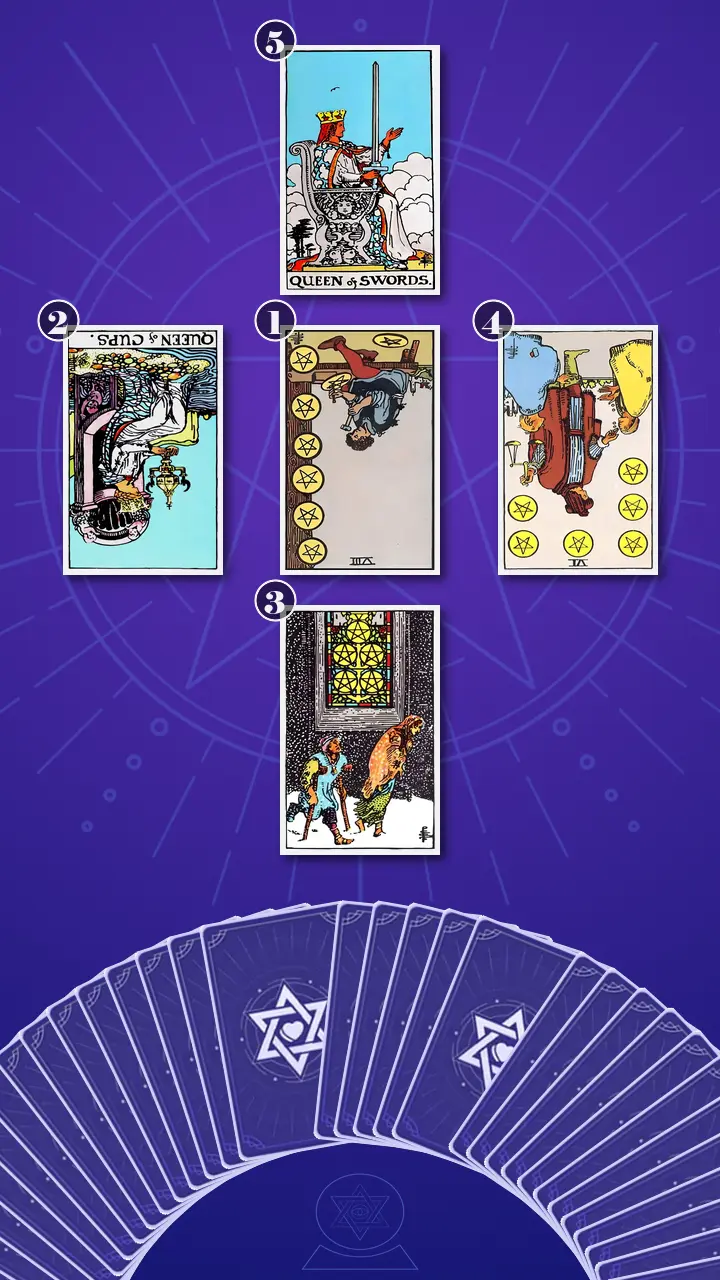
I chose the five-card Shadow Spread for uncovering usefulness-based belonging and integrating friendship boundaries. I use this classic structure when the visible problem is a repeated relationship behavior rather than a simple external choice. Its sequence moves from the present pattern to the protective role, the root belief, the relational cost and finally an integrating response, so it can show the whole maintenance loop without treating Maya's friends as problems to solve.
I explained the map in plain language. The first card would show the concrete habit that currently looked like care. The second would show the caring persona Maya used to feel secure. The third would reach the fear beneath that role. The fourth would reveal what over-giving was costing the friendship. The fifth would point toward a boundary that could remain warm, practical and hers.
I placed the cards in a cross around the centre. The layout looked less like a verdict than a compass around a knot, with the final card above the others as a possible north point. Tarot, as I practice it, does not remove Maya's authorship. It gives her a visual language for noticing what her own mind has been doing at speed.
The Hammer That Never Stops
Position 1: The Visible Pattern and the Eight of Pentacles
'Now I am turning over the card representing the visible pattern: the concrete habit of responding to friends' problems as urgent work that must be completed,' I said.
The card was the Eight of Pentacles, reversed.
At position 1, the reversed Eight of Pentacles was Maya at 11:47 p.m. treating a friend's apartment panic like a work assignment: replaying the voice note, researching listings, formatting options and editing advice after enough help had already been offered. Her skill was real, but its scope had become distorted. The message thread received the concentration that belonged to her unfinished application because usefulness briefly quieted the fear of losing her place.
In the Rider-Waite-Smith image, the artisan sits hammering one pentacle after another while the finished coins hang in a careful row above him. Upright, that focus can be practice and pride. Reversed here, Earth energy was excessive and misdirected. Maya was not lacking discipline; she was applying disciplined effort to an invisible test of whether she deserved connection. The small town in the background became, to me, the part of her own evening left outside the frame.
I pictured the project-coordinator half of Severance following her home and opening the group chat, assigning owners and next steps to every unsettled feeling. 'One more useful detail, then I can put the phone down,' she had told herself, then added another detail, another link and another revision.
Maya gave a quick, uncomfortable laugh and glanced at the unfinished tab on her laptop. 'That is almost rude,' she said. 'It is just a message, and I turn it into a deliverable.'
I smiled gently. 'The issue is not that you are too competent. It is that competence has become the way you try to buy certainty. For one conversation, the experiment is not to ignore the friend. It is to stop when your help is proportionate.'
The Covered Cup and the Role She Carries
Position 2: The Protective Role and the Queen of Cups
'Now I am turning over the card representing the protective role: the caring persona Maya adopts to secure a place in friendship and manage the fear of being unnecessary.'
The Queen of Cups appeared reversed.
The modern scene was immediate. A friend sent a two-minute voice note, and Maya listened to it twice, reading meaning into every pause. She heard the strain in the voice, felt the urgency in her own chest and decided she had to produce the perfect response before she could sleep. The caretaker role protected her from the uncertainty of simply being present, asking what was wanted or admitting that her own capacity had a limit. Feeling with a friend had quietly become feeling responsible for the friend.
The Queen's cup is carefully covered, held above the water rather than plunged into it. Upright, that image can suggest emotional depth with containment. Reversed, Water had become porous. Maya's empathy was not a flaw, but it had no reliable edge; every pause in a voice note became another tab in her working memory, another feeling she believed she had to close.
'If I can feel how overwhelmed they are, how can I leave it there?' she asked me.
'You can care about what you feel without accepting ownership of the outcome,' I said. 'Before you help, you can ask whether they want listening, ideas or practical help. That question does not make warmth less real. It gives warmth a shape.'
I watched Maya's shoulders lower slightly. Her fingers stopped rubbing the rim of her cup. The change was small, but it made room for a possibility she had not been allowing: sensing another person's distress did not automatically make her responsible for ending it.
The Warm Window from the Cold Street
Position 3: The Root Belief and the Five of Pentacles
'Now I am turning over the card representing the root belief: the fear that being less needed could expose a lack of worth or belonging.'
The Five of Pentacles lay upright.
I brought Maya back to a rainy Thursday morning on the Line 1 near Bloor-Yonge. Someone else had answered a worried group-chat message before she could. The practical problem was covered, yet her stomach had dropped. She had reread the exchange beneath buzzing fluorescent lights and thought, 'If they already have someone useful, what exactly am I here for?'
The two figures in the Rider-Waite-Smith card move through snow beneath a lit stained-glass window. The light is visible, but their attention is fixed on cold, injury and distance. Upright Earth in the root position showed a scarcity story: Maya could be surrounded by care and still experience belonging as a warm room from which she stood outside. She did not need evidence that rejection was inevitable. She needed to notice how quickly her mind treated another person's support as proof that her own place had expired.
'Other people can just show up,' I said, quoting the thought she had brought with her. 'You feel you need to bring something useful before you are entitled to ask for warmth.'
Maya became quiet. I saw her breath catch in her throat, and her eyes moved from the card to the window behind me as if she were replaying an old group-chat moment. After a few seconds she said, 'Being needed can feel like belonging without giving me the experience of being known.'
'Exactly,' I said. 'Care is not a job interview for your place in someone's life. The card is showing the fear that drives the work, not proving that the fear is true.'
The Invisible Splitwise Ledger
Position 4: The Relational Cost and the Six of Pentacles
'Now I am turning over the card representing the relational cost: the way over-giving creates unequal exchanges, resentment and less room for genuine mutuality.'
The Six of Pentacles appeared reversed.
I described the image as a Splitwise-style mental ledger. Maya had spent 45 minutes on the call, sent three links and made one professional introduction. Later, she reread the thread to see whether anyone thanked her or asked how she was. She said she had not been keeping score, but the numbers were still there: response times, favours, follow-ups and the exact amount of effort she had quietly placed into the exchange.
The raised scale and descending coins in the Rider-Waite-Smith image made the imbalance visible. Reversed Earth in this position did not condemn generosity. It showed giving that had lost its free quality because it was carrying a second request underneath: please let this prove that I matter. When that request remained unspoken, the exchange could produce resentment while Maya still looked like the person who needed nothing.
'I said it was fine,' Maya said. 'So why does it hurt that nobody noticed the cost?'
'Resentment may be the receipt for help you never freely budgeted,' I answered. 'It is information about capacity and an unspoken need, not proof that you are ungenerous and not proof that your friends have failed a test they did not know they were taking.'
Maya winced and paused over the phrase private ledger. Her thumb hovered above her phone. I saw the urge to tell me a story about a long call, an unreturned check-in and the next time she had volunteered anyway. She did not defend herself. She let the pattern become visible, which was more honest than forcing herself to call it fine.
When the Queen of Swords Kept the Door Open
Position 5: The Integrating Stance and the Queen of Swords
The room became quieter before I touched the final card. A pale gust moved the curtain, and the clouds outside crossed the window in a slow grey band.
'Now I am turning over the card representing the integrating stance: a practical, boundary-based way for Maya to remain caring without making herself responsible for another person's life.'
The Queen of Swords appeared upright.
Her modern scene was simple enough to try. Maya received the same late-night message, paused and replied, 'I care about this. Do you want listening, ideas, or practical help? I have about ten minutes tonight, but I cannot take over the decision.' The open hand remained available. The upright sword decided the form, amount and ownership of the support.
Upright Air arrived after overloaded Earth and Water. It did not erase her effort or empathy; it gave them language. The Queen of Swords could separate a friend's discomfort from Maya's responsibility, a limit from rejection and clarity from cruelty.
At this point I used two of my signature lenses. My Clique Power Dynamics lens looks at the subtle hierarchy inside a close-knit group without turning friends into villains: who is allowed to be messy, who receives comfort, who is thanked for being dependable and who becomes the crisis planner. My Sidekick Syndrome Diagnosis asks whether a group has quietly boxed someone into a restrictive role so thoroughly that everyone, including that person, mistakes the role for identity.
No one had held a meeting and assigned Maya the character of crisis manager. That was what made the pattern difficult to see. Her friends might simply have learned that she responded quickly, knew how to organize a mess and rarely asked for anything herself. Maya had also learned that being the sidekick with the map could keep her close to the centre of the story. The Queen of Swords offered a different character: present, discerning and still fully part of the scene.
The Sentence That Changed the Scene
I let the quiet hold for a moment. At 11:47 p.m., Maya's own tab was still open while she turned a friend's voice note into a numbered plan. The tea was cold, the phone was warm and her jaw stayed tight until the typing bubble appeared. She was trying to make a reply prove that she still mattered.
You do not have to make yourself indispensable to be welcome; like the Queen of Swords, offer an open hand while keeping your sword of discernment upright.
The sentence settled between us. I then gave her the plain-language version: You do not need to become indispensable to keep your place; care can be something you choose, not the price you pay for belonging.
For one beat, Maya's breath stopped and her fingers remained suspended above her phone. Then her eyes lost focus, as though she were watching the rainy train, the group chat and every late-night advice thread replay in sequence. Her first response was not relief. 'But does that mean I was wrong before?' she asked, with a small edge of anger in her voice. I told her that the care had been real; the assigned responsibility had simply become too large. The radiator clicked once. Her jaw loosened, her shoulders dropped and the hand gripping the phone opened. She let out a shaky breath that became a quiet, almost embarrassed 'Oh.' She typed the sample sentence into her Notes app without sending it: 'I care. Do you want listening, ideas, or practical help? I have ten minutes tonight.' I asked her to read it once more and notice whether her body moved toward warmth, resistance or both.
'Now, use this new perspective to revisit one recent, low-stakes message,' I said. 'Was there a moment when this insight might have made you feel different?'
I reminded her that the exercise could take ten minutes, that she could shorten it to one line or stop before sending anything, and that it belonged to an ordinary support request rather than an immediate safety emergency. The friend's final decision would remain the friend's. That distinction was the beginning of measured compassion.
I named the shift plainly: from uneasy, hyper-vigilant fixing and resentment to measured compassion, clear boundaries, and steadier reciprocal belonging. The Queen of Swords had not promised that every friend would respond perfectly. She had given Maya a credible middle path between taking over and disappearing.
The Story the Cards Told Me
When I gathered the five cards together, the pattern became a single story. Maya's work had rewarded anticipation, organization and constant movement, so she carried a Jira board into the group chat and turned every stressed voice note into a ticket with an owner, next steps and a resolved status. The reversed Eight of Pentacles showed the labour. The reversed Queen of Cups showed the empathy without a container. The Five of Pentacles showed the cold inner story beneath it: if she was not needed, she might be outside the warm window. Then the reversed Six of Pentacles showed the cost: over-giving, private scorekeeping and a friendship exchange that could not become mutual because her need remained hidden.
The blind spot was not that Maya cared too much. It was that she treated another person's discomfort as a request for total responsibility, and treated the friend's use of her advice as the success metric. The transformation direction was more precise: move from proving worth through immediate problem-solving to choosing a clear, proportionate form of support after checking what is actually wanted. She could stay helpful without becoming the owner of another person's outcome.
'Ask what support is wanted before turning care into a project,' I told her. 'Name your capacity before you offer more. Then leave the decision with the person whose life it is.'
The Warm-Hand, Clear-Sword Reply
I introduced my Role Resignation Act. It is a creative conversational pivot for refusing an assigned character without rejecting the people around you. Maya would not announce a dramatic exit from the friendship group or punish anyone with silence. She would simply decline the fixer role in a warm, firm sentence and let the conversation become more honest.
- Run the Support-Format CheckFor one non-urgent message this week, wait two minutes before replying, then ask the friend, 'Do you want me to listen, brainstorm, or help with one practical step?' Use it with a low-stakes request so the question can sound natural rather than rehearsed.Add the sentence as a phone text replacement. The minimum version is simply, 'Listening or ideas?' Clarity is information about your capacity, not a command that controls the other person.
- Resign the Fixer CharacterDuring one support conversation, use the Role Resignation Act: 'I care about this, and I can listen for ten minutes, but I cannot take over the decision.' Set a 15-minute timer, choose one mode of support and return to the personal task visible on Maya's laptop when the time ends.Give one resource or one idea, then stop. A five-minute version still counts. Close with, 'I need to get back to my evening, but I am glad you told me.'
- Make Reciprocity VisibleText one trusted friend and ask, 'Could you listen for ten minutes this week? I do not need solutions; I just want to say this out loud.' Make the request specific, then notice the urge to repay the care immediately.Treat the response as information about one interaction, not a final verdict on your worth or the entire friendship. You are allowed to receive before you produce something useful.
These were deliberately small next steps. They did not require Maya to stop being dependable, abandon a friend in distress or become perfectly comfortable with boundaries. They gave her a way to test whether connection could survive her full presence instead of only her output.

A Small Proof, Not a Perfect Ending
Four days later, I received a message from Maya. 'I waited two minutes before replying. I asked whether she wanted listening or ideas. She wanted listening, so I stayed for ten minutes and did not research anything. Then I went back to my application.'
The change was small enough to trust. Her plan was clearer, but the next morning still began with, 'What if I am wrong?' This time she smiled, made coffee and left the question unanswered while she opened her own document. The old fear had not vanished; it simply no longer held the phone.
That was Maya's first evidence of steadier belonging: not a perfect friendship, not a guarantee that nobody would ever need her again, but one ordinary moment in which she chose care instead of performing it. The cards had not rescued her or decided her future. They had helped her see the role she was playing, question the contract beneath it and take the pen back into her own hand.
When the group chat lights up and your jaw tightens before you have even read the whole message, it can feel as though your place in the friendship depends on becoming useful fast enough. If you can notice that reflex, you are already no longer standing at the exact point where the old script began.
If your place did not have to be earned in that moment, what might one warm, honest sentence from you sound like - one that keeps the open hand available while leaving the next decision with the person who owns it?
This story is adapted from psychological research, written so that those in a similar struggle can see their own pattern in it — and find their next step clearly.These insights are not a substitute for professional psychological, medical, legal, or financial advice.
Learn more about our Journey to Clarity.
How did this insight land for you?
🫂 This Resonates Deeply
🌀 Living This Story
✨ Now I See Clearly
🌱 Seeing New Possibilities
🧰 Useful Framework
🔮 The Confirmation I Needed
💪 Feeling Empowered
🚀 Ready for My Next Step
Author Profile
 AI
AI“I’ve always felt our lives are films currently in production. As an artist, I know that when you feel stuck, it’s often because you’ve bravely stayed in a painful scene for just a little too long. I’m not here to coldly analyze you. I want to sit closely with you, look at those difficult moments with profound empathy, and gently hand you the pen so you have the courage to write your next beautiful act.”
In this Friendship Tarot Reading :
Core Expertise
- Clique Power Dynamics: Deconstructing the subtle jealousy, micro-aggressions, and implicit hierarchies hidden within tight-knit friend groups.
- Sidekick Syndrome Diagnosis: Identifying how your friend group has boxed you into a specific, restrictive role (e.g., the clown, the therapist) to maintain their status quo.
Service Features
- The Role Resignation Act: A creative conversational pivot designed to gracefully but firmly refuse your assigned 'character' during your next group interaction.
Also specializes in :
Explore Related Patterns:
Conditional Self-WorthOn the train, Maya watches someone else answer the worried group-chat message and immediately wonders what she is there for if the useful role has already been filled. The friend's problem is resolved, but her stomach still drops because her mind has linked contribution with permission to belong. Conditional self-worth makes usefulness function like an admission price. When you rely on solving, organizing, or introducing to prove your place, being needed can feel safer than being known because output is measurable while affection is not; the cost is that ordinary presence may never feel sufficient, even when the relationship already contains care.
Emotional Hyper-ResponsibilityMaya hears strain in a two-minute voice note, feels urgency in her own chest, and decides she must create the perfect response before she can sleep. Her empathy crosses into responsibility when the friend's discomfort becomes a task she must end and the friend's use of her advice becomes the measure of whether she helped correctly. Emotional hyper-responsibility can make another person's distress feel like a demand on your nervous system, even when no one has explicitly assigned you the outcome. You can care deeply and still audit the transfer of ownership; feeling a friend's emotion gives you information about their experience, but it does not automatically make their decision, relief, or recovery your job.
Friendship OverfunctioningAt 11:47 p.m., Maya turns a friend's voice note into apartment research, numbered options, work advice, relationship advice, and a professional introduction while her own application remains unfinished. The amount of labor exceeds the request because taking charge gives her a visible function in the friendship and temporarily quiets the uncertainty about whether she still belongs. Friendship overfunctioning is the repeated move from caring about a problem to becoming its unofficial owner. When you anticipate, organize, and follow through for everyone else, your competence can make the arrangement look generous and efficient even as your own priorities disappear and mutual support becomes harder to access.
Productivity as SafetyAfter closing Teams at 7 p.m., Maya reopens the project-coordinator role in the group chat and turns a friend's voice note into a deliverable with research, options, owners, and next steps. The work structure offers temporary certainty because a completed task is easier to measure than the question of whether she is valued without it. Productivity as safety uses output to regulate insecurity rather than only to accomplish a practical goal. When you organize a friend's distress into something finishable, competence can briefly quiet the fear of being unnecessary, but the relief remains dependent on another task, another response, or another sign that the work was accepted.
Rejection SensitivityThe missing typing bubble keeps Maya reaching for her phone, and another person's helpful group-chat reply makes her stomach drop even though the practical problem has been covered. Neutral or positive events are filtered through the possibility that being less necessary means being less welcome. Rejection sensitivity can turn ambiguity into a rapid social threat calculation before clearer evidence is available. When you scan response speed, advice uptake, or who helped first for proof of your place, problem-solving becomes a protective attempt to prevent exclusion; noticing that interpretation gives you room to test whether the cue actually says anything about your worth or the friendship.
Rescuer IdentityMaya repeatedly becomes the planner, researcher, introducer, and follow-up monitor, then asks what she is there for when someone else supplies the useful answer. The repeated role has moved beyond something she does well and begun to organize who she believes she is allowed to be inside the group. A rescuer identity makes the problem-solving position feel safer than ordinary participation because the role supplies purpose, visibility, and a script. When you are known primarily as the person with the map, stepping back from management can feel like disappearing; the deeper experiment is learning whether you can remain in the scene while bringing uncertainty, needs, and presence instead of a solution.
People-Pleasing Resentment CycleMaya spends 45 minutes on a call, sends three links, makes an introduction, and says the effort was fine; later, she rereads the thread to see whether anyone thanked her or asked how she was. The resentment does not come from generosity itself but from giving beyond her freely chosen capacity while keeping the hoped-for recognition unspoken. The people-pleasing resentment cycle forms when you hide your limit, over-deliver, and then use the other person's response to assess whether the sacrifice mattered. Because the hidden need was never made visible, the friend cannot knowingly respond to it, and disappointment can drive another round of proving rather than a clearer request for reciprocity.
Boundary DiscernmentMaya's ten-minute reply names her care, asks whether the friend wants listening or ideas, and leaves the final decision where it belongs. Four days later, she uses that structure in a real conversation, listens without researching, and returns to her own application. Boundary discernment appears when you can remain warm without treating access to another person's distress as an assignment. The change is not withdrawal or indifference; it is the ability to identify your capacity, the other person's agency, and the point where chosen support would otherwise become self-abandoning responsibility.
Uncertainty ToleranceMaya places her phone face down without producing an immediate answer, later waits two minutes before replying, and leaves the next morning's question about being wrong unresolved while opening her own document. These are small but concrete moments in which uncertainty is allowed to exist without being converted into research, reassurance, or control. Uncertainty tolerance grows when you can feel the pressure to secure an outcome and still refrain from taking ownership of it. You do not need certainty that the friend will make the right choice or certainty that every relationship will reward your boundary; you only need enough internal space to choose your response before the fixing reflex chooses it for you.
Explore Related Struggles:
Capacity-Obligation FusionA two-minute voice note becomes a response Maya believes must be perfected before she can sleep, and feeling her friend's overwhelm makes leaving the issue unresolved seem almost impossible. Her available time stops functioning as a real limit because awareness of the problem is immediately translated into responsibility for its outcome. In this bind, your capacity and your obligation become difficult to tell apart: if you can perceive the need, you feel recruited to meet all of it. Recognizing that automatic handoff makes the structure visible, including the point where genuine concern can remain yours while ownership of the decision stays with the other person.
Caretaker Role LockNo one holds a meeting and appoints Maya as the crisis manager. The role hardens through repetition: friends learn that she replies quickly and organizes the mess, while Maya learns that being the person with the map keeps her close to the center of the group. Inside that locked arrangement, you are consistently welcomed as the caretaker but receive little evidence about whether other parts of you can occupy the same space. Your care remains real, yet the role becomes restrictive when its reliable performance is mistaken for your whole identity and stepping outside it begins to feel like stepping outside the friendship.
Competence-Connection SplitMaya looks at the unfinished application on her laptop and admits that she has turned an ordinary message into a deliverable. Her plans, links, and introductions make her highly effective inside the friendship, yet she also recognizes that being needed can resemble belonging without giving her the experience of being known. When connection is routed through competence, you remain close to other people as a function they can rely on while the rest of you receives less room to appear. The resulting split is painful precisely because capability succeeds at solving the visible problem while remaining unable to answer the deeper question of whether your unproductive, receptive, or uncertain self is equally welcome.
Utility-Belonging FusionAt 11:47 p.m., Maya leaves her own application glowing while she turns one voice note into listings, numbered options, and introductions. When another friend answers first, the practical relief lands as a threat to her place, revealing that each useful output is being asked to solve the problem and certify her membership at the same time. When usefulness carries the price of admission, you cannot choose help solely according to what is wanted or what you can freely give. The bind is not that your care is false; it is that care must keep producing evidence of welcome, making belonging feel conditional on your next piece of work.
Read Receipt Worth LockThe typing bubble does not appear, but Maya refreshes the chat and reaches for the phone again. She cannot fully return to her application until she knows whether the advice was read, used, or acknowledged, so a friend's digital response becomes the checkpoint that decides whether her effort counted. Once worth is locked to that feedback, you remain tethered to a conversation even when no new request exists. Monitoring promises a quick answer to whether the connection is secure, but every silent interval withholds the verdict and keeps your attention waiting outside your own life.
Self-Erasure ReliabilityMaya closes Teams at 7 p.m., then opens another unpaid shift in the group chat while her application remains unfinished and her tea turns cold. The thread receives the concentration that belonged to her own evening, and her friends continue seeing the version of her who responds quickly and appears to need nothing. Reliability becomes self-erasing when your continued availability is maintained by repeatedly moving your own priorities and limits out of view. You stay highly visible through what you provide while becoming less visible as someone with unfinished work, finite capacity, and an equal claim to receive care.
Unseen Cost BindAfter a 45-minute call, three links, and a professional introduction, Maya rereads the thread to see whether anyone thanked her or asked how she was. She says the help was fine, but the exact quantities remain in a private ledger because the practical gift also carried an unspoken request to have its cost noticed. When that second request stays invisible, you cannot openly negotiate what you need, and the other person cannot knowingly respond to it. The bind leaves you holding both sides of the exchange: freely generous on the surface, quietly waiting underneath for the recognition that would make the expenditure feel meaningful.
Explore Related Emotions:
Mutuality HungerMaya rereads the conversation to see whether anyone asks how she is, then recognizes that being needed can resemble belonging without giving her the experience of being known. She offers plans, introductions, and sustained attention while rarely making her own need visible. You may be reaching for more than appreciation when you search the thread after helping. You may want evidence that the relationship can move toward you, hold your unfinished feelings, and keep a place for you when you have nothing useful to produce. Mutuality Hunger names that deeper longing for care to circulate rather than remain attached to a single role.
Replaceability DreadOn the train near Bloor-Yonge, Maya sees that someone else has already answered the worried group-chat message. Nothing has been taken from her in practical terms, yet her stomach drops and the question arrives immediately: if the group already has someone useful, what is she there for? You can experience another person's contribution as evidence that your own place has narrowed when usefulness is carrying too much of your relational identity. Replaceability Dread names the sudden internal free fall that follows, where being unnecessary in one moment starts to feel dangerously close to being unnecessary as a person.
Usefulness-Based Belonging FearAt 11:47 p.m., Maya turns a friend's voice note into apartment research, numbered options, and introductions while her own application remains open. On another day, someone answers a group-chat problem before she can, and her stomach drops even though the practical need has already been met. You can feel how usefulness has become more than a generous contribution in this pattern. It acts as immediate evidence that your place is still secure, while having no problem to solve leaves your value harder to feel. Usefulness-Based Belonging Fear names the inner weather of treating capability as the price of admission, even when the friendship has not explicitly asked you to earn your place.
Grounded BelongingFour days later, Maya waits two minutes, asks whether her friend wants listening or ideas, listens for ten minutes without researching anything, and returns to her application. The friendship remains present even though she does not convert the conversation into a project. You begin to experience Grounded Belonging when connection survives a clear limit and your own life is still allowed to occupy the room. This is not certainty that every interaction will go perfectly. It is the steadier sense that you can participate as a whole person, with warmth, limits, and priorities, rather than securing welcome through constant output.
Hidden ResentmentMaya spends 45 minutes on a call, sends three links, makes a professional introduction, and later rereads the thread to see whether anyone thanked her or asked how she was. She says she was not keeping score, but the exact quantities and missing responses remain available in her mind. You can sincerely choose to help and still carry an unspoken request beneath the offer: please notice what this costs, and let the effort prove that I matter. When that request stays hidden, other people cannot respond to it directly, and the resulting hurt has nowhere to go. Hidden Resentment is the pressure left behind when outward generosity and inward capacity stop matching.
Hypervigilant AnxietyMaya's jaw tightens, her breaths become shallow, and her hand keeps reaching for the phone after the chat has gone silent. The absent typing bubble does not end the exchange; her body continues behaving as though another alert could arrive at any second. You are not only thinking about a friend's problem in this state. You remain physically mobilized around it, scanning for pauses, updates, and signs that more effort is required. Hypervigilant Anxiety captures that on-call inner weather, where another person's unsettled situation keeps your attention from recognizing that you are allowed to stand down.
Resentful ExhaustionMaya closes Teams at 7 p.m. and begins another unpaid shift in the group chat at 11:47. Her tea turns cold, her application remains unfinished, and one useful detail becomes another link, another revision, and another follow-up. You become depleted differently when the work is framed as voluntary care but does not feel internally optional. Part of you keeps producing support, while another part registers the evening, attention, and personal work being displaced. Resentful Exhaustion names that fused experience of running out of capacity while still feeling compelled to give more.
Cautious Self-TrustMaya first types the boundary sentence into her Notes app without sending it. Four days later, she uses its structure in a real conversation, and the next morning she opens her own document while allowing the question "What if I am wrong?" to remain unanswered. You do not need complete confidence before making a choice that respects your capacity. Cautious Self-Trust grows through these small acts of staying with your decision while doubt is still present. Its texture is measured rather than triumphant: you observe that you can care, stop, and return to your life without requiring immediate proof that the choice was perfect.
Explore Related Contexts:
Fixer Friend DynamicMaya closes Teams at 7 p.m. and opens what amounts to an unpaid advice shift at 11:47, transforming a friend's voice note into apartment research, numbered options, introductions, and follow-up monitoring. A conversation that could hold companionship becomes a project with deliverables, while her own application remains unfinished on the laptop. Repeated problem-solving creates a recognizable division of relational labor. Friends can bring uncertainty into the chat, and Maya supplies the structure, speed, contacts, and next steps. No one needs to deliberately exploit her for the arrangement to become durable; repeated availability can turn one person's competence into infrastructure that the group comes to expect. When you occupy a Fixer Friend Dynamic, your practical output can become more visible than your full participation in the friendship. Naming the dynamic lets you examine which help was requested, what amount you freely chose, and where responsibility still belongs to the friend whose problem is being discussed.
Sidekick Role Lock-InMaya is the friend who answers quickly, knows how to organize a mess, makes the introduction, and rarely arrives with a request of her own. The story explicitly places her at the side of other people's crises with the map, the plan, and the follow-up, while other group members receive more permission to be unresolved. That repeated distribution of roles forms a subtle hierarchy even without a meeting or formal assignment. Reliability becomes Maya's recognized social function, and the group has fewer opportunities to encounter her as someone with limited capacity, unfinished priorities, or needs that deserve attention. Her place remains close to the action but organized around supporting someone else's story. Sidekick Role Lock-In names the external position produced by that repetition. When you can see the position as a group role rather than your entire identity, you gain room to test whether the friendship can accommodate your limits, requests, and priorities alongside your competence.
Emotional Labor ImbalanceMaya spends 45 minutes on a call, sends three links, makes a professional introduction, and then rereads the thread to see whether anyone thanked her or asked how she was. The practical support is accompanied by quieter work: replaying the voice note, interpreting pauses, anticipating needs, and monitoring whether the intervention succeeded. The exchange gives friends access to substantial attention and organization while leaving Maya's capacity and need for care largely unexpressed. Because the additional request for recognition remains unspoken, the relationship cannot respond to it directly. The result is an externally visible imbalance in who brings the unresolved problem, who processes it, and whose needs remain outside the conversation. When you recognize Emotional Labor Imbalance, you can separate freely chosen care from labor carrying an undisclosed expectation of return. That distinction creates clearer information about the amount of support being exchanged and whether the friendship has practical room for you to receive as well as provide.