The Yellow-Light Bedroom Before Dinner
If you're the 20-something city girl who can write a firm client email by 9:14 a.m. but goes completely blank when an aunt comments on your body at Sunday dinner, I want to say this first: I don't read that as weakness. I read it as a family-shaped fawn response. A frozen smile is still a stress response.
When Maya came to me from Toronto, I could see the scene before she even finished describing it. Six-twelve on a Sunday. A small apartment bedroom. Two tops hanging off a desk chair, one on the floor, the closet mirror catching that slightly too-yellow overhead light. The radiator hissed, a text buzzed, and she smoothed fabric over her stomach the way people do when they want to look relaxed and invisible at the same time.
'I always think of what I should have said three hours later,' she told me. 'I smile so nobody thinks I'm making it weird.'
The contradiction was painfully clean: she wanted to say, 'Please don't comment on my body,' but her body had already learned to choose the polite smile if that was what kept the table smooth. Shame sat in her like swimming through grey syrup with a paper smile glued over her mouth—thick, slow, and impossible to spit out in real time.
I nodded. 'Then I don't want to force a perfect comeback out of you. I want to show you where your choice disappears, and how to bring it back. Let me draw you a map through the fog.'

Choosing the Compass: A Horseshoe Spread for Finding Clarity
I asked Maya to place both feet on the floor and breathe once without trying to calm down for me. Then I shuffled slowly, not as theater, but as a way to help her nervous system cross the threshold from replay into attention.
For this reading, I chose a seven-card Horseshoe Spread. When someone asks me a question like 'Why do I freeze and smile when family comments on my body?' I want a structure that can separate the live trigger from the older family training beneath it. The Horseshoe is one of my favorite classic spreads for relationship patterns because it is just large enough to track the whole arc: past family script, present shutdown, hidden wound, central blockage, outside pressure, guidance, and the direction of integration.
I told her what I was looking for as I laid the cards into their shallow arc. The left side would show me the learned script and the reflex that happens at the table. The apex would name the knot that makes silence feel safer than a boundary. The right side would tell me what kind of language could interrupt the pattern, and what self-trust might look like if she practiced it.
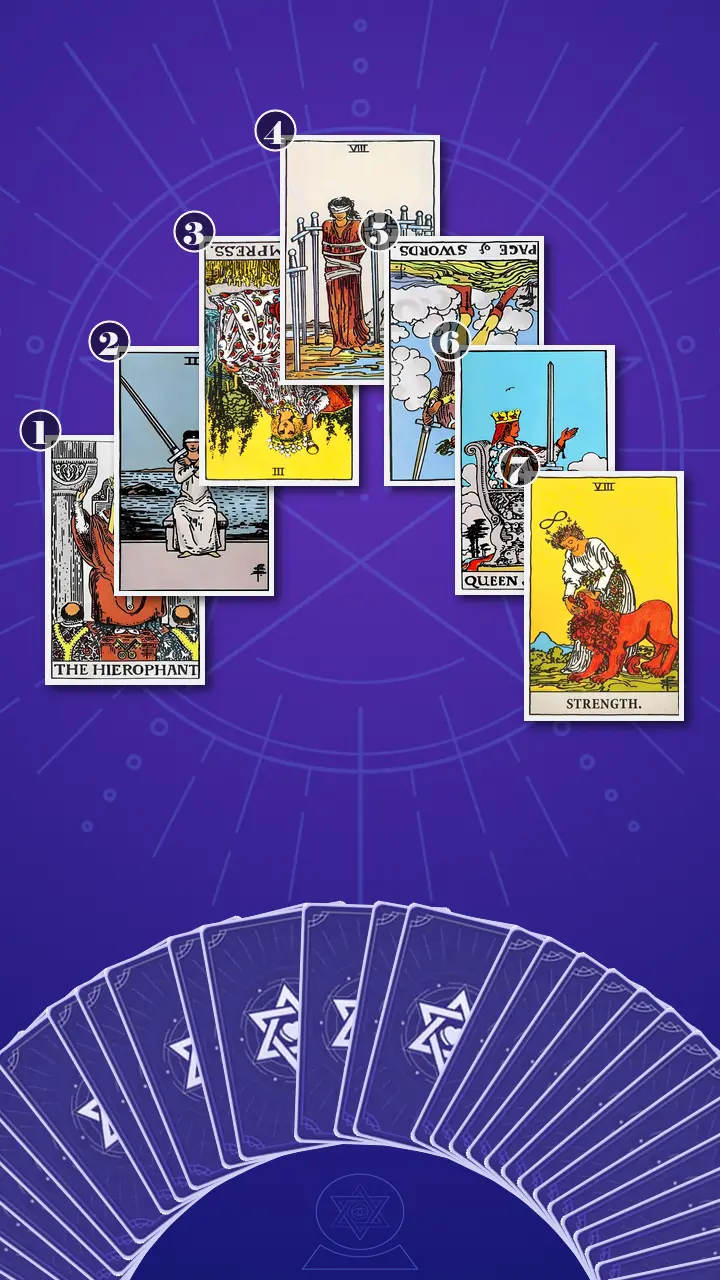
Reading the Arch of the Room
Position 1: The Rulebook Already Running
I turned over the first card. 'This position reveals the learned family script that taught you to stay polite, defer to elders, and keep the peace even when you feel exposed.'
The Hierophant, upright.
I told Maya that before a family dinner even starts, she is already standing inside an unwritten rulebook: be respectful, do not correct older relatives in public, do not be the reason the room gets awkward. At work she can send a clean client email in ten minutes, but with family she edits herself like authority still sits across from her at the table. This card showed me the freeze was not random. It was old training.
The Hierophant is balanced earth in one sense—structure, custom, belonging—but here that structure had hardened into automatic deference. Not balance. Overlearned obedience. The kneeling figures on the card made me think of a phrase I use in sessions: Generational Echo Mapping. I grew up with Venetian canals, where one sound can bounce from stone to water and come back larger than it began. Some family rules work exactly like that. One elder's preference becomes a whole acoustic system in the body. Maya was not just hearing one aunt. She was hearing the echo of 'good nieces stay agreeable.'
She let out a short laugh that had more salt than humor in it. 'Okay,' she said, looking down at the card. 'That's accurate enough to be annoying.'
Position 2: The Water-Glass Moment
I moved to the second card. 'This position shows the concrete freeze-and-smile reflex as it happens in the moment when your aunt comments on your body.'
Two of Swords, upright.
'This is the dinner-table freeze exactly,' I said. 'The comment lands, your face stays nice, your voice goes offline. Your fingers go to the water glass. The ice taps the inside. The room smells like garlic and roast chicken, and your throat closes before language arrives.'
The card's energy was blockage, not lack of intelligence. Like a screen locking right when you need to send the text. The blindfold and crossed swords showed a nervous system that had chosen pause before speech. Self-protection and social smoothness were colliding in the same two seconds, and smoothness was winning because it looked safer.
Maya inhaled sharply. One hand went to her throat, then to the edge of the table, then stilled there. 'Yes,' she said. 'That's the exact moment. It's like my cursor is blinking, but nothing sends.'
Position 3: When the Body Stops Feeling Like Home
I turned the third card. 'This position uncovers the quieter body-image wound or self-worth sensitivity that makes the comment land so hard under the surface.'
The Empress, reversed.
I told her this was the card of embodiment turning into surveillance. Later that night, instead of naming the comment as invasive, she was more likely to open her camera roll, zoom in on photos, study angles, decide what top would be safer next time. Not because she was vain. Because the remark had pushed her out of her own body and into somebody else's gaze. Family normal and body-safe are not always the same thing.
Reversed, the Empress was deficiency in self-nourishment and excess in self-monitoring. Care had been replaced by management. The body became a project instead of a home. I asked softly, 'When you stand in the bathroom after dinner, are you trying to understand your body—or explain away someone else's boundary crossing?'
Her jaw tightened first. Then it released. 'The second one,' she said quietly. 'Always the second one.'
Position 4: The Notes App Cage
I turned the apex card. 'This position identifies the main inner blockage: the belief that speaking up will threaten connection, safety, or social harmony.'
Eight of Swords, upright.
'This one,' I said, 'is the train ride home. Coat still on. Notes app open. Five drafts, all unsent. Too rude, too dramatic, too awkward, too sensitive, too much.'
The energy here was constriction—real in the body, but not entirely imposed from the outside. The loose bindings on the figure mattered to me. Maya did have a boundary. What disappeared in the moment was her felt access to it. The old story said that if she used it, belonging and self-protection would split apart. So every route looked bad, like opening Google Maps and deciding every option is terrible, then never leaving the platform.
I watched the recognition land in a three-beat sequence. First her breath paused. Then her eyes lost focus, as if she were replaying a subway window reflection only she could see. Then a heavy exhale left her chest and her shoulders dropped a fraction. Accurate silence filled the room.
Position 5: The Comment That Calls Itself Concern
I turned the fifth card. 'This position maps the outside relational pressure, including tactless commentary, family norms, and the social field you have to navigate in real time.'
Page of Swords, reversed.
I told her this card looked exactly like the kind of remark delivered in a light tone with a quick smile, then abandoned in the middle of the meal for someone else to absorb. Less honest care, more a sharp little inspection tossed into the group chat and left hanging. The moment a comment lands, Maya scans the room: who heard it, who noticed my face, how fast can I make myself look easygoing again?
Reversed, the Page was excess reactivity and immaturity in the field around her. Words cutting first, considering impact second. That mattered, because it meant the problem was not only inside Maya. There was real outside pressure. Her nervous system was not inventing the discomfort; it was trying to manage it in a room where appearance commentary had been normalized.
'That part helps,' she said. 'Because I always end up acting like I'm the whole problem if I take it badly.'
'You're not the whole problem,' I said. 'You're the one carrying the awkwardness privately so no one else has to notice it publicly.'
When the Queen Lifted Her Sword
Position 6: The Sentence That Protects
When I turned the sixth card, the room changed. Even the late-afternoon light at my window seemed to clear at the same time, a pale strip moving across the table until it caught the blade in the card.
'This position offers the most useful shift in mindset and communication style for interrupting the automatic appeasement response,' I said.
Queen of Swords, upright.
I felt the whole visual arc at once: Two of Swords blindfolded. Eight of Swords blindfolded. And now this queen, eyes open, sword upright, face visible. In my mind I flashed to the cruise decks where I used to read passengers just before storms changed course; the most useful moment was never when the sea became calm. It was when someone could finally distinguish wave from direction. That is what this Queen does. She separates discomfort from danger.
'This is less viral clapback, more grown-adult clarity,' I told Maya. 'One clean sentence. Not a speech. Not a defense brief. An out-of-office auto-reply for your body.'
She was still caught in the old equation: if I sound nice, I stay connected; if I sound direct, I become the problem. That was the blindfold.
You do not need to stay blindfolded to seem nice; raise the Queen's sword of clear language and let one honest sentence protect your space.
I let the words sit between us.
'Politeness is not consent,' I said more quietly. 'A frozen smile is not a yes. It's crowd control.'
The reaction came in layers. First she went completely still, so still I could hear the tiny click of the radiator. Then her eyes shifted away from me and unfocused, replaying some recent table, some bowl being passed, some version of herself smiling on autopilot. Then her mouth tightened and she said, with sudden anger under it, 'But doesn't that mean I've been helping everybody else stay comfortable while I just... disappear?'
'It means your nervous system found the fastest way to keep belonging,' I said. 'That was intelligent then. It just isn't the shape of self-trust now.'
Her eyes filled, not dramatically, just enough to brighten. Her shoulders descended as if someone had unclipped invisible weights from them, and then came that very specific kind of release I see right after clarity: relief, followed by a small dizzy blankness. The room gets clearer, and suddenly responsibility does too.
'Now,' I asked her, 'using this new angle, can you think of a moment last week when this insight would have changed how you felt, even if it didn't change the whole dinner?'
She nodded slowly. 'If I had known the smile didn't mean I agreed,' she said, 'I think I would've stopped attacking myself afterward.'
That was the real crossing. Not from silence to perfect confidence, but from shame-based appeasement and shutdown to the first flicker of steady self-trust and clear speech.
The Lion Doesn't Need a Performance
Position 7: Staying With Herself at the Table
I turned the final card. 'This position shows the integration path you can grow into when you practice the guidance and stay connected to yourself under pressure.'
Strength, upright.
'Good,' I said, almost smiling. 'Because the goal isn't to win dinner. It's to stay with yourself at the table.'
Strength was not promising a cinematic boundary moment. It was giving us a body-based future: heart racing, feet grounded, jaw unclenching, voice steady enough. Balanced fire. Not domination, not collapse. Like standing on a moving TTC car without pretending it isn't shaking—you still feel the motion, but you don't leave your body.
I told Maya that this was the state on the far side of the Queen: kind in tone, solid in limit. Softness without self-abandonment. 'I can be kind and still mean it,' I said, and she repeated the sentence back to herself as if testing the fit.
The One-Sentence Boundary and the Bollard
When I looked across the full Horseshoe, the story was coherent. A learned family script had taught Maya that politeness comes before protection. In the moment, her nervous system translated that script into a freeze-and-smile reflex. Underneath it sat a body wound that turned invasive comments into self-surveillance. At the center was the real knot: the belief that one honest sentence might cost her belonging. Outside her, there was a relational field where tactless commentary had been normalized. But on the right side of the spread, language matured. The same Air that trapped her in crossed swords became the Queen's discernment. Then Strength brought that clarity down into the body.
The blind spot was not 'I have no boundary.' The blind spot was 'if I use my boundary, I become rude.' The shift was simpler and harder than a perfect comeback: move from proving you are easy to be around to practicing one clear boundary sentence even when it feels awkward.
In my work, I sometimes call the next part the Bollard Marking Method, because I come from canals and harbors. A bollard does not chase every boat, explain itself to every boat, or argue with the tide. It marks the edge clearly enough that a vessel can either respect it or reveal that it won't. Boundaries are often like that. They are not speeches. They are mooring points.
- Write your one-sentence boundary tonightOpen Notes before bed and type the line you would actually say out loud: 'I don't want comments on my body.' Then add two lower-energy backups: 'I'm not discussing my body,' and 'Please don't comment on my appearance.'If the full sentence feels too blunt, start with the shortest version. Short is not cruel; short is usable.
- Rehearse it in a normal-room voiceTomorrow, stand in your kitchen or bathroom with both feet on the floor and say the line three times in the same tone you would use to ask someone to pass the salt. Not dramatic. Not apologetic. Just clear.If your throat locks, do one version only. The goal is pre-dinner sentence rehearsal, not performance.
- Give your body one extra beat at the tableBefore the next family event, set a 60-second timer by the door: drop your shoulders, unclench your jaw, feel both feet. If a comment lands, touch your glass with both hands or press your feet into the floor before you answer.This feet-on-floor reset is not about becoming perfectly calm. It is about staying present long enough to choose.
I also asked her to text one trusted friend or cousin after practice: 'I'm trying a boundary for family stuff. Can I send you the line I'm using?' Self-trust grows faster when it is witnessed.

A Week Later: Ownership, Not Certainty
A week later, Maya sent me a message from her phone at 9:41 p.m. It was short: 'She did it again. I said, "Not discussing my body," and then I picked up my water instead of smiling. My heart was going insane, but I stayed.'
She told me the room had gone a little awkward for a beat. Then dinner resumed. On the TTC ride home, she still replayed it—but this time the replay sounded different. Not 'Was I dramatic?' More 'I actually heard myself.'
That is the journey I trust most in tarot. Not fortune-telling. Not borrowed power. Just the moment a person sees the old script, finds one usable sentence, and returns authority to her own body. That is finding clarity. That is moving from keeping the peace at your own expense to staying with yourself.
When your throat locks and the smile shows up before your words do, the panic is often bigger than one comment—it's the old fear that protecting yourself might cost you your place at the table.
If you didn't have to prove you were easy to be around, what one sentence might feel honest enough to try the next time your body gets treated like public conversation?
This story is adapted from psychological research, written so that those in a similar struggle can see their own pattern in it — and find their next step clearly.These insights are not a substitute for professional psychological, medical, legal, or financial advice.
Learn more about our Journey to Clarity.
How did this insight land for you?
🫂 This Resonates Deeply
🌀 Living This Story
✨ Now I See Clearly
🌱 Seeing New Possibilities
🧰 Useful Framework
🔮 The Confirmation I Needed
💪 Feeling Empowered
🚀 Ready for My Next Step
Author Profile
 AI
AI“Having traveled across cultures... I've learned that what we often lack isn't a simple answer, but a moment of being truly understood. I use a Jungian psychological lens to help you deconstruct your subconscious patterns—not to prove anything, but to be the gentle companion who helps you unravel your knots, free of judgment, so you can reconnect with your inner wisdom.”
In this Family Tarot Reading :
Core Expertise
- Adult-Child Regression Auditing: Decrypting the specific environmental triggers that force you to regress into an anxious, defensive teenager around your parents.
- Emotional Blackmail Deconstruction: Identifying guilt-trips, silent treatments, and subconscious manipulation tactics used to enforce family loyalty.
Service Features
- The Regression Circuit Breaker: A cognitive grounding protocol to maintain your adult psychological sovereignty and objective reasoning during high-stress family interactions.
Also specializes in :
Explore Related Patterns:
Fawning ResponseAt Sunday dinner, Maya wants to say she does not want comments on her body, but her face stays pleasant and the table stays smooth. The smile is not random politeness; it is a fast appeasement strategy that learned to protect belonging by making her own discomfort look small. The family script turns directness into a relational risk, so the nervous system chooses the response most likely to keep the room from noticing the breach. You freeze and smile when the body has learned that visible disagreement might make you the problem, even when the comment itself is the problem. The pattern is not weakness. It is a stress-based negotiation with the room: keep everyone comfortable first, find your own words later. Naming it gives you a cleaner audit of what the smile is doing, so you can begin separating kindness from automatic self-erasure.
Freeze ResponseMaya's throat closes before language arrives; her hand goes to the water glass; the sentence shows up hours later. That sequence points to a body-level freeze, where the system pauses speech because self-protection and social safety collide too quickly for deliberate choice. The blankness is not lack of intelligence; the story even contrasts it with her ability to write a firm client email. You can be cognitively clear in one setting and still have your verbal access lock in a family trigger, especially when the old rule says the room must stay smooth. Seeing the freeze as a stress response changes the target. The work is not to force a perfect comeback, but to create one extra beat where your body can stay present long enough for a short boundary sentence to come online.
Self-SilencingMaya already has the sentence in her mind: please do not comment on my body. What disappears is not the boundary itself, but permission to speak it while the aunt, the meal, and the old politeness rule are all present. The Notes app drafts show how self-silencing keeps moving after the dinner ends. You watch yourself label every possible sentence as too rude, too dramatic, too awkward, or too much, which turns direct language into something that must be edited until it vanishes. This pattern protects connection by muting self-protection. The cost is that your own limit becomes private evidence instead of shared reality, and the room gets to continue as if nothing happened.
CatastrophizingAt the center of Maya's story is the belief that one honest sentence might threaten connection, safety, or social harmony. A short boundary like I am not discussing my body gets mentally inflated into being rude, dramatic, awkward, sensitive, or too much. That is how catastrophizing works here: the mind treats a brief moment of discomfort as if it could cost your place at the table. You are not just evaluating a sentence; you are predicting a relational fallout large enough that silence starts to feel safer. The later dinner gives the distortion a reality test. The room goes awkward for a beat, then dinner resumes, which shows that discomfort and danger were not the same thing.
Family Role RegressionMaya can send a firm client email in the morning, but an aunt's comment at Sunday dinner puts her back inside the family rulebook. The contrast matters because the shutdown is tied to context, not competence. The old role says good nieces stay agreeable, do not correct older relatives, and do not make the table awkward. When that role activates, your adult boundary can feel like a betrayal of the family script rather than a normal act of self-respect. Family Role Regression names that drop from present-day agency into an overlearned relational position. It explains why the same voice that works in the city, at work, or with friends can go quiet in the room where your body first learned who was allowed to speak.
Boundary DiscernmentMaya's shift begins when she realizes the smile did not mean she agreed. The one-sentence boundary, not discussing my body, separates tone from consent and kindness from self-abandonment. Boundary Discernment is the pattern of seeing where your space ends without turning the moment into a courtroom defense. You can be kind in tone and still mean the limit; you can feel your heart race and still stay with yourself at the table. The week-later message matters because the room becomes awkward and then continues. That is the new evidence your nervous system needs: a clean boundary can create discomfort without destroying belonging.
Post-Event RuminationMaya always thinks of what she should have said three hours later, then the train ride home becomes five unsent drafts in the Notes app. The mind tries to recover agency after the trigger by replaying the moment once the social danger has passed. Post-event rumination feels productive because it produces language, angles, and alternative timelines. But you are solving the scene after your nervous system has already chosen the smile, so the loop can become a private trial where every sentence is judged and none is used. The useful signal inside the rumination is that a boundary exists. The task is to move one sentence out of the replay loop and into a rehearsed, low-drama line your body can access before the next dinner.
Explore Related Struggles:
Inherited Role LockBefore the family dinner even begins, Maya is already moving inside an unwritten rulebook: be respectful, do not correct older relatives in public, and do not be the reason the room gets awkward. The aunt's comment activates more than one person at the table; it activates a role she has learned to occupy. Inherited Role Lock names the way an old family position can take over the present moment. You may have adult language, adult judgment, and a clear boundary, but the "good niece" script narrows your available moves before you have time to choose them. The lock starts loosening when Maya says "Not discussing my body" a week later and picks up her water instead of smiling. The room still feels awkward, but she stays with herself, which means the inherited role no longer gets full authority over her body and voice.
Performative HarmonyMaya says she smiles so nobody thinks she is making it weird, and the reading names the cost of that move with unusual precision: she carries the awkwardness privately so no one else has to notice it publicly. Dinner keeps its smooth surface because her discomfort is moved underground. Performative Harmony captures the pressure to look relaxed, agreeable, and easy to be around while your actual boundary is being bypassed. The smile is doing social labor; it is holding the table together, softening the aunt's comment, and protecting everyone else from the discomfort that properly belongs in the room. The deeper struggle is not politeness itself. It is the moment politeness becomes the price of belonging, and you start disappearing into the role of the person who makes everything easier for everyone else.
Privacy-Consent SplitThe aunt's comment is delivered lightly and left in the middle of the meal, while Maya's body becomes something other people can discuss and she is expected to stay pleasant about it. The story draws a hard line through that confusion: politeness is not consent, and a frozen smile is not a yes. Privacy-Consent Split fits because the boundary being crossed is not just verbal; it is about who gets access to make the body a topic. You are trying to preserve privacy while the room treats your silence and smile as permission. This struggle matters because it restores a missing distinction. Being socially careful does not mean you agreed to be inspected, and keeping your tone kind does not require leaving your body open for public commentary.
Voice-Safety FusionMaya can write a firm client email in the morning, but at Sunday dinner her aunt's body comment makes her face stay pleasant while her voice disappears. The story keeps returning to that exact split: the sentence is available somewhere in her mind, yet the table makes direct speech feel like a threat to connection. Voice-Safety Fusion names the moment when honest language and relational safety get tied into one impossible knot. You are not simply "bad at speaking up" in this scene; your body is treating one clear sentence as if it could cost you your place in the room. The struggle becomes visible when she later realizes the smile did not mean agreement. That recognition matters because it separates the stress response from consent, and it gives you a way to reclaim speech without needing the room to feel perfectly comfortable first.
Aesthetic Self-Management TrapAfter dinner, Maya does not only replay the conversation; she opens her camera roll, zooms in on photos, studies angles, and plans what top might be safer next time. The original problem was an invasive comment, but her attention gets redirected toward managing the body that was commented on. Aesthetic Self-Management Trap names that substitution. You are trying to solve a relational boundary crossing by making your appearance harder to criticize, which turns the body into a project instead of a place you get to live from. The trap is especially powerful because it can look like preparation or self-improvement from the outside. Inside the story, though, it is a displacement of agency: the question shifts from "Why was my body made public?" to "How do I make my body less commentable next time?"
Explore Related Emotions:
Boundary GuiltOn the train ride home, Maya opens the Notes app and rejects five drafts as too rude, too dramatic, too awkward, too sensitive, too much. The boundary itself is simple, but her internal court keeps treating it like an offense. Boundary Guilt names the moral charge that gathers around a normal limit. You may know the sentence 'Please don't comment on my body' is fair, yet still feel as if using it would make you harsh, ungrateful, or responsible for everyone else's discomfort.
Conditional Belonging FearThe central knot is stated plainly in the reading: if Maya uses her boundary, she might become rude, dramatic, awkward, or too much. Belonging and self-protection appear to split apart, as if one honest sentence could cost her place at the table. Conditional Belonging Fear is the inner weather beneath the freeze. You are not only reacting to one aunt; you are reacting to the learned equation that says connection is safest when you stay agreeable, even when your body is the subject.
Performance FreezeThe dinner-table moment is described with almost mechanical precision: the comment lands, Maya's face stays nice, her voice goes offline, and her fingers go to the water glass while her throat closes. You are not watching a lack of intelligence; you are watching a split-second lock between self-protection and keeping the room smooth. Performance Freeze names the inner weather of that lock. Your body can know the boundary before your mouth can carry it, so the smile arrives as crowd control while the real sentence shows up hours later in the Notes app. The label fits because the pain is not only that someone commented on your body; it is the blank, staged stillness that takes over precisely when you want access to yourself.
Rulebook ShameBefore dinner even starts, Maya is already inside the unwritten rulebook: be respectful, do not correct older relatives in public, do not be the reason the room gets awkward. You can send a firm client email in the morning, but family turns directness into something that feels socially punishable. Rulebook Shame names the pressure of feeling wrong before you have even spoken. The aunt's comment is one voice, but the deeper force is the echo of 'good nieces stay agreeable,' which makes a body boundary feel like a breach of character instead of a normal limit.
Self-Betrayal AcheWhen Maya hears 'A frozen smile is not a yes,' the realization hits her hard: she has been helping everyone else stay comfortable while she disappears. The smile protected the table, but it did not protect her access to herself. Self-Betrayal Ache fits the aftertaste of that bargain. It is the hurt of recognizing that your own body became negotiable in order to keep the room pleasant, and that the cost was paid privately after everyone else moved on.
Shame SpiralThe grey syrup image matters: Maya smiles in the moment, then the comment follows her into camera-roll zooming, angle-checking, safer-top planning, and five unsent drafts. The feeling does not end at the table; it gets rerouted into private self-inspection. Shame Spiral fits because the original boundary crossing turns inward and starts sounding like a verdict on her own body, tone, and reaction. You keep trying to solve the discomfort by editing yourself, even though the first wound came from being treated like a public topic.
Social Exposure DreadThe aunt's remark lands in a room with witnesses, food, and a table that is supposed to keep moving. Maya immediately scans who heard it, who noticed her face, and how fast she can look easygoing again. Social Exposure Dread names the threat of becoming visible in the wrong way. The body comment makes her feel watched from the outside and responsible for managing the room's awkwardness from the inside, so the smile becomes a quick cover over the exposed place.
Grounded Self-TrustA week later, Maya says 'Not discussing my body,' picks up her water instead of smiling, and stays even though her heart is going wild. The room turns awkward for a beat, then dinner resumes, and the ride home sounds different because she actually heard herself. Grounded Self-Trust fits because the change happens in the body, not in a fantasy of perfect confidence. You still feel the motion of the room, but your feet, voice, and attention remain connected long enough for your own limit to become real.
Regulated CourageStrength in the story is not a cinematic boundary moment; it is heart racing, feet grounded, jaw unclenching, and a voice steady enough. Maya practices the sentence in a normal-room tone, then uses the shorter version when the comment happens again. Regulated Courage names the bravery that stays usable under pressure. You are not waiting to feel fearless; you are building enough inner pacing to answer from your body before the old smile takes over.
Clarity ReliefWhen Maya says that if she had known the smile did not mean she agreed, she might have stopped attacking herself afterward, the room shifts. Her shoulders drop, the responsibility becomes clearer, and the old automatic smile loses some of its authority. Clarity Relief names the release that comes from separating politeness from consent. You do not need the whole family system to change in that instant; the relief comes from realizing the frozen response was not proof that you approved, failed, or chose the comment.
Explore Related Contexts:
Body Surveillance CultureMaya starts before dinner in a yellow-lit bedroom, smoothing fabric over her stomach while two tops hang off the chair. After the comment, she is likely to inspect photos, zoom in on angles, and choose a safer top next time instead of naming the remark as invasive. That chain turns one aunt's comment into a wider appearance-monitoring field. Your body is not simply being noticed; it is being made available for family inspection, then handed back to you as a management project. Freezing and smiling makes sense in that field because the table has already treated your body as public conversation, and the quickest cover is to look relaxed while you disappear from the center of attention.
Conditional Family BelongingMaya's central fear is that one honest sentence might cost her belonging. The old equation says that nice keeps connection, direct makes her the problem, and good nieces stay agreeable. That is a conditional belonging structure, because access to the family table is implicitly tied to performing ease. You freeze and smile when your place in the room seems to depend on not disturbing the hierarchy. The work is not to prove you are harmless; it is to notice where belonging has been made conditional on self-erasure.
Designated Peacekeeper BurdenMaya says she smiles so nobody thinks she is making it weird, and the reading names the private load she carries so no one else has to notice the awkwardness publicly. The aunt's remark is tossed into the room, then left for Maya to absorb while dinner continues. That makes her the unofficial manager of everyone else's comfort. You are not only responding to a body comment; you are being pushed into the role of keeping the family atmosphere smooth after someone else disrupted it. The smile is crowd control, and the cost is that your own boundary becomes the thing sacrificed to preserve the scene.
Family Boundary CreepThe aunt comments on Maya's body more than once, and the family setting has treated that kind of appearance talk as normal enough that Maya prepares safer clothing and rehearses a short line for next time. The boundary is simple, but the room has not been acting as if it exists. Family Boundary Creep shows up when intimacy is used as permission to cross personal edges. You freeze because the comment arrives from someone who already has social access to you, making it harder to mark the line without seeming like you are changing the rules. Naming the edge gives the room a clearer map of what is no longer available for discussion.
Family Script PressureBefore Sunday dinner starts, Maya is already inside the rulebook: be respectful, do not correct older relatives in public, and do not be the reason the room turns awkward. The same person who can write a firm client email edits herself at the family table as if authority still has the final word. This is external pressure carried through custom, not a lack of intelligence or language. You freeze because the family script has made politeness feel like the price of staying acceptable; the smile is the socially approved move inside a room where directness can be read as disrespect.
Unspoken Table Rule PressureThe comment lands over dinner, Maya's face stays nice, her voice goes offline, and her fingers go to the water glass. She scans who heard it and how quickly she can look easygoing again. The rule is never announced, but the room enforces it through awkwardness. You are expected to keep the meal moving, protect the mood, and absorb the interruption without making anyone account for it. The freeze-and-smile reflex is the table rule doing its work in real time.