The 10:47 p.m. Draft Nobody Sees
If you're a downtown Toronto twenty-something who can manage stakeholder emails all day but still gets drafted as family crisis PR the second the group chat lights up, I usually recognize the pattern before the first card is even on the table.
Maya, a 25-year-old communications coordinator, sat across from me and said, 'I can handle it, but I am so tired of being the one who handles it.' Then she described Tuesday night, 10:47 p.m.: still half-dressed from work, perched on the edge of her bed, family group chat open on split-screen beside an Apple Notes draft. The radiator hissed. Cold blue phone light washed over the duvet. Her denim waistband dug into her stomach while her jaw stayed locked around the sentence she actually wanted to send: 'I need a break from this tonight.'
Before she could even decide how she felt, her body had already decided its job. Shoulders up. Breath held. Voice softened. Useful first, honest later. That kind of resentment does not arrive like a dramatic speech; it feels like swallowing a buzzing phone and pretending the vibration is maturity. She wanted room for her own feelings and some basic fairness, but she was terrified that if she stopped being the easy one during a sibling meltdown, she would become another problem the family had to manage.
I told her what I tell a lot of reliable people who have been praised for staying calm too long: being the easy one can start to feel a lot like being the invisible one. 'We're not here to make you colder,' I said. 'We're here to see why your nervous system keeps volunteering you for a job you never actually agreed to, and to find a cleaner way through it. Let's draw a map through the fog and see where clarity really begins.'

Choosing the Compass: A Relationship Spread for Family Weather
I asked Maya to take one slower breath and keep her question simple in her mind: why do I always become the easy one when my sibling melts down? Then I shuffled slowly, not as theatre, but as a way of helping the body move from reaction into observation.
For this reading, I used the Relationship Spread · Context Edition. When people ask me how tarot works for family conflict and boundaries, this is one of the best structures I know because it does not flatten everything into blame. It lets me trace a clean ethical chain: the role you automatically step into, the destabilizing energy you react to, the unequal exchange that forms between those two forces, the old family rule underneath it, and the next grounded boundary that could actually change the pattern. My business-school brain still loves a strong framework; in practice, this spread works like a relational SWOT, showing pressure, imbalance, inherited assumptions, and leverage without losing the human story.
I showed Maya the cross layout and pointed to the center. 'This middle card will be the pressure plate,' I said. 'The card on the left shows the version of you that appears when the family weather turns. The card on the right shows the disruptive energy your system reacts to. The card above reveals the old house rule still running in the background. And the final card below the center gives us the most constructive next step — not in theory, but in real life.'
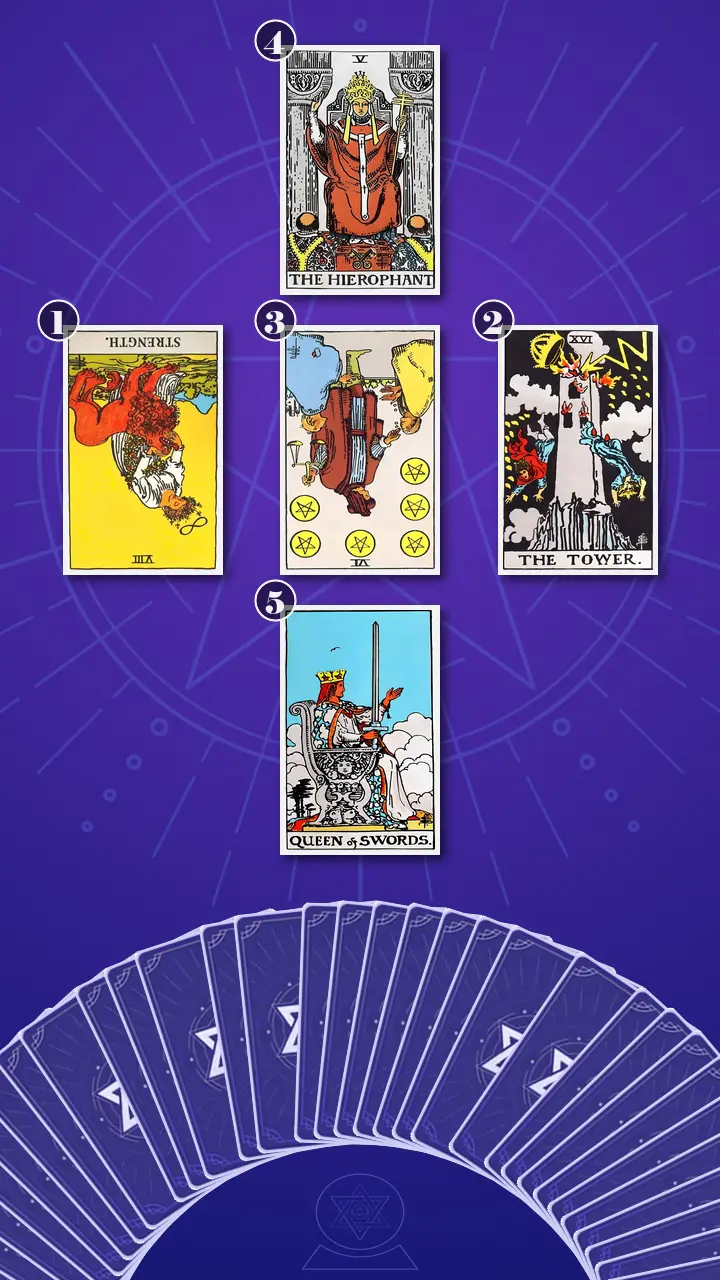
Reading the Pressure Plate of Family Emotional Labor
Once the cards were down, the spread looked exactly the way her story felt: one side bracing, one side erupting, a strained center holding the whole thing together. In my old Wall Street life, I learned that if you want to understand a crisis, you do not just watch the loudest spike. You study the structure that keeps absorbing the shock. This spread did that immediately.
Position 1: The Calm Voice That Costs Too Much
Now I turned over the card representing Maya's current stance inside the relationship: Strength, reversed.
In modern life, this card looks like being on a late-night family call using your softest customer-service voice, de-escalating everyone else while your own first reaction is locked behind your teeth. You sound calm, you look competent, and nobody notices your body is already in full emergency mode. Reversed, Strength is not a lack of strength at all. It is strength overused — self-control pushed so far past balance that it becomes self-erasure.
I pointed to the image of the hand over the lion's mouth. 'This is the exact moment you press down the first honest sentence,' I said. 'Stay calm. Keep it moving. Don't make this worse. The issue is not that you're weak. It's that your composure has quietly become labour.' Maya froze for a beat, rubbed her thumb once over the edge of her sleeve, then let out a small laugh with a bitter edge. 'Okay,' she said, 'that's accurate to the point of being rude.' I smiled. 'Good readings do that sometimes. This one isn't romanticizing the role. It's showing the cost of it.'
Position 2: When the Phone Becomes a Fire Alarm
The next card showed the destabilizing energy Maya reacts to when her sibling's meltdown takes over the room: The Tower, upright.
This card did not ask me to diagnose her sibling's inner life. Ethically, that matters. What it named was the impact in the shared field: the way a normal evening can flip in seconds, like stepping onto Line 1 after work, hearing your phone buzz hard in your hand, and feeling your shoulders rise before you even hit play on the voice note. The Bear episode 'Fishes' is the fastest shorthand I know for that nervous-system whiplash, except for Maya it arrived through a group chat bubble on an ordinary Tuesday.
'The Tower is disruption in excess,' I told her. 'Too much intensity, too quickly. Your system hears the alarm and becomes building coordinator before it even checks whether you're okay.' She looked down at the card, then away, as if replaying a recent night in her head. Her inhale caught, her gaze unfocused for a second, and then she nodded once. 'I never notice the switch,' she said quietly. 'It happens before thought.' 'Exactly,' I said. 'That means the pattern is locatable. We can work with the hook point.'
Position 3: The Invisible Invoice at the Center
At the center of the spread — the active exchange pattern created between both sides — sat the Six of Pentacles, reversed.
Of all five cards, this was the one that made the whole reading click into place. In real life, it looks like becoming the unpaid operations team for the emotional storm: arranging the ride, sending the check-in texts, smoothing the awkward aftermath, and then feeling almost embarrassed for wanting someone to ask if you're okay too. Reversed, the Six of Pentacles shows distorted reciprocity. Not no care, but uneven care. Not no love, but a system where one person's distress gets urgency and another person's steadiness gets assumed.
My finance brain always lights up around this card. On trading floors, I used to watch where risk was being offloaded without anybody naming it. In my practice, I call part of that instinct Network ROI Analytics: who keeps investing energy, who keeps drawing from the account, and who gets treated like a resource instead of a person. Maya's steadiness had become an auto-renewing subscription to family crisis management that nobody remembered signing her up for. 'This is why you feel that sting in your chest afterward,' I told her. 'You're not being petty. You're noticing the invisible invoice.'
Her fingers, which had been laced tight in her lap, loosened. Then came the long exhale. 'I always tell myself they had bigger feelings than I did,' she said. 'So wanting fairness feels selfish.' I shook my head. 'No. This card is the fairness card precisely because it asks what the exchange actually is. Calm is not consent. If your silence keeps being read as endless availability, the system never has to update.'
Position 4: The House Rule Nobody Voted On
Above the center, in the place of hidden influence, I turned over The Hierophant, upright.
This is the old code card. The inherited script. The family operating system installed before you were old enough to choose it. In Maya's life, it translated cleanly: the loudest distress gets exceptions, the most capable person gets responsibility. Nobody has to say the rule out loud for everyone to obey it. It is like a company policy nobody likes but everyone still acts as if it is mandatory.
I asked her, 'Growing up, what counted as being a good family member when someone was upset?' She did not answer immediately. Her jaw shifted first. Then her eyes went glassy, not with full tears, but with that specific kind of recognition that lands in the body before the sentence forms. 'Don't add to it,' she said at last. 'Be mature. Be the one who doesn't make things harder.' I nodded. 'There it is. It makes sense that fairness feels risky when usefulness has been your safest role. The problem is not just a sibling meltdown. It's a sanctioned role inside a larger permission structure.'
When the Queen of Swords Lifted Her Blade
Position 5: The Sentence That Ends the Apology Tour
By the time I reached the final card, even the room felt different. The city noise outside had thinned to a distant hush, and the space between us went very still. This was the guidance card — the antidote — and I knew before I spoke that everything in the spread had been leaning toward it.
The card representing Maya's most constructive next step was the Queen of Swords, upright.
I asked her to picture the 10:47 p.m. version of herself again: work clothes still on, family chat buzzing, Notes app holding the sentence she actually meant, jaw tight enough to feel it in her temples. That one moment held the whole role — the urge to soothe, the fear of being difficult, the split-second choice to disappear before anyone could ask anything of her.
Stop confusing silence with maturity; start naming your limit with the Queen of Swords' raised blade, because clarity can do what over-accommodation never could.
She stopped moving entirely. First the freeze: breath suspended, fingertips hovering at the edge of the chair. Then the cognitive drop, like I could almost see her replaying old scenes in fast cuts — group chat, holiday kitchen, next-day follow-up texts, all of it. Then the feeling hit. Not relief first. Anger. 'But if I do that,' she said, voice suddenly sharper, 'doesn't that mean I've been training everyone to expect the wrong version of me?' It was a good question. It was also the doorway.
'Maybe,' I said. 'But that doesn't make you wrong. It makes the pattern visible.' This is where my old deal-room instinct and my tarot work become the same language. I call it Negotiation Alchemy: before you enter a charged exchange, you need to know your clean terms and your BATNA — not your best alternative to winning, but your best alternative to self-abandonment. For you, that looks like this: I care about what's happening, and I am not available to mediate tonight. That is not cruelty. That is discernment. That is self-respect with human warmth still in it.'
I watched the change happen in layers. Her eyes reddened slightly. One shoulder dropped, then the other. She pressed her lips together, not to hold back words this time, but as if testing a new shape in her mouth. When I asked, 'Now, with this new perspective, can you think of a moment last week when one clean sentence would have changed how that night lived in your body?' she gave a small, shaky laugh and nodded. 'The whole night,' she said. 'Honestly, the whole night.' That was the hinge. Not from resentment to perfection, but from resentful self-containment to steady self-respect with clean boundaries. Calm is not the same as consent, and she did not have to disappear in order to be loving.
From Insight to Action: Your Next Boundary Window
This is exactly what the Relationship Spread · Context Edition is designed to reveal. It even moved elementally the way Maya's nervous system did: pressure, eruption, stuckness, old rule, then air. There was almost no water in the spread, which told me her feelings were being managed, redirected, or delayed — not actually given room.
When I stepped back and read the full arc out loud, the story was remarkably clear. Maya clamps down on her first honest reaction and calls that maturity because emotional eruption hits her system like a fire alarm. That shock feeds a one-sided emotional economy where her steadiness gets spent like endlessly available currency, all inside an inherited family rule that praises compliance as care. The Queen of Swords does not ask her to stop loving her family. She asks her to stop donating herself as proof of love.
The cognitive blind spot was this: Maya had been treating her silence as the thing that kept the family manageable. In reality, the silence was helping keep her role stable. The transformation direction was cleaner and more adult than 'be tougher': move from earning love by being low-maintenance to practicing clear, timely boundaries even when the room is emotionally messy. This is the heart of how to set boundaries with a sibling in crisis without feeling selfish: not by becoming colder, but by becoming earlier and clearer. Say the limit before resentment says it for you.
I gave her three practical next steps — small, specific, and built for real life rather than a perfect future self:
- Use the Clean Sentence PracticeOpen your Notes app today and write one 12-to-20-word boundary text for the next family flare-up. I had Maya use my Cocktail Party Algorithm in three beats: care, limit, close. Example: 'I care, and I'm not available to mediate tonight. I'll check in tomorrow.'Send the short version before you offer logistics. If the urge to explain spikes, save the draft and stop there — no apology tour.
- Do a body check before replyBefore responding to the next charged message, take three slower breaths, put one hand on your jaw or chest for ten seconds, and name your actual feeling in one word: angry, sad, resentful, scared, tired.If two minutes feels impossible, do a 20-second version. A pause is not abandonment; it is data.
- Run an Invisible Labor LedgerFor one week, track what you automatically do after family stress — rides, follow-up texts, translating everyone's feelings, checking if people got home — and reduce one recurring task by one step.Choose the least loaded task first. Reducing unpaid emotional labor is not the same as punishing anyone.
That is how I use tarot when someone asks how to stop overfunctioning in family conflict. Not as a prediction machine. As a pattern map that turns vague resentment into actionable advice and a doable next move.

A Week Later: The Quiet Proof
Five days later, Maya sent me a message. Family chat blew up again. This time she did not open with reassurance, logistics, or translation. She sent one sentence: 'I care, and I can't be the point person for this tonight.' Then she put her phone face-down, reheated leftovers, and let someone else step in. She told me the guilt hit first, hot and immediate. Then came ninety seconds of blank air. Then, for the first time in a while, her shoulders came down before midnight.
It was not a movie ending. The next morning her first thought was still, What if they think I'm cold? But she noticed the question, smiled at it, and got ready for work without drafting six different explanations. That is the kind of finding clarity I trust most: not a solved life, but a quieter jaw, a shorter text, a self that stays present instead of disappearing.
When I look back on our session, that is the journey to clarity I remember most clearly. Not whether Maya became less kind. She didn't. She became steadier without vanishing — compassionate, but no longer automatically available for every emotional weather system that crossed her phone.
When the room gets loud and your body goes still — jaw locked, breath held, already editing yourself before you speak — it can genuinely feel safer to disappear than to risk being called difficult for wanting fairness too.
If you didn't have to earn your place by being the least disruptive person in the room, what one clean Queen of Swords sentence would you want waiting in your Notes app the next time the family weather turns?
This story is adapted from psychological research, written so that those in a similar struggle can see their own pattern in it — and find their next step clearly.These insights are not a substitute for professional psychological, medical, legal, or financial advice.
Learn more about our Journey to Clarity.
How did this insight land for you?
🫂 This Resonates Deeply
🌀 Living This Story
✨ Now I See Clearly
🌱 Seeing New Possibilities
🧰 Useful Framework
🔮 The Confirmation I Needed
💪 Feeling Empowered
🚀 Ready for My Next Step
Author Profile
 AI
AI“I spent years in the intense, high-stakes world of Wall Street. I know exactly how isolating and heavy the weight of uncertainty can feel in the dead of night. I use strategic, commercial logic not to be cold, but to protect you from unnecessary friction. Think of me as a fellow traveler who has walked the same rocky path—offering sharp but deeply supportive wisdom to help you clear the fog and confidently win your narrative back.”
In this Friendship Tarot Reading :
Core Expertise
- Reciprocity ROI Analysis: Objectively measuring the emotional give-and-take in your core friendships to identify asymmetrical, high-drain relationships.
- Sunk-Cost Decoupling in Loyalty: Separating the 'ten years of history' from the current reality of a one-sided, demanding friendship.
Service Features
- The Friendship Downgrade Strategy: A calculated tactical approach to gradually and decently de-escalate a toxic friendship into a low-maintenance acquaintance without triggering dramatic conflict.
Also specializes in :
Explore Related Patterns:
Defensive OverfunctioningBy 10:47 p.m., you are half-dressed from work, looking at the family chat and the Notes draft, and your body has already moved into crisis-management mode. The story keeps showing you as the person who smooths, translates, arranges, and absorbs the fallout. You become the unpaid operations team before anyone has asked whether you can actually take that on. That is why the role feels competent and draining at the same time. It prevents immediate chaos, but it also turns responsibility into a reflex. Your own voice gets postponed until resentment has already built a bill in the background.
Family Role RegressionEach time the family group chat lights up, you do not just receive a new message. You slide back into a role the story says was already waiting in the background. The old house rule and the line about what counted as being a good family member make it clear that the system has trained you to treat upset as a cue to become the calm, responsible one again. That is why the sibling's meltdown feels bigger than the moment itself. The role is older than the current conflict, so your nervous system reaches for the familiar script before you can compare it with your actual limits. The pressure is not only the present crisis. It is the replay of a family assignment that was never renegotiated.
Guilt-Driven People-PleasingThe story says it plainly when you notice that stopping the easy-one role could make you 'another problem the family had to manage.' That turns fairness into something that feels risky, so staying low-maintenance starts to look like the safest way to protect your place in the room. The background rule keeps reinforcing it: don't add to it, be mature, do not make things harder. You are not just trying to be nice. You are trying to stay acceptable by never letting your own needs look expensive.
Self-SilencingYour first honest sentence is already written, but the story shows it getting held behind your teeth while your jaw locks and your voice softens. That is a clean picture of a self-protective filter that edits the truth before it becomes audible. In the moment, the edit buys short-term peace. Over time, it teaches the system that your real limit can be skipped, which is why the silence starts to feel less like maturity and more like self-erasure.
Explore Related Struggles:
Inherited Role LockWhen Maya names what counted as being a good family member, the rule is blunt: do not add to it, be mature, be the one who does not make things harder. Nobody has to announce that rule during the current meltdown because her body is already obeying it. You can feel how the present crisis is carrying an older instruction. The family chat lights up in the now, but the role she steps into was built earlier, through repeated lessons about which emotions receive exceptions and which people receive responsibility. Inherited Role Lock captures the weight of a family script that keeps running after the original room has changed. The struggle is that Maya is not only responding to her sibling's current intensity; she is responding through a role that taught her fairness becomes risky when usefulness has been the safest place to stand.
Low-Maintenance Worth LockMaya is terrified that if she stops being the easy one during a sibling meltdown, she will become another problem the family has to manage. That fear makes her own needs feel less like normal human limits and more like a threat to her place in the room. You can see the bind in the word easy. It does not mean she has no feelings; it means her feelings have been made easier for other people to avoid. The less she asks for, the safer her belonging seems to feel. Low-Maintenance Worth Lock names the structure where needing less becomes proof of being good to love. The struggle is that Maya's self-respect has to push against a family economy that rewards her most when she costs the least.
Reciprocity DeficitMaya is the one arranging the ride, sending the check-in texts, smoothing the awkward aftermath, and then feeling almost embarrassed for wanting anyone to ask how she is doing. The exchange is not empty of care, but it is badly weighted. You can see how urgency gets distributed. Her sibling's distress becomes the obvious emergency, while Maya's steadiness becomes the background resource that keeps getting spent without being replenished. Reciprocity Deficit is the cleanest name for that uneven emotional economy. The struggle is not a demand that everyone feel the same amount at the same time; it is the deeper imbalance where one person's pain gets response and another person's restraint gets mistaken for having no needs.
Self-Erasure ReliabilityThe sentence Maya actually wants to send is sitting in Apple Notes, while her jaw stays locked and her voice prepares to become softer than she feels. Her body knows the family job before her honest self gets a turn. You can see the friction in the order of operations: usefulness comes first, truth comes later, and later often means never. Each time she keeps the peace by editing herself down, her reliability becomes more legible than her personhood. Self-Erasure Reliability fits because the story does not show simple kindness; it shows a self becoming smaller so a system can keep treating her as stable. The cost is that being counted on starts to require disappearing before anyone has to notice what she needs.
Voice-Safety FusionMaya already has the clean sentence, but it lives in Notes instead of the family chat. The problem is not a lack of words; the problem is that saying the words makes her feel exposed to being judged as difficult, cold, or one more thing the family has to manage. You can feel the split at the level of the mouth and body. Her jaw holds the limit, her breath holds the risk, and her softened voice tries to keep belonging intact by keeping the truth delayed. Voice-Safety Fusion names the moment when speaking honestly feels tied to relational danger. The struggle is that her voice is not just communication anymore; it has become a test of whether she can stay connected without staying silent.
Fairness-Agency SplitMaya can name that she wants room for her own feelings and some basic fairness, yet the moment she tries to act on that knowledge, her body hits the brakes. The fair request is small, but inside the family system it lands like a disturbance. You can feel the agency split open around the boundary text. One part of her knows calm is not consent; another part has learned that asking for a fair exchange may be read as making the night harder for everyone else. Fairness-Agency Split fits because the story shows a person who can see the imbalance but hesitates to move from recognition into action. The struggle is not confusion about what would be fair; it is the cost of becoming someone who can ask for fairness in real time.
Unseen Cost BindThe story keeps returning to what nobody counts: the check-ins, the logistics, the translation of everyone's feelings, the quiet smoothing after the storm. Maya's calm produces order, but the price of that order is carried in her locked jaw, tight chest, and delayed resentment. You can see the bind because the cost only becomes visible after she has already paid it. As long as she stays composed, the family system can treat the night as handled instead of asking who handled it and what it took from them. Unseen Cost Bind names the hidden invoice attached to being the easy one. The struggle is that Maya's emotional labor has value, but it has been normalized so thoroughly that she has to feel the cost in her body before the system admits there was a cost at all.
Explore Related Emotions:
Boundary GuiltFive days later, Maya sends one clean sentence and the first thing to hit is not peace. It is hot, immediate guilt, followed by the next-morning question: What if they think I'm cold? When your limit has been treated as extra work for everyone else, even a kind boundary can feel like breaking the room. Boundary Guilt names the recoil that comes after you stop being automatically available: the body checking whether care is still allowed when you are no longer volunteering to absorb everything.
Fairness FatigueMaya says she wants room for her own feelings and basic fairness, then immediately runs into the old reflex that wanting fairness might be selfish. The imbalance is not subtle: one person's distress receives urgency, while her steadiness gets treated as a permanent utility. Fairness Fatigue is what builds when you have to keep proving that reciprocity is not cruelty. It is the weariness of noticing the invisible invoice again and again, then spending even more energy convincing yourself that asking to be considered is not the same as punishing anyone.
Invisible Labor DreadMaya is not only listening to the meltdown; she is coordinating the hidden work around it: rides, check-in texts, emotional translation, smoothing the awkward aftermath, and then quietly wanting someone to ask if she is okay too. The labor is everywhere, but it does not arrive with a formal request or a visible receipt. Invisible Labor Dread fits because the next family flare-up does not just signal noise. It signals a whole unpaid workflow waiting to attach itself to you. The dread comes from knowing that if you look calm enough, the system may treat your steadiness as infrastructure instead of care that also has a cost.
Low-Maintenance ShameMaya does not just choose calm in the moment; she has a whole inherited script telling her that the least disruptive person is the safest person to be. The line she remembers from growing up is painfully clear: don't add to it, be mature, don't make things harder. When your place in a family system has been protected by staying easy, having a need can start to feel like a social offense. Low-Maintenance Shame names that inner flinch: the part of you that suspects a boundary will make you harder to love, even when the boundary is reasonable and clean.
Performative CalmOn the late-night family call, Maya can sound composed while her body is already bracing. The story names the exact split: soft customer-service voice on the outside, emergency mode on the inside, first honest reaction locked behind her teeth. Performative Calm is the inner weather of looking safe for everyone else while not actually feeling spacious inside yourself. You are not calm in the way a rested person is calm; you are calm in the way a room stays quiet because someone is holding the door shut from the inside.
Resentful ExhaustionAt 10:47 p.m., Maya is still half-dressed from work with the family chat open and the sentence she needs sitting in Notes. Her body is already doing the job before her mind has caught up: shoulders up, breath held, voice softened, honesty delayed. When you become useful before you become honest, the tiredness is not just from one hard night. It comes from being drafted into the same crisis role often enough that your steadiness starts getting spent like household infrastructure. Resentful Exhaustion names the drained, sharpened edge of still caring while no longer wanting to be the one who always absorbs the impact.
Self-Betrayal AcheThe sentence 'I need a break from this tonight' is already there, but it stays behind Maya's teeth and inside a Notes draft. She does not lose the truth; she edits herself away from it before anyone else has to push back. Self-Betrayal Ache names the pain of watching your own inner boundary appear and then disappear under your own hand. In this story, the ache is not about being uncaring. It is about realizing that silence has been protecting the role more than it has been protecting you.
Quiet Self-RespectFive days later, Maya sends one sentence, puts the phone face-down, reheats leftovers, and lets someone else step in. The proof is small and physical: no apology tour, no six drafted explanations, shoulders coming down before midnight. Quiet Self-Respect is the feeling that appears when care remains but automatic availability ends. You do not have to become colder to stay intact; you become clearer, earlier, and more present with yourself. In this story, the shift is not a solved life. It is a self that stays in the room instead of disappearing to keep the room comfortable.
Relational WhiplashA normal Tuesday night flips through a group chat bubble. Maya is on the edge of her bed, still in work clothes, and the phone in her hand has the force of a fire alarm before she has even checked in with herself. Relational Whiplash captures the speed of that switch. You are pulled from private evening into family emergency field so fast that your body starts coordinating before your own perspective has entered the room. The disorientation matters because the role depends on that speed: if you are already reacting, you have less space to choose.
Explore Related Contexts:
Designated Peacekeeper RoleMaya sits with the Notes draft open, wanting to write that she needs a break, while the family chat keeps pulling her toward the softer, safer voice. The role appears in the split second where she edits herself before anyone has even asked her to. The designated peacekeeper role works by making one person's calm responsible for everyone else's manageability. Her sibling's meltdown becomes the visible event, but Maya's automatic de-escalation becomes the hidden service keeping the wider system from having to change. You can care about the family weather without becoming its permanent climate control. This context matters because it shows why a clean boundary feels so loaded: stepping out of the peacekeeper role does not just change one text exchange, it challenges the family's expectation that your steadiness should absorb the room.
Emotional Labor ImbalanceMaya is not only listening to a sibling's meltdown; she is managing the operational aftermath around it. The reading names the rides, check-in texts, smoothing, translating, and next-day emotional cleanup that gather around her whenever family stress spikes. That pattern creates an emotional labor imbalance because care is flowing through the family system unevenly. One person's distress is treated as urgent, while another person's steadiness is treated as proof that they need less support, fewer questions, and less recovery time. You are seeing the invisible invoice behind the resentment. The issue is not that Maya wants to stop caring; it is that the exchange has been structured so her care keeps being spent without consent, recognition, or replenishment.
Family Boundary NegotiationMaya's new text does not end the family pattern all at once, but it changes the terms of participation. She stays connected enough to say she cares, while refusing the automatic point-person job for that night. Family boundary negotiation is the real-world stage where a long-standing role starts to be rewritten through small, specific acts. The negotiation is not only with other people; it is also with the old access rule that made her availability feel assumed. You can see the leverage in the aftermath: someone else steps in, the night does not collapse around her refusal, and her body gets a little more room before midnight. That kind of evidence matters because it shows a boundary becoming practical, not just conceptual.
Family Script PressureMaya can name the old rule almost word for word: do not add to it, be mature, be the one who does not make things harder. That sentence is not just personal self-talk; it is the family script that has taught her which version of herself is acceptable during conflict. Family script pressure turns repeated expectations into a background law. No one has to explicitly order Maya to stay easy, because the system already rewards the person who absorbs tension quietly and treats their restraint as maturity. You get clearer agency when the script becomes visible. The question is no longer whether you are kind enough to keep swallowing your limit, but whether the family rule has been allowed to define care so narrowly that honesty starts looking like disruption.
Parentified Adult Child RoleMaya is twenty-five, coming out of a workday, and still gets pulled into family crisis management the moment the group chat lights up. The story shows her body moving into the job before she has chosen it: voice softened, shoulders raised, honest sentence trapped behind her teeth. That is the structure of a parentified adult child role in everyday form. The family does not need to formally appoint her as the adult in the room, because the operating rule already does it: the sibling's distress gets urgency, and Maya's steadiness gets converted into responsibility. You are not looking at a simple personality trait here. The pressure comes from a role system where competence becomes a trap, and where being capable makes it harder to be seen as someone with limits. The point of naming this context is to separate your actual care from the inherited job description that keeps using your calm as family infrastructure.
Clean Boundary PracticeFive days later, Maya does something concrete: she sends one sentence saying she cares and cannot be the point person tonight. Then she puts the phone face-down, reheats leftovers, and lets someone else step in. Clean boundary practice gives the family system a new data point without turning the exchange into a long defense. The sentence carries care and limit at the same time, which keeps the boundary grounded instead of reactive. You are not trying to become colder or harder to reach. You are practicing a clearer access rule before resentment has to speak for you, and that makes your care more deliberate instead of automatically extracted.
Conditional Family BelongingMaya's fear is specific: if she stops being the easy one during a sibling meltdown, she may become another problem the family has to manage. That fear shows the belonging contract underneath the visible crisis. Conditional family belonging appears when acceptance feels tied to being low-maintenance, useful, and emotionally convenient. In this structure, asking for fairness is not experienced as a normal need; it gets treated as a possible threat to the role that keeps someone safely included. You are allowed to notice the cost of that contract. Naming this context helps separate love from performance, because a family role that only works when you disappear is not the same thing as secure belonging.