The 10:47 p.m. Family-Role Lock-In
If you are the default family organiser with a hybrid city job, a career crossroads may look less like not knowing what you want and more like closing your plan whenever the family group chat asks for one quick thing. That was the pattern Alex (name changed for privacy), a 27-year-old project coordinator in London, brought into my reading room.
I asked them to take me to the last exact moment it had happened. At 10:47 p.m. on a Tuesday, they had been sitting at the small desk in their shared flat, a Google Doc comparing three possible paths glowing blue-white against the dark window. The boiler hummed through the wall; their tea had gone cold. Beside a blank column titled “First Experiment,” a WhatsApp banner appeared asking who could handle a routine Saturday task. Their throat tightened, their chest braced, and their fingers typed, “I can do it.” Then they closed the document and reopened their work calendar.
“I can disappoint myself quietly,” Alex told me, pressing both palms between their knees. “But family disappointment becomes a whole event. Every option looks possible until I imagine explaining it at home.” The guilt arrived in their body like a cinema safety bar locking across their ribs before the difficult scene had even begun. Beneath it, I could hear longing, resentment, grief, and genuine love occupying the same sentence.
“I’m not going to tell you to choose yourself as if your family, London rent, shared history, and practical support are disposable details,” I said. “I also won’t treat a card as a verdict on what your relatives will do. Let’s use the reading to separate what is real from what has only been forecast, and draw a map through this fog. The aim is clarity, not certainty, and the pen stays in your hand.”

Choosing the Bridge: The Relationship Spread
I invited Alex to place both feet on the floor, take one unforced breath, and hold a precise question in mind: “How can I change my path without confusing a change in my family role with the loss of my family?” I shuffled slowly, using the movement as a transition from rapid mental rehearsal into focused observation rather than as a performance of mystery.
I chose the Relationship Spread · Context Edition, a six-card relationship tarot spread adapted for family-role lock-in and path-choice guidance. For anyone wondering how tarot works in a reading like this, the cards are not surveillance tools for discovering what other people secretly think. I use them as a structured way to examine assumptions, recurring behaviour, values, and possible next steps.
This spread fit because Alex did not yet need a dramatic comparison between three fully defined futures. Their central problem was relational: each possible path passed through an inherited family role, and every imagined adjustment became a stop signal. The six positions let me follow that sequence without flattening it into either “stay” or “leave.”
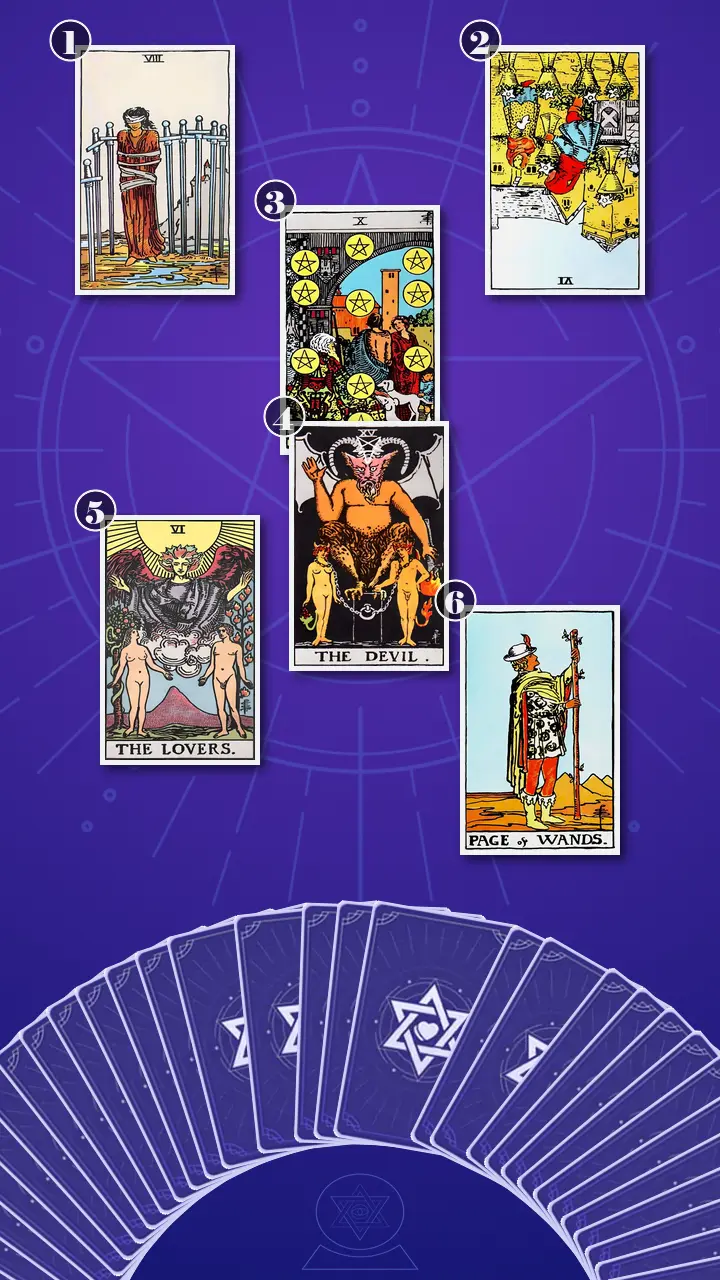
I showed Alex the bridge-shaped layout. The first card would reveal the observable pattern that made them feel trapped. The second would examine the inherited family role. The middle cards would identify the foundation worth protecting and the hidden mechanism keeping the role fixed. The fifth would hold the central transformation, and the sixth would turn insight into one reversible experiment. That structure matters because card meanings in context should build an argument, not produce six unrelated slogans.
Reading the Bridge Beneath the Bond
Position One: The Forecast Mistaken for a Verdict
“I’m turning the card that represents your observable current-state pattern,” I said. “This position asks what happens when you begin considering a personal path but experience anticipated family reactions as barriers before any direct conversation has occurred.”
The card was the Eight of Swords, upright.
I pointed to the blindfold, the loose cloth bindings, and the incomplete ring of swords. “This does not mean every obstacle is imaginary. London living costs are real. Work schedules, housing, family support, and existing commitments are real. The question is which restriction has actually been stated and which one has been inferred.”
I returned to the Google Doc Alex had described. Three viable directions sat on the screen, but beside each one they had mentally added an objection: someone would feel abandoned, a relative would struggle, a new schedule would cause conflict, a move would make them less welcome. By the time the forecast column was complete, it looked like a set of confirmed prohibitions. No relative had ruled on a protected 90-minute experiment, yet Alex closed the document as though a final decision had already been issued.
In energy terms, this was Air under blockage. Alex had plenty of thought, but the thought was circulating inside a narrowed field. Analysis had shifted from gathering useful information into trying to guarantee that nobody would be disappointed. It was like Google Maps hiding every route because possible traffic had been pinned to each road and every pin had been treated as a closure.
“No one has said, ‘You cannot try this,’” Alex said slowly. “But I’m already planning as if they have.” A short laugh escaped them, dry and almost disbelieving. “That is so accurate it feels a bit brutal.”
I did not rush to soften the recognition. “Accurate does not have to mean accusatory,” I said. “You developed this forecast because belonging matters and because some practical consequences deserve thought. We’re only moving predictions out of the confirmed-constraint column so they can be checked.” Their fingers stopped worrying the cuff of their jumper, and their gaze returned to the loose bindings.
Position Two: The Role Everyone Still Tags
“Now I’m turning the card that represents the inherited family role system,” I said. “This position looks at the expectation that you will preserve connection by remaining familiar, useful, and consistently available.”
The card was the Six of Cups, reversed.
I focused on the taller figure offering a flower-filled cup to the smaller figure. Upright, the Six of Cups can hold memory, kindness, and familiar affection. Reversed here, its Water energy was not absent; it had been overextended backwards. A caring exchange from the past had become a present-day assignment that nobody had formally reviewed.
I asked whether Alex recognised the scene. A weekend request lands in the family chat, and before checking their capacity, they respond as the version everyone already knows: the organiser who remembers the dates, finds the booking link, rearranges plans, and makes the issue disappear. The family’s oldest saved profile still reads: reliable, quick responder, always available.
Alex looked down at the card. “At lunch last month, someone said, ‘Alex will sort it,’ and everyone laughed because it’s true.” They paused. “The kitchen was warm. Everyone was being affectionate. But my shoulders went straight up.”
“That is the sadness of this card,” I said. “The role began as care, so changing it can feel ungrateful. Yet chosen generosity and an automatic assignment are not the same thing.” I asked when the flower-filled cup had stopped being freely offered and started arriving as a recurring calendar invitation with a permanent owner.
The reversal also carried an overcorrection warning. Renegotiating a role did not require Alex to stop replying to every message or disappear for several days to prove independence. A specific pause would reveal more than abrupt withdrawal: “Let me check my calendar and come back to you by seven.” That sentence would interrupt the old assignment without turning the entire family bond into a confrontation.
Position Three: What the Archway Is Holding
“The next card represents the relationship’s foundation,” I said. “It identifies what you are legitimately trying to protect beneath the conflict: continuity, practical security, shared history, and belonging.”
The card was the Ten of Pentacles, upright.
I traced the multi-generational scene beneath the decorated archway. Here, Earth energy appeared in balance: durable support, familiar rituals, people who had helped, and a network that carried real material as well as emotional value. Alex was not resisting a random inconvenience. They were trying to protect an infrastructure of home while also admitting that their function inside it no longer fit.
As an artist, the image took me back to collaborative productions where one person had quietly become the keeper of every prop list, key, and schedule. The production did not cease to exist when that job changed hands; it simply had to make its structure visible. I saw the same distinction here. The family bond was the shared production. Alex’s organiser role was one job inside it, not the whole story.
“The family role is part of the bond; it is not the whole bond,” I told them. “Changing the admin permission does not delete the archive.”
Alex’s face softened, although their eyes shone with something more complicated than relief. “I don’t want to lose Sunday lunch,” they said. “I don’t want to become a stranger. I just don’t want every practical thing to be mine before anyone asks.”
“Then that is useful clarity,” I said. “You are not trying to erase connection. You are distinguishing the rituals and care you actively choose from a permanent job description.”
Position Four: The Contract That Auto-Renews
“I’m turning the card that represents the repeating relational dynamic,” I said. “This position shows how a request triggers automatic compliance, short-term relief, lost personal momentum, and then stronger role lock-in.”
The card was The Devil, upright.
I kept my voice level. “This card does not declare your family harmful, and it does not prove that anyone is consciously manipulating you. It reveals a fear-bound contract: the belief that you must remain useful in the same way to remain securely connected.”
The loose chains around the two figures mattered. A notification appears during protected planning time. Alex’s chest braces. They say yes before checking the calendar. The chat goes quiet, and relief arrives. The personal tab closes. The immediate calm then feels like proof that compliance was the only safe choice. In energy terms, attachment had moved into excess while conscious choice had become blocked.
As I placed The Devil beneath the Ten of Pentacles, Alex’s phone vibrated once against the table. The sound was small, but their shoulders rose before they glanced at the screen. They caught the movement themselves and left the phone face-down.
“If I answer now, nobody is upset,” they said. “And if nobody is upset, it feels like I made the safe choice.”
“Exactly. An automatic yes buys immediate calm with tomorrow’s time.” I let the sentence settle. “The relief is real, but relief is not always evidence that the decision was right. Sometimes it is only evidence that an old nervous-system loop has been completed.”
I asked Alex to name the last non-urgent request they had accepted, the relief that arrived immediately afterwards, and the personal task that disappeared from their calendar. Their throat moved before any words came. Then they named the missed online taster session on the Northern line: the family message covering the registration button, the quick reply, the relief, and the later email confirming a session they had not attended.
“Care is still present,” I said. “The blockage is compulsion: every obligation has been fused with the imagined survival of the entire bond. Once the terms of that contract become visible, they can be examined.”
When The Lovers Opened the Sky
Position Five: Two Truths Standing Unchained
The rain at the window had thinned to a fine silver line when I reached the central transformation card. The room felt quieter, as though even the boiler had paused between cycles.
“This position represents the central challenge and lesson,” I said. “It asks how you can distinguish care you consciously choose from obligation driven by fear, without pretending that the people or the practical stakes do not matter.”
The card was The Lovers, upright.
I placed it directly beside The Devil. The visual structure remained relational: a human pair beneath a higher presence. But the chains and dark pedestal had given way to two distinct, unchained figures beneath an open sky. The relationship had not vanished. The quality of participation had changed.
In this position, The Lovers carried balanced energy: values alignment, conscious choice, honesty, and intimacy without self-erasure. In ordinary life, it looked like one accurate message: “I care about helping with family plans, and I’m not available to organise this Saturday. I can share the details on Thursday, or someone else can take it.” A relative might still be disappointed. The card did not promise otherwise. It asked Alex to stop turning that possible disappointment into a verdict on their lovability or membership in the family.
This was where I used what I call a Macro-Narrative Arc Audit. I asked whether Alex was treating the first uncomfortable family reaction as the climax of the entire film: the scene that proved everything had fallen apart. The cards showed something else. This was not a dead end, and it did not have to be a final rupture. It was the messy middle of a role transition, where old blocking still appeared on the floor even though the character had begun moving towards a different mark.
I brought us back to 10:47 p.m.: three paths on the screen, one routine WhatsApp request, a tight throat, and the familiar reply already forming. Alex had been trying to find a choice so perfect that nobody would need to adjust, then trading private disappointment for immediate family calm.
Staying unchanged is not the price of love; make one values-aligned choice and meet your family as the two unchained figures beneath The Lovers' open sky.
I left a full breath of silence after the line.
Family discomfort is not proof that the bond is broken; it may simply be the first evidence that your role inside the bond is changing.
For one beat, Alex did not breathe. Their thumb stopped halfway along the edge of the card, and their eyes lost focus as if the Tuesday-night scene were replaying on an internal screen. Then their mouth tightened instead of softening. “But doesn’t that mean I’ve been doing all of this wrong?” they asked, the words sharper than anything they had said so far. “I’ve lost so much time.” I watched the anger reach their face before grief followed it: brow drawn, eyes bright, one hand closing into a fist against their knee. “No,” I said. “It means an old strategy protected connection until its cost became too high. We can respect why it formed without giving it permanent control of the script.” Their fist loosened finger by finger. Their shoulders dropped, but the release left them briefly unsteady, like someone standing after a film has ended and remembering the lights are on. A small, tremulous “Oh” came out with their next breath.
“Now, using this new perspective, can you think of a moment last week when this insight might have made you feel different?” I asked.
Alex returned to the online taster session. “I could have let the message sit for twenty minutes,” they said. “I could have registered first. I wasn’t announcing my whole future. I was just attending one thing.” Their voice held relief, but also the vulnerability of recognising that the next choice would belong to them. “And I could have said, ‘I can’t do tonight, but I can help on Thursday.’”
I named the crossing the card had opened: this was a first movement from guilt-laced apprehension and automatic role compliance towards differentiated belonging, cautious self-trust, and values-aligned choice. It did not erase love or practical risk. It separated connection from compulsory sameness.
I also used a piece of Turning Point Catalysis: instead of framing family discomfort as the scene that ended Alex’s path, I invited them to treat it as the inciting incident for a more honest act. The new story was not “I stopped caring.” It was “I finally gave the relationship accurate information about who I am becoming.”
To keep the insight grounded, I set an eight-minute timer and divided a page into two columns: “What has actually been asked or stated” and “What I predict will happen.” Alex added one current family request, then circled a single assumption they could test with a pause or a draft response. I made it explicit that they did not have to send anything that day. If a boundary could affect housing, essential financial support, or personal safety, the exercise would remain private, the example would stay low-stakes, and practical support would come before action.
The Page Who Refused a Final Verdict
Position Six: Fire in One Protected Block
“I’m turning the final card, which represents a constructive next step,” I said. “This position translates the shift into one reversible path experiment and one specific availability boundary, without treating either as a final verdict on the relationship.”
The card was the Page of Wands, upright.
I drew Alex’s attention to the Page studying the budding wand in an open landscape. Fire had been delayed throughout the spread. Air had analysed, reversed Water had pulled towards the past, Earth had protected the foundation, and the Major Arcana had exposed and revised the hidden contract. Now Fire arrived not as a dramatic escape but as balanced curiosity.
“You do not need a final path; you need one protected experiment,” I said.
The blank “First Experiment” column could now hold a real calendar event: a 90-minute sample lesson, an informational call, a small portfolio task, or an application draft. During that block, one non-urgent family task could be delayed, shortened, redirected, or declined. Afterwards, Alex could record what actually happened: what held their attention, what drained them, what their relative actually said, and what they wanted to test next.
“So I’m not deciding who I’ll be for the rest of my life,” Alex said. Their fingers were already moving towards the Notes app, but this time without the frantic speed of an automatic reply. “I’m gathering evidence.”
“Exactly. The Page is a beginner making contact with the world. Self-trust grows from observable experience, not from another round of predicting every possible reaction.”
The Director’s Cut: Finding Clarity in One Block
What the Six Cards Said Together
I gathered the spread into one coherent story. The Eight of Swords showed why Alex felt trapped: genuine constraints and predicted rejection had been entered in the same column. The Six of Cups reversed traced that restriction back to an inherited role that began in care but had stopped updating. The Ten of Pentacles confirmed why the choice carried real weight: the family held history, support, and belonging worth preserving. The Devil exposed the mechanism beneath the bond, where automatic compliance purchased immediate relief while quietly taking time from Alex’s future. The Lovers revised that fear-bound contract into conscious participation, and the Page of Wands asked for one small act of contact with a possible path.
The cognitive blind spot was not simply “I struggle to say no.” It was the belief that every sign of family discomfort measured the health of the whole bond. That belief made Alex search for a path requiring nobody else to adjust, an impossible standard that disguised frozen planning as responsible analysis.
The transformation direction was precise: stop treating ordinary family discomfort as an automatic stop signal; preserve the care that remains freely chosen; state what availability can no longer be assumed; and test one reversible direction before demanding certainty. Family discomfort could be information without becoming a veto. Actual danger, material dependency, or threats to safety would require a different scale of planning and outside support.
Three Small Scenes Alex Could Direct Next
I framed the actionable advice as a Director’s Cut rather than a total rewrite. We were not trying to produce a flawless six-month ending in one evening. We were choosing the next usable scene.
- Run the Eight-Minute Facts-vs-Forecasts Check.In the Notes app, divide one page into “What was actually asked or stated” and “What I predict will happen.” Add one low-stakes family request or path decision, then circle one forecast that could be tested with a pause, a question, or a private draft.Use an eight-minute timer and stop when it ends. You do not have to send a message or resolve the whole situation.
- Use One Differentiated-Belonging Reply.The next time a non-urgent request arrives, send: “Let me check what I already have on and come back to you by 7.” After checking, give a specific yes, no, shorter time limit, or alternative: “I can’t organise Saturday, but I can send the link on Thursday.”If thirty minutes feels impossible, pause for five. Keep the reply about this request, not as a verdict on the whole family.
- Create a Director’s Cut Path Pilot.Write an objective six-month logline: “Over the next six months, I am testing [direction] through [one experiment] while keeping [chosen family commitment] and handing over or limiting [automatic duty].” Then book one 20-to-90-minute pilot this week and produce one observable result, such as a completed lesson, sent email, draft, or call.Treat it like a refundable visit to a possible future. Set a time and spending limit, make no final announcement, and record what actually happened rather than scoring the path as a permanent yes or no.
I reminded Alex that a pause was not punishment and a boundary was not a test of whether relatives cared. If changed availability could affect their housing, essential money, immigration status, health support, or personal safety, I would want them to choose a lower-stakes experiment and involve a trusted person or relevant professional before changing a high-impact arrangement. Tarot could clarify a pattern; it could not assess every practical risk or predict another person’s response.

A Week Later: One Hour Under an Open Sky
Six days later, I received a short message from Alex. A family request had appeared twenty minutes before their Path Pilot, an online introductory session connected to one of the three directions in the Google Doc. They had typed, “Let me check my calendar and reply after the session.” Their throat still tightened before they sent it.
They attended the session anyway. Afterwards, they offered to help for twenty minutes on Thursday rather than taking ownership of the whole weekend task. One relative replied, “Okay, no problem,” and someone else volunteered. Another relative sent nothing at all. Alex did not pretend the silence felt comfortable, but they also did not turn it into a confirmed story of rejection.
That evening, they finally typed three lines into the “What Actually Happened” section. The work had held their attention. The family task had still been completed. The relationship had not supplied a final verdict, because no final verdict had been required.
That night they slept through. In the morning, their first thought was, “What if I’m wrong?” This time they smiled, checked the next Path Pilot in their calendar, and allowed the question to remain a question.
I did not see tarot choose Alex’s path. I saw the spread help them distinguish the scene they were in from the ending they had feared, and then I watched them reclaim authorship through one hour of evidence. Their Journey to Clarity was not a perfect escape from guilt. It was the first lived proof that care and change could occupy the same frame.
When the family chat lights up and your throat tightens before you have even read the request, becoming more yourself can feel as though it might make you less welcome at home. If you can notice that old safety bar locking into place, you are already seeing the difference between a familiar body alarm and a finished story.
If family discomfort did not have to mean disconnection, what tiny, reversible entry would you place in your own blank “First Experiment” column and protect beneath The Lovers’ open sky for one hour this week?
Every reading at AceTarot is a journey to connect with inner wisdom and empower the path ahead. This reading shared here is a psychological mirror, not a private record—crafted to reflect universal emotional loops and help restore personal clarity. Please note that these insights do not replace professional psychological, medical, legal, or financial advice, and should not serve as the sole basis for major life decisions.
Learn more about our Journey to Clarity.
How did this insight land for you?
🫂 This Resonates Deeply
🌀 Living This Story
✨ Now I See Clearly
🌱 Seeing New Possibilities
🧰 Useful Framework
🔮 The Confirmation I Needed
💪 Feeling Empowered
🚀 Ready for My Next Step
Author Profile
 AI
AI Juniper Wilde
1056 readings | 537 reviews
“I’ve always felt our lives are films currently in production. As an artist, I know that when you feel stuck, it’s often because you’ve bravely stayed in a painful scene for just a little too long. I’m not here to coldly analyze you. I want to sit closely with you, look at those difficult moments with profound empathy, and gently hand you the pen so you have the courage to write your next beautiful act.”
In this Direction Tarot Reading :
Core Expertise
- Macro-Narrative Arc Auditing: Identifying whether your current confusion is a false climax, a dead end, or merely the messy middle of a transition montage.
- Turning Point Catalysis: Reframing your perceived 'dead end' as the necessary inciting incident for the next act of your life's narrative.
Service Features
- The Director's Cut Reframe: A creative micro-experiment to draft the objective 'logline' of your next 6 months, reclaiming your authorial voice over your trajectory.
Also specializes in :
Explore Related Patterns:
Approval-Driven Decision ParalysisThree viable directions are visible on Alex's screen, yet each one acquires an imagined family objection before any direct conversation occurs. Planning then stops being a way to compare evidence and becomes an attempt to find a future in which nobody has to adjust, so the blank 'First Experiment' column stays empty. Approval-Driven Decision Paralysis forms when you require anticipated social permission before allowing a personal option to become actionable. More analysis cannot solve the problem because the hidden standard is not adequate information; it is universal approval. As long as another person's possible discomfort counts as a stop signal, every route can be mentally closed without ever being tested.
Boundary DiscernmentSix days after the reading, Alex attends the introductory session before replying, then offers twenty minutes of help on Thursday instead of taking ownership of the whole weekend task. The family bond remains present, but the practical responsibility is no longer treated as automatically theirs. Boundary Discernment appears when you separate care from unlimited availability and distinguish a relationship from one job you have historically performed inside it. The boundary is neither disappearance nor punishment; it is accurate information about what you choose, what you can offer, and what another person is free to handle.
Emotional Hyper-ResponsibilityAlex tries to guarantee that no relative will be disappointed before anyone has responded to a boundary or path experiment. A routine request therefore carries an extra invisible assignment: manage the task, manage everyone's possible reaction, and protect the apparent stability of the entire relationship. Emotional Hyper-Responsibility makes other people's potential discomfort feel like work you must prevent or repair. You can consider the foreseeable impact of a choice without claiming ownership of every feeling it may produce. Once disappointment is allowed to belong partly to the person experiencing it, it can provide relational information without automatically becoming your veto.
Family Role RegressionWhen the family chat activates, Alex responds as the long-established version everyone can tag without discussion: quick, reliable, and ready to make the practical problem disappear. Their current career questions and present capacity recede while the older organiser role takes over the interaction. Family Role Regression occurs when contact with the family system pulls you back into a familiar behavioural position that no longer reflects your full adult range. The role may have begun as genuine care and may still contain care, but its age and familiarity do not make it permanently binding. The audit point is whether you are choosing the role now or reenacting it before your current self gets a vote.
Guilt-Driven People-PleasingAt 10:47 p.m., Alex sees a routine family request, types 'I can do it' before checking their calendar, and closes the document containing three possible paths. The same sequence previously displaced a taster session: anticipated guilt appears, immediate help is offered, the chat settles, and personal momentum disappears. Guilt-Driven People-Pleasing describes how you can use compliance to regulate the fear of disappointing others. The yes is not evidence that the request is genuinely right for you; it is a fast defence against guilt and possible disapproval. Because the relief arrives immediately while the personal cost arrives later, the loop can keep reinforcing itself.
Reality TestingThe three paths in Alex's Google Doc initially look blocked because imagined objections have been entered beside them as though relatives had already issued decisions. Separating what was actually stated from what was predicted exposes the hidden reasoning error: a forecast can deserve investigation without being promoted to a confirmed constraint. When you record the real response to a small boundary, you give observable evidence more authority than mental rehearsal. Reality Testing does not promise that every reaction will be comfortable; it keeps discomfort, silence, and disagreement from being assigned meanings the available facts do not yet support.
Usefulness-Based Self-WorthAt the family lunch, 'Alex will sort it' is affectionate enough to make everyone laugh and automatic enough to make Alex's shoulders rise. The organiser role has become more than a set of tasks: continuing to be useful in the familiar way feels tied to remaining recognisable, welcome, and securely connected. Usefulness-Based Self-Worth turns practical contribution into proof of relational value. When that equation is active, you are not merely deciding whether to organise Saturday; you are unconsciously testing whether you still deserve your place if you do less. Distinguishing the bond from the job weakens that equation without dismissing the real care and support contained in the relationship.
Values-Based Decision MakingAlex explicitly wants to keep Sunday lunch, shared history, and meaningful family support while ending the assumption that every practical task belongs to them. Protecting one path pilot while offering a smaller form of help turns those stated priorities into an observable choice. Values-Based Decision Making does not require you to label family connection or personal growth as the enemy. It asks which forms of care still express your values and which forms of compliance are being maintained mainly to suppress guilt. A reversible experiment can honour both belonging and development without pretending that every trade-off can be removed.
Emotional ReasoningThe WhatsApp banner makes Alex's throat tighten and chest brace before they have checked either the request or their calendar. After they say yes, the group chat becomes quiet and relief arrives, making compliance feel like proof that the correct and safe choice has been made. Emotional Reasoning treats the intensity or disappearance of a feeling as evidence about external reality. Your body alarm can reveal that an old relational rule has been activated without proving that the current choice is dangerous. Likewise, relief can show that you completed a familiar defence without proving that the decision served your longer-term interests.
CatastrophizingA change to one Saturday task expands in Alex's forecast into conflict, abandonment, reduced welcome, or loss of the family bond. The first uncomfortable response is mentally positioned as the final scene that would prove the whole relationship had broken. Catastrophizing compresses a chain of possible outcomes into the most damaging conclusion and then responds as though that conclusion is imminent. When you separate a limited role adjustment from the survival of the entire bond, disappointment can stay disappointing without becoming relational annihilation. That proportionality makes room for practical caution while preventing every small experiment from carrying the weight of a permanent rupture.
Uncertainty ToleranceAfter the path pilot, one relative says there is no problem, another volunteers, and a third says nothing. Alex notices the discomfort created by the silence but does not use it to manufacture a final story of rejection. The next morning, the question of being wrong remains present while the next experiment stays in the calendar. Uncertainty Tolerance lets you act without first predicting every family reaction or proving that one career path will define the rest of your life. The uncertainty is not erased; it is reduced to its proper size, so an unanswered message can remain unanswered and a pilot can remain a pilot rather than becoming a verdict on identity or belonging.
Mind ReadingBeside each possible path, Alex mentally adds what a relative might think: someone will feel abandoned, somebody will struggle, conflict will follow, or Alex will become less welcome. No relative has prohibited the protected experiment, but these imagined positions enter the decision as though they were direct quotations. Mind Reading fills an information gap with a confident interpretation of another person's motives or reaction. When you give that interpretation decision-making authority, an unasked question can function like an explicit no. Returning the prediction to hypothesis status does not make it false; it makes it available for proportionate checking instead of automatic obedience.
Explore Related Struggles:
Autonomy Guilt BindAt 10:47 p.m., Alex has three possible paths open in front of them, but one routine family request is enough to close the document. The movement toward a chosen future and the anticipation of family disappointment activate at the same moment, making personal agency feel inseparable from the prospect of causing relational pain. You can know that change matters and still find private disappointment easier to tolerate than visible family discomfort. The bind is not a simple lack of direction. It is the demand that every self-directed choice first survive guilt, even when nobody has actually prohibited the choice.
Belonging-Authenticity SplitAlex wants to keep Sunday lunch, shared history, and the practical support surrounding home, while no longer being the permanent owner of every task. Their emerging direction does not oppose love, but it does make them less identical to the familiar version of Alex that the family already knows how to rely on. You can become caught between being accurately known and remaining comfortably recognisable. The struggle appears when expressing who you are becoming seems likely to reduce your welcome, leaving belonging tied to a version of you that no longer has enough room to grow.
Future-Proofing ParalysisThe Google Doc contains three viable directions, yet the "First Experiment" column remains blank while Alex mentally attaches a possible family objection to every route. Planning has stopped gathering useful information and started trying to design a future in which nobody else ever has to react or adjust. You can keep searching for a perfectly protected path long after the available options are clear enough to test. The paralysis comes from requiring certainty about the relationship before collecting evidence about the path, leaving every real option disqualified by a future it cannot guarantee.
Guilt-Evidence FusionBefore any relative has ruled on a path experiment, Alex adds abandonment, conflict, and reduced welcome to the forecast beside every option. The guilt arrives physically before the conversation has occurred, and that bodily signal is treated as though it confirms the predicted outcome. You remain stuck when an internal warning is entered into the same column as observable evidence. Guilt may accurately show that the bond matters, but it cannot by itself establish what another person will do or whether the relationship will survive an adjustment. Recovering that distinction gives you something concrete to test.
Inherited Role LockAt lunch, someone says, "Alex will sort it," and the family laughs affectionately because the assignment is already familiar. The warmth of the scene allows an old act of care to keep functioning as a current job description, even though Alex's raised shoulders show that the role no longer fits without cost. You can find every new decision routed through an inherited profile before your present capacity is consulted. The role remains locked because it still solves practical problems quickly, making its age and rigidity easy to overlook while your current life keeps being organised around it.
Protection-Progress SplitThe three-path document stays unfinished beside a family network that carries real history, rituals, practical help, and belonging. Each move toward a different future therefore appears to take something away from a foundation Alex legitimately wants to protect. You are not simply choosing between progress and caring about other people. The deeper friction comes from trying to preserve what is valuable without making preservation a permanent brake on your development. A path can remain blocked when protection is required to mean that nobody else ever has to adjust.
Self-Erasure Reliability"I can disappoint myself quietly," Alex says after describing the closed career document and the taster session they never attended. Their reliability remains highly visible to the family, while the plans removed to sustain it disappear privately and leave no comparable event for anyone else to notice. You become dependable through self-erasure when your own time is always the least disruptive resource to sacrifice. The struggle runs deeper than taking on too much. It makes your absence from your own future part of how the relationship continues to recognise you as reliable.
Utility-Belonging FusionWhen Alex's phone vibrates, their shoulders rise before they even check the screen. They explain that answering immediately prevents anyone from becoming upset, so usefulness begins to operate as proof that their place in the family is still secure. You are locked into this structure when contribution stops being one way of participating and becomes the admission price for belonging. Saying less, pausing, or letting someone else take over can then feel larger than a change in availability because it appears to put your membership in the relationship on trial.
Short-Term Maintenance TrapA routine request appears, Alex says yes, the group chat becomes quiet, and relief follows. The family task is handled, but the personal tab closes, so the same action that restores the present also removes time from the future. You can remain trapped because the cycle genuinely works in the short term. Immediate calm makes compliance look like the safest and most effective choice, while the postponed experiment has no immediate consequence loud enough to compete. Each successful fix therefore strengthens the arrangement that keeps you stuck.
Explore Related Emotions:
Boundary GuiltAt lunch, your family was affectionate and the kitchen was warm, yet your shoulders rose when someone laughed that you would sort the practical issue. Later, when a request arrived during your planning time, your fingers formed an automatic yes before your calendar had been checked. Because the role began as care, changing its terms can register as ingratitude rather than as an ordinary adjustment. The guilt attaches itself to the boundary, making a limited answer feel like a statement about the whole relationship. A specific pause or alternative can give the relationship accurate information without asking you to abandon care.
Choice Paralysis OverwhelmAt 10:47 p.m., you were comparing three possible paths when a routine WhatsApp request appeared, and you typed that you could handle it before checking what you had already planned. The document closed, the calendar reopened, and the first experiment vanished even though the options were still viable. That sequence turns careful planning into a closed loop. The more completely you try to predict and prevent family disappointment, the less room remains to gather evidence from your own experience. Your difficulty is not a lack of possible directions; it is the weight placed on every imagined reaction before anyone has actually responded.
Guilt-Laced LongingThree possible directions were glowing on your screen, and you did not want to erase Sunday lunch, shared history, or the practical support your family has provided. You wanted a path that felt more like yours while keeping the parts of family life you genuinely value. That desire is not evidence that your love is false or that you must choose between change and connection. It shows two meaningful commitments occupying the same space. The guilt appears because your longing has been measured against an imagined cost to others, even though the story also shows that a role can change while the relationship remains present.
Relational Catastrophe DreadOn the Google Doc, you mentally added that someone might feel abandoned, a new schedule might cause conflict, or a move might make you less welcome. None of those reactions had been stated, but each possibility was given the force of a confirmed prohibition. The first uncomfortable response then becomes the imagined climax of the entire relationship. That gives one moment far more authority than the story supports. A relative's disappointment can be information about an adjustment in progress without becoming a verdict on your place, your lovability, or the future of the bond.
Usefulness-Based Belonging FearYour family's oldest saved profile still reads reliable, quick to respond, and always available. When you imagine explaining a different path at home, the question expands beyond one request and starts to sound like a question about whether you will still be welcome in the same way. That links usefulness with secure connection. The family role may be one expression of care, but the story shows you carrying it as though changing the role could change your membership in the family. Naming that fear separates the value of the relationship from the permanent job description assigned to you inside it.
Cautious Self-TrustYou attended the online taster session even though a family request arrived twenty minutes beforehand, then wrote three lines about what actually happened. The work held your attention, the family task was completed, and the next Path Pilot remained in your calendar. When the thought 'What if I am wrong?' appeared the next morning, you did not need to eliminate it before moving. You allowed it to remain a question while continuing to gather evidence. That is a quieter form of confidence built from lived information rather than from predicting every possible response in advance.
Grounded AgencyYou typed that you would check your calendar and reply after the session, then offered twenty minutes on Thursday instead of taking ownership of the entire weekend task. The choice was small enough to reverse, but specific enough to show where your time and capacity actually stood. By protecting one hour and defining one limited offer, you moved from being assigned by the next notification to participating on terms you could name. Your path did not become certain in that moment. You became the person collecting evidence and deciding what the next piece of information would be allowed to change.
Grounded BelongingSunday lunch, shared history, familiar rituals, and practical support are not disposable details in your story. When you attended the Path Pilot and offered twenty minutes on Thursday instead of taking the whole weekend task, the task was still completed and another person volunteered. One relative replied that it was okay, another said nothing, and neither response became the rejection you had forecast. The relationship held while your permanent ownership of practical tasks loosened. That gives you a more accurate measure of connection than the assumption that being welcomed requires remaining identical and constantly available.
Suppressed ResentmentAt the warm family lunch, everyone was being affectionate, yet your shoulders went straight up when the familiar joke assigned the task to you again. Later, when you named the missed online taster session, anger reached your face before grief, and your hand closed against your knee. The resentment is carrying a record of personal time repeatedly being converted into automatic availability. It does not cancel the genuine love described in the story. It gives precise information about the cost of a role that once expressed care but has stopped leaving enough room for your own direction.
Clarity ReliefYou divided the page into what had actually been asked or stated and what you predicted would happen, then circled one assumption that could be tested without sending anything that day. The separation gave the decision two different kinds of information instead of one crowded warning column. After the Path Pilot, the family task was completed and no final verdict was required. The facts did not guarantee the future, but they gave you a cleaner basis for the next choice. The relief comes from no longer making an imagined reaction carry the authority of an established fact.
Explore Related Contexts:
Career Exploration ParalysisThree viable directions are already visible in Alex's Google Doc, yet the "First Experiment" column remains blank. A routine family message closes the document, and an earlier request has already displaced an online taster session that could have supplied useful information. Your path can remain frozen even when options exist if every experiment must first survive London costs, work schedules, practical dependencies, and predicted family objections. Exploration then becomes an attempt to guarantee that nobody will need to adjust, which prevents you from gathering the evidence that would make the career decision clearer.
Family Boundary NegotiationSix days later, Alex tells the family chat that they will check the calendar after their scheduled session, attends the session, and then offers twenty minutes of help on Thursday. One relative accepts the limit, another person volunteers, and the weekend task is still completed. A boundary becomes a negotiation when you replace automatic access with accurate information about what you can offer. This does not require withdrawing from the family; it allows practical work to circulate among several people while your time, participation, and changing priorities become visible parts of the relationship.
Inherited Family Role Lock-InAt 10:47 p.m., Alex accepts a routine Saturday task, closes the document comparing three career paths, and returns to the work calendar. At a family lunch, the casual declaration that "Alex will sort it" shows that this is not an isolated favor but an established allocation of responsibility. When your usefulness has become part of the family's stable operating structure, changing your path also changes what other people can automatically expect from you. The lock-in comes from a real social role that has remained fixed while your work, time, and direction are changing, so choosing a path requires making that role visible and negotiable rather than treating every inherited duty as permanent.
Care Work SpilloverA routine Saturday request arrives during Alex's evening planning block, and the personal document is closed as soon as Alex volunteers. The same sequence previously covered the registration button for an online taster session and left Alex with confirmation for an event they did not attend. Care work is spilling across domains when family coordination repeatedly occupies time reserved for your career exploration. The immediate task gets resolved and the family chat settles, but the unpaid cost appears elsewhere: missed experiments, interrupted planning, and less evidence about the future you are trying to evaluate.
Career Pivot Validation TrialAlex attends an online introductory session connected to one of the three directions in the Google Doc and records that the work held their attention. The experiment occupies one protected block, requires no final announcement, and leaves a concrete next pilot on the calendar. When you treat a possible career change as a validation trial, the next decision can be based on direct contact with the work rather than a complete forecast of family reactions. A bounded experiment preserves practical flexibility while giving you observable evidence about attention, effort, cost, and what deserves a second test.
Designated Organizer BurdenAt a family lunch, someone says, "Alex will sort it," and the group recognizes the statement as an accurate summary of how practical work is normally allocated. Alex remembers dates, finds links, rearranges plans, and resolves tasks quickly enough that the labor can disappear from everyone else's view. When you become the household or family default for coordination, reliability can turn into an unofficial position with recurring duties but no agreed scope. The burden is not one Saturday errand; it is the expectation that you will absorb planning work before anyone checks your capacity, leaving your own projects to carry the opportunity cost.