Finding Clarity in the 9:17 PM Radiator Hiss
You’re a 20-something NYC early-career professional who can handle rent and groceries, but a student loan statement turns your body into a siren before your brain even catches up.
Taylor said that to me like it was a confession she’d been practicing on the walk over—eyes a little too bright, shoulders held up like she was bracing for impact. We were at my café after the dinner rush, when the street finally gets quiet enough that you can hear the espresso machine cooling down and the soft clink of saucers as I stack them.
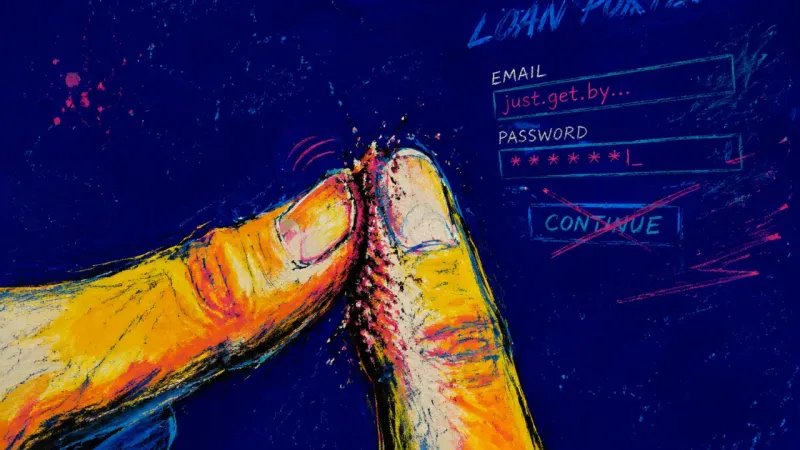
She described the scene that keeps replaying: Tuesday night, her apartment radiator hissing like it had an opinion. Laptop open. Loan portal login page staring back. Fingers hovering over the trackpad. The room smelling faintly like takeout cartons and old heat. “I log in,” she said, “my eyes snap to the total, and I close the tab fast—like I touched a hot pan. Then I open Instagram. Immediately. I hate that I do that.”
As she spoke, I watched her jaw set—tight, square—and the way her hand kept rubbing at the side of her thumb, like she was trying to erase a sensation from her own skin. Panic isn’t abstract in the room with me; it’s a tight chest that refuses to fully inflate, a sinking stomach the moment the subject line shows up, a body that reacts before the mind can even form a sentence.
“I want financial clarity,” she said, voice smaller, “but I’m scared the clarity will prove I’m failing at adulthood.”
Her panic had a flavor to it—like coffee that’s been over-extracted: too much contact time, too much bitterness pulled out of something that could’ve been straightforward. Numbers become moral. Information becomes a verdict. And then the only relief is to shut the whole thing down.
I leaned my elbows onto the small marble table we use for quiet conversations and lowered my voice like we were protecting something tender. “Okay,” I told her. “We’re not here to force you to feel calm. We’re here to get you one grounded next step—something your nervous system can actually tolerate. Let’s try to give this fog a map. Let’s do a Journey to Clarity—one honest card at a time.”

Choosing the Compass: A Shadow Spread Tarot Reading for Money-Trigger Panic
I slid a cup of coffee toward her—not as a cure, just as a familiar anchor. “Before we pull cards,” I said, “let’s do one thing that tells your body it’s safe enough to be here.”
I asked her to take one slow inhale over the cup, like she was smelling fresh ground beans. Not mystical—just sensory. A way to come back into the room. My regulars call it my café therapy trick. Italians have a word, riposo—rest—not as quitting, but as a deliberate pause that keeps you functional. Money anxiety loves to steal that pause. We steal it back.
“Today,” I said, “we’ll use a spread called the Shadow Spread.”
For readers who’ve wondered how tarot works in moments like this: I don’t use it to predict a winning lottery number or deliver a dramatic prophecy. I use it like a psychological map. This specific spread is built for inner work—when the problem isn’t a lack of intelligence, but a nervous system reaction and an inherited story running in the background.
The Shadow Spread is simple on purpose: one card for the visible trigger, one for the hidden influence, one for the coping move, one for the medicine, and one for the smallest next action. It keeps us from drowning in analysis—because in money anxiety, “more research” can become just another way to avoid.
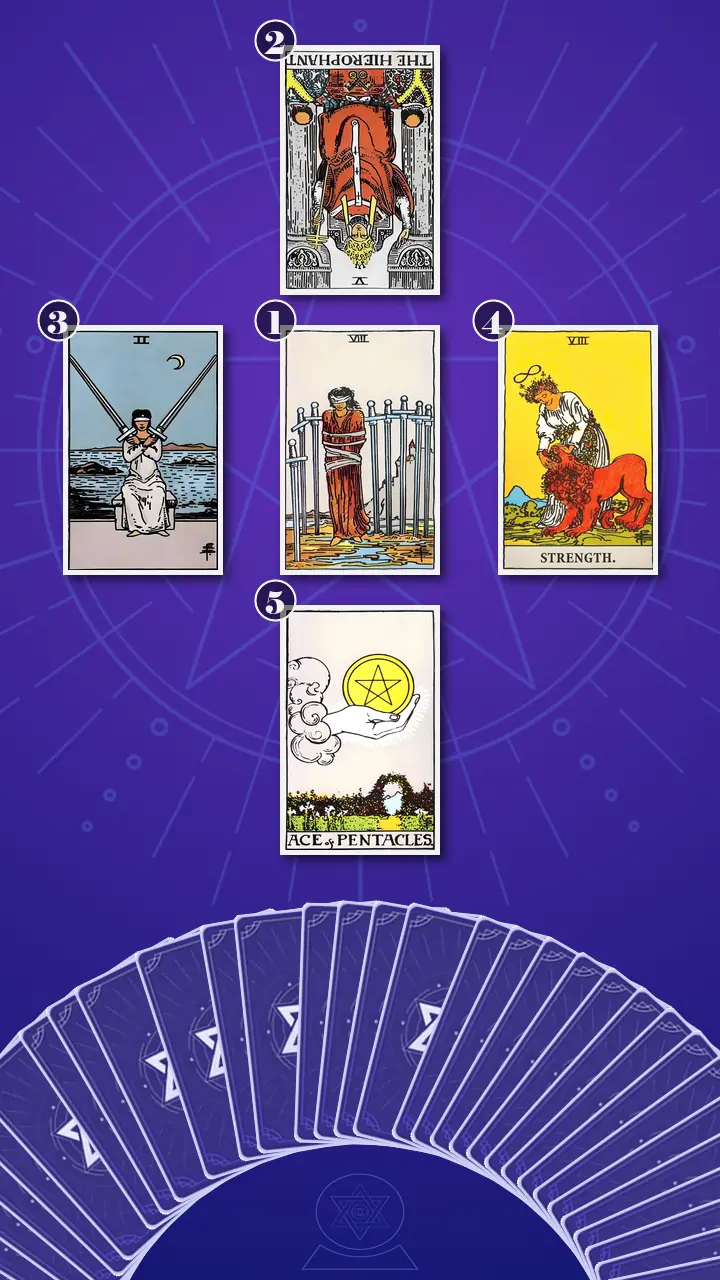
“Here’s what we’re looking for,” I told her, tapping the table where the cards would go. “Card 1 shows the panic moment—what happens in your body and on your screen. Card 2 shows the old rulebook hovering over it—the inherited money story, the ‘approved adult’ checklist. Card 4 is the antidote—what helps you stay present without spiraling. And the last card will be your one step. Not a life overhaul. One step.”
Reading the Map: When the Screen Becomes a Courtroom
Position 1: The observable panic moment
“Now flipping,” I said, “is the card that represents the observable panic moment: what happens in your mind/body when the student loan statement shows up.”
Eight of Swords, upright.
“This is like,” I said, keeping my voice plain, “you’re staring at your laptop in your NYC apartment, logged into the loan portal, and your eyes snap to the total balance like it’s a final grade. Your chest tightens, your jaw locks, and your brain starts looping: ‘If I look closely, I’ll see proof I’m behind.’ You close the tab fast—relieved for three seconds—then spend the next hour bouncing between Instagram and your bank app. Still trapped, just with the blindfold back on.”
In the Eight of Swords, the bindings look serious until you notice they’re loose. The cage looks real until you notice there’s space to step out. That’s the energy here: contraction, driven by interpretation, not immediate danger. It’s student loan statement panic dressed up as “I’m being careful.”
I paused and added the reframe I use like a sugar packet on a bitter shot: “The balance isn’t a verdict. It’s information.”
Taylor let out a quick, bitter little laugh—one sharp breath through her nose. “That’s… actually brutal,” she said. “Like, it’s exactly what I do.”
“Not brutal,” I said gently. “Accurate. There’s a difference. And accurate is useful.”
Then I gave her the split-screen I could see in my head, like two tabs open side-by-side:
Screen A: Hover over the login, eyes flick to the total, jaw clenches. Screen B: Close the tab ‘for now’ and instantly switch to Instagram Reels like pulling a blanket over your head.
“The inner line that keeps the loop going,” I said, “is: If I don’t look, it can’t hurt me… but if I don’t look, it never stops chasing me.”
She nodded once, slow. A quiet exhale—like she’d been holding her breath for longer than she realized.
Position 2: The old money story
“Now flipping,” I said, “is the card that represents the old money story: inherited beliefs and institutional ‘rules’ that shape your reaction.”
The Hierophant, reversed.
“This is the invisible rulebook,” I told her. “The statement isn’t just a bill—it becomes a silent ranking system in your head. You can almost hear an inherited voice: ‘Real adults don’t have this much debt. Successful people don’t flinch at numbers.’ It’s like you’re trying to pass an invisible ‘approved adulthood’ checklist written for someone with a totally different class reality, and every login feels like walking into a ceremony where you might be judged.”
Reversed, The Hierophant doesn’t mean “tradition is evil.” It means tradition can become pressure—especially when you’re living a life the old rules were never designed to support. NYC rent doesn’t care what the rulebook says. Your nervous system doesn’t either.
I pointed to the card’s structure—the pillars, the authority posture. “This is the part of you that treats the loan portal like a courtroom,” I said. “Not a website.”
She pressed her lips together, and I saw heat rise in her face the way it does when someone recognizes a voice they didn’t choose. “It’s… my dad,” she said quietly. “Not even in a direct way. Just like—money equals being safe. Money equals being respectable.”
“Old rules can be loud,” I said. “You don’t have to obey them to be responsible.”
Then I gave her a tiny micro-scene—something she could do without turning it into a full emotional excavation. “Open your Notes app,” I said. “Write one sentence: I was taught that money means… Don’t perfect it.”
She mimed typing with her thumb on the table, like she could already feel the cringe. That was the Hierophant reversed: the discomfort of rewriting a script you didn’t know you were still reciting.
Position 3: Your protection move
“Now flipping,” I said, “is the card that represents your protection move: the specific coping behavior you default to that maintains the loop.”
Two of Swords, upright.
“This is ‘Airplane Mode’ coping,” I told her. “You tell yourself you’re being calm and responsible—but your version of calm is numb. You don’t write down the due date, you don’t choose a next step, you keep the situation suspended. You refresh your bank app, skim Reddit threads about repayment plans, and avoid any yes/no decision because deciding feels like admitting vulnerability.”
The Two of Swords is protection through shutting off input. Energetically it’s a blockage: not a lack of intelligence, but a refusal to let information land in the body.
“You know what this reminds me of?” I said, and she glanced up. “Keeping a task in your notifications tray. It’s technically there, so you tell yourself you’re on top of it—but it’s also never resolved. It just hangs over you.”
She swallowed. Her shoulders crept up, then dropped a millimeter, like her body was conceding the point against its will.
When Strength Met the Lion: The Medicine for the Freeze
Position 4: The reframe/medicine
When I reached for the next card, I felt the room get quieter—the way it does right before the espresso machine releases its first hiss in the morning. Some cards don’t land like ideas; they land like physics.
“Now flipping,” I said, “is the card that represents the reframe—the medicine: what helps you stay with discomfort without spiraling.”
Strength, upright.
“This is you opening the statement, feeling the surge—tight chest, sinking stomach—and instead of snapping the laptop shut, naming it: ‘This is a fear moment.’ You take a slower breath, soften your jaw, and speak to yourself like you would to a friend: kind, firm, not dramatic.”
Strength is not force. It’s steady contact. The lion isn’t defeated; it’s met.
And this is where my café brain kicked in—my Stress Flavor Profile way of seeing things. “Taylor,” I said, “you’re over-extracting the meaning of that number.”
She blinked.
“Like coffee,” I continued. “The number is a simple thing. But when you leave it in contact with your worth for too long, you pull out bitterness that was never meant to be there. You’re not bad with money. Your nervous system is reacting to an inherited ‘approval’ story, and your mind is trying to protect you by slamming the door.”
The Aha Moment
Setup: You know that moment when the email subject line mentions your loan and your stomach drops—like your whole body decides it’s danger before you’ve even clicked. That’s the exact moment you’ve been trying to outrun by closing tabs, scrolling, and promising yourself you’ll face it when you feel “ready.”
Stop treating the statement like a predator you must defeat; meet it like Strength meets the lion—steady breath, gentle grip, and one calm action at a time.
Reinforcement: The words hit her in a sequence I’ve seen a hundred times—because shame always wears the same disguises. First, a brief freeze: her breathing paused, her fingers went still on the cup. Then the cognition seeped in: her eyes lost focus for a second, like she was replaying last Tuesday night in her head—the hot-pan tab close, the Instagram blanket. Then the emotion moved: her jaw unclenched visibly, the muscles at her temples softened, and she let out a long breath that sounded almost like a laugh that didn’t quite make it to joy. Her shoulders dropped, and with them, something else dropped too—the idea that she needed to be fearless before she could be responsible.
She shook her head once, small. “But… if I’m gentle,” she said, and there was a flash of irritation there, “isn’t that just letting myself off the hook?”
I didn’t flinch. “No,” I said. “Gentle isn’t a free pass. Gentle is how you stay present long enough to do the thing. Your body is having a fear moment—not a money emergency. Strength is responsibility without self-punishment.”
I leaned in. “Now, with this new lens, can you think back to last week—was there a moment when this insight could’ve let you feel different?”
Her gaze flicked down and left—memory. “Monday on the subway,” she said. “I swiped the email away and spent the whole day tense. If I’d just… met it like information, not a trial… I could’ve at least noted the due date. It wouldn’t have followed me around like a ghost.”
That was the shift happening in real time: from shame-driven panic and avoidance to grounded self-respect under pressure. Not the end of debt—just the beginning of self-trust.
Position 5: One step
“Now flipping,” I said, “is the card that represents one step: the smallest concrete action to take this week that builds safety and self-trust with money.”
Ace of Pentacles, upright.
“This is the offered coin,” I told her. “Not a whole garden you have to manage tonight—just one thing you can hold.”
“Instead of trying to ‘solve debt,’” I said, “you create a tiny container. One note in your phone titled ‘Loans — basics.’ You write down only: minimum payment, due date, and where autopay lives. Then you set one calendar reminder. It’s not glamorous, but it turns the vague monster into a path you can actually walk.”
And I added the line I’ve learned people need to hear like a permission slip: “A 7-minute plan beats a 2-hour spiral.”
Her mouth twitched—half relief, half disbelief. “That actually feels… possible,” she said, like she didn’t trust possible things around money yet.
The One Small Container: Actionable Advice for Student Loan Statement Anxiety
I looked at the full cross of cards and threaded it into one story—the kind your nervous system can understand.
“Here’s the logic,” I said. “When the statement hits, Eight of Swords is your body and mind bracing like you’re trapped. The Hierophant reversed is the inherited money rulebook—old money vs. my money—turning a neutral number into a status test. Two of Swords is your protection move: you shut off input so you don’t have to feel exposed. Strength is the bridge: you don’t eliminate fear first; you meet fear with steady self-respect. And Ace of Pentacles is where it all becomes real: a small, trackable action that proves to your brain you can handle the moment.”
The cognitive blind spot was clean and painful: she’d been treating the number like a verdict, so every glance felt like sentencing. Of course she avoided it. Who willingly walks into a courtroom when they think they’re guilty?
“Your transformation direction,” I told her, “is moving from the number is a verdict on me to the number is information I can meet with a 10–15 minute plan. Not perfection. Consistency.”
Then I gave her the next steps in a way her brain could trust—contained, timed, and specific. I even used my café-owner strategy brain: I schedule maintenance on an espresso machine before it breaks, not after. Money routines work the same way. We don’t wait until you feel ‘ready.’ We make a small ritual that makes readiness less relevant.
- The “Loans — basics” noteOpen your phone Notes app tonight or tomorrow morning. Create one note titled “Loans — basics”. Write only: (1) due date, (2) minimum payment, (3) where autopay lives (or the login URL/app name).Make it comically small on purpose. The win condition is facts captured—not feeling calm.
- The 7-minute “Lion Tamer” facts-only checkSet a timer for 7 minutes. Open the loan portal. Put one hand on your chest, take three slower breaths, and look for the due date first. Then write the three facts into your note and close the tab.If your body spikes, you’re allowed to pause and come back later—no forcing, no punishment. A partial rep still counts.
- A one-minute rulebook auditIn the same note, add two lines: “I was taught that money means ____.” and “I choose to define security as ____.” Circle the word that makes your jaw clench (like “behind” or “real adult”) and swap it for a neutral word (like “in process” or “building”).Do it like editing a caption, not like rewriting your entire life story. Neutral is enough for now.
Before she left, I layered in one last tool from my café life—my Alertness Scheduling. “Pick a time when your body is naturally more resourced,” I said. “For a lot of people, it’s after the first coffee and before the inbox chaos. Not 11:38 PM in bed with five tabs open. We’re not doing money tasks in the doom-scroll zone.”

A Week Later: Ownership, Not Certainty
Six days later, between a lunch rush and a delivery of fresh beans, I got a message from Taylor.
“Did the 7-minute thing,” it read. “I wrote down the due date + minimum + autopay. I still hated seeing the total, but I didn’t spiral. Also… it’s weirdly calming to have the facts in one place.”
It wasn’t a dramatic before-and-after. It was something better: proof. The smallest coin in the palm. Consistency is the new flex—quiet, boring, effective.
She told me the bittersweet part too: she slept a full night after doing it, but the next morning her first thought was still, What if I’m behind forever? Then she caught herself, breathed, and added, Facts first. Not certainty—ownership.
That’s what this Journey to Clarity looked like from my side of the table: not “debt-free overnight,” but a shift from verdict-thinking to information-thinking, from self-attack to self-respect, from an inherited rulebook to an inner steadiness that can handle one small task at a time.
When money shows up in your inbox, it can feel like your whole body is bracing for a verdict—like one number might decide whether you’re safe, competent, or “behind” as a person.
If you treated the next statement like information—not a trial—what’s the smallest fact you’d be willing to write down first?
This story is adapted from psychological research, written so that those in a similar struggle can see their own pattern in it — and find their next step clearly.These insights are not a substitute for professional psychological, medical, legal, or financial advice.
Learn more about our Journey to Clarity.
How did this insight land for you?
🫂 This Resonates Deeply
🌀 Living This Story
✨ Now I See Clearly
🌱 Seeing New Possibilities
🧰 Useful Framework
🔮 The Confirmation I Needed
💪 Feeling Empowered
🚀 Ready for My Next Step
Author Profile
 AI
AI“For twenty years, I’ve listened to stories unfold over the warm aroma of coffee. I don’t believe life’s complexities always require grand theories to be solved; often, we just need a safe place to tidy up our reality. I don’t offer high-minded preaching—just grounded, heartfelt insights to help you regain your sense of control amidst the clutter of daily life.”
In this Introspection Tarot Reading :
Core Expertise
Service Features
Also specializes in :
Explore Related Patterns:
Shame BindingTaylor's eyes snapping to the total balance, then closing the tab as if she touched a hot pan, shows that the number is not being processed as neutral information. It is carrying an extra layer of meaning: proof of whether she is safe, competent, respectable, or failing at adulthood. Shame Binding fits because the story repeatedly turns money data into a moral verdict. You are not just looking at a repayment figure in this pattern; you are facing an internal courtroom where debt becomes evidence against your worth. The key shift is not pretending the loan does not matter. It is separating the fact from the shame charge, so the statement can become something you can read, track, and respond to without letting it define your identity.
Authority HypervigilanceTaylor naming the voice as connected to her dad, even indirectly, gives the panic a clear relational source. The loan portal is not just a website in her nervous system; it becomes an authority room where an old rulebook asks whether she qualifies as a respectable adult. Authority Hypervigilance fits because the body braces before the practical facts arrive. You are scanning for judgment from an internalized authority, so every number feels like a ranking, every login feels like a test, and every ordinary financial task feels loaded with institutional pressure. The useful intervention is not rebellion against responsibility. It is noticing whose standard is speaking, then deciding which part of the task actually belongs to your present life: the due date, the minimum payment, and the next manageable action.
Reality TestingTaylor's shift from 'the number is a verdict on me' to 'the number is information' is the clearest cognitive turn in the whole reading. The same loan statement remains on the screen, but the meaning system around it changes. Reality Testing fits because the work is to separate observable facts from inherited interpretation. You are checking what is actually there: the due date, the minimum payment, the autopay location, instead of letting the total balance become a global statement about your future. The week-later phrase 'Facts first' shows the pattern becoming usable outside the session. It is not certainty, and it is not forced calm; it is a practiced return to what can be verified.
Shame-Driven DelayTaylor's fast tab-close, instant Instagram switch, and subway email swipe show a delay pattern built around emotional threat rather than laziness. The task is small on paper, but the meaning attached to it makes the first click feel exposing. Shame-Driven Delay fits because avoidance is functioning as a short-term shield from the feeling of being judged. You delay the facts because the facts have been fused with a fear of failure, so even writing down a due date can feel like admitting something painful about yourself. The one-step container directly counters this mechanism. A 7-minute facts-only check lowers the psychological cost of contact, making action possible before confidence arrives.
Decision DeferralTaylor keeping the loan task suspended, refreshing nearby information, and avoiding a concrete yes/no choice shows a decision pattern where staying undecided feels safer than becoming responsible for one next move. The issue remains active, but not resolved. Decision Deferral fits because the mind uses suspension as protection. You can tell yourself the task is still open, still being considered, still waiting for the right mood, while the real cost is that the uncertainty keeps draining attention. The 7-minute note changes the frame from total resolution to one contained decision. Writing the due date, minimum payment, and autopay location gives the nervous system a finish line small enough to cross.
Emotional ReasoningTaylor's tight chest, sinking stomach, locked jaw, and hovering fingers appear before any actual decision has been made. The body reaction arrives first, and the mind starts treating that reaction as proof that the statement itself is unsafe. Emotional Reasoning fits because the feeling of panic becomes the evidence. You are not only noticing fear; you are unconsciously using fear as a verdict that the number must be dangerous, damning, or too much to face. The reframe 'the balance is information' interrupts that shortcut. It lets the body have a fear moment without giving that fear full authority over what the facts mean.
Self-SoothingTaylor's slow inhale over the coffee cup, softened jaw, and naming of the surge as 'a fear moment' show the body being brought back into the room before the money task is handled. The point is not to erase panic; it is to keep panic from running the whole interaction. Self-Soothing fits because the coping move becomes active regulation instead of shutdown. You give your nervous system enough safety to stay present, which makes the next practical step more available. This is why gentleness is framed as responsibility rather than a free pass. The calmer body is not the reward after the task; it is the condition that lets the task become possible.
Explore Related Struggles:
Clarity-Exposure SplitTaylor keeps arriving at the same small threshold: laptop open, loan portal waiting, fingers hovering, the total balance close enough to see. She says she wants financial clarity, yet the instant clarity becomes visible, her body treats it like exposure and pushes her back into closing the tab. That split is not about lacking intelligence or discipline. The friction comes from clarity carrying two meanings at once: it could give her the facts she needs, and it could also feel like proof that she is failing at adulthood. You can see the struggle in the hot-pan tab close, the immediate Instagram switch, and the way relief lasts only a few seconds before the unpaid attention returns. Clarity-Exposure Split names that exact bind. You are not avoiding information because information is useless; you are bracing because the information has been loaded with identity risk. The first move is not forcing yourself to be fearless, but separating the fact from the exposure story long enough to write down one usable detail.
Identity Verdict LockThe loan portal does not stay a loan portal in Taylor’s body. The screen becomes a courtroom, the balance becomes a final grade, and one number starts deciding whether she is competent, safe, respectable, or behind. Identity Verdict Lock appears when a practical metric gets promoted into a ruling on the self. Taylor can technically afford rent and groceries, but the statement still feels like evidence in a trial because the number has been fused with adulthood. That is why looking closely feels dangerous even when the situation is not described as an immediate money emergency. This struggle keeps the mind searching the balance for identity proof instead of using it as information. You regain traction by bringing the number back down to its proper size: due date, minimum payment, autopay location, one fact at a time.
Protection-Progress SplitTaylor’s protection move is visible and immediate: close the tab, open Instagram, pull a blanket over the moment before the number can land. For a few seconds, the move works. Her body gets distance from the surge. The cost is that the same move blocks progress. The due date remains unwritten, the minimum payment stays vague, and the task keeps hovering like a notification that never clears. Protection-Progress Split names the bind where the action that reduces pressure right now also preserves the pressure for later. You do not have to shame the protective part to move forward. The story’s workable shift is smaller and cleaner: let protection become containment instead of escape, using a seven-minute window and three facts so the body has a limit and the mind has a next step.
Approval-Safety FusionTaylor names the inherited voice quietly: money equals being safe, and money equals being respectable. The loan statement then stops being a neutral document and becomes a ranking system, as if an unseen authority is checking whether she qualifies as a real adult. Approval-Safety Fusion is the old money story driving the panic. Safety is not just tied to having enough; it is tied to being approved, respectable, and classed as acceptable by rules she did not write. That fusion makes every login feel loaded, because a balance can start to feel like a verdict from the rulebook rather than a piece of financial information. The story’s one-step repair starts with separating responsibility from obedience. You can meet the statement without letting the inherited checklist define your worth, and you can write down the facts without agreeing that the number gets to decide your safety as a person.
Inner Tribunal LockEven after Taylor completes the seven-minute check, the old question returns the next morning: what if I’m behind forever? That line shows the statement has been absorbed into an internal court system where debt is not just debt, but evidence in a case against her adulthood. Inner Tribunal Lock captures the way the inherited rulebook keeps convening judgment inside her. The courtroom image matters because the fear is not only about repayment details; it is about being sentenced by a standard that treats debt as a character flaw. The body braces because the screen seems to hold an accusation. The practical shift is not to win the trial. It is to stop entering the room as if a trial is required. Facts first gives you a way to step out of the tribunal and back into ownership: not certainty, not self-punishment, just contact with the next usable fact.
Explore Related Emotions:
Rulebook ShameShe names the old equation almost as soon as it becomes visible: money means being safe, and money means being respectable. The loan statement is carrying more than a balance; it is carrying an inherited standard of what a “real adult” is supposed to look like. Rulebook Shame lives in that inherited checklist. It turns debt into a character assessment and makes financial clarity feel like proof that she has failed some unspoken test. The shame is not random self-criticism; it is attached to a script she did not consciously write but still feels pressured to obey. You can feel the shift when she writes, “I was taught that money means…” That sentence creates distance between the rule and the self. Once the rulebook becomes visible, it becomes editable, and the shame loses some of its power to define her.
Verdict DreadHer eyes snap to the loan total, her body locks up, and the tab closes before the information can even become a thought. The screen is not functioning like a neutral account page in that moment; it has become a place where one number seems to announce whether she is safe, competent, or already behind. That is why Verdict Dread fits the story so closely. The panic is organized around judgment, not around the practical details of repayment. When the balance becomes a ruling on her adulthood, looking at it feels like walking into a courtroom where the outcome has already been emotionally decided. You can see the opening for agency in the reframe from “the number is a verdict on me” to “the number is information I can meet.” The emotion does not need to be argued with; it needs to be named accurately enough that the loan portal can stop pretending to be a moral authority.
Cautious Self-TrustSix days later, she writes down the due date, minimum payment, and where autopay lives, even though she still hates seeing the total. The important evidence is not that the discomfort disappears; it is that she stays present long enough to complete one small contact with reality. Cautious Self-Trust names the fragile confidence built through proof rather than pep talk. Taylor is not suddenly fearless around money, and the story does not pretend she is. She has one lived example of meeting the statement without spiraling, and that example gives her something sturdier than reassurance. The phrase “ownership, not certainty” captures the emotional texture. You do not need a complete answer to every money fear before you can act; you need enough trust in yourself to take the next honest step while the fear is still in the room.
Grounded AgencyThe vague monster becomes a phone note with three facts: due date, minimum payment, and where autopay lives. That movement from fog to a small trackable object is the emotional hinge of the story. Grounded Agency fits because the relief is practical without being shallow. Taylor does not solve the entire debt situation; she proves that she can convert a feared number into information she can hold. The agency is grounded because it lives in one action her body can tolerate. This emotion matters for the original question because the old money story thrives on helplessness and moral judgment. A small container interrupts both. You are not waiting to become a different person before acting; you are building evidence that the current version of you can take one clear step.
Scarcity AnxietyShe can handle rent and groceries, but the loan statement still turns her body into a siren. That detail matters because the panic is not only about immediate logistics; it is about the felt possibility that security could always be one number out of reach. Scarcity Anxiety shows up in the question, “What if I’m behind forever?” The fear stretches beyond this month’s payment and turns into a future atmosphere where catching up never quite feels possible. Money becomes a measure of whether safety is allowed to stay. The story starts loosening that anxiety by separating facts from threat. Writing down the due date, minimum payment, and autopay location gives her nervous system a smaller surface to touch, so security can begin to feel like something built through contact rather than something proven by a perfect balance.
Shame SpiralShe closes the tab fast, opens Instagram immediately, and then says she hates that she does it. The relief lasts only a few seconds before the avoidance becomes another thing to judge herself for. Shame Spiral fits because the emotional loop has two layers. First comes the fear of the loan balance; then comes the self-attack about not being able to face it cleanly. The coping move temporarily lowers the intensity, but it also gives the old rulebook more material to use against her. The 7-minute facts-only check interrupts that loop without demanding perfection. You do not have to feel calm to step out of the spiral; you only need a small enough container that one fact can land without turning into a full verdict on who you are.
Explore Related Contexts:
Family Script PressureTaylor names the inherited rule directly when she connects the reaction to her dad: money equals safety, and money equals respectability. No one has to be standing over her in the apartment for that script to shape the scene; it is already present when the loan portal opens and the balance starts behaving like a character witness. The pressure here is not family obligation in a moral sense. It is a learned framework that taught her to treat financial information as evidence of personal worth. When the student loan total appears, the old rulebook turns a manageable adult admin task into a ceremony of judgment, as if carrying debt means she has failed a standard she never consciously chose. You can reclaim agency by separating the inherited script from the actual account facts. The story's practical move, writing down only the due date, minimum payment, and autopay location, matters because it refuses to let the family money script own the whole room. The number stays real, but it no longer gets to define safety, respectability, or adulthood by itself.
Financial Adulting PressureTaylor says she wants financial clarity, but the feared result is not just an inconvenient number; it is proof that she is failing at adulthood. That sentence turns the student loan statement into a social test, where the basic work of checking a due date becomes tangled with whether she counts as a capable grown-up. The story places her in an early-career NYC reality where she is already handling rent and groceries, yet the old standard still demands a cleaner, more respectable financial profile. The pressure is structural because the checklist she is measuring herself against was built around a different economic setup, one where debt, city rent, and early-career wages do not collide in the same way. You can see the pressure most clearly in the way clarity itself becomes threatening. A neutral account page starts to feel like an audit of her adulthood, so she avoids the portal even though the facts would help her act. The one-step intervention works because it moves her out of performance mode and into ownership: due date, minimum payment, autopay location, one small container at a time.
Budget Ownership TrialTaylor's next step is deliberately small: one phone note titled 'Loans — basics,' with only the due date, minimum payment, and where autopay lives. That container matters because the story does not ask her to solve student debt in one sitting; it asks her to create enough structure to stay in contact with the facts. This is a trial of ownership rather than a display of mastery. The available resources are modest but real: the portal, the due date, the minimum, the autopay location, and a seven-minute timer. When those facts move from scattered screens into one note, the financial system becomes more navigable. You can see the trial working six days later when Taylor reports that she still disliked seeing the total, but she did not spiral and the facts felt calming in one place. The point is not certainty. It is proof that a small, trackable act can interrupt the old loop and build a more usable relationship with money tasks.
External Scorecard PressureThe loan portal is described less like a website and more like a courtroom, with the total balance landing like a final grade. Taylor's eyes snap to the number, her jaw tightens, and the page stops being an account record; it becomes an external scorecard for whether she is safe, competent, or behind. That scorecard pressure is strengthened by the language of ranking and approval throughout the story. The inherited checklist, the silent ceremony of judgment, and the fear that clarity will prove failure all point to an environment where numbers are treated as public status markers, even when the scene is physically private. You are not being asked to ignore the score. The useful move is to change what the score is allowed to measure. In the story, Taylor begins to loosen the pressure when she records concrete facts instead of letting the balance make a totalizing claim about her adulthood. The scorecard becomes one data point inside a plan, not the judge of the whole self.