Finding Clarity in the Splitwise Notification That Hits Like a Gavel
If a Splitwise request can turn a totally normal hangout into instant Sunday Scaries-level dread, you’re not being dramatic—you’re catching a specific money-shame panic loop.
Jordan slid into the chair across from me in my little Italian café off College Street, still wearing that post-commute stiffness—shoulders creeping up like they were trying to hide their ears. Outside, the streetcar bell kept chiming; inside, the espresso machine sighed and clicked like it was keeping time.
They told me it started at 8:47 PM on Line 1 heading north: fluorescent buzz, stop announcements dissolving into white noise, phone warming their palm. A Splitwise notification lit up—nothing dramatic, just a number. And yet their body reacted like someone had yanked a trapdoor open: stomach dropping, chest tightening, fingers going cold.
“I do the loop,” they said, voice flat like they’d already tried to talk themselves out of it. “Splitwise. Banking app. Notes. Draft a message. Delete. Close everything. And then I feel… gross.”
Wanting to be seen as fair and dependable vs fearing that owing money will expose you as unsafe, burdensome, or not in control—that contradiction can make a tiny notification feel like a courtroom you didn’t consent to. Panic isn’t loud for everyone; sometimes it’s quiet, meticulous, and repetitive—like refreshing your balance the way you refresh a feed, hoping the next reload will finally make you feel safe.
I set down a small glass of water—cold enough to be real, not performative. “We’re not here to make you ‘good with money’ overnight,” I said. “We’re here to figure out what story gets activated, and how to give you a fair, simple next step. A Journey to Clarity—so money admin becomes logistics, not a personality test.”
Choosing the Compass: The Four-Layer Insight Ladder
I asked Jordan to take one slow inhale, one slow exhale—nothing mystical, just a nervous-system handoff from “brace for impact” to “let’s look at facts.” While the café hummed—milk steaming, a spoon tapping ceramic—I shuffled with the kind of steady rhythm you only get after doing something every day for years.
Today I used a spread called the Four-Layer Insight Ladder · Context Edition. I like it for moments like this because it’s not trying to predict the future. It’s designed for decoding a trigger—especially when someone asks, “What past money story is this?”
For you reading along (and maybe Googling something like why does a Splitwise request make me panic), this is also a clean way to see how tarot works in context: we start with the visible reaction, drop into the hidden driver, trace the origin story, find the stabilizing inner resource, then pivot into one reframe and one concrete action. Minimal cards, maximum signal.
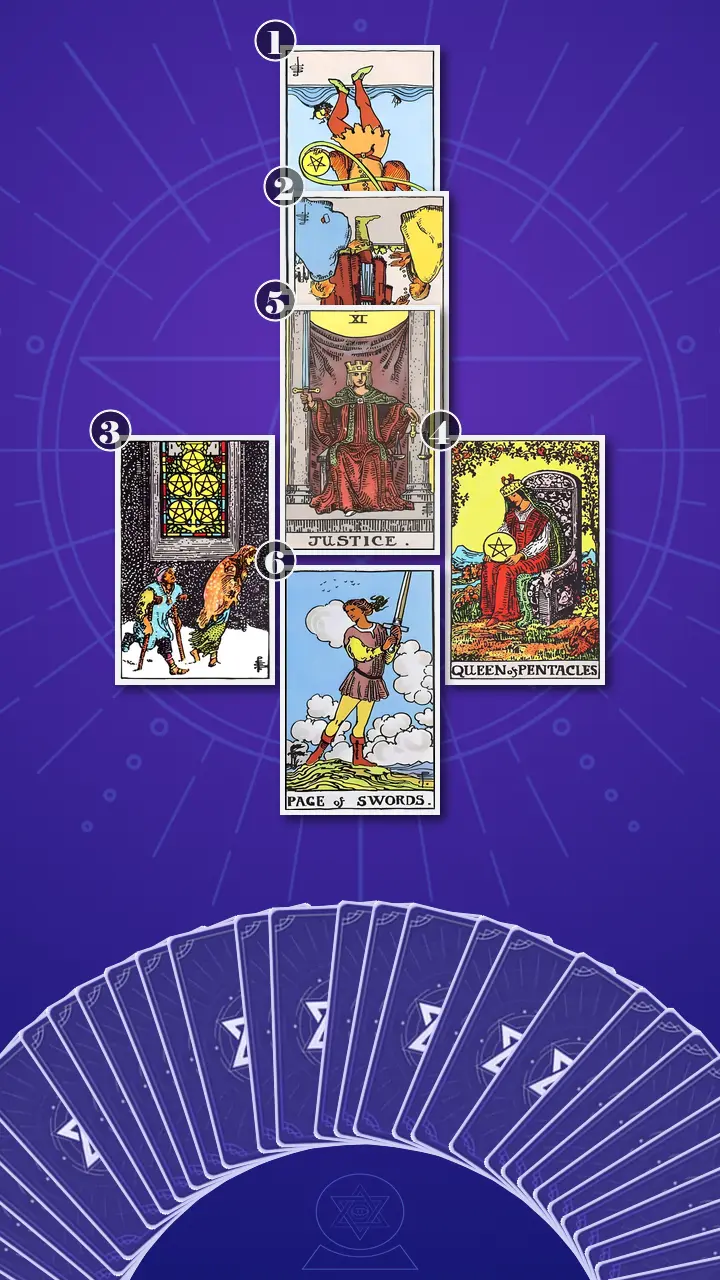
In this spread, the first card shows the immediate Splitwise reaction loop. The second captures the relationship-power charge—how apps can turn “owe” into “being watched.” The fifth is the key reframe: how to separate facts from shame and restore fairness-based clarity.
Reading the Map: From the App Loop to the Old Weather
Position 1: The immediate, observable reaction
“Now turning over,” I said, “is the card that represents the immediate, observable reaction—what you do and feel right after the Splitwise request hits.”
Two of Pentacles, reversed.
The image is a person trying to juggle two coins wrapped in an infinity loop. The symbolism is almost too on-the-nose for modern life: the infinity loop becomes the “app loop.”
“You’re on the TTC,” I said, “thumb bouncing between Splitwise and your banking app like you’re juggling two tabs in your brain. You keep re-checking, not because the math is hard, but because you’re trying to find a version of reality where you don’t feel exposed—then you close the apps without paying or replying.”
Reversed, this card isn’t ‘bad’—it’s overload. The energy is blocked earth: practical stuff that should be manageable becomes emotionally unfinished. The number can be correct and your body still won’t let you hit ‘pay.’ That’s the freeze response wearing a spreadsheet costume.
Jordan let out a quick laugh that wasn’t really humor. More like recognition with teeth. “Yep,” they said. “It’s… brutal seeing it that clearly.” Their fingers rubbed the edge of their phone case like they were trying to sand the feeling down.
In my head, I thought about espresso extraction: too short and it’s sour; too long and it’s bitter. Social panic does the same thing—when you keep “extracting” reassurance by checking again and again, you don’t get clarity. You get bitterness.
Position 2: The relational charge underneath it
“Now turning over,” I said, “is the card that represents the relational charge—what this request symbolizes about reciprocity, fairness, and being perceived.”
Six of Pentacles, reversed.
In the card, coins are being handed down while scales hover nearby. In real life, this can feel like Splitwise becomes a scoreboard when you’re already sensitive to being ‘the burden.’
“The request feels less like ‘please send $24’ and more like ‘we’re all watching who handles money like an adult,’” I said. “You want to be fair, but it triggers that prickly mix—guilt and resentment. Paying late feels like being ‘that person.’ Paying instantly feels like proving something.”
Reversed, the energy shows a perceived imbalance: not necessarily that anyone is actually unfair, but that your nervous system reads the interaction as power + evaluation. “Stop mind-reading your friends through an app,” I said gently. “The app tracks transactions, not your worth.”
Jordan nodded once, fast—like they were agreeing before they could argue. Then they swallowed. Their jaw tightened, released, tightened again.
Position 3: The past money story being activated
“Now turning over,” I said, “is the card that represents the past money story—the older scarcity or shame imprint this moment is activating.”
Five of Pentacles, upright.
Snow. A lit window. Two figures outside, moving like they’re trying not to take up space. This card doesn’t whisper; it radiates that sensation of being just slightly behind the glass, close enough to see warmth but not close enough to claim it.
“A small bill triggers a much older feeling,” I said. “Being the one who can’t keep pace. Who might be quietly excluded. Your body reacts like you’re about to be left out of the warm circle—even if your friends are actually reasonable—so you brace, hide, and try to handle it alone.”
Jordan went still in a way I recognized: breath paused, eyes unfocusing like they were replaying a clip. Then their shoulders sagged a millimeter, like gravity finally got permission. “I hate that this is true,” they said, quieter. “It feels… embarrassing.”
“Embarrassing doesn’t mean inaccurate,” I replied. “It usually means it’s old.”
The café door opened and a gust of cold air rolled in—Toronto spring pretending it was still winter. It fit the card too perfectly. Environment as co-conspirator.
Position 4: The stabilizing inner resource
“Now turning over,” I said, “is the card that represents the stabilizing inner resource—the part of you that can hold money with care and self-respect.”
Queen of Pentacles, upright.
She sits steady. Not flashy. Not apologetic. The pentacle is held like something valuable, not like evidence in a trial.
“Before you reply,” I said, “you make it physical and kind. Sit at the table. Drink water. Let your shoulders drop. Look at your budget once like it’s care, not punishment. From that steadier place, you pick a plan that protects your wellbeing—including timing—instead of trying to look effortlessly chill.”
This is balance returning to earth. Less braced body, more resourced body. The Queen isn’t here to impress your friends; she’s here to keep you housed, fed, and dignified.
Jordan’s face softened. They stared at the Queen for a long second, then gave a small exhale like they’d been holding air hostage. “I can do that,” they said. “The table thing. Not… in bed at midnight with my phone in my face.”
When Justice Spoke: Closing the Shame Tab
Position 5: The key reframe that breaks the loop
I slowed down before flipping the next card. The café noise faded into a kind of hush—still there, but farther away, like someone turned the volume knob down.
“Now turning over,” I said, “is the card that represents the key reframe that breaks the loop—how to separate facts from shame and restore fairness-based clarity.”
Justice, upright.
Here’s what I see every time Justice appears in a money-and-relationships question: the invitation to stop treating an amount like a moral evaluation. The scales are Splitwise at its best—neutral accounting. The sword is the message that ends the spiral.
Jordan was still living in that TTC moment where their brain turned a $24.60 request into a full character review. Their mind wanted certainty, like if they could just pick the perfect words, nobody could judge them. But that’s the trap: you can’t write a text that makes you un-judgeable. You can only write a text that is fair.
You don’t need a perfect excuse; you need a fair plan—let the scales of Justice hold the truth so you can put down the shame.
Jordan’s reaction came in three waves. First: a freeze—eyes widening, breath catching like they’d been startled. Second: the “tab switch”—their gaze drifted away from the card and went somewhere inside their own memory, like they were closing a ‘Shame Story’ window that had been running in the background for years. Third: a release—chin trembling slightly, then a long exhale that seemed to loosen their collarbone and unhook their shoulders from their ears.
“But if I’m not explaining…,” they started, and their voice sharpened with a flash of defensiveness, almost anger. “Doesn’t that make me seem cold? Or like I don’t care?”
I kept my tone even. “This is the part where your brain confuses clarity with cruelty. Justice isn’t cold. It’s clean. It’s respectful.” I tapped the scales lightly. “Fairness is facts + timing. Shame is guessing what the facts mean about you.”
Then I asked, “With this new lens—facts, not verdict—was there a moment last week when you felt the stomach-drop and you could’ve responded differently if you believed you were allowed to structure the conversation?”
Jordan blinked, fast. “Yeah,” they said. “Saturday. After dinner. I wanted to say, ‘I can pay Friday,’ but I started writing a whole backstory. Like I was submitting evidence.”
That was the shift: from panic-driven over-checking and people-pleasing to fairness-based clarity and calm self-respect. Not a personality makeover—just one internal adult stepping forward.
This is where my Social Espresso Extraction lens clicks in. In coffee, “optimal extraction time” changes depending on the beans and the method. In relationships, it changes depending on the context. Justice says: choose an extraction time that’s honest. Not instant payment to look chill. Not silence to avoid discomfort. A fair plan, delivered cleanly, at a time you can stand behind.
Position 6: The next-step action
“Now turning over,” I said, “is the card that represents a concrete next step—what you can do within a week to resolve the tension and rebuild self-trust.”
Page of Swords, upright.
The Page holds the sword up like: we’re doing this, even if it feels windy. This is communication as a skill—not a performance.
“You send the short message you’ve been avoiding,” I said. “Two sentences, max. The win is not sounding perfect; the win is closing the loop.”
I watched Jordan’s thumb hover over their phone like they were already seeing a typing cursor in their mind. Their shoulders were lower now. Not relaxed, exactly—more like ready.
The Fair Plan Framework: Actionable Advice That Actually Fits Real Life
Here’s the story your cards told, in one straight line: the Splitwise request hits (Two of Pentacles reversed) and your body goes into “juggle everything perfectly or drop the ball” mode. Under that is a fear of being judged and ranked (Six of Pentacles reversed), as if timing equals morality. Beneath that is an older exclusion-weather story (Five of Pentacles): if I can’t keep up, I don’t belong. The antidote isn’t more checking—it’s self-stewardship (Queen of Pentacles) plus a clean fairness agreement (Justice) delivered through simple communication (Page of Swords).
The cognitive blind spot is subtle: you keep treating discomfort as proof that the plan isn’t good enough. But discomfort is often just your nervous system adjusting. The transformation direction is exactly this: shift from perfecting your response to choosing one clear, fair boundary and communicating it directly.
Here are your next steps—small, specific, and designed for people who get decision fatigue and still need to function in group chats:
- One-Pass Money Check (7 minutes)Set a 7-minute timer. Open Splitwise once and your banking app once. Verify the amount one time, then choose one fair plan: pay now, pay by a specific date, or ask one clarifying question.If you feel the urge to loop again, treat that as a cue to act—shorten the process instead of expanding it.
- Two-Sentence Boundary TextSend: “Got it—thanks for sending this. I can pay on Friday.” (Or: “Just paid—thanks!”) No extra context, no apology spiral.If paragraph #2 starts forming, stop and delete one sentence. Fair plan > perfect excuse.
- One Clean Question (If Needed)If something’s unclear, ask exactly one: “Quick check—does this include the tickets, or just dinner?” Then wait.Clarity is kinder than disappearing. One question beats ten imagined arguments.
And because your stress spikes in relationships, I’ll add one of my café strategies: my Social Thermometer. Before you hit send, check your “temperature.” If you’re boiling—chest tight, jaw clenched—do the Queen of Pentacles reset: feet on the floor, one slow inhale/exhale, shoulders dropped. Then send. The goal isn’t to feel zero nerves. It’s to send from a temperature that won’t scorch you.

A Week Later: The Quiet Proof
Five days later, Jordan messaged me a screenshot: a clean, two-sentence reply sent—no essay, no apology stack. Under it, their friend’s response: “Totally fine, thanks!” Jordan added, “I still felt weird for like ten seconds. But then it was… done.”
The bittersweet part was almost funny in its honesty: they slept through the night for the first time in a week, and in the morning their first thought was still, What if I sounded cheap?—but this time they paused, breathed, and answered themselves: I sounded clear.
This is what clarity looks like in real life. Not the absence of feelings—just the presence of self-respect. A bill is logistics. Your worth doesn’t need to be negotiated in an app.
When a tiny money notification makes your stomach drop, it’s not the dollars—it’s the fear that being ‘late’ or ‘needing time’ will rewrite you as unreliable, and you can feel your whole body brace like you’re about to be judged.
If you treated the next Splitwise request as pure logistics—not a personality test—what’s one fair, specific plan you’d be willing to send in two sentences?
This story is adapted from psychological research, written so that those in a similar struggle can see their own pattern in it — and find their next step clearly.These insights are not a substitute for professional psychological, medical, legal, or financial advice.
Learn more about our Journey to Clarity.
How did this insight land for you?
🫂 This Resonates Deeply
🌀 Living This Story
✨ Now I See Clearly
🌱 Seeing New Possibilities
🧰 Useful Framework
🔮 The Confirmation I Needed
💪 Feeling Empowered
🚀 Ready for My Next Step
Author Profile
 AI
AI“For twenty years, I’ve listened to stories unfold over the warm aroma of coffee. I don’t believe life’s complexities always require grand theories to be solved; often, we just need a safe place to tidy up our reality. I don’t offer high-minded preaching—just grounded, heartfelt insights to help you regain your sense of control amidst the clutter of daily life.”
In this Friendship Tarot Reading :
Core Expertise
Service Features
Also specializes in :
Explore Related Patterns:
Shame-Driven DelayJordan's Splitwise-to-banking-app loop ends with the apps closed, the money unpaid, and no reply sent even though the number itself is visible. The delay is not about missing information; it is the moment shame turns a simple reimbursement into evidence that you might be unsafe, burdensome, or out of control. The mind tries to protect you by not acting until the shame has gone away, but the non-action keeps the shame alive. A fair plan gets postponed because hitting pay or sending a date feels like stepping into a character review. That is why the request lands like a gavel. The past money story is not just about dollars; it is the learned link between owing, being judged, and losing belonging.
Compulsive CheckingJordan's thumb bouncing between Splitwise, the banking app, and Notes gives the pattern its shape. You are not checking because the math is hard; you are checking because each screen seems like it might finally produce the feeling of safety that the last screen failed to deliver. The loop acts like emotional regulation disguised as admin. Splitwise gives the number, the banking app gives the balance, Notes gives a place to rehearse the message, but none of them can answer the deeper question of whether you are still acceptable to the group. That is why every reload makes the dread sharper instead of cleaner. The checking ritual promises certainty, then quietly expands the courtroom in your head.
Mind ReadingThe Splitwise request becomes a scoreboard the moment Jordan reads it as, we are all watching who handles money like an adult. No one in the story actually says that, but the app starts carrying an imagined audience. This is where the cognitive distortion tightens. You are not only responding to a reimbursement request; you are responding to the verdict you assume other people have already formed about you. The silence on the other side of the screen gets filled with judgment, cheapness, disappointment, or burden. The cleanest clue is that the friend's actual response, totally fine, arrives later with no punishment attached. The panic was reacting to an inferred social meaning, not to confirmed relational evidence.
Rejection SensitivityEven after the friend replies, 'Totally fine, thanks,' Jordan's first thought is still, 'What if I sounded cheap?' That detail matters because the system keeps scanning for rejection after the social evidence has already softened. The money request becomes a cue to anticipate exclusion. You start reading timing, tone, and payment speed as signs of whether you are still seen as acceptable, which makes a neutral app request feel socially loaded. This pattern does not mean the fear is irrational in a dismissive way. It means the nervous system is using an old belonging threat as its current evidence, so the present relationship has to be checked against facts instead of against dread.
Scarcity MindsetThe older money story appears in the image of being outside the warm circle, close enough to see belonging but not close enough to claim it. A small reimbursement request wakes up the rule that if you cannot keep pace, you might be quietly excluded. Scarcity here is not just a budget condition. It becomes a cognitive schema that treats timing, needing a few days, or owing a small amount as proof that there is not enough safety, status, or belonging to go around. That is why Jordan braces, hides, and tries to handle it alone. The body is not only reacting to $24.60; it is reacting to the old fear that needing time will move you outside the group.
Defensive OverexplainingSaturday after dinner, Jordan wanted to say, 'I can pay Friday,' but started writing a whole backstory like they were submitting evidence. The message stopped being communication and became a preemptive defense. Overexplaining tries to make you unjudgeable. It adds context, apology, and emotional labor in the hope that nobody can misread you as careless, cheap, or cold. But the more the message tries to manage every possible interpretation, the less it functions as a clear answer. The corrective moment is not becoming less caring. It is trusting that a fair plan can be respectful without becoming a trial brief.
Reality TestingThe Justice reframe turns the $24.60 request back into facts plus timing. Jordan's brain had turned the amount into a full character review, but the cleaner frame separates what is owed from what the mind says owing means. Reality testing restores a line between body alarm and evidence. You can notice the stomach drop without treating it as proof that you are being judged, and you can send a fair plan without solving every imagined interpretation first. Jordan practices this when the two-sentence reply goes out and the later fear, 'What if I sounded cheap?' gets answered with, 'I sounded clear.' The pattern is not emotional numbness; it is the ability to let facts hold the weight that shame was carrying.
Explore Related Struggles:
Fairness-Agency SplitJordan wants to be fair, checks the amount, starts drafting a reply, and then deletes the message before anything is resolved. The intention is clean, but the action jams at the exact point where fairness has to become visible. You are caught between two demands that should not be enemies. One part wants to settle the transaction with respect. Another part believes the timing of that settlement will expose whether you are dependable enough to belong. The more fairness matters, the harder it becomes to act freely. Fairness-Agency Split fits because the value itself becomes the brake. The struggle is not a lack of ethics or care. It is the moment when wanting to do the fair thing gets tangled with needing the fair thing to prove your worth.
Identity Verdict LockJordan turns a small reimbursement request into a courtroom scene before anyone else has said anything. Paying late starts to mean being “that person,” paying instantly starts to mean proving something, and a simple Friday payment plan starts to sound like evidence submitted for review. You can see the lock in the gap between the actual social data and the internal verdict. The friend has not rejected Jordan, the app has not assigned a moral score, and the amount is still just an amount, but the mind treats timing as if it can decide the whole character case. Identity Verdict Lock fits because the transaction becomes a ruling on the self. The real struggle is being trapped inside a private standard where ordinary delay, need, or imperfection feels like it might rewrite who you are in other people’s eyes.
Money Shame BindA $24.60 Splitwise request lights up on the train and Jordan’s body reacts as if the number has authority over who they are. The amount is not handled as ordinary logistics. It becomes a test of whether they are safe, reliable, adult, and still welcome in the group. You can feel the bind in the way practical tools start carrying shame they were never built to hold. Splitwise, the banking app, and the draft message should only help confirm an amount and send a plan, but they become evidence screens in a private trial. Money Shame Bind fits because the struggle is not the bill itself. The stuck point is the fusion between owing and being judged, where a neutral reimbursement request starts to feel like proof that something about you is exposed or defective.
Scarcity Compass LockThe Five of Pentacles moment gives the old money story its shape. Jordan is not only looking at a request. They are near the warm circle, aware of the glass, and bracing against the possibility of being the one who cannot keep pace. You can feel how scarcity becomes a compass in the present. It points every small shared expense toward belonging risk, so a delayed payment no longer means timing. It starts to mean distance from the group, possible exclusion, and the need to handle the whole thing alone before anyone sees the gap. Scarcity Compass Lock fits because the past rule starts steering the present map. The bind is not simply having limited money or needing time. It is the old equation that says falling behind means losing your place.
Clarity-Exposure SplitSaturday after dinner, Jordan wanted to write one clean sentence about paying Friday, but the message started turning into a whole backstory. The practical answer was available, yet clarity felt too exposed to send without padding. You can see the split in the fear that a direct plan might sound cold, careless, or cheap. Clear language would close the loop, but it also removes the extra explanation that feels like protection. The message becomes a place where you try to be understood before you are even misunderstood. Clarity-Exposure Split fits because the cleanest communication is also the most vulnerable move. The stuck point is the belief that directness leaves you undefended, even when a simple fair plan would actually give the relationship more respect and less distortion.
Monitoring-Safety FusionJordan’s thumb keeps moving through Splitwise, the banking app, notes, a draft message, delete, and then nothing. The loop looks organized from the outside, but each pass leaves the same unfinished transaction sitting there. You are not trying to solve hard math in that circuit. You are trying to make your body feel safe enough to act, and the phone keeps offering just enough data to invite one more check. The problem is that monitoring becomes a substitute for closure, so the next reload promises relief while quietly extending the freeze. Monitoring-Safety Fusion fits because safety gets outsourced to repeated verification. The app can confirm an amount, but it cannot confirm that you are not being judged, so the checking system keeps running past the point where it can actually help.
Explore Related Emotions:
Belonging ShameJordan hears the request as more than 'please send $24.' Under it sits the line that gives the whole story its sting: if they cannot keep up, they might not belong. That is why the lit-window image matters so much; warmth is visible, but the body acts like entry could be revoked. Belonging Shame names the burn of needing something ordinary and reading that need as social evidence against yourself. You can see it in the way Jordan tries to handle the request alone, as if a clean timing boundary would reveal too much. The shame is not about the amount; it is about the fear that needing time makes them less welcome.
Exposure DreadThe phone warms Jordan's palm, but their fingers go cold as soon as the request appears. That physical split mirrors the inner split in the story: the amount is visible, the bank app is visible, the draft is visible, and suddenly a private sense of not having everything perfectly handled feels publicly exposed. Exposure Dread fits because the fear is not only about owing money. You are watching a small balance become a spotlight, where needing time seems like it might reveal something unacceptable about competence, control, or worth. Closing the apps protects Jordan from visibility for a moment, but it also keeps the request charged.
Money-Admin GuiltJordan's loop is painfully specific: Splitwise, banking app, notes, draft a message, delete it, close everything. The money admin is technically simple, but each step gathers moral weight until even the correct number cannot become a completed action. Money-Admin Guilt captures that sticky charge around doing the 'responsible' thing visibly enough and fast enough. You can see how paying late feels like becoming 'that person,' while paying instantly feels like performing chill competence. The guilt turns logistics into a personality test, which is why the app loop feels so gross afterward.
Scarcity AnxietyThe past-money image in the story is cold and precise: snow, a lit window, and figures close enough to see warmth but not close enough to claim it. Jordan's small bill touches that same old weather, where being a little behind can feel like being outside the circle. Scarcity Anxiety is the pressure that says resources are never just resources; they are proof of whether you can keep pace. You can feel the past story activate when the Splitwise request becomes less about $24.60 and more about the possibility of falling behind socially, financially, and emotionally all at once.
Verdict DreadAt 8:47 PM on Line 1, a normal Splitwise number lights up and Jordan's body reacts before the amount can stay ordinary. The story keeps turning the app into a courtroom, a scoreboard, and a character review, so the request stops being a transaction and starts feeling like a verdict on whether they are reliable enough to stay respected. Verdict Dread names the inner weather that arrives when fairness gets confused with judgment. You can see how the body braces not because the math is unclear, but because the social meaning feels loaded; the payment request becomes a jury box, and the perfect reply starts to feel like the only way to avoid being misread.
Shame SpiralThe loop does not end when Jordan checks the number. It widens into the banking app, notes, a draft, a deletion, and then a full shutdown, leaving them with the flat aftertaste of feeling gross. Shame Spiral fits because each attempt to get reassurance creates more residue instead of more clarity. You can see how the repeated checking keeps Jordan close to the problem without letting them complete it. The longer the loop runs, the more the request sticks to identity instead of staying attached to logistics.
Evidence AnxietyAfter dinner, Jordan already has the clean sentence available: 'I can pay Friday.' Instead of sending it, they begin building a whole backstory, like the message has to defend their motives before anyone even asks. Evidence Anxiety is the strain of treating communication like a legal exhibit. You can see the mind trying to make the reply un-judgeable, but the story shows why that never works; more explanation only keeps the imagined trial alive. The emotional shift begins when the text becomes fair instead of exhaustive.
Quiet Self-RespectJordan eventually sends the clean two-sentence reply with no essay and no apology stack. The friend's response is simple, and the next morning Jordan can answer the old doubt with something equally simple: they sounded clear. Quiet Self-Respect is the steadier feeling that appears when worth is no longer negotiated through the app. You can see it in the move from proving to structuring, from looking effortlessly chill to making a fair plan. The self-respect is quiet because it does not need to win the room; it only needs to keep the facts, the timing, and the self intact.
Cautious Self-TrustJordan does not leave the cafe transformed into someone who never flinches at money again. They leave with one doable structure: sit at the table, drink water, check once, send the fair sentence. Cautious Self-Trust fits because the trust is built through a completed micro-action, not through pretending the old story is gone. You can see it in the week-later moment when the doubt still appears, but Jordan can answer it without reopening the whole trial. The inner voice has not become loud; it has become believable enough to use.
Clarity ReliefFive days later, the screenshot shows a reply that is clean, short, and finished. Jordan still feels weird for a few seconds, but then the open tab closes; the friend says it is totally fine, and the interaction becomes done instead of endlessly pending. Clarity Relief names the release that comes when facts and timing replace imagined defense. You can see how relief arrives not because every feeling disappears, but because the situation finally has a shape. The message gives the body proof that clear can be kind, and that a fair plan can be enough.
Explore Related Contexts:
Conditional Belonging PressureThe older money image is not a spreadsheet; it is being outside the lit window, close enough to see the warm circle but not close enough to claim it. In the current scene, a small Splitwise request pulls that image into the present, as if needing time could quietly move Jordan out of the group. Conditional Belonging Pressure is the social stage where acceptance feels tied to keeping pace. The external pressure is not just the dollar amount; it is the implied rule that financially smooth people stay included, while people who need timing, clarity, or a pause risk becoming burdensome. That matters for you because the request is activating a belonging contract, not just a payment obligation. Separating those two layers gives you agency: you can handle the bill fairly without letting the old social rule decide what your place in the circle is worth.
Financial Adulting PressureJordan names the social charge directly: the $24.60 request feels less like a bill and more like everyone is watching who handles money like an adult. Paying late becomes evidence of being unreliable, while paying instantly becomes a performance of having everything under control. Financial Adulting Pressure appears when ordinary money admin gets converted into a public competence test. The app is only asking for a transfer, but the surrounding social script asks you to prove that you are responsible, frictionless, and never behind. The story gives you a cleaner frame: adult responsibility is not instant payment at any cost, and it is not a paragraph of self-defense. It is a fair plan, a specific timeline, and a message simple enough to let the money task stay a money task.
Friend Group Money PressureThe trigger comes after a normal hangout, which is exactly why it hits harder: the social moment is over, but the money part follows Jordan onto the TTC through Splitwise. A friendly dinner turns into a visible reimbursement expectation with timing, tone, and group belonging attached. Friend Group Money Pressure shows up when shared costs become a test of social ease. The issue is not that friends are shown attacking Jordan; it is that the group-money format creates a narrow lane where paying late, asking a question, or needing Friday can feel socially exposing. For you, the useful distinction is between the group's actual request and the pressure added by the money script around it. The friend later answers, 'Totally fine, thanks,' which gives the clearest evidence that a fair plan can belong inside the friendship without requiring a performance of effortless money.
Peer Reimbursement LimboThe Splitwise request lands on Line 1, and Jordan moves from the app to the banking app to Notes, drafting and deleting instead of paying or replying. The amount is not complicated, but the reimbursement channel becomes a holding pattern where each extra check delays the clean end of the transaction. That is the external shape of Peer Reimbursement Limbo: a peer-to-peer money request is open, visible, and socially charged, but no message or payment closes it. For you, the pressure sits in the gap between owing a small amount and needing the interaction to prove you are still fair, safe, and dependable. The way out is not a more perfect explanation. The story shows that the loop starts to close when the payment plan is treated as logistics: verify once, choose the timing, send the short message, and let the exchange stop asking for a character defense.
Receipts CultureJordan describes the moment like a mini trial: Splitwise shows the amount, the banking app becomes a witness, and Notes becomes the place where a backstory gets drafted like evidence. The app is tracking a transaction, but Jordan's behavior shows how quickly tracked proof can feel like social judgment. Receipts Culture is the external environment where everyday interactions are itemized, timestamped, and easy to interpret as evidence. In this story, the payment record does not simply say what is owed; it starts to look like a file on whether you are fair, late, careless, or in control. The reframe is not to reject the record. It is to let the record stay narrow. The amount can be accurate, the timing can be stated, and the message can close the loop without turning your whole character into supporting documentation.