The RSVP Deadline That Turns Into a Jaw Clench
You see an RSVP deadline and instantly open your calendar three different ways… and still don’t answer (hello, decision paralysis).
Jordan met me on a Wednesday lunchtime—downtown Toronto, office kitchen energy: the fluorescent lights doing that faint, unforgiving hum, the counter smelling like reheated leftovers and burnt espresso. She stood with a lukewarm coffee and a phone that had gone slightly warm in her palm from being gripped too long, flicking between Google Calendar, her work calendar, and Notes like one more tab would finally produce certainty.
Her thumb hovered over “Accept” the way people hover over a “Confirm Purchase” button when they’re not sure they can afford the consequence. Her jaw was set so tight I could almost hear teeth trying not to grind. Chest held. Fingers jittery, like they wanted to hit “send” and also throw the phone across the room.
“It’s not even a huge thing,” she said, and the way she said it made “huge” sound like a trapdoor. “But it’s family-adjacent. So if I say yes, it feels like… I’m signing away my whole night. And if I say no, it’s like I’m proving I don’t belong.”
That was the core contradiction in plain language: wanting to be reliable and connected vs fearing that saying yes will trap you in someone else’s expectations.
Her apprehension didn’t look dramatic. It looked like someone trying to breathe through a sweater pulled too tight at the collar—an invisible pressure that made every “simple” choice feel like a test.
I set my hands on the table, steady, the way I do on-air before a difficult segment. “You’re not broken for reacting like this,” I told her. “Let’s treat this like a map problem, not a personality flaw. We’re here for finding clarity—enough clarity to take one real step before the deadline turns into a verdict.”

Choosing the Compass: A Tarot Spread for RSVP Anxiety and Family Patterns
I’m Alison Melody—radio host by day, music-therapy nerd by training, tarot reader by calling. My readings are practical on purpose: less fog, more “what do you do at 12:34 PM when your thumb freezes over the button?”
I asked Jordan to take one slow inhale, one slow exhale—not as a ritual, just as a gear shift. Then I shuffled while she held the question in mind: “RSVP deadline—what family pattern feeds my commitment fear, and what’s one step?”
“For this,” I said, “I’m using a custom six-card layout called the Four-Layer Insight Ladder · Context Edition.”
For anyone wondering how tarot works in a situation like this: the point isn’t prediction. This spread is designed to separate what you’re doing (surface behavior), what it costs you (emotional climate), what trained you into the pattern (family script), what you’re protecting (core fear), and then—crucially—what reframe and next step make the decision workable. It’s a tarot spread for commitment fear and family patterns that stays psychologically honest and still gives actionable advice.
“We’ll start with the on-screen stall,” I added, “then the mental cost, then the inherited ‘should’ that makes this feel loaded. After that, we’ll name the fear underneath, and we’ll use one key card as a bridge into a single, grounded action you can do this week.”
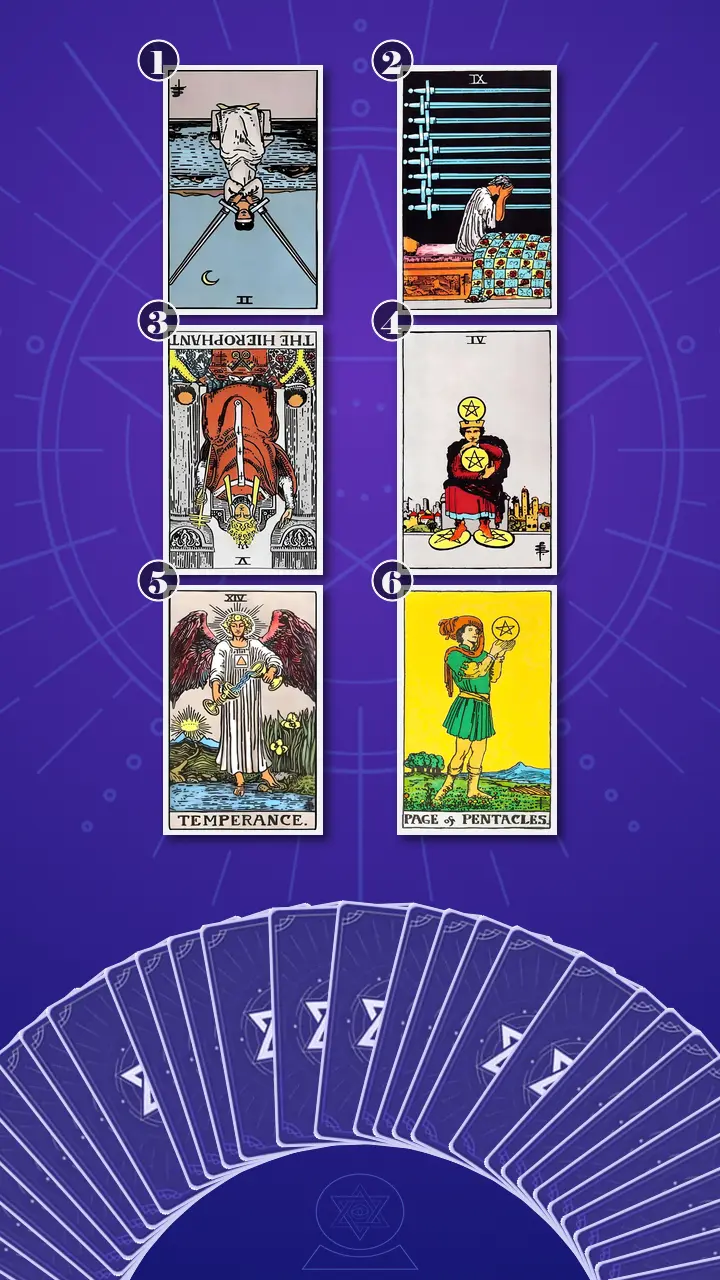
Reading the Ladder: When Decision Paralysis Is Actually Control
Position 1: The Hover-Over-Send Loop (Surface symptom)
“Now we’re turning over the card that represents the surface symptom: the concrete RSVP-stalling behavior and decision paralysis happening right now.”
Two of Swords, reversed.
I didn’t need to reach for anything mystical; the image did the job: the blindfold, the crossed swords held tight to the chest, the posture of “neutral” that’s actually tension.
“This,” I said, “is you on your lunch break with the invite open, flipping between Google Calendar, your work calendar, and Notes. You type a cheerful ‘Yes, I’d love to!’ then delete it. Not because you don’t care—because not choosing feels like staying in control.”
In reversed position, the Two of Swords isn’t calm balance. It’s an Air blockage: thought trying to manage emotion by suspending the decision. The energy is contracted—like holding your breath so you don’t have to feel the wave of impact.
I leaned in a little. “Here’s the part people miss: the ‘neutral’ stance isn’t neutral. It’s tense. It’s a form of control.”
And because it mattered to name it without shame, I added one of my favorite pattern-spotter truths: “A deadline doesn’t create your decision—it just exposes your pattern.”
Jordan let out a small, almost amused sound—half laugh, half wince. “That’s… brutal,” she said. “But yeah. That’s literally me.”
Her reaction came in a tiny sequence I’ve learned to trust: first, a brief stillness (thumb stopped moving); then her eyes unfocused as if replaying a screen recording of herself; then a tight nod with a small exhale—recognized and a little called out, but in the useful way.
Position 2: The 2:13 A.M. Group Chat in Your Head (Immediate emotional/mental cost)
“Now we’re turning over the card that represents the immediate emotional cost: what the stalling is doing to your inner state day-to-day.”
Nine of Swords, upright.
“This is the part where the RSVP doesn’t stay in your phone,” I said softly. “It moves into your sleep.”
I used the translation exactly as it shows up in real life: at 2 AM, Jordan wakes up and checks how close the RSVP deadline is. Imaginary conversations line up—someone sounding hurt, her sounding defensive, her sounding ‘flaky.’ The guilt lands in the body as a tight chest and clenched jaw. The event isn’t happening yet, but the stress already is.
Energy-wise, this is Air excess—the mind spinning because the decision is suspended. And the Nine of Swords doesn’t mean “something terrible will happen.” It means the inner narration gets harsh when you delay.
“If you want a practical tool,” I told her, “write down the single sentence you’re most afraid will be true if you RSVP yes. Then write the single sentence you’re most afraid will be true if you RSVP no. Not a paragraph. One sentence each.”
Jordan pressed her lips together and gave a tiny shrug that wasn’t casual—it was defensive. “I hate that I do this,” she said. “Like, why can’t I make a simple decision like everyone else?”
“Because your nervous system thinks this is a loyalty audit,” I said, keeping my tone warm. “Not a plan.”
Position 3: The Inherited Rule You Never Agreed To (Family pattern)
“Now we’re turning over the card that represents the family pattern: the inherited rule or relational script that makes commitment feel loaded.”
The Hierophant, reversed.
“Okay,” I said, and I felt the room get quieter in that way it does right before a song hits its chorus. “This isn’t you being indecisive. This is you negotiating with an old ‘should.’”
Her eyes flicked up at me, then back to the card—like she didn’t want it to be that accurate.
Reversed, the Hierophant points to tradition as pressure: rules about what a “good” person does, and the private urge to resist being controlled by them. The keys in the card aren’t just symbolic—they’re gate imagery. Approval as a door that opens only if you say the right thing.
And I let it land as a micro flashback, because that’s how these scripts actually live in the body:
“You open an invite, and somewhere under the surface there’s an old line—half guilt, half threat,” I said. “Something like: ‘We don’t say no.’ Or ‘People will talk.’ Or ‘If you don’t show up, you don’t care.’”
Jordan went very still. Then she swallowed. “My aunt literally says, ‘Family shows up.’ Like it’s… a law.”
“Exactly,” I said. “So now your RSVP isn’t about the event. It’s about belonging. Yes feels like submission; no feels like exile.”
The energy dynamic here is a blockage in self-authorship: your adult values are present, but the inherited script still grabs the mic.
Jordan didn’t nod right away. She stared at the edge of the table, silent for a beat too long. Then she said, quieter, “I always thought I just had commitment anxiety. But this feels… older.”
Position 4: Calendar-as-Fortress (Core fear)
“Now we’re turning over the card that represents the core fear: what you believe you will lose if you commit.”
Four of Pentacles, upright.
“This is control as safety,” I said. “Not because you’re selfish. Because you learned that if you open your hands, you might not get to close them again.”
The modern translation is painfully specific: treating your schedule like a protected stash. One RSVP feels like it could crack the dam—once you say yes, people will ask for more, you’ll be overextended, and then you’ll have to disappoint someone anyway.
Energy-wise, this is Earth in excess: containment turned rigid. A fortress can keep you safe, and it can also keep you alone.
Jordan’s fingers tightened around her cup when I said, “It’s budgeting your time like rent money—every plan feels like an unexpected charge.”
She gave a small, frustrated breath. “I’m friendly. I show up. But I’m terrified of agreeing and then realizing I’m exhausted and can’t leave. Because then I’m ‘flaky.’”
“That’s the fear right there,” I said. “Not commitment. Commitment without terms.”
Position 5: When Temperance Poured Between Two Cups (Key shift)
“We’re turning over the card that represents the key shift: the reframe that transforms commitment from threat into a workable practice.”
The air in the kitchen felt like it paused—like the fluorescent hum dropped half a notch. This was the bridge card of the whole reading.
Temperance, upright.
Temperance is integration. Mixing. Calibration. Not dramatic leaps—measured pours.
Here’s the setup, because I could see Jordan caught in the familiar trap: she was waiting for certainty to appear before she could press send, like hovering at the edge of a diving board, hoping for a feeling that never arrives. In her mind, “yes” or “no” wasn’t a choice—it was a permanent identity verdict.
Not a lifelong contract—make a measured mix and RSVP from the middle, like Temperance pouring between two cups.
Silence. Then the three-part reaction chain hit her all at once: first, her breath snagged like she’d been caught trying to sneak out of a room; second, her eyes went glassy and unfocused, as if an entire playlist of past family gatherings started buffering behind them; third, her shoulders dropped—slowly, reluctantly—like her body had been waiting for permission to stop bracing.
“But—” she said, and the word came out sharper than she expected. Her brows pulled together. “If I do that… doesn’t it mean I was doing it wrong before? Like I wasted all this time?”
I nodded, because that anger is honest. “It means you were using the tools you had,” I said. “Freezing and stalling kept you from immediate conflict. It wasn’t ‘wrong.’ It was protective. Temperance just offers a better tool—one that doesn’t charge you interest at 2 AM.”
Then I brought in my signature lens—because as a music-therapy radio host, I don’t just listen to words; I listen to patterns.
“Can I do a quick Music Pulse Diagnosis with you?” I asked. “What have you been playing on repeat lately—especially on the commute or late at night?”
She blinked, surprised, then laughed once. “Honestly? A lot of sad-girl indie. And then, like, ‘lofi beats to focus’ when I’m spiraling.”
“That makes so much sense,” I said. “Sad-girl indie is emotional truth. Lofi is control—soft walls around the mind. Temperance is neither: it’s the mix. It’s the ‘middle track’ where you can feel connection and keep your limits.”
I tapped the card gently. “So here’s the experiment: set a 10-minute timer. In Notes, write two lines: (1) ‘Family rule voice:’ and finish the sentence. (2) ‘Adult values voice:’ and finish the sentence. Then draft the RSVP from line two plus one concrete term—arrival time or leave time.”
Her jaw tightened again for a split second, so I offered the most practical bridge I know: “If your chest spikes, we don’t push through it. We regulate. I’ll give you a Breath Soundtrack: three slow breaths with a 4-second inhale and a 6-second exhale—like a song with a longer outro than intro. It tells your body: we’re safe enough to choose.”
I watched her try it—subtle, almost invisible in a public kitchen. On the last exhale, she whispered, “Okay. ‘Yes with terms’ feels… possible.”
“Now,” I said, “with this new frame, think back to last week. Was there a moment—one invite, one group chat, one family text—where this would’ve changed how trapped you felt?”
Jordan’s eyes shifted to the side, memory searching. “My cousin’s thing,” she said. “If I’d just said, ‘I can come but I’m leaving by nine,’ I wouldn’t have spent three days researching TTC routes like it was a dissertation.”
That was the emotional transformation clicking into place: from deadline-driven spiraling and option-hoarding to self-trusting, bounded commitments with clear terms. Not perfect confidence—just a workable pivot.
Position 6: The Beginner’s Checklist That Calms Your Nervous System (One step)
“Now we’re turning over the card that represents the one step: the smallest practical action you can take within a week to resolve the RSVP and rebuild self-trust.”
Page of Pentacles, upright.
“This is such a relief card,” I said, and I meant it. “Because it doesn’t ask you to ‘become a different person.’ It asks you to do one small, grounded thing.”
The Page studies the pentacle like a simple object you can hold in your hands. In modern terms: you send the RSVP, then you externalize one tiny logistics plan so your nervous system doesn’t have to keep the entire decision in your body.
Energy-wise, this is Earth in balance: practical containment that supports you instead of trapping you.
Jordan nodded faster this time. “I can do a checklist,” she said. “Like… if it’s in Notes, it’s not in my brain.”
“Exactly,” I said. “Make it practical enough that your nervous system can believe you.”
From Insight to Action: The Yes-With-Terms Experiment (and a Sound-Based Reset)
I slid the six cards into a neat ladder again, because the story they told was coherent—and, honestly, kind.
The short version went like this: you stall (Two of Swords reversed) because you’re trying to maintain control through “neutrality,” but the delay taxes you with rumination and guilt (Nine of Swords). Under that is an inherited family script that turns invitations into a belonging gate—say the right thing or risk distance (Hierophant reversed). So your body clamps down and guards time like it’s scarce currency (Four of Pentacles). Temperance doesn’t demand you pick the “right” identity; it teaches you to create a balanced agreement with explicit terms. Then Page of Pentacles turns that agreement into one small follow-through action you can complete this week.
Your cognitive blind spot—the sneaky one—is thinking the problem is lack of information. More calendar checks, more transit research, more “let me see what others are doing.” But what you’re actually avoiding is the terms conversation. The transformation direction is clear: shift from commitment-as-verdict to commitment-as-bounded agreement.
So I gave Jordan three next steps. Not aspirational. Not moral. Just doable.
- The 10-Minute Send Button RuleSet a timer for 10 minutes on your lunch break. No new research tabs. Decide yes/no based on one priority (rest, connection, finances, work capacity). When the timer ends, send the RSVP immediately.If you feel yourself trying to “earn” the decision with perfect logic, pause and ask: “What are my terms?” One term is enough.
- A Yes-With-Terms (or No-With-Care) ScriptDraft one sentence you can stand behind: “Yes—I can make it, and I’ll likely head out around 9.” Or: “I can’t make it this time, but I’d love to catch you for coffee next week.” Read it once out loud before sending and check your body: does it feel self-respecting?A bounded yes is still a real yes. Terms aren’t excuses—they’re information.
- Page of Pentacles 3-Bullet Logistics PlanRight after you RSVP, open Notes and write three bullets: (1) how you’ll get there (TTC/drive/rideshare), (2) what time you’ll leave, (3) one thing you’ll bring/do (card, dish, outfit). Add one reminder: “Leave by 8:40 to make it easy.”If you start spiraling, return to one practical detail. Externalize the plan so it stops living in your nervous system.
And because my work is always a blend of tarot and sound, I added a simple, immediate “nervous system first aid” layer Jordan could use the same night—my White Noise First Aid plus a tiny BGM Prescription:
BGM Prescription (pick one, 15 minutes): (1) Brown noise at low volume for “city brain” decompression after a TTC commute. (2) 432 Hz soft piano or ambient strings for unclenching the jaw without forcing emotion. (3) A steady 60–70 BPM instrumental beat (anything that feels like a slow walk) while you write the two-line “Family rule voice vs Adult values voice” exercise.
“You’re not trying to become someone who never feels mixed,” I reminded her. “You’re becoming someone who can choose with honesty and keep the agreement you make.”

A Week Later: Quiet Proof in a Sent Message
Five days later, Jordan sent me a screenshot: the RSVP bubble, finally not in drafts. Her message was simple—“Yes, I’m in. I’ll head out around 9.” Under it, a Notes app list with three bullets: TTC route, leave time, and what she was bringing.
Her follow-up text was even smaller, and somehow bigger: “I didn’t wait to feel certain. I just… chose terms.”
The bittersweet part, the part that felt most real: she celebrated by sitting alone in a café after work, headphones in, staring out at Queen Street traffic for ten quiet minutes—relieved, a little shaky, proud, and still not 100% sure she’d feel like going when the day came.
That’s the Journey to Clarity I trust: not certainty as a prerequisite, but ownership as a practice. A decision that doesn’t require self-abandoning. A commitment that’s an agreement—with terms.
When an RSVP feels like a character test, your chest tightens not because you don’t care—but because you’re trying to stay connected without handing your autonomy over to someone else’s unspoken rules.
If you let commitment be a small, bounded agreement instead of a permanent verdict, what would your most honest “yes (with terms)” or “no (with care)” sound like today?
This story is adapted from psychological research, written so that those in a similar struggle can see their own pattern in it — and find their next step clearly.These insights are not a substitute for professional psychological, medical, legal, or financial advice.
Learn more about our Journey to Clarity.
How did this insight land for you?
🫂 This Resonates Deeply
🌀 Living This Story
✨ Now I See Clearly
🌱 Seeing New Possibilities
🧰 Useful Framework
🔮 The Confirmation I Needed
💪 Feeling Empowered
🚀 Ready for My Next Step
Author Profile
 AI
AI“Through ten years of sound energy research, I’ve found that when we struggle, it's usually just our internal rhythm falling out of sync under pressure. I know firsthand the frustrating helplessness of wanting to move forward but feeling paralyzed. Without overwhelming theories, I want to be the soothing background track that helps you recalibrate, turning your heavy burdens back into a light, effortless, and harmonious melody.”
In this Introspection Tarot Reading :
Core Expertise
- Mental Noise Cancellation: Diagnosing severe internal friction not as a moral failing, but as a chaotic overlapping of incompatible psychological frequencies.
- Resonance Healing Calibration: Identifying the 'dissonant baseline' of your chronic anxiety and calculating the specific acoustic or rhythmic input needed to soothe it.
Service Features
- The Frequency Reset Pause: A customized rhythmic breathing or acoustic grounding technique to forcefully lower your brainwave state from a frantic beta frequency to a restorative alpha state.
Also specializes in :
Explore Related Patterns:
Commitment AvoidanceJordan's thumb hovering over Accept while she types, deletes, and keeps the RSVP unsent shows commitment being treated as more than one evening. The nervous system reads yes as signing away the whole night and no as evidence that she does not belong. Commitment Avoidance is active here because the commitment has no terms yet. Without a leave time, arrival plan, or self-respecting script, the RSVP becomes a trapdoor where connection and autonomy seem mutually exclusive. You can see why delay feels safer in the short term. It postpones the moment of exposure, but it also keeps her stuck inside the same fear. The shift is not forcing a yes; it is making commitment small enough, bounded enough, and honest enough that it no longer requires self-abandonment.
Control CopingJordan flipping between calendars while the RSVP stays open shows control being used as a pressure valve. The decision is suspended not because she has no preference, but because not choosing gives her a temporary sense that nothing can overtake her schedule yet. Control Coping becomes visible when her calendar turns into a fortress. One yes feels like it could lead to more requests, overextension, disappointment, and the accusation that she is flaky, so rigidity starts masquerading as safety. The problem is not that she wants control over her time. That is reasonable. The pattern becomes costly when control can only be maintained through delay, tension, and sleep-disrupting rumination instead of through clear terms she can actually communicate.
Guilt ConditioningJordan hearing 'Family shows up' as a law turns a normal RSVP into a belonging test. The invite is not just logistics; it becomes a cue that approval may be withdrawn if she sets a limit, so her body reacts before her adult reasoning can finish the sentence. That is the mechanism of Guilt Conditioning. Guilt has been trained to fire at the exact point where a boundary would normally appear. You can see the pattern in the way no becomes proof of not caring, while yes becomes submission to someone else's expectations. The useful audit here is that the guilt is not evidence that she is doing something wrong. It is evidence that an inherited rule has been activated, and the one step is to answer from her adult values rather than from the family rule voice.
Boundary DiffusionJordan needing to separate 'Family rule voice' from 'Adult values voice' shows how blurred the internal boundary has become. The aunt's line about family showing up does not stay outside her; it becomes part of the decision-making system. Boundary Diffusion is the pattern because her own capacity, the family's expectations, and the meaning of belonging are tangled together. That is why no feels like exile and yes feels like submission, even though the actual situation is one RSVP. The practical breakthrough is that she does not need a perfect emotional state before choosing. She needs a clean boundary sentence. A bounded yes or a no with care restores the distinction between connection and compliance.
Boundary DiscernmentJordan's final message, 'Yes, I'm in. I'll head out around 9,' converts commitment from a vague obligation into a bounded agreement. The relationship stays intact, but her autonomy is no longer erased inside the yes. Boundary Discernment is the adaptive pattern because it lets her separate care from compliance. She can show up, name a limit, and stop treating terms as excuses. For you, the important move is not becoming someone who never feels mixed. It is becoming someone who can make a clear agreement while still feeling human uncertainty. The boundary does not ruin the commitment; it makes the commitment trustworthy.
Values-Based Decision MakingJordan writing 'Family rule voice' and 'Adult values voice' as separate lines gives her a way to hear which part of the decision actually belongs to her. The exercise turns a vague emotional knot into two distinct sources of guidance. Values-Based Decision Making appears when she stops trying to earn the RSVP through perfect logic and chooses from one priority plus one concrete term. The adult value is not rebellion against family; it is self-authorship under pressure. The follow-through matters because she sends the message and externalizes the logistics into three bullets. That makes the decision real without demanding total certainty, which is exactly the kind of grounded action that rebuilds self-trust.
Certainty SeekingJordan opening three planning spaces and still not answering shows the mind trying to manufacture certainty before it permits action. The same pattern appears in the cousin example, where route research becomes so elaborate that the logistics start functioning like a substitute decision. Certainty Seeking is the cognitive safety behavior underneath the stall. If she can just check one more calendar, imagine one more reaction, or find one more piece of information, she might avoid the discomfort of choosing with incomplete confidence. The story makes clear that certainty is not the missing ingredient. The missing ingredient is a term she can stand behind. Once the decision becomes 'I can come, and I will leave around 9,' the need for total certainty loses some of its grip.
Analysis ParalysisJordan toggling between Google Calendar, her work calendar, and Notes while the RSVP remains unanswered is the visible loop of Analysis Paralysis. The analysis keeps expanding, but the decision does not move. The psychological function is protective. Extra analysis gives her something to do with the anxiety of being judged, disappointing someone, or losing control of her night. It turns emotional risk into a research project. The pattern breaks when the question changes from 'Do I have enough information?' to 'What are my terms?' That shift moves her out of mental over-processing and into a bounded action she can complete.
Explore Related Struggles:
Agreement-Agency SplitJordan keeps moving between Google Calendar, work calendar, Notes, TTC routes, and possible scripts, but none of that motion gives her the sentence she can send. The practical tools are not useless; they are just being asked to solve a deeper problem than logistics. The friction appears when an RSVP starts to feel like surrender. You can agree to attend only if the agreement does not erase your exit, your rest, or your right to name a limit. Until that limit is spoken, the yes feels like a door that might lock behind you. Agreement-Agency Split captures that exact divide: the part of you that wants to be connected and reliable is forced to negotiate with the part that fears losing authorship over your own time. The story begins to loosen when Jordan stops treating commitment as a total handover and turns it into a bounded agreement she can actually keep.
All-or-Nothing BelongingThe RSVP stops being an invitation and turns into a gate: say the right thing and remain inside, choose wrong and risk distance. Jordan names the trap directly when she says yes feels like submission and no feels like exile. This is a compressed belonging structure, where there is almost no room for partial presence, mixed capacity, or a caring boundary. You are allowed to be connected only through the narrow channel of compliance, so every small decision starts carrying the weight of membership. All-or-Nothing Belonging fits because the story shows belonging being reduced to a binary test. The repair is not emotional certainty; it is creating a third shape, where a bounded yes or a no with care can keep connection alive without making total availability the entry fee.
Autonomy Guilt BindThe line from Jordan's aunt, Family shows up, sits underneath the invite like a rule she never got to vote on. When the RSVP appears, she is not only deciding whether to attend; she is negotiating with a family script that treats presence as proof of care. That script makes autonomy feel costly. You can protect your time, but the moment you do, the old rule starts translating self-respect into selfishness and absence into betrayal. The body reacts because the choice has been loaded with guilt before you even type the reply. Autonomy Guilt Bind fits because the story's pressure point is the collision between adult self-authorship and inherited relational debt. Jordan's one step works because it does not ask her to abandon connection; it lets her choose connection without making guilt the price of entry.
Commitment Threshold StrainJordan stands in the office kitchen with the invite open, her thumb frozen over Accept while her body is already bracing for the consequences of a choice she has not made. The RSVP is small on paper, but it lands like a threshold: once she crosses it, the night may stop feeling like hers. That is why the deadline tightens her jaw instead of simply organizing her schedule. You can see the strain in the way one button becomes a doorway into obligation, visibility, and possible disappointment. The fear is not commitment itself; it is commitment that seems to expand beyond the agreement you actually made. Commitment Threshold Strain names the moment where saying yes feels too loaded to be neutral and saying no feels too relationally expensive to be clean. The workable shift in the story is not forcing confidence, but shrinking the threshold back to human size: a yes with terms, a no with care, and a choice that does not require handing over the rest of yourself.
Control LockJordan's non-answer looks passive from the outside, but inside the story it functions like a clenched fist. By keeping the RSVP unsent, she avoids the immediate exposure of a yes or a no, and for a while that suspended state feels safer than contact with the consequences. The cost shows up after hours: the deadline moves into sleep, imagined conversations start lining up, and the same logistics get checked again without becoming a decision. Control is no longer helping her steer; it is holding the entire situation in place. Control Lock names the point where staying undecided becomes the only available form of safety, even though it keeps charging interest in attention, rest, and self-trust. The story's release comes when control is redistributed into terms: a leave time, a three-bullet plan, and one message that can leave drafts.
Inherited Role LockJordan hears the invite through an older sentence: Family shows up. The words operate less like a preference and more like a role assignment, making attendance feel like proof that she is still the kind of person the family system recognizes as good. That role keeps her adult values from speaking first. You may know, logically, that your time is yours, but the inherited script still grabs the mic when a family-adjacent request appears. The result is not simple indecision; it is a present-day choice being routed through an old obligation structure. Inherited Role Lock names the way a role can keep making claims on you after the original setting has changed. Jordan's movement comes from separating the family rule voice from the adult values voice, then letting the RSVP be written from the part of her that can care without reenacting the whole script.
Explore Related Emotions:
Approval AnxietyThe old approval door shows up in the tiny pause over the button. The story names it directly through gate imagery and the family line that says showing up is not a preference but a rule. Approval Anxiety fits because the choice is organized around how the answer will be received. You are not just checking your calendar; you are checking whether your answer will keep the relationship warm, whether the group will still read you as reliable, and whether a term will be treated as care or rejection.
Boundary GuiltThe imaginary conversations at 2 AM already have someone sounding hurt, you sounding defensive, and you sounding flaky. Before any boundary is spoken, the body rehearses the cost through the tight chest and the jaw clench. Boundary Guilt lives in that rehearsal. The story shows a person trying to protect rest and capacity while also feeling responsible for the emotional meaning others might attach to her answer. A yes-with-terms becomes powerful because it lets care exist without requiring self-erasure.
Cautious AutonomyThe shift happens when the answer becomes 'Yes, I'm in. I'll head out around 9.' That line keeps connection intact while also giving the evening an edge, a time, and a way back to yourself. Cautious Autonomy names the careful relief of realizing that participation does not have to equal surrender. You can choose contact without handing over the whole night, and that makes autonomy feel less like rebellion and more like a practical condition for staying honest.
Commitment ClaustrophobiaYour body reacts to the RSVP before the event even exists in real time, with the phone warm in your palm, jaw locked, fingers jittery, and chest held. Saying yes does not register as one evening on a calendar; it lands as signing away the whole night. That is the claustrophobic edge of commitment in this story. The commitment only becomes bearable once it has terms, because the real pressure is not connection itself. It is connection without a visible exit, without a leaving time, and without proof that your autonomy will still be there after you say yes.
Conditional Belonging FearThe phrase 'Family shows up' turns an invitation into a gate. When no feels like proving you do not belong and yes feels like submission, the RSVP stops being a plan and starts acting like a test of membership. This is why the family pattern has such force. Belonging appears conditional on saying the right thing quickly enough, warmly enough, and with no visible limit. The fear is not only that someone will be disappointed; it is that one boundary might be read as evidence that you are outside the circle.
Verdict DreadThe deadline keeps changing shape in Jordan's mind until it becomes a verdict. A yes says she is compliant, a no says she is uncaring, and even waiting starts to sound like being flaky in the imaginary conversations that line up at 2 AM. Verdict Dread names the pressure of feeling judged before anyone has actually responded. The dread comes from treating one RSVP as a character ruling instead of a bounded choice, so every option feels like it will announce who you are.
Grounded AgencyThe one step is deliberately small: set a timer, write the family rule voice and the adult values voice, send the RSVP, then make a three-bullet logistics plan. The route, leave time, and what to bring move the decision out of the body and into a form that can be handled. Grounded Agency is not dramatic confidence. It is the moment action becomes specific enough to trust. The story turns agency into a sequence of doable moves, so choosing does not require perfect certainty first.
Quiet Self-TrustFive days later, the proof is quiet: one RSVP bubble, one leaving time, and a Notes list with three simple bullets. Jordan still is not completely sure she will feel like going, but she no longer needs total certainty to act. Quiet Self-Trust is the emotional texture of that moment. It is not loud confidence or a personality overhaul. It is the steadier feeling that you can make a bounded choice, keep it realistic, and adjust without abandoning yourself.
Choice Paralysis OverwhelmThe RSVP stays open while you flick between Google Calendar, work calendar, and Notes, as if one more tab might create certainty. Your thumb hovers over Accept, drafts appear and disappear, and the deadline keeps gathering weight while the decision stays untouched. That loop turns a simple response into mental weather. The body is already paying for the stalled choice through a held chest, a clenched jaw, and late-night deadline checks, so the overwhelm is not about the invite itself. It is the pressure of too many imagined consequences packed into one button.
Clarity ReliefThe first relief arrives in small physical signals: a stopped thumb, a tight nod, a small exhale, shoulders slowly dropping. Later it becomes a screenshot of the sent message and the sentence, 'I didn't wait to feel certain. I just chose terms.' Clarity Relief fits because the clarity is practical rather than glossy. The pressure does not vanish, and Jordan is still a little shaky, but the pattern is no longer foggy. She can see the difference between commitment as a verdict and commitment as an agreement.
Scarcity AnxietyYour schedule gets treated like a protected stash, with time budgeted like rent money and one RSVP reading as an unexpected charge. Even a family-adjacent event feels as if it could crack the dam and let in more requests than you can carry. Scarcity Anxiety is the inner weather of time feeling too fragile to spend. The calendar becomes a fortress because commitment seems to threaten the limited supply of energy, exit options, and recovery space you are trying to preserve.
Explore Related Contexts:
Commitment Cliff EdgeJordan's thumb hovers over Accept the way someone hovers over a purchase they are not sure they can afford. She types a cheerful yes, deletes it, checks another calendar, and keeps trying to gather enough certainty to make the button feel safe. Commitment Cliff Edge captures the way a small RSVP becomes an all-or-nothing ledge. The external deadline is real, but the sharper pressure comes from the social meaning attached to the answer: yes appears to surrender the night, while no appears to threaten belonging. The choice stops functioning like a plan and starts functioning like a verdict. Your leverage point is to shrink the cliff back into a step. A commitment with terms is not a life sentence, and a refusal with care is not a disappearance. Once the answer has edges, you can choose without handing the whole meaning of your character to the RSVP field.
Conditional Family BelongingJordan opens a family-adjacent invite and the choice immediately becomes bigger than her calendar. Saying yes feels like signing away the night, while saying no feels like proving she does not belong. Her aunt's line, 'Family shows up,' gives the invitation a gatekeeping charge, as if attendance is not about availability but about membership. Conditional Family Belonging fits because the pressure comes from an external relational system where warmth, legitimacy, and inclusion appear tied to compliance. You are not only choosing an event; you are navigating a family-adjacent scoreboard where presence is treated as proof of care. Seeing the structure gives you room to act with more agency. A yes with a leave time, or a no with a concrete reconnection offer, separates belonging from unlimited availability and lets you respond from adult terms instead of from the old gate.
Family Boundary NegotiationFive days later, Jordan sends the RSVP bubble: 'Yes, I'm in. I'll head out around 9.' Under it sits the three-bullet Notes plan: TTC route, leave time, and what she is bringing. The answer is not dramatic, but it changes the agreement. Family Boundary Negotiation fits because the story's workable step is not total refusal or total compliance. Jordan stays in the relationship field while making the terms visible. The boundary is not hidden in resentment, delayed until the event, or outsourced to an excuse; it is placed inside the commitment from the start. For you, the one-step version is clear: make the RSVP an agreement instead of a performance. A bounded yes or a caring no gives the other person real information while keeping your time attached to your own values. That is how connection becomes possible without handing over autonomy.
Family Calendar Boundary CreepJordan describes a yes as signing away her whole night, then protects her schedule like a stash that could be raided. One RSVP seems capable of pulling in transit research, emotional obligation, extra requests, and the risk of being called flaky if she needs to leave. Family Calendar Boundary Creep fits because the invitation is no longer confined to the event. It reaches into the evening before she has agreed, claims planning bandwidth before any plan exists, and turns open-ended availability into the hidden price of staying in good standing. The exit term changes the structure. When you state a leave time before the event, the commitment stops being a blank check and becomes an agreement with edges. That is why 'Yes, I'm in. I'll head out around 9' is not a small wording tweak; it is calendar sovereignty in one sentence.
Family Script PressureJordan is not responding to a blank invitation; she is responding to inherited lines like 'We don't say no,' 'People will talk,' and the aunt's 'Family shows up.' The RSVP carries the force of a rule she never explicitly chose, which is why a routine answer starts to feel like a moral audit. Family Script Pressure names the outside pattern pressing on the decision. The family system has supplied a script where a good person proves care by appearing, and the cost of deviating is social judgment. You can want connection and still notice that the rule is doing more work than the event itself. The useful move is not to argue with the whole script at once. It is to identify the sentence that is running the room, then answer from the adult value underneath it: connection with limits, care without self-erasure, attendance with terms.