The Friday Push Notification That Steals a Weekend
You open your phone on Friday afternoon and see family plans already added to the shared calendar—no text, no question—just your weekend getting booked, and your shoulders doing that instant “here we go” thing (Sunday Scaries, but make it family).
When Taylor said it to me on our call, they didn’t even sound dramatic. They sounded… practiced. Like they’d told this story to themselves so many times it had become a weather report.
They were curled into the corner of a small Toronto apartment couch at 8:47 p.m., laptop half-open like it was still trying to be “productive,” the blue phone-glow lighting their hands. The fridge had that steady hum that turns quiet into a kind of pressure. Street noise sifted in through a cracked window, and every time their phone buzzed, their shoulders twitched as if someone had tapped them on the collarbone.
“It’s the shared family calendar,” they said, thumb scrolling. “It started helpful. Now it’s like… my weekends are a public resource.”
When they showed me a screenshot—Sunday brunch dropped in at 11 a.m., no question mark, no “are you free?”—their chest rose high and stayed there. Their jaw held tension like a clamped lid. That particular mix of guilt and irritation sat on them like a heavy winter coat they couldn’t take off indoors.
“I love my family,” they added quickly, as if to preempt judgment. “But I hate feeling like my weekends aren’t mine. And if I say no, I feel selfish. Like I’m… opting out of belonging.”
I let that land. “You’re not wrong to want closeness,” I told them. “And you’re not wrong to want consent. Those two can exist in the same room.” I watched their shoulders drop a millimeter, like their body understood before their mind did. “Let’s try to turn this fog into a map. Not a lecture. A map—so you can find clarity and actual next steps the next time the calendar pings.”

Choosing the Compass: The Celtic Cross · Context Edition
I asked Taylor to take one slow breath—nothing mystical, just the kind of breath that tells your nervous system, we’re not in a group chat right now. While they did, I shuffled my well-worn deck on camera, the soft rasp of the cards steadying the moment like rain against a window.
“Today,” I said, “I want to use a spread called the Celtic Cross · Context Edition.”
For a question like ‘Why does my family assume I’m free every weekend—and how do I reset my role without drama?’ the Celtic Cross works beautifully because it doesn’t treat this as just scheduling. It shows the whole chain: the visible burden, the exact moment you freeze, the deeper family script underneath it, and then the most realistic communication shift—followed by the practical system that makes it stick.
I pointed to the structure as I laid the cards. “The center shows what your weekends look like right now and what blocks you in the moment you need to respond. The lower card touches the deeper role rule—what you were taught a ‘good’ person does. Then we move toward the near future: the cleanest boundary move available. And on the right-hand column, we’ll look at how you hold steady emotionally when guilt spikes, plus the family-calendar dynamics around you, and finally the outcome—your most supportive direction of growth if you make one consistent change.”
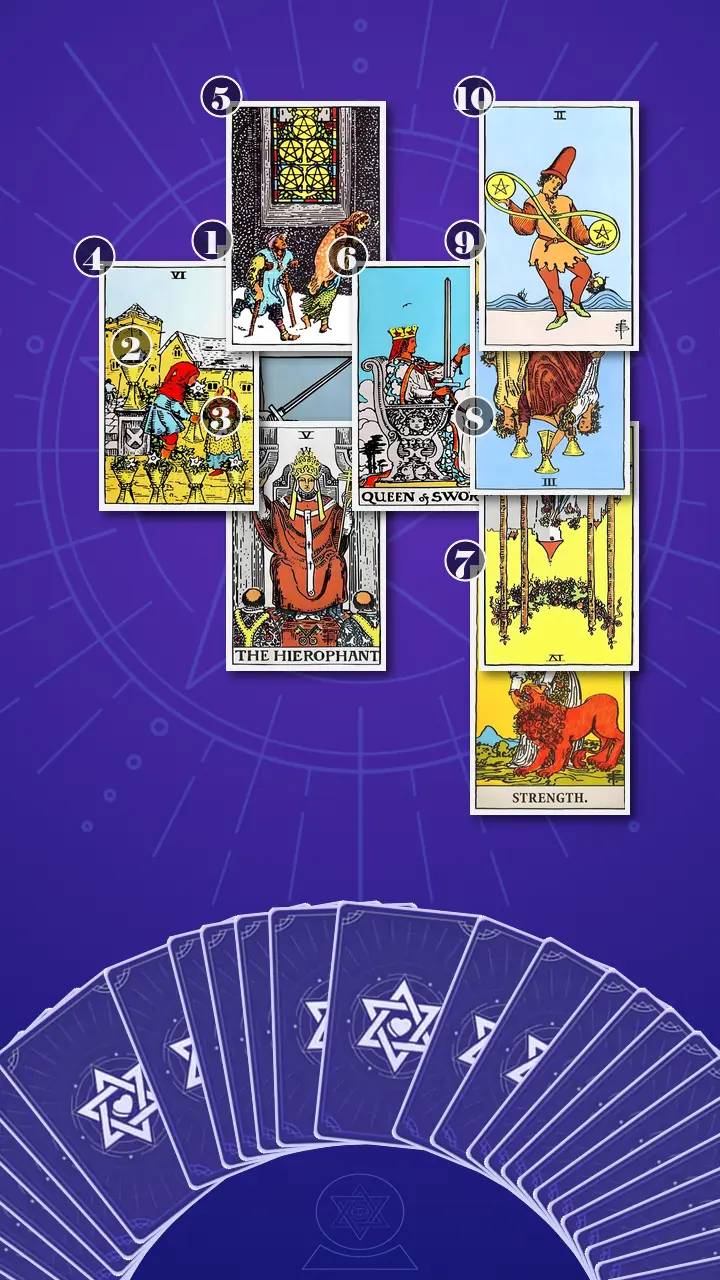
Reading the Map: From Burden to Belonging
Position 1: The Weight You’re Carrying (Ten of Wands, upright)
“Now flipping over,” I said, “is the card that represents what your weekends look like right now in observable behavior and felt load.”
Ten of Wands, upright.
In modern life, this is the Friday-afternoon moment: you close your laptop, you’re already tasting the two-day reset—and then you check the shared family calendar and realize it’s stacked. Brunch. A birthday. A quick “just stop by.” You can technically make it happen, but you’re doing it hunched over in the role of the dependable one, with zero space left to ask what you actually need.
Energy-wise, this card is Excess: too much responsibility being carried by one person, for too long, without renegotiation.
I traced the figure’s posture with my finger. “See how the wands block his vision? This isn’t just ‘busy.’ It’s that you can’t even see your own needs until after you’ve already committed. Your weekend becomes an overstuffed carry-on: you can lift it, but you can’t see where you’re going.”
Taylor gave a small, uncomfortable laugh—more air than sound. A three-step reaction moved through them like a ripple: first their breath paused (a tiny freeze), then their eyes unfocused as if replaying Thursday-night screenshots, and finally their shoulders sank with a quiet, defeated exhale.
“That’s… kind of brutal,” they said, with a grim little smile. “But yeah.”
“Brutal can be honest,” I said gently. “And honesty is how we start changing default settings.”
Position 2: The Exact Moment You Freeze (Two of Swords, upright)
“Now,” I said, “this card represents what specifically blocks you from resetting the role in the moment you need to respond.”
Two of Swords, upright.
This is the card of the blinking cursor. The half-written text. The blindfold that isn’t ignorance—it’s avoidance of the real cost. In modern life: you’re staring at the family group chat invite and you freeze, not because you don’t know what you want, but because either option has a social price tag. So you choose the third option: delay, soften, stay silent until the decision gets made for you… or you send the fastest “Sure.”
The energy here is Blockage. It’s not that you lack boundaries. It’s that you can’t access them at speed—right when the group chat needs an answer.
I described the scene I could almost feel in Taylor’s thumb: phone screen bright in a dark room, Slack finally quiet, and then that family message that reads like a plan but is actually a decision. “Two competing tabs open in your head,” I said. “One says: If I answer now, I lose my weekend. The other says: If I don’t answer now, I become A Problem. And the body hates ‘A Problem’ more than it hates being overbooked, so it reaches for the peacekeeping button.”
I used one of the phrases I’ve seen change lives precisely because it doesn’t shame: “A ‘neutral’ response is still a choice—and the system learns from it.”
Taylor’s mouth tightened, then softened. They nodded once, slow. “Yeah. I call it keeping the peace. But it’s… self-erasing.”
“Exactly,” I said. “And we’re not going to fix it with a heroic speech. We’re going to fix it with a new default.”
Position 3: The Rule You Didn’t Agree To (The Hierophant, upright)
“This next card,” I said, “represents the deeper family script or identity rule that keeps the default pattern running.”
The Hierophant, upright.
In real life, this is when the calendar stops being logistics and becomes a tradition machine. The invisible rule reads something like: A good family member shows up. A good family member doesn’t complicate plans. A good family member doesn’t make their needs the center. So you’re not just saying yes to brunch—you’re saying yes to the old definition of what earns approval.
The energy is Balance in the sense that it keeps the system stable—but it’s the kind of stability that can quietly cost one person their autonomy.
This is where my own lens—what I call Generational Pattern Reading—often matters. I’ve been the seventh-generation matriarch in my own line; I’ve watched how a family can “assign” a role the way a river assigns a path. Not with malice. With repetition.
“Taylor,” I said, “this looks like inherited choreography. Someone learned long ago that reliability keeps things warm. And then the family started moving around that reliability like it was furniture.”
Their eyes flicked up. “So… it’s not just me being weak?”
“It’s not weakness,” I said. “It’s a role that hasn’t been updated since you were smaller.”
Position 4: Where ‘Being Easy’ Once Felt Like Love (Six of Cups, upright)
“Now we’re looking at what past dynamics trained you into this role of being readily available,” I said.
Six of Cups, upright.
This card holds nostalgia with both hands. In modern terms: you can trace the “I’ll just go” reflex back to earlier versions of you—when being easy, helpful, and present kept things warm and stable. That role used to feel like love. Now, it sometimes feels like the price of admission.
The energy here is Balance tipping into Habit. The sweetness is real—but sweetness can harden into expectation when no one ever renegotiates.
Taylor swallowed. “I used to get praised for being ‘low maintenance.’ Like, ‘Taylor’s always down.’ It’s embarrassing how much that still gets me.”
“It makes sense,” I said. “Praise is a kind of weather. Your nervous system remembers where warmth came from.”
Position 5: The Fear Under the Calendar (Five of Pentacles, upright)
“This card,” I said, “represents the fear or belief you’re most aware of when you consider saying no.”
Five of Pentacles, upright.
In modern life, the calendar isn’t what scares you. What scares you is the imagined emotional winter: people bonding without you, your name not mentioned, your absence “noted.” So you pay with your time to avoid that excluded feeling.
The energy here is Deficiency: a shortage of felt belonging—specifically, belonging that can survive your boundaries.
I pointed to the warm window in the image. “This is the ‘warm circle’ you fear losing,” I said. “It’s why a simple ‘no’ doesn’t feel like a schedule choice. It feels like risking your place.”
Taylor’s throat moved like they were trying to push down a lump. “Yeah,” they said, quieter. “Like I’ll be the difficult one.”
“And yet,” I said, “if closeness is real, why does it need automatic access to your time?”
Position 6: The Policy Update (Queen of Swords, upright)
“Now we’re at the next realistic shift available through communication or a boundary move,” I said.
Queen of Swords, upright.
This is the moment you stop writing essays. You send one clean sentence: “I’m keeping Saturdays unbooked for myself going forward—please ask before adding anything.” And then you don’t stack three explanations underneath it. You let the clarity stand there, like an updated rule, not a debate invitation.
The energy is Balance: firm and fair. Not cold. Not apologetic. Just clear.
I framed it the way I know young professionals instantly understand: “This is like switching from a messy Slack thread to a one-line policy. You’re not trying to ‘win’ a conversation. You’re setting an RSVP flow.”
Taylor’s face changed—visible relief, like someone had opened a window in a stuffy room. They actually reached for their phone and started typing, not a paragraph, but a single line in Notes.
“One sentence. No debate. Repeat as needed,” I said softly.
When Strength Put a Hand on the Lion
Position 7: The Way You Hold the Line (Strength, upright — Key Card)
When I turned over the next card, the room on my end went unusually quiet—no heater click, no shuffle sound—just that thin, attentive silence that comes right before something important.
“This,” I said, “is the card that represents how you can hold your boundary emotionally, without collapsing into guilt or snapping into anger.”
Strength, upright.
And I could feel Taylor’s Thursday-night moment hovering in the space between us: you open the shared calendar, see another brunch added, and your shoulders jump like you just got assigned homework. You’re not battling the event. You’re battling the spike in your body—the guilt, the pressure, the old script that says make it easy.
Stop proving you’re ‘easy to book’ and start practicing steady, gentle firmness, like Strength’s calm hand on the lion instead of wrestling it.
I let it sit there, like a stone placed carefully on a path.
Then I watched Taylor’s reaction unfold in layers. First: their eyes widened, just slightly, as if they’d been caught in a familiar loop and someone had finally named the mechanism. Second: their hands—tight around their mug—loosened, fingers uncurling one by one. Third: a quiet exhale that sounded like surrender, but wasn’t. It sounded like relief.
“But if I’m calm,” they said, and a flash of resistance rose up, “does that mean I’m just… letting them get away with it? Like I’m the one who has to do all the work?”
I nodded. “That’s the exact fear. That being steady equals being a doormat. But Strength isn’t compliance. Strength is tone control. It’s choosing not to turn your boundary into a courtroom drama because you’re afraid they’ll reject you.”
Here’s the heart of it: in my Generational Pattern Reading, I often see one person in a family cast as the adapter. The one who makes everything smoother. The one whose flexibility becomes the family’s hidden infrastructure. Strength is how that person stops being infrastructure and starts being a person—without turning cold.
“Make guilt the lion,” I said. “It gets loud the second you set a boundary. It paces. It roars. It tells you you’re selfish. But you don’t have to fight it and you don’t have to feed it.”
I used the line I keep for moments like this because it’s practical, not poetic: “Guilt can be in the room. It doesn’t get to run the meeting.”
Taylor’s face softened, then their eyes went shiny. Not tears spilling—just that near-tear brightness when someone recognizes themselves without being blamed. “I always thought boundaries had to be… intense,” they whispered. “Like I’d have to be mad enough to do it.”
“Strength says the opposite,” I replied. “You reset the role by being consistent, not convincing. And that consistency is gentle on purpose—because it’s repeatable.”
I leaned in. “Now, with this new lens—think back to last week. Was there a moment you could have said, ‘Let me check and get back to you,’ and your body would have survived it?”
They stared up at the ceiling for a beat, eyes tracking memory. Then: “Friday. 4:42. I closed Slack and the message came in. I said ‘Sure’ in five seconds.” Their voice cracked on the last word, half laugh, half grief. “I could have bought myself time.”
“That’s the shift,” I said. “From guilt-driven compliance to calm self-trust. Not overnight. But one boundary held once is a new piece of evidence.”
Before we moved on, I gave them a small, embodied practice—because Strength isn’t an idea; it’s a nervous system skill. “A ten-minute Boundary Rehearsal,” I said. “Open Notes. Write one single-sentence boundary—no reasons, no backstory. Set a timer for two minutes and read it out loud five times in a neutral voice. Then set another timer for eight minutes and draft one follow-up line for pushback: ‘I hear you. That doesn’t work for me this weekend.’ If your chest tightens, pause. Hand on sternum. Three slow breaths. Stop. The goal isn’t to force yourself. It’s to make the words survivable in your body.”
Position 8: The ‘Celebration’ That Feels Like a Checkpoint (Four of Wands, reversed)
“Now,” I said, “we’re looking at family calendar dynamics and unspoken expectations shaping your options—context, not destiny.”
Four of Wands, reversed.
This is the garland of “family fun” hung a little too tightly over the doorway. It looks welcoming. But when it’s reversed, it can feel like an entryway you’re pushed through rather than invited into.
The energy here is Instability—not because your family is evil, but because the structure is wobbly: celebrations without consent become obligations in disguise.
Through my Home Energy Diagnosis lens, I think of thresholds. A doorway is meant to separate “outside” from “inside.” The shared calendar is your family’s doorway. Right now, it doesn’t have a door. It’s an open archway anyone can walk through with an event and drop it into your life.
“This is why a request-only rule matters,” I said. “Not to create distance. To make the doorway real.”
Position 9: The Group Chat After You Say No (Three of Cups, reversed)
“This card represents what you secretly hope will happen and what you fear will happen if you change the pattern,” I said.
Three of Cups, reversed.
In modern terms, this is the dread of watching the inside jokes keep going without you. The fear that you’ll decline once and suddenly the vibe shifts. That you’ll become the “not a team player” in the family’s emotional group chat.
The energy is Blockage again—not a lack of love, but a clog in the belonging story: Do I belong because I’m present, or because I’m real?
I brought back the warm-window metaphor: “You’re afraid that if you’re not physically there, you’ll be emotionally outside. So you keep checking the chat, rereading neutral replies like they’re coded messages.”
Taylor nodded, almost embarrassed. “After I even think about saying no, I check the chat like… twenty times.”
“That’s not pettiness,” I said. “That’s a nervous system seeking reassurance. Strength teaches you to tolerate that discomfort long enough for the system to update.”
Position 10: The Sustainable Rhythm (Two of Pentacles, upright)
“Finally,” I said, “this card shows the most supportive direction of growth if you implement one boundary and one scheduling rule consistently.”
Two of Pentacles, upright.
This is the outcome I like best for boundary work: not a fantasy where nobody ever asks anything of you, but a rhythm that can handle real life. The infinity loop around the coins is the recurring weekend. The ships in the background are the waves of changing demands. The lesson is simple and quietly radical: you treat your weekend like a budget, not an open tab.
The energy here is Balance as Practice. Not a one-time confrontation. A template you can repeat.
“This,” I told Taylor, “is you creating a simple rule: one family commitment max per weekend, with the rest decided based on energy and priorities—not guilt. Your family still has access to you, but not automatic access to your time.”
A Weekend Budget, Not a Moral Referendum
I leaned back and let the spread speak as one story instead of ten separate messages.
“Here’s what I see,” I said. “Right now you’re in Ten of Wands mode—carrying weekends like unpaid project management. Two of Swords shows the snap-freeze moment where you avoid discomfort and default to yes. The Hierophant and Six of Cups explain why: you learned an old rule that being ‘easy’ equals being loved, and it used to work. But Five of Pentacles and Three of Cups reversed reveal the hidden engine: the fear of being outside the warm circle. Queen of Swords is the turning point—one sentence, policy-level clarity. Strength is your bridge—soft voice, firm boundary. And Two of Pentacles makes it sustainable: a weekend template that stops every invite from becoming a weekly moral referendum.”
Then I named the blind spot, because clarity usually arrives with one clean truth: “Your cognitive blind spot is that you’ve been treating their expectation as more urgent than your consent. So you keep trying to feel ‘ready’ to set boundaries, when the real change is a default behavior update.”
“The key shift,” I reminded them, “is moving from automatic yes to: ‘Let me check and get back to you’—and proactively blocking one non-negotiable personal anchor on your weekend calendar first.”
I offered Taylor a small set of actions—specific enough to do, boring enough to repeat, kind enough to keep connection intact.
- Install the “Let-Me-Check” DefaultNext time a family invite lands (group chat or calendar), do not answer “Sure” on impulse. Reply: “Let me check and get back to you by tonight.” Even if you already know the answer.If guilt spikes, treat it as a cue to shorten your message, not lengthen it. Copy/paste beats courage in the moment.
- Save One “Weekend Boundary” SentenceCreate a text shortcut named “Weekend Boundary.” Use one sentence like: “I’m keeping Saturday mornings unbooked going forward—please ask before adding anything.” Send it once, then stop.One sentence. No debate. Repeat as needed. Over-explaining turns your boundary into more labor and invites negotiation.
- Protect One Anchor + Run a No-Recheck TimerBlock one non-negotiable personal anchor on your weekend calendar (e.g., Sat 10 a.m.–2 p.m. “Reset Time”). After you send a boundary text, set a 20-minute “no re-check” timer so you don’t spiral in the group chat.Use my 3-minute family energy check: before replying, glance at a houseplant. Is it reaching for light or cramped against a window? Let it remind you: growth needs space. Then do one full exhale and reply.
Taylor looked down at their calendar again, but their shoulders didn’t jump this time. “So I’m not trying to get them to agree,” they said slowly. “I’m just… updating what’s true.”
“Yes,” I said. “You don’t reset your family role by winning the argument—you reset it by calmly repeating the same boundary until it becomes boring.”

A Week Later: Ownership, Not Certainty
A week later, Taylor messaged me. Not a paragraph. Not a spiral. A screenshot: their calendar with a repeating block called Unbooked and another called Reset Time. Under it: “They added brunch. I said ‘Let me check.’ Then I said no. I didn’t die.”
Clear but still human: they told me they slept a full night… and woke up with the first thought, What if they’re annoyed? Then they caught themselves, smiled once, and made coffee anyway.
That’s what I mean by a Journey to Clarity. Not certainty. Ownership. A weekend that’s no longer a public resource—especially not by default.
And if you’re reading this with that familiar tightness in your shoulders—because your own weekend gets booked like a public resource—remember: saying no doesn’t feel like a schedule choice when it’s tangled up with belonging. It feels like risking your place in the warm circle.
So let me turn it toward you: If you didn’t have to prove you belong with constant availability, what’s one small piece of your weekend you’d protect first—just to see what it changes in you?
This story is adapted from psychological research, written so that those in a similar struggle can see their own pattern in it — and find their next step clearly.These insights are not a substitute for professional psychological, medical, legal, or financial advice.
Learn more about our Journey to Clarity.
How did this insight land for you?
🫂 This Resonates Deeply
🌀 Living This Story
✨ Now I See Clearly
🌱 Seeing New Possibilities
🧰 Useful Framework
🔮 The Confirmation I Needed
💪 Feeling Empowered
🚀 Ready for My Next Step
Author Profile
 AI
AI“As the seventh generation of a Highland healing family, I see modern anxieties as a simple, temporary disconnection from nature's rhythm. I bring 67 years of lived seasons not to instruct you, but to hold space for you. Using tarot as a mirror, I want to gently guide you out of the chaos, helping you breathe deeply and rediscover the organic, steady heartbeat of your own life.”
In this Family Tarot Reading :
Core Expertise
Service Features
Also specializes in :
Explore Related Patterns:
Boundary DiffusionThe shared family calendar starts as a helpful tool, then turns into a system where Sunday brunch appears without a question mark and Taylor's weekend is treated like a public resource. That detail matters because the issue is not simply scheduling; it is consent being bypassed in a relationship that still calls itself closeness. Boundary Diffusion shows up when the line between access and intimacy gets blurred. Taylor loves their family, but the calendar has become a doorway without a door: people can drop plans into their life before Taylor has had a chance to decide whether they have the capacity, desire, or time. You can see the pattern most clearly in the blind spot named near the end: Taylor has been treating their family's expectation as more urgent than their own consent. The repair is not cold distance. It is a clearer operating rule where family can still ask, but automatic access is no longer mistaken for belonging.
Boundary DiscernmentTaylor's new sentence, 'Let me check and get back to you,' is small on purpose. It creates a pause between family expectation and Taylor's consent, which is exactly the missing space in the old calendar dynamic. Boundary Discernment is the ability to separate closeness from automatic access. Taylor does not have to reject their family to protect a weekend; they only have to make the doorway real by requiring a request before a plan lands in their time. The pattern becomes sustainable because it is procedural, not dramatic. A request-only rule, one protected reset block, and a repeatable sentence turn the boundary from a moral referendum into a normal operating system.
Decision DeferralTaylor is staring at the family invite with two mental tabs open: say yes and lose the weekend, or hesitate and risk becoming 'A Problem.' In that exact moment, the body chooses a third route: freeze, delay, soften, or send a quick agreement before the discomfort can build. Decision Deferral here is not lack of clarity. Taylor knows they want more control over their weekends, but the social price of answering directly makes the decision feel unsafe in real time. The pattern turns avoidance into an invisible choice. When Taylor stays silent long enough for the decision to be made for them, the family system learns that no clear no means usable availability. The new 'Let me check and get back to you' default interrupts that loop without forcing a dramatic confrontation.
Family Role RegressionThe story keeps returning to the same role: Taylor as the dependable one, the easy one, the person whose flexibility keeps family plans moving. Even in their Toronto apartment as an adult, one calendar ping can pull them back into that older part of the family system. Family Role Regression happens when the current self is overtaken by an old relational assignment. Taylor is no longer a child trying to earn warmth by being low maintenance, but the family calendar activates that earlier script as if it were still the default rule. You can see the regression in how quickly adult consent disappears. Taylor has a full life, a limited weekend, and a clear need for rest, yet the old role says the good family member shows up and does not complicate the plan.
Guilt ConditioningTaylor immediately adds 'I love my family' before saying they hate feeling like their weekends are not theirs. That preemptive disclaimer is a small but revealing move: before the boundary is even spoken, the guilt is already preparing a defense. Guilt Conditioning forms when approval has been repeatedly attached to being easy, helpful, and available. Taylor was praised for being low maintenance, so the nervous system learned a rule that still fires in adulthood: if you make plans complicated, you may lose warmth. That is why a simple no does not register as a normal scheduling answer. It lands in the body like opting out of belonging. The work is to notice guilt as a conditioned signal, not as proof that Taylor has done something wrong.
People-PleasingTaylor's thumb moves toward the fastest 'Sure' even when their body is already bracing against the loss of another weekend. The behavior looks polite from the outside, but internally it functions as a peacekeeping reflex: avoid becoming difficult, avoid the social cost, keep the group atmosphere smooth. People-Pleasing is the coping mechanism underneath that reflex. Taylor has learned that being easy, flexible, and low maintenance keeps connection warm, so disagreement starts to feel less like a preference and more like a threat to belonging. You can feel the self-erasure in the sentence Taylor uses for it: keeping the peace, but self-erasing. The pattern is not that Taylor lacks love for their family; it is that their love has been routed through automatic availability, so their own needs only become visible after they have already committed.
Emotional RegulationTaylor's body reacts before their mind can organize a response: shoulders twitch, chest tightens, guilt gets loud, and the old script says to make it easy. The boundary work begins when Taylor stops treating that spike as an emergency command. Emotional Regulation in this story is calm firmness under social pressure. Taylor practices one sentence in a neutral voice, lets guilt be in the room, and does not turn the boundary into a courtroom drama through over-explaining. You can see why this matters for resetting the role. If Taylor can stay steady without collapsing into yes or snapping into anger, the family system receives a consistent new signal: access is possible, but it is no longer automatic.
Rejection SensitivityTaylor is not only worried about missing brunch; they are worried that their absence will be noticed, interpreted, and quietly used as evidence that they are less inside the family circle. That fear makes a normal boundary feel emotionally larger than the actual event. Rejection Sensitivity shows up when neutral or unknown reactions become charged with possible exclusion. Taylor rereads the group chat like it contains coded messages, trying to work out whether the vibe has shifted after they even think about saying no. You can see how exhausting the pattern is: the mind tries to protect belonging by scanning for signs of rejection, but the scanning keeps the threat alive. The boundary is not just 'I cannot come this weekend'; it becomes 'will I still count if I am not constantly available?'
Compulsive CheckingAfter Taylor even thinks about saying no, they check the family chat around twenty times. The behavior is concrete and repetitive: open the chat, scan the replies, reread neutral language, look for proof that the family vibe has or has not changed. Compulsive Checking works here as reassurance seeking. Taylor is not gathering practical information; they are trying to calm the fear that setting a boundary has pushed them outside the warm circle. The catch is that each recheck gives short relief while training the nervous system to need another scan. The 20-minute no-recheck timer matters because it breaks the micro-loop where uncertainty gets managed through monitoring instead of self-trust.
Energy ConservationTaylor's repeating blocks called Unbooked and Reset Time change the weekend from open inventory into protected capacity. That is a psychological shift, not just a calendar trick, because it makes rest visible before other people can claim the space. Energy Conservation appears when Taylor starts treating their weekend like a budget instead of an open tab. One family commitment max per weekend gives the relationship room to continue while protecting the recovery time Taylor needs to stay intact. The pattern is grounded in ownership. Taylor is not waiting to feel less guilty before protecting time; they are building a structure that helps the body learn, through repetition, that family access and personal capacity can coexist.
Explore Related Struggles:
Autonomy Guilt BindTaylor opens the shared calendar and finds the weekend already claimed before anyone has asked whether they are free. The conflict does not land as ordinary scheduling friction because the invite carries two pressures at once: the wish to stay close to family and the need to have a real say over their own time. That is why the body reacts before the message is even answered. A no does not feel like a clean preference; it feels like a possible withdrawal from belonging. You can see the bind in the way Taylor names both truths in the same breath: they love their family, and they hate feeling like their weekends are not theirs. Autonomy Guilt Bind fits because the struggle is not simply about getting better at saying no. The deeper pressure is that self-ownership has been emotionally coded as selfishness, so every boundary has to pass through guilt before it can become action. The path back to clarity starts when consent stops being treated as a threat to connection.
Boundary CollapseThe shared calendar began as something useful, but in Taylor's story it now works like automatic entry into their weekend. A brunch appears, a stop-by gets dropped in, and the absence of a question turns free time into a space other people can occupy by default. Taylor's quick sure, delayed reply, or silence keeps the immediate social friction low, yet it also teaches the system that consent can stay implied. The calendar looks neutral on the surface, but the boundary has already collapsed by the time Taylor notices the event. Boundary Collapse fits because the issue is no longer one awkward invite. The personal doorway between family access and private recovery time has stopped functioning. You regain leverage by making that doorway visible again: please ask before adding anything, one commitment max, one protected block that does not need to justify its existence.
Earned Love BindTaylor remembers being praised for being low maintenance and always down, and that praise still has weight in the present. The old warmth attached to being easy did not disappear; it became a role that follows them into every weekend invite. This makes availability feel less like a choice and more like proof. Before Taylor can even say they are frustrated, they rush to clarify that they love their family, as if care must be established before consent is allowed to enter the room. Earned Love Bind fits because the story shows affection being filtered through usefulness and ease. You are not trying to stop loving your family; you are separating love from constant availability, so belonging no longer has to be purchased with the parts of your weekend meant to restore you.
Inherited Role LockTaylor is not only reacting to a calendar notification. They are reacting to a long-standing family rule about who they are supposed to be: the one who shows up, stays easy, and does not make the plan more complicated. That role has become so familiar that the peacekeeping answer arrives faster than the self-protective one. Even when their shoulders jump and their chest tightens, the family system still knows how to find the dependable version of Taylor before Taylor can check in with themselves. Inherited Role Lock fits because the struggle is carried through repetition, not force. The role may once have kept things warm, but now it keeps Taylor's adulthood organized around an outdated version of belonging. Resetting the role means making a new default boring enough to survive family habit.
All-or-Nothing BelongingWhen Taylor imagines saying no, the fear is not just missing brunch. It is the warm circle continuing without them, the inside jokes moving on, the possibility that one declined invitation could shift their place in the family atmosphere. That fear compresses the decision into an all-or-nothing test. Showing up means staying inside; protecting time risks becoming the difficult one. The weekend becomes a referendum on belonging instead of a normal container with limits. All-or-Nothing Belonging fits because Taylor's connection feels fragile under boundaries. The work is to let belonging become more durable than attendance, so one no can be one no rather than evidence that you have stepped outside the circle.
Explore Related Emotions:
Belonging ShameTaylor does not describe saying no as a simple scheduling choice. They describe it as “opting out of belonging,” and later the fear takes on a vivid social shape: the warm circle continues, the inside jokes keep moving, and their absence might be silently noted. The shame sits in the belief that belonging has to be earned by constant availability. When a weekend boundary threatens that role, the question underneath becomes painfully personal: do you still have a place when you are not making yourself easy? Belonging Shame captures that exposed feeling of wanting closeness while fearing that your real needs make you less welcome. The story’s deeper work is not to make Taylor care less about family, but to help them test whether connection can survive a more honest version of them.
Boundary GuiltTaylor says “I love my family” almost immediately after admitting they hate that their weekends are not theirs. That quick disclaimer matters because it shows the inner bind: the need for personal time has to be softened before it can even be spoken, as if a normal boundary might be mistaken for withdrawal. The shared calendar turns consent into something Taylor has to recover after the fact. A brunch appears, the body braces, and the old script says that a good family member stays easy to book. You are watching a private equation form in real time: closeness equals availability, and refusal feels like a threat to belonging. Boundary Guilt fits because the ache is not about disliking family. It is the loaded feeling that protecting your weekend makes you morally suspect, difficult, or less loving. Naming it separates the feeling from the fact: guilt can spike when a role is being updated, but it does not get to decide whether your time belongs to you.
Cautious AutonomyTaylor does not choose a grand exit from family life. They choose a repeating block called Unbooked, a Reset Time anchor, and a rule that one family commitment per weekend is enough unless they decide otherwise. The autonomy is cautious because it still cares about connection. Taylor is not trying to become unreachable; they are making their availability chosen, visible, and sustainable. That difference gives the relationship a cleaner doorway instead of leaving the weekend as an open tab. Cautious Autonomy fits the fragile new stance at the end of the story. You are allowed to protect a piece of your time before everyone else has finished asking for it, and the first protected block becomes evidence that a more honest rhythm can exist.
Grounded AgencyTaylor’s body changes when the issue becomes specific: one sentence, no debate, repeat as needed. They reach for Notes and type a boundary that is clean enough to survive the next calendar ping. That movement matters because agency in this story is not loud. It looks like buying time with “Let me check,” blocking Reset Time, and understanding that family access does not have to mean automatic access. The power returns through a repeatable default, not a dramatic showdown. Grounded Agency names the steadier feeling that appears when Taylor stops trying to earn permission for their own weekend. You can still care about the relationship while letting your calendar reflect a self that has a vote.
Low-Maintenance ShameTaylor remembers being praised for being “low maintenance” and “always down,” and the memory still has force. The old warmth of being easy did not disappear; it became part of the emotional reward system that makes five-second agreement feel safer than a pause. That is why the calendar issue feels embarrassing to them. Adult Taylor can see the pattern, but a younger part of the role still believes that being undemanding is how warmth stays available. The shame comes from recognizing how much a compliment can keep shaping your behavior long after it stops serving you. Low-Maintenance Shame fits because the painful feeling is not laziness, weakness, or lack of love. It is the sting of realizing that your most praised quality may have trained you to make your needs smaller than everyone else’s plans.
Relational ClaustrophobiaThe shared calendar is described like a doorway with no door. Family plans do not arrive as invitations; they appear as entries already placed inside Taylor’s weekend, which makes the homey surface of brunches and celebrations feel physically tight. That tightness is relational rather than logistical. Taylor is not asking for isolation; they are asking for a threshold, a moment where “Are you free?” comes before “You are booked.” Without that threshold, closeness starts to feel like being entered without warning. Relational Claustrophobia names the squeeze of being surrounded by connection while having no room to choose your own shape inside it. You can love the people involved and still feel compressed by the way access to you has become automatic.
Self-Betrayal AcheTaylor names the peacekeeping reflex directly: “self-erasing.” The story keeps returning to the same small rupture, where the phone lights up, the body freezes, and a quick “Sure” leaves their own need behind before it has had time to become a sentence. The pain is sharp because Taylor is aware. They are not confused about wanting rest, space, or consent; they are watching themselves choose the response that preserves ease for the family while quietly costing them ownership of the weekend. Self-Betrayal Ache names the soreness that follows those moments. It is the feeling of abandoning your own side in order to keep the room calm, then having to live inside the weekend that decision created.
Approval AnxietyAfter Taylor even thinks about saying no, they check the family chat again and again. They are not looking for new logistics; they are scanning the emotional temperature, trying to see whether the group still feels safe after they have considered disappointing it. The pull of old praise makes that scan feel urgent. Being easy once earned warmth, so becoming less easy now feels like stepping into a space where approval might be withdrawn, even if nobody has said so directly. Approval Anxiety names the vigilance around how your boundary will be received. In this story, the reset is not only about sending a clearer text; it is about tolerating the minutes afterward without treating every neutral reply as evidence that you have lost your place.
Suppressed ResentmentTaylor’s jaw holds like a clamped lid, and the story describes the mix sitting on them like a heavy winter coat they cannot take off indoors. The body is doing the talking before Taylor allows the feeling to become confrontation. Every automatic calendar entry adds another layer. The family may not be acting with malice, but the system keeps benefiting from Taylor’s quiet flexibility, and each neutral response teaches it that their time can be absorbed without asking. Suppressed Resentment fits because the heat has nowhere clean to go. You can hear it in the tight posture, the grim little laugh, and the wish to reset the role without drama: not an attack on the family, but a stored protest against being treated like hidden infrastructure.
Explore Related Contexts:
Access as Proof PressureTaylor says they love their family, but saying no to a weekend plan feels like opting out of belonging. The story keeps returning to the same social equation: being present, easy, and available has become the way Taylor proves they are still inside the warm circle. This is Access as Proof Pressure because family closeness has been tied to automatic access to Taylor's time. A brunch invite is not experienced as one event on a calendar; it carries the weight of a membership test. You can reset the role by separating connection from availability, so showing up becomes a choice instead of the price of admission.
Designated Peacekeeper BurdenTaylor describes the exact five-second moment after closing Slack when a family message lands and they answer "Sure" before they have checked what they want. The freeze is practical, not abstract: either they protect their weekend and risk becoming "A Problem," or they keep the peace and lose the time. That is the burden of being the designated peacekeeper. You are carrying the social labor of preventing friction, so your quick compliance becomes the family system's easiest route. The reset is not a dramatic confrontation; it is a slower default response that stops peacekeeping from automatically overruling your consent.
Family Boundary NegotiationTaylor starts typing a single sentence in Notes: "I'm keeping Saturdays unbooked for myself going forward—please ask before adding anything." A week later, the calendar shows repeating blocks called Unbooked and Reset Time, and Taylor has already used the new default: "Let me check," followed by a no. This is Family Boundary Negotiation because the story has moved from private frustration into a visible operating system. You are not trying to cut off closeness; you are changing the procedure for access. The boundary becomes stronger because it is specific, repeatable, and attached to the same calendar system that used to erase it. The role reset happens when your family still has a way to reach you, but no longer has automatic booking rights over your weekend. That turns the negotiation into a practical structure: request first, wait for consent, and treat protected time as real.
Family Calendar Boundary CreepFamily plans appear on Taylor's shared calendar on Friday afternoon without a text or question, and even a Sunday brunch arrives as a finished decision rather than an invitation. The calendar started as coordination, but in practice it now lets other people claim parts of the weekend before Taylor has had a chance to consent. That makes the problem bigger than being busy. You are dealing with a boundary that has been outsourced to a shared tool, so the family system can treat open calendar space as available family space. Resetting the role begins by changing the access rule: plans can be requested through the calendar, but they cannot be booked into your life by default.
Family Script PressureThe family rule in Taylor's story is spelled out clearly: a good family member shows up, does not complicate plans, and does not make their needs the center. That rule is reinforced by older praise for being low maintenance and "always down," so weekend availability carries a history of approval. Family Script Pressure turns a calendar invite into a role test. You are not only responding to brunch; you are responding to an inherited definition of what makes you loving, reliable, and easy to keep close. Resetting the role means updating the script in behavior, one clear boundary at a time, until the family has new evidence for how access to you works now.