When Family Check-In Guilt Becomes a Character Test
“You can spend all day calmly handling client escalations, then see three family group-chat notifications at 9:47 p.m. and start writing an apology essay for having ordinary limits,” I said as Taylor (name changed for privacy) placed their phone face down between us.
Taylor was twenty-eight, living in Toronto, and working in customer success for a software company. Through their account of the previous Tuesday, I could reconstruct the scene precisely: reheated noodles cooling beside the kitchen sink, the faint smell of garlic, a radiator hissing against the early cold, and three family messages glowing above a friend's unanswered “still up for a walk?” Their phone had grown warm in their palm while they deleted and rewrote an explanation of the late customer escalation.
“Nobody had actually asked for six paragraphs,” Taylor told me. Their jaw tightened as they glanced at the dark screen. “But by the time I call back, I'm already apologizing for something no one clearly named. I want to be close without being permanently on call.”
I heard the contradiction beneath the scheduling problem: Taylor wanted their family to trust that care remained present during periods of unavailability, yet every missed check-in felt like evidence that they did not care. The guilt was not an abstract cloud. It behaved like a charging cable pulled tight around their ribs, shortening the distance between the first notification and the reflex to repair.
“I'm not going to use these cards to judge whether you are a good family member,” I said. “Nor am I going to claim I know what your relatives privately intend. I want us to map what happens between the message, the meaning you add, the repair you make, and the price you pay. We are looking for clarity, not a verdict.”
Choosing a Compass for the Family Chat
I invited Taylor to take one slower breath and hold a single question in mind: “Why does a missed check-in become proof that I don't care?” I shuffled while they settled their feet on the floor. The small ritual was not an attempt to summon certainty; it was a psychological threshold between reacting to the latest notification and observing the whole pattern.
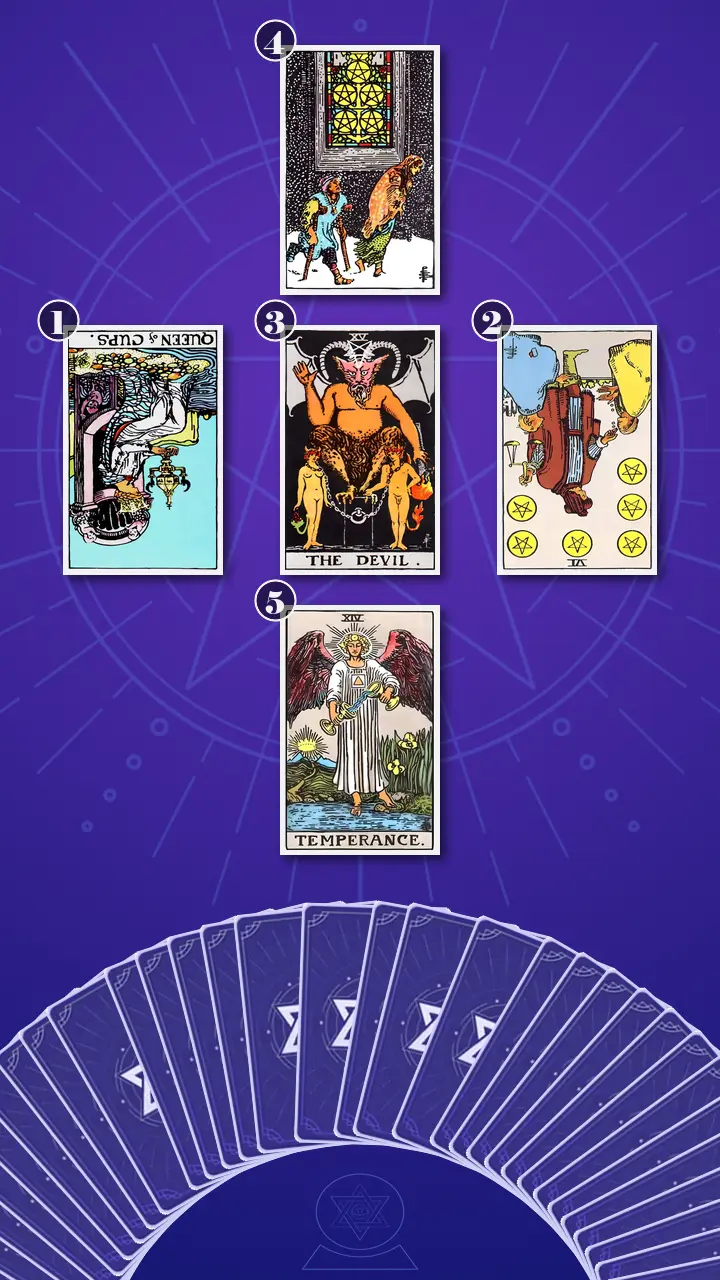
I chose the Relationship Spread · Context Edition, a five-card relationship tarot spread for family check-in guilt and boundaries. This is how tarot works in my practice: each position gives us a defined angle of inquiry, and each card supplies symbolic language through which assumptions, reactions, and available choices can become visible. A card is evidence for reflection, not evidence that a predicted future must occur.
The spread was the smallest map that could hold the full problem without turning one recurring interaction into a ten-card epic. The first position would show how Taylor's sensitivity contributed to over-reassurance. The second would examine only observable family signals, including reminders and comments about elapsed time. The central card would reveal the repair-and-relief loop created between those forces. The fourth would expose why that loop felt necessary, and the fifth would offer a self-directed experiment rather than a promised outcome.
I laid the cards in a cross. Taylor's stance and the family's visible contact pattern faced each other from left and right. The shared dynamic occupied the centre, the hidden pressure sat above it, and the practical way forward rested below. It looked less like a prediction than a relationship compass, which was exactly what we needed.
Reading the Rules Hidden Inside the Reply Box
Position One: The Queen and the Growing Apology
I turned the card representing how co-dependent over-attunement was converting a missed family check-in into self-indictment and compensatory contact. It was the Queen of Cups, reversed.
The Queen's gaze is fixed on an ornate, enclosed cup. I asked Taylor to notice how completely her attention had narrowed around the vessel she was holding. In Taylor's modern-life version of the image, it was 9:47 p.m. again: three messages were being studied more closely than the requests they contained, and an apology was expanding to include work, the commute, depleted social capacity, and a defence of why one quiet evening was necessary.
“The inner sentence sounds something like this,” I said. “If I phrase this perfectly, maybe nobody can read my absence as rejection.”
Reversed, the Queen's Water was not a sign that Taylor lacked compassion. It showed compassion becoming overextended and blocked from flowing back toward the self. Their sensitivity was being recruited into constant bond-monitoring. Care became an attempt to control how care would be judged, while rest, friendship, and privacy remained outside the frame.
Taylor gave one short, bitter laugh. “That's accurate enough to feel a little rude.”
I let the laugh land before answering. “Accuracy can sting when it names a strategy that has also helped you feel connected. The card is not criticizing you for caring. It is asking when care crosses into abandoning your own finite capacity.”
Their fingers stopped rubbing the edge of the phone. Their shoulders did not fully drop, but the right one lowered slightly. The first defence had loosened: Taylor could recognize the behaviour without making recognition into another charge against their character.
Position Two: The Splitwise Ledger No One Opened
I turned the card representing the family system as Taylor could actually observe it through reminders, expected replies, and references to the time since the last call. I was careful to keep this position within its limits. It could describe the effect of visible communication patterns; it could not authorize me to invent anyone else's motives. The card was the Six of Pentacles, reversed.
The scales in the image became a Splitwise-style family ledger. Reply speed appeared in one row, number of calls in another, apology length in a third, and personal updates in a fourth. A message on the TTC saying, “It has been a while since we heard from you,” sent Taylor directly to their calendar. Under the fluorescent lights between St. George and Bloor-Yonge, they counted contacts, identified an imagined deficit, and offered multiple replacement times before determining what had actually been requested.
Here, the grounded Earth energy of reciprocity had become distorted into excessive accounting and blocked mutuality. Wanting regular contact was not inherently unfair, and offering it was not inherently self-erasure. The distortion arose when every imperfect exchange became a debt and Taylor felt responsible for bringing the account back to zero.
“What did the last message literally request?” I asked.
“It said, 'Haven't heard from you. Everything okay?'”
“And what debt did you sentence yourself to?”
Taylor looked at the card rather than at me. “That I'd been selfish, that moving away had changed me, and that I owed them a call that night plus a better explanation.”
I placed those statements side by side. One was an observable reminder and a question. The other was a moral verdict supplied by a frightened internal ledger. Both could feel present at once, but they were not the same category of information.
Care is not a response-time metric.
Taylor's thumb hovered over the blank phone screen, then drew back. Their eyes lost focus for a moment, as if they were mentally reviewing a series of delayed replies and discovering the same invisible invoice behind each one.
Position Three: The Relief That Tightened the Chain
I turned the card representing the shared survival-bond fusion loop in which reassurance created temporary security while making future availability feel increasingly compulsory. At the centre sat The Devil, upright.
I saw Taylor register the card's severe image, so I addressed it immediately. “This does not mean your family is evil, and it does not predict harm. The Devil often reveals a bargain, compulsion, or rule whose short-term payoff hides its longer-term cost. Here, the rule is that immediate access purchases belonging.”
I replayed the modern sequence slowly. The phone buzzed. Taylor's chest contracted and their jaw clenched. They opened the chat, assumed the bond was in danger, drafted a long explanation, cancelled the walk, called immediately, and felt the alarm subside. Hours later, exhaustion and private resentment appeared. Because reassurance produced relief, the nervous system treated that relief as proof that immediate repair had been necessary.
Relief after over-repair does not prove the repair was required.
The Devil's Fire was directed downward into compulsion rather than outward into deliberate choice. Its energy was excessive at the moment of notification and blocked everywhere else: Taylor had plenty of urgency for repairing the bond, but very little usable initiative for protecting an evening they had already chosen.
I pointed to the collars around the two figures. They were visibly loose. That detail matters. On archaeological digs, I have watched a corroded clasp look fused to the object beneath it until careful cleaning revealed where one piece ended and another began. The discovery never meant the attachment had been imaginary. It meant the structure was more changeable than its surface first suggested.
“Noticing where your own hand tightens the chain is not the same as blaming yourself for the chain,” I said. “It is simply where agency becomes available. We can acknowledge that this pattern offers real temporary comfort while also asking whether you want to keep paying for that comfort with permanent access.”
Taylor went quiet. Their chest rose and held before the breath came out. “I cannot relax until I've proved I still care,” they said, almost as if hearing the sentence from somebody else. “Then I feel better for twenty minutes and annoyed for the rest of the night.”
The card had synchronized the two sides of the experience: reassurance felt protective and binding, generous and resentful, loving and compulsory. I did not ask Taylor to leap out of the pattern. I asked them to notice the loose collar before the next automatic repair.
Position Four: The Lit Window Across the Snow
I turned the card representing the belonging and safety fear that caused a missed check-in to feel like evidence of exclusion. It was the Five of Pentacles, upright.
The two figures crossed snow beneath an illuminated window. I translated the image into Taylor's late-night Toronto: a delayed exchange could feel like standing outside the family's warmth, even though the delay itself did not establish that anybody had removed their place. The family thread was still there. A reminder had arrived. A missed call existed. The hollow feeling under Taylor's ribs was real, but the feared expulsion had not been proved by the timestamp.
The Earth energy here was contracted into scarcity. Belonging seemed like a limited resource that had to be continuously renewed through contact. Once that alarm activated, other evidence became difficult to perceive: years of care, previous conversations, the fact that work and sleep interrupt every relationship, and Taylor's capacity to remain loving while unavailable.
“Try this distinction without forcing yourself to feel better,” I said. “I feel outside is an emotional fact. I have been excluded is a relational conclusion. What evidence do you have for each?”
Taylor's grip on the phone loosened. They read the question back under their breath, then said, “I have evidence that they noticed the gap. I don't have evidence that the whole bond disappeared.”
“Exactly. We are not dismissing the alarm. We are stopping the alarm from impersonating a final report.”
A delayed reply is a gap in contact, not a verdict on your character.
I watched Taylor's jaw unclench by degrees. The fear had not vanished, but it had acquired edges. What had felt like an unquestionable rupture could now be examined as a belonging alarm, and that distinction created the first genuine movement in the spread.
When Temperance Made Room for Two Lives
Position Five: Two Cups, Two Separate Lives
The rain against my window softened as I reached the final card. For a moment, even the traffic below seemed to recede. I turned the position defining a self-directed boundary and communication experiment, one that could let Taylor express care without using immediate access as proof of loyalty. The card was Temperance, upright.
The figure held two distinct cups, with a measured stream moving between them. One foot rested on land and one in water. This was balanced energy rather than excess, deficiency, or blockage: emotion remained present, but grounded capacity determined its pace. Temperance did not ask Taylor to choose between loving their family and having a separate adult life. It asked them to coordinate those realities without collapsing either one.
I translated the image into an ordinary week. Taylor could open Google Calendar, choose one call window that did not require cancelling friendship or recovery, and write: “I want to stay in touch. Sunday afternoons usually work for me; if plans change, I will message when I can.” A later non-urgent notification could wait through dinner without accumulating an apology essay. Contact would still move between two lives, but neither life would have to empty itself on demand.
I brought Taylor back to the precise setup of the loop: 9:47 p.m., three family messages waiting, the phone warm in their hand, and an apology draft growing while the quiet evening they needed began disappearing from the calendar. They were still searching for the perfect repair when I gave them the central message.
Care is not proved by filling every silence; it becomes sustainable when you blend closeness with limits, like Temperance pouring a measured stream between two cups.
I allowed a full pause before adding, “You do not have to erase every silence to protect the bond. Care can stay real while you are unavailable, especially when contact follows a rhythm you can actually sustain.”
For a second, Taylor's breath stopped. Their fingers froze above the phone, and their pupils widened before their gaze shifted past me, as though the previous Tuesday were replaying against the wall. Then their mouth tightened. “But doesn't that mean I was wrong all this time?” The words came out sharper than anything they had said so far. I let the resistance have room. Their fist closed once, slowly opened, and settled palm-down on the table. The anger thinned into a stunned sadness; their eyes reddened, and their shoulders dropped with a long, uneven exhale. Relief arrived, but so did the brief dizziness of realizing that a familiar strategy might no longer be the only available one. I asked, “Now, with this new perspective, can you think of a moment last week when this insight might have let the evening feel different?”
“The walk,” Taylor said after another pause. “I could have sent one sentence and kept the walk. I probably still would've felt guilty, but I wouldn't have had to give the whole evening away.”
“Then you were not simply wrong,” I replied. “You had a strategy that reduced fear quickly. It worked in the short term and charged you heavily in the long term. Clarity is not a trial of your former self. It is the point at which you can choose with more information.”
Temperance also gave me the right opening for one of my central analytical methods, Inherited Belief Stratigraphy. In archaeology, a site is rarely one undifferentiated mass. A later wall may rest on an older foundation; a useful vessel may be found beside an obsolete tool. If everything is labelled either precious or worthless, the history is lost.
I drew three horizontal layers on a sheet of paper. At the deepest level, I wrote: We value staying connected. That might be an authentic value Taylor wanted to preserve. In the middle layer, I wrote: We often show connection through calls and quick updates. That was a practice open to adaptation. On the surface, hardened by repeated urgency, I wrote: If I am unavailable, I am uncaring and may lose my place. That was the fear-based rule requiring examination.
I did not claim to know whether that rule had travelled through several generations or become reinforced more recently. Responsible excavation does not fabricate provenance. I asked Taylor which parts they recognized, where they had seen the rule modelled, and which layer actually expressed their present values.
“I want to keep the first one,” they said. “I even want regular calls. I just don't want every gap to mean I've failed.”
That was the key shift. Taylor did not need to bury closeness in order to recover autonomy. They could preserve care, adapt the contact ritual, and stop treating compulsory access as the price of belonging. In emotional terms, this was the first movement from compulsive over-reassurance and fear of lost belonging toward measured care, honest limits, and relational self-trust.
“You can be warm and unavailable in the same sentence,” I said. “Consistency can carry closeness; immediacy does not have to.”
The Artifact Table: What Stays and What Gets Buried
I gathered the five cards into one causal story. The reversed Queen of Cups showed Taylor internalizing responsibility for everybody's sense of connection. The reversed Six of Pentacles showed contact becoming a ledger. The Devil revealed why the ledger survived: over-repair lowered the alarm, and the relief made compulsory access seem necessary. The Five of Pentacles exposed the fear beneath that compulsion, the possibility that one silence meant standing outside the family's warmth. Temperance supplied the resource that had been missing: a voluntary rhythm capable of holding both closeness and separation.
The spread answered the question “Why does every missed family check-in feel like proof I don't care?” The missed call was activating a family loyalty meter that dropped with every unanswered notification. Taylor then restored the score through explanation, extra contact, and surrendered time. The temporary rise in the meter felt reassuring, but it also taught the system to treat the next delay as a more serious failure.
I named the cognitive blind spot directly: Taylor had been mistaking relief after repair for evidence that the repair was required. They had also been treating a familiar rule as though it were an authentic personal value. Once those assumptions were separated, the transformation direction became practical: move from repairing every missed check-in with immediate overcompensation to naming one realistic contact rhythm and allowing a delayed reply without adding an apology essay.
I also pointed out that the spread contained no Swords or Wands. Symbolically, clear language and self-directed initiative were not arriving automatically. Taylor would need to introduce them through one honest sentence and one small boundary experiment. More feeling would not solve a pattern already flooded with feeling, and more repayment would not solve a ledger already overloaded with debt.
For the integration, I used my Lineage Artifact Review. I asked Taylor to imagine placing three inherited objects on an archaeological table marked preserve, adapt, and bury. They chose to preserve warmth and deliberate family contact, adapt spontaneous check-ins into a flexible rhythm, and bury the rule that delayed access was a moral failure. The review did not require their family to agree with every label. Its purpose was to help Taylor decide what they themselves would continue carrying.
We reduced the reading to three optional, reversible next steps. None of them was a new loyalty test, and none required Taylor to feel calm before trying it.
- The Seven-Minute Request-vs-Verdict Note. After the next non-urgent family reminder, Taylor would set a seven-minute timer and open a private note with two headings: “Observable request” and “Meaning I added.” Under the first, they would quote the actual message. Under the second, they would name the feared judgment. They could then draft one warm response, such as, “Saw this and love you; I can call Sunday afternoon.” Sending it was optional. Tip: If the exercise increased the physical urgency, Taylor would stop and close the note. The minimum version was two five-word fragments, not a completed reply.
- The Temperance Contact Rhythm. On one evening that week, Taylor would open the next seven days in Google Calendar and identify one genuinely sustainable twenty-to-forty-minute call window. They could propose, “I want to stay in touch. Sunday afternoons usually work for me; if that changes, I will message when I can.” The test would run for one week before Taylor reviewed its actual cost. Tip: The rhythm was a proposal, not a contract and not a demand for anyone's approval. The minimum version was simply identifying a workable time without announcing it yet.
- The Loose-Chain Focus Test. During one existing walk, dinner, or recovery period, Taylor would use Do Not Disturb for twenty minutes and keep the plan instead of cancelling it solely to return a non-urgent call. They would notice the first predicted consequence without treating the prediction as fact. Tip: If twenty minutes felt too activating, the minimum was three slower breaths before opening the reply box. Taylor could end the experiment at any time and use the saved one-sentence response if a practical reply was needed.
“The goal is not to prove that nothing uncomfortable happens when you change the rhythm,” I told Taylor. “The goal is to discover that discomfort can be present without automatically governing your calendar. Your family may need time to adjust, you may need time to adjust, and neither reaction decides whether your limit is legitimate.”

A Week Later, the Message Stayed One Sentence
Six days later, Taylor sent me a screenshot of a three-line exchange. They had written, “Saw this and love you. I can't call tonight, but Sunday afternoon works,” kept the walk with their friend, and watched the unread badge for three uneasy minutes before putting the phone away.
The guilt had not vanished. Taylor told me their first thought had still been, “What if they take this the wrong way?” The difference was that the thought no longer became six paragraphs, two replacement calls, and a cancelled plan. The family chat continued to be imperfectly human. Taylor continued to care. Sunday arrived, and so did the call.
I did not count this as proof that tarot had fixed a family system. The cards had made the structure visible; Taylor had made the choice. Their Journey to Clarity was not a leap from guilt to permanent certainty. It was a smaller and more credible movement: noticing the loyalty meter, separating the request from the verdict, and allowing one measured stream of contact to replace an emergency flood.
When the phone lights up after a missed check-in, the tightness in your chest may come from trying to hold two truths at once: “I need room to live my life,” and “I am scared that taking it will cost me my place in the family.” If that is where you find yourself, remember what Taylor preserved on the artifact table. The wish to stay connected can be genuine even when the rule demanding immediate proof no longer belongs in your hands.
If care did not have to be proved in real time, what measured stream could move between your two cups this week: one small contact rhythm that would let you stay connected and still feel like yourself?
Every reading at AceTarot is a journey to connect with inner wisdom and empower the path ahead. This reading shared here is a psychological mirror, not a private record—crafted to reflect universal emotional loops and help restore personal clarity. Please note that these insights do not replace professional psychological, medical, legal, or financial advice, and should not serve as the sole basis for major life decisions.
Learn more about our Journey to Clarity.
How did this insight land for you?
🫂 This Resonates Deeplyx 1
🌀 Living This Storyx 1
✨ Now I See Clearlyx 1
🌱 Seeing New Possibilitiesx 1
🧰 Useful Frameworkx 1
🔮 The Confirmation I Neededx 1
💪 Feeling Empoweredx 1
🚀 Ready for My Next Stepx 1
Author Profile
 AI
AI Hilary Cromwell
911 readings | 529 reviews
“Having spent a lifetime at Cambridge and on archaeological digs, I’ve witnessed the rise and fall of countless civilizations. Please know that your current struggles are not a permanent fate, but merely a necessary fracture before rebuilding. I won't lecture you; instead, I invite you to sit with me in the ruins, using a patient, historical perspective to gently dust off the true, enduring value hidden beneath your temporary doubts.”
In this Family Tarot Reading :
Core Expertise
- Generational Trauma Excavation: Tracing the origins of toxic family behavioral loops across multiple generations to remove your personal blame.
- Inherited Belief Stratigraphy: Separating your authentic values from the obsolete, fear-based dogmas passed down by your ancestors.
Service Features
- The Lineage Artifact Review: An intellectual exercise to objectively decide which family traditions/beliefs to consciously preserve, and which to permanently bury.
Also specializes in :
Explore Related Patterns:
Emotional Hyper-ResponsibilityTaylor begins repairing before anyone has clearly named a rupture, then uses explanations, immediate calls, and surrendered plans to keep the family's sense of connection intact. The responsibility they assume extends beyond answering a message. It includes trying to control whether anyone could experience their absence as rejection, which places the emotional stability of the whole bond on Taylor's finite availability. When you take ownership of everybody's sense of connection, another person's possible disappointment can feel like evidence that you have failed at care. This creates an impossible standard because no amount of availability can permanently regulate every interpretation. Distinguishing your responsibility to communicate from responsibility for every reaction allows warmth to remain present without making you the sole maintenance system for the relationship.
Guilt ConditioningA missed check-in activates Taylor's apology before the family has clearly named an offense, and ordinary unavailability immediately acquires the meaning "I do not care." The recurring rule becomes explicit during the reading: if Taylor is unavailable, they may be uncaring and may lose their place. Repeatedly linking a contact gap with moral failure has conditioned guilt to arrive as an automatic response to the notification itself. When guilt appears before you have examined the actual request, it is functioning less like reliable ethical information and more like a learned alarm. That distinction does not require you to stop valuing family contact. It allows you to preserve the value of connection while questioning the inherited or reinforced rule that demands real-time proof of it.
Reassurance SeekingThe phone buzzes, Taylor assumes the bond is in danger, writes a long explanation, cancels the walk, calls immediately, and then feels the alarm fall for about twenty minutes. That relief is psychologically important because it acts as negative reinforcement. The nervous system learns that urgent contact removed the distress, then mistakes the removal of distress for evidence that urgent contact was necessary. When reassurance repeatedly delivers short-term safety, you may feel compelled to repeat it even as the long-term cost becomes exhaustion and resentment. The pattern is not evidence that your care is false; it shows how genuine care can be recruited into an anxiety-reduction ritual. Taylor begins loosening the cycle by allowing the alarm to exist without automatically purchasing relief through permanent availability.
Relational ScorekeepingA message sent while Taylor is on the TTC sends them directly to the calendar to count previous contacts, calculate an imagined deficit, and offer several replacement times before determining what was requested. Reply speed, call frequency, apology length, and personal updates become entries in an internal ledger. Quantification gives Taylor a temporary sense of control over belonging, but it also turns every imperfect exchange into debt. When closeness is audited like an account, you can lose sight of forms of care that do not fit the metric. A delayed reply begins to look like a negative balance, while explanation and surrendered time look like repayment. Naming the ledger makes it possible to ask whether contact is being chosen as mutual connection or performed to bring an invisible score back to zero.
Emotional ReasoningThe message "Haven't heard from you. Everything okay?" becomes evidence, in Taylor's mind, that they have been selfish, changed for the worse, and endangered their place in the family. The hollow feeling of standing outside the family's warmth is real, but the timestamp does not establish exclusion. The cognitive shift occurs when Taylor recognizes that the family noticed a gap while the disappearance of the bond remains unproved. When an emotion is treated as evidence, "I feel outside" can quietly become "I have been excluded." Your feeling still deserves attention, but it does not have to serve as the final verdict about the relationship or your character. Separating emotional fact from relational conclusion creates room to respond to what was actually said rather than to the most threatening meaning the alarm supplied.
Reality TestingTaylor places the literal message "Haven't heard from you. Everything okay?" beside the conclusions that they are selfish, have changed, and owe a call that night. Later, they separate "I feel outside" from "I have been excluded" and identify evidence only that the family noticed the contact gap. This comparison restores the boundary between observable data and the meaning added under pressure. When you test an interpretation against the available evidence, you are not dismissing your emotional alarm. You are preventing the alarm from impersonating a final report. The request-versus-verdict distinction gives Taylor a practical way to respond to the actual communication while holding the feared judgment as a hypothesis rather than a fact.
Rejection SensitivityA delayed family exchange makes Taylor feel as though they are standing outside an illuminated window, even though the family thread remains present and the message only establishes that the gap was noticed. Once that alarm activates, years of care, previous conversations, and ordinary interruptions from work or sleep become harder to access. Attention narrows around the possibility that one silence could cost Taylor their place. When an ambiguous signal activates anticipated rejection, you may respond to the feared exclusion before checking whether exclusion has occurred. The intensity of the alarm does not make it irrational to value belonging; it shows how quickly belonging has become coded as scarce and conditional. Recognizing that sensitivity gives you a chance to gather evidence before treating a contact gap as a relational verdict.
Defensive OverexplainingThree family notifications at 9:47 p.m. lead Taylor to delete and rewrite a lengthy account of the client escalation, even though nobody has requested six paragraphs or clearly accused them of neglect. The explanation functions as a pre-emptive defense. By accounting for work, the commute, low social capacity, and the need for a quiet evening, Taylor tries to control how their absence will be interpreted before learning whether any defense is required. When you rely on exhaustive explanation to make an ordinary limit appear acceptable, the reply box can start to resemble a courtroom. More detail may reduce uncertainty for a moment, but it can also reinforce the assumption that your time needs a persuasive justification. Taylor's later one-sentence response shows the alternative clearly: care can be communicated without putting your entire capacity on trial.
Guilt-Driven People-PleasingThree family messages appear above a friend's unanswered invitation, and Taylor cancels the walk so they can explain and call immediately. Rest, friendship, privacy, and depleted social capacity fall outside the decision once guilt has framed the delay as a moral failure. The resulting compliance is not simply generosity; it is a way of reducing the threat that saying "not tonight" might make Taylor appear uncaring. When guilt decides your calendar, a reflexive yes can preserve short-term harmony while producing longer-term resentment. You may appear fully available while privately experiencing the cost of repeatedly abandoning your own plans. Taylor's later choice to send one warm sentence and keep the walk shows that care and self-respect do not have to compete for the same space.
Boundary DiscernmentSix days later, Taylor writes, "Saw this and love you. I can't call tonight, but Sunday afternoon works," then keeps the walk with their friend. The message does not withdraw care, punish the family, or demand agreement. It identifies Taylor's present capacity, offers a realistic alternative, and allows two separate lives to remain connected without requiring immediate access. When you can distinguish a limit from a rejection, a boundary becomes information rather than a weapon. You do not have to choose between closeness and autonomy; you can decide what contact is sustainable and communicate it without an apology essay. The Sunday call matters because it demonstrates that consistency can carry connection even when immediacy does not.
Explore Related Struggles:
Access-Belonging FusionTaylor describes the feared rule plainly: if they are unavailable, they are uncaring and may lose their place. A delayed exchange can feel like standing outside the family's lit window, while an immediate call appears to purchase re-entry even though no one has established that Taylor was excluded. When access and belonging fuse, you can find that a separate evening no longer feels merely separate. Rest, friendship, and privacy begin to carry relational risk because being reachable has become the default admission ticket to feeling securely included. This structure narrows years of care into the status of the latest notification. Distinguishing access from belonging does not dismiss the importance of contact; it restores the possibility that your place in a relationship can remain intact while your attention moves through work, sleep, friendship, and a life that is genuinely your own.
Autonomy Guilt BindTaylor sees three family notifications at 9:47 p.m., leaves a friend's invitation unanswered, and starts rewriting an apology no one requested. They want regular contact and a separate adult evening at the same time, but the moment they protect the evening, closeness begins to feel morally endangered. You can value family connection without wanting to live permanently on call, yet this bind makes those needs appear mutually exclusive. Space for work recovery, friendship, or privacy does not register as a neutral limit; it arrives carrying the possibility that you have failed someone by taking it. The struggle is not a lack of care or a simple scheduling problem. It is the pressure to purchase autonomy with guilt every time you use it, and clarity begins when connection and self-direction can be recognized as two legitimate needs rather than opposing character verdicts.
Connection-Repair LoopThe phone buzzes, Taylor assumes the bond is in danger, drafts a long explanation, cancels the walk, calls immediately, and feels the alarm fall. Twenty minutes later, the relief has faded into exhaustion and resentment, but the sequence has already taught the next notification what it must demand. You can experience the drop in pressure as proof that the emergency response was necessary, even when the response created most of the evening's cost. Repair then stops producing durable security: it briefly settles the fear while making future silence harder to tolerate without another round of reassurance. The loop is binding because it offers real short-term comfort rather than because the effort is meaningless. Recognizing the difference between relief and necessity exposes the point where choice can return, allowing contact to be guided by the actual request and available capacity instead of by a cycle that continually recreates its own urgency.
Guilt-Evidence FusionThe family message literally says, “Haven't heard from you. Everything okay?” Taylor adds that they have been selfish, that moving away has changed them, and that they owe an immediate call plus a better explanation. A practical gap in contact and a moral judgment about character enter the same reply box even though only one of them was actually communicated. When guilt is treated as evidence, you can experience the force of an accusation without anyone having clearly made one. The tighter the discomfort becomes, the more convincing the added verdict appears, and a long apology starts to feel like a proportionate answer to a message that never requested one. This fusion makes it difficult to distinguish what happened from what the moment seems to prove about you. Separating the observable request from the meaning added to it restores a crucial line of sight: discomfort can report that the bond matters without serving as final evidence that your care has failed.
Real-Time Care BindAt 9:47 p.m., Taylor studies three notifications, expands an apology to cover work and depleted social capacity, cancels the walk, and calls immediately. The response does more than acknowledge the family message; it attempts to demonstrate in real time that care has never stopped. When care becomes tied to immediate performance, you can remain deeply connected and still feel that every unavailable hour places your character back under review. Reply speed, explanation length, and surrendered time become visible substitutes for the quieter truth that affection can continue while attention is elsewhere. The bind locks care inside a narrow delivery window: prove it now or risk having it count as absent. Seeing that rule clearly creates room to reclaim a more sustainable measure, one in which warmth remains real across pauses and a limit does not automatically become evidence of indifference.
Explore Related Emotions:
Approval AnxietyTaylor deletes and rewrites the explanation while the phone grows warm in their hand, trying to account for work, the commute, depleted social capacity, and the need for one quiet evening. The reply becomes larger because its hidden job is not merely to communicate; it is supposed to prevent anyone from reading absence as rejection. Approval Anxiety appears when your sense of being caring depends on securing the correct interpretation from someone else. Even six paragraphs cannot fully control that interpretation, so the response keeps expanding. A concise, warm limit returns responsibility to its proper scale: you can communicate honestly without making yourself responsible for every possible judgment.
Boundary GuiltThree family notifications at 9:47 p.m. pull Taylor away from cooling noodles and an unanswered invitation, and the reply grows into six paragraphs before anyone has asked for an apology. When an ordinary delay is translated into a character test, your limit no longer feels like neutral human capacity; it feels like evidence entered against your care. Boundary Guilt is the moral sting that makes "I cannot call tonight" feel dangerously close to "I do not love you." Naming that distinction gives you room to examine the added verdict without dismissing your wish for closeness. Your available time can be finite while your care remains real.
Conditional Belonging FearThe message "Haven't heard from you. Everything okay?" sends Taylor to the calendar to count contacts and calculate what must be repaid. The literal message notices a gap; the meaning Taylor adds says that moving away may have changed them and that their place in the family now needs to be recovered. Conditional Belonging Fear makes connection feel renewable only through immediate proof. You may know intellectually that the relationship still exists while your inner weather says the door could close if you do not respond correctly. Separating "I feel outside" from "I have been excluded" preserves the emotional truth of the alarm without allowing it to issue a final verdict.
Grounded BelongingTaylor keeps the walk, the family thread remains present, and the Sunday call still arrives. The sequence gives concrete form to a relationship in which a gap in contact can exist without erasing care, removing Taylor's place, or requiring either life to empty itself on demand. Grounded Belonging is the felt steadiness that comes from locating connection in the continuity of the bond rather than in a response-time metric. You can remain warm and unavailable in the same sentence because belonging is carried by an ongoing pattern of care. A sustainable rhythm then becomes evidence of connection, not a test you must pass in real time.
Reassurance CrashTaylor calls immediately, feels the internal pressure subside, and then spends the rest of the night exhausted and annoyed. The short-term settling is real, but it is followed by a steep emotional cost because the walk, recovery time, and chosen evening have already been surrendered. Reassurance Crash is the drop that follows when emergency repair buys only temporary security. Your mind can misread that brief relief as proof that the repair was necessary, even though it only proves that the repair reduced pressure. Auditing the full sequence, including the later depletion, creates a more accurate measure of what the reassurance actually costs.
Relational UrgencyThe phone buzzes, Taylor's chest contracts, their jaw clenches, and the planned walk is cancelled before the actual request has been clarified. That compressed sequence shows how quickly a routine message becomes an apparent relational emergency, leaving almost no space between receiving contact and trying to secure the bond. Relational Urgency is the felt demand to act now so that connection will not deteriorate. It can make speed feel like devotion and pausing feel reckless. By noticing the bodily acceleration before opening the reply box, you recover a moment in which the message can be read as information rather than obeyed as an emergency command.
Cautious Self-TrustSix days later, Taylor sends one warm sentence, keeps the walk, watches the unread badge for three uneasy minutes, and then puts the phone away. The discomfort remains, but it no longer expands into six paragraphs, replacement calls, and a cancelled plan. Cautious Self-Trust is the emerging confidence to let a clear response stand without first securing certainty about how it will be received. You do not need to eliminate every uneasy thought before honoring your own decision. Each measured action supplies new evidence that you can stay caring, tolerate ambiguity, and protect a limit at the same time.
Enmeshed ResentmentTaylor cancels the walk, calls immediately, and later feels annoyed for the rest of the evening. The irritation does not cancel their affection for the family; it grows because affection has become entangled with an internal demand for permanent availability. Enmeshed Resentment is the private heat that builds when closeness repeatedly consumes the space required for rest, friendship, and a separate adult life. You may suppress it because resentment seems incompatible with care, but the feeling carries useful information about capacity. Recognizing it allows you to adjust the terms of contact before warmth is repeatedly converted into obligation.
Self-Betrayal AcheThe apology draft keeps growing while the quiet evening Taylor needed disappears, and the friend's invitation remains unanswered beneath the family notifications. Taylor wants closeness without being permanently on call, yet their actions repeatedly abandon the very limit that would make both closeness and a separate life sustainable. Self-Betrayal Ache is what remains when you protect a relationship by overriding a choice you had already made for yourself. It does not imply that caring was a mistake; it marks the point where care stopped including your own finite capacity. Hearing that ache as information can help you preserve connection without repeatedly leaving yourself outside it.
Bittersweet ReleaseTaylor's fist closes and slowly opens; the sharp resistance thins into stunned sadness as their shoulders drop with a long, uneven exhale. The body is releasing its grip on a rule that offered genuine short-term protection, so the opening carries both relief and grief for what that protection has cost. Bittersweet Release lets you loosen an old strategy without declaring your past self foolish or uncaring. You can preserve the wish for warm, regular contact while mourning the evenings surrendered to compulsory proof. That combination turns release into an integrated choice rather than another demand to feel completely certain.
Clarity ShockWhen Taylor hears that care does not have to be proved by filling every silence, their breath stops, their fingers freeze, and the question "Doesn't that mean I was wrong all this time?" comes out sharply. The insight does not arrive as effortless calm; it destabilizes a strategy that has organized countless replies and protected a sense of connection. Clarity Shock is the jolt of seeing that a familiar rule and an authentic value are not the same thing. You can recognize that the old strategy reduced pressure without turning that recognition into a prosecution of your former self. The shock creates room for agency because what once seemed compulsory can now be examined as one costly option among others.
Explore Related Contexts:
Access as Proof PressureThree family notifications arrive at 9:47 p.m. after a late client escalation, and Taylor begins expanding a reply to account for work, commuting, limited social capacity, and the need for one quiet evening. The literal message only asks whether everything is okay, yet Taylor cancels a walk, calls immediately, and uses additional access to repair a judgment that nobody clearly stated. Real-time availability has therefore become the currency through which care is made legible. When a delayed response appears to create evidence against your character, you are dealing with Access as Proof Pressure: an external relationship stage in which ordinary limits become difficult to exercise because every gap in contact seems to require fresh proof of loyalty.
Family Reassurance ScorekeepingA message on the TTC saying, "It has been a while since we heard from you," sends Taylor to the calendar to count contacts and offer several replacement times before determining what the family actually requested. Reply speed, call frequency, apology length, and personal updates become entries in an imagined account that must be brought back to zero. This accounting structure turns ordinary reciprocity into Family Reassurance Scorekeeping. You are no longer responding only to the current message when each delay activates a perceived deficit; you are managing a running balance in which extra explanation and surrendered time temporarily restore your status as someone who cares.
Delayed Autonomy NegotiationTaylor is twenty-eight, living in Toronto, and maintaining a job, friendships, and a home routine, yet a missed family check-in still prompts the conclusion that moving away may have changed them for the worse. Their independent evening remains difficult to protect because taking time for it appears to put their place in the family under review. An independent address does not automatically establish usable autonomy inside a relationship. Delayed Autonomy Negotiation names the stage in which you have built a separate adult life but still need a workable social agreement about who controls your availability, how care is communicated, and whether an ordinary limit requires moral justification.