Finding Clarity in the Central Line Text
I meet a lot of high-functioning people in their late 20s and early 30s—London professionals who can run a roadmap workshop, ship features, handle stakeholders—yet one “I’m disappointed” from Dad turns their nervous system into a 12-tab browser of shame and contingency plans. Jordan said it like she hated how true it was: “I hate how fast I turn into a kid when he says that.”
She’d booked me after a Thursday commute that went sideways emotionally. 6:12 p.m. on the Central line heading east: carriage swaying, someone’s headphones leaking tinny bass, grey daylight flattening everyone’s faces. Her phone lit up with a single word from her dad—Disappointed. No context. No specifics. Just that.
Jordan told me her stomach dropped so fast it felt like missing a step on the stairs. Her thumb hovered over WhatsApp, typing “I didn’t mean—” then deleting it. Typing again. Deleting again. She could feel her throat tighten like she was swallowing a stone; her jaw locked the way it does right before you try not to cry in public.
“The worst part,” she said, staring at the table between us like it had the answer, “is I don’t even know what he wanted from me. But I’m already writing an essay to fix it.”
I nodded, not as a performance of empathy, but because I recognize that exact body math: the way shame turns your chest into a too-tight jumper. “Okay,” I said gently. “Let’s not make you improvise in the middle of an emotional fire alarm. We’re going to map the loop—so you can hear his disappointment without treating it like a verdict on your worth.”

Choosing the Compass: The Celtic Cross · Context Edition
I asked Jordan to take one slow inhale, then an exhale that was just a second longer than the inhale—enough to give her nervous system a tiny signal of we’re safe enough to look. While she did that, I shuffled slowly. Not for mystique. For focus. A clean transition from “reliving the text” to “observing the pattern.”
“Today,” I said, “we’ll use a spread called the Celtic Cross · Context Edition.”
For readers who wonder how tarot works in a practical way: I like this structure for family-trigger loops because it separates the visible trigger-response (what you do right after the sentence lands) from the deeper imprint (the old belief underneath), and then it shows a workable path of change that isn’t about predicting your dad’s next move. It’s about finding clarity and building actionable advice you can try in real life.
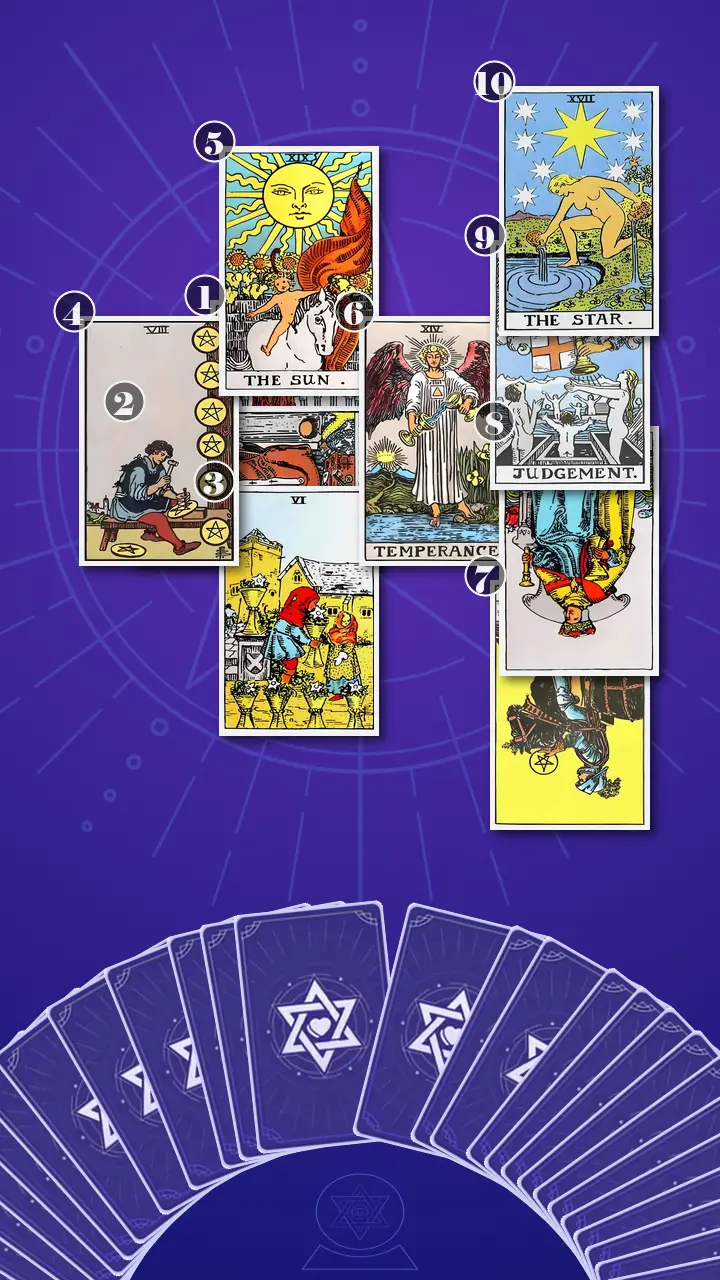
I told Jordan what to expect: “Card one is the immediate reaction pattern. Card two is the block—the thing that keeps the loop running. Card three and four take us into the older conditioning. And there’s a card near the right side—position six—that’s your next experiment. Not a grand transformation. A near-term shift you can actually do.”
Reading the Map: The Loop in Card Meanings, in Context
Position 1: The immediate reaction pattern
“Now we turn over the card that represents the immediate reaction pattern: what you do right after hearing ‘I’m disappointed.’”
Eight of Swords, upright.
I watched Jordan’s eyes land on the blindfolded figure ringed by swords. “Right after Dad says it,” I said, “your options collapse into two: defend yourself with a detailed explanation, or go quiet and accept being ‘the problem.’ You stare at your phone, chest tight, and your mind starts generating scripts like a crisis comms plan—except the crisis is your worth.”
This is Air energy in blockage form: thought loops that feel like “research,” but actually tighten the cage. The Eight of Swords is a perceived no-win—like being stuck in a pop-up modal with only two buttons: Explain Yourself or Accept Guilt, and no obvious X in the corner.
Jordan let out a short laugh that didn’t reach her face. “That’s… so accurate it’s kind of brutal,” she said. Her shoulders rose as if she was bracing for impact, then dropped half a centimetre, like her body was relieved to be understood.
Position 2: The core block
“Now we turn over the card that represents the core block: what keeps the approval loop running in the moment.”
The Hierophant, reversed.
“This,” I said, tapping the edge of the card lightly, “is the internal rulebook. The thing keeping the loop running isn’t the single sentence—it’s the inherited logic that activates instantly: good daughter = approved, competent adult = praised.”
Reversed, The Hierophant shows authority energy that’s gone rigid and outdated—like you’re still trying to pass an old compliance checklist for a company you don’t even work for anymore. His disappointment lands like you violated doctrine, so you scramble to get back into compliance instead of checking what you actually believe.
I kept my voice clear and direct. “That’s not a conversation—you’re in a performance review you didn’t consent to.”
Jordan’s hand moved to her throat without her noticing. She pressed her thumb under her jaw, as if she could physically hold the words in.
Position 3: The old imprint underneath
“Now we turn over the card that represents the old imprint underneath: the unconscious belief that gets activated.”
Six of Cups, upright.
“A younger part of you,” I said, “still believes closeness is earned by being sweet, impressive, and easy to approve of. When he’s disappointed, it doesn’t feel like adult feedback—it feels like warmth got taken away, and your system reaches for the old way to get it back.”
This is Water energy in attachment form—tender, sticky. The Six of Cups isn’t accusing you of being childish. It’s naming why the reaction is so fast. Your nervous system is reacting to the memory of what “being good” used to buy you: peace, attention, predictability.
Jordan stared at the card, blinking slowly. “I used to bring home good grades like… offerings,” she said, then immediately looked embarrassed, like she’d overshared. I shook my head. “That makes sense,” I said. “It’s a strategy that worked.”
Position 4: The earlier conditioning
“Now we turn over the card that represents the earlier conditioning: the pattern you learned about love, praise, and performance.”
Eight of Pentacles, upright.
“You learned that effort equals safety,” I said. “So after a hard call, you soothe yourself by producing: staying late, polishing, stacking achievements like receipts. It’s not ambition—it’s emotional regulation through work, because excellence used to reduce the chance of being criticised.”
This is Earth energy in excess: steady craft becoming self-punishment. I’ve seen this in product teams and in families—when your work ethic becomes a way to manage someone else’s mood. Jordan’s face tightened like she’d been caught on CCTV. “I literally did that last night,” she said. “I polished a deck that was already fine.”
I thought of my own radio studio days—how you can’t fix a distorted vocal by turning the volume up. You have to change the mix. “Same principle here,” I said. “More output won’t resolve an emotional distortion.”
Position 5: The conscious goal
“Now we turn over the card that represents the conscious goal: what you think will make you feel okay again.”
The Sun, upright.
Jordan’s eyes softened at the bright image—like her body remembered what warmth feels like. “What you consciously want isn’t perfection,” I said. “It’s uncomplicated warmth. You want the version of the relationship where you can share your life and hear a simple ‘I’m proud of you’ that lets your body unclench and your mind stop bargaining.”
I held her gaze for a beat. “Wanting your dad to be proud of you is tender—not childish.”
The Sun is Fire in balance: visibility, being seen. The risk, as this spread is showing, is outsourcing your inner light to someone else’s mood.
When Temperance Lowered the Volume
Position 6: The next experiment
I took a breath before turning the next card. The room felt quieter, like even the traffic outside had decided to listen.
“Now we turn over the card that represents the next experiment: a near-term inner move that disrupts the loop without escalating conflict.”
Temperance, upright.
“This is the pause that creates choice,” I said. “You acknowledge his feeling without turning it into a trial: one breath, one clarifying question, one boundary sentence. You let his disappointment exist without immediately paying it off with proof.”
Then I brought in my own lens—my signature way of diagnosing relational energy through sound. “Jordan, can I use a music therapy framework for a second?” I asked. She nodded, wary but curious.
“One of my tools is something I call Generational Echo,” I said. “In families, certain phrases function like a recurring hook in a song. ‘I’m disappointed’ isn’t just information—it’s a sample that’s been looped for years. When it plays, your system jumps into the same old verse: prove, soothe, perform. Temperance is you becoming the sound engineer. Not muting him. Not blasting your résumé. Adjusting the mix so you can hear his feeling without it swallowing your self-respect.”
I watched Jordan’s face go still in a three-beat sequence: (1) her breath paused—tiny freeze; (2) her eyes unfocused as if she was replaying old scenes like a playlist; (3) her shoulders dropped with a shaky exhale that sounded like relief and grief at the same time.
Stop treating his disappointment as a verdict, start practicing the slow alchemy of Temperance—one paused breath and one clear sentence at a time.
Jordan swallowed hard. In that moment, she was exactly in the setup I see so often: trapped in the instant shame spike—tight throat, clenched jaw, stomach drop—like she’d just been handed a grade she didn’t study for, and the only way to survive was to argue the marking scheme.
Her reaction wasn’t clean relief. It was complicated. She blinked fast, then frowned—angry for a second. “But if I don’t explain,” she said, voice sharper, “doesn’t that mean I’m just… letting him think I’m failing?”
I didn’t rush to soothe that. I respected it. “It means you’re refusing to put your worth on a live debate,” I said. “Respecting his feelings doesn’t require surrendering your self-trust.”
I leaned in slightly, keeping it practical. “Try this once within the next 7 days: when you feel the urge to send the long explanation, set a timer for 90 seconds. In that time, do only two things: (1) exhale slowly five times, (2) write one sentence that asks for specifics. Then stop. You can choose to send it or not—either way, you just practiced not turning your worth into a live debate.”
Jordan’s eyes went glassy, then steadier. Her jaw unclenched in a way you can almost hear. She stared at Temperance again, and her voice dropped. “Last week,” she said quietly, “he said it on a call and I started listing everything I’d done at work like I was reading a PRD. I could’ve just… asked what he meant.”
“Exactly,” I said. “Now, with this new lens—think back. Is there a moment in the last week where one paused breath and one clear sentence would’ve changed how your body felt?”
That was the shift: not from conflict to harmony, but from shame-driven performance to self-led response. A real step on the journey from “I can’t trust myself” toward steadier self-respect.
The Ladder Up: From Judgement to a Quieter Star
Position 7: Your role in the cycle
“Now we turn over the card that represents your role in the cycle: the identity you step into when seeking approval.”
Knight of Pentacles, reversed.
“In this loop,” I said, “you become ‘the responsible one’ so hard that it turns into a cage. You keep grinding because it feels like the best defence against disapproval. But reversed, this is Earth energy in stagnation—duty without movement.”
Jordan nodded once, sharp. “I call it being practical,” she said. “But it’s… fear.”
Position 8: The relational environment
“Now we turn over the card that represents the relational environment: the family emotional climate and how it impacts your nervous system.”
King of Cups, reversed.
“This is mood-as-authority,” I said. “Feelings are powerful but not clear. ‘I’m disappointed’ arrives heavy and vague, and you end up managing his mood—softening your voice, offering fixes—because the unspoken pressure feels like it sets the rules of the room.”
Water energy here is in distortion: emotion without clarity becomes pressure. Jordan’s lips pressed into a line. “It’s the vagueness,” she said. “If he told me what it was, I could… do something.”
“Or,” I said gently, “you could decide what’s yours to do.”
Position 9: The deep pull
“Now we turn over the card that represents the deep pull: the hope and fear that keeps you hooked to his verdict.”
Judgement, upright.
I felt Jordan go still again, but this time softer. “Judgement is the fantasy of a final ruling,” I said. “Cleared and you can relax. Condemned and you must work harder. And this card is the wake-up call that the real court is inside you now—you’re not waiting for his sentencing; you’re rehearsing your own.”
As I said it, I could see her mind doing what so many minds do after a hard family call: re-reading the transcript in her head like a case file, checking tone the way she’d rewrite a Slack message five times so it couldn’t be criticised.
“Is this feedback,” I asked, “or is this an old court?”
She exhaled through her nose—quiet, almost a laugh. “Old court,” she said.
Position 10: Integration outcome
“Now we turn over the card that represents the integration outcome: what changes internally if you practice the shift consistently.”
The Star, upright.
“This is the part people underestimate,” I said. “The Star isn’t fireworks. It’s recovery. It’s you building a quiet inner steadiness—self-trust that doesn’t require him to be in a good mood for you to feel okay.”
The Star is healing energy in balance: practical grounding and emotional replenishment, held in two steady hands. “Your worth isn’t produced,” I said. “It’s practiced.”
Clarity First. Résumé Later (If at All)
I summarised the story the spread told us: the trigger (“I’m disappointed”) blindsides Jordan into a mental cage (Eight of Swords), and the cage is built from an inherited rubric she never agreed to (Hierophant reversed). Underneath is a younger part that learned closeness through being good (Six of Cups), reinforced by a very effective coping method—excellence as anesthesia (Eight of Pentacles). Consciously, she wants warmth and visibility (The Sun), and the bridge out is Temperance: a regulated pause where she can ask for clarity and hold her own standard. From there, she stops living as the dutiful achiever in standby mode (Knight of Pentacles reversed), stops treating someone else’s mood as the weather system of her week (King of Cups reversed), wakes up to the internal courtroom (Judgement), and rebuilds self-trust through repeatable recovery (The Star).
The cognitive blind spot was simple and brutal: Jordan had been treating relief as something her dad could grant—so she kept trying to earn it in real time. The transformation direction was just as simple: self-approval first, then choose a response that matches her values and limits.
I gave her next steps that were deliberately small—because that’s how you retrain a loop.
- Pin the one-sentence Temperance scriptIn your phone Notes (or as a pinned chat with yourself), save: “I hear you’re disappointed. What specifically are you disappointed about?” Use it the next time the vague critique lands—text or call.If your throat tightens, read it out loud once before sending. Hearing your own calm voice helps your nervous system believe you.
- Practice the 10-second gapOnce this week, after he answers your clarifying question, count ten seconds in your head before you explain anything. If ten is too much, do three. The goal is to prove to your body that silence won’t kill you.Use my radio-host trick: imagine you’re leaving “room tone” on a recording. Silence isn’t failure—it’s space for meaning.
- Build a Soundproof Barrier for after-contact recoveryRight after any family contact, do a 2-minute jaw + throat reset (unclench jaw, drop tongue, exhale longer than inhale for five breaths), then put on one low-tempo track or steady sound (brown/pink noise, or a 60–80 bpm song) for five minutes with your phone face-down.This isn’t about “fixing” your feelings; it’s about giving your body a boundary. If you’re tempted to open your laptop and overwork, treat that as the cue—not a command.
I added one more option, because it fit her real life: “If you’re ever at home and you’re cooking together, you can use my Kitchen Radio strategy. Not to manipulate anyone—just to soften the charged silence. A neutral playlist at a steady tempo makes it easier for you to stay in Temperance while you ask for specifics.”

A Week Later: Ownership, Not Certainty
Six days later, Jordan sent me a message: “He did it again. I used the script.” She told me her hands shook as she typed it, but she sent the one sentence anyway. When he replied with something slightly more specific (still imperfect, still Dad), she did a three-second gap and didn’t launch into her life résumé.
Her proof of progress wasn’t that the relationship suddenly felt easy. It was smaller: she put her phone face-down, took a shower, changed into a clean T-shirt, and went to bed early. In the morning, the first thought was still, “What if I handled it wrong?”—but then she wrote, “I’m proud I didn’t perform,” and made tea anyway.
That’s the journey I care about: not certainty, but ownership. Not chasing the perfect emotional response from someone else, but practicing a steadier breath inside yourself.
When a single “I’m disappointed” makes your throat tighten and your brain scramble for proof, it’s not because you’re fragile—it’s because some part of you still thinks love is something you have to re-qualify for, fast.
If you didn’t have to earn relief from his mood, what’s one small sentence—or one small pause—you’d want to try the next time disappointment shows up?
This story is adapted from psychological research, written so that those in a similar struggle can see their own pattern in it — and find their next step clearly.These insights are not a substitute for professional psychological, medical, legal, or financial advice.
Learn more about our Journey to Clarity.
How did this insight land for you?
🫂 This Resonates Deeply
🌀 Living This Story
✨ Now I See Clearly
🌱 Seeing New Possibilities
🧰 Useful Framework
🔮 The Confirmation I Needed
💪 Feeling Empowered
🚀 Ready for My Next Step
Author Profile
 AI
AI“Through ten years of sound energy research, I’ve found that when we struggle, it's usually just our internal rhythm falling out of sync under pressure. I know firsthand the frustrating helplessness of wanting to move forward but feeling paralyzed. Without overwhelming theories, I want to be the soothing background track that helps you recalibrate, turning your heavy burdens back into a light, effortless, and harmonious melody.”
In this Family Tarot Reading :
Core Expertise
Service Features
Also specializes in :
Explore Related Patterns:
Achievement FusionJordan remembers bringing home good grades like offerings, then recognises the same logic in adulthood when she polishes a deck that is already good enough after a difficult interaction with her father. Achievement is repeatedly recruited at the exact moment relational approval feels uncertain. Achievement Fusion develops when what you produce stops being merely something you do and becomes evidence of whether you are acceptable. More effort can briefly restore a sense of control, but it cannot resolve a vague emotional message; it instead reinforces the belief that safety, warmth, and self-worth must be continuously produced through competence.
Approval SeekingJordan starts writing an essay before she even knows what her father is disappointed about, and a previous call prompted her to list her professional accomplishments as though they were evidence for her defence. Those reactions show that the immediate goal is not simply to understand the message; it is to restore approval quickly enough to stop the shame response. When this loop is active, you may treat another person's positive evaluation as the route back to safety, closeness, and relief. The repeated urge to prove, soothe, and perform is what makes this Approval Seeking: your response becomes organised around earning a favourable verdict rather than deciding whether the criticism is specific, fair, or relevant to your own values.
Defensive OverexplainingOn the Central line, Jordan types, deletes, and rewrites an apology before her father has identified a single problem. She later remembers answering a similar call by listing her work accomplishments like a product document, showing that the explanatory reflex is not confined to one message. Defensive Overexplaining turns language into protective coverage: if you can supply enough context, qualifications, and evidence, perhaps no one can sustain a negative interpretation of you. The defence feels rational because it resembles clarification, but its actual function is to pre-empt rejection and control the verdict, leaving you responsible for disproving a criticism that was never made specific.
Defensive OverfunctioningAfter difficult contact with her father, Jordan stays late, improves work that is already sufficient, and reaches for more output even though the original issue remains undefined. In the relationship itself, she also offers explanations and fixes before she knows what responsibility, if any, belongs to her. Defensive Overfunctioning uses excessive effort to reduce emotional uncertainty. When this defence takes over, you do more because doing less feels dangerously close to being careless, selfish, or disappointing. The extra labour creates temporary control, but it also prevents you from discovering that another person's mood can remain unresolved without becoming your assignment.
Self-Judgment LoopJordan rereads difficult interactions like case files, checks her tone for anything that could be criticised, and imagines a final ruling that will either clear or condemn her. Even after she responds differently and goes to bed, the next morning begins with the question of whether she handled it wrong. A Self-Judgment Loop keeps the original evaluation running internally after the other person has stopped speaking. You become both defendant and judge, repeatedly reviewing your conduct in search of certainty. The loop can look like careful self-reflection, but its hidden rule is that relief is available only after you establish that you were faultless.
Family Role RegressionJordan says she turns into a kid almost instantly when her father expresses disappointment, even though she is highly capable in demanding adult environments. The message does not remain an adult-to-adult exchange; it activates the younger position from which praise signalled closeness and disapproval threatened the loss of warmth. Family Role Regression occurs when a familiar relationship cue pulls you back into an older identity with an older set of permitted responses. In that role, you are no longer evaluating what your father means from your present-day perspective; you are becoming the responsible daughter who must be good, impressive, and emotionally manageable enough to restore the room.
Boundary DiscernmentJordan asks her father what he is specifically disappointed about, waits before explaining, and declines to turn her whole life into evidence. The sentence does not deny his feeling or force agreement; it asks him to identify his concern while preserving her right to evaluate it. Boundary Discernment is the capacity to separate what belongs to you from what belongs to someone else without cutting off the relationship. In this response, you can acknowledge another person's disappointment while refusing to absorb its vagueness, manage their entire mood, or surrender your self-trust. The boundary is created through a clear distinction, not through hostility or emotional withdrawal.
Emotional RegulationJordan first practises a slow breath, a short delay, and one clarifying sentence; six days later, she uses that sequence while her hands are still shaking. She then puts the phone down, completes an ordinary evening routine, and allows the interaction to remain imperfect without returning to work or producing a résumé in her defence. Emotional Regulation here does not mean eliminating the body response or becoming indifferent to her father. It means giving activation enough time to stop dictating the next action. You can still feel the stomach drop and the urge to explain while choosing a response that is proportionate, deliberate, and consistent with your present-day priorities.
Explore Related Struggles:
Earned Love BindJordan remembers carrying good grades home like offerings, and the same exchange returns in adult form when one word from her father launches an urgent attempt to prove, soothe, and perform. Approval once brought peace, attention, and predictability, so present-day criticism still makes closeness appear conditional on a rapid display of goodness. You are inside this bind when affection feels less like a relationship you can inhabit and more like a status you must continually renew. Seeing the old transaction clearly makes room to value the bond without treating every disappointed mood as notice that your eligibility for love has expired.
Inner Tribunal LockOne context-free word from Jordan's father becomes a full ruling before he has named the issue. She reviews conversations like case files, checks her tone, and prepares a defence while the imagined court offers only acquittal and temporary relief or condemnation and more work. You are held by this inner court when external criticism continues prosecuting you long after the actual exchange has stopped supplying evidence. Naming the hearing for what it is lets you examine the standard, the evidence, and who has been granted authority instead of automatically accepting the sentence.
Internal Authority CollapseJordan's inherited rulebook activates before her father explains his complaint and before she checks her own view of what happened. His mood can determine whether she explains, works, rests, or continues reviewing the exchange, giving an unspecified reaction more governing power than her own considered standard. You encounter this collapse when your internal decision-maker disappears at the exact moment another person's disapproval arrives. Rebuilding authority begins with retaining the right to ask what happened, decide what is yours to address, and let your values participate before your worth is placed under review.
Nurture-Competence SplitJordan wants an uncomplicated sign of warmth from her father, but after a difficult call she stays late, polishes an already-finished deck, and starts assembling evidence of competence. The work can demonstrate skill, yet it cannot provide the tenderness or relational clarity she is actually trying to reach. You carry this split when the language you use to ask for care is achievement. Competence remains real and valuable, but treating it as the only available bridge to connection leaves the original need unanswered no matter how strong the finished work becomes.
Performance-Worth FusionJordan drafts an essay, polishes a deck that was already complete, and lists professional achievements after her father's criticism as though evidence of output could settle the exchange. Her work stops being only work in those moments and becomes testimony offered in defence of her overall acceptability. You become locked into this fusion when a criticism of one choice can be answered only by proving the value of your whole life. The resulting performance may look productive from the outside, but it cannot deliver stable self-respect because the standard keeps moving with another person's mood.
Third Path BlindnessJordan's thumb moves between typing an explanation and deleting it while one vague word narrows the screen to two apparent choices. She can build a detailed defence or stay silent and absorb the blame, so even deciding how to reply becomes another test she believes she can fail. You are caught in this structure when every available response seems to confirm the authority of the original judgment. Recognizing the clarifying question as a legitimate third route restores choice without requiring you to prove everything or agree that you are the problem.
Dignity-Belonging SplitJordan wants to remain close enough to hear her father's feelings, yet she fears that declining to explain will leave his negative judgment standing. The relationship therefore places belonging and self-respect at the same pressure point, making a simple pause feel as though it could cost her connection. You meet this split when staying relational seems to require arguing against your own failure, while protecting your dignity seems likely to be read as withdrawal or indifference. Holding both needs in view allows care for the relationship to remain a choice rather than a price paid with self-trust.
Explore Related Emotions:
Adult Child PanicJordan is on the Central line when the single disappointed text lands, and her body reacts before the adult part of her can think: stomach dropping, throat closing, jaw locking, thumb hovering over WhatsApp. She can run workshops and manage stakeholders, but this one word pulls her into the exact sentence she says she hates: turning into a kid fast. Adult Child Panic fits because the loop does not begin as a reasoned disagreement. It begins as a body-level scramble to recover closeness and avoid being marked as wrong. You are not dealing with ordinary feedback in that moment; you are watching an older approval reflex take over the controls before your current self has had time to choose.
Approval AnxietyHer thumb keeps drafting and deleting the apology, even though she does not know what her dad actually wants. The pressure is already making her write the essay, offer the fix, soften the tone, and prove she is still acceptable before any clear request has been made. Approval Anxiety names the weather inside that reflex: relief feels outsourced to someone else's response, so your mind starts bargaining in real time. The old loop says safety arrives when you become easy to approve of, and the work of self-trust gets replaced by the work of winning Dad back.
Authority ClaustrophobiaHis mood enters the room before any specifics do, and Jordan starts managing the atmosphere around it. She softens, fixes, performs, and prepares for an uninvited performance review where the rules are implied rather than stated. Authority Claustrophobia names the compressed feeling of being governed by someone else's vague emotional weather. Your space for choice shrinks because the relationship starts to feel like a room with no clear exit: respond too little and you are failing, explain too much and you surrender your own center.
Certainty HungerJordan says she does not even know what he wanted from her, but she is already trying to fix it. Later, the reading names the fantasy of a final ruling: cleared and she can relax, condemned and she must work harder. Certainty Hunger is the pull toward a verdict that would end the suspense. You do not just want information; you want the moment where the body's bargaining can stop. The old approval loop keeps promising that if you can get the ruling, you can finally know whether you are okay.
Grounded AgencyTemperance turns the whole exchange into one breath, one clarifying question, and one boundary sentence. Jordan does not have to mute her dad or flood him with proof; she gets to ask for specifics and decide what belongs to her. Grounded Agency is the feeling of choice returning to the body in small, practical units. You are still in contact with the relationship, but your worth is no longer the live document being edited by someone else's mood. The pause becomes a place where your own standard can speak.
Rulebook ShameThe phrase good daughter equals approved, competent adult equals praised is not just an idea in the reading; it acts like an old compliance checklist. Dad's disappointment lands as if Jordan has broken a rule she never consciously agreed to, and her body moves as though she needs to get back into line. Rulebook Shame is the inner pressure of being judged by an inherited standard rather than by your own values. The sting is not only that he is disappointed; it is that some part of you still treats his reaction as evidence that you have failed a private exam on worth.
Self-Audit AnxietyAfter the disappointment lands, Jordan's mind rereads the transcript, checks tone, rewrites the imagined Slack message, and sorts the exchange like evidence. Even silence becomes data to interpret, and every possible response gets measured for how critic-proof it might be. Self-Audit Anxiety fits because the old court has moved inside. You become both defendant and examiner, looking for the flaw before someone else finds it, and the emotional cost is a constant inner review cycle that keeps you from simply asking what is yours to do.
Shame SpiralThe phone becomes a tiny courtroom: type, delete, replay, draft, defend, then reread the whole exchange like a case file. Jordan is not simply deciding whether to reply; her mind is building a crisis plan around the possibility that she has become the problem. Shame Spiral fits the loop because each attempted explanation creates more material to inspect. You search for the perfect sentence that will make the verdict disappear, but the search itself tightens the cage and keeps your worth on trial.
Clarity ReliefJordan's shoulders drop when the loop is mapped instead of relived. The text, the throat, the essay, the grades, the polished deck, and the old court suddenly belong to one pattern rather than a swarm of separate failures. Clarity Relief is the quiet release that comes when the shape of the loop becomes visible. You still have the same dad, the same sentence, and the same body memory, but now you have a map. That map gives you a little room to respond from observation instead of from automatic repair.
Inner Child ReliefJordan says she hates how fast she turns into a kid, and then the reading gives that younger part a reason instead of a verdict. The good grades as offerings, the wish for a simple proud of you, and the fast reach for sweetness all become strategies that once made sense. Inner Child Relief names the softness that appears when the younger reflex is understood without being mocked. You stop treating that part of you as embarrassing, and the old need for approval becomes something you can hold with more steadiness instead of something you have to hide.
Productivity AnxietyAfter hard family contact, Jordan polishes a deck that was already fine and later remembers listing everything she had done at work like she was reading a PRD. Achievement becomes the nearest available lever, even when the actual wound is relational. Productivity Anxiety is the pressure to produce proof whenever approval feels unstable. You are not simply being diligent; you are trying to make output regulate the room, as if a cleaner deck, a longer resume, or one more receipt of competence could make your body safe again.
Hard-Won ComposureSix days later, Jordan's hands shake as she sends the one sentence, then she waits three seconds and does not launch into her life resume. Afterward, she puts the phone face-down, showers, changes clothes, goes to bed early, and makes tea the next morning even with the old doubt still present. Hard-Won Composure fits because the calm here is not glossy or effortless. It is practiced while the body is still activated. You do not need perfect certainty to act differently; you need enough steadiness to let the old impulse pass without obeying it.
Explore Related Contexts:
Authority Approval BottleneckA single WhatsApp word from Jordan's dad, 'Disappointed,' arrives with no context, yet it immediately reorganizes her adult life around explanation, defense, and approval-seeking. She can run workshops, ship features, and handle stakeholders, but this one authority signal makes her feel as if she has been summoned into a performance review she never agreed to. You can see the bottleneck in how relief becomes routed through one person's response. The external pressure is not simply a hard conversation with a parent; it is a family authority structure where Dad's approval functions like a checkpoint Jordan must clear before she can trust her own standing again. Naming it as an Authority Approval Bottleneck helps separate the real outside pressure from the assumption that her worth has to wait for his verdict.
Conditional Family SupportJordan remembers bringing home good grades like offerings, and the present-day pattern still follows that old exchange. When Dad is disappointed, warmth feels temporarily unavailable, so she starts reaching for the old currency: sweetness, achievement, explanation, and proof that she is still acceptable. You are looking at a family support system where emotional closeness feels conditional on performance. The pressure is external because another person's approval appears to control access to ease, warmth, and predictability. The useful shift is seeing that this is a contingent support structure, not an objective measure of whether Jordan has earned care.
Emotional Labor ImbalanceAfter Dad's vague critique, Jordan starts doing the work of clarification, repair, and mood management. She softens, fixes, offers proof, and even moves the pressure into work by polishing a deck that was already fine. You can locate the imbalance in the distribution of effort. Dad's feeling arrives without a clear request, while Jordan carries the labor of decoding it, soothing it, and preventing it from becoming a verdict on her. Emotional Labor Imbalance names the external relational setup where one person's mood becomes another person's workload.
Family InfantilizationJordan says she hates how fast she turns into a kid when Dad says he is disappointed. That line matters because the story places it beside her adult competence: she is a London professional who can manage roadmaps, stakeholders, and product pressure, yet the family hierarchy can still pull her into a smaller role. You can read the outer context as Family Infantilization because the relationship temporarily strips her adult authority from the exchange. She is not simply remembering childhood; she is being pushed into a social position where she must account, justify, and wait for approval from above. The pressure point is the mismatch between her real adult capacity and the child role that the family dynamic reactivates.
Family Script PressureThe family rulebook is named plainly in the session: good daughter equals approved, competent adult equals praised. Jordan does not have to be told the whole rule out loud because the script is already installed; one vague disappointment is enough to make her start performing the role. You can see the pressure in how the script travels across life domains. A family sentence turns into workplace overproduction, a polished deck, and a mental résumé of everything she has done. Family Script Pressure captures the external social code that keeps asking her to re-qualify for approval, even when the current situation only calls for a clear question and a grounded response.
Family Boundary NegotiationJordan practices a pause, asks for specifics, and chooses not to launch into a full defense of her life. After contact, she puts the phone face-down, takes care of her immediate environment, and lets the exchange end without turning it into another proof cycle. You can see Family Boundary Negotiation because the work is happening at the edge between respect and surrender. Dad is allowed to have a feeling, but that feeling no longer automatically gets unlimited access to Jordan's self-trust, time, and explanation. The boundary is practical, not theatrical: one clearer sentence, one pause, and one decision not to make her worth available for live debate.
Unspoken Expectations GapDad's message contains one word and no usable criteria. Jordan does not know what he wanted from her, but the absence of specifics still pushes her into drafting explanations, deleting them, and preparing an essay to fix an undefined problem. You can treat this as an Unspoken Expectations Gap because the conflict is organized around missing information. The outside pressure is not just disapproval; it is disapproval without a standard, request, or clear next step. That gap forces Jordan to guess the rules while already feeling accountable to them.