When the Fork Stopped: From Silence to One Boundary at Dinner

The Fork That Stopped When Family Dinner Felt Like a Trial
If you can defend a UX decision in a Monday design critique but can only manage "work is fine" when Sunday dinner turns toward your career, you know the particular family dinner anxiety of being articulate everywhere except that table.
Casey (name changed for privacy) was twenty-six, a junior UX designer in Toronto, and usually precise with language. In my consultation room, they could explain information architecture, office politics, and the mathematical cruelty of the city's rental market without losing their train of thought. Then they told me what happened at 7:18 on Sunday evening.
The smell of garlic and roasted vegetables was still rising from the plates. Cutlery scraped against china, a chair dragged half an inch across the floor, and a relative asked what Casey was "doing with the career thing." Casey's fork stopped above the plate. Three faces turned toward them.
"I drafted three answers in my head," Casey said. "The honest one sounded too vulnerable. The factual one would invite advice. The joke would make me look immature. So I said, 'It's fine,' and started stacking dishes people were still eating from."
I watched Casey demonstrate the movement without realizing it: shoulders lifting, chin dropping, fingers closing around an imaginary plate. Their throat seemed to become a doorway with a security system set to deny every sentence. The heavy feeling in their stomach was not vague nervousness. It was the sensation of sitting in a witness box while everyone else already had a copy of the verdict.
They wanted to speak honestly and remain connected. They also feared that any answer would be treated as testimony waiting to be challenged. That was the contradiction underneath the shutdown.
"I can answer difficult questions at work," Casey said. "But at that table I forget how to form a sentence. Clearing the table is easier than defending my life."
"Then I don't think our goal is to force you into a dramatic speech," I told them. "Your silence has been doing a protective job. We can respect that job while looking for one more option. Let's give this fog a map, and let's make sure the pen stays in your hand."
I also clarified what I would not do. I would not use tarot to declare what their relatives secretly thought, predict the next dinner, or tell Casey they owed anyone disclosure, attendance, or reconciliation. I would use the cards as an objective pattern-recognition tool: a way to place the internal loop on the table, examine it from several angles, and identify the part Casey could actually direct.

Turning a Courtroom Cross into a Compass
I invited Casey to put both feet on the floor, take one unforced breath, and hold the question in plain language: "Why do I go silent when family dinner feels like a trial?" I shuffled slowly, not to summon certainty, but to create a clean transition from replaying the dinner to observing it.
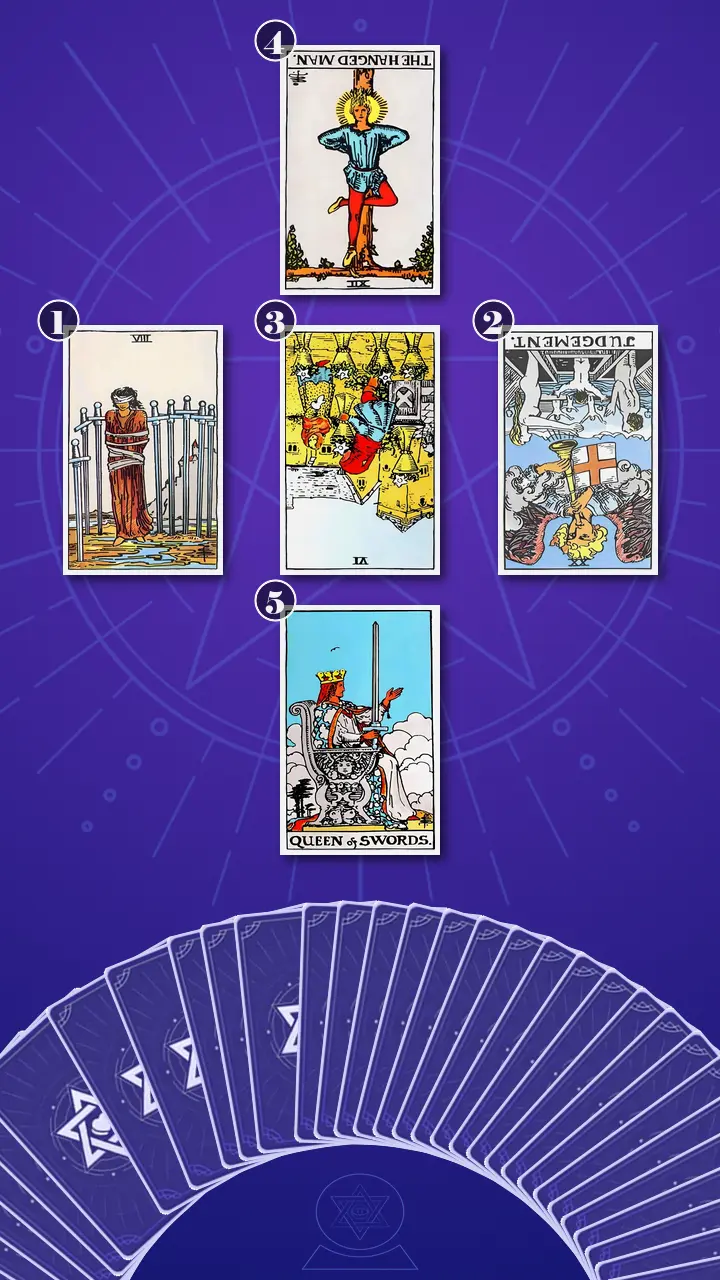
I chose the Relationship Spread · Context Edition, a five-card relationship tarot spread designed to separate factors that can become tangled in a charged family interaction. A larger Celtic Cross would have produced more information, but Casey's question did not need more layers. It needed a focused map.
For anyone wondering how tarot works in a family-boundary reading, the value lies in card meanings in context. The first position would show Casey's present stance. The second would show family pressure as Casey experienced it, without claiming to know anyone else's private motives. The centre card would reveal the historical role beneath the reaction. The card above it would name the active blockage, and the final card below would identify a response Casey could choose for themselves.
The arrangement looked like a courtroom cross: Casey's restricted speech on one side, experienced scrutiny on the other, old family history in the centre, and the unresolved blockage hanging overhead. But the lower card would turn that cross into a compass by pointing toward self-led participation rather than another verdict.
"The cards won't decide whether you should answer a question," I said. "They can help us distinguish what belongs to the current moment, what has been carried in from older dinners, and what remains within your control."
Reading the Map from Bound Air to a Held Blade
Position One: The Eight of Swords and the Five-Second Trial
I began with the card representing Casey's current relational stance: rehearsing answers, restricting speech, and becoming quiet when dinner-table attention turned evaluative. I turned over the Eight of Swords, upright.
The figure stood blindfolded and loosely bound inside an uneven ring of swords. I pointed to the gaps between the blades. The image did not suggest that Casey had unlimited freedom or that the pressure was imaginary. It showed how attention captured by anticipated criticism could make a narrow but meaningful route almost impossible to see.
"This is the exact 7:18 moment," I said. "The question lands, and every possible answer gets run through an imagined comment section. If you say what you actually think, they may ask why. If you explain why, somebody may challenge your plan. If you keep explaining, the conversation may expand into salary, rent, and your entire future. By the end of that internal review, only 'fine' is approved for publication."
The Eight of Swords held blocked Air energy. Casey did not lack thoughts; they had too many thoughts forced through an impossible safety test. The resulting silence reduced exposure for a few seconds, but it also removed Casey's perspective from the room and fed the resentful Notes app monologue on the Line 1 ride home.
"Your silence is not proof that you have nothing to say; it is what remains after every sentence has been made to audition for safety," I told them.
Casey gave one short laugh, but there was no amusement in it. Their fingers tightened around the mug, their eyes dropped to the card, and then their mouth softened into a tired half-smile. "That is almost too accurate," they said. "A little brutal, honestly."
"The card is describing the mechanism, not accusing you of creating the room," I replied. "Going quiet has been understandable. The useful question is whether it still needs to be your only available protection."
Position Two: When an Update Sounds Like a Verdict
I moved to the card representing how Casey experienced the family system's questioning pressure, while deliberately leaving their relatives' motives unclaimed. The card was Judgement, reversed.
In the Rider-Waite-Smith image, an angel sounds a trumpet over exposed figures rising to answer a call. Reversed, that call can become fear of evaluation, self-doubt, or an internal tribunal that issues its ruling before the person has spoken.
I asked Casey to separate the literal question from the message their body received. The literal words might be, "So, what's happening with work?" But the experience landed like an unscheduled performance-review notification during dinner. Cutlery seemed to stop. A chair shifted. Several people appeared ready to offer advice. Casey's body heard: justify the entire direction of your life.
"A routine question can feel like a final verdict when the table has trained you to expect cross-examination," I said. "That does not prove the questioner intended a trial. It tells us that your nervous system is already preparing for one."
The reversal showed blockage and overcorrection. Instead of responding to the present question, Casey prepared an excessively polished defence against every predicted follow-up. That much evidence could exhaust them and inadvertently turn an ordinary update into the full hearing they were trying to avoid.
Casey's breathing went shallow for a moment. They rubbed one thumb across the handle of the mug and said, "It's Sunday Scaries, but for one dinner question. I hear the trumpet before anyone has even finished the sentence."
I nodded. Naming that distinction mattered. The external question and the anticipated verdict might overlap, but they were not automatically the same thing. Finding clarity began with noticing where the present exchange ended and the internal tribunal began.
Position Three: The Old Role Waiting in the Kitchen
I turned the centre card, representing the historical family roles and repeated interactions that had taught Casey speaking would not meaningfully change the exchange. It was the Six of Cups, reversed.
The traditional image shows a larger child offering a flower-filled cup to a smaller figure inside an enclosed old courtyard. Reversed, the card can reveal emotional habits from the past that continue assigning scale and influence in the present.
I placed two scenes beside each other. At 10:06 on Monday morning, Casey could stand in front of a bright Figma prototype, explain a difficult trade-off to a product manager, and answer a follow-up without apologizing. Six days later, the familiar kitchen, an old nickname, or one raised eyebrow could load a younger version of Casey before the present-day adult got a word in.
"The family kitchen can load an old version of you before the present-day one gets a word in," I said. "It's like logging into an old account and discovering that your permissions were never updated."
This was where I used a lens I call Family Casting Analysis. I do not use it to label a family from a single scene or to assign malicious intent. I use it to identify the part a person has repeatedly been expected to play. I asked Casey, "If this dinner were a film, what role does the room hand you before you have chosen one?"
Casey stared at the unequal figures on the card. "The one who never has a plan," they said. Then, after a pause, "Also the easy one. The quiet, helpful one who doesn't make dinner awkward."
I wrote those roles down, then asked for one current fact that contradicted each of them. Casey managed a Toronto budget, paid rent, navigated work decisions, and communicated clearly in design reviews. The family role was therefore context-specific casting, not a complete account of Casey's voice or capacity.
The reversed Cups showed old emotional water flowing backward into the present. Familiarity was not neutral; it carried earlier expectations into the room. Yet recognizing the casting created a crucial separation: Casey could care about the relationships without treating an inherited role as a permanent contract.
Their shoulders lowered, but their eyes became glossy. I saw recognition arrive with grief attached. "I keep wondering why I turn into a teenager there," they said. "Maybe I don't. Maybe I just know the part too well."
Position Four: The Pause That Became the Pattern
I turned the card representing the present stagnation lock: waiting for a perfectly safe opening while each silent dinner reinforced the belief that nothing could change. The card was The Hanged Man, reversed.
The figure hung from one bound foot beneath a halo. Upright, the pause can produce perspective. Reversed, that suspension can harden into delay: awareness remains active, but no new evidence enters the story.
Casey knew the dinner pattern in remarkable detail. They noticed the first pointed question, the raised eyebrow, the overlapping advice, and the moment their throat tightened. But their inner conditions for speaking were exacting: not this question, not with everyone listening, not while someone might interrupt, not until the right sentence arrived without fear. Maybe next time.
The energy here was blocked suspension. Casey was waiting for the room to create perfect safety before testing any boundary. Because perfect safety never arrived, they cleared the plates again. The unchanged dinner then appeared to prove that no other response was possible.
Casey's jaw set. Their hand stopped moving, their eyes sharpened, and their voice rose half a level. "But doesn't that make this my fault? Like I'm the one keeping it stuck?"
"No," I said. "A protective strategy is not a moral failure. Waiting may have been the most workable option at many dinners, and it may still be the right choice when there is a practical safety or dependency risk. This card only shows that waiting for the family to supply ideal conditions cannot be the sole route to change. We are looking for one controllable interruption, not assigning blame."
Casey's fingers slowly released the mug. The discomfort remained in their face, but the anger had made room for a more precise question: "What would count as an interruption if I don't want to start a fight?"
When the Queen of Swords Kept Her Seat
Position Five: A Disclosure Filter, Not a Closing Argument
The rain against my window thinned to a faint ticking, and the radiator clicked off. The room became unusually still as I turned the final card, representing Casey's self-led next step: one concise, repeatable boundary or selective answer that would not depend on controlling the family's response.
It was the Queen of Swords, upright.
She held one sword vertically in her right hand while extending her left hand toward the open air. I read those gestures together. The sword created a clear distinction; the open hand preserved the possibility of connection. This was neither total disclosure nor total withdrawal. It was discernment, self-respect, and Casey's authority to decide what was answerable, what was private, and when enough had been said.
The spread's Air element had not disappeared. It had been retrained. In the Eight of Swords, multiple blades surrounded Casey as imagined objections. In the Queen, one blade was held deliberately. The same sharp awareness once used to predict criticism could become a disclosure filter: this question receives an answer, that topic remains private, and neither choice requires a courtroom speech.
I brought Casey back to the exact scene. "At 7:18 on Sunday, the fork stops above the plate. You draft three answers to the career question, reject all three, say 'It is fine,' and reach for dishes that are still being used."
Then I placed the new line of dialogue into that scene.
You do not need a case nobody can pick apart. You need one clear sentence that marks what is, and is not, available for discussion.
I let the sentence sit between us before giving them the full message of the card.
Silence is not your only protection; a concise boundary can keep you present without putting your whole life on trial, like the Queen's upright sword separating a truthful answer from an unwanted interrogation.
Casey's breath stopped first. Their fingers hovered above the mug as if the next movement required permission. Then their gaze slipped out of focus, and I could almost see the previous Sunday replaying behind their eyes: the fork, the question, the plates gathered too early. Their pupils widened. Their lips parted, but the first sound was a small, frustrated exhale.
"But doesn't that mean I've been doing it wrong all this time?" they asked. The question came out sharper than the rest of our conversation. Their shoulders stayed high for another second; then one dropped, followed by the other. Their eyes reddened slightly, and their hands opened on their knees. Relief arrived, but it was not clean relief. It carried the dizzy vulnerability of realizing that a new choice would still belong to them even if nobody applauded it.
"No," I said. "Your silence protected you with the tool you had. The Queen is not judging that tool. She is adding another one."
I leaned forward. "Now, with this new perspective, think back: was there a moment last week when this insight could have changed how you felt?"
Casey remembered a question about whether their salary was "enough for Toronto." They had started assembling rent figures and career projections in their head. With the Queen's perspective, they could imagine saying, "I'm managing it, and I don't want to discuss the numbers." They would not need to prove financial adulthood, disclose a budget, or persuade anyone that the limit was reasonable.
"A boundary is not a closing argument," I said. "It is a limit on what you are available to discuss."
The Queen was the spread's antidote, but not because she promised a calm dinner. She offered a different measure of success. Casey could stay seated, give a suitable answer, decline an intrusive part, and remain connected to their own judgment. That marked the first movement from anticipatory dread and protective silence toward selective participation, concise boundaries, and cautious self-trust.
Editing One Line Instead of Defending the Whole Film
When I looked at the complete cross, my mind went to an editing bay. As an artist, I know how a painful scene can start to feel like the whole film when it has remained on the timeline too long. Yet the footage on screen is not the final cut, and a character does not need to deliver a five-minute monologue for the next act to begin. Sometimes one changed line alters the direction of the scene.
The spread told a coherent story. The Eight of Swords showed Casey's present self-censorship: many possible answers, none permitted to leave the internal review. Judgement reversed showed a routine update becoming an anticipated verdict. The Six of Cups reversed revealed the historical casting beneath that reaction, especially the role of the quiet, helpful person who supposedly still needed a plan. The Hanged Man reversed named the blockage: waiting for an opening so safe that it never appeared. The Queen of Swords revealed the existing resource, not a new personality Casey had to manufacture: precise language, discernment, and the right to participate selectively.
The cognitive blind spot was the belief that an effective response had to be unchallengeable. Casey had been measuring success by whether the family accepted the answer, stopped asking questions, or approved of the boundary. That placed the success metric in other people's hands.
The shift was smaller and more powerful: prepare one brief boundary for the first intrusive question and measure the experiment by Casey's own choice. They could answer, decline, redirect, step outside, leave, or decide not to use the sentence if the situation felt unsafe. The goal was not to win the dinner-table case. It was to remain the author of what they disclosed.
The Script-Flipping Rehearsal
I called our practical exercise The Script-Flipping Rehearsal. In the established dinner script, a personal question cued rapid self-editing, one neutral word, and an exit into cleanup. We would rehearse one deliberately out-of-character response: Casey would stay seated, deliver one sentence, and stop. The purpose was not to shock the family or guarantee a new power dynamic. It was to give Casey's body a short, repeatable alternative to the only sequence it currently knew.
"What if I panic and still pick up the plates?" Casey asked.
"Then noticing the impulse is data," I said. "You can read the sentence privately, use it later by text, choose an exit, or do nothing that evening. Rehearsal expands your options; it does not create another obligation."
- Create the Five-Minute Queen of Swords NoteOn Tuesday evening, open your phone and make a note titled "Sunday: one sentence." Write the first intrusive question you expect, then place one response beneath it: "I am not getting into that tonight," "I am still figuring that out, and I do not want advice on it," or "I would rather talk about something else." Edit only until it sounds like your natural voice, then stop when five minutes ends.Tip: The minimum version is four words: "Not discussing that tonight." You do not owe supporting evidence or a softer second paragraph.
- Rehearse the Script Flip OnceWhile seated at your kitchen table with both feet on the floor, ask a trusted roommate or friend to play the relative and deliver the expected question once. Say your chosen boundary, put down your glass, and remain silent for five seconds. End the rehearsal after one attempt; it should take less than three minutes.Tip: Do not practise sounding perfectly calm. The skill is completing the sentence while some discomfort is present, not performing confidence.
- Run the Present-Day Role CheckBefore leaving for dinner, write one inherited role, such as "the one who never has a plan," and one current fact that contradicts it, such as "I manage projects, rent, and adult decisions every week." Decide how long you want to stay and note a practical exit point, such as the end of dessert or a specific TTC departure.Tip: After dinner, log only what you chose: "I said it," "I redirected," "I left," or "I chose not to use it because the situation felt unsafe." Success is saying the sentence, not winning approval for it.
I added one firm safety condition. If speaking could threaten Casey's housing, finances, physical safety, or another meaningful dependency, the sentence could remain private. A low-risk exit, a later text, a shorter visit, or skipping dinner could be the wiser expression of the Queen's discernment. The cards did not outrank Casey's knowledge of their own circumstances.

A Week Later, One Sentence and Two Shaking Hands
A week later, I received a message from Casey at 7:24 on Sunday evening.
"I used it. They asked what my real career plan was, and I said, 'I'm still figuring that out, and I don't want advice on it tonight.' My aunt sighed. I thought I might evaporate. But I stayed in my chair. Then my cousin asked who wanted dessert."
Casey did not tell me the whole dinner had changed. Their hands had shaken beneath the table, and they had spent several minutes wondering whether the sentence sounded rude. The boundary did not erase history or guarantee approval. It did something more modest and more credible: it gave Casey one piece of evidence that silence and confrontation were not the only available roles.
Casey told me they rode Line 1 home alone, opened the Notes app under the harsh carriage lights, and wrote three facts beneath the old folder of post-dinner speeches: "I said it. I stayed seated. I didn't explain." The next morning, their first thought was still, "Did I make it weird?"
This time, however, the question did not become a verdict. Casey could notice it, breathe, and return to the evidence. The transformation was still in production: discomfort while testing one line, cautious relief after maintaining it, and self-trust built through repetition rather than a single perfect performance.
I did not see tarot rescue Casey or predict a transformed family. I saw five cards help them externalize a pattern, distinguish old casting from present competence, and locate one actionable choice. Casey supplied the missing Earth by writing the sentence down and the missing Fire by saying it once. The authorship was theirs.
When the table goes quiet and every face turns toward you, a tight throat can make honesty feel like the very thing that might cost you your seat there. If that happens, remember that noticing the old script already places the pen back within reach; you do not have to earn belonging with an answer nobody can challenge.
If you did not have to win the case, justify the whole film, or persuade the room to approve your boundary, what single Queen of Swords sentence might let you stay on your own side of the conversation?