The 11:48 p.m. Draft-Delete-Reopen Loop
I recognized Casey (name changed for privacy) before she finished explaining why she had come to see me. She was a 28-year-old digital marketing coordinator in London, polished enough to keep a calm professional tone through a day of Slack messages, campaign dashboards, and client deadlines, yet caught in post-breakup choice paralysis whenever the flat went quiet.
At 11:48 p.m., her laptop was still glowing at the edge of the bed beside a cooling mug of tea. She opened the old WhatsApp thread, typed “How have you been?”, deleted it for the fourth time, and held the warm, slightly slick phone in her palm while the radiator clicked into the silence. Her throat tightened before the chat even loaded.
“I cannot tell whether I want to talk to him,” she said. “I might just want the uncertainty to stop. If I text, I might make it worse. If I do not text, I will never know whether I gave up too soon.”
I listened to the pressure inside those two doors. Reaching out could feel like relief and risk; letting go could feel like self-respect and regret. It was as if she were trying to carry two full glasses through a crowded Tube carriage without spilling either one, her hands locked around the problem while her body never got to rest.
“You are not only deciding whether to text,” I said. “You are trying to make one choice remove the pain of uncertainty. We do not have to force that tonight. Let us give the feeling somewhere to land and draw a map toward clarity.”

Choosing a Compass for an Unfinished Question
I invited Casey to take one slow breath and notice the question beneath the question: not what her former partner might feel, but what she needed to understand about her own next move. I shuffled slowly, using the movement as a psychological transition from reacting to observing, rather than as a promise of hidden certainty.
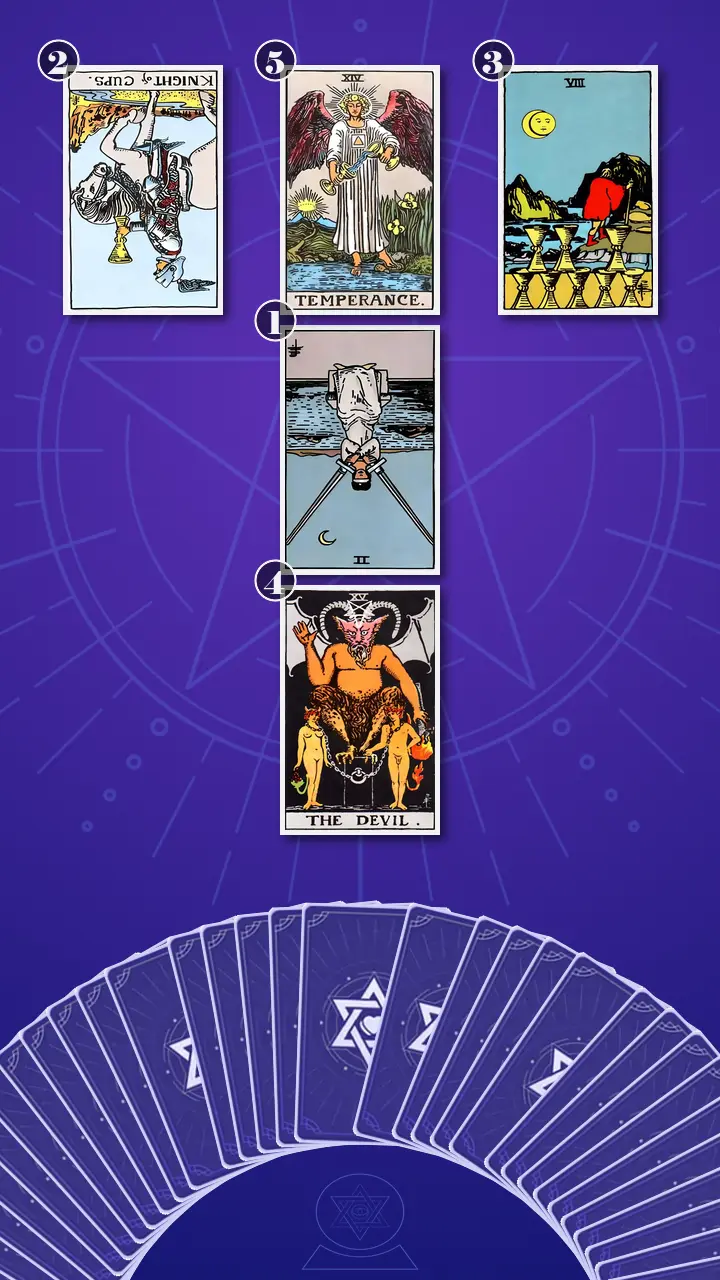
“I am using the five-card Decision Cross · Context Edition,” I explained. “This spread is designed for a choice between two actions. It does not predict your ex’s response or make the relationship decision for you. It shows the visible stalemate, the emotional pull toward reaching out, the meaning and grief within letting go, the attachment loop beneath both options, and a practical way to author your next step.”
I explained this to the reader as well: a contextual breakup tarot spread works here because the real issue is not a lack of arguments. The issue is how the late-night draft-delete-reopen loop turns a small message into a final verdict. The five-card Decision Cross keeps both paths visible without declaring either one morally superior, then asks what would help choice return to the person making it.
“The centre card will show the observable tension,” I said. “The two cards on either side will let us compare reaching out and letting go. Beneath the centre, we will look at the attachment loop. Above it, we will find an integration practice that can turn all of this information into a measured next step.”
The Two Swords Behind the Send Button
Position 1: The Observable Stalemate
“Now turned is the card representing the observable stalemate: the repeated drafting, deleting, and reopening of the message thread.”
I turned over the Two of Swords, in reversed position.
The blindfolded figure and the two swords crossed tightly over the chest brought Casey's bedroom into sharp focus. At 11:48 p.m., she was not lacking intelligence or possible interpretations. She was holding reaching out and letting go in suspension because each option felt like exposing herself to a result she could not control. The dark water behind the figure was the grief she kept converting into analysis.
Reversed, the air energy had moved from a protective pause into overload. “If I send it, this could happen; if I do not, that could happen; if I wait, maybe I can avoid choosing,” I said. “The delay gives you a brief exhale, but reopening the thread keeps the relationship active in the background. A draft becomes a suspended decision queue.”
Casey gave a short, humourless laugh. “That is almost too accurate. I am not even sure I want the conversation.”
Her fingers stopped moving around the edge of her mug. She looked at the card, then at her phone, and her shoulders lifted as if bracing for a notification. I did not ask her to agree with the card; I asked, “What feeling might the repeated return be protecting you from for ten minutes at a time?”
The Cup That Carried Too Much Hope
Position 2: The Emotional Pull Toward Reaching Out
“Now turned is the card representing the emotional energy and hidden assumptions behind the impulse to reach out.”
I revealed the Knight of Cups, in reversed position.
The knight extends one cup, and Casey knew exactly what it contained. An old Brighton photo or an Instagram Memory could prompt her to draft a warm, composed check-in that sounded casual while privately carrying hopes of an apology, a meaningful conversation, reassurance, or proof that the relationship still had a future.
“The feeling is real,” I said. “The question is whether the message is being asked to deliver something no reply can guarantee. You work in digital marketing, so you know how easy it is to build an appealing campaign pitch before checking whether the audience, timing, or goal still exists. This reversed knight is that polished message: emotionally persuasive, carefully phrased, and not fully tested against your present need.”
I could feel my own old professional instinct surface as I watched her study the card. In a former life, I might have called it an optimisation problem. Now I saw the more human truth: a person trying to make a five-word text carry the weight of an entire unfinished relationship.
“Try separating two things,” I continued. “What do you hope contact will give you, and which part of that outcome would remain outside your control?”
Casey inhaled as though she had been about to answer a different question. Her jaw tightened, then released. “Maybe I want him to confirm that it mattered,” she said. “Or confirm that I did not ruin everything.”
She looked down at her hands. The room was quiet except for the faint traffic beyond the window, and the romantic pull of the card became less like an instruction and more like information about the size of the hope inside the draft.
The Walk That Did Not Erase the Story
Position 3: The Values and Grief Within Letting Go
“Now turned is the card representing the values, grief, and self-trust involved in letting go without denying that the relationship mattered.”
The Eight of Cups, in upright position, showed a cloaked figure walking away from eight upright cups beneath a moonlit sky. I did not read it as a command to stop caring. I read it as a values-based departure from using the old relationship to organise every evening.
“What mattered can remain meaningful without directing tonight's action,” I said. “Leaving the thread unopened for one evening does not delete the history. It lets you learn what is present when you stop asking the relationship to provide an answer.”
I asked Casey to picture the smallest version of the card: placing the phone face-down, putting on a coat, and walking around the block while the ache remained. The mountains were not a dramatic new identity. They were the less familiar work of rebuilding rhythm, friendship, attention, and a sense of self beyond the old couple structure.
For a moment, her breath caught. Then she let it out slowly and rubbed her thumb over the seam of her sleeve. “I could leave the thread unopened without deciding that the relationship meant nothing,” she said, almost testing the sentence.
“Exactly,” I replied. “You are not erasing the story. You are finding out what is here when you stop asking it for an answer.”
That small exhale mattered. Movement had begun before certainty arrived, and it did not require Casey to pretend that grief was finished.
The Loose Chain Beneath Both Doors
Position 4: The Attachment Loop Beneath the Decision
“Now turned is the card representing the attachment loop beneath the apparent no-win decision, especially the fear that uncertainty proves a lack of control.”
The Devil, in upright position, appeared beneath the centre of the cross.
I kept my voice plain. “This card is not a judgement about your desire, and it is not a statement about your former partner. It names the painful mental contract underneath both paths: ‘I must know exactly what he feels, or what the perfect message would produce, before I can be whole again.’”
The figures in the image wore loose chains. Casey stared at them. The chain was like an app notification loop: each profile check offered a tiny burst of possibility, followed by the nervous system waiting for the next signal. The old conversation had become a pinned project, quietly claiming that every other part of life was blocked until one unknown field was completed.
“The problem is not simply contact or no contact,” I said. “The deeper pressure is asking either action to guarantee safety. That is why postponing the decision feels briefly soothing and then leaves you more tethered. Naming the chain is not blaming yourself. It is the moment an automatic pattern becomes available for questioning.”
Casey's breath paused. Her eyes moved from the figures to the crossed swords above them, then back again, as if replaying a series of late-night checks. Her fingers curled against her palm, loosened, and curled once more.
“So if I send the text, I might still be waiting for the reply to tell me who I am,” she said.
“Yes. And if you never send it, you might still be waiting for silence to prove that you made the right choice. Neither action has to carry that impossible assignment.”
When Temperance Poured Choice Back Into Her Hands
Position 5: The Integration Practice
The room seemed to quiet around the final card. I turned it over and found Temperance, in upright position, the angel pouring water steadily between two cups, one foot on land and one in water.
At first, I described its basic meaning: emotional moderation, patience, integration, and self-trust. Temperance did not ask Casey to choose feeling over boundaries or boundaries over feeling. It asked her to let both inform a proportionate decision.
She was still caught in the familiar demand for a perfect answer. Every imagined path ended with a question: What if I regret this? What if waiting means losing my chance? What if silence says something permanent about my worth?
You do not need to obey the old belief that relief comes only from instant contact or instant erasure; let Temperance's poured cups turn longing into a measured boundary and a self-trusting next step.
For a few seconds, Casey did not move. Her breath stopped halfway in, her eyes fixed on the water passing between the cups. Then the meaning entered slowly: longing could be present without being promoted to commander. Her shoulders dropped; the hand gripping her phone opened against her knee. A faint flush rose around her eyes, and the first sound she made was not a sob but a long, unsteady exhale. “I can miss him, protect my boundary, and decide later,” she said. The relief was real, but it carried a thin edge of vulnerability. With the pressure gone, she could feel the responsibility of choosing for herself, and the space seemed briefly too wide. Outside, a bus sighed at the kerb, its brakes releasing like the room had released with her.
“Now use that new view to remember last week,” I invited. “Was there a moment when you could have noticed longing as information rather than treating it as an instruction?”
Casey nodded. “The Brighton photo. I thought I needed to decide what the whole breakup meant before I could put my phone down.”
This was the first movement from certainty-seeking ambivalent longing toward boundary-aware self-trust. Not a solved relationship, not instant closure, but a deliberate pause in which grief could remain true without controlling the next action.
The Unsent-Message Buffer
From Insight to Actionable Advice
I gathered the five cards into one story. The reversed Two of Swords showed thought working overtime to prevent pain. The reversed Knight of Cups gave that pressure a beautiful, hopeful message to carry. The Eight of Cups showed that leaving the checking ritual for one evening could be a movement toward present values rather than a denial of the past. The Devil exposed the demand for guaranteed certainty, and Temperance offered the missing structure: let emotion move, keep your feet in present reality, and choose after intensity has shifted.
Casey's blind spot was not that she cared too much. It was that she had made contact or silence responsible for proving that she would be safe either way. The direction of change was smaller and more practical: stop asking one decision to erase discomfort, then create enough time to distinguish a genuine present need from the urge for immediate relief.
I brought out a notepad. “I use what I call the Coffee Bean Filter Protocol for decisions like this,” I said. “For the next 24 hours, we sort what is essential from what is emotionally noisy. It is not a rule about no contact. It is a container that gives you your judgement back.”
- Create the pauseWhen the urge to text appears this week, open a dated note titled “After the feeling changes” instead of the old WhatsApp thread. Write the exact message, the time the urge appeared, and one body sensation, such as a tight throat or clenched jaw. Set a reminder for the next day.Treat 24 hours as a temporary buffer, not a permanent no-contact decision. If that feels too large, begin with ten minutes and one sentence.
- Filter the hopeBefore sending anything, write one line under “What I hope contact will give me” and one under “What I can give myself or ask for elsewhere today.” Use a concrete answer such as rest, a friend’s company, information, or a boundary. Read both lines once the following day without editing them into a verdict.Do not use the exercise to argue yourself out of contact. Its job is to reveal the purpose of the message before the imagined reply writes the whole story.
- Leave one evening openChoose one evening when the old thread is usually reopened. Put the phone in a bag or on a shelf, walk for ten minutes around the London block or to the corner shop, and notice three present-day details. When you return, write, “What I was walking toward was...”You are not proving that you are over the breakup. Turn back, shorten the walk, or choose a grounding activity if the feeling becomes too intense.
I also gave her my own analysis lens: Analysis Paralysis Deconstruction. “When the mind produces twenty what-ifs,” I said, “strip them down to the grounded realities. What do you need now? What is within your control? What would a message actually be for? Then use Complexity Reduction to make only one clean distinction: present need or immediate relief. You can revisit the larger decision after that.”

A Week Later, One Quiet Proof
Four days later, Casey sent me a message during her lunch break. She had seen an old restaurant tagged in an Instagram Story and felt the familiar warmth rise in her throat. This time, she opened the dated note instead of the chat, wrote two lines, and walked to a nearby café. She did not decide the entire future. She let the message wait until morning.
The next day, she read it and realised the draft was mostly asking for reassurance that she could begin again. She called a friend, left the old thread unopened that evening, and still missed him. The small victory was not that the longing disappeared. It was that longing no longer had automatic access to the send button.
“You are not waiting for a perfect answer,” I told her when we spoke. “You are learning what remains true after the intensity moves. That is how self-trust begins: not through choosing perfectly, but through noticing, pausing, and choosing in proportion to the life you are actually living.”
When the old thread is open and your throat tightens, you can want contact and still fear what either choice says about your control; sometimes the painful part is not choosing, but asking one message to prove that you will be safe either way.
If you allowed the next feeling to be a feeling rather than a verdict, what small sign of your present needs might you notice before deciding what the old thread means?
Every reading at AceTarot is a journey to connect with inner wisdom and empower the path ahead. This reading shared here is a psychological mirror, not a private record—crafted to reflect universal emotional loops and help restore personal clarity. Please note that these insights do not replace professional psychological, medical, legal, or financial advice, and should not serve as the sole basis for major life decisions.
Learn more about our Journey to Clarity.
How did this insight land for you?
🫂 This Resonates Deeply
🌀 Living This Story
✨ Now I See Clearly
🌱 Seeing New Possibilities
🧰 Useful Framework
🔮 The Confirmation I Needed
💪 Feeling Empowered
🚀 Ready for My Next Step
Author Profile
 AI
AI Sophia Rossi
892 readings | 623 reviews
“For twenty years, I’ve listened to stories unfold over the warm aroma of coffee. I don’t believe life’s complexities always require grand theories to be solved; often, we just need a safe place to tidy up our reality. I don’t offer high-minded preaching—just grounded, heartfelt insights to help you regain your sense of control amidst the clutter of daily life.”
In this Choice Tarot Reading :
Core Expertise
- Analysis Paralysis Deconstruction: Stripping away abstract 'what-ifs' to focus strictly on the grounded realities and immediate constraints of your options.
- Complexity Reduction: Tidy up cluttered decision parameters into a clean, practical binary choice.
Service Features
- The Coffee Bean Filter Protocol: A 24-hour pragmatic sorting exercise to physically categorize decision variables into 'Absolute Must-Haves' and 'Emotional Noise', instantly restoring decisiveness.
Also specializes in :
Explore Related Patterns:
Analysis ParalysisAt 11:48 p.m., you draft the same kind of message, delete it, reopen the thread, and then run through another set of what-ifs. The thinking is doing more than gathering information: it is trying to prevent either possible outcome from hurting, so postponement becomes a short-term relief strategy. Because the decision has been made to represent the entire breakup, the send button carries more weight than a five-word check-in can hold. Four days later, the old restaurant trigger brings the same loop back, which shows a repeatable pattern rather than a single moment of indecision. You do not need to solve the whole relationship before making one bounded choice; noticing when analysis is functioning as pain avoidance gives you room to pause without turning the pause into another verdict.
Certainty SeekingYou describe the choice as reaching out for relief or letting go for self-respect, but both options are being asked to guarantee an outcome that neither can control. The need to know exactly what he feels, and to know what the perfect message would produce, turns uncertainty into a problem that must be eliminated before you are allowed to move. That certainty-seeking contract keeps the relationship psychologically active even when no message is sent. The useful distinction is not whether you can obtain a perfect answer, but whether the next step is aligned with your present need while uncertainty remains. A decision can be responsible without being able to promise emotional safety.
Regret AversionYou keep both doors open because either one could later be used as evidence that you made the wrong choice: sending might make things worse, while not sending might mean you gave up too soon. Preserving both options protects you from an immediate verdict, but it also makes every delay feel loaded with future regret. The fear is not simply missing a message opportunity. It is the possibility that one imperfect decision will define what the breakup meant or what you are capable of next. Treating the next step as a limited decision, rather than a permanent judgment of your worth, loosens the need to keep every option alive at once.
Reassurance SeekingYour proposed check-in sounds casual, but the hope inside it is much larger: an apology, reassurance, proof that the relationship mattered, or confirmation that you did not ruin everything. The polished wording becomes a way to package several vulnerable questions into one low-risk-looking message. That makes contact less about exchanging present information and more about obtaining reassurance from a person who cannot reliably provide it. The pattern becomes easier to question when you separate what you hope his reply will give you from what you can offer yourself or ask for elsewhere today. The goal is not to invalidate the feeling; it is to stop one message from carrying the burden of your entire self-trust.
Compulsive CheckingWhen the old thread, a Brighton photo, or an Instagram Memory appears, you return to the same digital cues and briefly feel that another signal might settle the question. The check does not provide the certainty it promises; it refreshes the possibility, followed by another period of waiting and monitoring. That is how an ordinary reminder becomes part of an attachment loop. The behavior is visible because the thread is reopened and the urge returns, but the deeper mechanism is the temporary relief supplied by checking. Moving the message into a dated note interrupts the cue-relief-waiting sequence long enough for you to see what the urge is asking for.
Explore Related Struggles:
Binary Choice LockAt 11:48 p.m., you open the old WhatsApp thread, type a check-in, delete it for the fourth time, and reopen the chat. Reaching out is asked to end the uncertainty, while staying silent is asked to protect you from making things worse, so each path carries a different promise that neither can fully keep. The decision becomes locked when one message is expected to determine whether you gave up too soon, whether the relationship mattered, and whether you can trust yourself afterward. Your hands remain on the same choice because sending and not sending have both been assigned the burden of preventing regret. Clarity begins to return when the next action is allowed to be one action rather than a final verdict on the entire breakup. You can acknowledge what contact might offer, what it cannot control, and what decision would fit the life you are living today.
Certainty-Safety FusionYou say, "If I text, I might make it worse. If I do not text, I will never know whether I gave up too soon." The two possibilities are not merely options; each is being asked to remove the risk of uncertainty before you are willing to move. The imagined reply becomes responsible for confirming that you mattered and that you did not ruin everything, while silence is asked to prove that waiting was wise. Contact and distance therefore carry a job larger than communication or boundary-setting: they must guarantee emotional safety and settle your view of yourself. Neither action can provide that guarantee in advance. A steadier decision becomes possible when safety is treated as something you can build through a pause, a present-day need, and a bounded choice rather than something an old thread must certify.
Hope-Agency SplitAn old Brighton photo or Instagram Memory can prompt you to draft a warm, composed check-in that quietly carries hopes of an apology, reassurance, a meaningful conversation, or proof that the relationship still has a future. The message looks small, but the hope inside it is carrying the weight of the whole unfinished relationship. That hope pulls you toward contact while the reality of another person's response pulls you back. You can carefully shape the wording, timing, and tone, but you cannot author what the reply will mean or whether it will arrive, leaving your desire and your actual agency separated at the send button. The useful distinction is not whether the hope is valid. It is whether the message is being used to express a present intention or to obtain an outcome that belongs partly to someone else. Once those functions are separated, your next step can be chosen by you without requiring hope to disappear.
Closure DeficitYou keep returning to the old thread while asking whether you actually want a conversation or simply want the uncertainty to stop. The unanswered question stays alive even when no contact is happening, and the possibility of giving up too soon makes leaving the thread unopened feel consequential. The missing conclusion is not only information about what your former partner feels. It is also a way to place the relationship in your own timeline without treating its meaning as settled by one reply or one silent evening. That leaves the past present in your bedroom, your phone, and the choices you make after the flat goes quiet. Closure can become more workable when it is separated from a final external answer. The relationship can have mattered, the question can remain incomplete, and you can still decide what role the old thread has in the next day of your life.
Memory-Loyalty BindYou say you could leave the thread unopened without deciding that the relationship meant nothing, yet the need to preserve its meaning keeps appearing beside the urge to check, draft, and reconsider. You still miss him after choosing not to reopen the conversation, so remembering and moving forward remain active at the same time. The bind forms when stepping away from present contact starts to resemble disloyalty to the past. Keeping the old thread available can feel like evidence that the relationship mattered, while closing that route for an evening can feel like rewriting what happened, even though the history itself does not depend on a new message. Memory does not have to be maintained through ongoing access to the old conversation. You can carry what was meaningful, notice what is needed now, and let the present decision describe today's boundary rather than deliver a verdict on the past.
Explore Related Emotions:
Anticipatory RegretYou name the two feared outcomes with unusual precision. Sending might make it worse, while not sending might mean you gave up too soon. Each imagined path then produces another what-if, keeping tomorrow's possible regret in the room with tonight's decision. The feeling is less a verdict about what you should do than a forward projection of self-blame. Because either action is asked to protect you from regretting the other one, choosing becomes harder to inhabit.
Certainty HungerYou say you might only want the uncertainty to stop, then the imagined message grows to include an apology, reassurance, proof that the relationship mattered, and a possible future. You are not simply waiting for one piece of information; you are asking a single reply to settle several open questions at once. When exact knowledge of his feelings or the perfect wording becomes a condition for feeling whole again, every option stays unfinished. The craving for certainty keeps your hand near the thread because silence cannot reassure you and contact cannot guarantee the outcome.
Choice Paralysis OverwhelmAt 11:48 p.m., you open the old WhatsApp thread, type the five-word check-in, delete it for the fourth time, and reopen the chat. The repeated movement turns a small message into a queue of competing futures, so each brief pause feels like relief while keeping the decision physically active. Because reaching out could make things worse and staying silent could mean you gave up too soon, your attention has no neutral landing place. The experience is not a lack of intelligence or options; it is the heavy, stop-start effort to make one choice remove the uncertainty created by both choices.
Guarded LongingWhen an old Brighton photo or an Instagram Memory appears, you draft a warm, composed check-in that sounds casual while carrying hopes of apology, reassurance, and a future. You can miss him and still hesitate to let the size of that hope become visible. That split gives longing a guarded shape. The message reaches toward closeness, while the delete button protects you from a reply that might expose what you actually want or fail to hold it.
Identity Verdict DreadYou ask a future reply to confirm that the relationship mattered and that you did not ruin everything, then imagine silence saying something permanent about your worth. The old chat has become more than a route to contact; it is carrying a story about who you are. That is why the send button feels disproportionately consequential. When his response or absence is recruited to define you, your own sense of self waits outside your control, and both reaching out and letting go feel like personal judgments.
Liberating UncertaintyAfter an old restaurant tag brings the familiar warmth back, you open the dated note instead of the chat, write two lines, and let the message wait until morning. The pause does not promise that the choice will become painless; it creates enough room to see what remains true after the first intensity moves. Uncertainty becomes open space rather than a demand for instant contact or instant erasure. You can ask what you need now, what is within your control, and what the message is actually for, without making the unknown answer the author of the next step.
Liminal GriefYou place the phone face-down, walk around the block, and still let the relationship matter. The loss does not need to be deleted for you to stop organising every evening around the old couple structure. That in-between quality is why grief can be honest without becoming an instruction. You can leave the thread unopened for one evening and still miss him, allowing the past to remain meaningful while your current life starts taking up space.
Cautious Self-TrustYou say, 'I can miss him, protect my boundary, and decide later,' and later you read the draft without sending it during the first wave. That sequence gives your own observation more weight than the imagined reply. Self-trust arrives here as a small repeatable act, not as certainty about the relationship. You notice the longing, allow the feeling to change, call a friend, and choose in proportion to the life you are actually living.
Grounded AgencyFour days later, the old restaurant tag brings the familiar warmth back, but longing no longer has automatic access to the send button. You write in the dated note, walk to a cafe, call a friend, and choose what to do after the intensity has shifted. The decision returns to your hands when contact and silence are no longer assigned the job of proving that you will be safe either way. Agency here feels grounded because it does not require a perfect outcome; it is the ability to author one honest next step.
Finality DreadWhen you leave the old thread unopened, the pause is repeatedly translated into giving up too soon, while keeping the possibility available preserves a different ending. Closing the thread seems to risk making the whole relationship permanent in retrospect. That pressure turns a temporary boundary into an imagined final door. The fear is not simply missing him; it is the sense that one ordinary evening's decision could erase meaning or foreclose a future you have not fully released.
Explore Related Contexts:
Breakup Closure LimboAfter the breakup, Casey keeps the old conversation available while treating one text or one night of silence as if it must settle what the relationship meant. You can be in that same suspended space when the history is over but the present boundary has not yet become clear. Her walk, the rebuilding of rhythm and friendship, and the decision to leave the thread unopened for one evening show the real transition at stake. The task is not to deny the past; it is to find a current place for it that does not organise every quiet evening. Closure here is a social position you are still establishing, not a verdict that a single reply can issue. Letting the next step remain temporary can give the present room to become legible without pretending the relationship did not matter.
Post-Breakup No-Win DecisionAt 11:48 p.m., Casey opened the old WhatsApp thread, typed 'How have you been?', deleted it for the fourth time, and reopened it. You are looking at a decision that has stopped being a single contact choice and has become a test of whether the relationship mattered, whether you gave up too soon, and whether you can trust the result. Reaching out and letting go are each being asked to remove uncertainty, even though the former partner's reply or silence remains outside your control. That makes the draft-delete-reopen cycle a no-win structure in which postponement briefly lowers the pressure while keeping the old relationship active in the background. You do not have to make one message carry the whole breakup. A bounded pause can separate the purpose of contact from the meaning you hope an answer will supply, returning the next step to the person who can actually choose it.
Relationship Reassurance LoopCasey says she may want her former partner to confirm that the relationship mattered or that she did not ruin everything, then builds a warm, composed check-in around that hope. You are looking at an exchange in which your preparation is immediate and concrete while the reassurance you want depends on another person's reply. The old thread becomes a holding channel. Each profile check or reopened draft offers a small possibility, but it leaves the larger question with the absent response rather than with a clear present purpose for contact. You can ask what the message is for before asking what it might produce. That distinction keeps a former partner's answer from becoming the only available evidence about your history or your next move.