One Accessibility Task Began Reframing Career Security as a Base Camp

The Golden Cage Inside a Successful Career
If you are a Toronto UX designer in your late twenties who can explain exactly why your job is a good deal but still feels your chest tighten when Sunday night arrives, you may be living the Sunday Scaries inside a success story.
At 8:47 p.m. on a Sunday, Jordan (name changed for privacy) joined our video reading from their Toronto apartment kitchen. The refrigerator hummed behind them while the warm light of their phone illuminated a full week of stand-ups, Figma reviews, stakeholder meetings, and roadmap calls. They opened a Notion page titled Possible Directions, then tapped the phone's edge with restless fingers while their shoulders remained lifted toward their ears.
“I know this is a good situation,” they said. “So why does it feel like I'm disappearing inside it? I keep telling myself I can leave when I have proof that the next thing will be safer and more meaningful.”
I heard the bind beneath the sentence. Jordan wanted work that felt alive, but loosening their grip on a respected, well-paid role felt like putting their judgment on trial. Their ambivalence was almost physical: two hands pulling in opposite directions beneath the sternum, one guarding the life they had built and the other reaching for a life they could not yet prove.
“A good situation can still be the wrong shape for your life now,” I told them. “We are not here to pressure you into quitting or to predict what will happen. I want to help you see what is keeping the current arrangement unquestionable, then find one safe way to gather clearer evidence from your own experience. Let us make a map of the fog before we ask you to walk anywhere.”
Choosing the Ladder Out of the Gilded Room
I asked Jordan to place both feet on the floor, take one ordinary breath, and hold the question in simple language: What keeps me in a golden cage after it stops feeling meaningful? I shuffled slowly and angled the deck toward the camera. The pause was not a mystical performance; it gave their attention somewhere quieter to land.
I chose the Four-Layer Insight Ladder · Context Edition. For anyone wondering how tarot works in a career meaning crisis, I use the cards as a structured psychological mirror rather than a forecast. A ten-card Celtic Cross would have introduced external influences and distant outcomes that Jordan did not need. This four-card tarot spread stayed with the self-reinforcing pattern in front of us.
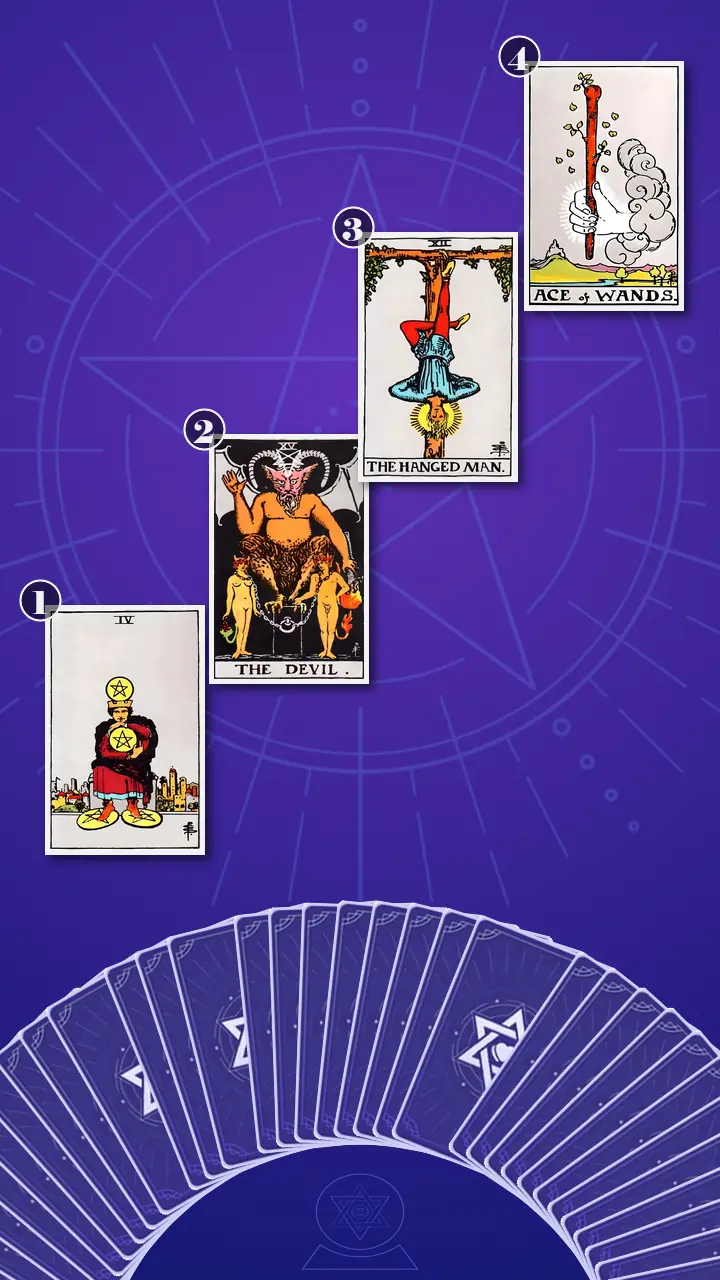
I laid the cards in a rising diagonal. The first position would show the visible grip: what Jordan was repeatedly doing to protect the comfortable arrangement. The second would reveal the hidden attachment and the fear connecting security to self-worth. The third, at the centre, would offer the perspective shift. The fourth would turn that shift into a small, observable experiment.
The sequence mattered: visible behaviour, underlying bargain, changed question, grounded action. It was a staircase out of a gilded room, but no card would order Jordan through the door. The purpose was self-exploration and agency. Jordan would decide what counted as useful evidence and what happened next.
The Grip That Looked Like Gratitude
Position 1: The Routine Being Held Against the Chest
I turned over the card representing the visible trap and current behaviour: the concrete pattern of protecting a comfortable arrangement after it had stopped feeling meaningful.
It was the Four of Pentacles, upright.
The figure holds one pentacle against the chest, pins two beneath the feet, and balances another above the head. I asked Jordan to notice the closed posture before reaching for any traditional definition. The whole body is recruited into preservation: heart, movement, and thought are organised around keeping hold of what has already been secured.
In Jordan's life, that looked like keeping the stable UX role, the familiar weekly routine, and the evidence of competence pressed close. The job paid reliably, supported life in Toronto, looked strong on LinkedIn, and gave them a portfolio other designers respected. Yet the same grip held down their time, identity, and willingness to test anything uncertain. Their Possible Directions page had columns for salary, benefits, location, and education costs, while the column for what feels alive remained mostly blank.
I read this upright card as an excess of protective Earth energy. Security itself was not the problem. The excess appeared when preservation became the only acceptable measure of a good decision. Each saved article and postponed message protected Jordan from immediate exposure, but it also kept their real options theoretical.
“When you open that calendar on Sunday night,” I asked, “what are you protecting besides income?”
Jordan gave a short laugh with a bitter edge. “That is so accurate, it's almost cruel. I'm protecting the idea that I made good choices. If this job isn't right anymore, I don't know what that says about the last six years.”
I let the laugh settle before answering. “The card is not calling those years a mistake. It is showing a strategy that once served you and may now be overextended. Protecting what you built was intelligent. We are only asking whether the same grip is still protecting your life, or whether it has started protecting you from new information.”
Position 2: The Contract Hidden Inside the Benefits Package
I turned over the card representing the hidden attachment and core fear: the belief that loosening security might expose poor judgment and, beneath that, threaten Jordan's sense of worth.
It was The Devil, upright.
I always handle this card plainly. It is not an omen, a punishment, or proof that someone is trapped forever. In this context, The Devil shows an attachment that has begun to sound like law. The loose chains around the figures' necks do not deny real financial constraints; they ask where a practical condition has expanded into a total rule about what a person is allowed to want.
Jordan recognised the modern version immediately. Security, status, and competence had become a contract with hidden terms: You may keep the salary, benefits, flexibility, and respect, but you must postpone the question of purpose until the next raise, project, or milestone. Every promotion moved the finish line. Every new career article reduced the pressure for ten minutes while making an actual conversation easier to postpone.
I brought them back to a performance review they had described earlier. Their manager had praised a polished Figma flow and sent a compensation update that afternoon. Jordan had smiled, typed Thanks! in Slack, and then sat on the TTC ride home with their chest pulled tight. The praise should have settled the question. Instead, it made the absence louder.
“It feels a bit like Severance,” Jordan said, “except there is no sci-fi procedure. I'm functional at work, and some other part of me goes missing while I do it.”
I saw The Devil here as a blockage created by a fused equation: income plus approval plus competence had come to equal proof of personal worth. Desire could not enter the decision matrix without being treated as reckless. The research loop behaved like a recommendation algorithm, serving Jordan more risk comparisons because every click brought temporary relief without requiring contact with a real possibility.
I used one of my diagnostic lenses, Hidden Cost Deconstruction. I drew two columns. In the first, I wrote the visible price of change: uncertainty, possible retraining, reduced income, and the risk of regret. In the second, I wrote the emotional bills omitted from Jordan's spreadsheet: the Sunday tightening, the attention consumed by comparison, the grief after praise, and another year in which competence might continue growing while meaning remained unfed.
“I am not using those costs to argue that you should leave,” I said. “I am correcting an incomplete calculation. If only change is assigned a cost, staying will always appear free.”
Jordan's fingers stopped around their mug. Their eyes drifted away from the screen as if they were replaying the train ride after that review. Then a long breath left their chest.
“If I leave, I might prove I can't judge my own life,” they said quietly. “If I stay, I keep proving only that I can tolerate being disconnected.”
In Jungian terms, I could see a conscious identity built around being the sensible, reliable professional, while longing had been pushed into shadow because it threatened that identity. Shadow did not mean bad or irrational. It meant a part of Jordan's experience had lost permission to speak in the meeting where decisions were made.
“Some parts of this contract are real,” I told them. “Some parts are fear speaking in the voice of practicality. Security can be a resource without becoming a verdict.”
When the Hanged Man Rotated the Canvas
Position 3: The Question That Changed Orientation
I reached the card representing the perspective shift and transformation: the central hinge between recognising the old bargain and approaching meaning differently.
The refrigerator compressor behind Jordan clicked off. The sudden quiet seemed to widen the kitchen as I turned over The Hanged Man, upright.
I brought Jordan back to Sunday night: the full calendar, the open Possible Directions page, the warm phone, and the hands that kept moving while no message was sent. Gratitude and grief were occupying the same room, while their mind insisted that only a guaranteed escape could justify one honest experiment.
The suspended figure is calm, not defeated. One leg is crossed into a stable shape, and a halo surrounds the inverted head. I read the upright energy as balance through deliberate suspension: a chosen interruption of rigid control, not passivity, collapse, or a command to sacrifice wellbeing.
The card translated neatly into Jordan's working language. It was like rotating a Figma canvas instead of redesigning the whole product. The facts stayed in place: rent, benefits, savings, competence, and uncertainty. What changed was their relationship. Instead of asking which next career was guaranteed to be safe and meaningful, Jordan could ask what one reversible action might reveal about energy, curiosity, contribution, and the desire to return.
I introduced my Fear-Driven Logic Decoupling lens. I asked Jordan to divide the decision matrix into two channels. One channel held authentic desire: accessibility work, closer contact with communities, and projects whose effects they could see. The second held fear's predictions: If I explore this, I will become irresponsible. If I want something different, my past choices become failures. If the experiment disappoints me, I will have proved I cannot trust myself.
The purpose was not to dismiss fear. Fear could identify boundaries, budgets, and protections. It could not be allowed to impersonate desire or cast the deciding vote simply because it spoke in spreadsheet language.
The cage does not become meaningful because it is secure. Meaning becomes clearer when you stop asking for a guaranteed escape and let one bounded experiment show you what feels more alive.
I left a brief silence, then gave Jordan the sentence at the centre of the reading.
The cage does not become meaningful because it is secure; like the Hanged Man, suspend the demand for certainty and take one bounded action that tests a different source of meaning.
I watched Jordan's breath stop high in their chest. Their right index finger, which had been tapping the mug, froze in midair. Their eyes widened, then lost focus for a moment as though the previous six years were being replayed under different lighting. Their mouth tightened before they looked back at me. “But doesn't that mean I've been wrong this whole time?” they asked, sharper than before. The anger arrived first; beneath it I heard the sting of time spent trying to become safe enough to want something else. I answered without rushing to soften it. “No. It means your old strategy was effective at creating stability. Effectiveness is not a lifetime contract. You can thank a strategy for carrying you here without giving it permanent control.” Their fist slowly opened against the counter. Their shoulders dropped, but the release left them briefly unsteady, like setting down a bag so heavy that the body still expects its weight. “Oh,” they said on a trembling exhale. “Then I don't have to turn leaving into proof that staying was stupid.”
“Now, with this new perspective, think back to last week,” I said. “Was there a moment when this insight could have made you feel different?”
Jordan remembered a rainy Saturday at a Queen West coffee shop. They had closed three career-change tabs and, for a few seconds, turned the laptop sideways in frustration. “I could have asked, What could I test without leaving?” they said. “I keep asking which path is safe enough to choose. This card is asking what one small pause could let me see.”
I gave them ten minutes to write one possible experiment, then asked them to make it smaller until it fit into one conversation, one hour, or one task. I had them title the note Evidence, Not Verdict. They retained the right to edit it, discard it, or stop if the exercise became too activating. No decision was required that day.
This was the key crossing in Jordan's journey to clarity: not from uncertainty to a perfect answer, but from protecting a secure role through perfect-certainty analysis to beginning grounded self-trust through lived evidence. More evidence can become a way of avoiding the evidence your body already notices. The Hanged Man changed which kind of evidence counted.
The Spark That Needed No Announcement
Position 4: A Prototype, Not a New Identity
I turned over the card representing grounded integration: one small, open, observable experiment that could embody the new perspective without requiring an irreversible escape.
It was the Ace of Wands, upright.
A hand emerges from a cloud holding a sprouting wand. A castle sits in the distance, but the card does not provide a route, deadline, or guarantee. I read it as a response to a deficiency of living Fire in Jordan's current pattern. Their Earth energy had built excellent structures; curiosity and initiative needed one protected place to re-enter the system.
In practical terms, the Ace looked like a 20-minute conversation with someone doing mission-driven design, a one-hour accessibility review for a community organisation, a public portfolio session, or a tiny project that did not require a LinkedIn announcement. Jordan did not need to quit, retrain, or debut a new identity. They needed contact with one source of aliveness and permission to observe what happened next.
“You do not need proof of a perfect escape to collect evidence of a living alternative,” I said. “The distant castle is a possible direction, not a promised destination. Treat the next step like a prototype, not a product launch.”
Jordan leaned back, then rubbed both palms over their face. “My week is wall-to-wall,” they said. “Even forty-five minutes gets claimed by work or by recovering from work. What if I can't make space for this without turning it into another productivity challenge?”
I reduced the scale instead of challenging the reality. “Then the experiment is not forty-five minutes. It may be one message drafted in Notes, a ten-minute body-and-energy log, or twenty minutes at a public talk with no obligation to speak. No unpaid ongoing commitment. No announcement. The experiment counts even if nobody replies, because part of the data is what happens in you when you reach toward it.”
Jordan looked from the sprouting wand to the Four of Pentacles. I watched their hand settle flat on the counter instead of closing around the mug. The outer circumstances had not changed. Their posture had begun to.
Base Camp, Not Cage
I gathered the four cards into one story. Jordan had learned to build safety through competence, planning, and reliable work. That history was a real resource. The Four of Pentacles showed the present over-grip: preserving the role had become more important than noticing its emotional shape. The Devil revealed why the grip felt necessary: security had fused with self-worth, while the cost of staying remained absent from the calculation. The Hanged Man interrupted that bargain by changing the question. The Ace of Wands restored a small amount of initiative so direct experience could join the decision.
The cognitive blind spot was not simply overthinking. It was treating the volume of analysis as proof of responsibility while treating no action as neutral. No action also produced evidence: another recurring week, another praise-filled launch followed by a flat TTC ride, another moving milestone. Jordan did not need to condemn that pattern. They needed to include its costs in the decision.
The transformation direction was clear: move security from judge to support structure. I called the reframe Base Camp, Not Cage. Base camp protects food, shelter, tools, and rest; it does not decide which landscape is worth exploring. Jordan's salary, benefits, savings, and professional skill could support careful discovery without being asked to define their purpose.
Three Bounded Ways to Gather Lived Evidence
- Keep a 10-Minute Meaning Signal Log. On Sunday evening, create a note with three lines: What gave me energy? What felt absent? What did I want to contribute? Complete it once after a normal workday and once after an exploratory activity. Use the Notes app and stop at ten minutes. Record one bodily signal if three answers feel like too much; the log is observation, not a grade on your career.
- Run a One-Conversation Career Experiment. By Thursday, send one low-pressure message to a trusted contact whose work seems meaningful: I am exploring what meaningful UX work feels like in practice. Would you be open to a 20-minute conversation about one project you actually enjoyed? Ask what made them want to return the next day, then record your own response before opening another research tab. Draft the message first if sending feels exposed. A reply is not required for the experiment to count, and the conversation does not obligate you to apply, retrain, or disclose more than you choose.
- Try the 48-Hour Shadow Choice Experiment. On paper only, act for 48 hours as though you have chosen the option fear resists most: taking one source of meaningful work seriously enough to test it. List each defence as it appears under four headings: Trigger, Predicted Loss, Practical Fact, and Protection Needed. Make no employment, financial, or public change during the exercise. Spend five minutes on the page each evening. The goal is to reveal the subconscious defence mechanism, not to force a decision; Jordan can stop, edit, or discard the exercise at any point.
I explained why I use the Shadow Choice Experiment through a Jungian lens. When the conscious identity says, I am the person who makes sensible choices, the shadow may carry the forbidden sentence, I want work that affects me, even before I can prove its value. Temporarily choosing that sentence on paper lets the defences speak clearly. Once visible, a defence can be respected for the protection it seeks without being mistaken for the whole truth.
“None of these actions is a resignation plan,” I told Jordan. “They are ways to gather evidence from life instead of requiring life to submit a five-year forecast. You remain the person who chooses whether the evidence is meaningful, whether the experiment continues, and whether staying, changing, or pausing best supports you.”

A Week Later: The Quiet Proof
Six days later, I received a short message from Jordan. They had sent the conversation request to a former colleague who now worked with a food-security organisation. The colleague replied, and their 20-minute call became a discussion about an inaccessible intake form. Jordan offered to spend 45 bounded minutes sketching one improvement, with no promise of ongoing unpaid work.
The experiment did not reveal a perfect career path. The task included awkward constraints, and Jordan still noticed fear when they checked their budget afterward. But their attention had stayed in one place. In the Meaning Signal Log, they wrote: I wanted to keep going for another ten minutes. I could see who the change might help.
That night they slept through. In the morning, their first thought was still, What if I'm wrong? They told me they smiled, not because the fear had vanished, but because it was no longer the only voice in the room.
I did not see tarot solve Jordan's career. I saw Jordan use a four-card map to separate protection from confinement, fear from fact, and a living impulse from a demand for reinvention. Their clarity was not certainty. It was ownership of the next question and enough lived evidence to take that question seriously.
If your stable life looks good from the outside while your chest tightens at the thought of another year inside it, you are allowed to feel grateful for what it protects and still grieve the part of you that has gone quiet there. Noticing both does not prove that your judgment failed; it means you have stopped requiring one truth to erase the other.
If your stability became base camp rather than a verdict, what small, reversible encounter could you offer the Ace's sprouting wand this week: one message, one hour, or one task that lets your own attention answer?