Why the Proper Role Kept Winning: How Desire Got a Fair Hearing

The Sunday Calendar That Voted Before She Did
“You’re the associate everyone calls dependable, and that is exactly why your own plan is the first thing removed when an approved responsibility appears,” I said when Jordan (name changed for privacy) joined my video call from her rented London flat.
It was 10:40 p.m. on Sunday. Her colour-coded work calendar glowed beside a nearly blank note titled “What I Want Next.” The tea near her elbow had gone cold, the laptop fan hummed against the rain, and an email requesting extra availability arrived with a bright, efficient ping. I watched her jaw lock before she admitted that she had already clicked accept and deleted the Thursday block marked “mine.”
For a few seconds, accepting had calmed her. The choice could be defended. Then her shoulders had dropped as if someone had placed a wet coat across them. Earlier that week, a former colleague’s LinkedIn post about moving to four days had produced a brief lift behind her ribs. Three seconds later, she had protected herself by deciding the colleague’s choice was probably unrealistic.
“Why do I keep choosing the proper role over the life I want?” she asked. “I can justify staying more easily than I can justify wanting. I don’t know whether I want this role or whether I’m just good at performing it.”
I heard the central conflict clearly: living the life she wanted versus remaining inside the proper role she kept choosing. Her guilt-laced longing had the physical logic of a well-tailored uniform one size too small. It looked coherent from the outside, yet every deeper breath pulled at the seams.
“I’m not here to tell you to leave law or to predict that staying is wrong,” I told her. “London rent, financial stability, professional commitments, and the years you invested in qualifying are real. I want us to examine why one side of the decision keeps winning before the other is allowed to produce evidence. Let’s make a map of the fog, then see what belongs to the weather and what belongs to your longer orbit.”

Choosing the Compass: The Five-Card Shadow Spread
I asked Jordan to put both feet on the floor and take one ordinary breath, without trying to make herself feel calm. I shuffled slowly, using the movement as a transition from inbox speed to deliberate attention rather than as a performance of mystery.
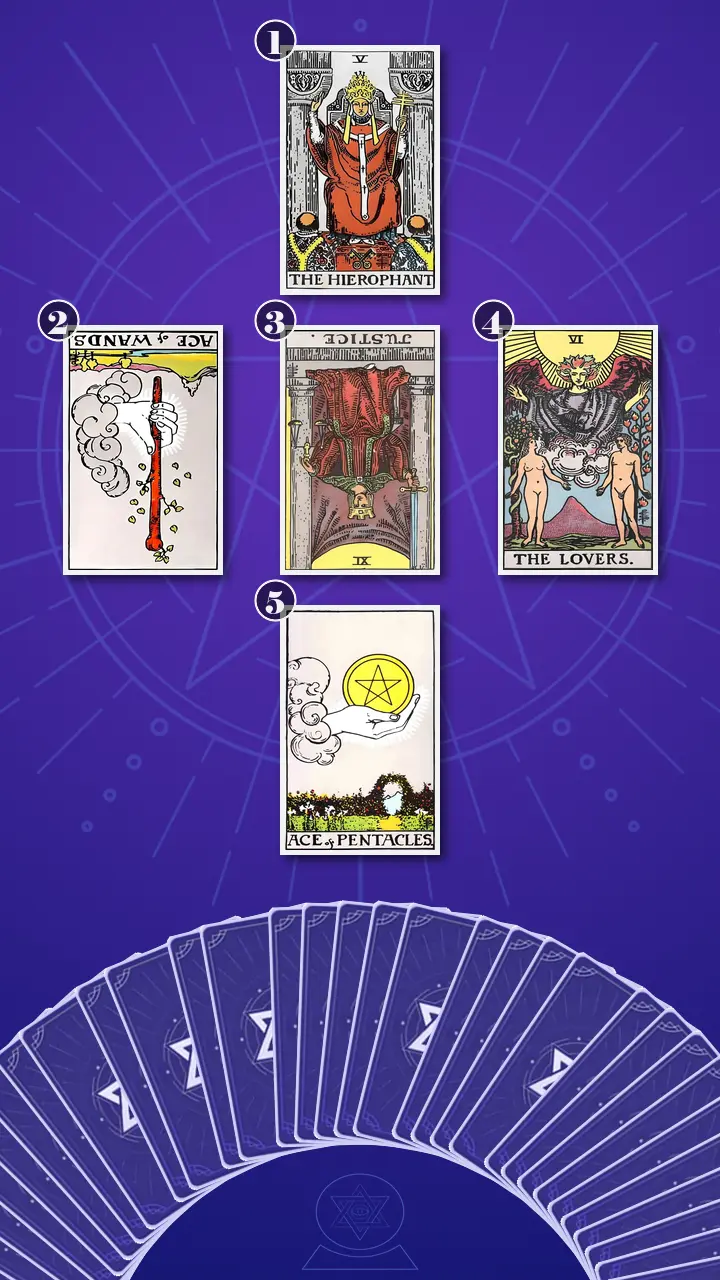
I chose a five-card Shadow Spread. The question was causal, not predictive: Jordan was not asking me to compare two fully defined career options or forecast an outcome. She wanted to understand the pattern beneath her career crossroads, especially the proper-role lock-in, the desire she kept excluding, and the belief guarding that exclusion.
This is how tarot works in my practice. I treat the cards as a structured external surface on which a pattern can be inspected. A card meaning is not evidence by itself; I offer an interpretation, connect it to observable life, and ask whether the connection survives contact with the querent’s experience. Jordan would remain free to reject any part that did not fit.
I arranged the cards in a cross. The top position would show the dependable identity she presented and protected. The left would reveal the desire removed from conscious consideration. The central card would expose the judgment keeping those sides apart. The right would recover the hidden gift, and the bottom would translate that insight into a grounded practice. It was a compact map of approved identity, disowned desire, biased judgment, whole-self choice, and practical evidence.
Reading the Crossroads Beneath the Proper Role
Position 1: The Praise That Quietly Auto-Renewed an Identity
I turned over the card representing the visible way Traditional Role Lock-In was enacted through Jordan’s morally proper, dependable identity. It was The Hierophant, upright.
I pointed to the elevated teacher, the two acolytes below him, and the crossed keys at his feet. The image carried institutional legitimacy, established codes, recognised training, and the security of knowing how to belong. In Jordan’s life, it looked like an appraisal in the City where a partner praised her judgment, composure, and dependability. The approval, her solicitor title, and the years spent qualifying could combine into what felt like a complete answer to whether the role still fit.
Upright did not mean that the institution was bad or that its guidance should be rejected. At its balanced level, Hierophant energy preserves knowledge, standards, and professional continuity. The excess appeared when recognition replaced consent. Praise for dependability began behaving like an auto-renewal notice: every successful performance quietly extended an identity Jordan had never been invited to reconsider.
“The inner line sounds something like this,” I said. “If I’m still good at this and people trust me with more, what right do I have to question it?”
Jordan gave a short laugh, but there was no lightness in it. Her fingers tightened around the cold mug, then loosened. “That’s so accurate it’s almost cruel.”
“The card isn’t accusing you,” I replied. “It’s distinguishing a skill from a permanent contract. Being good at a role is not the same as consenting to it forever. Which parts of being a solicitor express values you still endorse, and which parts feel binding mainly because they are already approved?”
She looked away from the screen before answering. “I still care about doing careful work and not letting people down. I’m less sure that being constantly available is a value. I think I’ve been treating it as one.”
Position 2: The Spark That Never Received a Start Date
I turned over the card representing the disowned desire behind Jordan’s value-desire split, including the impulses she dismissed before they could become lived evidence. It was the Ace of Wands, reversed.
The hand in the card offered a sprouting wand before the distant destination was fully mapped. Reversed, that gift was difficult to receive. I connected it to the note called “What I Want Next.” Jordan could open it, feel a spark around autonomy and unclaimed time, then demand that the spark explain how it would become a respectable career. When it could not supply an immediate answer, she closed the warm laptop, worked late, and later cited the nearly blank page as proof that she wanted nothing clearly.
“This is a Blockage of fire, not proof that there is no fire,” I said. “You may not lack desire. You may be filtering out every impulse that cannot immediately demonstrate usefulness.”
I asked what she had researched more than once without giving it even 45 minutes of direct experience. Her eyes moved toward the blank note. She named flexible working models, a writing course, and the possibility of having one weekday that did not belong to a firm or a career plan.
“Then the line beneath the card may be, ‘I would let myself want this if I could explain where it leads,’” I said. “But a beginning is not required to submit a five-year forecast.”
Her stomach seemed to drop before her shoulders shifted back against the chair. She rubbed one wrist where it had rested on the laptop. “I’ve been researching the same things for months. I keep assuming the vagueness means they’re not real.”
“Vagueness can be the result of repeated non-use,” I said. “An algorithm trained only on approved choices eventually concludes that no other preference exists. That conclusion tells us about the training data, not the full person.”
Position 3: Justice Reversed and the Weighted Spreadsheet
I turned over the central card, representing Moral Certainty as the guarding belief and the fear that choosing desire might undermine Jordan’s moral worth. It was Justice, reversed.
The fridge in her kitchen clicked off, and the room became suddenly quiet. In the card, the scales should have compared evidence evenly. Jordan’s internal version began with salary, pension, training, status, references, and familiarity already loaded onto one pan. “More autonomy” received no research budget, trial period, or factual hearing. It was marked “selfish” before it could speak.
Justice energy is meant to create Balance through truthful evaluation and proportionate consequences. Reversed, it showed an Imbalance in procedure. Jordan’s solicitor path only had to be familiar. Wanting something else had to survive cross-examination. The upright sword gave that unequal process decisive language, making a biased verdict sound objective.
“The proper role keeps winning because it enters as evidence; desire enters as a defendant,” I said. “A preference is information, not a character witness.”
Her breathing stopped for a beat. Her gaze unfocused as if she were replaying the last spreadsheet she had built. Then she exhaled through her nose and pressed her tongue against the inside of her cheek. “I gave staying twelve rows,” she said. “Autonomy got one line, and I literally put ‘self-indulgent?’ beside it.”
I asked her to reopen the decision as a process audit. “What did the proper option get to assume, and what did the wanted option have to prove?”
“Staying got to assume I was sensible,” she said slowly. “Wanting had to prove I was still a good person.”
Seeing Justice in front of a solicitor, I could not help thinking about the difference between a confident judgment and a fair hearing. I also thought of the planetary cycles I had watched over a decade of readings. A temporary period of pressure can dominate the sky without defining the whole orbit. In the same way, Sunday-night exhaustion, a demanding matter, or the adrenaline of being praised could affect the felt urgency of a decision without becoming reliable evidence about Jordan’s long-term fit.
“Maybe the verdict feels certain because the rules were written to protect one answer,” I said. “That does not tell us which external choice you should make. It tells us where you can restore fairness before making it.”
When The Lovers Put Both Lives Under One Light
Position 4: The Choice That Needed No Moral Loser
A bus passed outside Jordan’s window, and its reflected light moved across the table before fading. I turned over the card representing the capacity to integrate responsibility and desire through consciously chosen values rather than treating them as moral opposites. It was The Lovers, upright, and it was the key card of the reading.
I directed Jordan’s attention away from the romantic shorthand often attached to this card. The two figures were unarmoured and visible at eye level, a direct contrast to The Hierophant’s elevated authority and Justice reversed’s internal courtroom. The Lovers offered values-aligned self-authorship: a conscious choice that could include duty and aliveness without declaring either side morally impure.
Jordan was still caught in the Sunday-night sequence: a full work calendar, a nearly blank personal note, an availability email, a tightened jaw, and the brief relief of making the defensible choice. Beneath that sequence sat a harder demand: she believed she had to identify the correct person to be before she could permit a small preference.
You do not have to split goodness from aliveness; choose with your whole self, as the two unarmoured figures of The Lovers stand openly beneath one shared light.
I let the sentence remain between us. First, Jordan became completely still. Her fingers hovered above the trackpad, her mouth parted slightly, and her next breath seemed to stop high in her chest. Then her eyes lost focus. I could see her replaying something beyond the screen, perhaps the deleted Thursday blocks or the appraisal praise that had felt like a contract. Her pupils widened, and a thin line appeared between her brows. Finally, her fist opened against the table and her shoulders descended, but relief did not arrive cleanly. Her eyes brightened with tears, and irritation sharpened her voice.
“But doesn’t that mean I’ve been wrong this whole time?” she asked. “That I’ve wasted years choosing for the wrong reasons?”
“No,” I said. “It means your earlier choices may have met real needs, used real strengths, and reflected the information you had. Fairness is not retroactive prosecution. You do not have to turn your past into a mistake in order to review your consent now. The Lovers is asking for ownership, not a confession.”
Her jaw released, then tightened once more as the responsibility inside the insight became clear. Certainty had allowed her to disappear behind the proper answer. A choice she owned would be more exposed and more adjustable, but it would also be hers.
“Now, using this new perspective, think back to last week,” I said. “Was there a moment when this insight could have made you feel different?”
Jordan remembered the partner asking her to cover another matter. “I still might have said yes,” she told me. “But I could have checked my diary first. I could have noticed that I wanted the evening before deciding whether work genuinely needed it.”
This was where I used Cyclical Variable Filtering, one of the ways I separate temporary friction from the variables that can shape a person’s longer orbit. I asked Jordan to filter out the Sunday-night fatigue, the emotional charge of LinkedIn comparison, the immediate glow of a partner’s praise, and the pressure of one unusually demanding week. None of those factors was imaginary, but each was time-sensitive.
Then I asked her to retain the structural variables: her actual contractual duties, minimum sustainable income, London housing costs, health, autonomy, capacity, quality of work, and continuing consent. Once those categories were visible, the question changed. It was no longer, “Am I a good person if I want something different?” It became, “Which arrangement can responsibly hold the values I consciously endorse, and what evidence would help me review it?”
A responsible choice does not require desire to lose; it requires duty and aliveness to be weighed by values you actually chose.
I set an eight-minute timer and asked Jordan to divide a page into three columns: obligation, preference, and consequence. She chose the live question of extra availability and placed two concrete facts under each heading. I asked her not to use “good,” “selfish,” “proper,” or “sensible.” When the timer ended, she circled one preference that could receive a reversible 45-minute trial during the coming week.
I made the boundaries explicit. The exercise was not a demand to resign, cancel essential duties, disclose anything at work, or spend beyond her means. She could keep the trial private, make it smaller, or stop if it became uncomfortable. Real contractual, financial, caring, health, and safety obligations would remain real. The purpose was simply to stop mixing them with imagined judgments.
I saw the first clear movement in the reading. Jordan had begun in guilt-laced contraction, treating every preference as a referendum on moral worth. Now she was entering the discomfort of separating obligation from preference, the first step toward values-aligned self-authorship grounded in reversible evidence. It was not complete confidence. It was a fairer process, and that was enough to change what could happen next.
Position 5: The First Visible Entrance
I turned over the final card, representing the reversible, resourced experiment that could give Jordan’s wanted life a concrete place in her calendar and decision process. It was the Ace of Pentacles, upright.
The hand held one pentacle above a cultivated garden. Beyond it, a narrow path passed through an arch toward mountains that remained distant. I read the card as balanced earth energy: time, money, boundaries, dates, and observable experience. Jordan did not need to know where the entire path ended. She needed one visible entrance.
In ordinary life, the card looked like a one-week pilot in Google Calendar: one 45-minute desire-led block, a modest spending limit, notifications off, and a ten-minute review the following Sunday. Jordan could record her energy immediately before and after, then choose to stop, repeat once, or adjust. The wanted life would receive one material place in reality without becoming a resignation letter or a permanent identity.
The paired Aces made the movement especially clear. The reversed Ace of Wands held a spark that had been denied a beginning. The upright Ace of Pentacles gave that same spark a container. More analysis was not the missing bridge. No Swords appeared to suggest that another elaborate argument would produce clarity, and no Cups appeared to show that feeling had yet been granted a formal place. The bridge was honest acknowledgment followed by grounded evidence.
“You do not need a new identity,” I told Jordan. “You need one piece of lived evidence.”
Her shoulders settled against the chair. She opened her calendar while we were still speaking, but paused before creating an ambitious side project. “One block,” she said. “Not a new life plan.”
“Exactly. The first calendar block is an entrance, not a contract to reach the mountain.”
Evidence, Not Verdict: A Path with Review Points
I gathered the cards into one causal story. Jordan’s years of training had created genuine competence, financial structure, and professional belonging. The Hierophant showed how those benefits became fused with a socially approved identity. The reversed Ace of Wands showed what happened next: desires that could not justify themselves immediately were denied practical expression. Justice reversed revealed the mechanism maintaining the split, an internal court that gave duty the presumption of innocence and placed desire under a burden of proof. The Lovers restored Jordan’s capacity to choose through values she could name and own. The Ace of Pentacles gave that choice a bounded material form.
The cognitive blind spot was not that Jordan had no responsibilities. It was the assumption that institutional recognition proved continuing inner consent, combined with the habit of treating temporary pressure as a reliable verdict on her long-term direction. Her established solicitor path was a strong orbit with real gravity, but gravity was not the same as destiny. Her next move was to separate obligation, preference, and consequence, then give one preference enough reality to produce information.
I also introduced my Orbital Pause Strategy, a calculated 72-hour delay for non-urgent, high-stakes crossroads decisions. I explained that the pause was not passive waiting and certainly not a cosmic command. It was Decision Timing Calibration: checking whether the current environment was structurally fit for a consequential choice. A Sunday night immediately after an inbox request might be useful for noticing a pattern, but it was a poor place to issue a final verdict about an entire career.
- Run the Orbital Pause and Three-Column Fairness Check.For the next non-urgent, high-stakes role commitment, Jordan would create a 72-hour decision window. During the first eight minutes, she would open a phone note titled “Obligation / Preference / Consequence” and place two factual lines under each heading without using “good,” “selfish,” “proper,” or “sensible.” For an ordinary availability request that could not wait 72 hours, she would take the shortest honest pause available, check her diary, and use the one-fact-per-column version before replying.Tip: The pause applies only where the real timetable permits it. Deadlines, safety needs, contractual duties, and financial boundaries do not disappear; the goal is to prevent imagined judgment from disguising itself as obligation.
- Complete the Whole-Self Choice Audit.At her kitchen table, Jordan would take ten minutes to name three values she personally endorsed, such as integrity, autonomy, and sustainability. For one live decision, she would write one way each option served and obstructed each value in practice. Before a non-urgent commitment, she would also ask, “Would I still choose this if nobody used it as evidence that I am dependable?”Tip: Values should describe how she genuinely wanted to decide, not what would sound impressive in an appraisal. If three felt heavy, she could use one question: “Did this option include my consent?”
- Launch the Evidence, Not Verdict Pilot.Jordan would place one 45-minute desire-led activity in the coming week, close work email, and set a hard time or spending cap before beginning. She would record energy from 1 to 5 immediately before and after, complete the sentence “I noticed...,” and schedule a ten-minute review for the following Sunday. At that review, the only options would be stop, repeat once, or adjust.Tip: The minimum version is fifteen private minutes. Ending the experiment is valid data, and she would not turn it into a demanding side project merely to make the preference look serious.
None of these next steps required Jordan to decide whether to remain a solicitor forever. They replaced moralised decision fatigue with actionable advice, direct observation, and review points. Tarot had clarified the evaluation process; Jordan would decide what to do with the evidence.

A Week Later: The Quiet Proof
Six days later, I received a message from Jordan. She had used the short Three-Column Fairness Check before accepting another piece of work. The obligation column showed that the matter needed cover, but not necessarily from her. The preference column showed that she wanted to keep Thursday. The consequence column showed that asking for one evening to check capacity would not place the case at risk.
She had replied, “Let me check my existing deadlines and confirm tomorrow morning.” A colleague with more room took the matter. No confrontation followed. No one withdrew their respect. Jordan kept the block.
Her message continued: “I walked along the South Bank for 45 minutes with no work email, no career podcast, and no plan to make the time useful. My energy went from two to four. I still don’t know whether I’ll leave law, but blankness is not the same as having no desire.”
She slept through the night. Her first thought on Friday was, “What if I’m wrong?” She told me she smiled anyway, because the question no longer sounded like a verdict. It sounded like a review point.
I did not see this as proof that one external career choice was destined for her. I saw a smaller and more reliable transformation: guilt-laced contraction had made room for curiosity, curiosity had produced one piece of lived evidence, and evidence had begun strengthening self-trust. The cards had not protected the evening. Jordan had.
I know how convincing the proper role can look when every calendar block could be defended, your jaw remains tight, and your own note stays blank. Wanting a life of your own can begin to feel like evidence against your goodness. Yet noticing that duty and desire have been judged by different rules already means you are no longer at the beginning. Responsibility and aliveness belong on the same page.
If your next choice no longer had to testify that you are good or selfish, which tiny, reversible preference would you place through the first visible arch and give one honest week in your calendar?