Sending the Update at 5:17: From Extra Passes to a Meaning Test

The Stable Job That Was Eating Tuesday Night
You have the stable salary, benefits, and good reviews, yet Sunday evening still lands in your chest like an elevator dropping past its floor. Nothing is technically wrong, which somehow makes it harder to admit that you are unhappy.
I first met Maya (name changed for privacy) through a video window at 9:18 p.m. in her Toronto apartment. A half-finished dinner beside her laptop smelled faintly of cold garlic. The laptop fan hummed beneath Slack's occasional ping, and the screen cast a hard white light over her tired eyes as she moved a table two pixels to the left in a project update that had been ready at five.
“It'll only take five minutes, and then I can relax,” she said, repeating the sentence she had told herself forty minutes earlier. Her shoulders sat almost level with her ears. “I keep saying this quarter is unusually busy, but every quarter becomes the same story. I'm good at the job. I just don't feel present in my own life.”
What she described was compulsive overworking in a stable but unfulfilling job, driven by a fear of being replaceable. She wanted meaningful work, but she kept protecting the security of her current role by giving it the energy she would have needed to discover what meaning actually looked like. Her hollow exhaustion felt less like ordinary tiredness and more like walking home with an office building still strapped to her back.
“The job is stable enough that leaving feels unreasonable,” I said, “but empty enough that staying present inside it feels difficult. Nothing is technically wrong, but that does not make the emptiness imaginary. Let's slow this down and draw a map of the loop. We aren't asking the cards to make a career decision for you. We're looking for the point where your choices can become yours again.”

Choosing a Compass for Golden Cage Burnout
I asked Maya to close Slack, place both feet on the floor, and take one breath without trying to make it especially deep or calm. I shuffled slowly while she held a precise question in mind: “Why do I keep overworking when this stable job feels so empty?” The small ritual was not about summoning a fixed answer. It gave her nervous system a clean transition from performing the problem to observing it.
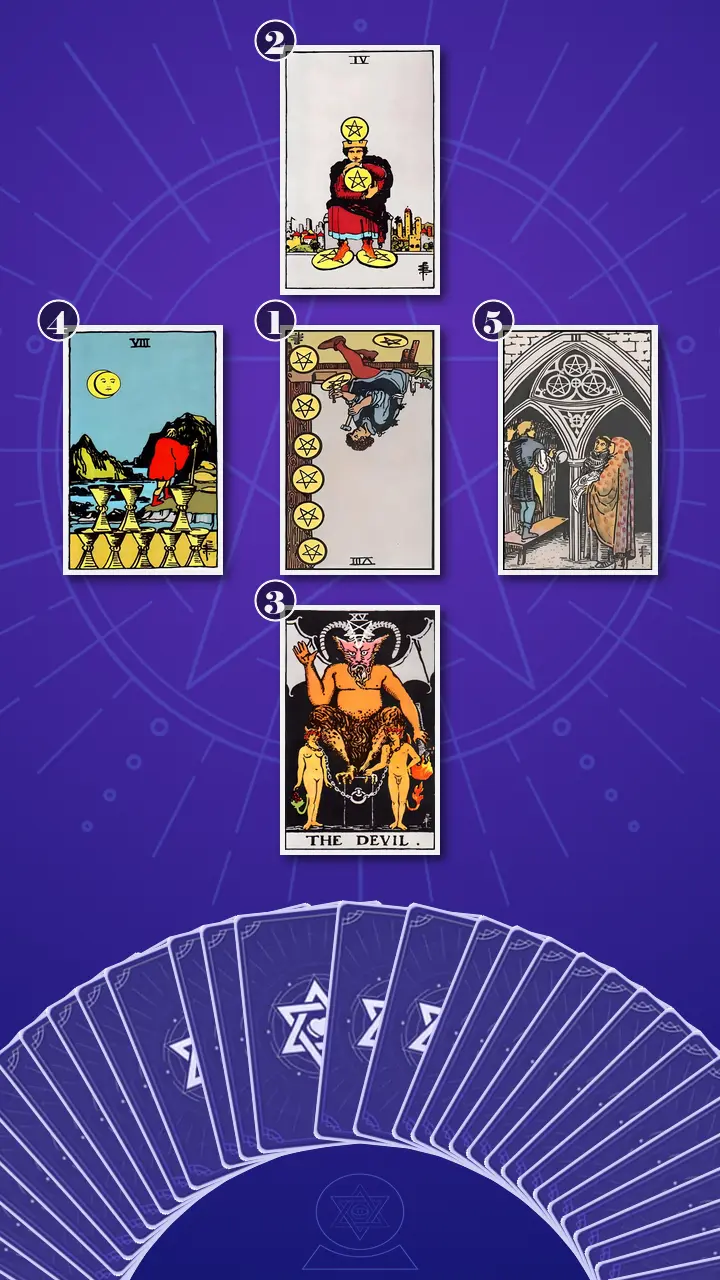
I chose the five-card Shadow Spread. For anyone wondering how tarot works in a career reflection like this, the spread is not a predictive machine and it is not a disguised instruction to quit. It is a structured way to place behavior, belief, fear, need, and action where they can be examined separately. Card meanings in context help turn a vague feeling into a testable pattern.
A decision spread would have pushed Maya too quickly toward “stay or leave.” A larger Celtic Cross would have added breadth when her question needed depth. The Shadow Spread was more precise because it followed the actual sequence of her workaholic loop: visible behavior, the protective security story, the hidden availability-for-worth contract, the neglected need, and an integration practice.
I placed the first card at the center for the concrete overwork pattern. Above it went the story she consciously used to protect that pattern; below it, the fear operating underneath. The fourth card would reveal the need she had been suppressing, and the fifth would show how to turn insight into bounded, practical action. On my table, the cross looked like a compass centered on a habit, with one horizontal route opening from emotional truth toward grounded contribution.
Reading the Loop Behind the Green Dot
Position One: The Document That Was Already Done
“The card now open represents the visible workaholic loop: staying late, claiming optional tasks, and refining completed work even after usefulness has ended,” I said. “It is the Eight of Pentacles, reversed.”
In the Rider-Waite-Smith image, a solitary craftsperson repeats the same action at a bench while finished pentacles already hang behind him. Upright, this can be disciplined practice and growing mastery. Reversed in Maya's visible-pattern position, that discipline had tipped into excess while purpose had fallen into deficiency. The work continued, but development had stopped. Repetition was being used to purchase reassurance.
I pointed toward the row of completed pentacles. “This is your Tuesday night almost frame for frame. It is 9:18. The update has met the brief. No one has requested a revision. Dinner is cooling, Slack is still open, and you are adjusting spacing because one more cosmetic improvement briefly quiets the thought that ordinary competence might not be enough.”
As an artist, I recognized the moment. I have stood in front of a finished piece and felt the urge to alter one more line, not because the image needed it, but because releasing it would remove the protection of being “still at work.” Looking at the reversed Eight, I thought of an editing timeline that keeps gaining cuts after the scene has already told the truth. At some point, refinement stops serving the work and starts serving the fear of being seen.
“Your inner monologue says, 'It will only take five minutes; then I can relax,'” I told her. “Forty minutes later, the question becomes, 'Why am I still here?' That does not mean your standards are fake or your competence is a problem. It means high standards and diminishing returns have become difficult to tell apart.”
Maya gave one short laugh, but there was no amusement in it. Her eyes dropped to the still-open document. “That is so accurate it's almost cruel.”
I did not rush to soften the recognition. “Accurate does not have to mean condemning. This pattern probably helped you earn trust and build a secure career. We are only asking whether the same strategy is still helping at 9:18 p.m. A useful experiment is not 'care less.' It is to define what done means before one low-risk task, make one review pass, and stop when the agreed standard has been met.”
Her cursor hovered over the project update. Then I watched her save it and close the window. The movement was almost comically small, but her hand remained on the trackpad for a second after the document disappeared, as though her body expected a consequence to arrive immediately.
Position Two: Paying for Security Twice
“The card above the center represents the protective story around the golden cage: the salary, benefits, predictability, competence, and approval that make excessive work feel responsible,” I said. “This is the Four of Pentacles, upright.”
The figure holds one pentacle against his chest, balances another on his head, and pins both feet beneath two more. The security is real. So is the immobilization. In this position, the upright energy of preservation had become excessive: protection had expanded until Maya was trying to preserve not only her job, but every after-hours behavior she associated with deserving it.
“I don't want to pretend the practical side doesn't matter,” Maya said. “Toronto is expensive. I have benefits, a decent pension contribution, and a promotion path. I worked hard to get here. Saying I'm unhappy feels ungrateful.”
“Those are legitimate reasons to value the job,” I said. “The card is not asking you to dismiss them. It is asking whether a stable salary also requires a Tuesday dinner to go cold when no deadline exists. You may be paying for security twice: once with good work, and again with your evenings.”
I asked her to distinguish the protection supplied by the role from the protection she was trying to manufacture. Her salary arrived because she performed an agreed job. Her health coverage did not become safer when she adjusted a table after dinner. Her pension did not increase because her Slack dot stayed green. An optional late night could feel like insurance, but it did not insure her against every future career risk. It mainly removed recovery time from the present.
Maya's mouth tightened. She pressed her thumb against the side of her mug and looked away from the screen. “When you say it like that, I realize I treat the whole package like something I have to repay every day. Not just with the job. With being the most available person in the room.”
I nodded. “That distinction matters. Financial caution is not the problem. The blockage begins when caution is asked to eliminate all uncertainty, because it can never finish that assignment. If the job is already stable, how many donated evenings would finally make it feel secure enough?”
Position Three: The Contract No One Signed
“The card below the center represents the hidden bargain beneath the pattern: the fear that reducing output will expose replaceability and weaken personal worth,” I said. “It is The Devil, upright.”
I kept my voice plain. The Devil was not a warning that something terrible was coming, and it did not diagnose Maya or condemn ambition. In this spread, it showed a blockage created when output, approval, compensation, and identity fused into one unquestioned contract. The figure's pedestal looked imposing, but the chains around the two people were loose enough to examine and remove.
“Imagine a non-urgent Slack notification appearing at 8:56 p.m.,” I said. “Your stomach drops before you have checked the deadline. The thought compresses into a rule: 'If I don't answer, I'll look less committed. If I look less committed, I'll become easier to replace.' You reply. Someone says, 'You're a lifesaver.' You get a quick lift, and twenty minutes later you feel flat and irritated because another piece of the evening is gone.”
Maya inhaled sharply enough for me to hear it through the call. “That happened on Thursday. Almost exactly.”
“The deadline may be external; the rule that you must always exceed it may not be,” I said. “No urgent tag. No on-call agreement. No deadline that night. Your colleagues were already offline. You have treated immediate availability as mandatory, but where is that rule written?”
I told her that I sometimes think of this pattern as an app permission granted years ago and never reviewed. It keeps running in the background, consuming energy because it once seemed useful. Every time overwork earns praise, the personal algorithm receives another signal: recommend more overwork. The feed begins to look like proof when it is really trained repetition.
This was also where I used my Workplace Typecasting Analysis. I asked Maya to describe what happened in cross-departmental meetings when an unowned problem appeared. Before anyone clarified scope, she usually said, “Happy to take this.” Her office ecosystem had learned to cast her as the hyper-competent supporting character: the person who absorbed messy work, protected everyone else's deadlines, and made the plot run smoothly without being asked what she wanted to lead.
“Typecasting does not mean your colleagues secretly planned this role for you,” I explained. “Teams learn from repeated cues. Every automatic yes teaches the system that your capacity is elastic. Every late reply teaches it that access to you continues after hours. The praise is real, but it keeps rewarding a version of your professional identity built around rescue rather than authority.”
Her breathing paused. Her fingers tightened around the mug while her gaze lost focus, as if she were replaying a sequence of meetings. Then her grip loosened, and she released a low breath from deep in her chest. “I keep calling it leadership,” she said, “but sometimes I'm just making sure no one can function without me.”
“That is the loose chain,” I said. “You can see the difference now. The fear may still be present, but it is no longer the same as a written requirement. Agency begins with a low-stakes evidence test: one message left until morning, one optional problem not claimed before ownership is discussed, one completed task not reopened. The card reveals a contract you can renegotiate. It does not declare a fate you must obey.”
When the Eight of Cups Found the Missing Space
Position Four: A Complete Career With One Visible Gap
The work laptop chose that moment to dim. Its fan slowed, Slack went silent, and the apartment seemed to expand around the absence of its noise. I turned the fourth card, the bridge of the reading, and let the image rest between us before speaking.
“The card now open represents the neglected need and the key transformation: permission to treat emptiness as information without forcing an immediate stay-or-quit decision,” I said. “It is the Eight of Cups, upright.”
Eight cups stand in a careful, complete-looking arrangement, yet a visible gap remains. A cloaked figure turns toward a moonlit path and distant mountains. The figure is not fleeing a disaster. The cups are upright. Something substantial has been built. The movement begins because outward sufficiency and inward fulfilment are not automatically the same thing.
I placed the image beside the facts of Maya's career: salary, health benefits, title, promotion path, positive reviews, and proven competence. Then I pointed to the gap. “Nothing is technically wrong, so why does Sunday night feel this heavy? What if emptiness is data, not evidence that you are ungrateful?”
The Cups introduced emotional information into a spread crowded with earth: labor, money, control, measurable output, and material security. This was not practicality giving way to fantasy. It was a closed work system finally receiving a missing input. Maya had tried to solve a meaning problem using more effort and more analysis. The Eight of Cups restored the possibility that felt experience could influence a practical decision.
I could see the familiar equation still running behind her eyes. It was 9:18 p.m.; dinner had cooled beside a finished update, and extra polish had created one minute of relief without answering why the work felt empty. Part of her still believed she needed a perfect alternative before she was allowed to stop producing.
Meaning will not appear at the bottom of another finished task list; reclaim one deliberate step toward what matters, like the Eight of Cups figure turning from a complete but unfulfilling stack.
I watched Maya freeze. Her breath stopped first, and her fingers remained suspended above the rim of the mug. Then her eyes moved away from me and settled somewhere beyond the screen, pupils slightly widened as memories seemed to run behind them: declined dinners, annual leave spent checking email, the LinkedIn post about climate finance, every “happy to help” sent before she had asked whether she cared. Her eyes reddened at the edges. Next came the release: her jaw unclenched, her shoulders lowered by a visible inch, and the hand around the mug slowly opened. She exhaled with a faint tremor, but relief did not arrive alone. I saw the brief disorientation that can follow when a burden is revealed as partly optional. “But doesn't that mean I've been doing this to myself?” she asked. “Doesn't it mean I've wasted all those evenings?”
“It means you used a strategy that once helped you build competence and safety,” I said. “Now you can see where that strategy has become too expensive. Recognition is not a prosecution of your past. It is a change in who gets to direct the next scene.”
I asked, “Now, using this new perspective, think back to last week. Was there a moment when this insight could have made the experience feel different?”
Maya returned to Sunday night. A former colleague had posted a polished LinkedIn announcement about moving into climate finance. Maya's chest had hollowed out as she stared at the new title and carefully framed origin story. Within minutes, she had opened Monday's deck and started improving it.
“I thought I needed to research courses, compare salaries, build a five-year plan, and know whether I could succeed before I did anything,” she said. “So I did none of that. I worked on the deck because at least I knew how to be good at it.”
“The Eight of Cups offers a smaller movement,” I said. “Protect one Wednesday evening from overtime. Use forty-five minutes to remember a contribution that felt worthwhile, investigate a mission-led internal project, or ask someone in another field what the day-to-day is actually like. Then stop. You are gathering evidence, not announcing a career rebrand.”
I told her this was not a Truman Show sprint toward the edge of a manufactured world. It was the quieter first act of testing one boundary and discovering whether it was truly fixed. She did not have to reject stability to question the conditions attached to it. She could keep the job while allowing one protected piece of effort to travel somewhere new.
This was where my Leadership Narrative Construction lens sharpened the card's message. Maya's old professional script read: I prove that I belong by absorbing whatever other people cannot carry. The emerging script read: I am an operations leader who decides which problems deserve my capacity, names the purpose, and builds conditions in which responsibility can be shared.
As an artist, I know that leaving a painful scene does not mean abandoning the whole film. Sometimes it means recognizing that the camera has remained there after the scene has given everything it can. The Eight of Cups handed Maya no resignation letter. It handed her the pen for one deliberate transition.
I named the crossing clearly: this was a first movement from hollow exhaustion and fear-based overwork to values-led curiosity, bounded effort, and steadier self-trust. Not a total transformation. Not certainty. Just the moment when dissatisfaction stopped functioning as a verdict and began functioning as usable information.
Position Five: Work With a Shared Blueprint
“The final card represents the integration step: a bounded, collaborative experiment that connects your existing competence with a contribution you consider worthwhile,” I said. “It is the Three of Pentacles, upright.”
The card shows a craftsperson standing with two collaborators who hold a plan. Skill is visible, but so are shared purpose, feedback, and structure. After the excess earth of repetitive labor and defensive control, this Pentacles card restored earth in balance. Maya did not need to become less capable. She needed scope, reciprocity, and a reason for the work beyond proving that she could carry it.
I translated the scene into a twenty-five-minute conversation with a trusted colleague or manager. In a shared document, Maya would use three headings: purpose, scope, and definition of success. They would name why the problem mattered, what she could contribute within a fixed amount of time, who owned the remaining work, and which current task would move if the experiment proceeded.
“I don't have to solve my whole career identity alone,” Maya said slowly. “I can test whether a different kind of contribution feels different.”
“Exactly. The Three of Pentacles contrasts solitary overfunctioning with shared ownership. It is not another invitation to volunteer for meaningful-looking unpaid overtime. If nobody can name the owner, the time limit, or what comes off your plate, the experiment has no boundary and the old pattern has simply changed costumes.”
Maya reached for her phone and opened her calendar. I watched her hover over Wednesday evening, then stop. “My first instinct is to schedule three conversations and make a Notion dashboard.”
“That would be the task list trying to impersonate clarity,” I said. “Choose one person, one problem, and one limited contribution. Meaning needs contact with reality, not a more sophisticated postponement system.”
She smiled, this time without the earlier bitterness, and created a single forty-five-minute block.
The Meaning Test and the One-Pass Rule
I drew the cards together into one coherent account. A history of being rewarded for reliability had taught Maya that extraordinary availability created safety. In the present, the Eight of Pentacles reversed showed her running faster on a treadmill because stopping might expose that it faced the wrong direction. The Four of Pentacles explained why she kept running: salary, benefits, and professional approval were real assets, but she had fused them with every excessive habit surrounding the job. The Devil revealed the hidden contract underneath: if she stopped exceeding expectations, she feared she would become replaceable and therefore less worthy.
The transformation pair changed the direction without demanding a dramatic escape. The Eight of Cups treated emptiness as emotional evidence and redirected a protected portion of effort toward curiosity. The Three of Pentacles grounded that curiosity in a shared, scoped contribution. Maya's drive was never the enemy. The question was who directed it, what it served, and where it was allowed to stop.
Her cognitive blind spot had been assuming that most of the pressure was external. Some deadlines were real, but the expectation of constant overperformance often arrived before she checked the evidence. She had also confused being essential with being valuable. Making herself the emergency route for every problem increased dependence on her labor, but it did not necessarily increase authority, purpose, or meaningful leadership.
“The shift is not from ambitious to disengaged,” I said. “It is from adding hours to prove value toward setting a firm stopping point and using one protected block each week to test what contribution feels meaningful. A boundary is not lower ambition; it is how effort gets a direction.”
- Run the One-Pass Done Rule.Before one low-risk email, update, or internal document tomorrow, write three acceptance points in a private note. Complete one review pass, confirm that the points are met, and send or close the task without cosmetic changes after hours. The next morning, record whether anyone requested revisions, how strong the urge to reopen it felt, and how much time the stopping rule returned.Use a task without legal, safety, or regulatory stakes. The aim is not to lower quality; it is to compare a feared consequence with what actually happens.
- Protect one Meaning Test.Choose one evening this week and reserve forty-five minutes with a fixed start and stop time. For the first ten minutes, create two phone notes: “Work that drains me even when I do it well” and “Contribution that has felt worthwhile, even briefly.” Add one concrete memory to each, circle a value in the second note, and use the remaining time to research one role, internal project, person, or problem connected to that value.This is evidence gathering, not a resignation plan. If forty-five minutes feels impossible, use fifteen and investigate one memory or send one low-pressure request for a twenty-minute chat.
- Use the Protagonist Reframe Directive.At the next cross-departmental meeting, pause for one breath before saying “happy to take this.” Ask, “What outcome matters, who owns the work, and what should move if I contribute?” If the problem feels worthwhile, offer a defined limit: “I can contribute up to two hours this week if we agree on the specific deliverable and shared definition of success.”Keep a one-page purpose-scope-success note in front of you. The new leadership signal is not refusing everything; it is making responsibility, tradeoffs, and authority visible before donating capacity.
I asked Maya to choose the smallest version she could genuinely complete. She chose the One-Pass Done Rule for a Thursday update and the Wednesday Meaning Test. The meeting script would wait until a relevant project appeared. That choice mattered: she was already practicing direction by refusing to turn a clarity exercise into three new obligations.
“And when the discomfort shows up after I log off?” she asked.
“Expect it without treating it as proof that the boundary is wrong,” I said. “Your body has learned that completing one more task produces immediate relief. A stopping point may feel unsafe before it feels restorative. Notice the tight jaw or the hand moving toward Slack, name the feared consequence in plain language, and check the evidence. You remain free to respond if something is genuinely urgent. The goal is choice, not a performance of perfect boundaries.”

A Week Later, Dinner Was Still Warm
Six days later, I received a message from Maya. She had written a three-point definition of done for a routine project update, completed one review, and sent it at 5:17 p.m. Her hand had moved toward the file twice that evening. She did not reopen it. No revision request arrived the following morning.
On Wednesday, she kept the forty-five-minute Meaning Test. One memory stood out: helping a junior colleague redesign an onboarding process so new hires did not spend their first week feeling lost. The repeated value was not prestige or novelty. It was making complicated systems more humane. Maya sent one low-pressure message to someone working on an internal financial-accessibility initiative and asked for a twenty-minute conversation about the actual day-to-day work.
The change was small enough to fit inside the life she already had. She had not quit, discovered a single perfect calling, or stopped caring about financial security. She had simply closed one finished task, eaten dinner while it was warm, and allowed one piece of her competence to investigate a contribution that mattered to her.
That night she slept through, but her first thought in the morning was, “What if I'm getting this wrong?” She told me she smiled, not because the fear had disappeared, but because it no longer had administrator access.
I thought again of the figures across the spread: the solitary worker repeating, the guarded figure pinned by what he protected, the loose chains, the traveler beginning to move, and the craftsperson building from a shared plan. The cards had not rescued Maya or selected her future. They had made the pattern visible enough for her to reclaim authorship. She supplied the boundary, the message, and the first real-world evidence.
When a quiet evening makes your chest feel heavy, it can seem safer to reopen the laptop and prove you are needed than to risk discovering that competence, security, and a life that feels like yours are not automatically the same thing. If you notice that you are paying for security twice, you are already beginning to separate the job you may choose to keep from the hidden contract you are allowed to revise.
If one protected piece of your effort no longer had to keep your green dot lit or prove that you deserved your place, what worthwhile contribution would you let it audition for this week?