Finding Clarity on the 8:52 Victoria Line Scroll
You’ve re-opened the reunion invite three times on your commute and still haven’t replied—because you’re stuck in people-pleasing decision paralysis and waiting for social proof to make it “safe.”
Taylor told me that sentence like it had been following them down the escalator. They were 27, a junior UX designer in London, and their phone had become a little slot machine: pull to refresh the attendee list, flick to Instagram Stories, glance at WhatsApp, back to the email. The carriage was too warm. The fluorescent lights turned everyone’s faces slightly grey. The screen in their palm was the only warm thing, and it made the whole decision feel weirdly intimate—like the invite was reading them back.
“If I just know who’s going,” they said, jaw working like they were chewing through a thought, “then I’ll know what to do.”
I watched their hands while they spoke—restless, fast, hovering. Every time the reunion subject came up, their chest tightened as if the RSVP had teeth. Their anxiety wasn’t abstract. It was a tight jaw, a shallow breath, and that small adrenaline spike you get when your name shows up on a screen and your body assumes it’s about to be graded.
Underneath the logistics was the real tug-of-war: wanting to choose based on what they actually wanted vs fearing that their choice would change how others valued them.
“I don’t even know if I want to go,” Taylor admitted, voice dropping, “or if I just want to not look weird.”
I leaned in—warm, practical, no theatrics. “Okay,” I said. “Let’s treat this like a Journey to Clarity. Not ‘Will the reunion be good?’—but what old approval pattern is steering your yes/no, and what would it look like to choose from the present, not from the old room in your head.”

Choosing the Compass: How the Horseshoe Spread Maps a Pattern
I asked Taylor to take one slow breath—not as a ritual, just as a nervous-system handbrake—and to hold the question in a single line: “What’s actually driving this RSVP?” While I shuffled, I kept my tone grounded. Tarot works best, in my experience, when we use it as a structured mirror: it gives the mind something concrete to look at, so it stops spinning in vague threat.
“We’ll use a Horseshoe Spread today,” I told them. “It’s a seven-card arc—past conditioning to present tension, then hidden influence, obstacle, external pull, advice, and finally integration.”
For a question like Taylor’s, this spread is ideal because it doesn’t pretend the dilemma is just a pros-and-cons list. It makes room for the hidden rulebook—the subconscious “shoulds” that steer you before you even realise you’ve been steered. It also forces a landing: advice and integration, so we don’t leave you with more analysis and no next step.
“Card 2 will show the exact stuck posture you’re in,” I added, “Card 3 will reveal what’s quietly running underneath it, and Card 6 will give you the cleanest way to respond—yes with limits, or a calm no.”
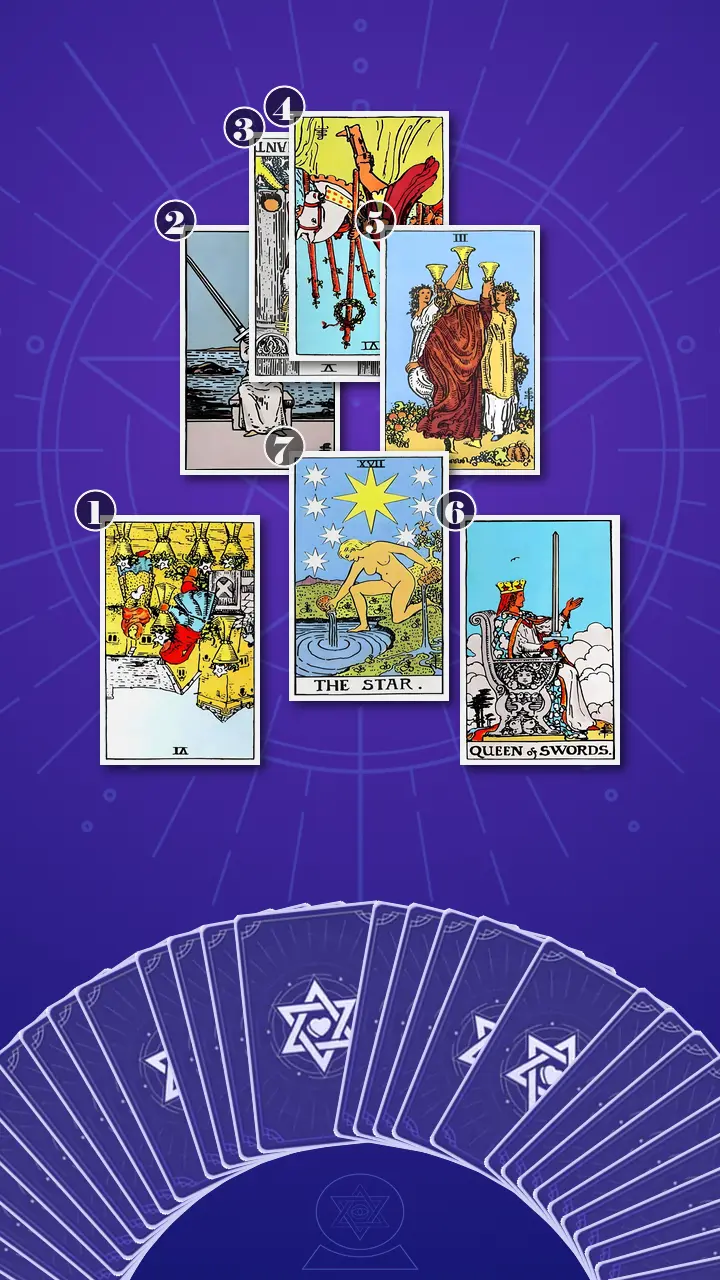
Reading the Arc: Card Meanings in Context (and in Your Inbox)
Position 1 — Past conditioning: the old approval pattern and social role you learned to play
“Now we’re turning over the card that represents your past conditioning: the old approval pattern and the social role you learned to play around this group.”
Six of Cups, reversed.
I tapped the image lightly. “This is like when you open the reunion invite and suddenly you’re not 27 in London—you’re back in an old courtyard version of yourself, trying to be the easy, agreeable one. You start shaping your RSVP to match a memory of how you used to be seen, rather than your current capacity. The past isn’t just a vibe here; it’s a script trying to drive your thumbs.”
Reversed, the Six of Cups often shows nostalgia pulling you backwards—not as sweetness, but as a role you slip into automatically. The energy isn’t balanced Water; it’s Water that’s been rerouted into old approval habits.
Taylor let out a short laugh that carried a little bitterness. “That’s… brutal,” they said. “Like, it’s true, but it’s almost rude how true.”
“It’s specific,” I agreed gently. “Not rude. And it’s useful.”
Position 2 — Present tension: what your RSVP dilemma looks like in real time
“Now we’re turning over the card that represents your present tension: what the stuck moment looks like on your screen and in your body.”
Two of Swords, upright.
“Your email is open, then minimised, then open again,” I said. “You keep switching apps—attendee list, Instagram, WhatsApp—like one more piece of information will finally make the decision safe. You’re not neutral; you’re braced. Not replying feels like control, but it’s really a pause button you can’t stop pressing.”
This is Air energy in blockage: thinking as protection. The blindfold isn’t ignorance—it’s the move of ‘I can’t decide until I can guarantee how it will feel.’ The crossed swords aren’t strength; they’re guardrails over the heart.
And this is where I name it cleanly, because people need a line they can hold: “Social proof isn’t the same thing as self-truth.”
Taylor’s shoulders dropped a millimetre—barely, but I saw it. Their mouth pressed into a line, then loosened. It wasn’t relief yet. It was recognition: a quiet, uncomfortable nod that said, Yeah. That’s exactly the loop.
Position 3 — Hidden influence: the internalised rules about belonging steering your yes/no
“Now we’re turning over the card that represents the hidden influence: the internalised rules about belonging that quietly steer your RSVP.”
The Hierophant, reversed.
“The invite triggers an invisible checklist,” I said, keeping it practical: “be successful, be friendly, don’t be awkward, don’t seem bitter, don’t seem lonely. You start hunting for the socially ‘correct’ RSVP, as if the reunion is an institution that can stamp you approved or rejected.”
This is the ‘rulebook’ card, flipped. The energy here isn’t healthy tradition; it’s a borrowed authority—a set of community guidelines no one posted, but you’re moderating yourself as if you’ll be banned from belonging.
I asked, “If you list three ‘should’ thoughts you’ve had about this reunion—are they group rules or your rules?”
Taylor stared at the card and went very still. Then: “Wait—yeah. They’re… not mine.” Their fingers, which had been picking at a sleeve seam, paused.
Position 4 — Main obstacle: the approval-seeking fear that inflates the stakes
“Now we’re turning over the card that represents the main obstacle: the specific approval fear that makes this choice feel high-stakes.”
Six of Wands, reversed.
“You’re not asking ‘Do I want to go?’” I said. “You’re asking, ‘Will I look like I’m winning if I go?’ You consider the outfit, the story you’ll tell about work, the vibe you’ll project—before you even RSVP. And if you can’t find a ‘win’ to carry into the room, your body pushes you toward decline just to avoid being perceived as less-than.”
This is Fire energy, but distorted—recognition as a condition, not a bonus. It’s a deficiency of internal validation, and an excess of imagined audience.
“It’s like a live LinkedIn annual review,” Taylor said, and winced as they said it—like they’d just admitted something they wished wasn’t true.
“Exactly,” I replied. “And here’s a line to keep close: Connection is real. Applause is optional. The card is showing you where the pressure sneaks in: you’re turning a potential catch-up into a status pitch.”
Position 5 — External pull: social pressure, group energy, and what’s genuinely inviting
“Now we’re turning over the card that represents the external pull: the group energy, the pressure, and the genuine invitation inside it.”
Three of Cups, upright.
“A friend messages, genuinely excited. You remember a couple of people you’d actually like to see—real warmth, real laughter potential,” I said. “The pull isn’t all people-pleasing; some of it is legitimate connection. But the group energy also amplifies the pressure, like your RSVP is a vote on whether you still belong.”
This is Water in balance—a reminder that not every room is a competition. It’s important because it stops the story from becoming ‘going is bad’ or ‘social things are unsafe.’ The card says: there is real relational nutrient here. You just don’t have to pay for it with your self-respect.
When the Queen of Swords Cut the Noise: One Sentence That Doesn’t Beg
When I reached for the sixth card, the room seemed to go quieter—not dramatic, just that natural hush that arrives when the mind senses something true is about to be named.
“Now we’re turning over the card that represents advice: the healthiest boundary-based way to RSVP.”
Queen of Swords, upright.
“This is you stopping the negotiation with your inbox,” I said. “One sentence that’s true and kind. Either: ‘Thanks for inviting me—I can’t make it.’ Or: ‘Yes—can do 7–8pm, then I’m heading off.’ No life-update pitch. No defence brief. Clarity over performance.”
As a Jungian psychologist, I’m always listening for the moment a pattern tries to masquerade as logic. And because I used to train intuition for travellers on international cruises—where we made decisions with weather, schedules, and human limits in real time—I have a way I like to diagnose choices. I call it my Choice X-Ray.
“Let’s X-ray this RSVP,” I told Taylor. “Not ‘What looks correct?’ but hidden costs and benefits. The hidden cost of a yes-for-approval is exhaustion and resentment. The hidden cost of a no-for-image is isolation and rumination. The hidden benefit of a truth-based sentence—either way—is dignity. Your nervous system relaxes because it finally knows where the boundary is.”
Setup: Taylor was still stuck in that Tube moment—invite open, attendee list half-loaded, Instagram already in the other hand—trying to predict the whole night before choosing yes or no. Their mind wanted a guarantee: that they wouldn’t feel exposed, that they’d be perceived correctly, that they could control the narrative.
Delivery:
Stop treating the RSVP like a popularity vote—raise a clear sword of truth, choose one sentence, and let the boundary do the work.
I let the sentence hang there for a beat, the way you pause after a clean edit, so the meaning can land.
Reinforcement: Taylor’s reaction came in a sequence I’ve learned to trust—the body tells the truth before the mouth can package it. First, a micro-freeze: their breath caught, and their hands stopped moving as if someone had finally taken the phone out of the loop. Then the cognitive seep-in: their gaze went slightly unfocused, like they were replaying every draft they’d written—paragraphs of apology padding, achievements smuggled in, the anxious little justifications. And then the release: a long exhale that sounded almost like a laugh, their shoulders dropping, their jaw unclenching in a way that changed the whole shape of their face.
But it wasn’t only relief. There was a flicker of defensiveness too—new clarity can feel like stepping into cold air. “But if I send one sentence,” Taylor said, voice tight again for a moment, “won’t they think I’m rude?”
“That,” I said softly, “is the old rulebook trying to keep its job.” I nodded at the Queen. “You’re allowed to be polite without being porous.”
I leaned forward. “Now, use this new perspective and recall: last week, was there a moment—opening the invite, seeing a classmate’s glow-up post, getting a ‘Are you coming?’ ping—where this one-sentence truth would have changed how your body felt?”
Taylor blinked, swallowed, and nodded once. “Thursday,” they said. “Outside Pret. I saw someone’s promotion post and I immediately started… building a case. Like I needed evidence to exist.” Their eyes went a little shiny, not in a dramatic way—more like a contact lens you suddenly notice.
“That’s the shift,” I told them. “From approval-driven RSVP paralysis and social-proof checking to body-and-calendar-based clarity with compassion. Not ‘confidence’ as a performance—clarity as self-respect.”
Position 7 — Integration: what it feels like when you choose from self-approval
“Now we’re turning over the card that represents integration: what comes after you hit send, and what helps you close the loop.”
The Star, upright.
“After you RSVP, you don’t keep refreshing for reactions,” I said. “You do something small and grounding—shower, walk, one song—so your body registers that nothing catastrophic happened. The reunion stops being a verdict, and becomes what it always was: optional information.”
This is the energy of healing after visibility triggers. Not armour. Not winning. Just an unforced baseline returning. The Star is Water restored to gentle flow—softening the Queen’s clean boundary into self-compassion.
Taylor’s chest rose a little deeper on the next breath. Their shoulders eased back into the chair as if they’d been holding themselves forward for days.
One Sentence. Send. Close the Loop: Actionable Next Steps for RSVP Anxiety
I brought the whole arc together for them, like threading beads into one string. “Here’s the story these cards told,” I said. “The past (Six of Cups reversed) pulls you into an old likeable role. The present (Two of Swords) tries to stay safe by not committing. Underneath, the hidden rulebook (Hierophant reversed) says you must be acceptable to belong. The obstacle (Six of Wands reversed) turns the reunion into a stage—like you need a victory wreath to show up. And yet, the external pull (Three of Cups) shows something real: connection. The way through is the Queen of Swords: one clean truth. And the landing is the Star: closure, self-trust, a nervous system that gets an ‘end’ signal.”
“Your blind spot,” I added, “is thinking the attendee list will give you safety. It won’t. It only delays the moment you have to choose from your own data. The transformation direction is simple, but not easy: from ‘What will they think of my choice?’ to ‘What do my body and my calendar say is true this week?’”
Then I gave Taylor a plan that didn’t require a personality transplant—just a small, clean experiment. I also borrowed my own navigation language from life at sea: on a cruise, you don’t ‘commit to the whole ocean’ in one thought. You decide where to dock, for how long, with what boundaries. I call it my Port Decision Model.
- The Two-Line Check (My body says / My calendar says)Open Notes and write two lines: “My body says…” and “My calendar says…”. Add one specific data point to each (e.g., “jaw tight when I imagine going,” “back-to-back this week; Sunday is recovery”).If you feel yourself trying to make it profound, keep it blunt. One fact each is enough.
- Choice X-Ray Drafts: Yes-with-limits vs Clean NoWrite two one-sentence RSVPs: (A) “Yes—can do 7–8pm, then I’m heading off.” (B) “Thanks for inviting me—I can’t make it this time. Hope it’s a great night.” Read both out loud and notice which one loosens your chest by even 5%.You can be polite without being porous. Put extra explanation in Notes (private), not in the RSVP (public).
- Send + Closure Cue (Phone face-down rule)Pick the true sentence, send it, then put your phone face-down and turn on Do Not Disturb for 10 minutes. Do one finite grounding loop: a quick shower, a short walk round the block, or one song you know by heart.This isn’t forcing calm. It’s giving your nervous system an “end” signal so you stop reopening the decision like a tab.

A Week Later: Ownership, Not Certainty
A week later, Taylor messaged me a screenshot: one clean sentence sent, and beneath it, their calendar with a tiny appointment labelled “Leave at 8.” They’d chosen a yes-with-limits. Not because the attendee list looked safe—because their body and their week did.
They added, “I still woke up and thought, What if I’m wrong? But I didn’t spiral. I made tea, put the phone face-down, and… it passed.”
That’s what I love about this work: clarity doesn’t always arrive as fireworks. Sometimes it arrives as a jaw unclenching, a calendar boundary, and a screen that finally stops asking you to audition.
When an RSVP starts feeling like a verdict, it’s usually because you’re not choosing an event—you’re trying to choose the version of you that won’t get quietly downgraded in someone else’s head.
If you trusted your body and your calendar more than the group chat for just one decision this week, what would your clean, one-sentence truth sound like?
This story is adapted from psychological research, written so that those in a similar struggle can see their own pattern in it — and find their next step clearly.These insights are not a substitute for professional psychological, medical, legal, or financial advice.
Learn more about our Journey to Clarity.
How did this insight land for you?
🫂 This Resonates Deeply
🌀 Living This Story
✨ Now I See Clearly
🌱 Seeing New Possibilities
🧰 Useful Framework
🔮 The Confirmation I Needed
💪 Feeling Empowered
🚀 Ready for My Next Step
Author Profile
 AI
AI“Having traveled across cultures... I've learned that what we often lack isn't a simple answer, but a moment of being truly understood. I use a Jungian psychological lens to help you deconstruct your subconscious patterns—not to prove anything, but to be the gentle companion who helps you unravel your knots, free of judgment, so you can reconnect with your inner wisdom.”
In this Choice Tarot Reading :
Core Expertise
- Fear-Driven Logic Decoupling: Separating authentic desire from the subconscious fear of failure in your decision matrix.
- Hidden Cost Deconstruction: Identifying and quantifying the unstated psychological 'emotional bills' attached to each option.
Service Features
- The Shadow Choice Experiment: A 48-hour paper exercise to intentionally 'choose' the most feared option, forcing your subconscious to reveal its true defense mechanisms and breaking the paralysis.
Also specializes in :
Explore Related Patterns:
Certainty SeekingTaylor's repeated return to the attendee list, Instagram, WhatsApp, and the unopened RSVP shows a mind trying to make the social risk measurable before taking action. The line "If I just know who's going, then I'll know what to do" turns other people's choices into a substitute for Taylor's own internal signal. That is the logic of Certainty Seeking: the nervous system treats more information as safety, even when the real issue is tolerance for uncertainty. You are not simply gathering context; you are trying to remove the possibility of feeling exposed, misread, or socially downgraded. The pattern keeps the decision alive because every new data point creates another condition to check. Clarity begins when the question shifts from "Can I guarantee how this will feel?" to "What do my body and calendar already tell me is true enough to choose?"
Compulsive CheckingTaylor's phone becomes a regulation loop: attendee list, Instagram Stories, WhatsApp, back to the email. The checking is not random scrolling; it is attached to the hope that one more social cue will lower the stakes of the RSVP. Compulsive Checking works by offering tiny hits of control while quietly feeding the threat system. You check to feel safer, but the checking teaches your brain that the decision is dangerous enough to keep monitoring. The important signal is that Taylor does not become freer after checking. They become more fused with the screen, the room, and the imagined audience, which is why closing the loop after sending the RSVP matters as much as the sentence itself.
Decision DeferralTaylor's email is opened, minimized, and opened again, while the actual RSVP remains unsent. The delay feels like control because no public choice has been made yet, but the pause button starts running the whole nervous system. Decision Deferral appears when postponing becomes a defense against being perceived. You are not waiting because the facts are unavailable; you are waiting because choosing would make your preference visible before you feel guaranteed protection from judgment. The cost is that the decision keeps taking up space without moving. A clean yes-with-limits or a clean no interrupts the loop because it makes the boundary real instead of keeping the self hidden inside more deliberation.
People-PleasingTaylor's clearest sentence is not about the reunion logistics; it is "I don't even know if I want to go, or if I just want to not look weird." That line exposes how the RSVP has become a performance of acceptability before it has become a choice. People-Pleasing shows up here as self-abandonment in miniature: the question "What do I want?" gets displaced by "What answer will keep me easy to approve of?" The old likeable role becomes a social script, and the body starts treating a simple RSVP like a test of belonging. The exit is not becoming colder or less considerate. It is separating care from compliance, so your answer can be kind without being engineered around everyone else's imagined opinion.
Boundary DiscernmentTaylor's cleanest response is not a perfect explanation; it is one sentence that is true and kind. A yes-with-limits or a calm no gives the decision a boundary instead of turning the RSVP into a negotiation with imagined judgment. Boundary Discernment is the ability to separate genuine care from self-erasure. You can be warm without giving a defence brief, and you can be polite without making your availability endlessly adjustable. In Taylor's case, the boundary is practical: a clear sentence, a time limit, and a closure cue after sending. The psychological shift is larger than the RSVP because it trains the body to feel where the self ends and the group's opinion begins.
Defensive OverexplainingTaylor's imagined RSVP comes with apology padding, a life-update pitch, and small justifications meant to make the answer harder to judge. Even the idea of sending one true sentence brings up the fear that they will seem rude. Defensive Overexplaining turns explanation into social armor. You try to manage how your boundary will be received by making it airtight, warm enough, reasonable enough, and impossible to criticize. The pattern looks polite on the surface, but underneath it treats other people's possible reactions as something you must pre-control. The one-sentence RSVP matters because it lets kindness stay intact without making your boundary porous.
External ValidationTaylor starts looking for the socially correct RSVP, as if the reunion has the power to approve or reject the version of them who shows up. The invite stops being an invitation and becomes a public scoreboard. External Validation turns other people's imagined reaction into the main source of permission. You begin asking whether you will look successful, friendly, unbothered, and socially acceptable before you ask whether the event fits your actual capacity. This pattern explains why the RSVP feels so inflated. The choice is carrying more than attendance; it is carrying the hope that the room will confirm you are still acceptable.
Friendship Role RegressionThe reunion invite pulls Taylor back into an old courtyard version of themselves, trying to be the easy, agreeable one. The past is not just remembered; it becomes a role that tries to move their thumbs toward a socially safe answer. Friendship Role Regression happens when an old group context activates an earlier self-state. You may be 27 in London, but the nervous system starts responding as if the old room still decides how acceptable you are. That is why Taylor's current body and calendar matter. They bring the decision back into the present, where the RSVP can belong to the adult self rather than the version of you trained to stay likeable.
Values-Based Decision MakingTaylor's final answer comes from body data, calendar reality, and one clear limit: leave at 8. The decision is no longer outsourced to the attendee list or to the imagined reaction of the room. Values-Based Decision Making replaces social approval as the steering system. You choose from what is true in your present life rather than from the version of yourself that is trying to avoid looking wrong. The pattern is grounded, not dramatic. Taylor still has a moment of "What if I'm wrong?" afterward, but they do not spiral, because the choice has been anchored in self-respect rather than audience management.
Social ComparisonTaylor's reaction to a classmate's promotion post is immediate: they start building a case, like they need evidence to exist. Before the RSVP is even sent, the mind is already preparing an outfit, a work story, and a projected vibe. Social Comparison turns the reunion into a ranking environment. You measure your readiness to enter the room against other people's visible progress, then mistake that comparison for useful decision data. The pattern is painful because it makes connection conditional on looking like you are winning. The cleaner question is whether there is real warmth or capacity here, not whether your life can survive an imagined audit.
Explore Related Struggles:
Approval-Safety FusionTaylor opens the invite, checks the attendee list, flicks to Instagram, glances at WhatsApp, and returns to the email without answering. You can feel the decision stop being about attendance and start becoming about whether enough people have made the room feel safe. The friction is not indecision alone. The external list is being asked to approve the internal yes or no, so safety gets outsourced to group signals. Every refresh postpones the moment your own body and calendar get to count as data. Approval-Safety Fusion fits because approval has become the condition that makes a choice feel allowed. The way through is not forcing confidence; it is separating social feedback from the simple truth of what you can choose this week.
Belonging-Authenticity SplitTaylor says they do not know whether they want to go, or whether they just want to not look weird. That sentence places the whole RSVP on a fault line between genuine preference and the wish to remain acceptable to the group. One part of the choice moves toward real connection: a friend is excited, and there are people Taylor might actually like to see. Another part scans for the version of Taylor that will not be judged as awkward, bitter, lonely, or behind. Belonging-Authenticity Split holds because the reunion asks for a social answer while Taylor's body is trying to protect a private truth. Choosing from the present means letting the RSVP answer the event, not the old fear of being quietly downgraded.
Status-Belonging FusionBefore Taylor answers the invite, the reunion becomes a stage: outfit, work story, projected vibe, and the question of whether they will look like they are winning. The RSVP stops being a calendar choice and starts acting like a public performance review. The promotion post outside Pret sharpens the pressure. Taylor immediately starts building a case, as if existence in that room requires evidence of progress. The old group is no longer just a group; it becomes an imagined audience with ranking power. Status-Belonging Fusion fits because connection has been tied to visible proof of doing well. A room that could offer warmth becomes a scoreboard, and your yes or no starts serving the image that might keep you ranked safely in other people's heads.
Internal Authority CollapseThe invite triggers an invisible checklist: be successful, be friendly, do not be awkward, do not seem bitter, do not seem lonely. Taylor starts looking for the socially correct RSVP, as if the reunion has the power to stamp the choice approved or rejected. When Taylor realizes the shoulds are not theirs, the decision changes shape. The problem is not that they lack information; it is that the decision has been handed to a borrowed authority that speaks in group rules and imagined penalties. Internal Authority Collapse names the moment your own reference point goes quiet under someone else's standards. The repair begins when body and calendar become legitimate evidence again, strong enough to stand beside the noise of the old rulebook.
Explore Related Emotions:
Approval AnxietyTaylor reopens the reunion invite three times, checks the attendee list, and says they will know what to do once they know who is going. The choice has moved out of simple preference and into a social approval circuit, where the body waits for external permission before it can answer. Their jaw, shallow breath, and tight chest show that the RSVP is being processed as a possible evaluation. You are not just weighing a night out; you are trying to prevent a shift in how others might value you. Approval Anxiety fits because the old pattern steering the yes or no is the fear that your choice will be read as evidence about your worth. The emotional pressure gathers around being acceptable enough to belong, even before anyone else has reacted.
Belonging AmbivalenceA friend messages with genuine excitement, and Taylor can name people they would actually like to see. The invitation contains real warmth, but the same group field also makes the RSVP feel like a vote on whether they still belong. This creates a split pull: connection is available, but it arrives through a room that also feels evaluative. You want the relational nutrient without handing the group full power over your self-worth. Belonging Ambivalence fits because the feeling is not a clean yes or a clean no. The old approval pattern makes belonging feel both desired and risky, so the decision carries warmth and threat at the same time.
Permission AnxietyTaylor keeps looking to the attendee list as if the group can authorize the answer. Their own body and calendar are present, but social proof keeps being treated as the safer source of truth. The decision space is crowded by imagined classmates, projected reactions, and the hope that someone else's presence will make the choice legitimate. You are waiting for permission from the room before you let your own preference count. Permission Anxiety fits because the emotional pressure comes from not feeling internally allowed to choose. The approval pattern steers the yes or no by making your own data feel incomplete until the group validates it.
Rulebook ShameTaylor lists the invisible requirements around the reunion: be successful, be friendly, do not be awkward, do not seem bitter, do not seem lonely. The moment they realise those rules are not theirs, their fingers stop picking at the sleeve. The body has been living under a set of borrowed social instructions. You are trying to answer from the present while an older standard of acceptability keeps marking your response as potentially wrong. Rulebook Shame fits because the discomfort is tied to failing rules no one openly stated. The old approval pattern makes belonging feel conditional on performing the correct version of yourself, even when you can see the standard is not truly yours.
Social Exposure DreadTaylor describes the invite as pulling them back into an old agreeable role, and their body braces around the thought of being seen by that group again. The reunion is not only a place; it is a social mirror carrying older versions of them. Being visible there feels risky because visibility may invite comparison, projection, or outdated expectations. You are not afraid of contact in general; you are afraid of being read through an old social lens you no longer consent to. Social Exposure Dread fits because the RSVP opens the possibility of being watched and interpreted before you feel anchored in yourself. The approval pattern steers the decision by treating visibility as something that must be survived or perfectly managed.
Verdict DreadThe reunion invite starts feeling less like an event and more like a verdict. Taylor imagines being quietly downgraded in someone else's head, and even their name appearing on a screen produces that small body-level spike of being graded. This turns the RSVP into a miniature trial. You are not only asking whether you want to go; you are trying to choose the version of yourself least likely to be judged. Verdict Dread fits because the fear is not the reunion itself, but the imagined ruling attached to it. The yes or no becomes loaded with the possibility of being measured, ranked, or found lacking by the old room in your head.
Cautious Self-TrustA week later, Taylor has sent a yes-with-limits and added a small calendar boundary: leave at 8. They still wake up with the thought that they might be wrong, but they make tea, put the phone face-down, and let the feeling pass. The trust here is not loud or absolute. You are practicing the quieter skill of staying with a choice after the approval system tries to reopen the case. Cautious Self-Trust fits because the emotional gain is modest and real. The old pattern still speaks, but it no longer gets to steer the whole decision once your body, calendar, and boundary have already answered.
Clarity ReliefTaylor's hands stop moving, their jaw unclenches, and a long exhale arrives after the one-sentence RSVP lands. The body responds before the mind can turn the choice into another debate. The clean sentence gives the decision a boundary and an ending. You no longer have to perform a full defence brief to be polite, and the nervous system can register that the loop has closed. Clarity Relief fits because the emotional shift is physical, practical, and grounded. The relief does not come from perfect certainty; it comes from having a true enough sentence that lets you stop auditioning for approval.
Grounded AgencyTaylor moves from refreshing the attendee list to choosing one true sentence: either a yes with limits or a clean no. The question shifts from what will look correct to what their body and calendar say is true this week. That shift gives the self a place to stand. You are still aware of the group, but the group no longer has full control of the decision. Grounded Agency fits because the emotional movement is toward owned choice rather than performed certainty. The approval pattern loses force when the RSVP is answered from present data instead of from the old room in your head.
Truth ReliefTaylor hears the line, chooses one sentence, and lets the boundary do the work. The apology padding, achievement smuggling, and anxious justifications are no longer required to make the RSVP acceptable. The truth becomes small enough to send and strong enough to hold. You do not have to make the choice impressive; you only have to make it accurate. Truth Relief fits because the emotional release comes from stopping the negotiation with the inbox. The old approval pattern wants a sentence that manages everyone, but the relief arrives when the sentence simply tells the truth.
Status AnxietyTaylor sees a classmate's promotion post outside Pret and immediately starts building a case. The reunion becomes a room they imagine entering with evidence, updates, and proof that they are doing well enough. The social field turns into a status mirror. You are not just deciding whether to reconnect; you are checking whether your current life can survive comparison. Status Anxiety fits because the emotional charge gathers around visible achievement and perceived ranking. The old approval pattern asks whether you will look like you are winning before it lets you ask whether you actually want to go.
Analysis ParalysisTaylor's email opens, minimizes, and opens again while the attendee list, Instagram, and WhatsApp become part of the same loop. Each refresh promises safety, but the loop keeps the decision suspended instead of making it clearer. The mind is trying to turn uncertainty into a solvable data problem. You keep looking for the final piece of context that will remove the emotional risk of choosing. Analysis Paralysis fits because the thinking has stopped serving clarity and started protecting against exposure. The old approval pattern hides inside the need for more information, making delay feel rational while your body stays braced.
Grounded BelongingTaylor remembers a couple of people they would actually like to see, and a friend messages with genuine excitement. The story makes room for real warmth inside the group without pretending the pressure is not there. This allows belonging to become more specific and less totalizing. You can want connection with certain people without handing the whole room authority over your self-worth. Grounded Belonging fits because the emotional movement is toward contact with limits. The approval pattern loses its grip when belonging no longer has to be bought through performance, over-explaining, or self-abandonment.
Nostalgia AcheTaylor is described as suddenly not just 27 in London, but back in an old courtyard version of themself. The laugh that follows carries bitterness because the past is not arriving as softness; it is arriving as a role. The old social scene presses on the present choice, making the RSVP feel like a return to a version of you that learned to be easy, agreeable, and low-friction. You can feel the ache of that older self without wanting to let it drive. Nostalgia Ache fits because the pull backward is emotionally charged but not comforting. The approval pattern lives inside the memory of how you used to be seen, and the ache comes from realizing that memory is still reaching for your thumbs.
Explore Related Contexts:
Approval BottleneckTaylor keeps delaying the RSVP because the attendee list, Instagram Stories, and WhatsApp seem to promise one more clue. Each refresh offers the possibility that someone else's presence, absence, or reaction will make the answer feel safe enough to send. The bottleneck forms when external approval becomes the missing input for a decision that already has enough personal data. You can see the decision queue getting jammed at the same gate again and again, not because the logistics are impossible, but because the system is waiting for social proof before it will let your own preference count.
Conditional Belonging PressureThe hidden checklist around the reunion is explicit in the reading, be successful, be friendly, do not be awkward, do not seem bitter, do not seem lonely. Taylor treats the invite like an institution that can stamp them approved or rejected, even though no one has posted those rules anywhere. That creates a conditional belonging field. You are not simply deciding whether to attend; you are negotiating with an imagined membership policy that says acceptance depends on performing the correct mood, status, and social ease. Naming the pressure gives you a boundary around it, because unspoken rules are hardest to resist when they keep pretending to be common sense.
Old Friend Role Lock-InThe reunion pulls Taylor out of the present and back into the old courtyard version of themself, the one who knew how to be easy, agreeable, and low-friction around this group. Their RSVP starts being shaped by a remembered role rather than by their current capacity at 27 in London. That is the lock-in. You are dealing with an old social script that still has access to the controls, especially when familiar names and reunion logistics bring the previous hierarchy back online. The outer pressure is not nostalgia on its own, it is a group context that invites you to re-enter a version of yourself that used to earn safety by being liked.
Public Approval CrossroadsThe invite gets reopened three times on the Victoria Line while the attendee list, Instagram Stories, and WhatsApp keep being checked for a safer answer. The yes or no is no longer just about an evening out; it has become a public-facing choice where you are trying to predict how the group will read you before you let yourself choose. That structure puts approval in the decision chair. You are not weighing the event against your actual week, you are scanning for the version of the answer that will keep your social value intact. The pressure point is the crossroads itself, where a simple RSVP turns into a test of whether you can act from your own data without first securing the room's permission.
Social Performance LoopBefore Taylor even replies, the outfit, the work story, the vibe, and the classmate's promotion post enter the decision. The reunion starts to feel like a live LinkedIn annual review, where showing up only seems acceptable if there is a convincing status narrative to bring into the room. That is a social performance loop, because the event stops being measured by connection and starts being measured by audience impact. You are pushed to audition for being fine, successful, and unbothered, while the original question, whether this gathering fits your body and calendar this week, gets crowded out by the need to look like you are winning.