Feeling Watched in a Family iCloud Shared Album: The Warm Phone, the Tight Jaw
If you open the shared album and your jaw tightens before you even see a comment, that’s not drama—it’s your nervous system clocking an invisible audience.
Casey sat across from me in my little Toronto studio space—half tarot table, half radio booth. It was 8:47 p.m. on a Tuesday, the streetcar bell faint through the window like a distant notification. The mini-fridge hummed. Casey’s phone was warm in their palm, iCloud Shared Albums open, thumb hovering the way it hovers over a risky text.
They scrolled, and I watched their body answer before their words did: jaw braced, shoulders slightly up, the tiniest drop in the stomach like stepping off a curb you didn’t see.
“I got added to the family album,” they said, staring at the screen the way you stare at a work dashboard when you already know what you’ll find. “And now I… curate. I zoom in, crop, rewrite captions. I don’t want to disappear, but I also don’t want to be discussed.”
Their self-consciousness wasn’t an idea—it was a physical contraction, like their whole chest was trying to become a smaller target. Included… and put on display at the same time.
I nodded, gentle but direct. “We can work with that. Let’s treat tonight like a Journey to Clarity—not to make your family different, but to make your next move feel like it belongs to you.”
And because I’ve spent ten years studying how sound changes a nervous system in real time—on-air, off-air, in families, in fights—I added, “Also: your body is giving us data. We’ll use it.”

Choosing the Compass: The Energy Diagnostic Map (7) for Boundaries Online
I asked Casey to take one slow breath—not as a ritual, just as a gear shift. Then I shuffled, letting the cards make that soft, papery whisper that always reminds me of cueing up vinyl: you can’t rush it without scratching something important.
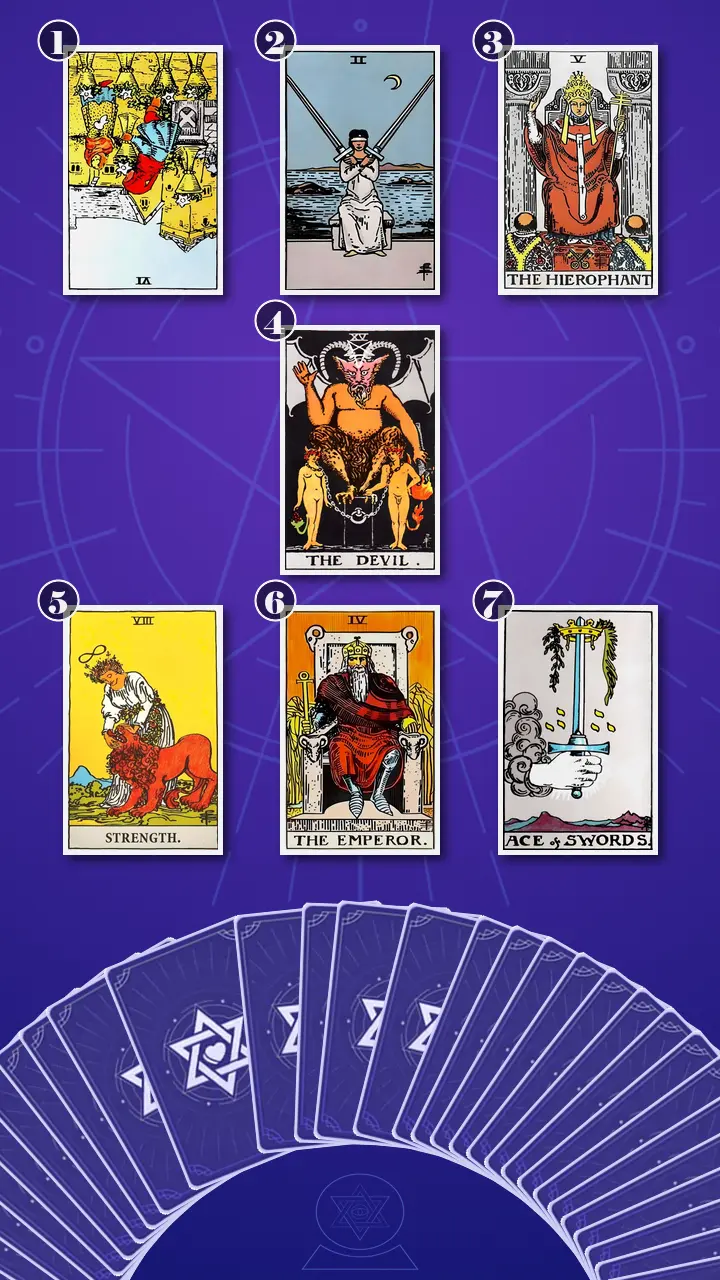
“Today we’ll use a spread I call the Energy Diagnostic Map (7) · Context Edition,” I said. “It’s a 7-card tarot spread for boundaries with family online—especially in shared digital spaces like a family iCloud or Google Photos album.”
For you reading along: this layout works because this problem isn’t a single decision like ‘Do I post or not?’ It’s a system. There’s the trigger (shared visibility), the inner tug-of-war, the external rulebook, and then the real knot: the compulsion to manage perception. This spread puts the core blockage in the center, then routes us intentionally toward resource → boundary principle → one concrete next step. It’s not prediction. It’s pattern recognition—how tarot works best when you’re trying to stop feeling stuck and start finding clarity.
“We’ll look at the surface reaction first,” I told Casey, “then what you’re protecting yourself from feeling, then the family norms pressure. The center card is the real blockage. And the bottom row is your way out: what you can rely on, the boundary that restores agency, and the one-week action that makes it real.”
Reading the Map: From the Time-Machine Effect to the Approval Trap
Position 1 — Surface reaction: the immediate trigger
“Now flipped over,” I said, “is the card representing your surface reaction—the immediate, observable way the shared family album triggers self-curation and old-role activation.”
Six of Cups, reversed.
“This is like opening the family iCloud album and it feels like stepping into a room you grew up in—same furniture, same roles,” I told them, using the card’s modern translation almost word for word because it landed so cleanly. “You hover over uploading a current photo, then second-guess it because you can already hear the old narrative—who you’re ‘supposed’ to be.”
Reversed, the Six of Cups is memory with pressure in it. Nostalgia that stops being sweet and starts being a script. The energy here is blockage: the past-self version of you is taking up too much room in the present.
Casey let out a small laugh—sharp, a little bitter. “That’s… mean,” they said. Then softer: “It’s true. The album makes me feel fourteen again.”
I didn’t correct the laugh. I respected it. “Yeah. It can feel unfair. But it also explains why your brain turns every photo into a risk assessment.”
Position 2 — Inner tug-of-war: what you won’t name
“Now flipped over,” I said, “is the card representing your inner tug-of-war—what you’re protecting yourself from feeling or naming when you start performing.”
Two of Swords, upright.
“You tell yourself the album ‘isn’t a big deal,’ but you keep delaying a simple decision like posting a casual photo,” I said. “You stay quiet to feel safe—then feel trapped by the quiet—like neutrality is your only protection.”
This is deficiency in emotional honesty, not because you’re dishonest—because you’re bracing. The blindfold isn’t ignorance. It’s strategy. If you don’t choose, you can’t be judged. But the cost is paralysis.
I asked, “When you go ‘neutral,’ what feeling are you trying not to feel—hurt, anger, embarrassment, something else?”
Casey’s eyes flicked up, then away. Their fingers tightened around the phone like it could keep them steady. “Embarrassment,” they admitted. “And… like I’ll be misunderstood and then I’ll have to explain, and that’ll make me look dramatic.”
Position 3 — External pressure: the unspoken rulebook
“Now flipped over,” I said, “is the card representing external pressure—the family-system norms and unspoken expectations shaping what feels ‘acceptable.’”
The Hierophant, upright.
“The album doesn’t feel like a scrapbook,” I said. “It feels like a place where there’s a correct way to be understood. You catch yourself choosing photos that look ‘respectable’ or ‘easy to explain,’ because you can feel the norm-policing even when nobody says it out loud.”
The Hierophant’s energy is excess of inherited standards—belonging-by-compliance. Like being graded on a vibe you never agreed to. I’ve seen this in music therapy sessions too: families don’t just share stories; they share a soundtrack of expectations.
“What’s one ‘family rule’ you’ve been following in the album that you never explicitly agreed to?” I asked.
Casey swallowed. “That I’m supposed to be… legible. Easy. No surprises.”
I nodded. “Like Slack at work. Feedback-heavy all week, and then you come home and the shared feed turns into another performance review thread.”
Position 4 — Core blockage: the compulsion loop
“Now flipped over,” I said, “is the card representing the core blockage—the attachment or belief that turns visibility into obligation and makes you manage perceptions.”
The Devil, upright.
“You keep checking who viewed or reacted to the album,” I said, “then pre-write explanations in your head like you’re on call. The stage isn’t your family—it’s the belief that once they see you, you owe them narrative control.”
Here the energy is excess—too much attention given to approval, too much weight given to reaction. The Devil isn’t ‘bad.’ It’s magnetic. It’s the loop that feels like responsibility.
I described the scene the way it often plays: “It’s like a notification slot machine. Refresh the album. See a ❤️. Your chest spikes. Then you draft an iMessage paragraph nobody asked for: If I can just pre-empt the question, I won’t have to feel exposed.”
Then I named the mechanics cleanly, because clarity loves a simple diagram: “Trigger—new shared visibility. Belief—If I’m seen without control, I’ll be judged or reduced. Coping—over-editing, delaying, deleting, over-explaining. Short-term relief—less exposure. Long-term cost—less authentic connection and more vigilance. And then the belief gets reinforced.”
Casey went still for a beat—breath held, fingers hovering mid-scroll. Their gaze unfocused like they were replaying a week of late-night checking. Then a quiet, involuntary “Oh.” Their shoulders dropped a fraction.
“I thought I was being… responsible,” they said.
“That’s the Devil’s best disguise,” I replied. “It offers ‘responsibility’ when it’s really compulsion.”
Position 5 — Usable resource: steadiness without disappearing
“Now flipped over,” I said, “is the card representing your usable resource—the inner capacity that helps you stay present without tightening into performance.”
Strength, upright.
“You feel the urge to crop, rewrite, and manage,” I said, “and instead, you pause—two breaths, shoulders down—and decide from values: Do I want to share this? not Will this be judged? That tiny pause is where the performance loop loosens.”
The energy here is balance. Strength isn’t loud. It’s regulated. It’s your calm ‘no’ being more protective than your perfect explanation.
I watched Casey try it right there: two slow breaths. Jaw unclenched. Phone turned face-down for thirty seconds. When they picked it up again, their eyes looked a little more like theirs.
“I can stay here with the discomfort without fixing it,” they whispered, almost surprised by their own sentence.
When the Emperor Spoke: The Doorway-Lock Boundary for Finding Clarity
Position 6 — Key transformation: the boundary principle
I let myself slow down before turning the next card. The studio felt quieter—like the moment right before I push a fader up live on-air and everything becomes audible.
“Now flipped over,” I said, “is the card representing the key transformation—the boundary principle that restores agency in shared digital spaces.”
The Emperor, upright.
Setup—because I could see the loop still trying to run in Casey’s eyes: You’re on the couch after dinner, iCloud open, thumb hovering over Upload. You zoom in, crop, rewrite a caption, then exit—heart doing that tiny drop like you just avoided being ‘made into a thing.’ You want closeness, but your body keeps treating the album like a spotlight you have to survive.
Not a spotlight you must survive—claim your seat on the throne, set the terms, and let the mountains behind you remind you that your stability doesn’t depend on anyone’s approval.
I let the sentence sit in the air. Casey’s reaction came in layers—like a chord resolving.
First: a physiological freeze. Their eyes widened a millimeter, and their breathing paused, as if their nervous system was checking whether it was safe to believe that. Second: cognitive seep-in. Their gaze slid off the card toward the door of my studio, unfocused, like they were seeing their own apartment hallway—the lock, the peephole, the choice to open or not. Third: emotional release. A long exhale left them, shoulders dropping, hands unclenching from the phone. Then—unexpectedly—irritation flared across their face.
“But if I stop managing it,” they said, voice sharper, “doesn’t that mean I’ve been… doing this wrong? For years?”
I held that with them, no shaming. “It means you adapted. In a family system, adaptation is how you belong. The Emperor isn’t judging you for surviving. It’s offering you adult authorship.”
And this is where my signature lens clicked in—the one I call Generational Echo. “Can I ask you something weirdly specific?” I said. “What was the background music in your home growing up? Like—Sunday mornings, car rides, cooking.”
Casey blinked. “My dad’s classic rock. Always. And my mom had this… ‘cleaning playlist’ that meant nobody should be in the way.”
“Exactly,” I said. “Families run on unspoken soundtracks. Your body hears ‘the album’ like it hears that cleaning playlist: be easy, be legible, don’t complicate the room. The Emperor is you changing the station. Not fighting the family. Not disappearing. Just choosing your terms of engagement.”
Then I brought it back to the core principle, because it needed to be portable: “Visibility is optional. Interpretation is not your job.”
I leaned in slightly. “Now, with this new perspective, can you think back to last week—was there a moment where this would’ve changed how you felt?”
Casey nodded slowly. “My aunt commented, ‘Look at you! So grown up!’ and I spiraled. If I’d had… terms? I could’ve just heart-reacted and moved on.”
“That’s the shift,” I said softly. “From hyper-monitored self-curation to grounded self-respect and choice-based connection. Not perfect. Just different.”
Position 7 — Next step: the clean sentence
“Now flipped over,” I said, “is the card representing your next step—a concrete one-week boundary action that reduces monitoring and over-explaining.”
Ace of Swords, upright.
“This is the moment you delete the draft paragraph and replace it with one clean line,” I said. “One sentence you can copy/paste. Because clarity reduces performance when you stop negotiating your existence photo by photo.”
I smiled, just a little. “Stop writing captions like a press release.”
Casey laughed—this time with relief. “I literally do that.”
From Insight to Action: Your Terms of Engagement for the Next 72 Hours
I pulled the whole story together for them, the way I’d summarize a complicated song into its chorus.
“Six of Cups reversed shows the time-machine effect—old roles waking up the moment you open the album. Two of Swords says you protect yourself by going neutral, which turns into silence. The Hierophant is the external rulebook—the family-approved version of you. The Devil is the approval-compulsion loop: visibility starts to feel like obligation, so you manage optics to feel safe. Strength is the stabilizer—two breaths, body-first steadiness. And then The Emperor: boundaries as structure, not argument. Finally, Ace of Swords: one clean sentence that ends the guessing game.”
“Your cognitive blind spot,” I added, “is thinking you need better content—better photos, better captions—when what you actually need is a policy. Your transformation direction is exactly this: from ‘I need to control how they see me’ to ‘I decide what I share, and I don’t manage other people’s interpretations.’”
Then I gave Casey the smallest possible next steps—practical, copy/paste-friendly, designed for a real life with TTC commutes and Slack still ringing in your head.
- The One-Sentence Boundary ScriptOpen Apple Notes and write one reusable line: “I’m keeping this album for highlights—no updates or Q&A.” Keep it pinned so you can copy/paste if questions start.Expect the cringe. Keep it boring and repeatable—policy, not argument. You can send it once, then stop replying after one clarification.
- Pick One “No-Discussion” CategoryChoose one category you won’t discuss from photos this week (body, dating, money, location). If someone asks, reply with a simple redirect like, “Not something I’m getting into—how’s your week been?”Don’t try to cover everything at once. One clear limit is easier for your nervous system to hold.
- Soundproof Barrier (My Go-To Strategy)Mute iCloud Shared Album notifications for 72 hours (Focus / Do Not Disturb), and when you do check the album, play a steady background track (lo-fi, brown noise, or any “no lyrics” mix) for 10 minutes to keep you out of reaction-chasing mode.This isn’t avoidance—it’s interrupting conditioning. If you feel a spike, close the app. That still counts as practice.

A Week Later: Ownership, Not Certainty
Six days later, Casey texted me a screenshot: a simple streetcar-window photo in the family album. Caption: “Tuesday commute.” Nothing else. No disclaimer. No pre-emptive explanation. Under it, a couple of ❤️ reactions and an aunt’s “Toronto looks so busy!”
“I didn’t correct anything,” their message read. “I just liked it. My stomach did the drop, but it passed.”
It wasn’t a perfect ending—more like a real one. Clear but a little vulnerable: they told me they slept through the night for the first time in weeks, then woke up with the familiar thought, What if I’m being rude? And this time, they exhaled and didn’t chase the thought down the hallway.
That’s the quiet proof I look for in a Journey to Clarity: not a life overhaul, but a new relationship to the moment you usually perform. A shared album stops being an invisible audience when you stop treating every glance like a verdict.
When a shared album turns into an invisible audience, your body tightens like you’re back in an old role—wanting closeness, but bracing to be reduced to a story you didn’t choose.
If you treated the album like a doorway you control instead of a spotlight you survive, what’s one small term you’d set—just for this week?
This story is adapted from psychological research, written so that those in a similar struggle can see their own pattern in it — and find their next step clearly.These insights are not a substitute for professional psychological, medical, legal, or financial advice.
Learn more about our Journey to Clarity.
How did this insight land for you?
🫂 This Resonates Deeply
🌀 Living This Story
✨ Now I See Clearly
🌱 Seeing New Possibilities
🧰 Useful Framework
🔮 The Confirmation I Needed
💪 Feeling Empowered
🚀 Ready for My Next Step
Author Profile
 AI
AI“Through ten years of sound energy research, I’ve found that when we struggle, it's usually just our internal rhythm falling out of sync under pressure. I know firsthand the frustrating helplessness of wanting to move forward but feeling paralyzed. Without overwhelming theories, I want to be the soothing background track that helps you recalibrate, turning your heavy burdens back into a light, effortless, and harmonious melody.”
In this Family Tarot Reading :
Core Expertise
Service Features
Also specializes in :
Explore Related Patterns:
Boundary DiscernmentCasey's reusable line and no-discussion category turn a vague discomfort into an actual boundary. Instead of negotiating each photo, caption, and question as if every moment requires a new defense, the story gives the album a clear policy. The mechanism is discernment: separating what belongs to You from what belongs to other people's interpretation. You decide what to share, what not to discuss, and when a simple redirect is enough, which reduces the pressure to justify every limit in real time. Boundary Discernment fits because the transformation is not about cutting off connection. It is about knowing where the doorway is, deciding when it opens, and refusing to make other people's curiosity the manager of your self-expression.
Compulsive CheckingCasey's repeated checking of views and reactions turns the shared album into a feedback loop. A heart reaction, a comment, or the possibility of being noticed becomes enough to pull attention back into the app and restart the scan for emotional risk. The mechanism is a short-term relief cycle: check, feel a spike, prepare an explanation, reduce uncertainty for a moment, then return to checking because the deeper fear has not actually been resolved. The behavior feels responsible because it appears to prevent embarrassment, but it keeps the nervous system trained on the next possible signal. Compulsive Checking fits because the story shows monitoring that does not produce clarity. It creates a loop where You keep looking for reassurance from the same environment that is activating the discomfort, so the album becomes harder to leave alone even when nothing urgent is happening.
Defensive OverexplainingCasey's draft paragraphs and pre-written explanations appear before a real question is even asked. The story shows explanation being used as a shield, as if the right sentence could prevent embarrassment, misinterpretation, or the feeling of being made into a family story they did not choose. The defensive logic is understandable: if You can control the context in advance, maybe You will not have to feel exposed later. But the coping strategy also expands the performance field, because every casual photo now needs a press-release level of preparation before it can be shared. Defensive Overexplaining fits because the core action is not communication for clarity; it is explanation as pre-emptive self-protection. The pattern tries to secure safety through more context, but in practice it keeps You negotiating your existence photo by photo.
Family Role RegressionCasey's line that the album makes them feel fourteen again is a direct marker of old-role activation. A current photo is no longer just a current photo; it gets filtered through a remembered family script about being easy, legible, and unsurprising. The cognitive mechanism is temporal compression. The present-day self tries to act, but the nervous system responds as if the old room, the old role, and the old expectations are back online. That makes adult choice feel less available, because the upload is being evaluated through an earlier version of belonging. Family Role Regression fits because the pressure is not only external commentary. It is the way a family-coded space pulls You back into a younger relational position, where being seen feels tied to being interpreted through a version of You that may no longer fit.
Relationship Performance AnxietyCasey's zooming, cropping, caption rewriting, and hesitation around a simple family album upload show a casual social action becoming a performance task. The phone is not just a device in the story; it becomes a stage where every photo feels like it has to pass an invisible review before it can exist. That performance pressure is held together by a cognitive prediction: if You are seen without enough control, You may be judged, reduced, or misunderstood. The defensive move is to pre-manage the image before anyone comments, which briefly lowers exposure but also teaches the nervous system that visibility is only safe when it is carefully produced. Relationship Performance Anxiety fits because the tension is not simply about posting a photo. It is about turning connection into a monitored presentation, where closeness is wanted but being discussed feels risky enough to trigger self-curation, delay, and vigilance.
Secure VisibilityCasey's two-breath pause, the phone turned face-down, and the later streetcar-window photo show visibility becoming less performative and more chosen. The caption is plain, the disclaimer is absent, and the upload does not have to carry a full defense of the self. The psychological shift is from managing perception to tolerating being seen without controlling every interpretation. You still feel the stomach drop, but the discomfort passes because it is no longer treated as proof that a corrective action is required. Secure Visibility fits because the story does not end with total certainty or universal approval. It ends with a steadier relationship to exposure: You can share something real, keep the boundary intact, and let other people have reactions without turning those reactions into your job.
Spotlight EffectCasey's jaw tightens before a comment even appears, and the body reacts as if the audience is already watching. The shared album becomes a room full of imagined interpretation, even when the visible data may only be a photo, a reaction, or silence. The cognitive mechanism is an inflated sense of being observed and evaluated. Attention narrows around how the photo might land, what others might infer, and whether a casual upload could become a family discussion. That imagined spotlight drives the self-curation before any actual conflict has occurred. Spotlight Effect fits because the story shows You feeling more visibly judged than the situation has objectively confirmed. The pattern does not mean the family context is irrelevant; it means the mind fills the uncertainty with an audience so powerful that even a small upload can feel like exposure.
Strategic VisibilityCasey's insight that they do not need better content, but a policy, is the cleanest turn in the story. The problem stops being solved at the level of each photo and starts being handled at the level of terms of engagement. The mechanism is strategic participation. You are neither disappearing from the album nor offering unlimited access to your life for discussion; You are choosing what kind of visibility is actually sustainable, repeatable, and aligned with your sense of agency. Strategic Visibility fits because the boundary that stops performance is not more perfect self-presentation. It is selective, structured exposure: sharing enough to stay connected while refusing to hand over narrative control every time You are seen.
Values-Based Decision MakingCasey's shift from controlling interpretation to deciding what to share changes the decision-making system underneath the behavior. The one clean sentence, the simple photo, and the refusal to chase every thought down the hallway all point to a choice being made from values rather than fear of evaluation. The cognitive mechanism is a move from externalized control to internal authorship. You stop asking the family album to confirm whether You are acceptable and start using a clearer standard: whether the action matches your terms, your comfort, and your actual desire for connection. Values-Based Decision Making fits because the boundary stops being a reaction against scrutiny and becomes a structure for self-respect. The point is not to guarantee that no one comments; it is to choose from a principle stable enough that every comment does not get to rewrite the rule.
Visibility Shame LoopCasey wants to stay connected through the family album, but the moment visibility enters the frame, their body prepares to survive being seen. That split is the central tension: wanting closeness without wanting to be turned into a topic, a role, or a version of themselves they did not authorize. The loop works by binding visibility to shame and obligation. If You are seen, the mind predicts that You owe an explanation, a cleaner caption, a more acceptable photo, or a version of yourself that will not create friction. Self-curation then reduces the immediate shame spike but makes the next moment of visibility feel just as dangerous. Visibility Shame Loop fits because the story repeats the same sequence: exposure, contraction, perception management, temporary relief, and renewed vigilance. The boundary question matters because the loop breaks when being seen stops meaning that other people's interpretations get to control your next move.
Emotional RegulationCasey's pause, lowered shoulders, and phone turned face-down show the body interrupting the performance reflex before the mind starts negotiating. The discomfort is still present, but it is given a few seconds of space instead of being converted immediately into cropping, checking, or explaining. The mechanism is nervous-system regulation in service of agency. You use body data as information, not as a command, which makes it possible to ask a better question: whether You want to share, not whether the photo can survive judgment. Emotional Regulation fits because the story shows a practical shift from reactive monitoring to steadier choice. It is not the central boundary itself, but it is the skill that lets the boundary hold when the old spike of embarrassment or exposure returns.
Explore Related Struggles:
Approval-Safety FusionCasey checks who viewed or reacted, then starts drafting explanations in their head as if a heart reaction might turn into a verdict. The album does not need to openly criticize them for the loop to start; the possibility of being seen is enough to make approval feel like the thing that keeps the situation safe. You can see the fusion in the sequence of checking, bracing, editing, and over-explaining. The short-term relief comes from reducing exposure, but the longer-term cost is that your safety system learns to depend on other people's reactions. Every small sign from the feed starts to feel like information you must manage. The deeper struggle is that approval has been assigned the role of protection. A stronger boundary gives that job back to you. You are allowed to let relatives have reactions without treating those reactions as instructions for how much of yourself you are permitted to show.
Boundary Ambiguity LockCasey keeps trying to solve the album by making the photo cleaner, the caption safer, and the possible explanation more complete. The friction is that none of those edits answer the real question of what the shared album is allowed to demand from them. You get pulled into performance when the rules are blurry. Without a clear term of engagement, every upload becomes a case-by-case negotiation with an imagined audience, and your nervous system treats each caption like it has to prevent a misunderstanding before one exists. A boundary here is not a dramatic announcement. It is a simple operating policy that makes the space legible to you first: what you share, what you do not discuss, and where your responsibility ends. Once the rule is externalized into one clean sentence, the album stops requiring you to reinvent your safety photo by photo.
Curated Belonging TrapCasey zooms, crops, rewrites, delays, and sometimes deletes, trying to make the posted version of themselves easy enough for the family album to hold. The performance is not random vanity; it is a way of staying included without becoming too complicated for the room. You get trapped when belonging starts to require a curated version of you. The photo may look casual from the outside, but inside the loop it has been polished against imagined questions, old expectations, and the pressure to be legible. The self that arrives in the album has already been negotiated down. The boundary that loosens this trap is choosing connection that does not require total editability. A simple caption, a no-discussion category, or a decision not to explain can become a way of staying present without auditioning for the family-approved version of yourself.
Observer-Self SplitCasey's jaw tightens before any comment appears, and their body answers the invisible audience before the screen gives them a reason. The family album becomes less like a place to share and more like a room where they are already being watched. You start splitting when you experience yourself first as an object in other people's view. Instead of asking whether you want to share the commute photo, part of you moves ahead to how it might be read, reduced, or discussed. The observer arrives before the self gets a full vote. A useful boundary returns the order of operations to you. You get to decide from the inside first, then let the outside have a limited amount of access. That shift is small, but it changes the album from a surveillance mirror into a doorway you can open on purpose.
Visibility-Connection SplitCasey says they do not want to disappear, but they also do not want to be discussed, and that sentence holds the whole pressure point of the family album. The shared space offers a way to stay present with relatives, while the same act of posting turns into a risk of being interpreted, narrated, or made into a version they did not choose. You can feel the split in the hovering thumb and the tightened jaw. Sharing would keep you connected, but visibility makes your body prepare for exposure, so the album becomes both a bridge and a stage. The struggle is not whether a photo is harmless; it is the way connection and being seen have become welded together. The boundary that stops the performance starts by separating presence from availability. You can share a highlight without opening a discussion thread, and you can stay connected without surrendering the right to decide what parts of your life remain unprocessed by the family feed.
Inherited Role LockThe family album makes Casey feel fourteen again, as if a current photo has opened a room from the past with the same furniture and the same roles. A shared feed that should belong to the present starts carrying the old instruction to be easy, legible, and not disruptive. You are not just reacting to relatives seeing a picture. You are reacting to the older version of yourself that the family system still knows how to summon. When that role takes over, adult authorship gets crowded by the expectation that you will remain recognizable to the people who remember you in a narrower shape. The boundary here is a claim on time as much as space. You can let the album contain a present-tense version of you without asking the past-self role for permission. That does not require fighting the family story; it requires refusing to let that story be the only frame available.
Monitoring-Safety FusionCasey keeps checking who viewed or reacted, and the feed starts behaving like a control panel for whether it is safe to relax. A heart, a comment, or the absence of a response becomes something to read, manage, and revisit. You get pulled deeper when monitoring offers a tiny hit of certainty. Checking reduces the pressure for a moment, but it also teaches your body that relief lives in the next refresh. The album becomes less about sharing and more about tracking the room. The boundary is not just about what you post; it is about how often the feed is allowed to recruit your attention. Muting notifications, checking on purpose, and closing the app when the spike hits all interrupt the idea that safety has to be constantly verified by other people's reactions.
Explore Related Emotions:
Approval AnxietyCasey keeps checking who viewed or reacted, then pre-writes explanations in their head as if they are on call. A heart reaction can spike the chest because approval has become a signal to decode rather than a small sign of contact. You can see how the loop rewards itself. Edit more, explain earlier, reduce exposure for a minute, then monitor again. Approval Anxiety fits because the pressure is not just to be liked, but to stay ahead of imagined judgment by managing the story before anyone asks.
Conditional Belonging FearCasey wants closeness, but the album also makes them feel included and displayed at the same time. The shared space offers connection, yet the cost seems to be becoming discussable, explainable, and small enough not to disrupt the room. You can want to stay in the family channel without handing over narrative control. Conditional Belonging Fear fits because belonging here feels available only when Casey performs the version of themselves that will not invite questions.
Privacy AnxietyCasey says they do not want to disappear, but they also do not want to be discussed. The no-discussion categories and reusable boundary line are not about hiding; they are attempts to keep certain parts of life from becoming open threads in a shared family feed. You can share a highlight and still need a private interior. Privacy Anxiety fits because the discomfort is centered on how quickly visibility can turn into access, questions, and implied permission to interpret.
Rulebook ShameCasey names the family rule clearly: be legible, be easy, no surprises. The album carries an inherited standard for what kind of person can be shown without friction, and Casey starts choosing images that fit that silent standard. You are not reacting to one comment alone; you are moving inside a rulebook that makes ordinary self-presentation feel like compliance. Rulebook Shame captures the heat that rises when your real self has to pass through someone else's acceptable version before it feels safe to appear.
Verdict DreadCasey treats every possible glance like a verdict, from the aunt's comment to the imagined reactions waiting behind the album. Before anyone openly criticizes them, the body is already preparing for being judged or reduced. You are watching a photo become a courtroom in miniature, where a heart reaction, a comment, or silence can all feel loaded. Verdict Dread names the anticipatory drop in the stomach when being seen feels like being evaluated rather than simply noticed.
Visibility PressureCasey's jaw braces before a comment appears, phone warm in palm, thumb hovering over iCloud like a risky text. The body is responding to an audience that is technically invisible but socially present, so the album stops being a scrapbook and starts acting like a room full of possible viewers. You can want connection and still feel your chest trying to become a smaller target. Visibility Pressure names the moment being included turns into being assessable, where a photo carries the weight of possible discussion before anyone has actually said anything.
Clarity ReliefCasey moves from better captions to a policy: highlights only, no updates or Q&A. The clean sentence reduces the guessing game because it gives the boundary a shape before the next question arrives. You can feel relief in the simplicity of not negotiating your existence photo by photo. Clarity Relief fits because the story's pressure loosens when Casey can name the terms of engagement instead of improvising a defense every time.
Grounded AgencyCasey pauses for two breaths, lowers their shoulders, and asks whether they want to share the photo rather than whether it will be judged. The phone goes face-down, the body gets a few seconds of space, and choice returns in a quieter register. You can still feel the stomach drop and act from your own terms. Grounded Agency names the steadiness that appears when Casey stops outsourcing the decision to an imagined audience and lets the boundary become a structure they can stand inside.
Performance FreezeThe thumb hovers over Upload, then the photo gets zoomed, cropped, captioned, rewritten, and abandoned. A simple share turns into a sequence of almost-actions, each one meant to make the next moment safer. You are not simply avoiding a post; the story shows a body holding still at the exact point where choice would make you visible. Performance Freeze names that suspended state where the wish to participate remains alive, but the act of being seen locks the movement in place.
Self-Audit AnxietyCasey turns every photo into a risk assessment and starts looking for better content, better captions, and better ways to be read. The actual question underneath is not whether the image is good enough, but whether the self behind it can pass inspection. You can feel the internal reviewer taking over the feed. Self-Audit Anxiety names the unease of constantly examining yourself through imagined external eyes, trying to remove anything that might be misread before you let yourself appear.
Inner Child AcheCasey says the album makes them feel fourteen again, and the whole room of old roles wakes up through one shared digital space. The present-day photo is not only a photo; it becomes a trigger for the younger version who learned to be easy, legible, and out of the way. You can hear that younger self in the tight jaw and stomach drop. Inner Child Ache names the soreness of being pulled back into a past self before your adult boundaries have had time to speak.
Hypervigilant AnxietyCasey refreshes the album, checks reactions, and drafts explanations nobody requested. The mind keeps scanning for social weather changes, trying to catch the first sign that someone has misunderstood the post. You can see why the checking feels responsible in the moment, even as it keeps the body on alert. Hypervigilant Anxiety fits because the attention has become threat-scanning around interpretation, with the nervous energy aimed at preventing a problem before it exists.
Micro-Performance ShameCasey describes captions that read like press releases and admits they fear looking dramatic if they have to explain themselves. The smallest digital gesture starts to feel staged, as if every photo needs to prove it is reasonable, respectable, and easy to understand. You can feel the scale of the shame in its smallness. Micro-Performance Shame names the sting of turning tiny everyday self-expression into an audition, where even a commute photo can feel like it needs a defense strategy.
Visibility ReliefThe streetcar photo stays in the album with a couple of heart reactions and a casual comment, and Casey does not correct anything. Visibility becomes lighter because it no longer demands a full explanation attached to every image. You can be seen in a smaller, cleaner way, without turning the moment into a performance review. Visibility Relief names the soft release that comes when the shared album becomes a doorway Casey can use, not a spotlight they must survive.
Explore Related Contexts:
Digital Intimacy Boundary ConfusionCasey says they do not want to disappear, but they also do not want to be discussed. That is the exact tension of a shared digital family space: the album offers closeness, but the same visibility can make every upload feel open to interpretation. The confusion sits in the design of the situation. A family album looks private because it is not public social media, yet it still creates an audience, notifications, reactions, and a comment trail. You can want connection and still need limits on the access that connection creates. The boundary here is a terms-of-engagement boundary, not total withdrawal. You can stay present in the album while deciding which parts of your life are highlights, which parts are not open for Q&A, and which reactions do not require a performance.
Family Album Performance PressureCasey is not simply choosing photos; they zoom, crop, rewrite captions, and draft explanations before anyone has asked for them. The family iCloud album turns a casual upload into a managed presentation, where each image has to be respectable, legible, and safe from later discussion. That pressure gives the album the structure of a performance stage: visibility creates obligation, reactions become feedback, and even a heart icon can trigger another round of self-editing. You are dealing with an external audience problem, not a lack of confidence or a content problem. The boundary that interrupts the performance is a policy rather than a perfect caption. When you decide what the album is for, what categories are off-limits, and when you will stop explaining, the shared space stops being a rolling review of your identity and becomes one channel you can choose how to use.
Family Privacy NegotiationCasey pins a single line: "I'm keeping this album for highlights - no updates or Q&A." The point is not to win a debate with every relative; it is to place a clear operating rule around a shared digital space that has started leaking into body, dating, money, and location territory. Family privacy negotiation shows up here because the pressure is not only about posting. It is about who gets access to your life, what that access entitles them to ask, and how much interpretation work you are expected to perform after you share something. A usable boundary makes privacy boring and repeatable. You can post a small streetcar photo, like a comment, and move on without turning every upload into a family briefing.
Family Script PressureOpening the album makes Casey feel fourteen again, and that detail matters because the pressure is not coming from the app alone. The shared album wakes an older family script where the acceptable version of Casey is supposed to be legible, easy, and free of surprises. The photos become evidence in a system of inherited interpretation. A current streetcar picture, a caption, or an aunt's casual comment can pull Casey back into a role the family already knows how to read, even when Casey is trying to show a present-tense adult life. The useful boundary is not an argument about whether the family means well. It is a refusal to let old scripts decide the format of your visibility. You can share a slice of life without volunteering the whole story for family review.
Family InfantilizationCasey's clearest sentence is that the album makes them feel fourteen again. Later, an aunt's "So grown up!" lands in the same pattern: a present adult moment gets translated through an older family lens before Casey has a chance to define it for themselves. Family infantilization is visible here because inclusion does not automatically equal recognition. Casey is inside the family album, but the audience can still pull them into a smaller, earlier version of themselves: the child who should be easy to understand, easy to explain, and not too complicated. The adult boundary is a position boundary. You do not have to fight every outdated reading, but you also do not have to feed it with disclaimers. A simple post, a boring caption, and no extra explanation can become a way of staying visible without handing the family the younger role to manage.