Closing One Tab at 11:47, Then Scheduling a Bounded Career Experiment
The Safe Harbor That Felt Like Giving Up
If you are the person who can explain every risk but still cannot name what you want, this may feel familiar. Jordan (name changed for privacy) sat across from me and slid a phone onto the table. On its screen was a photo taken at 11:47 p.m. in their Queen West apartment: a stable product brief on the left side of a laptop, an application for an experimental role on the right, and a Notion decision matrix layered between them.
Jordan told me the laptop fan had been making a thin mechanical whine. Cold coffee tasted metallic. The trackpad felt warm beneath a rigid hand as they added one more line to the spreadsheet: possible credibility loss. Then they closed the application. Their shoulders dropped. Twenty minutes later, they reopened it.
“Why do I keep choosing safe harbor when it feels like giving up?” they asked. “I call it being realistic, but it keeps feeling like I am disappearing.”
I could see the contradiction before I touched the deck. Jordan wanted work that felt alive, but every uncertain possibility activated a demand for control. The predictable option settled their body quickly; the abandoned option returned because predictability had not answered their need for curiosity, creative energy, or meaning. Their conflicted longing felt like a hand knocking from inside a locked glass door while the other hand held the key so tightly that it could not turn.
The financial concerns were not imaginary. Toronto rent, grocery totals, and the ordinary cost of keeping a life running made stability a legitimate safeguard. I had no interest in shaming that. The problem was the safety-versus-aliveness loop: choosing the lowest-risk path, feeling relief for a day, and then privately returning to the possibility that had never been tested.
Jordan told me about seeing a former coworker announce an independent studio on LinkedIn while riding Line 1. Before they could admit they felt curious, they had opened a salary calculator, two Reddit threads, and a productivity podcast. By the time the train reached Queen's Park, they had gathered more information but made no contact with the possibility itself.
“The safe choice calms the body before it answers the longing,” I said. “I am not going to use tarot to tell you to stay, leave, or gamble with your rent. I want us to make the pattern visible enough that you can choose consciously. Let us draw a map through the fog, then find one next step that still belongs entirely to you.”

Choosing the Compass in the Fog
I invited Jordan to place both feet on the floor and take one slow breath while holding the question in mind. I shuffled at an unhurried pace. The pause was not a mystical requirement; it was a way to move from the speed of risk scanning into focused observation.
I chose a five-card Shadow Spread. In a Jungian reading, the shadow is not an evil or defective part of the self. It is often a protective pattern working outside full awareness, preserving something important while creating consequences that the conscious mind cannot easily explain.
For anyone wondering how tarot works in my practice, I use the cards as an externalized pattern-recognition tool, not as a fixed prediction. A symbol placed on the table gives us enough distance to examine a habit without confusing the habit with the whole person. Card meanings in context become hypotheses that I test against the querent's lived experience. Jordan remained free to accept, reject, or revise every interpretation.
The Shadow Spread suited this career crossroads because Jordan was not asking me to compare two fully defined job offers. They wanted to understand why the same internal loop kept making the default choice for them. A larger spread would have added noise. These five positions could trace the visible behavior, the protective shadow beneath it, the root fear, the hidden resource, and an integration practice.
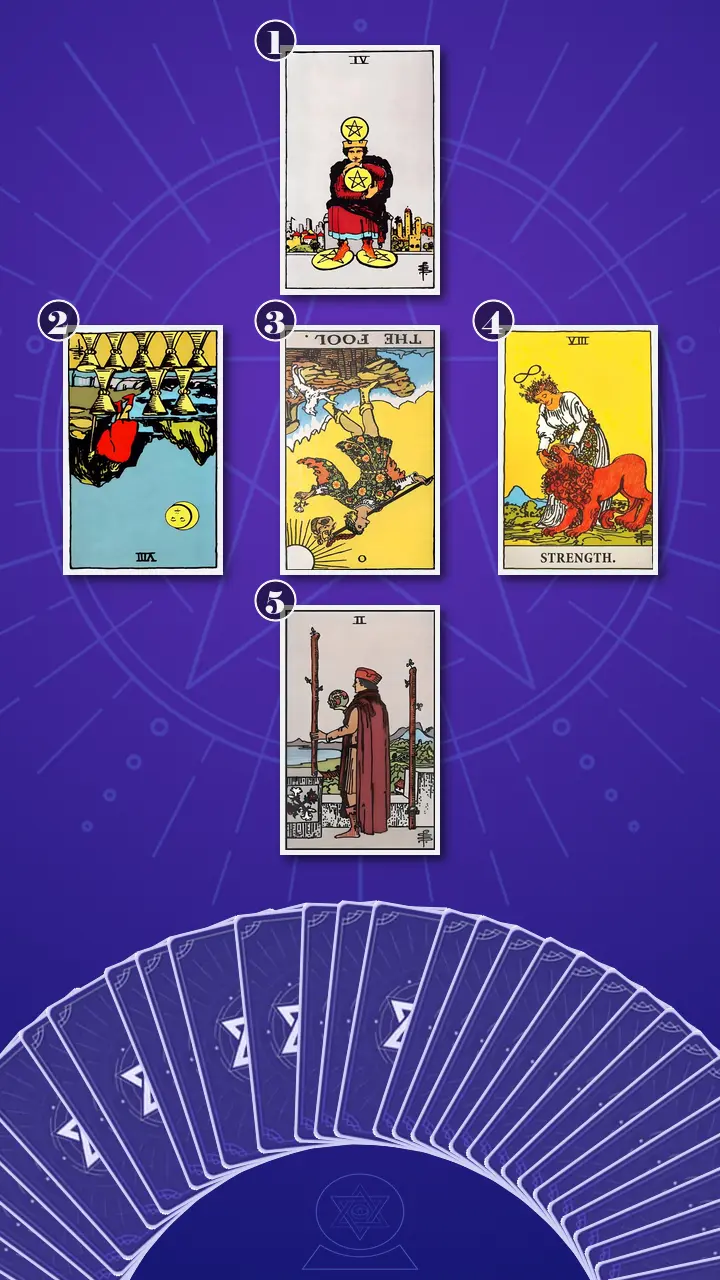
I arranged the cards as a cross, like a harbor compass. The card above would show the safe-harbor behavior Jordan already recognized. The card on the left would reveal the longing that kept returning. The center would identify the fear that turned uncertainty into a cliff edge. The card on the right would show a capacity Jordan could use, and the final card below would translate insight into a bounded next step.
“None of these positions will decide whether leaving is correct,” I said. “The spread is here to show us what currently makes a fair test feel impossible.”
What the Harbor Was Holding
Position 1: Four Coins and No Free Hand
I turned over the card representing Jordan's presenting safe-harbor behavior: the conscious way they held tightly to the familiar and experienced protection as increasing immobility. It was the Four of Pentacles, upright.
I pointed to the pentacle pressed against the figure's chest and the two coins pinned beneath the feet. The distant city remained visible, but the figure had no free hand with which to reach toward it and no free foot with which to move. Security was present, yet its energy had tipped into excess. Conservation had become constriction.
“This is the afternoon when the stable product roadmap and the invitation to an undefined discovery sprint arrive together,” I said. “You protect salary, routine, and credibility by declining the sprint before asking whether it lasts two weeks, what the hours are, or whether you can leave the trial. Those concerns matter. But the inner rule becomes: I need to protect the whole structure, so I cannot even test one small part of the alternative.”
I rested my fingers beside the card rather than on it. “The issue is not that you have an anchor. The issue is that both hands and both feet are occupied by it.”
Jordan stared at the card, glanced at the phone containing the split-screen photo, and gave a short, bitter laugh. Their jaw tightened, their eyes narrowed with recognition, and then one shoulder dipped as though the pose on the card had become physically tiring.
“That is so accurate it feels almost rude,” they said.
“Then we will use the accuracy without turning it into blame,” I replied. “The Four of Pentacles is not calling you selfish, cowardly, or materialistic. It is showing us a protective function in overdrive. Your safeguards are doing real work. We only need to ask which ones protect an actual limit and which ones prevent you from gathering any new evidence.”
Position 2: The Tab That Survived the Decision
I next turned over the card representing the protective shadow behind Jordan's repeated return to declined possibilities, including the need that the safe choice had not satisfied. It was the Eight of Cups, reversed.
In the upright image, a cloaked figure leaves an incomplete arrangement of cups and walks toward difficult mountains. Reversed, the energy of departure was blocked. The figure could neither complete the leaving nor settle fully into staying. I drew Jordan's attention to the visible gap among the cups.
“This is Thursday, when you decline the experimental role for sensible reasons,” I said. “On Friday your shoulders drop. On Sunday, while reheating dinner under that blue-white microwave light, you search for the archived email and reopen the listing. The stable choice has answered continuity, but the gap remains where creative engagement, autonomy, or learning was never measured.”
The reversal was a blockage, not a command to resign. Jordan's return to the page did not prove that the rejected job was secretly right. It showed that the question represented by the job was still alive.
I used one of my diagnostic tools, Hidden Cost Deconstruction. I asked Jordan to look beyond the visible costs of the uncertain option and identify the unstated emotional bills attached to the safe one. We named them without exaggeration: several Sunday evenings lost to counterfactual research, a flatter response to work by midweek, repeated requests for reassurance, and fewer opportunities to learn whether Jordan could adapt.
“Your spreadsheet treats stability as if it has no price because its costs do not arrive as one dramatic invoice,” I said. “They arrive as a month of reopening the same tab.”
Jordan's fingers stopped moving along the rim of their water glass. Their gaze drifted past me, as though a sequence of Sunday evenings were replaying just behind my shoulder. After a few seconds, they released a breath from deep in the chest.
“I said no for sensible reasons,” they said quietly. “So why am I still there every weekend?”
“That is the right question,” I said. “Not, Why have I failed to leave? Ask instead, What need am I still trying to meet when I return? You remain free to stay. We are simply refusing to make the recurring longing invisible.”
When a Preview Became a Production Deploy
Position 3: The Cliff Inside a Twenty-Minute Call
I turned over the center card, representing the root fear that leaving safety could create an irreversible mistake and expose a loss of control. It was The Fool, reversed.
I focused on the small distance between the Fool's raised foot and the cliff. The bundle over one shoulder was light; the actual beginning required little equipment. Yet reversed, the open energy of the beginner had become blocked by fear of appearing careless. In Jordan's internal model, the distance beneath that raised foot expanded until every experiment resembled a total fall.
“You consider sending someone a message requesting a twenty-minute informational call,” I said. “Within minutes, the message has become resignation, lost rent money, public failure, damaged credibility, and proof that your judgment cannot be trusted. The actual action has a clear end and no binding consequence. Your mind handles it like a production deploy with no rollback plan.”
Jordan's chest rose but did not fall immediately. Their hand moved toward the phone, then stopped halfway. I watched recognition enter in layers: first the held breath, then the unfocused stare of someone replaying a familiar chain of thought, then a small shake of the head.
“I do that with courses too,” they said. “I ask a six-week workshop to prove it can justify a whole new career.”
“Exactly. The Fool reversed does not say risk is wise, and it does not predict a fall. It shows a deficiency of permitted beginner energy. Uncertainty has been collapsed into irreversibility. Experimentation has been confused with recklessness.”
For a moment, I remembered arriving alone at a train platform abroad with only enough language to ask where the line ended. I had not known the whole route. I had known the next stop, the fare, and how to return. Looking at the Fool, I saw the same distinction with unusual sharpness: control did not have to mean knowing the entire journey; it could mean defining the terms of one movement.
“A reversible test is not a disguised resignation,” I told Jordan. “If a step can be limited, stopped, and reviewed, it is not the same as staking your future on a single outcome.”
When Strength Opened Its Hands
Position 4: The Lion Did Not Need to Vanish
The rain at the window softened to a faint, even tapping as I reached for the card on the right. A streetcar bell sounded once beyond the glass, then the room became still.
I turned over the card representing the constructive capacity hidden inside Jordan's caution: the ability to regulate fear and engage uncertainty without becoming reckless. It was Strength, upright, the key card and antidote of the reading.
I showed Jordan the woman's open hands resting around the lion's jaws. She did not crush the animal, flee from it, or pretend it was harmless. Her energy was balanced and relational. Instinct remained powerful, but it no longer held final authority over the scene.
“In ordinary life, Strength is the moment before you close the application,” I said. “You notice the held breath and tight shoulders. You do not argue the fear away. You name the outcome it is trying to prevent, set a sixty-minute limit and a zero-dollar boundary, and complete one sample task while the discomfort is still present. Self-trust is not proved by certainty. It is practised through limits, contact, and review.”
I then used Fear-Driven Logic Decoupling, the diagnostic lens I rely on when authentic desire and fear of failure have become fused inside the same decision matrix. I placed two blank cards beside Strength. On the first, I wrote: What wants contact? On the second: What predicts catastrophe?
Jordan's authentic desire was not an impulsive demand to quit. It was a wish to learn whether more experimental work would restore energy, autonomy, and engagement. The fear-driven logic added a different claim: if Jordan tested that desire and the test failed, the failure would expose them as incapable of managing their own life. Once separated, those were no longer two equal descriptions of the same risk. One was a curiosity. The other was a protective prediction.
I brought Jordan back to 11:47 p.m. The stable brief sat on one half of the screen and the experimental-role application on the other. One more risk entered the spreadsheet; the application closed; the shoulders dropped; twenty minutes later, the tab reopened. A small test had become an entire ocean crossing before the boat had left the marina.
I said, “The safe harbor is not the problem. The problem is asking safety to make every meaningful step risk-free. Courage here is tolerating enough uncertainty to run one reversible test.”
Do not wait for fear to disappear; meet it with a steady hand, as Strength meets the lion, and take one bounded step toward what feels alive.
Jordan went completely still. Their breath paused first, and their fingers remained suspended above the edge of the phone as if the next movement needed new instructions. Then their gaze lost focus. I watched their eyes move slightly from side to side while they replayed the late-night closing, reopening, and searching. Their pupils widened; the line between their brows softened; moisture gathered along the lower lids without becoming tears. A long exhale followed, rough at first and then quieter. Their shoulders descended, and both hands opened on the table. For a moment, relief made them look almost light-headed, as though setting down the demand for certainty had also removed the structure they had used to judge every choice. Then their brow tightened again.
“But doesn't that mean I was wrong before?” Jordan asked, their voice sharper than it had been. “Have I just wasted years calling fear responsibility?”
“No,” I said. “It means your protective strategy successfully reduced exposure. That was real. We are examining whether it now has too much authority, not putting your past on trial.” I let the protest settle, then asked, “Now, using this new perspective, was there a moment last week when this insight might have made you feel differently?”
Jordan looked down at the Strength card. “The discovery-sprint invite. I had already typed the decline. I could have asked about the hours, deliverables, and exit options before deciding. Asking would not have committed me.”
“That is the distinction,” I said. “You did not need to defeat the fear. You only needed to keep it company long enough to ask one measured question. Courage is fear with boundaries and somewhere specific to go.”
I set a ten-minute timer and asked Jordan to open a blank note titled One reversible test. I gave them three prompts: For 60 minutes or less, I could test this by...; I am keeping these safeguards...; and I can stop if.... I made it explicit that no test had to be completed during the session and no larger decision had to follow. If planning for ten minutes became too activating, Jordan could reduce it to a five-minute search or close the note without penalty.
They wrote: I could ask for a twenty-minute conversation with someone doing experimental product work. I keep my job, income, privacy, and current commitments. I can stop after one conversation.
I named the shift I was witnessing. This was not sudden fearlessness. It was the first movement from contracted relief-seeking and counterfactual replay toward regulated courage, evidence-based curiosity, and steadier self-trust. Jordan still felt exposed, but exposure was no longer being mistaken automatically for danger.
Position 5: One Fixed Wand, One Wider Horizon
I turned over the final card, representing the integration practice through which Jordan could convert insight into a bounded, reversible experiment. It was the Two of Wands, upright.
One wand stood fixed to the battlement while the figure held a globe and looked toward distant land and water. The energy was balanced, directed fire. Expansion did not require the destruction of the base. One support could remain anchored while curiosity made deliberate contact with a wider world.
“This is you keeping your current salary and product-design commitments,” I said, “while scheduling one Saturday hour for a sample brief and one twenty-minute informational conversation. You can set a zero-dollar budget, a firm stopping time, and a Sunday review point. The purpose is not to force a career pivot. It is to learn whether the work engages you and which risks actually appear in reality.”
I noticed Jordan unlock their phone and open Google Calendar. This time their hand was not clamped around the device. Their thumb hovered, moved, and placed a sixty-minute block on Saturday morning. They labelled it test, not commitment.
“So I do not need the experiment to tell me my whole future,” they said.
“Correct. It only owes you one piece of firsthand evidence. Keep the anchor; free one hand.”
The Anchor-and-Explore Plan
I drew the five cards together into one coherent story. The past influence was repetition itself: whenever uncertainty appeared, exhaustive comparison delayed a reversible test until the familiar option became the default. Immediate bodily relief then rewarded the retreat. In the present, the Four of Pentacles showed useful protection becoming immobility. The Eight of Cups reversed revealed the unmet need that survived every sensible decline. The Fool reversed exposed the structural lock, the belief that one uncertain beginning could become an irreversible verdict on Jordan's judgment.
Strength changed the form of control. The hands that had clenched around security became hands capable of calm contact with fear. The Two of Wands then turned that regulation into direction. The harbor did not have to be burned down; it could support a supervised harbor test.
I also pointed out that no Swords card had appeared. Jordan was highly capable of analysis, but the spread did not frame missing information as the central problem. Earth had been held too tightly, emotional water had been unable to complete its movement, and fire appeared only when a real-world experiment became possible.
“You are not short on analysis; you are short on firsthand evidence,” I said.
The central cognitive blind spot was now clear. Jordan had been treating the relief after saying no as evidence that the safe choice was right, when relief could simply measure the end of exposure. Their decision matrix counted salary loss, credibility loss, and remote failure scenarios, but gave no weight to energy, learning, or meaning. Most importantly, it applied commitment-stage risks to test-stage actions.
The transformation direction was not from caution to recklessness. It was from choosing whichever option contained the least uncertainty to running one bounded, reversible career experiment before making a larger commitment. Safety could remain a base for exploration instead of becoming the condition that prevented all exploration.
Three Actionable Next Steps
- Run the 48-Hour Shadow Choice Experiment At home after work, intentionally choose the feared option on paper only: one sixty-minute, no-cost sample of experimental work. Create a one-page Notion card with five fields: question, maximum time, maximum cost, safeguards kept, and stop condition. For forty-eight hours, notice and record each defense that appears, especially any thought that turns this limited test into resignation, financial collapse, or a permanent identity claim. At the end of forty-eight hours, review the notes. No action or larger commitment is required. Tip: define success as revealing the defense mechanism and obtaining one piece of information. If the exercise feels too activating, use a five-minute version. Rent, health, ethics, consent, and existing work obligations remain non-negotiable boundaries.
- Send One No-Referral Message Within the next two days, send a four-sentence LinkedIn message to one person doing the kind of experimental work you keep revisiting. Ask for a twenty-minute informational call, state that you are not requesting a referral, briefly name what you want to understand, and offer two time windows. Keep your current job and commitments unchanged. Tip: the call succeeds if it produces firsthand evidence, even if the evidence lowers your interest. You do not need certainty, approval, or a new opportunity.
- Separate Test Risk From Commitment Risk Open the current decision spreadsheet for ten minutes and add one column: Does this risk occur during a 60-minute test? Mark each existing item yes, no, or unknown. Do not add new scenarios. Keep only genuine test-stage risks as immediate boundaries; move resignation, long-term income changes, and public career identity into a later commitment-stage review. Tip: audit one opportunity and one safeguard only. The purpose is to define a practical floor, not to pressure yourself into leaving or spending money.
I asked Jordan to choose only one action to begin. A long list can become another polished hiding place, and the cards had made that pattern visible enough. They chose the no-referral message and kept the Shadow Choice Experiment as a way to observe what happened internally before pressing send.
A Week Later, the Quiet Proof
A week later, I opened a message from Jordan. They had completed the paper exercise and found one sentence repeating through almost every entry: If I discover that I like this work, I will owe the possibility my whole life. Seeing the sentence written down exposed the hidden contract. Curiosity had been treated as obligation.
Jordan did not resign. They sent the four-sentence LinkedIn message, booked a twenty-minute call, and completed a sample discovery brief during the Saturday calendar block. The hour did not reveal a perfect new career. It gave them something more useful: they enjoyed the early problem-framing work, disliked the idea of immediate freelance instability, and wanted to ask about more discovery work inside their existing company.
They also received another invitation to a two-week sprint. Instead of typing an automatic decline, they asked about hours, deliverables, and the option to step back. The fear remained present. It simply did not get to send the message alone.
I later learned that Jordan slept through the night after sending those questions. Their first thought in the morning was still, What if I am wrong? This time, they smiled, made coffee, and left the question unanswered until the scheduled conversation.
I did not see tarot choose a career for Jordan. I saw five images help them separate legitimate safety from fear-driven certainty seeking. The cards supplied an objective map; Jordan supplied the boundary, the experiment, and the movement. That was the real Journey to Clarity: not certainty about an entire ocean, but enough self-trust to test the water without surrendering the shore.
If the safe choice lets your shoulders drop for one night but has you reopening the same tab days later, the ache is not ingratitude. It may be the emotional bill that arrives when control has to veto everything that makes you feel alive. Noticing that bill does not obligate you to leave; it simply means the recurring longing deserves an honest place in the decision.
If you could keep one wand fixed, free one hand, and let curiosity touch reality for just one hour, which possibility would you want to meet without promising it your whole future?