Stuck Between Pet Adoption and Routine: From Forecasts to Evidence

Pet Adoption Decision Paralysis at 10:45 p.m.
At 10:45 p.m. on a Tuesday, Jordan sat at the counter in their compact Toronto kitchen with a Petfinder profile glowing on their warm phone and the next two weeks of Google Calendar open on their laptop. Blue light washed across the countertop. The refrigerator hummed behind them while the trackpad clicked beneath restless fingers: add a morning care block, add an evening feeding block, notice two familiar routines shift, delete everything.
Jordan worked a hybrid schedule as a product designer, and their colour-coded week did real work for them. Focus blocks separated Slack from personal time. Workouts cleared the residue of long Figma reviews. Quiet evenings restored what the city, the TTC, and a full week of decisions took out of them. A routine was not a trivial preference. It was part of how they stayed steady.
Then a rescue profile would appear after an uninterrupted evening alone, and Jordan would picture the warm, ordinary repetitions of companionship: feeding, greeting, playing, caring, hearing another presence move through the apartment. Their face would soften. Seconds later, their shoulders would climb towards their ears as that same picture expanded into early mornings, appointments, exercise, and care that could not simply be paused.
“I want the bond,” Jordan told me through the video call, “but I keep calculating the disruption. I can make either option sound right depending on the day.”
Their ambivalence felt less like standing calmly between two choices and more like carrying a full coffee mug across a floor tiled with calendar blocks. Every step seemed capable of spilling either the tenderness they wanted or the control they had worked hard to build. Closing the adoption page lowered the pressure in their chest for a few minutes, but the relief came with the dull frustration of knowing the same decision would be waiting behind another saved tab.
I set my coffee beside the deck and said, “I am not going to tell you that adopting is the more loving choice, or that protecting your routine is selfish. Both companionship and autonomy matter. Tarot cannot certify that a particular future will be easy. What it can do is help us separate facts from forecasts, identify the rule keeping you stuck, and give you a safer way to gather the information you do not have yet. Let us make a map of the fog without pretending the map gets to choose for you.”

Choosing the Decision Cross as a Map
I asked Jordan to place both feet on the floor, let one breath leave without forcing the next, and hold one clear question in mind: “What keeps me stuck between adopting a pet and keeping my routine?” I shuffled slowly. The pause was not a mystical performance. It was a transition from scrolling, forecasting, and self-judging into focused observation.
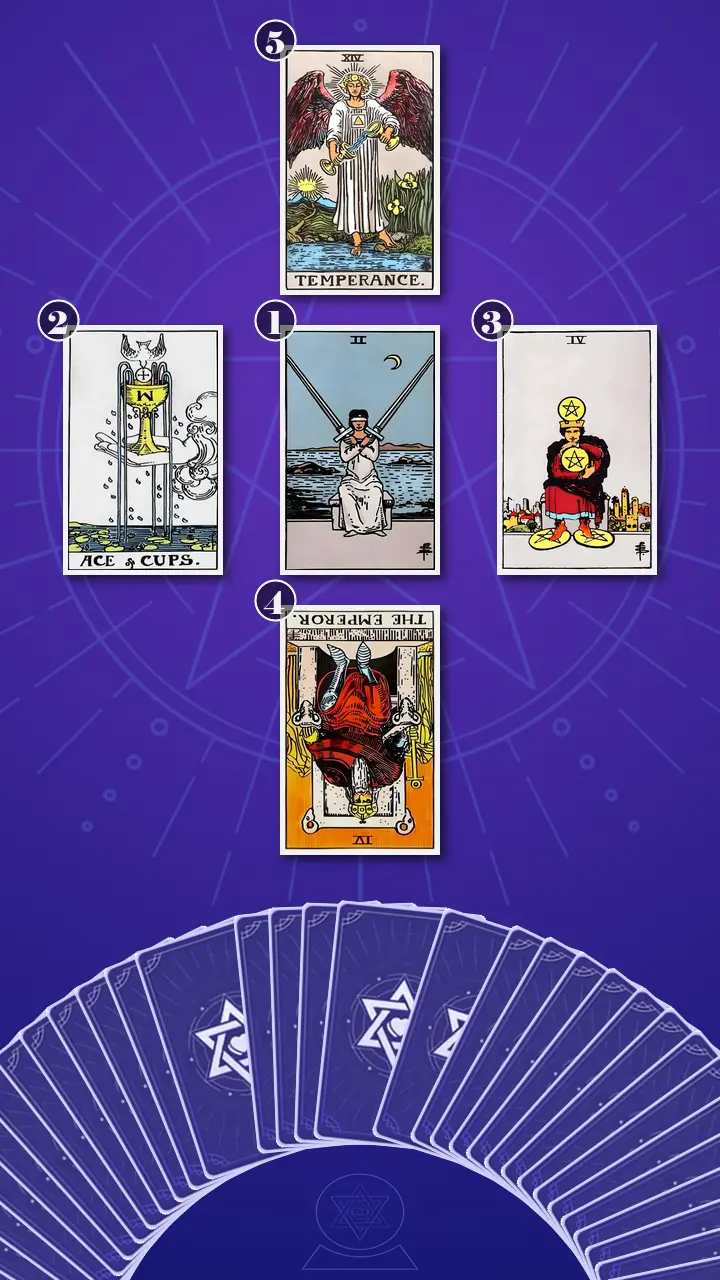
For this reading, I chose the five-card Decision Cross. I use this tarot spread when two legitimate paths have been turned into opposing verdicts. It is compact enough to keep the question precise, but broad enough to show the visible stalemate, the value of each option, the hidden influence beneath the conflict, and the perspective that can integrate what initially looks incompatible.
I placed the first card in the centre for Jordan's current decision knot: opening adoption listings, comparing them with the calendar, and postponing a clarifying next step. I placed the second card to the left for what adoption represented emotionally, and the third to the right for what the established routine protected. Beneath the centre, the fourth card would expose the hidden belief maintaining the stalemate. Above it, the fifth would offer guidance for conscious decision-making without predetermining the outcome.
The layout resembled a crossroads with a foundation below and a compass point above. That structure mattered. A larger spread would have added future projections and outside influences when Jordan already had more imagined scenarios and borrowed opinions than they could use. The Decision Cross kept the reading anchored to one practical question: what information and experience would allow Jordan to make their own responsible choice?
This is how I understand how tarot works in a decision reading. The cards do not issue a verdict. Their symbols externalise patterns that are difficult to inspect while they are running inside the mind. Card meanings in context become a structured mirror, giving intuition something concrete to meet and logic something honest to test.
Two Open Tabs and One Unasked Question
Position 1: The Choice That Looked Like Research
The card I opened first occupied the position of the current decision knot, showing the observable pattern of comparing adoption with the calendar and then postponing the next clarifying step. It was the Two of Swords, upright.
I pointed to the blindfolded figure holding two crossed swords in exact balance. Behind the figure, water remained at a distance. “This is not a picture of someone who has failed to choose,” I said. “It is a picture of someone working very hard to preserve two opposing positions without allowing new information to disturb the balance.”
In Jordan's daily life, the crossed swords had become two illuminated screens. A rescue profile sat on the phone; Google Calendar sat on the laptop. Jordan compared a possible feeding block, a changed workout, and a hypothetical vet appointment, then closed the browser before asking the rescue what that specific animal actually needed. Keeping both imagined futures untouched had become the observable choice.
The Two of Swords was upright, but its Air energy was blocked in repetition. Thought should help distinguish relevant facts, yet here it kept generating comparisons without increasing knowledge. Research lowered uncertainty for a minute while preventing Jordan from collecting evidence. It was an A/B test designed in exquisite detail and never launched because a result might require a real adjustment.
I asked, “What fact have you avoided gathering because a factual answer might make the trade-off more concrete?”
Jordan let out a short laugh, but there was no humour in it. “That is so accurate it feels a bit brutal. I have six saved profiles, and I do not know the actual daily requirements of any of them.”
I did not hurry to soften the recognition. I said, “The card is describing a strategy, not accusing you of dishonesty. The strategy gives you temporary predictability. It simply cannot produce the kind of clarity you are asking it to produce.”
Jordan's thumb stopped rubbing the edge of their phone. For the first time that evening, they turned both screens face down.
Position 2: What the Open Cup Was Really Holding
The next card represented what adopting a pet meant emotionally, especially the hoped-for care, connection, and fulfilment that kept drawing Jordan back to the possibility. I turned over the Ace of Cups, upright.
The card showed a cup overflowing into a pool, with water moving freely rather than being forced into storage. I read that balanced Water energy as genuine emotional openness that had not yet found a practical channel. It did not promise that adoption was right, and it certainly did not claim that affection could erase logistical limits. It confirmed that Jordan's interest was more than a passing reaction to a cute rescue reel.
I asked Jordan to picture an ordinary Wednesday rather than an ideal first week: closing the laptop after work, preparing food, greeting and caring for another living being, making room for play or a walk, and noticing a different kind of presence in the apartment.
“What enters that picture for you?” I asked. “Companionship, purpose, a reason to get outside, the chance to care, or something else?”
“Consistency,” Jordan said after a pause. “Not consistency in my schedule. Consistency in the relationship. Someone is there, and I am showing up for them. Ordinary days feel less disposable.”
I watched their expression change as they spoke. The line between their eyebrows eased, but their fingers curled around the cuff of their sweatshirt. The hope was real, and so was the weight of what repeated care would require. I told them the Ace asked us to honour the longing without allowing an idealised bond to answer every practical question.
Position 3: The Calendar Blocks Held Underfoot
The third card occupied the position of what keeping the present routine protected: stability, autonomy, known limits, and the possibility that these valid benefits were being held too tightly. It was the Four of Pentacles, upright.
I showed Jordan the pentacle pressed against the figure's chest and the two coins held immobile beneath the figure's feet. In context, those coins looked like calendar blocks treated as fixed possessions. Jordan's schedule protected work focus, exercise, meals, errands, and recovery time. The card did not ask them to dismiss any of that. Sustainable pet care should include the caregiver's wellbeing, not consume it as proof of devotion.
The difficulty was an excess of conserving Earth energy. When a possible care task moved one evening routine by thirty minutes, Jordan's body interpreted the movement as lost autonomy rather than a limited adjustment that could be observed and reversed. Every existing habit received the same level of protection, so a necessary recovery block and a low-stakes hour of scrolling appeared equally non-negotiable.
“Which two or three parts of your routine genuinely keep you well?” I asked. “And which parts have never been tested because the first sensation of disruption feels like evidence that the whole week will become unmanageable?”
Jordan looked towards the kitchen window. Rain traced narrow lines through the reflected blue of the laptop. “I need one evening with no social plans, and I need my morning focus time on office days,” they said. “But I have been defending every workout time, every errand slot, even when I move those things for friends without thinking my life is collapsing.”
Their shoulders dropped, then rose again slightly, as if the admission created both room and exposure. I named the conflict plainly: Jordan was not choosing between caring and having a life. They were trying to discover what kind of rhythm, if any, could responsibly hold both connection and stability.
When the Calendar Became the Emperor
Position 4: The Rule Beneath the Routine
The fourth card represented the hidden belief beneath the inner conflict, specifically the fear that disruption would prove Jordan could no longer manage their life. I turned it over below the centre card: The Emperor, reversed.
The upright Emperor creates structure, boundaries, and dependable order. Reversed, that energy can become a blockage in which structure stops serving life and begins demanding that life obey. The stone throne becomes too heavy to move. The armour stays on even when there is no immediate threat.
For Jordan, the modern version was painfully specific. A useful planning system had been promoted into the final authority on whether a caring commitment was permissible. They redrew a perfect week, documented imagined edge cases as if preparing a product launch, and rejected any scenario the calendar could not fully predict. Their hidden rule was not merely, “I need to prepare responsibly.” It was, “I must control every variable before I am allowed to learn more.”
I have spent twenty years listening to lives unfold over coffee, and I have seen useful systems harden in this quiet way. A budget becomes a judge of whether joy is allowed. A productivity app becomes a measure of personal worth. A calendar built to protect a person starts grading the person instead. Looking at the reversed Emperor, I thought of all those cups left to cool while someone tried to earn permission from a tool they had created themselves.
I said, “A calendar can protect your life without becoming the authority that decides what your life is allowed to include.”
Jordan's jaw tightened. Their gaze moved to the laptop as though the colour-coded blocks had acquired a voice. I gave that voice its exact sentence: “I am not asking for information yet; I am asking for a guarantee that nothing will change.”
They went still, then slowly pressed their tongue against the inside of their cheek. “I thought all the planning meant I was taking the responsibility seriously.”
“Some of it does,” I replied. “We are not throwing away your planning skill. We are distinguishing a support structure from absolute control. Responsible preparation asks for relevant facts, clear boundaries, and contingency plans. Absolute control asks the future to stop being a future before you take one reversible step.”
I invited Jordan to imagine moving one evening block by thirty minutes instead of deleting the entire simulated week. The adjustment did not have to prove they could adopt. It only had to reveal what happened next.
“Maybe the discomfort is data, not a warning,” Jordan said, almost under their breath.
I nodded. That sentence marked the Emperor's catalytic turn. The perfect plan had not become possible. The calendar had simply become a tool again, and a testable plan had begun to look more responsible than another flawless simulation.
When Temperance Put Both Futures on the Same Page
Position 5: The Rhythm That Could Be Tested
The room changed as I reached for the final card. On Jordan's side of the call, the refrigerator motor clicked off, leaving the kitchen unexpectedly quiet. This position held the integrating principle that could turn an absolute either-or comparison into a reality-based process for testing capacity. I turned over Temperance, upright.
The figure on the card poured water continuously between two cups, with one foot on land and the other in water. I read this as balanced, circulating energy: practical limits remained grounded while emotional truth was allowed to enter the same system. Temperance did not split the difference or demand compromise at any cost. It asked for proportion, observation, and adjustment.
I brought Jordan back to the 10:45 p.m. kitchen counter. A rescue profile glowed on the phone while hypothetical care blocks filled the laptop. The possibility of companionship lifted their face; two altered evenings tightened their chest. Then they deleted the whole experiment before it could teach them anything.
This was where I used my Analysis Paralysis Deconstruction. I stripped the decision of its abstract forecasts and separated immediate realities from imagined total futures. Jordan did not yet know a specific animal's care needs. They did know which work blocks and recovery periods mattered. They could test two small schedule adjustments without applying, adopting, or judging their competence.
I then used Complexity Reduction to identify the practical binary hiding beneath the emotional one. The next decision was not “adopt a pet or protect my life.” It was simpler: continue forecasting without new evidence, or collect one bounded week of evidence while keeping essential limits visible.
Keeping every part of your routine untouched is not the same as being responsible; build clarity through small adjustments, like Temperance pouring between two cups until a workable rhythm becomes visible.
I let the sentence remain between us. Then I added, “A responsible choice does not require a perfectly unchanged routine. It requires enough real information to test whether the essential parts of your life can flex around what you value.”
Jordan's breath stopped halfway in. Their fingers hovered above the trackpad, rigid and slightly spread, as if another schedule were about to disappear beneath them. Then their focus slipped beyond the screen. I could see the remembered sequence moving across their face: the Tuesday workout, the imaginary feeding block, the deleted week, the sudden relief, and the frustration that followed. Their eyebrows pulled together, and a flash of anger sharpened their voice. “But doesn't that mean I have been doing responsibility wrong this whole time?” A moment later, their eyes shone at the edges. Their clenched fingers loosened one by one, their shoulders lowered, and they released a shaky breath that sounded less like relief than the slight dizziness of putting down something heavy and realising they would now have to decide how to walk without it.
I answered the anger before reaching for reassurance. “It means your method protected you from uncertainty until the protection became more expensive than the uncertainty. That method was understandable. It is also editable. Recognising that does not make your earlier choices foolish, and it does not obligate you to adopt now.”
I leaned a little closer to the screen. “With this new perspective, think back to last week. Was there a moment when this insight could have made the situation feel different?”
Jordan looked down at the counter. “Tuesday. I moved a workout for a friend and it was fine. Later that night, I refused to move the same block in a pretend pet schedule because it suddenly felt permanent. I could have left the block there for one day and noticed what was actually hard.”
That was Temperance in ordinary life: emotional desire and practical limits on the same page, with observations moving between them over time. Its inner operating rule was, “I do not need to choose which side is real; I need to see what happens when they meet.”
I named the emotional movement carefully. This was not instant certainty, and it was not a prediction that adoption would work. It was the first shift from tense ambivalence and certainty-seeking over-planning to grounded confidence in a values-based pet adoption choice. Jordan had moved from protecting two imagined futures towards trusting themselves to collect evidence, honour limits, and respond to what the evidence showed.
The spread also contained no Wands. I did not treat that absence as fate. I read it as a practical clue: Jordan already had Air for thought, Water for connection, and Earth for stability. What had been missing was Fire in its safest form, not a reckless leap, but a small experiment that could generate lived information.
The Seven-Day Path from Insight to Evidence
I gathered the five cards into one coherent story. Jordan's established routine had become a genuine source of steadiness and autonomy. The Ace of Cups introduced an equally genuine wish for companionship and repeated care. The Two of Swords kept those needs sealed in separate imagined futures, while the reversed Emperor imposed the rule that responsible action required total predictability. Temperance restored circulation by allowing care and stability to meet through measured experience.
The central blind spot was not simply overthinking pet-care responsibilities. Jordan had been treating the body's first discomfort with change as proof of an actual capacity limit. They had also been defending every calendar block equally, which made a thirty-minute adjustment look as consequential as losing essential recovery time. The transformation direction was clear: move from comparing two absolute futures to running one time-limited, reality-based test of pet-care demands against the current routine.
I told Jordan, “The result is allowed to be no. If the real care needs conflict with your essential capacity, that is useful clarity, not personal failure. The result is also allowed to be maybe, followed by another question. Your task is not to perform readiness. It is to gather enough evidence to make a choice you can own.”
To keep the next steps small, I adapted my Coffee Bean Filter Protocol into a twenty-four-hour decision filter. I asked Jordan to sort the variables physically rather than building another Notion dashboard. “Emotional Noise” would not mean that feelings were trivial. It would mean a forecast, such as “every quiet evening will disappear,” that had not yet been supported by a fact or a test.
- Run the Coffee Bean Filter Protocol. Set a 10-minute timer tonight. Write each concern on a separate slip of paper and place it beside one of two coffee mugs: Absolute Must-Haves or Emotional Noise. Put verified work obligations, building restrictions, financial limits, and protected recovery needs under Must-Haves. Put perfection rules and unsupported forecasts under Emotional Noise. Revisit the two groups once, 24 hours later. Tip: Keep the list to three true must-haves. If a concern is actually an unanswered care question, do not force it into either mug; turn it into the factual inquiry in the third step.
- Complete the two-block, seven-day care-capacity test. Add one realistic 20-to-30-minute morning care block and one evening block on two different days in Google Calendar. Label both Test, Not Commitment. At the end of each tested day, write one sentence in Apple Notes recording what moved, what stayed easy, and what still felt genuinely difficult. Keep one recovery block visibly protected. Tip: Do not redesign the rest of the week. If the exercise becomes overwhelming or stops producing useful information, pause after one observation. Jordan, not the cards, decides whether to continue.
- Send one factual rescue inquiry. Choose one saved profile from a local Toronto rescue and send three questions: What are the animal's typical daily care needs? How much time can they comfortably spend alone? Are there known medical, exercise, or behavioural support requirements? Record the reply under Facts, Assumptions, and Still Unknown. Tip: Asking is not applying. Contact one organisation instead of opening five more profiles, and step back without guilt if the facts do not fit your boundaries.
The protocol gave Jordan's systems-oriented mind a job it could perform without becoming the reversed Emperor again. The seven-day simulation would reveal whether a schedule block bent easily or exposed a serious constraint. The rescue inquiry would replace generic internet stories with relevant information about one possible commitment. Together, those steps created evidence before certainty.
I asked Jordan to open their calendar while we were still together. They placed a 25-minute block on Wednesday morning and another on Friday evening. Their hand paused over the Friday block.
“That is usually when I protect doing absolutely nothing,” they said.
“Then keep that recovery time protected,” I replied. “Temperance is not asking you to sacrifice the part of your routine that keeps you well. Choose a lower-stakes evening block. The experiment has to include your boundaries, or it is testing self-abandonment instead of capacity.”
Jordan moved the test to Tuesday and left Friday untouched. It was a tiny edit, but it showed a different form of control: not forcing life to remain unchanged, and not surrendering the calendar either. Jordan was using structure responsively.

A Week Later, the Calendar Still Moved
Seven days later, I received a message from Jordan. It began, “I did not apply. I asked.” The rescue had explained that the animal Jordan first chose needed more daytime support than their office schedule could reliably provide. Instead of treating that mismatch as evidence that they could never care for a pet, Jordan recorded it as a specific limit connected to a specific animal.
They had also completed the two-block test. One morning block had felt rushed because it collided with an office commute. The evening block required moving an errand by thirty minutes and turned out to be almost uneventful. Friday's recovery time remained protected. For once, the calendar contained changes that had been observed rather than deleted on sight.
Jordan slept through the night after sending the inquiry, then woke with the thought, “What if I still get this wrong?” They smiled, opened the rescue's reply, and read it again as information rather than a verdict.
I did not see a person who had solved pet adoption in one week. I saw the first credible evidence of adaptive self-trust. Jordan could now distinguish an essential routine from an adjustable habit, and a real care constraint from the physical jolt of encountering change. Whether they eventually adopted or kept their present routine would remain their choice.
For me, that is the Journey to Clarity at the heart of a five-card Decision Cross. Tarot offered Jordan a clean view of the pattern, but the cards did not move a calendar block, contact a rescue, or protect Friday evening. Jordan did. Their agency was not the reward at the end of the reading; it was the method that made the reading useful.
If you also want the warm, ordinary bond of caring for a pet while your chest tightens at every moved calendar block, remember that noticing the difference between a true limit and an untested forecast means you are no longer standing at the untouched crossroads.
If this decision became one seven-day pour between Temperance's two cups, rather than a verdict on your competence, which part of your week would you be most curious to observe first?