When the Right Step Feels Wrong: Separating the Signal From the Story
When the Right Next Step Feels Wrong at 9:38 p.m.
I know the decision-paralysis loop that catches thoughtful people who can build a flawless rationale at work but still cannot press Send when the choice becomes personal. When I met Jordan, a 27-year-old communications coordinator in Toronto, they already had the language of boundaries, growth, and self-trust. What they did not have was a way to translate the signal arriving from their body.
At 9:38 on a Sunday night, Jordan sat at a small kitchen table on my screen and shared their desktop with me. Their laptop fan hummed beneath a polished Notion comparison table; through the microphone, I heard streetcar brakes scrape along wet rails outside. Their phone was warm from one last scroll through posts about intuition versus fear, and their jaw tightened each time the cursor drifted toward a draft email.
The email would request a twenty-minute conversation about a better-paid senior communications role. It looked right because it offered career momentum, more rent money, and work Jordan could clearly do. It felt wrong because the role might revive the always-available culture they had promised themselves not to accept again. So they had added another column to the comparison table, reopened three advice threads, and left the message unsent.
“I can explain the choice,” Jordan said, rubbing one thumb against the edge of their phone, “but I cannot make myself believe it. If this is the healthy next step, why does it feel like self-betrayal? I do not want to call fear intuition, but I also do not want to call intuition fear.”
I could see the physical weight of that ambivalence. It was like a streetcar caught at a track switch, motor humming and brakes engaged, every jolt suggesting movement while the carriage remained in exactly the same place. A rational plan brought Jordan brief relief; imagining the plan becoming real pulled the doors shut across their chest.
I told them I would not treat that tightness as a mystical command to proceed or retreat. “We are not asking the cards to choose the role for you,” I said. “Our Journey to Clarity is to separate what you feel from the meaning you have assigned to it, identify what the feeling may be protecting, and find one next move small enough to teach you something without taking over your future.”

Six Cards Across a Fogged Doorway
I asked Jordan to place both feet on the floor, take one unforced breath, and state the question once: “What am I missing when the next step looks right but feels wrong?” I shuffled slowly. I use that brief ritual as a transition from reacting to observing, not as theatre and never as a claim that the cards possess authority over someone's life.
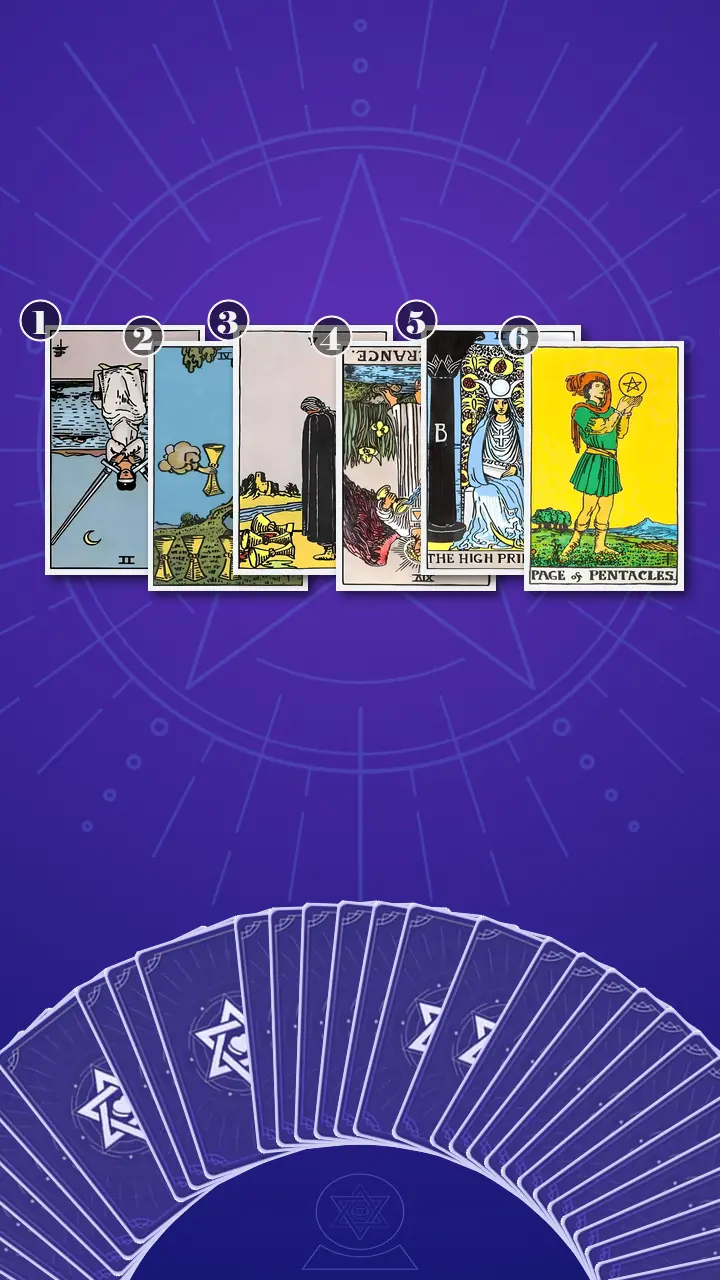
I chose The Shadow Spread, a six-card tarot spread for inner decision conflict. I laid the cards in a horizontal line, left to right, like a path running from a fogged doorway toward a small patch of workable ground.
For anyone wondering how tarot works in my practice, I use card meanings in context as a structured set of questions. Jordan was not comparing two fully defined external options, so a predictive or broad future-oriented spread would have added noise. The Shadow Spread was better suited to the actual problem: the missing information appeared to be inside the way the decision was being held.
The first card would show the visible behavior that kept reopening the choice. The second would reveal the quiet need or boundary screened out by the demand for reassurance. The third and fourth would trace old disappointment and the belief that healing must be complete before action. The fifth would identify an inner resource, and the sixth would translate the reading into a practical, reversible next step. The sequence would explore the problem without pretending to issue a verdict.
The Browser Tabs Behind the Blindfold
Position 1: The Choice That Never Stays Closed
I turned the card representing Jordan's observable decision behavior: the logically persuasive next step that was repeatedly reopened whenever it felt wrong. It was the Two of Swords, reversed.
I pointed to the blindfolded figure and the two swords crossed over the chest. In Jordan's modern version of the image, the blindfold was not ignorance. It was the assumption that one more source of input must contain the missing certainty. The crossed swords were two defended arguments: “This is the sensible move” and “My discomfort means the move is unsafe.” Neither argument was allowed to lower its weapon long enough for the underlying feeling to speak.
The card precisely mirrored the Sunday-night loop on Jordan's shared screen: a balanced Notion table, six open tabs, and a draft email that could begin the next step. Each time their chest tightened, they added another criterion or asked another friend. Their private refrain was, “I already know the reasons, but if I still feel this tense, maybe I have missed something.”
Reversed, the card showed blocked air and an overextended decision process. Research was no longer producing new facts; it was postponing direct contact with the consequence of choosing. The action window kept closing, and the unresolved choice began to feel like evidence that Jordan could not trust their judgment.
“Which part is genuinely unclear?” I asked. “And which part are you keeping unresolved because sending even an exploratory message feels like surrendering the right to reconsider?”
Jordan gave a short laugh with a bitter edge. “That is so accurate it feels a little cruel.” Their fingers stopped above the trackpad, but their shoulders remained high.
I did not rush to soften the recognition into a positive lesson. “The card is not accusing you of wasting time,” I said. “Research has helped you avoid real mistakes. I am only asking whether it is still generating information or now generating temporary relief. More input can reduce the pressure to choose without improving the choice.”
I wrote one sentence beside the card: An uneasy feeling is information; the story attached to it is still a hypothesis.
Position 2: The Plain Sentence That Did Not Feel Profound Enough
I turned the card representing the decision blind spot: the need, value, or boundary Jordan might be overlooking while expecting the apparently right choice to feel reassuring. It was the Four of Cups, upright.
The figure's crossed arms could look like indifference, but I read them as protection. The fourth cup, quietly offered from the cloud, resembled a sentence Jordan had already written in Apple Notes: “I might be open to this if I can ask about after-hours expectations before I apply.”
Jordan had dismissed that line because it did not produce immediate relief. They had gone back to scrolling for an answer that would make the role feel obviously right or obviously wrong. Their inner logic was, “That cannot be the insight because it does not make me feel instantly better.”
Here, the water energy was protective but excessive. Jordan's attention had narrowed around the absence of reassurance, while a modest condition already present in their own experience went unnoticed. The blind spot was not necessarily a secret third career option. It might be a boundary that turned an overwhelming decision into a specific conversation.
“When you say the step feels wrong,” I asked, “what does the current version ask you to abandon? Your evenings? Your privacy? Your ability to change your mind? Your preferred pace?”
Jordan looked down at the note they had shared. Their thumb pressed into the phone case, held there, and then eased. “I think I have been treating curiosity as consent,” they said. “As if asking about the role means I have already agreed to become the version of me who takes it.”
I nodded. “The feeling may not be saying no. It may be saying, ‘Do not leave this part of me behind.’ Sometimes the useful signal is not ‘never.’ It is ‘not like this.’”
Position 3: The Old Decision Still Sitting in the Interview
I turned the card representing the root influence: the disappointment still shaping Jordan's present choice without being allowed to dictate it. It was the Five of Cups, upright.
I followed the black-cloaked figure's gaze toward the three spilled cups. Jordan told me about an earlier communications contract they had accepted because the job description called the pace “dynamic.” In practice, dynamic had meant late-night Slack messages, shifting expectations, and a manager who treated availability as enthusiasm. Jordan had defended the choice to friends before eventually admitting that the role was hollowing out their weekends.
Now, whenever a new opportunity sounded ambitious, Jordan mentally reopened an old message from that period. Their stomach dropped, and the past cross-examined the present: “I explained that decision too. Logic did not protect me then, so I cannot afford to be wrong again.”
The imbalance in the Five of Cups was attention captured by loss. The card did not tell me Jordan was overreacting, and I would not use the two upright cups as a forced positive spin. The disappointment deserved to remain disappointing. At the same time, the experience had left something usable behind: a clearer question about after-hours culture and a firmer boundary around access to their personal time.
I asked, “What did that experience teach you to ask now, before trust is required?”
Jordan's breathing paused. Their eyes moved away from the screen as if rereading the old thread; then their lips parted on a long, low exhale. “I need to know whether ‘ownership’ means autonomy or whether it means being reachable all the time.”
“That is grief becoming a criterion,” I said. “It is not the past predicting the future. It is the past helping you write a better question.”
Position 4: The Notion Board With No Column for Learning
I turned the card representing Jordan's central inner conflict and the all-or-nothing healing threshold that made mixed signals difficult to interpret. It was Temperance, reversed.
The interrupted flow between the two cups showed a blocked integration process. Jordan had been creating, deleting, and recreating the same calendar entry. One evening the script was, “I need to stop overthinking and just do it.” The next was, “The dread proves I am obviously not ready.” Under both reactions sat a stricter rule: “If I were actually healed, this would feel clean.”
Reversed Temperance showed energy swinging between excess and deficiency: forcing movement to prove growth, then withdrawing completely to restore safety. Reason, emotion, protection, and desire were being asked to agree unanimously before any of them could be trusted. A bounded middle option felt too ordinary to count as healing, so it kept disappearing.
Looking at the figure with one foot on land and one in water, I flashed back to my years on Wall Street. On a trading desk, serious risk was rarely managed by declaring a position either perfectly safe or completely forbidden. Exposure changed with size, terms, timing, and exit conditions. I was not comparing Jordan's life to a trade; I was remembering that boundaries turn an undefined threat into a structure that can be evaluated.
“One exploratory call with no application promised is not the same exposure as accepting the role,” I said. “The discomfort may respond differently when the step has a size limit and an exit. If it does not, that is information too.”
Jordan's jaw tightened visibly at the phrase “fully healed.” They pressed their palm against the table and said, “I have a whole mental Notion board with only two statuses: completely ready and not allowed to begin.”
“Then the missing column is learning in progress,” I replied.
When the High Priestess Lowered the Volume
Position 5: The Pause That Was Not Another Delay
For a moment, the streetcar noise outside Jordan's apartment stopped. I could hear only the faint click of their radiator and the soft edge of a card against my table. I turned the card representing the inner resource that could distinguish protective discomfort from values-based misalignment through quiet observation. It was The High Priestess, upright.
I showed Jordan the black and white pillars holding opposing truths without requiring either one to disappear. The veil did not promise a supernatural answer hidden beyond ordinary reach. It represented meaning that could emerge through privacy and attention. Upright, the High Priestess brought balanced stillness, tolerance for ambiguity, and an underused form of self-trust: listening before converting a feeling into a verdict.
In everyday terms, this was Jordan at the kitchen table with the phone face down, the comparison document closed, and one blank page in front of them. Instead of searching “how to tell intuition from fear,” they would write what felt wrong separately from what they believed the feeling meant. “This role is wrong” might become, “I do not want an exploratory conversation to create immediate pressure, public commitment, or routine access to my evenings.” That was not a prediction. It was a condition that reality could test.
I asked Jordan to picture the familiar Sunday scene again: the plan polished, the message drafted, the phone warm from one last advice post, and their chest tightening as the cursor hovered. The old question was already waiting: warning, fear, or proof that more healing was required?
This was where I brought in my Potential Actionability Assessment. I require an abstract insight such as “trust yourself” to pass three gates before I consider it useful: an observable signal, a value or boundary the signal may be protecting, and a milestone small enough to test without pretending to settle the future.
Jordan identified the signal as chest pressure that intensified when they imagined the conversation becoming public or binding. They identified the protected values as control over their personal time and the freedom to decline without having to defend the decline. The testable milestone was one twenty-minute conversation, explicitly exploratory, with three prepared questions about after-hours expectations, decision-making autonomy, and what the hiring process would require next.
I let the structure sit between us before saying the simpler truth beneath it.
You are not missing one more argument; you are missing enough quiet to hear what the feeling protects, and a small enough test that it does not have to become a verdict.
You do not have to force a step because it looks right or dismiss it because it feels wrong; use the High Priestess's stillness to hear the value beneath the feeling, then let a small grounded experiment test your understanding.
Jordan's breath stopped halfway in. Their right hand, which had been turning the phone face down and up, froze flat on the table. For several seconds their focus left the cards; I watched their eyes move as if replaying the cancelled calendar invite, the old contract, and every friend's voice note. Then their mouth tightened. “But does that not mean I have wasted months doing this wrong?” The anger came first, thin and quick. I did not argue it away. I told them the research had been protective and sometimes useful; it had simply reached diminishing returns. Their eyes shone, their jaw released, and the shoulders that had sat near their ears dropped by degrees. A long breath left them, followed by a quiet, almost disoriented laugh, the kind that comes when a burden lifts and reveals responsibility underneath. Clearer did not mean easier. It meant the next observation was theirs to make. I asked, “Now, with this new perspective, think back to last week. Was there a moment when this insight might have made the situation feel different?”
Jordan remembered cancelling an informal call while washing dishes. “I thought I was afraid of the conversation,” they said slowly. “But I was imagining the conversation as a promise. What felt wrong was the permanence, not the first conversation.”
I named the crossing carefully. This was not sudden enlightenment and not proof that the role was right. It was one movement from tight ambivalence and certainty-seeking toward quiet discernment, grounded self-trust, and learning through a small reversible experiment. The High Priestess had changed the quality of the pause: from postponed judgment to deliberate listening.
Position 6: The Page's One-Step Field Test
I turned the final card, representing the small reversible action that could gather lived information without asking tarot to decide. It was the Page of Pentacles, upright.
The Page studied one pentacle rather than trying to see the entire route over the mountains. I read that focused earth energy as balance: practical curiosity, patient effort, and willingness to begin as a learner. After so much blocked air and emotionally saturated water, the spread did not end with a burst of fire or a dramatic leap. It ended with something Jordan could observe.
In modern life, the Page might schedule one exploratory conversation, draft one boundary without sending it, or trial one version of a routine for an afternoon. Before the test, Jordan could choose three observation criteria: what actually happened, whether the stated boundary was respected, and whether curiosity expanded or contracted afterward. Stopping could be valid evidence. Continuing could be valid evidence. Neither result would be a verdict on Jordan's worth.
“I am not choosing my whole future,” Jordan said, testing the sentence aloud. “I am collecting one piece of lived information.”
“Exactly,” I said. “A reversible step is not a vote for your whole future. The Page is not performing certainty. The Page is studying reality.”
The Signal-Story Split and a Doorway With an Exit
I drew the six cards back into one coherent account. The reversed Two of Swords showed why Jordan kept reopening the decision: discomfort triggered more research, reassurance, and postponement. The Four of Cups revealed the overlooked condition already sitting in their Notes. The Five of Cups connected the hesitation to a real disappointment that deserved respect, while preserving the boundary that had survived it. Reversed Temperance exposed the impossible rule that growth should feel clean and healing should be complete. The High Priestess separated the signal from the story, and the Page of Pentacles gave the insight a modest material form.
The spread answered why Jordan felt stuck. They had been standing before a fogged doorway with a convincing map, but they were waiting for the feeling of absolute permission. Every new browser tab looked like a clearer map fragment, yet the duplicate pages were hiding the only line that mattered: “I may be willing to explore this, but not without a boundary around permanence and personal time.”
I stated the cognitive blind spot directly. Jordan had assumed that a healthy next step should produce emotional reassurance, and that mixed feelings meant either failed healing or unreliable judgment. The transformation was not from discomfort to comfort. It was from treating discomfort as a verdict to treating it as information that could contain fear, grief, context, desire, or a boundary.
I then used my Pseudo-Growth Eradication audit. I did not dismiss therapy language, journaling, coaching, or support from friends. I asked Jordan to evaluate their actual return on each new input: Did it reveal a more specific fact, value, boundary, or action? Did it improve execution? Or did it reproduce the same question in more polished language?
The audit exposed the friction. Jordan's most useful reflection had produced one plain sentence about an exit point. The rest had largely reduced pressure for twenty minutes without changing the decision. The new ROI measure would not be immediate certainty. It would be specificity, boundary protection, and completed observation. That put personal growth back in service of Jordan's life instead of turning it into another requirement they had to perfect.
The Shadow Spread had done its job as a six-card map for inner decision conflict. Now the map needed behavior. I offered three pieces of actionable advice, each deliberately small enough to begin without surrendering autonomy.
The Evolution KPI Framework: Thirty Days of Lived Evidence
- Run the Eight-Minute Signal-Story Split On one evening this week, sit at the kitchen table with the phone on Do Not Disturb and set an eight-minute timer. Write three separate lines: “What feels wrong is...”; “The meaning I am assigning to that feeling is...”; and “The value or boundary this feeling might be protecting is....” Stop when the timer ends. The purpose is separation, not a final answer. Minimum version: write only “The sensation I notice is...” You may stop at any point, and the first sentence is an observation, not a command.
- Put a Boundary Before the Verdict Before asking a friend for another opinion or sending the career email, write one boundary beside the proposed step: “one conversation only,” “no application today,” “I will not announce this,” or “the call ends after twenty minutes.” Then spend no more than ten minutes beginning the reversible version, such as drafting the request or writing the three questions. A boundary is part of the evidence, not a loophole. If safety, consent, legal advice, or professional guidance is involved, use the appropriate qualified support instead of treating the situation as a personal experiment.
- Track the Evolution KPI for Thirty Days For the next thirty days, run no more than one bounded experiment per week for this decision. Use four measurable fields: private note completed before outside advice; boundary named; reversible test completed; and a ten-minute review recorded twenty-four hours later. In each review, note what happened, what your body did during and after, and whether the action respected the value you named. Score completed observation cycles, not emotional certainty. A deliberate stop can count as useful evidence. If a week is missed, record it and resume; do not compensate with a larger or more dramatic action.
I told Jordan that the discipline in the Evolution KPI Framework was not about forcing a promotion decision within thirty days. It was about making a philosophical shift measurable. Self-trust would no longer mean always interpreting the first feeling correctly. It would mean staying present, protecting the named boundary, and updating the next move from evidence.
The cards had not selected the role, guaranteed safety, or labelled the discomfort as intuition or fear. They had clarified the process. Jordan still owned every yes, every no, every pause, and every exit.
One Week Later: A Quieter Kind of Proof
One week later, I received a message from Jordan. They had sent the request for one twenty-minute exploratory call, explicitly marked “no decision expected.” They slept through the night. Their first thought on waking was still, “What if I am wrong?” They smiled at it and made coffee.
The call had not solved Jordan's career or removed the grief attached to the old role. It had produced something more reliable than a dramatic feeling of certainty: the hiring manager answered the after-hours question directly, Jordan noticed their chest loosen when the boundary was respected, and they gave themselves twenty-four hours before considering another step.
I think of that as the quiet proof from our Journey to Clarity. Tarot supplied an objective structure for seeing the loop; Jordan supplied the honesty, criteria, and lived evidence. Their narrative began to return to them the moment they stopped asking one uneasy feeling to decide everything at once.
If a sensible choice makes your chest tighten tonight, I want to leave you with this: the hardest weight may not be the decision itself, but the fear that one wrong move will expose your judgment as permanently unsafe. Noticing that fear is already a movement from the blindfold toward the High Priestess's quiet threshold. Self-trust is not perfect certainty; it is staying present while you learn.
So, if the next step did not have to prove your judgment, what is the Page's version in your life: one tiny, reversible field test, with one boundary and one exit point, that you feel curious enough to observe?