Grad School Funding Versus Mentor: Two Tabs, Then Two Messages Go Out
The 8:47 Line 1 Funding-or-Mentor Spiral
When I first met Jordan, I met a first-year research graduate student in Toronto with a funding offer on one tab, a potential mentor's profile on another, and a blank email draft waiting in the background. Every attempt to decide had become another round of grad school decision paralysis.
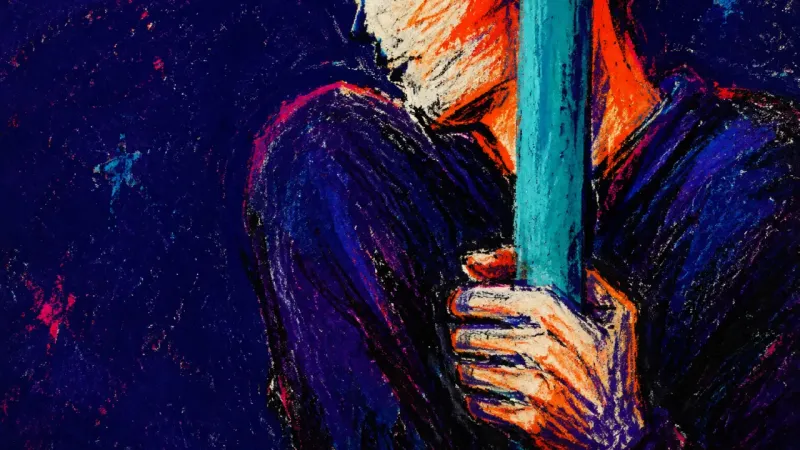
Jordan gave me a precise timestamp: 8:47 p.m. on a Tuesday, riding Line 1 home from campus. The fluorescent carriage lights buzzed overhead as they toggled between the funding spreadsheet and the mentor's profile, their phone growing warm against their palm. Their shoulders had climbed towards their ears, but their restless thumb kept reopening the same documents as if the next swipe might reveal an option with no cost attached.
A deadline reminder had landed just after someone in the cohort chat announced a funded placement. Jordan described the thought that immediately started running in the background: “One more comparison will make this feel safe enough to choose.” Twenty minutes later, they had added another column to Google Sheets and sent neither of the messages that could have produced new information.
“If I choose for the money, I might lose my direction,” Jordan told me. “If I choose for the mentor, I might lose my security. I keep looking for the option that makes the other option irrelevant.”
I could hear the refrigerator humming through our call. A half-finished dinner sat beside Jordan's laptop, and a rent notification glowed beneath the funding deadline. The anxious uncertainty in their body seemed less like ordinary nerves and more like trying to breathe while a browser kept refreshing inside their ribcage: every new result arrived as another reason not to exhale.
“I don't hear someone who doesn't care,” I said. “I hear someone trying to make one decision protect every part of their future. You are not stuck because you do not care. You are stuck because you care about both.”
I told Jordan that I would not ask the cards to predict which path would be perfect. Our purpose was more practical: to find out what the delay was protecting, what evidence the decision genuinely required, and where Jordan still had room to act. “Let's draw a map of the fog,” I said, “without pretending the map has the authority to walk the road for you.”
Choosing a Map That Would Not Choose for Them
I asked Jordan to place both feet on the floor and take one slower breath while holding the funding-versus-mentor question in mind. I shuffled deliberately, using the small physical rhythm as a transition from compulsive comparison into focused attention, not as a performance of mystery.
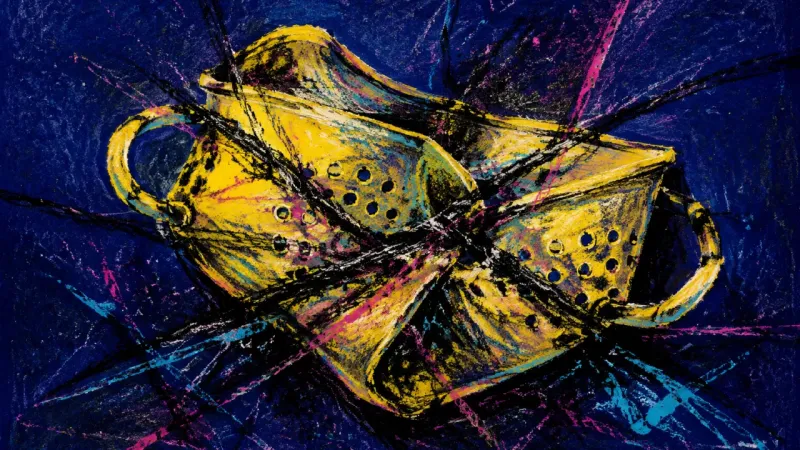
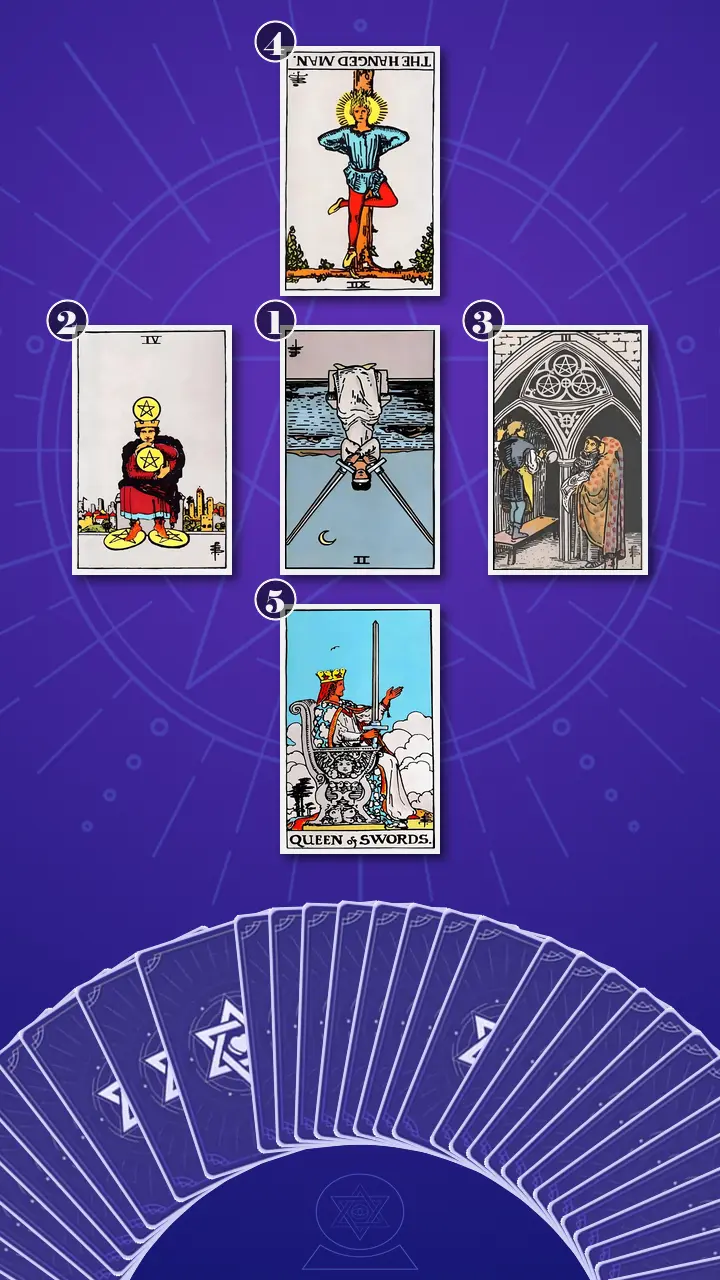
I chose a five-card Decision Cross tarot spread. This is how tarot works in my practice: the spread does not appoint a winner or replace official funding information. It gives a decision a visible structure, allowing us to examine the central state, the realities of each path, the hidden blockage, and the next action separately.
A broader Celtic Cross would have introduced history and future-outcome positions that Jordan did not need. The compact Decision Cross was better suited to a graduate-school crossroads because it could hold both legitimate needs without reducing them to a simplistic winner-versus-loser contest.
I placed the first card at the centre to reveal the observable procrastination and direction stagnation. The second would examine what the funding path protected; the third would make the mentor path concrete. Above them, the fourth would expose the hidden influence keeping both options suspended. Below the centre, the fifth would integrate the evidence into counsel Jordan could use.
The layout resembled a crossroads sign above a narrow exit path. I wanted Jordan to see from the beginning that the problem was not merely funding versus mentorship. The deeper question was how to resume movement when no route could preserve every possible future.
Reading the Crossroads Through Two Open Tabs
Position 1: The Choice Kept Theoretical
I turned over the card representing the central decision state: the observable procrastination around the funding-or-mentor choice and the academic direction stagnation it produced.
It was the Two of Swords, reversed.
I pointed to the blindfold, the crossed blades, and the arms held tightly against the figure's chest. In Jordan's life, the image was almost literal: the funding offer and potential mentor profile stayed pinned side by side, while the email capable of creating clarity remained unsent. Jordan repeatedly compared the options without ranking the criteria or asking the one question that could change the decision.
The reversed card showed blocked Air. Jordan's intelligence was not deficient; it was being used to hold two possibilities open indefinitely. Research, routine coursework, citation cleanup, and inbox sorting offered temporary relief because they allowed movement without exposure to commitment. The blockage was not a lack of thought. It was thought circulating without receiving new evidence.
“What if the spreadsheet isn't failing to find the answer?” I asked. “What if it is succeeding at keeping the choice theoretical?”
Jordan gave a short laugh, but there was bitterness in it. Their eyes dropped towards the laptop, and their fingers rubbed the edge of a cold mug. “That's so accurate it feels a little cruel.”
“Then let's be careful with it,” I replied. “The delay has been protecting you from a fear. That deserves understanding, not punishment. But protection can become confinement when it stops letting new information in.”
Position 2: Security Is a Criterion, Not the Whole Verdict
I turned to the card representing the funding path: what prioritising funding could protect, make possible, or place under Jordan's control, including the safety concern beneath the delay.
It was the Four of Pentacles, upright.
The figure held one coin against the chest, balanced another above the head, and fixed two beneath the feet. I read those coins as the practical Toronto stack Jordan carried every week: stipend, tuition, rent, groceries, Presto balance, renewal terms, and the modest buffer that could keep one unexpected cost from becoming a crisis.
The funding path represented a legitimate form of balance when it established a material floor. The energy moved towards excess when the funding number was asked to answer every other question: whether Jordan would receive useful feedback, feel intellectually engaged, develop confidence, or have enough support to sustain the work.
“Security is a criterion, not the whole verdict,” I said. “The stipend can tell you whether a path is financially viable. It cannot tell you, by itself, what Tuesday afternoon supervision will feel like six months from now.”
Seeing the card did not make Jordan relax immediately. Their hand tightened around the mug before loosening. “I think I've been treating the higher number as the only answer I could defend to other people,” they said.
I noticed the phrase to other people. The card was already separating an actual financial requirement from the need to make the decision appear unassailably responsible. Jordan did not need to minimise rent or tuition. They needed to stop asking material security to carry the entire meaning of their academic future.
Position 3: Mentor Fit Becomes Real in the Work
I turned over the card representing the mentor path: the developmental and collaborative value of direct guidance, and whether that working relationship could address Jordan's need for academic direction.
It was the Three of Pentacles, upright.
The card showed an artisan with a plan and two people examining the work closely. I translated that scene into a shared Google Doc, a project plan, and a twenty-minute supervision conversation about meeting frequency, feedback style, autonomy, authorship, and how project decisions would actually be made.
The Three of Pentacles carried balanced Earth energy: collaboration made observable through structure. It did not promise that a respected mentor would remove uncertainty or become the answer to every need. It showed Jordan how to evaluate fit without idealising a profile viewed from a distance.
“Mentor fit becomes real when you can ask how the work will happen,” I said. “You don't have to choose your entire future in one email. You can ask whether the relationship has usable feedback loops.”
Jordan's breath left their chest in a long exhale. Their shoulders lowered by a fraction, and they looked back at the blank draft on the screen. “I could ask about meeting frequency without implying that I've accepted anything,” they said. “I thought I needed the answer first. Maybe I need the question that makes the answer usable.”
This card acted as the spread's catalyst. It moved Jordan from private speculation towards observable exchange. Conversation was not commitment; it was evidence gathering, and evidence could be gathered within boundaries.
The Calendar Hold That Never Became a Meeting
Position 4: When Preparation Produces Nothing New
I turned over the card representing the hidden influence and blockage: the procrastination and fear of choosing the wrong graduate-school direction that kept both paths suspended.
It was The Hanged Man, reversed.
The upside-down figure, bound by one foot, distinguished a useful pause from an unproductive one. An intentional pause changes what can be seen. Jordan's pause had become a calendar block called “Decision time” that kept getting moved while the funding notes and mentor profile remained untouched as an actual decision.
The reversed energy was a blockage: resistance to accepting that every graduate path would require a trade-off. Another week of research felt safer than direct contact, but nothing new entered the decision. Time passed, the deadline moved closer, and the absence of movement began to feel like additional evidence that Jordan could not trust their judgment.
This was where I used my Research Bottleneck Analysis. I asked Jordan to stop treating the stalled decision as a personal failure and examine it as I would examine a blocked research project: What material was missing? What method had stopped producing results? What next intervention could generate genuinely new evidence?
“One more spreadsheet can be research, or it can be another way of waiting,” I said. “The test is simple: what new information will the next task introduce?”
Jordan's breathing paused. Their gaze drifted away from the cards as if they were mentally replaying the previous week: the renamed Notion pages, the formatted table, the reorganised inbox. Then their shoulders released with a small, uncomfortable drop.
“I have called this preparation before,” they said quietly. “But nothing new has entered the decision.”
I remembered archaeological trenches where an intact layer could look silent until the excavation question became precise. Waiting beside the trench did not reveal its structure; careless digging damaged it. The work required a bounded intervention: one defined area, one suitable tool, and a record of what the new layer actually showed.
“Your pause was not pointless,” I told Jordan. “It showed us the trade-off you were unwilling to release: the hope that one option might protect both security and direction without asking anything difficult of you. We do not need to shame that hope. We do need to stop mistaking it for a plan.”
When the Queen of Swords Opened the Sky
Position 5: Three Criteria, Two Questions, One Bounded Move
The final card represented integrating counsel and the next step: how Jordan could move from waiting for certainty into a bounded practice of criteria, direct communication, and self-trust.
When I turned it over, the room seemed to become quieter. Even the refrigerator hum through the call receded behind the image.
It was the Queen of Swords, upright.
Her sword stood vertical rather than crossed. One hand held the blade; the other extended towards the open air. I read her as a clear-sighted editor: someone who could decide what evidence deserved access to attention and what belonged in the background.
I thought of the section drawings I had made on archaeological digs and of years spent helping arguments survive the intellectual clutter of Cambridge rooms. Through my Academic Stratigraphy lens, Jordan's decision contained three different layers. The material floor of rent, tuition, and confirmed funding was bedrock. Evidence about meetings, feedback, autonomy, and authorship formed the working layer. Imagined regret, peer announcements, and predictions about what a future mistake would supposedly prove were loose topsoil. Every layer was real, but they did not all carry equal evidentiary weight.
“Stratigraphy does not simplify a site by pretending layers are absent,” I said. “It clarifies which layer can support which conclusion. Your task is not to erase complexity. It is to stop letting every thought occupy the bedrock position.”
At 8:47 p.m. on the Line 1 ride home, Jordan had carried the funding spreadsheet, mentor document, and unsent email together in their mind while the phone warmed their palm. Because the choice felt like security versus direction, continued research had become the most convincing way to remain uncommitted.
The goal is not to find a graduate path with no trade-offs. It is to name what matters, ask for usable evidence, and let one bounded choice belong to you.
You do not have to stay blindfolded until the funding-or-mentor trade-off disappears; use the Queen of Swords' clear blade to separate evidence from imagined regret and make one informed next move.
I let the sentence remain between us. Jordan's breath stopped first, and their fingers froze above the trackpad. Their eyes lost focus for a moment, as though the last several weeks were replaying behind them: every reopened tab, every moved calendar block, every polished question left unsent. Then their mouth tightened.
“But doesn't that mean I was wrong this whole time?” they asked, sharper than before. “That I wasted weeks pretending to be responsible?”
The anger arrived before the relief, and I welcomed its honesty. “No,” I said. “It means you used a protective strategy until its cost became visible. The research helped you establish that both needs matter. It simply cannot perform the next task for you.” Jordan's eyes reddened slightly. Their shoulders sank, their clenched hand opened, and a trembling breath escaped as a quiet “Oh.” The release carried a moment of dizziness with it: if the perfect answer was not coming, the next move truly belonged to them.
“Now, with this new perspective, think back to last week,” I said. “Was there a moment when this insight could have made the situation feel different?”
Jordan returned to the draft about supervision. “I could have sent one question instead of trying to make the email prove I was ready to commit,” they said. “I could have asked how often we would meet. That answer would not decide everything, but it would tell me something real.”
The Queen marked a specific emotional crossing: from fear-driven comparison and imagined regret towards grounded self-trust built through clear criteria, direct communication, and a bounded choice. It was not the transformation from uncertainty to certainty. It was the smaller, more durable transformation from treating uncertainty as proof of poor judgment to treating it as information that could be organised and tested.
The One-Page Thesis Stratigraphy Framework
I gathered the spread into one coherent account. The reversed Two of Swords showed Jordan holding both futures open through comparison. The Four of Pentacles established that financial safety was materially important, while the Three of Pentacles showed that academic direction could emerge through a real working exchange. The reversed Hanged Man revealed why neither path had become concrete: Jordan was waiting for a perspective that required no surrender. The Queen of Swords supplied the missing method by separating criteria, evidence, and imagined regret.
The cognitive blind spot was subtle: Jordan had assumed that because many details were true, all of them deserved equal influence over the decision. They also assumed that continued uncertainty meant more private research was required. In fact, some unknowns could only be clarified by another person, and some fears could not be researched away because they concerned the meaning Jordan might assign to future regret.
I also named what the spread did not contain. There were no Cups, so Jordan's needs for belonging, encouragement, and emotional sustainability had remained undernamed. There were no Wands, so initiative would not arrive as spontaneous confidence. It had to be supplied deliberately through one small action.
I adapted my Thesis Stratigraphy Framework into a decision brief. In academic writing, the method helps a core argument pierce through a pile of interesting but unranked material. Here, it would help Jordan preserve the full complexity of the decision without allowing that complexity to bury the criteria that could actually guide it.
- Build a three-layer Decision Stratigraphy. Set a 10-minute timer and create a one-page Notion or Google Doc note. Write one observable requirement under each layer: material security, supervision quality, and development or fit. Mark one as non-negotiable, one as important, and one as a preference. Keep the full spreadsheet as an archive, but do not score either path yet. If three criteria feel too simplistic, label them “current priorities for this week.” They can be revised when new evidence arrives; they do not have to become permanent laws.
- Open the Two-Conversation Clarity Loop. This week, send one short message to the potential mentor asking about meeting frequency, feedback style, project autonomy, and authorship or collaboration decisions. Send a separate question to the funding office about the single term that could change your view, such as confirmed stipend, fee coverage, workload, renewal conditions, or duration. Put each conversation on Google Calendar as a 20-minute information appointment, not a decision deadline. If sending feels too consequential, draft only the first precise question and ask a trusted peer, student advocate, or neutral programme contact to review it. A request for information is not an acceptance.
Jordan objected to the first exercise immediately. “But my future is more complicated than three lines.”
“Of course it is,” I said. “The three lines are not your whole future. They are the load-bearing argument for this week's decision. The archive can keep every other detail. The Queen simply refuses to let the footnotes impersonate the thesis.”
I reminded Jordan that the cards had not selected funding or mentorship. They had clarified the work Jordan needed to do before choosing: establish a financial floor, investigate the actual supervision relationship, and set a boundary around research that produced no new evidence. The authority remained with Jordan, including the right to revise a criterion, delay contact if the context felt unsafe, seek official advice, or decide that neither available arrangement met their minimum needs.
A Week Later, One Question Was in Sent
Six days later, I received a brief message from Jordan. They had made the one-page note. It contained three ranked lines, no colour coding, and a separate column labelled “imagined regret.” They had sent one question to the funding administrator and one meeting request to the potential mentor.
The decision itself was not finished. The administrator's reply clarified the renewal terms, while the mentor had offered a twenty-minute conversation later that week. Yet on the Line 1 ride home, the same phone no longer held two futures in perfect suspension. One direct question sat in Sent, and late light moved cleanly across the train window.
Jordan slept through the night after sending both messages. Their first thought on waking was, “What if I'm wrong?” This time, they smiled and opened the replies.
I considered that the quiet proof of our Journey to Clarity. Tarot had not removed the trade-off, guaranteed the correct graduate path, or granted Jordan certainty. It had helped them uncover the structure beneath the delay, and Jordan had supplied the courage, judgment, and action that changed their relationship to the choice.
When you have stared at the same two tabs until your shoulders ache, trying to make one choice protect both your financial safety and your sense of direction, I want you to remember this: the fear is not proof that you do not care or cannot trust yourself. It may be the mark of caring deeply about two legitimate needs. The moment you distinguish the bedrock fact from the loose layer of imagined regret, you are no longer standing at the beginning.
So, if your choice could become one honest, bounded excavation rather than a verdict on your judgment, which question would you quietly lift from the layer of imagined regret and ask first?