A Holiday Hallway, a Deleted Check-In, and One Honest Return Point

The 8:47 P.M. Group Chat Glow
I have learned that fear of exclusion in a relationship rarely enters as a dramatic fight. It enters when a partner’s phone lights up during a sofa night, their face warms at a family message, and a second check-in starts forming before they have finished the first reply.
Jordan, a twenty-eight-year-old non-binary UX designer in Toronto, replayed that exact scene for me. At 8:47 on a Tuesday evening, the radiator clicked behind the sofa and the screen cast a blue rectangle across the coffee table. Their partner opened the family group chat and began smiling at a voice note. Jordan felt the phone grow warm in their palm as their fingers prepared to type, even though nobody had asked them to leave.
“I know this should be ordinary, but my body is treating it like evidence,” Jordan said. “I know they love me. I don’t want to compete with their family, but the second they turn toward them, I start wondering when they’ll be free again. Why do I cling when I’m trying so hard to give them space?”
I heard the contradiction clearly: Jordan wanted dependable closeness, yet every shift toward the family felt like a doorway closing. The fear moved through them like an elevator dropping one floor inside the ribs, followed by restless hands searching for the nearest proof of connection. I told them, “Needing reassurance does not make you difficult. Today, I want us to slow down the scene, separate what happened from what fear added, and draw a map through the fog. The cards will not decide who matters more. They can help us see where your own leverage lives.”

Choosing the Crossing: How This Relationship Tarot Spread Works
I invited Jordan to place both feet on the floor, take one unforced breath, and hold the question in mind while I shuffled. I use this small transition to focus attention, not to manufacture mystery. In my practice, tarot works as a structured reflection tool: the images make an emotional pattern visible enough to examine.
I chose the Relationship Spread · Context Edition, a focused five-card relationship tarot spread. A broader Celtic Cross could have explored Jordan’s entire emotional landscape, but it would have diluted the specific interaction among Jordan, their partner, and the partner’s established family network. Card meanings in context matter here because the family is not an antagonist and Jordan is not the sole problem. I needed a layout that could hold the whole relational system without forcing anyone into a loyalty contest.
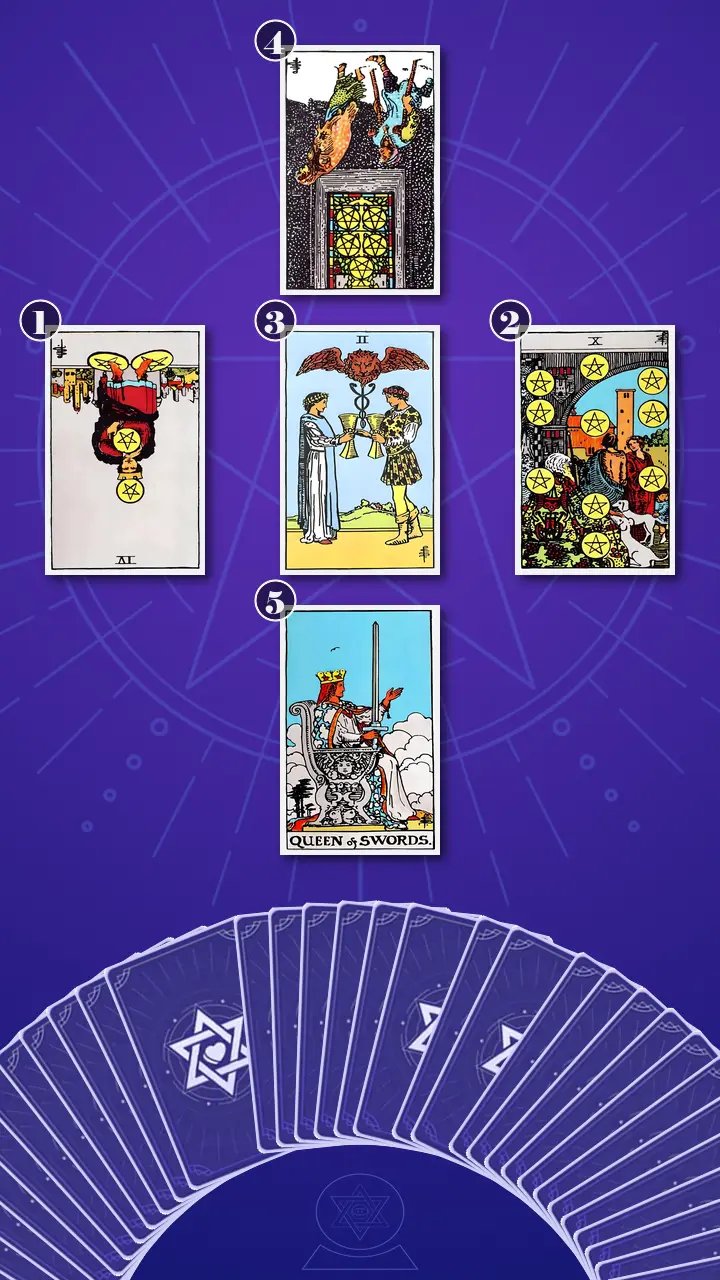
I placed Position One on the left for Jordan’s present stance and Position Two on the right for the partner’s family context. Position Three went between them to show the couple’s living bond. Above that center, Position Four would expose the hidden fear keeping the cycle active. Position Five rested below as the grounded, self-directed next step. The arrangement looked like two paths meeting at a crossing, with one card revealing the pressure above and another showing where Jordan could place their own feet.
“We’ll begin with what you do when the trigger arrives,” I said. “Then we’ll look at what the family bond actually represents, what exists between you as a couple, what your mind fears beneath all of it, and what you can choose next.”
The Grip, the Household, and the Two Cups
Position One: The Hand Around the Phone
The card I turned over for Position One represented Jordan’s present stance: the specific clinging behavior and contracted response that appeared when their partner’s family pulled them in. It was the Four of Pentacles, reversed.
I showed Jordan the figure closed around what he feared losing, with one pentacle held to the chest and two pinned beneath his feet. Reversed, the card described a blockage in security and an excess of holding. It was not saying Jordan cared too much. It was showing how care had become fused with the attempt to control distance.
“This is the Tuesday sofa scene,” I said. “The notification arrives, you move closer, ask when your partner will be available, and begin reading the exchange for signs that you are losing importance. The pentacle becomes the warm phone in your hand. The planted feet become the part of your body that stays anchored beside them, as if physical or digital proximity can stop separation from beginning.”
I asked what Jordan usually did first: move closer, send another message, ask how long the call would take, or go quiet. They gave a short, bitter laugh.
“All four,” they said. “That’s so accurate it feels kind of rude.”
I did not rush to soften the recognition. “I hear the sting,” I said. “But the card is not calling you clingy as a fixed identity. It is showing a strategy. For a few minutes, checking reduces uncertainty. Then your partner can feel monitored and ask for more room. Your mind reads that room as proof that the original fear was right, so the grip returns faster next time.”
Jordan’s smile disappeared. Their thumb rubbed the edge of their mug, then stopped. I watched the pattern become less like a character flaw and more like a loop with identifiable parts. Their family attention was a shift in focus, not automatically a verdict on Jordan’s place.
Position Two: The Network That Existed Before the Date
The card I turned over for Position Two represented the partner’s relational context: the established family bonds and obligations shaping their availability without requiring them to choose between relationships. It was the Ten of Pentacles, upright.
I pointed to the multigenerational household, the archway, and the figures held within a larger structure. Here, Pentacles energy was balanced. It described continuity, history, recurring care, and a network that had been built over years. It did not prove that every family request was reasonable, and it did not require Jordan to accept broken agreements. It simply supplied context before interpretation.
“Think of the long-running family group chat,” I said. “It contains old jokes, holiday routines, recurring calendar plans, and stories that began before your relationship. As a UX designer, you might think of it as existing infrastructure. Sometimes it is awkward to integrate with a newer part of life, but its age does not make the newer bond less valuable.”
Jordan looked at the household on the card. “When my partner gets animated with them, I compare it to how animated they were with me earlier. It’s like I’m running a side-by-side test.”
“Your work rewards noticing tiny shifts in timing and behavior,” I replied. “That skill is useful in Figma research and usability testing. In intimacy, it can turn a warm facial expression into a data point about your worth. The observation is real: your partner lit up. The conclusion that their warmth subtracts from your relationship has not yet been established.”
I saw Jordan lean back for the first time. The family scene on the card was still crowded, but it no longer looked like an army at the gate. It looked like a context the couple would need to navigate deliberately.
Position Three: Two Cups at Equal Height
The card I turned over for Position Three represented the couple’s living bond: the mutual connection and emotional reciprocity that existed apart from using proximity to prevent separation. It was the Two of Cups, upright.
The water energy arrived in balance. I drew Jordan’s attention to the two figures facing each other and holding their cups at equal height. Neither person was gripping both cups. Neither was disappearing into the other. The connection lived in an exchange.
I brought them back to a Friday evening at a Queen West cafe, where their partner had listened to a family voice note while Jordan quietly dragged their dinner plan across Google Calendar. “Imagine the moment after the message,” I said. “Instead of asking, ‘How long is this going to take?’ you sit across from each other and ask, ‘What would help us reconnect after this?’ You name the fear of being outside. Your partner gets to describe what the family needs without being forced to defend their loyalty.”
Jordan looked from one cup to the other. “So I’m not asking for all their attention. I’m asking for a clear way back to each other.”
“Exactly,” I said. “You can name the need without asking anyone to choose sides. Closeness is an exchange, not a grip.”
Their shoulders lowered by a fraction, and I heard a slower breath leave their chest. The Two of Cups did not promise perpetual harmony. It showed the relationship’s available resource: two people capable of offering information, listening in return, and creating a reconnection agreement together.
The Lit Window Above the Cross
Position Four: What Happened, and What Fear Added
The card I turned over for Position Four represented the hidden challenge: the fear of being left outside when family attention increased, along with the boundary tension that kept the clinging cycle active. It was the Five of Pentacles, reversed.
I held the card where Jordan could see the figures moving through snow beneath a lit stained-glass window. Reversed, this was a blockage beginning to loosen. The outsider story had become internalized, but it was also available for examination. The feeling was intense enough to seem like evidence, even when no rejection had been stated.
“I see the holiday hallway you described,” I said. “Your partner is laughing on a family video call in the living room. You are in the cooler hallway, hearing the warmth through a half-closed door. You type, ‘Are we still good?’ and delete it. The family focus is real. The cold sensation in your body is real. But then your mind completes the scene: ‘They have a circle I cannot enter. If I let them go, I will become an afterthought.’”
I placed a blank page beside the card and drew two columns. At the top of one, I wrote What happened. At the top of the other, I wrote What my fear added.
“The call lasted twenty minutes,” I said, pointing to the first column. “They said they would text later. Their replies slowed while they were talking. Those are observable events. ‘I am being replaced,’ ‘I matter less,’ and ‘I will be forgotten’ belong in the second column. Those interpretations may feel convincing, but they are still hypotheses.”
Jordan’s breathing paused. Their fingers hovered over the page without touching it. Then their gaze slipped past me as if they were replaying several delayed replies at once. Finally, they exhaled from low in the chest and let their hands rest open on their knees.
“My body doesn’t wait for the evidence,” they said quietly.
“Then we do not demand that your body become calm before you respond,” I said. “We create a small gap between the alarm and the conclusion. The feeling of being outside is real; the conclusion that you were rejected is still a question.”
I also made the boundary explicit. “This distinction is not a way to excuse genuinely unreliable behavior. If your partner repeatedly breaks agreements or refuses reasonable communication, the facts will show that too. Separating fact from fear protects your discernment. It does not require you to tolerate a relationship that does not work for you.”
When the Queen Opened Her Hand
Position Five: The Sentence That Changes the Scene
The last card I turned over represented Jordan’s self-directed next step: moving from urgent holding toward one clear request, a workable boundary, and an agreed point of reconnection. It was the key card of the reading, the Queen of Swords, upright.
The room seemed to become quieter around her. A streetcar bell sounded once beyond the window and faded down Queen Street. On the card, the Queen held her sword upright while extending an open hand. I saw clarity and invitation occupying the same body: a boundary without punishment, and honesty without a grip.
Her air energy was balanced. The sword distinguished a delayed reply from a rejection. The open hand made a request without seizing control of the partner’s family interaction. In ordinary language, she sounded like this: “I know your family matters to you, and I would like us to choose a time to reconnect after this conversation.”
I could see the old problem gather in Jordan’s face. They still wanted a sentence that would guarantee their partner’s attention could never move away. The Queen offered no such guarantee. She offered something harder and more useful: language that did not need control in order to be honest.
I used one of my signature tools, a Dialogue Loop Audit, and wrote the recurring scene as four lines of a script. The partner says, “I’ll text you later.” Jordan’s fear adds the subtitle, “You may be forgotten.” Jordan asks, “How long will you be?” and repeats the question when certainty does not arrive. The partner hears monitoring, begins explaining or creating more room, and Jordan interprets that room as rejection.
My artist’s mind pictured an editing timeline. Repeat the same worried reaction shot often enough and an ordinary pause begins to look like abandonment, even though the raw footage has not changed. The Queen’s role was not to cut emotion from the film. It was to interrupt the edit and give Jordan a different line.
I told them, “The relationship does not become safer because one person’s attention is kept captive. A clearer kind of closeness can begin with one honest request and one agreed return point, while your partner remains free to care for family and you remain visible in the relationship.”
The sword does not prove love by cutting family ties or gripping the partner more tightly; it replaces the old need to control distance with a clear request and a boundary that lets both bonds remain visible.
I let the sentence remain between us.
I watched Jordan freeze. Their index finger stopped halfway around the rim of the mug, and their breath held high in the chest. Their eyebrows drew together before their eyes sharpened with sudden resistance. “But doesn’t that mean I’ve been doing it wrong this whole time?” they asked, louder than before. Beneath the anger, I heard grief for every evening spent watching a typing indicator and every request disguised as a test. Their gaze then lost focus as the hallway, the sofa, and the changed weekend plans seemed to replay behind it. A few seconds later, their fist loosened. Their shoulders descended, their eyes shone, and a trembling breath escaped. Relief arrived, but so did the slight dizziness of realizing that clarity brought responsibility. They could no longer treat every alarm as a verdict, yet they did not have to pretend the alarm was gone.
“I’m not asking you to condemn the old response,” I said. “It was trying to keep you connected with the tools it knew. We are giving it a better tool. You are not wrong for needing a return point. You are learning to request one without making distance pass a test of love.”
I leaned toward the spread. “Now, with this new perspective, think back to last week. Was there a moment when this insight could have made the experience feel different?”
Jordan returned to the holiday hallway. “I could have walked in before the call and said, ‘I know you want time with them. Can we make tea and have twenty minutes together afterward?’ That’s what I wanted. I didn’t actually want them to leave the call.”
“That is the open hand beside the sword,” I said. “I can say what I need without making them prove who matters more. A return point can hold more security than five check-ins.”
I gave Jordan ten quiet minutes to write one sentence beginning with, “What I actually want them to know is…” and one possible reconnection point. I told them they did not need to send it. As they read it back, I asked them to notice their hands, chest, and breathing. Their fingers still moved, but they were no longer reaching for the phone.
This was not instant security. It was the first clear step from urgent proximity-seeking and fear-based exclusion stories toward honest, self-respecting connection that could tolerate temporary distance. The shift belonged to Jordan, not to the Queen. The card had made the choice visible; Jordan would decide whether and how to practise it.
The Rewrite: One Clear Ask, One Return Point
I gathered the five cards into a single sequence. The reversed Four of Pentacles showed the present grip. The Ten of Pentacles supplied the established family context that activated it. The Two of Cups confirmed that the couple’s bond could function through reciprocity rather than constant access. The reversed Five of Pentacles exposed the old outside-the-window story. The Queen of Swords placed the available power back in Jordan’s language.
I also used my Toxic Script Identification lens to name the automatic casting without confusing the roles with the people. Fear cast Jordan as the Watcher, the partner as the Defendant, and the family as the Rival. Nobody had consciously auditioned for those parts. Each repetition simply made the scene feel inevitable. When Jordan changed their line, the other people no longer received the same cue.
The cognitive blind spot was now precise: Jordan had been treating a body alarm as relationship evidence and family attention as a zero-sum resource. Monitoring felt less vulnerable than asking directly, but it created the very room Jordan feared. The transformation direction was equally precise: from monitoring to naming, from controlled proximity to reciprocal planning, and from repeated reassurance-seeking to one clear request and one agreed reconnection point.
The spread contained no Wands, and I found that useful. I did not see a need for a dramatic confrontation or a grand declaration. The movement was from heavy Earth, through the water of mutual exchange, into the clear air of speech. The actionable advice needed to be small enough to use during an ordinary Tuesday evening.
Jordan looked doubtful when I suggested a pause after the request. “Thirty minutes sounds impossible when I’m already spiralling,” they said.
“Then do five,” I replied. “This is an experiment, not a purity test. We are interrupting one repetition, not trying to solve your entire attachment history before bedtime.”
- The Pattern Interruption Script: One Clear Ask + One Return Point At the next family call or message, take one slow exhale and say once: “I know your family matters to you, and I’d like us to choose a time to reconnect after this. Could we have twenty minutes together at 9:30?” Agree on one realistic time, place it in the shared calendar or send one confirmation, then let the family interaction continue without another status request. Start with a five-minute no-checking window if thirty minutes feels too sharp. Set a timer and place the phone face down. If the proposed return time does not work, ask for one alternative rather than withdrawing or sending a test message.
- The Five-Minute Fact Versus Fear Split After one family-related trigger this week, open the plain Notes app and write two headings: “What happened” and “What my fear added.” Record up to three observable facts, place the exclusion prediction in the second column, and only then choose one direct request about future contact. Keep the exercise to five minutes. If it intensifies the feeling, stop after one fact and one prediction. Use the note to clarify your next request, not to build a case against your partner.
I reminded Jordan that a clear request was not a command and a boundary was not silent punishment. Their partner remained free to manage family contact. Jordan remained free to decide whether the resulting level of communication and follow-through felt acceptable. Finding clarity did not mean surrendering judgment; it meant giving judgment cleaner information.

Seven Days Later: The Phone Stayed Face Down
A week later, I received a short message from Jordan. Their partner’s sister had called during dinner about a family issue. Jordan felt the familiar drop in the chest, noticed their hand moving toward the phone, and used the Pattern Interruption Script. They asked once for a return point. Their partner suggested 9:15.
Jordan sent the request once, put the phone face down, and sat by the window with tea. The quiet pinched. At 9:15, their partner returned as agreed; Jordan’s first thought was, What if this changes? This time, they let the thought pass without turning it into a test.
“I didn’t feel magically secure,” Jordan wrote. “I still checked the clock once. But I didn’t send the second message, and when we talked, I told them I’d felt left out instead of asking them to prove I mattered. It was awkward, but it was honest.”
I kept thinking about that word, honest. Tarot had not made the family call safe, predicted the relationship’s future, or removed Jordan’s fear. It had helped Jordan see a repeatable script, identify the frame where choice returned, and rehearse a different line. Jordan had made the change themselves.
That was the real Journey to Clarity: not certainty that distance would never hurt, but enough room to distinguish a notification from a verdict, a feeling from a conclusion, and a need from a loyalty test.
When the person you love turns toward their family and your hand moves toward your phone before they have even left the room, wanting closeness and fearing exclusion can feel like the same thing. If that is where you are tonight, noticing the grip is already a small release. You do not have to shame the need before you can give it clearer language.
If one open-hand request and one shared return point could replace one extra check-in, what would you want your own Queen of Swords sentence to sound like in your relationship?