From "Maybe Later" to Five Invitations and One Piece of Evidence

The 11:43 p.m. Folder Called Maybe Later
If you are a city renter with a respectable job and a second tab containing the life you cannot explain cleanly, this may feel familiar.
When Alex (name changed for privacy) sat across from me, they described the recurring scene with the precision of someone who had replayed it too many times. At 11:43 p.m., a project proposal waited beside a Google Sheets budget and a LinkedIn feed full of promotion posts at the small desk in their Toronto apartment. The laptop fan whined. Their tea had gone cold. After changing the projected costs for the sixth time, Alex braced their shoulders, took one shallow breath, and renamed the proposal folder Maybe Later.
They worked four days a week as a project coordinator and used the remaining weekday to test creative and community-based work. The stable income covered essentials, but Toronto rent made every reduction in predictable earnings consequential. Alex was not trying to ignore that reality. They were trying to make the off-script desire impossible to criticise before allowing themselves to touch it.
"I can explain why the safe option makes sense," they told me, turning their coffee cup between both hands. "I just can't explain why it feels dead. And I don't want to confuse freedom with carelessness."
I heard the real question beneath the career-pivot analysis paralysis. Alex wanted to trust what felt true about a portfolio life, but the same desire made them fear they were irresponsible, selfish, or somehow less worthy. Their self-doubt did not feel like an ordinary unanswered question. It felt like a smoke alarm strapped beneath the sternum, sounding every time they tried to name what they wanted.
"I won't use the cards to certify this path as right or condemn it as wrong," I said. "That would just install another gatekeeper. Let's use them to tidy the problem: what you know, what you fear, what must genuinely be protected, and what can be tested. We'll try to draw a map through the fog without pretending the map controls where you go."

Choosing the Shadow Spread: A Map Down and Back Up
I invited Alex to place both feet on the floor and take one unforced breath while holding the question: What feels true about the off-script path I keep calling wrong? I shuffled slowly, not as a supernatural performance, but as a deliberate transition from spiralling through tabs to examining one pattern at a time. The warm smell of coffee softened the room.
I chose a five-card RWS Shadow Spread. For anyone wondering how tarot works in a reflective career reading, I use the images to externalise a pattern so it can be inspected without becoming a prophecy. Card meanings in context give us hypotheses, contrasts, and better questions. Alex still decides what evidence matters and what action, if any, follows.
This spread fit because the problem was not simply a choice between two jobs. Alex was asking what lived underneath the moral label they had attached to an unconventional path. A standard decision spread would have overemphasised choosing an outcome. The Shadow Spread could show the conscious verdict, the truth excluded by that verdict, the fear being protected, the resource that could integrate both sides, and one ordinary action through which the insight could meet reality.
I laid the cards in a shallow V. The first would reveal the judgment Alex consciously applied to the path. The second would hold the felt truth that had lost permission. At the base, the third would show what postponement protected. The fourth would provide the bridge from right-or-wrong thinking to grounded discernment. The fifth would point toward a bounded, reversible experiment. Visually, I saw the spread descend into a valley to recover a compass, then climb out by a different route.
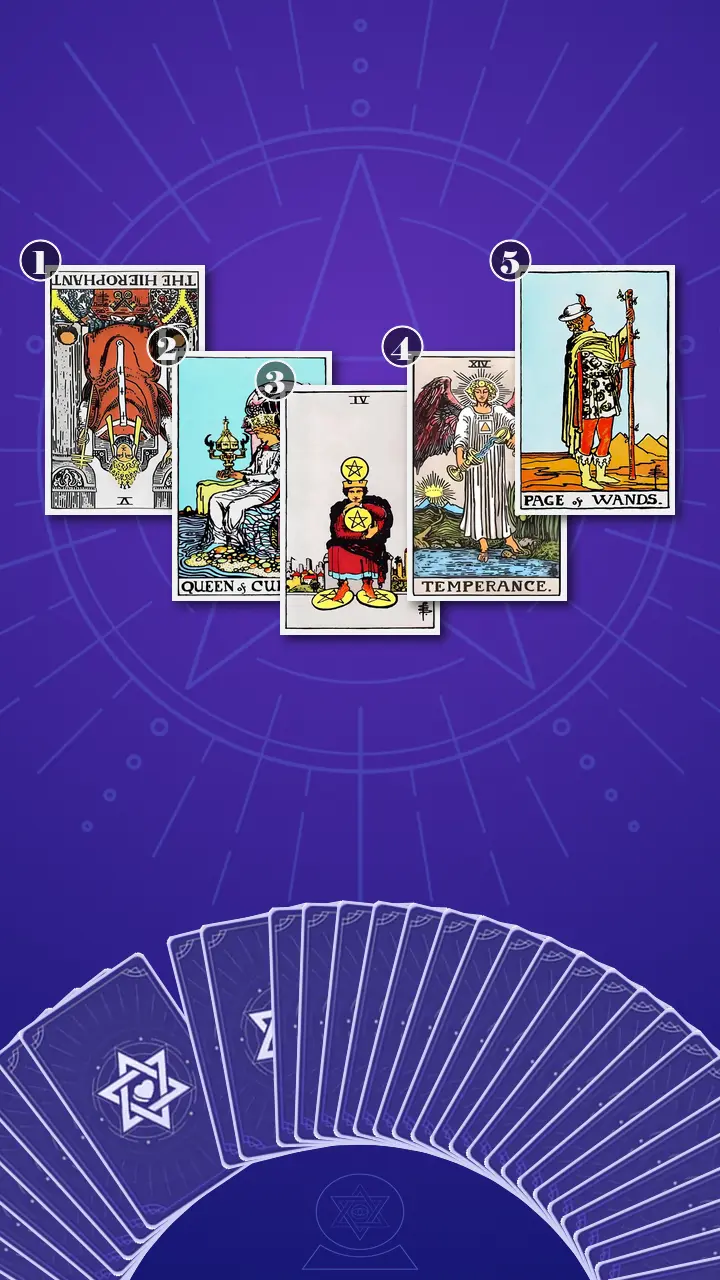
Reading the Valley Beneath the Career Crossroads
The Hierophant Reversed and the Invisible Approval Panel
The card I turned over first represented the conscious verdict Alex applied to the off-script path, including the habit of converting desire into a case for irresponsibility. It was The Hierophant, reversed.
I drew Alex's attention to the formal authority, the raised hand, the crossed keys, and the two followers kneeling for instruction. In the reversed position, I read the Hierophant's energy as a blockage around authority. Alex consciously questioned the conventional career ladder, yet an internal gatekeeper still controlled access to what counted as a legitimate life.
"This looks like an invisible LinkedIn accreditation board," I said. "You no longer believe it should define you, but you still submit every new possibility for approval. The private line underneath the process sounds like: I no longer believe this rule, but I still need it to clear me."
I connected the card to a Monday morning Alex had mentioned. A former colleague posted a promotion. Alex opened their own LinkedIn About section, typed project coordinator and community workshop designer, then deleted the second role because it did not resemble a familiar upward ladder. The problem was not that every convention was oppressive. The problem was that Alex had granted social legibility the authority of an ethical law.
I thought briefly of The Wizard of Oz: the impressive authority approached for an answer, the curtain, and the discovery that discernment cannot simply be handed over by the figure behind it. I did not want Alex to replace external dogma with the equally rigid belief that every unconventional choice must be authentic. I wanted to identify which rules deserved influence.
"Before a rule gets a vote," I said, "we need to classify it. Does it protect an ethical commitment? Does it describe a practical constraint? Or is it a social convention that merely feels compulsory because it is familiar? Those are not the same thing. Uncertainty is not evidence of wrongdoing."
Alex gave one short laugh, but there was no amusement in it. Their fingers tightened around the cup before loosening again. "That is so accurate it feels a bit brutal. I keep asking for permission from standards I don't even believe in."
"Recognition can sting before it helps," I said. "But I am not asking you to reject structure. I am asking you to stop making structure impersonate moral authority. Rent is real. A former colleague's imagined opinion is not rent."
The Queen of Cups and the Evidence Kept Private
The second card represented the felt truth Alex had disowned because it could not satisfy the demand for moral certainty. I turned over the Queen of Cups, upright.
The Queen studied an ornate, lidded cup at the edge of the water. I read her as balanced emotional intelligence, but in Alex's current process that resource was underused. Their intuition was neither blocked completely nor trusted proportionately. They noticed it, then excluded it from the report because it could not guarantee an outcome.
I returned to a Thursday session Alex had described. They had worked on a community project for ninety minutes. The laptop fan remained audible and the coffee went cold, but their concentration held after the novelty faded. Their jaw loosened. Their breathing became easier. Then a friend texted, asking whether this was their new career, and Alex opened salary-comparison tabs before replying, No, just messing around.
"The Queen is not telling you to quit your job because a task felt good," I said. "She is asking why repeated attention, easier breathing, and sustained interest are not allowed to count as information. Your desire is data, not a verdict or a command."
I asked Alex what happened internally after those focused work sessions.
"I keep calling it a phase," they said quietly, looking at the closed cup in the card, "but my attention keeps returning there."
Their gaze went unfocused for a moment, as if they were replaying that Thursday afternoon. Then their jaw released. I watched one shoulder drop by a fraction. The change was small, but it mattered: the card had not promised that the path was correct. It had simply restored a piece of evidence Alex had been deleting.
The Four of Pentacles and the Safeguard That Became a Veto
The card at the lowest point of the V represented the worth-and-control fear protected by rigid judgment, along with the short-term safety Alex gained by postponing experimentation. I turned over the Four of Pentacles, upright.
The figure held one pentacle against the chest, balanced another above the head, and pinned two beneath immobile feet. I read this as security energy in excess. Thought, feeling, and movement had all been assigned to preventing loss. Stability had stopped functioning as a foundation and had become a total containment system.
I described the Sunday-night spreadsheet Alex knew well. A three-month savings buffer became six months. Then another qualification appeared. Then another contingency tab. Then two more friends needed to approve the idea. Each safeguard was individually defensible, but together they removed every possible start date.
"The inner sentence is, I can begin as soon as I am safe enough," I said. "Then the definition of safe enough moves. A safeguard stops being support when its finish line moves every time you approach it."
Alex's breath paused. Their thumb hovered over a small chip in the cup's glaze while their eyes fixed on the pentacles beneath the figure's feet. I saw recognition move through them in three stages: first the physical freeze, then the distant look of someone scanning several old spreadsheets at once, and finally a low exhale from deep in the chest.
"I changed the savings target after I reached the first one," they said. "And then I told myself the new target proved the first one had been irresponsible."
"That does not make your need for security foolish," I replied. "Toronto's cost of living is not an imaginary mindset problem. The card asks a narrower question: which protections keep your life stable enough to explore, and which protections are designed to make uncertain contact impossible? Total control offers brief relief, but it also prevents the lived evidence you need for clarity."
I noticed the elemental pattern in the spread. Alex's behaviour was saturated with Air-like arguments, labels, and imagined cross-examination, yet no Swords card had appeared. Water arrived through the Queen, then fixed Earth held it still through the Four. More analysis was unlikely to provide the missing information. The spread was waiting for circulation and direct experience.
When Temperance Made the Choice Smaller
The Bridge Between Aliveness and Responsibility
The card I turned over next represented the key shift from final moral classification to integrating personal aliveness with practical responsibility. The room seemed to quiet as I revealed Temperance, upright. Even the radiator clicked off, leaving the rain at the window suddenly distinct.
I pointed to the liquid moving continuously between two cups, one foot resting on land and the other meeting water. I read the card as Balance in active form. Temperance did not ask Alex to discard the stable job, silence their desire, or split the difference until nothing meaningful remained. It asked for repeated calibration between felt data and practical data.
I placed two ordinary documents side by side: a private note about what felt alive and a budget containing non-negotiable limits. I showed Alex how both could pour into one four-week pilot with a time cap, a cost cap, and a review date. Two trails of rain met on the glass and ran downward together. I watched the window quietly borrow the card's grammar.
At 11:43 p.m., Alex had been caught between the proposal, the budget sheet, and the LinkedIn feed, shoulders braced as they renamed the folder Maybe Later. Postponed contact had felt like responsible certainty because the only alternatives they could see were permanent commitment or complete refusal.
"You do not need to prove the path morally pure; you need a small enough experiment that feeling and consequence can both tell the truth."
I let the sentence settle. Then I named the central message of the card without softening it:
The off-script path is not wrong simply because it cannot pass an inherited purity test; combine felt truth with accountable experiments, as Temperance pours between two cups without discarding either one.
I used a diagnostic lens that has become second nature to me over twenty years of listening beside cooling cups of coffee. I call it Analysis Paralysis Deconstruction. I stripped away the abstract futures first: no imagined resignation, no permanent identity announcement, no hypothetical five-year collapse, no requirement to defend an entire non-linear career path to every possible observer. What remained was immediate and measurable: Alex had a four-day role that covered essentials, one available weekday, a small amount of experimental capacity, and a recurring form of work they had not yet tested consistently.
Then I used Complexity Reduction to locate the clean binary choice hidden beneath all the moral noise. The choice was not stable employment or authentic life. It was simpler: Will I permit one protected four-week test, or will I continue withholding the evidence that could inform me? Either answer remained Alex's to choose. Only one of them would produce new information.
Alex did not relax immediately. Their breath stopped, and their fingers remained suspended above the table as if the next movement might commit them to something irreversible. Their pupils widened. A flush rose along their cheeks while the card's meaning reached the part of the pattern that planning had kept protected.
"But doesn't that mean I was wrong?" they asked, their voice suddenly sharper. "That I wasted all this time and made myself miserable for nothing?"
"No," I said. "Postponement gave you a temporary sense of safety when exposure felt unbearable. That strategy had a function. We can respect what it protected without allowing it to govern every next step. Seeing its limits now does not turn your past self into a defendant."
The sharpness left Alex's face first. Then their grip softened. Their eyes moved away from me and settled on the stream between the cups, as though several late-night scenes were replaying behind them. Their eyes shone, but they did not cry. Finally, their shoulders descended on a long, unsteady breath. The relief carried a flicker of vertigo. If no perfect verdict was required, Alex could move, but movement also meant accepting responsibility for choosing limits and reading the resulting evidence.
"Oh," they said, almost under their breath. "I don't have to choose between trusting myself and acting responsibly."
"Now, using this new perspective, can you think of a moment last week when this insight might have made you feel different?" I asked.
Alex returned to the Thursday project session. "When I noticed I had worked for ninety minutes without checking the clock, I could have written that down instead of immediately asking whether it justified a whole new career. I could have let it be one piece of information."
I set an eight-minute timer and divided a page into two columns: What feels alive and What must stay protected. Alex wrote designing small community workshops holds my attention in the first column. In the second, they wrote rent, sleep, the four-day role, and no more than CAD 150.
I asked them to complete one sentence: For the next four weeks, I can test one workshop offer for two hours a week, within a CAD 150 cap, and review energy, cost, and response on the final Friday.
"You do not have to publish a new identity, resign, or tell anyone today," I said. "You can stop, revise, or decline the experiment. Responsibility can look like a review date, not a life sentence."
I marked the shift clearly for Alex. This was not instant confidence. It was the first movement from contracted self-doubt and guilt toward grounded discernment and quieter self-trust through lived evidence. The discomfort had not disappeared; it had become small enough to carry without turning it into a moral verdict.
The Page of Wands and One Living Possibility
The final card represented a bounded, reversible experiment through which Alex could gather lived evidence about the off-script path. I turned over the Page of Wands, upright.
The Page studied a sprouting staff in open terrain. I read the Fire as healthy but deliberately young: enough energy to make contact, not enough certainty to claim mastery. Alex's spark had not been deficient. Its expression had been postponed because every action was forced to stand for an entire permanent identity.
"Think of this as the beta version of one portfolio-career offer," I said. "It only needs to be real enough to meet reality and small enough to revise. You could send one clearly scoped workshop invitation to five relevant contacts, wait seven days, and record what happens. A yes is data. A no is data. Silence is data. None of them is a verdict on your worth."
Alex looked up from the card. I watched the scale of the future contract in their expression. Instead of picturing a resignation announcement and a complete replacement life, they began naming one workshop, one community channel, and one person who might offer useful clarity feedback.
"This doesn't have to announce who I am forever," they said. "It only has to teach me something."
"Exactly," I replied. "Let the next step answer a question, not defend your worth."
The Four-Week Working Hypothesis
I read the spread back as one coherent story. Alex had absorbed a model of legitimacy in which a life choice became acceptable only after an imagined authority approved it. That judgment pushed repeated aliveness outside the evidence file. Beneath the judgment, the Four of Pentacles protected real needs for income, housing, identity, and control, but the protection kept expanding until no experiment could begin. Temperance did not overthrow those needs. It gave them proportion. The Page then converted proportion into one small act of contact.
In other words, Alex had been using a courtroom to read a compass. Every directional signal was cross-examined as if interest could prove guilt or innocence, even though a compass was never designed to issue a moral verdict. The missing piece was not a stronger closing argument. It was experience gathered within boundaries.
I named the cognitive blind spot directly: Alex had been treating the inability to justify every future consequence as evidence of present irresponsibility. They had also mistaken safeguards for neutral facts even when those safeguards changed each time a start became possible. The transformation direction was equally direct: replace the final moral verdict with a bounded, reversible portfolio-career experiment that could test aliveness, practical limits, and real-world response together.
Alex raised an immediate objection. "But my rent doesn't become experimental because my career is. And I can already feel myself turning a four-week test into a massive Notion board."
"Correct on both counts," I said. "Essential expenses stay protected, and Notion does not get invited. We need one sheet of paper, two containers, one calendar block, and a stop condition. If two hours or CAD 150 feels too exposed, the pilot becomes forty-five minutes and CAD 0. Smallness is what makes this observable."
I gave Alex two next steps, each designed to be completed without resignation, debt, public rebranding, or a dramatic leap.
- Run the 24-Hour Coffee Bean Filter On the next free weekday, set an eight-minute timer. Write each decision variable on a separate slip and sort the slips between two coffee mugs labelled Absolute Must-Haves and Emotional Noise. Put rent, the four-day role, sleep, prior commitments, the spending cap, and honest consent from participants under Must-Haves. Put the imagined LinkedIn panel, the need for a permanent title, and the demand that every friend agree under Emotional Noise. Leave the mugs untouched for twenty-four hours, then review them once over coffee. Tip: Emotional Noise does not mean the feeling is fake or unimportant. It means the variable is loud but does not determine whether this four-week test is responsible. If breaking a limit would create concrete harm during the pilot, move it to Must-Haves. Use no third mug.
- Launch One Four-Week Working Hypothesis On Alex's next free Thursday, open a one-page document with that title. Define one workshop offer, one small audience, a maximum of two hours per week, a CAD 150 total cap, and a final-Friday review date. Send the plain offer to no more than five relevant contacts. After each session, record only three fields: energy before and after, actual cost and time, and external response. Keep the coordinator role unchanged throughout the test. Tip: Define success as making contact and collecting information, not earning money or proving a calling. Reduce the pilot to one forty-five-minute session and CAD 0 if needed. Pause after two missed sessions or immediately if essential expenses, sleep, or existing commitments are affected.
I reminded Alex that these were options, not assignments issued by the cards. They could choose the smaller version, alter the boundaries, postpone with a named review date, or decide that this particular experiment was not worth running. The point was to make the decision process accountable to reality rather than to fear wearing the clothes of moral certainty.
A Week Later: One Message, Not a New Identity
Seven days later, I received a screenshot: five invitations sent, one yes, one maybe, three silent. Alex had slept through the night, then woken to "What if I'm wrong?" This time, they smiled, made coffee, and opened the review sheet.
The one yes did not prove the portfolio path was destined. The three silences did not condemn it. Alex recorded that the offer took seventy minutes, cost nothing, left them more energised than expected, and needed a clearer description. Then they scheduled the next review instead of opening conventional job listings to erase the discomfort.
I recognised the change in that ordinary act. Alex had not solved their entire life. They had gathered one piece of lived evidence without making it testify about their goodness. Their shoulders could still brace; comparison fatigue could still arrive with the next promotion post. But the inner gatekeeper was no longer the only voice permitted in the room.
For me, that is the real value of a five-card RWS Shadow Spread for non-linear career self-doubt. The cards did not choose Alex's future. They helped us separate inherited rules, felt information, protective fear, practical responsibility, and exploratory action. Alex supplied the boundaries, made the contact, and retained the right to revise. The agency was theirs throughout.
When a path feels quietly alive but hard to defend, I know how quickly the chest can tighten and the invisible approval panel can convene, as though an imperfect choice could expose an imperfect worth. Simply noticing that hearing has begun does not give you certainty, but it may be the first moment the courtroom loosens its grip on the compass.
If your own off-script path could become a four-week question instead of a verdict on who you are, what one tiny contact would you let the Page make, with Temperance's time cap, cost cap, and review date beside it?