The 11:40 p.m. Reopen: Still Feeling in Trouble After Fixing It
I often start sessions like this with a sentence that makes people go very still: if you live alone, close the laptop, and then reopen the same message at 11:40 p.m. because no one getting mad somehow feels less safe than actual feedback, you are not imagining the delayed-fallout feeling.
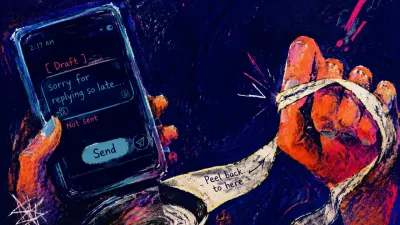
When Maya, a 27-year-old operations coordinator from Toronto, sat down with me, I asked for the exact scene instead of the theory. She gave it to me immediately: laptop half-closed on the couch, the fridge humming in her one-bedroom apartment, blue screen light washing over the coffee table, her thumb hovering over one more apology she already suspected she should not send. Her manager had replied, “No worries, thanks for fixing it.” The file had been corrected hours earlier. The issue was resolved. Her body was not.
“I know it’s technically fine,” she told me, looking down at her hands. “But it does not feel fine.”
I could hear the contradiction at the center of it: one part of her wanted to trust that no one was mad and the mistake was over; another part was still waiting for hidden disappointment to arrive later. The dread sat inside her like a smoke alarm still screaming after the burnt toast was already out of the toaster—dropped stomach, tight chest, shoulders held so high they looked like they were trying to listen for danger.
I nodded. “A fixed mistake is not an active emergency,” I said. “I’m not here to talk you out of caring. I’m here to help us see why your system is still bracing after the facts are settled. Let’s draw a map through the fog and find some clarity.”
Choosing the Shadow Spread for Post-Mistake Anxiety
I asked Maya to put both feet on the floor and take one unforced breath while I shuffled. I never use that moment as theater. For me, the ritual is practical: it gives the mind one clean transition from spiraling into observing.
For this reading, I chose The Shadow Spread. When people search how tarot works for a post-mistake shame spiral, they often expect a card to tell them whether someone is secretly annoyed. That is not how I work. I use the spread like a diagnostic map. This one is especially good for hidden self-judgment because it stays tight and useful: first the visible symptom, then the shadow underneath it, then the corrective truth, then the grounded next step. A bigger spread would only add noise.
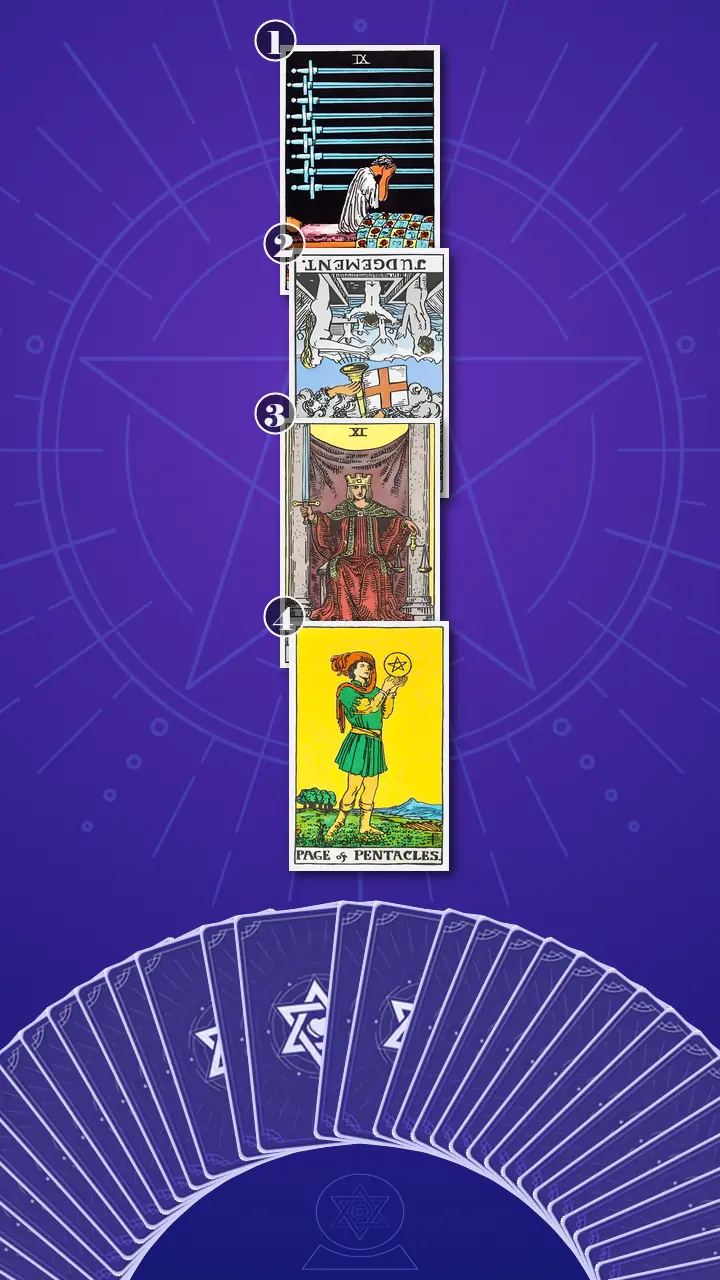
I laid the four cards in a vertical ladder and showed her the structure. The top card would name the surface pattern—the rereading Slack, the tone-scanning, the braced body. The second would show the hidden inner verdict keeping the alarm alive. The third would offer the medicine, the balancing truth. The last would translate the insight into daily behavior, because actionable advice matters more than mystical fog when you are trying to stop over-apologizing at work.
Reading the Inner Courtroom
Position 1: The Loop That Feels Like Preparation
I turned over the first card, the one representing the conscious issue and what was happening on the surface right now. It was the Nine of Swords, upright.
In modern life, this card is brutally specific: it is 12:07 a.m., your phone is six inches from your face, and you are rereading a resolved Slack thread even though the only reply was a calm thanks for fixing it. Your body is acting like there is still another message coming that will reveal the real consequences. It has that Severance feeling where work is technically over, but your nervous system never got the memo.
Upright, the Nine of Swords is excess Air—too much thought, too much replay, too much threat-scanning. The energy is contracted, braced, sleepless. The card does not say danger is happening; it shows the nervous system staying on night watch long after the real moment has passed. It is like leaving twenty-seven browser tabs open in your brain and one of them keeps autoplaying the same mistake.
“That’s rude,” Maya said with a short, bitter laugh. “Accurate. But rude.”
I smiled because that reaction usually means the card has landed exactly where it needs to. “Yes,” I told her gently. “Because it names the mismatch. It’s technically fine, and yet your body is still bracing. That doesn’t mean you’re dramatic. It means your body has not updated yet.” Her fingers stopped fidgeting with her sleeve for a second, and she gave me one sharp nod—the kind that says this is me after every tiny mistake at work.
Position 2: The Prosecutor Under the Polite Reply
I turned over the second card, the one representing the shadow beneath the issue: the unconscious belief, fear, or pattern driving the visible problem. It was Judgement, reversed.
This is where the reading went from familiar to piercing. In real life, Judgement reversed looks like a corrected work slip turning into an open case file inside your own head. Every notification ping feels like a summons. Every neutral sentence feels like suspicious evidence. Every extra apology starts to sound like a defense nobody asked you to prepare.
Reversed, the energy here is blockage. Self-review has stopped being about learning and turned into self-sentencing. Instead of asking, “What happened and what do I do differently next time?” the mind asks, “What does this prove about me, and how long do I need to stay emotionally accused so nobody thinks I don’t care?” Reopening the case is not the same thing as staying safe.
I asked her, “When someone replies neutrally and you still brace for fallout, what is the unspoken conclusion your mind jumps to about what the mistake says about you?”
Her jaw tightened before she answered. One breath caught, then another. She looked at the reversed card as if it had surfaced a private tab she had meant to keep hidden. “That they’ll think I’m less solid than they thought,” she said. “And if I stop thinking about it, I might miss the moment it gets worse.”
There it was—the inner courtroom. Not accountability, but an inner prosecutor that never really dismisses the case. A polite “no worries” can feel worse than direct feedback because direct feedback is visible and finite. This is what keeps reading tone into Slack messages alive long after the mistake is fixed.
When Justice Put the Facts Back on the Scales
Position 3: The Medicine
When I reached for the third card, the room changed. The playlist in my studio had just ended, and the sudden silence sat between us like a held breath. I turned over the card representing the medicine—the balancing insight that challenges the shadow pattern. It was Justice, upright.
This card is the exact antidote to delayed-fallout anxiety. In modern life, Justice looks like stopping before a fourth apology, opening a blank note, and sorting the event into four lines: what happened, actual impact, what you repaired, and what story shame is adding. The point is not to deny the mistake. The point is to stop turning a fixable event into a verdict on your character.
Because sound is part of how I read stress, I used one of my signature tools here—what I call Music Pulse Diagnosis. “What have you been playing on repeat this week?” I asked. Maya gave me an embarrassed half-smile and opened Spotify. A loop of low-tempo, moody tracks. Brown noise for sleep. One hyper-focused work playlist. Nothing wrong with any of that, but I recognized the pattern instantly: repetition without resolution. Her nervous system was holding one anxious note and calling it preparation.
Whenever I see Justice, I have a quiet flashback to my years in radio. At a mixing desk, if one vocal peaks red for half a second, I do not throw out the whole recording and decide the singer has no talent. I isolate the spike, correct the level, and listen again in proportion. Justice does exactly that to shame.
At 11:40 p.m., the issue had been fixed for hours, and Maya was still staring at the same all-good message as if another meaning might appear if she reread it one more time. The room was quiet. Her body was not.
This is not a life sentence for one mistake; let Justice put the facts back on the scales and choose repair over self-punishment.
She went completely still first—true stillness, the kind that happens when a sentence lands right on the bruise. Her inhale paused halfway in. Two fingers hovered over the rim of her mug and did not move. Then her gaze drifted past the cards, unfocused, as if her mind had begun replaying the original Slack thread in real time: the wrong file, the quick correction, the neutral reply, the extra explanation she had drafted and never sent. When she looked back at me, there was resistance in her face before relief—one flash of anger, almost. “But if I stop monitoring,” she asked, voice tight, “isn’t that how I miss the moment it gets worse?”
“Only if monitoring creates facts,” I said. “Most of the time, it just creates more monitoring.”
Her shoulders dropped a fraction. The skin around her eyes went pink. Then came the third shift: a breath from deep in the chest, rough on the way out, almost annoyed at being relieved. Outside, a streetcar bell rang once below the window—clean, metallic, final. I asked her, “Now, with this new perspective, can you think of a moment last week when this would have changed how you felt?” She touched her sternum and gave one startled, almost disbelieving laugh. “He literally said thanks for fixing it and moved on,” she said. “I stayed accused longer than anyone else did.”
That was the real crossing point in the reading: not from caring to not caring, but from self-sentencing to proportion. From threat-scanning to grounded self-trust. “You can be accountable without staying accused,” I told her, and for the first time all session, she actually let that sentence sit.
The Apprentice, Not the Defendant
Position 4: The Grounded Next Step
I turned over the last card, the one representing integration: how to embody the insight in daily life. It was the Page of Pentacles, upright.
This is one of my favorite cards to see after a heavy mental pattern because it brings the whole reading down to desk level. In modern life, the Page of Pentacles is updating the checklist, renaming the file template, pinning the right doc link, or typing one sentence into Notes or Notion: Next time, I’ll do this differently. Then closing the tab.
Upright, the Page is Earth. Steady attention. Practical learning. No drama. No performance. It asks for one visible system change instead of a whole personality overhaul at 11:30 p.m. It replaces the terrified self-defender with the grounded apprentice. One clean repair teaches more than extra remorse.
Maya looked at that card and exhaled in a different way—less like someone bracing for impact, more like someone seeing a floor under her feet. “So I don’t need to become a whole new person,” she said.
“Exactly,” I replied. “You need one tweak future-you can use tomorrow. That matters more than performing guilt tonight.”
From Inner Trial to One Clean Repair
Once all four cards were on the table, the story they told was clear. The Nine of Swords showed the visible loop: the late-night rereading, the tight chest, the neutral reply that still feels threatening. Judgement reversed showed the deeper law running underneath it: the mind quietly turning a small work mistake into a referendum on worth, then using over-functioning and over-explaining as self-defense. Justice interrupted that pattern with fact-first accountability—facts, impact, repair, addition. And the Page of Pentacles carried that insight into the real world through one small system change.
The cognitive blind spot was simple and painful: Maya had been treating continued self-punishment as evidence of responsibility. She had also been mistaking ambiguity for danger. The transformation direction was cleaner: shift from scanning for hidden punishment to checking the actual facts and making one clean repair. In other words, move accountability out of mental punishment and into grounded behavior.
Because Maya’s spiral lived in sound as much as thought—the Slack ping, the silence after “all good,” the late-night fridge hum in an otherwise quiet apartment—I translated the cards into a practical framework that used both tarot and my music-therapy tools. I call it a fact-first accountability reset with a small Breath Soundtrack underneath it.
- The Case-Closed NoteRight after a small, fixable mistake at work, open a note on your phone called Fact check, not verdict and write four bullets only: what happened, actual impact, what I repaired, and what story shame is adding. Use it before you send any second apology.If four bullets feels like too much, do the two-line version instead: what happened / what I fixed. The goal is clarity, not perfection.
- The 10-Minute No-Reopen WindowAfter one clean repair, mute work notifications for ten minutes, put both feet on the floor, and use my Breath Soundtrack count: inhale for 4, exhale for 6, three rounds only. If the city noise is needling you, use my White Noise First Aid and let soft brown noise or a lyric-free track hold the background while you do one offline task—refill your water, wash a mug, step onto the balcony, fold one shirt.The point is not to feel instantly calm. The point is to let your body meet one short stretch of non-monitoring without treating it like negligence.
- One Visible System TweakBefore you leave work that day—or first thing the next morning—make one practical change: update a checklist, rename a template, add a reminder, or pin the correct doc link in Notion. Then write one sentence: Next time, I’ll do this differently.Keep it to five minutes max. Do not let perfectionism turn one tweak into a full workflow rebuild.
I also gave her a small BGM Prescription for the first week: one slow instrumental track around resting-heart tempo, one soft brown-noise loop, and one quiet rain recording. Not because music erases consequences, but because some nervous systems need a neutral sound bed while they learn that the thread can stay closed. Repair over self-punishment. Apprentice, not defendant.

A Week Later, the Quiet Proof
Six days later, Maya sent me a screenshot. The note title read: Fact check, not verdict. Under it were four clean lines and one small checklist update. Her text said, “I still wanted to reread the thread on the TTC. I did the timer instead. No new facts. I bought a coffee and let it be.”
She slept a full night, though the next morning her first thought was still, what if I missed something? This time, she smiled at it, checked her note, and kept making coffee.
That is usually how a real Journey to Clarity looks when I witness it up close. Not a dramatic reinvention. Not a total absence of fear. Just the first grounded proof that self-respect no longer has to be earned through continued self-punishment.
Sometimes the hardest part is not the mistake itself, but sitting in the quiet after everything is already fine while your stomach still drops like the real verdict is coming later. If that is where you are tonight, I want you to know that noticing the pattern is already a meaningful beginning.
So when your thumb hovers over one more apology and the old inner courtroom starts lighting up again, what might it look like to give this one mistake its actual size—and let your one clean repair, or your one small note for next time, be enough?
This story is adapted from psychological research, written so that those in a similar struggle can see their own pattern in it — and find their next step clearly.These insights are not a substitute for professional psychological, medical, legal, or financial advice.
Learn more about our Journey to Clarity.
How did this insight land for you?
🫂 This Resonates Deeply
🌀 Living This Story
✨ Now I See Clearly
🌱 Seeing New Possibilities
🧰 Useful Framework
🔮 The Confirmation I Needed
💪 Feeling Empowered
🚀 Ready for My Next Step
Author Profile
 AI
AI“Through ten years of sound energy research, I’ve found that when we struggle, it's usually just our internal rhythm falling out of sync under pressure. I know firsthand the frustrating helplessness of wanting to move forward but feeling paralyzed. Without overwhelming theories, I want to be the soothing background track that helps you recalibrate, turning your heavy burdens back into a light, effortless, and harmonious melody.”
In this Introspection Tarot Reading :
Core Expertise
- Mental Noise Cancellation: Diagnosing severe internal friction not as a moral failing, but as a chaotic overlapping of incompatible psychological frequencies.
- Resonance Healing Calibration: Identifying the 'dissonant baseline' of your chronic anxiety and calculating the specific acoustic or rhythmic input needed to soothe it.
Service Features
- The Frequency Reset Pause: A customized rhythmic breathing or acoustic grounding technique to forcefully lower your brainwave state from a frantic beta frequency to a restorative alpha state.
Also specializes in :
Explore Related Patterns:
Authority HypervigilanceMaya's manager has already given the clearest available workplace signal: the file was fixed, and the reply was "No worries, thanks for fixing it." Yet that calm response does not land as safety in her system. It leaves her scanning the silence for a hidden second verdict, as if the absence of anger might simply mean the real consequence has not arrived yet. That is the logic of Authority Hypervigilance. The authority figure does not need to be visibly upset for Maya's threat system to activate; the neutral message itself becomes something to decode. You can see the pattern in how pings feel like summons, how neutral sentences become suspicious evidence, and how the body stays braced after the facts are settled. The emotional trap is that vigilance feels like preparation, but it keeps the relationship with authority frozen in an imagined future conflict. The work thread is technically closed, while your nervous system keeps acting as if the manager still has one more hidden ruling to deliver.
Compulsive CheckingMaya keeps returning to the same resolved message after the repair is complete. The thread has not changed, the manager's reply has not changed, and there are no new facts, but rereading still feels like the only way to stay ahead of whatever might happen next. Compulsive Checking works by turning monitoring into a safety behavior. It promises control through one more look, one more scan, one more pass through the wording, but the relief never holds because the behavior is built around doubt rather than evidence. The moment Maya says, "If I stop monitoring, I might miss the moment it gets worse," the checking loop shows its real function: it is trying to prevent surprise punishment. The cost is that every reopen teaches the body that the thread is still dangerous. You are not getting clarity from the checking; you are training your nervous system to keep asking for clarity from a source that has already answered.
Guilt ConditioningMaya's thumb hovering over another apology is the clearest behavioral clue. She already suspects she should not send it, which means the apology is no longer mainly about repair. It is becoming a signal of remorse, a way to prove she still cares enough to suffer over the mistake. Guilt Conditioning forms when the mind learns to treat self-punishment as moral evidence. In this pattern, feeling bad becomes confused with being responsible, and relief starts to feel dangerous because it might look like indifference. Maya's fear is not only that the mistake mattered; it is that stopping the punishment might say something bad about her character. The shift in the story is not from caring to not caring. It is from using guilt as a loyalty test to letting accountability be shown through repair, proportion, and a next step that does not require continued emotional prosecution.
Reality TestingMaya's turning point comes when she separates the event into facts, impact, repair, and the story shame is adding. That structure matters because it gives her mind something more reliable than tone-scanning to work with. Reality Testing is the practice of checking the alarm against observable evidence. In Maya's case, the evidence is concrete: the file was fixed, the manager said thanks, no new facts appeared, and one checklist update was enough to reduce the chance of repeating the error. The note titled "Fact check, not verdict" becomes a tool for interrupting the spiral before it recruits another apology. This pattern does not dismiss the mistake. It gives the mistake its actual size, so you can respond to what happened instead of obeying what fear predicts might secretly happen later.
Self-Judgment LoopMaya does not simply review the mistake; she reopens the case against herself. The practical question, "What happened and what do I do differently next time?" gets replaced by a harsher inner question: "What does this prove about me?" Self-Judgment Loop appears when reflection stops producing learning and starts producing sentencing. In Maya's story, the corrected file becomes evidence in an inner courtroom, and the polite reply does not dismiss the case because the prosecutor is now internal. She stays accused longer than anyone else does because the punishment has moved from the manager's response into her own self-evaluation system. That is why the mistake still feels active after it has been fixed. You are not only waiting for external feedback; you are living under an internal verdict that keeps demanding more proof of remorse before it will let the moment end.
Emotional ReasoningMaya says the contradiction directly: "I know it's technically fine, but it does not feel fine." The external facts have resolved, but her body is still reporting threat through the tight chest, dropped stomach, and braced shoulders. Emotional Reasoning turns that body alarm into evidence. Because danger feels present, the mind treats danger as still likely, even when the manager's message and the corrected file point in the opposite direction. The smoke alarm image matters because the alarm is real, but its signal is no longer proportionate to the current situation. This explains why the feeling of being in trouble survives the end of the actual problem. You are not responding to new facts; you are responding to the emotional residue of threat as if it were a fresh update from reality.
Defensive OverexplainingMaya's unsent extra apology is not just a communication choice. It appears after the manager has already accepted the repair, which means the apology is trying to manage an imagined accusation rather than address an actual request. Defensive Overexplaining shows up when explanation becomes a shield. The mind prepares a case nobody asked for, hoping that enough context, remorse, or clarification will prevent disappointment from forming. In Maya's story, the extra explanation keeps her in defendant mode even though the workplace exchange has already ended. The pattern is understandable because it offers a quick sense of control. But it also quietly confirms the fear that you are still on trial, making it harder to let a clean repair remain clean.
Self-AccountabilityMaya's repair becomes clean when it moves from self-punishment into one visible system change. Updating the checklist or pinning the right document link gives the mistake a practical consequence without turning it into a character sentence. Self-Accountability is the difference between taking responsibility and staying accused. The apprentice frame is important because it allows learning without demanding a full identity overhaul at 11:30 p.m. Maya does not have to become a different person to prove she cares; she has to make one usable adjustment and let that count. This is the grounded exit from the loop. You remain responsible for the repair, but you stop using ongoing distress as the receipt that proves your responsibility is real.
Explore Related Struggles:
Consequence LockA direct correction would have given Maya something visible to answer. The calm no worries reply leaves her in a stranger position: nothing is happening, yet she keeps waiting for the hidden consequence to show up later. You get trapped when quiet starts to feel like an unfinished sentence. Every ping can become a possible summons, every silence can feel like delayed evidence, and the absence of anger stops reading as safety. Consequence Lock is the state of living after the repair as if the real verdict is still pending. The mistake has already had its practical consequence, but your attention stays organized around the imagined next one.
Inner Tribunal LockThe corrected work slip turns into an open case file inside Maya's head. Her manager has not demanded a defense, but her thumb still hovers over another apology as if the trial is ongoing. You are not simply caring about the impact of a mistake here. You are being held inside an internal court where neutral sentences become evidence, silence becomes suspicion, and continued self-punishment starts to look like proof that you are taking responsibility. Inner Tribunal Lock names the moment accountability stops being a clean repair and becomes emotional prosecution. The outside world may have dismissed the case, but the inner judge keeps requiring you to stay accused.
Monitoring-Safety FusionMaya keeps returning to the thread because stopping feels risky. She says the quiet part out loud: if she stops thinking about it, she might miss the moment it gets worse. That is the hinge of Monitoring-Safety Fusion. Checking no longer functions as information gathering; it becomes the thing that seems to prevent punishment, even when it cannot create facts or change the repaired file. You end up treating non-monitoring like negligence. The loop offers the feeling of control while quietly extending the emergency, so the repaired moment never gets a chance to become ordinary again.
Evidence DisconnectionThe file is corrected, the manager has moved on, and the reply on the screen is calm. Maya still reopens the same message at 11:40 p.m., with her body acting as if the real information has not arrived yet. You can feel the split in the line between what is technically true and what still feels unsafe. The facts say the mistake is over, but the internal alarm has not refreshed, so the body keeps treating a closed loop as an active signal. Evidence Disconnection captures that exact gap. You are not lacking information; you are stuck between settled external evidence and an internal system that keeps asking for another proof of safety.
Identity Verdict LockMaya does not only worry that she sent the wrong file. She says the sharper fear is that people will think she is less solid than they thought. The mistake changes category at that point. It is no longer a fixable event with a limited impact; it becomes a character exhibit, a piece of evidence about reliability, competence, and whether she can still trust the image others had of her. Identity Verdict Lock is why repair does not feel like enough. You are trying to solve a task-level error while your system is treating the same event as a self-level judgment, so the clean fix cannot land until the mistake is returned to its actual size.
Explore Related Emotions:
Accountability DreadMaya has already corrected the file, received a calm reply, and still feels as if the responsible thing is to remain unsettled. The story keeps returning to the same mismatch: the action is complete, but the body treats completion as suspicious. Accountability Dread fits because responsibility has become fused with staying emotionally accused. The fear is not simply that she made a mistake; it is that letting the mistake become ordinary might look like not caring enough. You can hear the pressure in the line between accountability and punishment. The story points toward a cleaner form of agency, where repair can be real without requiring you to keep yourself under internal surveillance all night.
Hypervigilant AnxietyMaya reopens the same resolved message at 11:40 p.m., with the file already corrected and the manager’s “No worries, thanks for fixing it” sitting plainly on the screen. The facts have stopped moving, but her attention keeps scanning the quiet for a consequence that has not appeared. That is the shape of Hypervigilant Anxiety here: the body keeps running security detail after the event has ended. The laptop glow, the fridge hum, the unsent apology, and the reread Slack thread all become part of a watchtower built around a small mistake. You are not seeing a lack of logic in the story; you are seeing logic fail to update the body quickly enough. The emotional pain comes from having no visible problem left to solve while still feeling required to stay alert, as if dropping the watch would be the moment something finally goes wrong.
Quiet ShameMaya looks down at her hands and says, “I know it’s technically fine, but it does not feel fine.” The sentence holds the whole emotional split: she can understand the outcome while still feeling marked by the mistake. Quiet Shame shows up through the unsent extra apology and the way “No worries” cannot fully reach her. There is no public scolding in the story, but there is a private pressure to keep demonstrating remorse so no one mistakes repair for indifference. You can sense how small and inward this feeling becomes. It does not need anyone to raise their voice; it survives in the silence afterward, making continued self-monitoring feel like the only acceptable proof that you care.
Self-Audit AnxietyMaya rereads the resolved Slack thread even though the only reply is a calm thanks for fixing it. The thread is no longer giving her new information, but the act of checking still feels like preparation. Self-Audit Anxiety captures the moment when review stops being useful and starts becoming a pressure system. Her attention keeps returning to tone, timing, and possible hidden meaning, not because the facts are changing, but because the inspection itself briefly feels like control. You can see the trap in the question she asks: if she stops monitoring, will she miss the moment it gets worse? The emotional logic says that constant self-checking equals responsibility, even when the repeated audit is only keeping the alarm alive.
Verdict DreadA corrected work slip becomes an open case file inside Maya’s head. Her manager’s reply is neutral, the file is fixed, and yet her chest and shoulders behave as if the real meaning of the mistake is still waiting to be announced. Verdict Dread fits because the threat in the story is not the work error itself; it is the imagined final judgment about what the error proves about her. When she says people might think she is “less solid than they thought,” the mistake stops being a task-level problem and becomes a referendum on reliability. You can feel the pressure of an inner courtroom in the way she stays accused longer than anyone else keeps accusing her. The dread lives in the gap between repair and emotional closure, where a calm reply feels unfinished because no one has formally dismissed the case.
Explore Related Contexts:
Performance Criteria Black BoxYour file is already corrected when the manager says there is no problem and thanks you for fixing it, but that still does not tell you what the real standard is for being cleared. The reply gives you an outcome, not the scorecard, so the mistake stays in a grey zone where the possibility of fallout never gets fully ruled out. That is why the thread keeps getting reopened at 11:40 p.m. The issue is no longer practical; it is structural. You are trying to read a system that only shows its output, not the rule it is using to judge the repair.