The 10:45 p.m. LinkedIn Spiral
At 10:45 on a Tuesday night, Alex, a 29-year-old project coordinator in Toronto, appeared in my video window at the laminate kitchen table of their shared apartment. Blue laptop light sharpened the tired planes of their face. The radiator clicked behind them, a mug beside the trackpad had gone cold, and their phone was still warm from displaying a former classmate’s LinkedIn post: “Thrilled to share…” followed by the kind of promotion announcement that can make an ordinary evening feel like a verdict.
Alex could organize a cross-functional project without blinking, yet the cursor on their half-finished personal exercise had not moved for nearly an hour. Their stomach had dropped when they saw the post. Their limbs looked heavy, as if discouragement had been sewn into the sleeves of their sweatshirt with wet thread. Instead of finishing the twenty-minute task they had chosen for themselves, they had opened Notion and started rebuilding a color-coded five-year plan.
“I know lives aren’t linear,” they told me. “But I still grade mine like there’s a deadline. Every time someone else moves forward, my options seem to shrink.”
I heard envy in the sentence, but I also heard the shame that arrived immediately afterward, trying to police the envy. I wanted to separate those two before either could harden into a judgment. “Envy is not a character verdict,” I said. “Here, it sounds like longing caught beside someone else’s timestamp.”
They looked down at the phone. “I want to trust that my path is possible. But if I start this slowly, it feels like I’m proving how far behind I am.”
There was the central contradiction in plain sight: Alex wanted to trust a personally meaningful path, yet they were treating other people’s timelines as evidence that their own path was impossible. Comparison became replanning, replanning became postponement, and postponement was then misread as proof that the route had closed.
“Another person’s milestone is information about their life, not evidence against yours,” I said. “I’m not going to ask the cards to predict whether you will catch up. That would preserve the race. I’d rather use tarot as a mirror and map the mechanism that keeps turning somebody else’s visible progress into a conclusion about your capacity. We’re looking for clarity, but also for one choice that remains yours.”

Choosing the Three-Stop Map
I asked Alex to place both feet on the floor and take one unforced breath. I shuffled slowly while they held the question in mind: “Why do I keep letting others’ timelines make my path feel impossible?” The pause was not a mystical performance. It was a transition from reacting to observing.
I chose a three-card Past-Present-Future tarot spread. For anyone wondering how tarot works in a situation like this, I use the cards as structured prompts rather than fixed predictions. Card meanings in context can separate a problem into formative influence, current mechanism, and an emerging direction supported by present choices.
This focused spread suited Alex’s question better than a larger Celtic Cross. We did not need ten layers of possibility. We needed the smallest clear map of causality: what taught Alex to use a public timeline as a private grading system, what kept the next task suspended now, and what kind of practice could restore grounded agency.
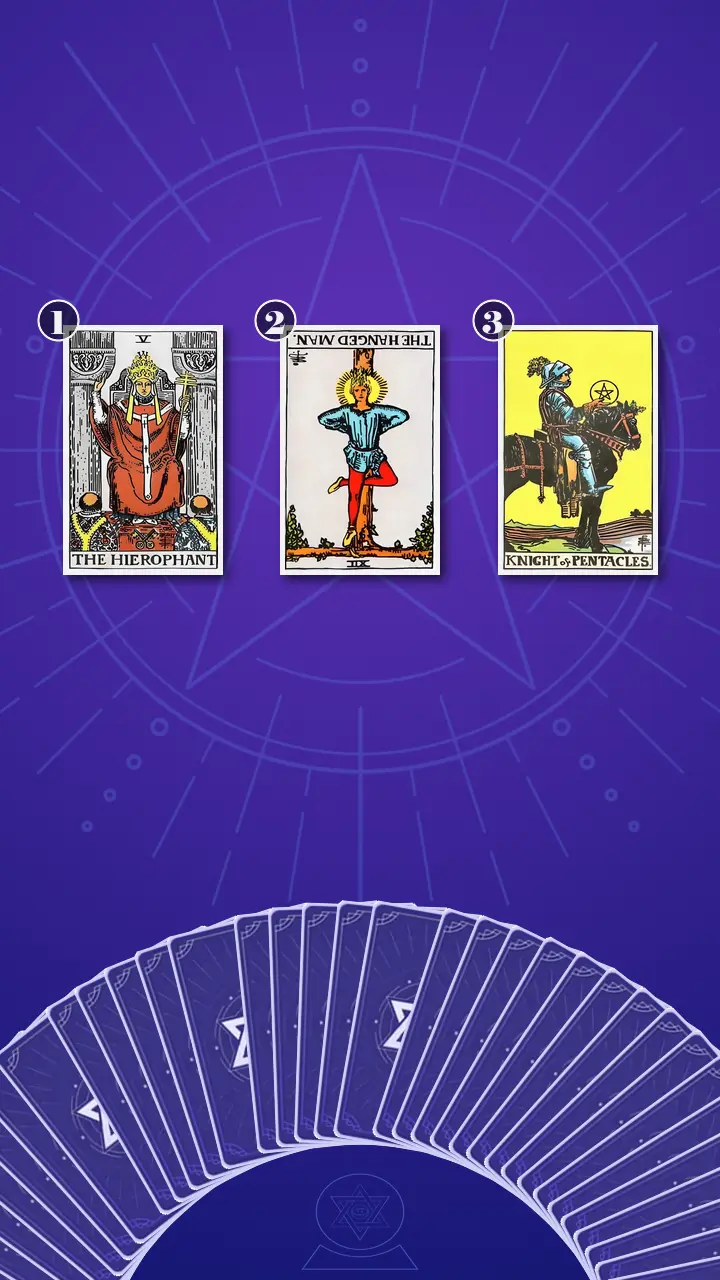
I laid three cards in a horizontal line on my oak table and angled the camera toward them. I explained that the first position would reveal the formative life script behind the comparison habit. The centre card would show how that script was currently expressed through replanning and postponement. The third would identify an emerging direction, not a guaranteed outcome.
The line looked like three stops on a transit map. Being at a different stop, I reminded Alex, did not mean the network had disappeared.
The Borrowed Syllabus
Position One: The Keys Beneath Someone Else’s Authority
I began with the card representing the formative life-script pressure behind Alex’s comparison habit: the conventional milestones and public sequences they had absorbed as the standard for being “on track.” I turned it over.
It was The Hierophant, upright.
I pointed to the seated authority between the grey pillars, the two acolytes facing him, and the crossed golden keys at his feet. Upright, the Hierophant can represent useful traditions, shared teachings, and social frameworks. That energy was not inherently harmful. In Alex’s life, however, its authority had become excessive. A culturally familiar sequence had been promoted from “one possible route” to “the official curriculum.”
“Think about your last workplace review,” I said. “Your manager asks where you see yourself in three to five years. Later, you’re on the TTC with that phrase still in your head, and you open LinkedIn. Promotions, engagements, relocations, and home purchases line up like required modules in an unofficial syllabus. By the time you get home, they no longer feel like options. They feel like rules.”
I thought briefly of Severance and its polished corporate world, where a designed system presents itself as neutral reality. The Hierophant was showing the same sleight of hand: a public framework had become so familiar that Alex no longer noticed who had written it.
“I thought this was what I wanted,” Alex said slowly, “but when did it become the rule I use to grade myself?”
I asked which deadline appeared first when they looked at the crossed keys. Alex gave a short, bitter laugh. “Honestly? Promotion by thirty. That is painfully accurate. Almost rude.”
I smiled without softening the point. “The card is not saying a promotion is wrong for you. It is asking whether the age attached to it expresses your values, your real circumstances, or simply the most visible syllabus in your feed.”
Their laugh faded. Their fingers tightened around the cold mug, then loosened. Their gaze drifted away from the screen as if they were replaying several performance reviews at once. When they looked back, there was recognition in their face, but also grief for how long an imported rubric had been allowed to score work it was never designed to measure.
I also named the environmental reality. In my work, I call this Environmental Friction Sensing: distinguishing an internal loss of momentum from resistance in the actual soil. Toronto housing costs, a stable role without a clear promotion path, and limited money for casual career experiments were real constraints. They affected timing. They did not constitute evidence of lesser worth.
The Task That Stayed Suspended
Position Two: The Hanged Man and the Reload Loop
I moved to the centre card, representing the current expression of healing stagnation and learned powerlessness: comparison, repeated replanning, and postponement that made an available path feel closed.
The card was The Hanged Man, reversed.
I showed Alex the single ankle tied to the wooden beam and the halo still visible around the figure’s head. Upright, the card can describe a voluntary pause that allows a new perspective. Reversed, that pause can become a blockage: reflection continues, but it no longer changes the view or produces movement.
“This is your 10:45 p.m. loop,” I said. “The unfinished task is open. The phone is warm in your hand. A promotion post makes your stomach sink. Then the sequence begins: ‘I need a better plan first.’ Then, ‘A small step won’t matter now.’ Finally, ‘The fact that I did nothing proves I can’t change.’”
Alex went still. I watched their chest tighten before they exhaled through their nose.
“Planning can feel like movement while keeping the only meaningful task perfectly still,” I said. “That does not make you lazy. Rebuilding the timeline gives you temporary protection from the vulnerability of trying while you still feel behind. But the protection has a cost: the untouched task creates no new evidence, so the old conclusion survives.”
I used the image of a browser caught in a reload loop. More information kept entering, but the page never advanced to the action state. The Hanged Man’s halo mattered because Alex already possessed the insight that lives are nonlinear. The missing ingredient was not another explanation. It was a small physical action capable of testing what they already understood intellectually.
“The social clock gets loudest when your own next step feels quiet,” I said. “So I want to zoom in on the few seconds after the comparison trigger and before the five-year plan opens. That is the interruption point. In that moment, you do not need a new worldview. You need one small piece of evidence.”
Alex pressed their fingertips to the edge of the laptop. “But what if the small thing really is pointless?”
“Then we let reality tell us that after a bounded experiment,” I replied. “We do not let somebody else’s announcement decide it in advance. The aim is not to force productivity or pretend structural pressure is imaginary. The aim is to create enough contact with your own path that you can evaluate it using information from your life.”
When the Knight Held One Real Thing
Position Three: Progress Without the Performance
The room seemed to become quieter as I reached for the final card. Even the radiator on Alex’s side of the call stopped clicking. I turned over the card representing the key transformation available now: a self-defined pace supported by one small, repeatable action rather than a prediction about the whole future.
It was the Knight of Pentacles, upright.
I drew Alex’s attention to the Knight holding one pentacle steadily at eye level. The dark workhorse was motionless, yet the fields behind it had been cultivated. This was balanced earth energy: patient self-trust, practical stewardship, and consistency supported by just enough fire to begin. The Knight did not need speed to prove that the work was active.
I described a different Tuesday evening. The phone would be charging in another room. One bookmarked lesson would be open at the kitchen table. A timer would run for twenty minutes. When it ended, Alex would write one private line in the Notes app: “I showed up.” No score, no projected completion date, and no comparison with a former classmate’s title.
At 10:45 p.m., Alex had been caught between an unfinished twenty-minute task and a polished promotion post. Their stomach had sunk, and a cleaner five-year plan had begun to feel safer than making imperfect contact with the life they actually had. The Knight challenged the assumption hidden inside that choice.
Being later is timing data, not proof of incapacity. Your path becomes believable when you collect evidence one repeatable step at a time.
I placed my finger beside the pentacle and gave Alex the reading’s central sentence.
Being later than someone else is not evidence that you cannot move; choose one steady commitment and hold it as deliberately as the Knight holds the pentacle.
For two beats, Alex did not move. Their breath stopped first, and one hand remained suspended above the warm phone. Then their pupils widened slightly and their gaze lost focus, as if the past month of postponed calendar blocks were replaying behind their eyes. Their mouth tightened. The tension travelled down through their shoulders before releasing in a long, uneven exhale. Their fingers finally opened and rested flat on the table.
“But doesn’t that mean I wasted all that time?” they asked. The words came out sharper than before, carrying anger beneath the tremor.
“No,” I said. “It means you can see the cost of the loop now. Clarity creates responsibility, and that can feel more exposing than confusion. You do not need to punish your past self to use the next available choice.”
I let the silence settle, then asked, “Now, using this new perspective, can you think of a moment last week when this insight might have changed how the evening felt?”
Alex remembered Thursday, when they had abandoned a saved course lesson after seeing a friend announce a major move. “I didn’t need to finish the course,” they said. “I could have opened the lesson before deciding the whole career idea was dead.”
I named the lens I was using: Seasonal Trajectory Alignment. At sixty-seven, with the seasonal language of my Highland family still shaping how I listen, I do not expect every field to display a spring harvest at the same time. A field in winter is not a failed field. Yet true winter dormancy gathers and protects resources; it does not dig up the same seed each night to check whether it is behind another field.
Alex had been trying to force a spring harvest because other people’s crops were visible online, then interpreting exhaustion as proof that nothing could grow. The Knight offered another relationship with time: tend one patch, respect the climate, and let repeated contact reveal what the soil can support.
“Do not ask whether twenty minutes can fix your life,” I told them. “Ask whether it can create one fact your fear cannot erase.”
Before we moved on, I invited Alex to choose one saved resource within the next ten minutes. They placed the phone out of reach, opened the bookmarked lesson, and made contact with it for five minutes while I waited quietly. I asked them not to assess their future afterward, only to record, “I showed up for five minutes.” Nothing had to be shared, purchased, completed, or turned into a major decision. A two-minute version would have counted too, and they remained free to stop.
That small act did not produce instant certainty. It marked a more honest transition: from comparison-driven discouragement, shame, and stalled momentum toward patient self-trust, grounded agency, and hope at a self-defined pace. The emotional shift was cautious because it was real.
The One-Pentacle Practice
I drew the three cards together into one causal story. The Hierophant showed how a publicly rewarded milestone sequence had become an internal rulebook. The Hanged Man reversed showed the rulebook entering the body as suspended action: compare, replan, postpone, then mistake the absence of movement for incapacity. The Knight of Pentacles moved authority into Alex’s own hands through one modest commitment that could be repeated and observed.
The visual progression was precise: crossed keys beneath an authority figure, an ankle held in suspension, and finally one pentacle held directly by the person responsible for tending it. Alex did not need to seize the whole map. They needed to reclaim ownership of the next workable unit.
I named the cognitive blind spot clearly. Alex had been treating “I did not act” as evidence that they could not act, without accounting for the fact that comparison-driven replanning had consumed the action window. The five-year plan looked like an attempt to create direction, but it was also protecting them from starting where they actually were.
The transformation direction was therefore not dramatic acceleration. It was replacing global catch-up plans with one self-chosen weekly action, then measuring that action against last week’s behaviour rather than another person’s age, title, relationship, home, or relocation. I offered three bounded next steps.
- Protect One Twenty-Minute Session On Tuesday at 7:30 p.m., Alex would leave the phone in another room, open one already-bookmarked lesson or personal task at the kitchen table, set a twenty-minute timer, and stop when it rang. If “this is too small to matter” appeared, they would treat it as part of the comparison habit. On a low-energy day, the minimum version would be two minutes.
- Keep an “Evidence, Not Catch-Up” Log Immediately after the session, Alex would add one dated line to a private note: “I showed up for ___ minutes.” At the end of the week, they would compare only whether contact happened last week and whether it happened this week. No quality score, completion forecast, or peer benchmark was allowed. Attendance was the only data point.
- Use the Winter Dormancy Protocol Before Scrolling Before the first milestone-heavy social-media check on two evenings, Alex would put both feet on the floor, set the phone down for one breath, and name the current climate: real external constraint, low energy, comparison urge, or available action. They would then complete fifteen minutes of the chosen task, or the two-minute minimum, before deciding freely whether to open the feed. This protocol is a deliberate pause, not indefinite withdrawal. A seven-day mute is available if one feed repeatedly depletes them, but rest, action, muting, and continued scrolling all remain choices rather than moral tests.
I reminded Alex that none of these actions could erase Toronto’s cost of living, manufacture a promotion, or guarantee that a particular path would work. Their value was narrower and more reliable: each action could generate direct information about Alex’s capacity, interest, energy, and next choice. Tarot had clarified the measurement problem; Alex would decide what to cultivate.

A Week Later, the Quiet Proof
Six days later, I received a message from Alex. On Tuesday at 7:30, they had put the phone in the bedroom, opened the bookmarked course lesson, and completed twenty minutes. Their note contained one line: “I showed up for 20 minutes.” They had stopped when the timer rang instead of turning the session into a midnight overhaul.
The next morning, their first thought was, “What if this is still too slow?” The doubt had not vanished. Alex told me they smiled, made coffee, and left the note unedited.
That was the micro-proof I trusted. They had not solved a career crossroads or become immune to milestone comparison. They had allowed uncertainty to remain without giving it control of the next action. The path felt active because Alex had touched it, not because the Knight had promised an outcome.
I understood our Journey to Clarity as a transfer of authority. The cards had offered a mirror, a transit map, and a cultivated field. The movement belonged to Alex. They were beginning to treat timing as context rather than a verdict and to build self-trust from behaviour they had chosen for themselves.
Ownership, Not Certainty
When someone else’s milestone makes your stomach drop and your limbs go heavy, it can feel as though their visible progress has exposed something lacking in you. What I saw with Alex was an exhausting conflict between wanting an individual path and fearing that a different pace made them less worthy. Simply recognizing that conflict does not finish the journey, but it does mean the borrowed syllabus is no longer invisible.
If no one else’s age or milestone had the authority to grade it, what small commitment would you feel curious to hold for twenty minutes this week, as deliberately as the Knight held that single pentacle?
This story is adapted from psychological research, written so that those in a similar struggle can see their own pattern in it — and find their next step clearly.These insights are not a substitute for professional psychological, medical, legal, or financial advice.
Learn more about our Journey to Clarity.
How did this insight land for you?
🫂 This Resonates Deeply
🌀 Living This Story
✨ Now I See Clearly
🌱 Seeing New Possibilities
🧰 Useful Framework
🔮 The Confirmation I Needed
💪 Feeling Empowered
🚀 Ready for My Next Step
Author Profile
 AI
AI“As the seventh generation of a Highland healing family, I see modern anxieties as a simple, temporary disconnection from nature's rhythm. I bring 67 years of lived seasons not to instruct you, but to hold space for you. Using tarot as a mirror, I want to gently guide you out of the chaos, helping you breathe deeply and rediscover the organic, steady heartbeat of your own life.”
In this Direction Tarot Reading :
Core Expertise
- Seasonal Trajectory Alignment: Diagnosing your deep sense of being 'stuck' as a structural mismatch—trying to force a spring harvest during a winter dormancy phase.
- Environmental Friction Sensing: Identifying the profound mismatch between your internal growth energy and the 'soil' of your current macro environment.
Service Features
- Winter Dormancy Protocol: A deliberate grounding ritual to actively pause, gather resources, and stop forcing directionless movement until the 'climate' aligns.
Also specializes in :
Explore Related Patterns:
Social Clock ComplianceAlex hears a manager ask about the next three to five years, carries that phrase onto the TTC, and then encounters promotions, engagements, relocations, and home purchases arranged like required modules. "Promotion by thirty" reveals how a culturally familiar sequence has moved from being one possible route to functioning as a compulsory private deadline. When you absorb a public timetable this deeply, you can experience deviation as failure even when the timetable does not reflect your values, resources, or circumstances. Social Clock Compliance is the mechanism that gives conventional ages and milestones grading authority over your path. Naming the borrowed rulebook creates room to examine which ambitions are genuinely yours and which deadlines entered through repetition and visibility.
Productive ProcrastinationAlex leaves a half-finished twenty-minute exercise untouched and rebuilds a color-coded five-year plan instead. A similar interruption occurs when a friend's major move precedes the abandonment of a saved lesson. Planning creates the appearance of career engagement while protecting Alex from the vulnerable act of starting imperfectly from the position they currently occupy. Productive Procrastination is effective as short-term emotional defense because organizing the future can temporarily restore a sense of control. Its cost is behavioral: the available task produces no new evidence, and the original fear remains untested. When you distinguish planning that enables action from planning that replaces action, you can keep useful structure while interrupting the part of the ritual that suspends your path.
Self-Fulfilling ProphecyAlex's sequence is explicit: comparison becomes replanning, replanning becomes postponement, and postponement is interpreted as proof that the route has closed. The conclusion "The fact that I did nothing proves I can't change" omits the mechanism that consumed the action window, allowing an outcome produced by avoidance to masquerade as neutral evidence of incapacity. A Self-Fulfilling Prophecy forms when a belief influences behavior and the behavioral result is then used to confirm the original belief. When you restore the missing middle of the sequence, inaction no longer has to function as a character verdict. One bounded act cannot guarantee an outcome, but it can interrupt the feedback loop and generate evidence that the comparison-driven prediction would otherwise prevent you from collecting.
Timing DiscernmentAlex names real timing constraints: Toronto housing costs, a stable role without a clear promotion path, and limited money for casual career experiments. The later twenty-minute session does not erase those constraints, but it gives Alex a way to hold them as context while leaving the completed evidence intact when "What if this is still too slow?" appears the next morning. When you practice Timing Discernment, you separate three things that comparison tends to collapse: the pace you prefer, the conditions you actually face, and your capacity to take the next step. This does not require pretending structural friction is imaginary. It allows timing data to inform your decisions without turning delay into a verdict about worth or possibility.
Timing PerfectionismAlex says that starting slowly would prove how far behind they are, then replaces a twenty-minute task with a five-year plan and questions whether a small action can matter. Even after completing the later session, the first returning doubt is about whether the pace is fast enough. Progress is being evaluated against an ideal speed before it is allowed to count. Timing Perfectionism turns pace into an entry requirement: if a step cannot close the imagined gap quickly, taking it feels exposing or pointless. When you notice this mechanism, you can evaluate a step by its actual function rather than by whether it performs an immediate catch-up. A bounded action can be informative and meaningful without proving that the whole timeline is resolved.
Upward Social ComparisonA former classmate's promotion stops Alex's twenty-minute task, and a friend's major move later precedes the abandonment of a saved lesson. These are not passive encounters with information: attention moves upward toward people displaying more advanced or more visible milestones, then uses those selectively visible outcomes as the reference point for judging Alex's own position. When you repeatedly compare your unfinished process with someone else's announcement, the comparison changes the question from "What is available to me now?" to "Why am I not where they are?" Upward Social Comparison names that filtering mechanism. Recognizing it lets you treat the emotional drop as a cue that the benchmark has shifted, not as reliable evidence that your path has narrowed.
Zero-Sum ThinkingAlex says that every time someone else moves forward, their own options seem to shrink, and a friend's major-move announcement is followed by the conclusion that an entire career idea is dead. The milestones are unrelated events, yet Alex's interpretation places both lives inside one limited field of possibility where another person's gain appears to reduce what remains available. Zero-Sum Thinking explains why comparison feels like more than disappointment. When you read someone else's progress as evidence against your capacity, their timeline becomes a threat to your route instead of separate information. Catching that conversion point allows you to ask what concrete option actually disappeared, distinguishing an emotional sense of scarcity from a change in the choices available to you.
Internal ValidationAlex records one private line, "I showed up for 20 minutes," and leaves it unedited when the next morning brings the thought that the pace may still be too slow. The log deliberately excludes quality scores, completion forecasts, and peer benchmarks, so the evidence cannot be converted immediately into another public performance ranking. Internal Validation develops when you let self-chosen behavior count before an external title confirms that it mattered. This is not automatic self-approval or forced positivity. It is a change in measurement authority: your direct contact with the path becomes valid data, while other people's ages, titles, homes, and relocations return to being information about their lives.
Achievement-Based Self-WorthAlex describes grading their life as though it has a deadline, while a former classmate's promotion makes an ordinary evening feel like a verdict. The pressure is therefore not limited to wanting a career result. Achievement timing has become entangled with the right to regard the current self and path as legitimate. When you use visible achievement as evidence of worth, being later can feel morally or personally disqualifying rather than merely different. Achievement-Based Self-Worth explains why a milestone post carries more force than neutral career information should carry. The audit is not whether achievement matters to you, but whether a title and an age have been assigned the power to determine your value before your own circumstances are considered.
Explore Related Struggles:
Catch-Up ParalysisA promotion post suspends Alex's task on Tuesday, and a friend's major move leads them to abandon a saved lesson on Thursday. Each trigger starts the same sequence: compare, rebuild the plan, postpone the available action, and then use the resulting stillness as proof that too much time has already been lost. Catch-Up Paralysis is the lock created when the demand to recover an entire timeline makes the next small action look pointless. You are left needing movement to challenge the belief that you are behind, while the belief that you are behind disqualifies every manageable form of movement. A repeatable action interrupts that lock by creating present evidence without requiring you to settle the whole future first.
Metric-Compass FusionAlex converts a classmate's promotion, a friend's relocation, and a manager's three-to-five-year question into a grading system for a private career path. None of those milestones can test Alex's interest in the bookmarked course or reveal what twenty minutes of contact might produce, yet they are given more authority than information drawn from Alex's own behavior. When a public metric becomes your private compass, direction and evaluation collapse into the same borrowed signal. You can keep moving toward something meaningful while repeatedly concluding that it is wrong because it does not resemble the most visible route. Metric-Compass Fusion identifies why direct, self-generated evidence matters: it restores a distinction between what other people have achieved and what your own path is showing you.
Social Clock EntrapmentA former classmate's promotion appears at 10:45 p.m., and Alex's open twenty-minute task immediately loses ground to the deadline of promotion by thirty. Promotions, engagements, relocations, and home purchases begin to resemble required stops, even though Alex's actual route includes different resources, constraints, and priorities. When other people's timestamps determine whether your path still counts, you must pursue what matters while simultaneously treating your own pace as disqualifying evidence. Social Clock Entrapment names that structural bind. Reclaiming the next workable unit does not require denying time or material constraints; it means allowing evidence from your life to participate in deciding what remains possible.
Internal Authority CollapseA manager's three-to-five-year question follows Alex onto the TTC, where promotions, engagements, relocations, and home purchases line up in the feed like required modules. By the time Alex reaches home, promotion by thirty carries the force of a rule even though they cannot connect that age to their own values, resources, or circumstances. Internal Authority Collapse occurs when a public framework becomes so familiar that you stop noticing who authored the standard now judging you. Your own route is still present, but it cannot supply the final verdict because authority has been transferred to the most visible syllabus. Naming that transfer makes authorship visible again, giving you room to decide which milestones express your priorities and which ones merely arrived with an externally assigned timestamp.
Explore Related Emotions:
Comparative JealousyAt 10:45 p.m., a former classmate's promotion post makes Alex's stomach drop while their own unfinished task sits beside it. The reaction carries a painful awareness of what they want for themselves, and somebody else's timestamp makes that longing suddenly feel exposed. Once the envy is named without being treated as a character verdict, you can read its sting as information about an unmet wish rather than proof that you resent another person's success. That distinction lets the feeling move: it can point toward what matters to you without granting the comparison authority over what remains possible.
Timeline ShameAlex says they know lives are not linear, yet they still grade their own life as though it has a deadline. Promotion by thirty becomes one required module among a feed full of engagements, relocations, and home purchases, so a difference in timing is absorbed as a verdict about personal adequacy. When a public sequence becomes your private grading system, being later can feel morally loaded rather than merely different. Naming the syllabus as borrowed restores an important boundary: the clock may explain the pressure you feel, but it does not possess the authority to measure your worth or decide whether your path is viable.
Cautious Self-TrustDuring the call, Alex puts the phone out of reach and opens the bookmarked lesson for five minutes; six days later, they complete a bounded twenty-minute session and stop when the timer rings. The next morning, the thought that the pace may still be too slow returns, but they leave the evidence note unedited. Self-trust develops here without demanding complete confidence or a guaranteed career outcome. You can allow doubt to remain while giving more authority to behaviour you deliberately chose. The trust stays cautious because the larger question is unresolved, yet it is grounded in direct evidence that comparison did not control the next action.
Stalled Momentum DreadAlex's cursor remains still for nearly an hour while a color-coded five-year plan grows around the untouched twenty-minute task. Comparison becomes replanning, replanning consumes the action window, and the resulting absence of movement is interpreted as proof that the route has closed. The dread comes from experiencing a temporary suspension as a permanent verdict on capacity. You are no longer only facing the task; you are facing the frightening conclusion that not moving now means you may never move. Mapping the sequence makes that conclusion auditable: the stalled moment was produced by a specific loop, which means it can be interrupted before it becomes evidence against you.
Wasted Potential PanicWhen the past month of postponed calendar blocks replays in Alex's mind, their first question is whether all that time has been wasted. Starting slowly already feels like evidence of being behind, and the accumulated delay makes the remaining future appear smaller and more urgent. This panic compresses several unfinished evenings into a global conclusion about lost capacity. You can feel compelled to rescue the entire future at once because any modest step seems too late to redeem the past. The bounded lesson interrupts that conclusion with present-tense evidence: elapsed time is real, but it does not remove your ability to make the next available choice.
Comparison FatigueThe phone is still warm from the promotion post while the mug beside Alex's trackpad has gone cold. Workplace-review language follows them onto the TTC and into the kitchen, where promotions, moves, engagements, and purchases become another round of late-night self-assessment. Repeatedly translating other people's updates into judgments about your own progress makes comparison physically expensive. Attention keeps flowing outward while the work that could generate information from your own life remains untouched. The resulting fatigue is not evidence of lesser ambition; it shows how much energy has been spent treating every visible milestone as a demand to re-evaluate yourself.
Clarity ShockAlex's fingers tighten around the cold mug when they recognise that an imported rubric has been scoring work it was never designed to measure. Later, their pupils widen, postponed calendar blocks replay, and a long uneven exhale follows the realisation that planning has been protecting the loop as well as describing it. Clarity can land as a jolt because it reveals both the mechanism and its accumulated cost at once. You may feel grief, anger, and exposure before the insight becomes useful. That sharpness does not require self-punishment; it marks the moment when an invisible rule becomes visible enough for you to decide whether it should keep governing the next choice.
Explore Related Contexts:
LinkedIn Performance LoopAt 10:45 p.m., a former classmate's "Thrilled to share" promotion post sits beside Alex's unfinished personal task. Instead of completing the chosen twenty minutes, Alex opens Notion and rebuilds a color-coded five-year plan; later in the week, a friend's major move contributes to another saved lesson being abandoned. The platform repeatedly places polished outcomes into the same visual field as your private, unfinished work while withholding the resources, tradeoffs, and time behind those outcomes. A LinkedIn Performance Loop forms when each new post prompts another total reassessment, keeping the feed in control of the action window until you deliberately decide what information deserves access to that window.
Rigid Life Script Lock-InA workplace review asks Alex to account for the next three to five years, while LinkedIn presents promotions, engagements, relocations, and home purchases in a neat public sequence. Alex then supplies an age deadline, "promotion by thirty," and uses that combined sequence as the curriculum against which every private choice is scored. The lock-in comes from a cultural route becoming so familiar that its authorship and assumptions disappear. When you identify which requirements came from an employer, a platform, or a visible peer group, you can inspect them separately and decide which milestones reflect your material circumstances and values rather than treating the whole sequence as compulsory.
Social Clock PressureAt twenty-nine, Alex watches a former classmate announce a promotion, carries a manager's three-to-five-year question home from work, and identifies "promotion by thirty" as the first deadline that appears. Promotions, engagements, relocations, and home purchases then line up as age-stamped requirements rather than outcomes produced under different circumstances. When public milestones become a timetable, your current position can be graded before your actual resources, goals, and available routes are considered. Social Clock Pressure names that external timing regime and makes its authority visible, allowing you to separate useful information about other lives from the deadlines that genuinely belong to your own decisions.
Catch-Up ParalysisAlex leaves a twenty-minute task untouched for nearly an hour, rebuilds a five-year plan after one promotion announcement, and abandons a saved lesson after a friend's major move. The sequence is observable across more than one evening: comparison expands the scale of the decision, replanning consumes the available time, and the resulting inactivity is used to judge the route itself. Catch-Up Paralysis describes the real-world standstill created when every next step is required to close an imagined life-stage gap. You regain usable information by reducing the scale of the test, because direct contact with one task can show what your present path supports without requiring you to erase the distance between your life and somebody else's timeline first.
Cost-of-Living PressureAlex joins the call from the kitchen table of a shared Toronto apartment, and the story directly names housing costs and limited money for casual career experiments. Those conditions affect how quickly a twenty-nine-year-old project coordinator can test alternatives, absorb failed experiments, or make a major change. Public milestone posts rarely display the financial runway that helped produce a promotion, relocation, or home purchase. Cost-of-Living Pressure matters here because your pace is partly shaped by the room your material environment gives you; accounting for that constraint produces a more accurate map without surrendering the choices that remain available within it.