Research Instead of Writing, Until One Draft Asked the Next Question
The 8:47 p.m. Zotero Loop: When Research Replaces the Thesis
I recognized the scene from a sentence I often hear: “If your campus-library session ends with 12 saved PDFs, a cleaner Notion dashboard, and the same unfinished heading, research-as-procrastination may be hiding inside work that looks completely legitimate.” When I met Jordan (name changed for privacy), a 27-year-old non-binary master’s student in Toronto, I saw that sentence become physical.
At 8:47 p.m. on a Tuesday, I sat with Jordan on the fourth floor of a downtown campus library. I watched them click “Add to Zotero” on another journal article while the thesis document remained behind the browser. The fluorescent lights buzzed overhead, the coffee tasted cold and metallic, and the laptop warmed their wrists as their fingers fluttered over the trackpad. Their shoulders had pulled almost to their ears.
“I want to write my thesis,” Jordan told me, “but I keep collecting more research because starting the draft feels riskier than preparing for it. If I keep researching, I can still say I’m making progress.” A supervisor check-in waited on Tuesday’s calendar. Their notes were extensive, their folders were carefully labelled, and the document still stopped beneath the same unfinished heading.
I could see the contradiction without judging it: the research was real work, and it was also keeping the writing from becoming visible. Apprehension had the texture of a hand hovering over a hot stove—restless enough to keep reaching, cautious enough never to touch the sentence. Every new source offered a few minutes of relief; every return to the blank page made the thesis feel larger, heavier, and more personal.
“You are not avoiding the thesis because you do not care,” I said. “You have found a preparation system that protects you from the most exposed part of the work. I use tarot as an objective cognitive tool here, not as a verdict or a prediction. Let’s make the loop visible, then draw a map toward one small, usable paragraph. Research can inform the draft; it cannot make the draft risk-free.”

Choosing a Smaller Map for Thesis Blank-Page Anxiety
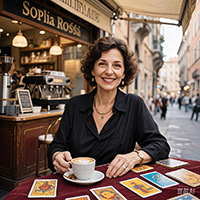
For twenty years, I have listened to complicated stories unfold over the warm aroma of coffee, and I have learned that people rarely need a grand theory before they can see their next honest move. I asked Jordan to place both feet on the floor, notice their hands and jaw, and take one unforced breath. Then I shuffled slowly. The ritual was simply a way to move attention from the browser’s noise to the question in front of us.
“Today I’m using the Four-Layer Insight Ladder · Context Edition,” I explained. “This is how tarot works in my practice: the images give us a structured language for patterns you can test against your actual study sessions. They do not remove your agency, and they do not decide whether your thesis succeeds.”
I chose this four-card insight spread because Jordan was not comparing external thesis options. They were caught in an inner, self-reinforcing loop: the blank page felt demanding, another search brought short-term relief, and the thesis remained unwritten. A ten-card Celtic Cross could add more layers than this compact problem needed, while a Past-Present-Future spread would not separate the protective behaviour from the practical experiment. The Four-Layer Insight Ladder gave us the smallest structure that preserved the whole chain.
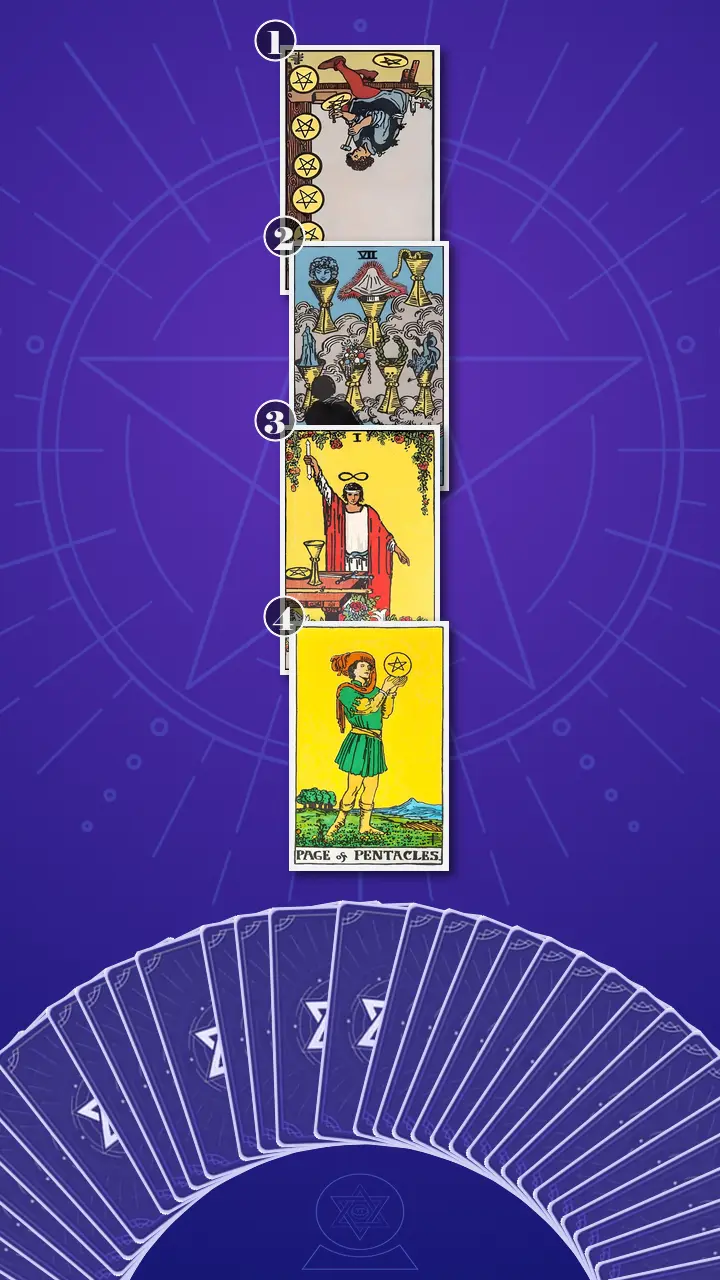
I laid the cards in a vertical line, like a staircase descending from repetitive preparation into one tangible first step. The first position would show the present condition and the current blockage. The second would reveal the root cause or hidden mechanism. The third would identify the central guidance and transformative lever. The fourth would turn that insight into a practical application. I wanted Jordan—and anyone reading over my shoulder—to know exactly where each interpretation belonged.
The Ladder from Endless Research to the First Sentence
The Workbench That Never Produces a Piece
Now I am turning over the card for the current blockage: the observable pattern of repeatedly researching and organising material instead of writing, together with the contracted energy behind it.
The card is the Eight of Pentacles, in reversed position.
In the Rider–Waite–Smith image, a craftsperson sits at a workbench, concentrating on one pentacle while completed pentacles line the wall. The image is not accusing the craftsperson of laziness; it is asking where the hand’s careful effort is actually going. At the start of a planned writing block, Jordan corrects citation metadata, rereads annotations, and creates a cleaner folder for sources that are already usable. Two hours later, the digital workbench looks more polished, but the thesis still ends at the same heading.
The reversed earth energy is blocked and diverted. There is plenty of diligence, repetition, and attention to detail, but too little movement toward a visible piece of writing. The excess is preparation: every claim must feel exhaustively supported before it is allowed to exist. The deficiency is provisional expression: there is no room for a sentence to be rough, questioned, and revised. That is how perfectionistic preparation becomes productive procrastination in graduate school without ever looking like doing nothing.
I pointed to the active hand and then to the row of finished pentacles. “Are you practising the craft of thesis writing,” I asked, “or becoming exceptionally skilled at preparing to practise it?” I suggested one small reversal of the pattern: write one provisional paragraph from the notes already available, mark uncertain claims with [source needed], and research only after the paragraph shows what it genuinely needs.
First, Jordan’s fingers stopped moving over the trackpad. Then their eyes shifted from the fuller Zotero folder to the unchanged heading, as though the two images had suddenly become impossible to separate. Finally, they gave a short, bitter laugh. “That’s too accurate,” they said. “Almost rude.”
I softened my voice rather than defending the interpretation. “I’m not calling the effort fake. You really have been working for hours. I’m showing you the difference between invisible preparation and material progress. The card is describing diverted skill, not a character flaw.” Jordan’s hand settled around the cold coffee cup, but they did not drink.
Seven Cups, Forty-Seven Tabs
Now I am turning over the card for the underlying mechanism: the limiting belief and deeper fear that make continued research feel safer than producing a thesis draft.
The card is the Seven of Cups, in upright position.
Seven cups rise from a cloud in the Rider–Waite–Smith image. One offers a castle, another jewels, another a serpent, another a dragon, another a veiled mystery. I saw the modern version immediately in Jordan’s browser: one relevant paper led through a Cited by link to three possible theoretical frames, two additional literature-review sections, and an entirely different argument. Because every option looked potentially important, choosing one felt careless.
This is water energy in excess: possibilities multiplying faster than discernment can organise them. The problem is not a shortage of material. It is information abundance turning into commitment avoidance. As long as every direction remains open, Jordan can postpone the vulnerable act of testing one direction in sentences. The browser becomes a visual menu of possible theses, while the actual thesis remains an imagined object rather than a draft that can answer back.
“Each option could matter,” Jordan said quietly. “So choosing now feels irresponsible. What if I close off the frame that would have made the whole thing work?”
“That is the protection,” I replied. “Thoroughness is being asked to do the work of commitment. But no amount of reading can prove which argument works until one argument is written clearly enough to be tested.” I asked Jordan to look at the last article they had saved and ask one precise question: which existing sentence did this source need to change? If the answer was none, the search might have been responding to the discomfort of not yet having a sentence.
I watched Jordan’s jaw tighten, then loosen by a fraction. Their gaze drifted toward the browser tabs, and they let out a small breath that sounded less like agreement than recognition. “A gap in the draft is a research question, not a verdict on my worth,” they repeated, testing the sentence carefully. I left a little silence around it.
When the Magician Put the Draft on the Table
The fluorescent hum seemed to recede as I reached for the third card. Somewhere beyond the glass wall, a library cart clicked over a seam in the floor, then the room settled again. This was the bridge in the reading: the moment when scattered resources could become one deliberate act.
The Table of Tools: Transformative Lever
Now I am turning over the card for the transformative lever: the cognitive and behavioural shift that turns available knowledge into direct expression and challenges the need to be fully prepared.
The card is The Magician, in upright position, and its strategic role in this reading is Bridge. Its invoked energy is resourcefulness, self-trust, deliberate initiation, and the ability to integrate several tools into one clear act.
The Magician’s table holds a cup, a sword, a pentacle, and a wand. The raised hand and lowered hand connect intention with material action; the infinity symbol suggests an ongoing relationship between learning and making. In Jordan’s life, the table already exists: emotional investment in the topic, critical thinking, an outline, language skills, saved sources, and enough notes to support a beginning. The modern translation is simple. Jordan closes the database, chooses one claim from the existing outline, and places the notes, citations, and thesis document on one screen. They write a provisional version and mark an unsupported point with [source needed] instead of treating the gap as proof that they are not qualified to write.
The upright fire, air, water, and earth are integrated here rather than scattered. The Magician does not promise that the first sentence will be brilliant. The card asks what can be made with the materials already on the table. Writing becomes a tool for directing attention, not a reward handed out after every uncertainty has been solved.
At this threshold, I reached for my signature diagnostic lens, Syllabus Deconstruction. I use it to strip the paralyzing dread from a massive deadline by reducing the task to mechanical, emotionless daily actions. I asked Jordan to stop carrying the whole thesis as one enormous emotional object and name only three components: one claim, one reason, and one piece of evidence already in the notes. A thesis is still intellectually significant, but the next action can be mechanically small.
“Writing is not the reward for certainty; it is how you find the next useful question,” I said. “The draft does not have to prove that you belong here. It has to give you something specific to examine.”
Jordan was still inside the old bargain: if one more source could remove every uncertainty, the draft could begin without risk. The blank thesis tab had turned a provisional sentence into a test of belonging, while another PDF offered relief that looked like progress.
I said the sentence I wanted Jordan to keep:
You do not need more information to earn the right to begin; use the tools already on the table to turn one clear intention into a draft, as the Magician does.
First, Jordan’s fingers froze above the trackpad, and their breath stopped halfway in. Their face went still; their pupils widened slightly as their eyes left the card and went unfocused, moving across the closed tabs as if replaying the last week: the supervisor reminder, the softened claim, the search for its opposite. Their right hand tightened around the mug, released it, and came to rest beside the keyboard. Finally, a quiet “Oh” moved through their chest. Their shoulders lowered, but the posture carried vulnerability rather than instant confidence. “But does that mean I’ve been doing it wrong this whole time?” they asked. I shook my head. “It means the strategy has been protecting you from exposure, not proving that you lack ability.” Their eyes shone as they looked at the unfinished heading and took one long, shaky breath. Relief arrived with a small blankness—the odd dizziness of seeing a path and realizing they would be the one to walk it.
“Now, use this new perspective to think back to last week,” I invited. “Was there a moment when a seven-minute draft could have made the next research question clearer?”
I asked Jordan to write another sentence beside the heading: “The gap can tell me what to look for; it does not have to tell me who I am.” That sentence marked the first step from apprehensive hyper-analysis and hidden preparation toward grounded self-trust through visible, revisable writing. The Magician did not take responsibility away from Jordan. The card returned it.
The Single Pentacle: Concrete Integration
Now I am turning over the card for the concrete integration: the small, practical next step that lets Jordan write before conducting more research and learn from the draft itself.
The card is the Page of Pentacles, in upright position.
The Page stands in a tilled field, holding one pentacle at eye level while the mountains remain steady in the distance. I read that focus as grounded earth restored to balance. The Page is not asked to complete the entire landscape. The Page studies one real object closely enough to learn from it.
For Jordan, the scene is specific: choose one subsection that already has notes, set a short timer, and write a 150-word paragraph before conducting another search. Afterward, identify one genuine evidence gap and place it in a Research Parking Lot. The draft becomes visible process data. It can be highlighted, questioned, revised, and used to decide what research is actually necessary.
“For the next seven minutes,” I told Jordan, “your task is not the thesis; it is one visible piece of it.” I watched their hand move toward the keyboard, pause, and then rest on the desk. A long breath left their chest. The goal was not to force a breakthrough or turn a small exercise into another standard they could fail. It was to make the task bounded enough that curiosity could enter.
“A rough paragraph is not failed writing,” I said. “It is process data. You can write fifty words, three bullets, or one claim with one reason if 150 words feels too exposed. Small does not mean meaningless.” Jordan nodded, this time without the bitter laugh, and copied the phrase into their notes.
The One-Page Workbench for Finding Clarity
When I placed the four cards side by side, the story became practical. The reversed Eight of Pentacles showed effort trapped in repeatable preparation. The Seven of Cups showed that the growing research pile was not necessarily evidence of an underdeveloped topic; it was an overload of plausible directions that made commitment feel dangerous. The Magician gathered the cup, sword, pentacle, and wand already available. The Page of Pentacles brought that integration back to earth as one paragraph.
That sequence answered the question “Why do I keep researching my thesis instead of writing it?” The blank document triggered apprehension. Apprehension activated the belief that more evidence was required. Searching and reorganising brought short-term relief. The relief made the search feel productive, but the untouched draft became larger and more evaluative, which strengthened the original belief. The loop was not a lack of care. It was a protective system that had become more practiced than the writing itself.
I named the cognitive blind spot plainly: Jordan had been treating a gap in a draft as information about personal worth and treating invisible preparation as the most reliable measure of progress. The deeper shift was to stop treating research as a prerequisite for writing and start using writing as the method that reveals which research is genuinely needed. The emotional transformation would not be from apprehension to flawless confidence. It would be from apprehensive hyper-analysis and hidden preparation to grounded self-trust through visible, revisable writing.
I also used my second signature lens, Study Environment Auditing. I asked Jordan to notice how physical clutter and disorganised systems quietly consumed limited psychological bandwidth: the cold mug beside the laptop, loose printouts, multiple note systems, colour-coded folders, and a browser that kept presenting new intellectual doors. This was not a moral judgement about mess. It was a practical question about whether the environment made the next action easier or kept offering escape routes.
For actionable advice, I did not hand Jordan a heroic schedule. I used my Desktop Reset Ritual, a pragmatic 15-minute physical clearing exercise I often suggest before opening a textbook or beginning concentrated study. I adapted it to the thesis desk: clear the visible surface, keep only the tools needed for the immediate task, and let the timer—not perfectionism—decide when the reset is finished. Then I used Syllabus Deconstruction to make the large deadline small enough to touch.
- Reset, then draft before searchAt the usual desk before the next study session, set a 15-minute timer for the Desktop Reset Ritual. Remove cold mugs, loose papers, and visual clutter, leaving only the laptop, current notes, notebook, and pen. When the timer ends, close Google Scholar and the library database, keep one existing thesis heading open, set a seven-minute phone timer, and write three rough sentences using only the notes already available.Put a sticky note above the trackpad that says “Draft first; search after 150 words.” The reset must stop when the timer rings so it does not become another organisational project. The minimum version is one unpolished sentence in three minutes. If evidence is uncertain, type [source needed]; never invent facts or citations.
- Make one paragraph diagnosticOn one weekday this week, choose a thesis subsection with existing notes and label the document “Rough by design — v0.1.” At the usual desk, write 150 words without editing the first sentence until the final sentence exists. Highlight what the notes genuinely support in green, mark real gaps with [source needed], and finish with one sentence beginning “This draft shows that I need to clarify…” You do not have to send the paragraph to your supervisor.If 150 words triggers too much pressure, reduce the experiment to 50 words, three bullets, or one claim-plus-reason pair. Stop after the agreed block instead of turning it into an all-day rescue mission. A rough paragraph is evidence for the writing process, not evidence for or against your intelligence or academic worth.
- Let the draft ask the next questionAfter the paragraph is visible, choose one [source needed] marker and turn it into a single searchable question. Run one 20-minute Google Scholar or library-database search after drafting, using no more than two active tabs and saving no more than three potentially useful sources. Write one line for each source explaining how it could change the existing paragraph, revise one sentence with useful evidence, and place unrelated discoveries in a plain-text note called “Research Parking Lot.”Use [source needed] as a bridge, not a stop sign. If a promising article opens several new directions, record them in the Parking Lot rather than pursuing every branch. On Friday, review three columns—draft question, focused search, sentence changed. If concentration is depleted, form the search question and stop; the experiment still counts.
“This is not a ban on research,” I told Jordan. “It is a boundary around when research begins. The draft gets to speak first. Then the search has a job: answer a question the visible writing has raised.” That distinction gave the next steps a shape that did not depend on feeling fearless.
A Week Later, the Quiet Proof
Four days later, I received a message from Jordan: “I did the desk reset, wrote for seven minutes, and ended up with 126 words. I put one gap in the Research Parking Lot instead of opening another tab. The focused search afterward changed one sentence.” The paragraph was not polished, and the thesis was not suddenly finished. But for the first time, research had responded to writing rather than replacing it.
Jordan told me they slept through the night, but woke with the old thought—What if I’m wrong? It stayed for a minute. This time, they smiled, wrote it in the Parking Lot, and began with the paragraph. That was a clear but fragile change: not certainty, but a new way to interpret uncertainty.
That was Jordan’s first small proof of the Journey to Clarity. The Four-Layer Insight Ladder did not write the thesis, remove every gap, or guarantee an easy week. It helped Jordan see the sequence clearly enough to choose a different first move. The cards offered a mirror and a structure; Jordan remained the person holding the tools, making the claim, and deciding what happened next.
When your shoulders tighten over a blank document and your hand opens another search tab, it may feel safer to keep proving that you are preparing than to let one imperfect paragraph seem to speak for your worth. But noticing the loop is already a change in position: you are no longer only inside it.
If a rough sentence could be a question-finder rather than a verdict, what might you be curious to let it say before the next search?