The 8:41 PM Email That Made Everything Shrink
When Maya settled into the chair, she had the exact look I associate with a work-anniversary reminder: laptop glow on her face, shoulders creeping toward her ears, a cold mug of tea beside her, and LinkedIn still open on her phone like a private scoreboard. In an East London flatshare kitchen, the radiator clicked, the cursor blinked, and she was reopening Monday's status update for the third time even though it was already clear. One more edit felt safer than asking for a stretch assignment. This was not laziness. It was promotion anxiety wearing a very neat blazer.
'I know I'm capable,' she said, staring at the screen, 'but I keep choosing the version of me that cannot be criticised.' That line named the whole knot in one breath: career growth on one side, and the old play-it-safe script on the other, telling her that staying controlled was the smartest way to stay valuable. I could see the cost in her body before she said another word—tight chest, guarded shoulders, the restless urge to check again—as if her ambition had been folded so many times it no longer remembered its full shape.
To her, the feeling was not a dramatic panic. It was more like trying to breathe through a scarf left out in cold rain: not blocked, exactly, but damp, muffled, and hard to trust.
I told her, gently, 'Let's draw a map for the fog.' That is the moment I stepped fully into my work: not to judge the script, but to read it. This was exactly the kind of career crossroads reading where a Celtic Cross tarot spread can do real work, because the question is never just 'Should I move?' It is 'What has made movement feel so risky in the first place?'

Choosing the Celtic Cross
I asked her to take one slow breath, put the phone face down, and keep the work-anniversary reminder in mind while I shuffled. For a career tarot spread like this, I reach for the Celtic Cross because the problem is layered: the symptom in the centre, the pressure point across it, the root below it, and then the inner narrator, the environment, and the longer arc all in view. It lets me read the whole mechanism instead of offering a vague confidence boost.
The centre would show the posture she was living in now. The crossing card would show what kept that posture locked. Beneath it, I wanted the scarcity memory. Off to the side, I wanted the voice that kept writing the safe story for her. And at the top, I wanted to see whether there was a real next step, not a fantasy of reinvention.
The Cards Before the Spark
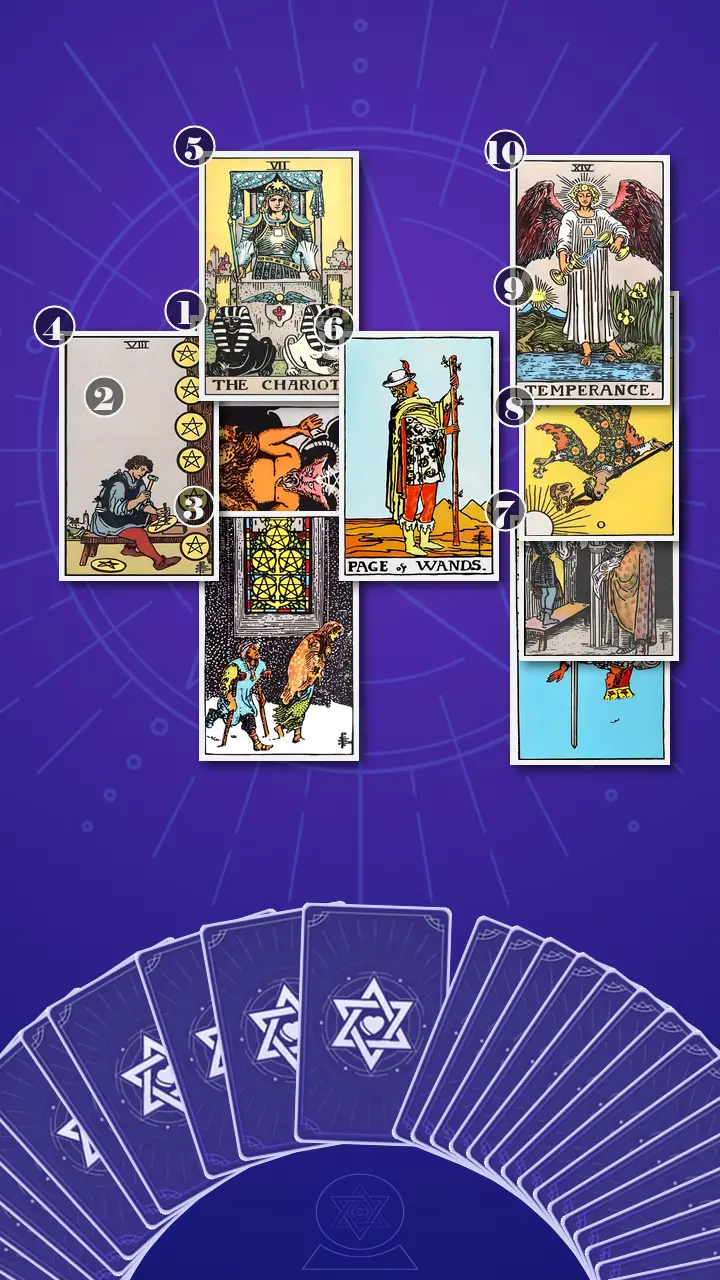
Position 1: The Grip That Looked Like Maturity
Now I turned over the card showing her current career-safety posture: Four of Pentacles, upright.
In modern life, this is the version of you who keeps the résumé tightly edited, the workload tidy, the ambitions carefully zipped up. The coin held against the chest is not greed here; it is vigilance. The energy is excess holding, almost no circulation. And that was exactly what I saw in Maya's status update—something already good, repeatedly sanded down until it could not risk wanting anything more.
She let out a short laugh, the kind with almost no air in it. 'That is painfully specific,' she said, and then looked down at her hands. Her shoulders stayed high, but her mouth had started to soften around the truth.
Position 2: The Low-Risk Contract
The next card, crossing the first, was The Devil, upright—the pressure point.
This was the low-risk career contract dressed up as common sense. Predictability, praise, control: the three little chains that look voluntary until you inspect them. In the spread, the energy is blockage by repetition. Not because she lacks talent, but because the old rule keeps whispering that being visible is dangerous, and being dangerous is somehow the same as being irresponsible.
Maya gave a tiny nod, then a longer exhale. 'I keep calling it realism,' she said, 'but it feels more like I am obeying something I never agreed to.' That was the first crack in the shell, and I could see it in the way she stopped fidgeting with the mug for a second and simply listened.
Position 3: The Cold Memory Underneath
Beneath it all sat Five of Pentacles, upright.
The modern scene here is simple and brutal: a stretch opportunity appears, and your body remembers winter before your mind can name the opportunity. Less risk. Less need. Less chance of being left out in the cold. This is the scarcity memory under the safety script, and its energy is not a character flaw; it is an old survival reflex that has overstayed its original contract. I have seen this pattern in archives too: a protective behaviour can survive long after the conditions that created it have changed.
When I said that, Maya's eyes moved off the cards and fixed on the window for a moment. Her breathing went very shallow, then one hand slid up to the base of her throat, as if she had found the exact place where the old weather still lived. 'Yes,' she said quietly. 'That is the part I do not like admitting.'
Position 4: The Bench Where Skill Became Safe
Eight of Pentacles came next, in the recent-past position.
This card is the workbench, the repeated coin, the respectable satisfaction of becoming excellent by doing the same clean thing again and again. In modern terms, it is polishing the same portfolio bullets, the same bio, the same deck, until competence starts to masquerade as momentum. The energy is not bad at all; it is simply too narrow. The skill is real, but it has been used as a shelter from the blank page.
She smiled without humour. 'I do that all the time,' she said. 'If I can make the existing thing better, I do not have to ask for the bigger thing.' Her jaw unclenched a little after she said it, which told me the sentence had landed where it needed to.
Position 5: The Hand on the Wheel
At the crown, The Chariot, upright.
This is the part of her that wants motion, not just maintenance. Not recklessness—direction. In RWS terms, the rider moves forward by holding opposites together, and that is the correction here: movement does not require a reckless leap, only an intention strong enough to steer. The energy is balanced force, a self-directed line through the noise.
I had a brief inner flash of an old excavation trench: one cart can carry a lot, but it still needs someone deciding where the path runs. Maya looked up at this card longer than she had looked at any other so far.
When the Page of Wands Opened the Room
When I turned the sixth card, the room seemed to get quieter, as if even the radiator had decided to wait.
Position 6: The Small Experiment That Breaks the Loop
At this point, Maya was caught in the familiar little panic of deciding she must either make a perfect move or make none at all. Her body had started preparing for a verdict instead of a test: shoulders tight, jaw set, breath shallow, eyes flicking between the card and her laptop as if the answer might be hiding in the tabs.
Not every next step has to be a leap; the Page of Wands' upright wand makes one curious experiment count as real movement.
A small, visible experiment can tell you more about your career than another year of staying safe. Caution is not the same thing as maturity; it is just caution. What changes the story is treating reversible moves as real career data, not as a referendum on your worth.
This is where my own practice of Skill Archaeology comes in. I look at the behaviour that seems most defensive and ask what talent it is protecting. Under Maya's over-editing I did not see emptiness; I saw a buried exploratory muscle. The Page of Wands did not ask her to become a different person by Monday. It asked her to stop treating the first test like the final exam.
Her reaction was not instant relief. First came stillness: a tiny freeze, like the body waiting for impact. Then her eyes moved over the card again, as though she were replaying the sentence in her mind. Then the release: her fingers, which had been gripping the mug, finally opened; her shoulders slid down an inch; and a breath came out of her that sounded surprised even to her. 'So I do not need to know the whole plan?' she asked. The corners of her mouth lifted, then dropped again into something softer, more vulnerable. That was the point. The spark did not erase the fear; it made space around it.
Now, with this new view, think back to last week: was there a moment when this insight could have made you feel differently?
What the Room Kept Reinforcing
Position 7: The Inner Courtroom
Queen of Swords reversed was the self-position.
Here the inner narrator becomes a very efficient solicitor. Every ambition gets cross-examined; every sentence is polished until it sounds calm, strategic, and strangely uninhabited. The energy is blockage by over-analysis. Intelligence is still there, but it has turned into a shield that cuts away possibility before possibility can even speak.
Maya gave a small, knowing wince. 'That is my Slack draft brain,' she said, and then actually laughed this time, because the recognition was too exact to keep dignified. She leaned back in the chair, one shoulder dropping for the first time since she arrived.
Position 8: The Room That Rewards Reliability
Three of Pentacles described the environment.
This is the workplace that applauds craftsmanship, coordination, and the person who always makes the deck clean. Useful, yes. But it can also teach you to keep wearing the same narrow badge: dependable, organised, easy to trust, not too hungry. The energy here is balance in the team, but also a quiet reinforcement loop that keeps the wider ambition off the table.
She nodded toward the card and gave a little half-smile. 'So the room likes me best when I stay easy to manage,' she said. I did not need to correct the room into a villain; environments simply reward what is already familiar.
Position 9: The Cliff Edge and the Bookmark Tab
The Fool reversed sat in hopes and fears.
This is the browser full of saved roles and side projects, and the hand that keeps closing the tab because one more proof of readiness seems necessary. It is not laziness; it is the fear that a fresh start will make you look naive. The energy is hesitation at the edge, the beginner's curiosity still alive under a layer of self-protection.
She swallowed, then nodded once. 'That one hurts,' she said, very quietly. The sad part was not that she did not want the new thing. The sad part was how badly she did want it, and how trained she had become to treat wanting as evidence against herself.
Position 10: Mixing Stability and Growth
Finally, Temperance in the outcome.
I always like this card here because it refuses the melodrama of a total reset. It says the answer is not to detonate the old life; it is to blend stability and growth like a good flat white, adjusting the ratio until the whole thing tastes alive again. The energy is balance, not stasis. This is A/B testing your next move, not rebranding your whole life overnight.
In my mind, the spread moved from read-only mode to a live document. Maya was still allowed to be careful; she just no longer had to make caution the final measure of maturity.
From Read-Only Mode to a Reversible Move
So the story underneath the cards was not 'she lacks confidence.' It was this: a work-anniversary reminder activates a safety script; the safety script narrows the ask; the narrowed ask earns short-term relief; and the relief convinces the nervous system that shrinking was wise. Four of Pentacles showed the grip. The Devil named the private contract that made the grip feel moral. Five of Pentacles revealed the old scarcity memory underneath. Eight of Pentacles explained why mastery became the default shelter. Queen of Swords reversed showed the inner lawyer who keeps justifying all of it. And Page of Wands, the catalyst, proved that one reversible experiment can break the loop without asking for a grand leap.
The blind spot was not ability. It was the belief that a bigger move has to be a permanent identity decision. The transformation direction was much kinder: from fear-driven self-protection to self-directed, curiosity-led momentum. That is the practical heart of this reading, and it is also the most useful kind of finding clarity I know.
For the action plan, I used one of my own field tools: Megalith Transport. No one moves a stone circle by lifting the whole thing at once. You break the weight into pieces, check the fit, and move only what can actually be carried.
Before any shiny opportunity gets treated like destiny, I also run a quick Relic Authentication pass: is this a real stretch, or just a fear dressed up as prudence? Once that is clear, the next steps stay small enough to be honest.
- Draft the stretch askWrite one sentence asking your manager for a stretch assignment or a 15-minute conversation about what would make one possible. Keep it in a Google Doc or Slack draft, and do it after work when the urge to over-explain is strongest.Use a single edit pass. If the sentence starts growing teeth, stop at the first version that is clear.
- Run the curiosity chatBook a 15-minute coffee chat with one person whose role you genuinely want, or volunteer for one small piece of a bigger project at the agency. Your only job is to gather information, not to prove you are ready for the whole mountain.If the conversation feels awkward, that is still data. Afterward, write down one sentence about what felt interesting, not just what felt scary.

A Week Later, the Quiet Proof
Four days later, Maya sent me a message with a screenshot of the 15-minute chat request she had finally booked and, below it, a draft stretch ask she had stopped trying to perfect. She told me she had paused before sending, breathed once, and pressed send anyway. Then she bought a flat white on the walk back to her desk and stood by the window for a minute, half-smiling at the strange little tremor in her hands.
That, to me, is finding clarity: not a grand verdict, not a total reinvention, just one body a notch less braced and one action that proves the old script no longer has total authority.
If tonight you are sitting inside that familiar tug between 'stay solid' and 'want more', remember that noticing the tug already means you are no longer obeying it blindly.
A reversible move is still real career data. So, if this week only had to be an experiment, what is one small, reversible step you would actually be curious to try?
This story is adapted from psychological research, written so that those in a similar struggle can see their own pattern in it — and find their next step clearly.These insights are not a substitute for professional psychological, medical, legal, or financial advice.
Learn more about our Journey to Clarity.
How did this insight land for you?
🫂 This Resonates Deeply
🌀 Living This Story
✨ Now I See Clearly
🌱 Seeing New Possibilities
🧰 Useful Framework
🔮 The Confirmation I Needed
💪 Feeling Empowered
🚀 Ready for My Next Step
Author Profile
 AI
AI“Having spent a lifetime at Cambridge and on archaeological digs, I’ve witnessed the rise and fall of countless civilizations. Please know that your current struggles are not a permanent fate, but merely a necessary fracture before rebuilding. I won't lecture you; instead, I invite you to sit with me in the ruins, using a patient, historical perspective to gently dust off the true, enduring value hidden beneath your temporary doubts.”
In this Career Tarot Reading :
Core Expertise
- Core Competency Excavation: Digging through the 'strata' of your past roles to uncover undervalued, highly transferable foundational skills.
- Career Epoch Analogies: Contextualizing your career plateau as the end of one professional era and the necessary foundation for the next.
Service Features
- The Resume Stratigraphy Review: A structured framework to rewrite your professional narrative, highlighting immutable assets over obsolete job titles.
Also specializes in :
Explore Related Patterns:
Action ParalysisMaya's tiny freeze at the Page of Wands moment gives the pattern a physical anchor: tight shoulders, set jaw, shallow breath, and eyes moving between the card and laptop as if the answer might be hiding in the tabs. The body is not preparing for a small test; it is bracing for impact. Action Paralysis appears when the emotional cost of choosing becomes bigger than the action itself. You keep waiting because the next move has been overloaded with identity meaning. A stretch ask stops being a practical conversation and becomes a verdict on whether you are ready, credible, or allowed to want more. The story's corrective insight is that paralysis softens when the move becomes reversible. Maya does not need to solve her whole career arc to interrupt the freeze response; she needs one contained action that gives her data without demanding total reinvention.
Black-and-White ThinkingMaya's body prepares for a verdict instead of a test when the next step appears. The story makes the distortion concrete: a small stretch ask or curiosity chat starts to feel like either a perfect career move or proof that she should not move at all. Black-and-White Thinking compresses a flexible situation into two extreme options. You either know the whole plan or you stay put; you either look fully ready or you risk looking naive; you either make the right identity decision or avoid the decision entirely. That cognitive split removes the middle ground where experiments, drafts, questions, and partial data can exist. The Page of Wands moment matters because it introduces a third category: a reversible move. For Maya, the psychological shift is not from fear to fearlessness; it is from all-or-nothing evaluation to real-world testing, where one small action can count without becoming a referendum on her worth.
Inner CriticMaya names the pattern herself when she says she keeps choosing the version of herself that cannot be criticised. The story then gives that voice a shape: an inner solicitor that cross-examines every ambition and polishes every sentence until it sounds calm, strategic, and strangely uninhabited. The Inner Critic is not just harsh self-talk here; it is a defensive auditing system. You pre-empt external criticism by running the criticism internally first, hoping that if every sentence is controlled enough, no one else will find the weak point. The cost is that possibility gets cut away before it can become action. In this career script, the critic protects Maya from exposure while also keeping her trapped inside the safest version of herself. The useful distinction is that discernment helps refine a move, while the inner critic keeps prosecuting the desire to move at all.
Productive ProcrastinationMaya's third pass over an already clear status update is not random perfectionism; it is movement disguised as maintenance. Editing gives her a controlled task with a clean standard, while asking for a stretch assignment would require visible desire, uncertain feedback, and a risk of being seen before she feels fully ready. That is the mechanism of Productive Procrastination: the avoidance does not look passive, because it is wrapped in competent activity. You keep improving the safe artifact, the draft, the deck, the bio, or the plan, and the activity creates just enough relief to feel responsible while quietly delaying the action that would change the situation. In Maya's case, the pattern keeps the old career script alive by making polish feel more mature than experimentation. The useful audit point is that the work is real, but its function has shifted: it is no longer only improving the output; it is protecting her from the vulnerability of asking for more.
Scarcity MindsetMaya's reaction to a stretch opportunity is described as her body remembering winter before her mind can name the opportunity. That image matters because the risk calculation is not only intellectual; it is a learned survival reflex that makes less need, less exposure, and less wanting feel safer. Scarcity Mindset turns career movement into a resource threat. You may be capable, but your nervous system still treats visibility as something that could cost belonging, stability, or protection. The narrowed ask then brings short-term relief, and that relief reinforces the belief that shrinking was wise. For Maya, this pattern explains why playing safe can feel morally sensible rather than merely fearful. The work is to audit whether caution is responding to present-day evidence or to an old scarcity memory that has outlived the conditions that created it.
Visibility AvoidanceMaya keeps the stretch ask off the table even while the desire for growth is clearly present. The story shows her ambition being carefully zipped up, not because she lacks ability, but because being seen wanting more has been coded as exposure, criticism, and the possibility of looking naive. Visibility Avoidance forms when self-protection starts managing the optics of desire. You do not only avoid the task; you avoid the version of yourself who would be legible as ambitious, hungry, or ready to outgrow the familiar badge. The workplace's reward system makes this easier to rationalise, because reliability and polish keep earning approval. This pattern speaks directly to the old career script in the question. Maya is not simply playing safe around workload; she is playing safe around being visible as someone who wants a bigger room. Naming that mechanism creates the first clean separation between real caution and the fear of being seen in motion.
Explore Related Struggles:
Growth-Exposure SplitMaya says she knows she is capable, then chooses the version of herself that cannot be criticised. The stretch assignment is not blocked by lack of skill; it is blocked because growth would make her visible, and visibility would invite judgment. Growth-Exposure Split sits in that exact friction. You are not watching ambition disappear. You are watching ambition get folded into safer shapes until the career step no longer looks like a step, but like a public test of whether wanting more is allowed. The Page of Wands shifts the scale of exposure by making one curious experiment count as movement. A reversible chat or draft ask lets growth happen without turning every visible move into a final verdict on your worth.
Perfect Readiness TrapAt the threshold, Maya's body prepares for a verdict instead of a test: shoulders tight, jaw set, eyes moving between the card and the laptop. The saved roles, side projects, and overworked drafts all carry the same demand for one more proof before action. Perfect Readiness Trap names the way preparation stops being support and becomes a gatekeeper. You can keep improving the sentence, the deck, the bio, and the plan, while the actual career data remains out of reach because the first experiment is being treated like the final exam. The later screenshot matters because she stops trying to perfect the ask before sending it. The move is not grand, but it breaks the rule that readiness must be complete before movement is real.
Safety-Identity FusionThe work-anniversary reminder pulls Maya into an already clear status update, and the safer version of her becomes the one who cannot be criticised. Staying controlled is not just a tactic in the story; it becomes the measure of being valuable, mature, and responsible enough to keep her place. Safety-Identity Fusion fits because the career move is no longer judged only by whether it is useful or interesting. It is filtered through the question of who she is allowed to be if she wants more, so a stretch assignment starts to feel like an identity risk rather than a reversible professional step. You can see the old script losing absolute authority when she sends the 15-minute chat request anyway. The action is small, but it separates safety from self-definition for long enough to let ambition have a body again.
Craft Ceiling LockEight of Pentacles shows Maya becoming excellent at the same clean thing again and again: portfolio bullets, bios, decks, status updates, all made sharper and safer. Her own line is precise: if she can make the existing thing better, she does not have to ask for the bigger thing. Craft Ceiling Lock emerges when real skill becomes the ceiling it was supposed to help her outgrow. You are seeing competence used as shelter, not because the work is fake, but because mastery inside the known lane can quietly replace momentum toward the next one. The workplace reinforces the lock by rewarding the person who is dependable, organised, and easy to trust. The cost is that the wider ambition stays off the table until skill is allowed to become a launch point instead of a hiding place.
Inner Tribunal LockQueen of Swords reversed turns Maya's inner narrator into a solicitor: every ambition is cross-examined, every Slack draft polished until it sounds strategic and strangely uninhabited. The mind is active, but it is using intelligence to cut possibility down before it can speak. Inner Tribunal Lock captures the way self-review becomes an internal courtroom. You are not simply thinking carefully; you are making desire defend itself against standards so tight that any imperfect wish looks inadmissible. The small laugh at her Slack draft brain matters because recognition interrupts the authority of the court. Once the voice is heard as a voice rather than objective truth, action can move from defence into experiment.
Explore Related Emotions:
Approval AnxietyMaya names the workplace dynamic with painful accuracy: the room likes her best when she stays easy to manage. Clean decks, tidy coordination, and reliable polish are rewarded so consistently that the safer version of her starts to feel like the only professionally lovable one. Approval Anxiety forms when external praise becomes the weather system around your choices. You may still want growth, but the body keeps checking whether that growth will threaten the role that has kept you trusted, useful, and low-friction. The career script keeps her playing safe by turning approval into proof of safety. As long as she stays dependable and not too hungry, she gets short-term reassurance; the hidden cost is that her ambition has to ask permission from the room before it can breathe.
Beginner ShameMaya has saved roles and side projects open like bookmarks to a possible self, then keeps closing the tab because one more proof of readiness seems necessary. The painful part is not a lack of desire; it is how badly she wants the new thing, and how quickly wanting becomes something she feels she must defend against. Beginner Shame is the sting of being seen at the start of something, before polish can protect you. You may crave the wider role, the bigger project, or the fresh path, while also feeling embarrassed by the evidence of your own desire. The old script keeps her safe by treating beginnerhood as a reputational risk. If she never has to look new, hungry, or unfinished, she never has to risk feeling naive; but she also never gets the real data that only comes from stepping into the first visible experiment.
Caged RestlessnessCareer growth is clearly present in the story, but it keeps meeting the same controlled posture: edited status updates, carefully zipped ambitions, and a version of Maya built to stay valuable by staying contained. Her ambition has not disappeared; it has been folded down until it barely resembles its original size. Caged Restlessness is the pressure of wanting movement while living inside a role that rewards containment. You can feel the appetite for direction, but every route outward gets narrowed by the need to remain polished, reasonable, and difficult to criticise. The script keeps her playing safe by confusing restraint with wisdom. Underneath that restraint, the story keeps showing motion trying to return: the wish for a stretch assignment, the saved roles, the small experiment, and the part of her that wants more than maintenance.
Exposure DreadMaya reopens a status update that is already clear, with LinkedIn still glowing on her phone and her shoulders creeping upward, because another edit feels safer than asking for a stretch assignment. The scene shows a body trying to reduce the surface area of visibility: fewer rough edges, fewer wants, fewer places where criticism could land. That is the emotional logic of Exposure Dread. You can be capable and still feel your nervous system tighten when capability has to become visible, because visibility turns skill into something other people can judge, question, or misunderstand. The old career script keeps her safe by making control feel like maturity. In that script, the less she asks for, the less she risks being seen wanting more; the cost is that ambition gets folded into a version of herself designed to be uncriticisable rather than fully alive.
Performance FreezeMaya's shoulders tighten, her jaw sets, and her eyes flick between the card and her laptop as if the answer might be hiding in the tabs. The story makes the freeze physical: the next step stops feeling like a test and starts feeling like a verdict. Performance Freeze is the internal lock that appears when a small career move gets inflated into proof of who you are. You may know the action is reversible, but your body treats it as if one imperfect ask could expose something final about your competence. That is why another edit feels safer than sending. The old script makes stillness look responsible by demanding perfect readiness first, while the actual growth edge asks for something far less dramatic: one move small enough to survive being imperfect.
Scarcity AnxietyThe stretch opportunity arrives, but the story says Maya's body remembers winter before her mind can name the opportunity. Her hand goes to the base of her throat, her breathing turns shallow, and the safer option starts to feel less like preference and more like protection. Scarcity Anxiety lives in that split second where wanting more becomes linked with the possibility of losing warmth, security, or belonging. You are not simply choosing the smaller move; you are trying to avoid the old sensation of being left out in the cold. This is why playing safe can feel so convincing. The script does not need to say that Maya is incapable; it only has to make expansion feel expensive, as if every bigger ask might cost more safety than she can afford.
Cautious MomentumMaya's fingers finally open from the mug, her shoulders drop, and the breath that comes out of her sounds surprised even to her. Nothing in the room asks her to become reckless; the shift happens because the next step becomes small enough for her body to believe it can move. Cautious Momentum is the feeling of forward motion that still respects the part of you that needs guardrails. You are not pretending the fear has vanished; you are giving it a smaller vehicle to ride in. Four days later, the 15-minute chat request and the imperfect stretch ask become quiet proof. The old script no longer has total authority because Maya has evidence that a reversible step can be real without becoming a permanent identity decision.
Clarity ReliefThe story moves from read-only mode to a live document when Maya sees that caution can stay present without running the whole system. She pauses, breathes once, presses send anyway, and stands by the window with a tremor in her hands that no longer has to stop the action. Clarity Relief arrives when the script is named precisely enough to become negotiable. You do not need a total reinvention to feel the room inside you change; sometimes relief comes from seeing the mechanism and realizing it is not the same thing as your identity. For Maya, the relief is quiet rather than glossy. She is still careful, still human, still feeling the charge of being visible, but the old equation has loosened: safety no longer has to mean shrinking.
Explore Related Contexts:
Career Stability Lock-InThe work-anniversary reminder finds Maya in an East London flatshare kitchen reopening a status update that is already clear. The scene is small, but the structure is not: another year of work has gathered around a role where polish, control, and reliability feel safer than asking for a stretch assignment. The external pressure comes from a career lane that still functions well enough to defend. The workplace rewards clean decks, dependable coordination, and the person who is easy to trust, so the safe version of Maya keeps receiving just enough validation to stay in place. You can see how stability becomes a lock-in when the role keeps paying out predictability while quietly narrowing the space for growth. Career Stability Lock-In fits because the old script is not simple avoidance. It is a social contract between a reliable worker identity and an environment that keeps rewarding that identity, even when the next stage requires more visible ambition.
Career Visibility ParalysisMonday's status update is reopened for the third time even though it is already clear, and that tiny repetition carries the whole career blockage. One more edit is not really about quality control anymore; it has become a substitute action that feels safer than putting a stretch ask in front of another person. The story keeps placing Maya near visibility without letting her fully enter it. LinkedIn is open like a private scoreboard, Slack drafts get cross-examined, and saved roles stay in the browser while another proof of readiness seems necessary. You are looking at a career stage where the next move depends on being seen, but being seen has been coded as exposure to criticism. Career Visibility Paralysis fits because the problem is not whether Maya has ability. The external career field is asking for a visible claim on scope, while her current position has trained her to stay legible as reliable rather than legible as ambitious.
Skill Underutilization TrapMaya names the loop directly when she says that if she can make the existing thing better, she does not have to ask for the bigger thing. The repeated polishing of portfolio bullets, bios, decks, and status updates shows real craft, but the craft is being spent inside the safest available lane. The external structure here is a career role that keeps converting skill into maintenance instead of expansion. Clean execution earns trust, but it does not automatically become scope, sponsorship, or a stretch assignment. You can be genuinely good at the work and still have the work arranged in a way that keeps your ability under-deployed. Skill Underutilization Trap fits because the story is not about a lack of competence. It is about competence being used as shelter, where mastery of the current task keeps delaying the social risk of becoming a beginner at the next level.
Workplace Recognition PressureThe environment is described as a room that applauds craftsmanship, coordination, and the person who always makes the deck clean. Maya's own summary lands with precision: the room likes her best when she stays easy to manage. That recognition economy matters because it turns reliability into the safest form of social currency. The workplace does not need to be framed as a villain for the pressure to be real; it simply keeps rewarding the familiar version of Maya more clearly than the emerging version that wants broader scope. You can see how a team culture can quietly teach someone which ambitions are welcome and which ones should be sanded down first. Workplace Recognition Pressure fits because the external reward system is part of the old script. Maya is not just privately playing safe; she is responding to a workplace stage where being polished, useful, and not too hungry has become the most legible way to stay valued.