Twelve Tabs, a Blank Slide—Then a Question Put the Draft in Motion

The Blank Slide at 9:40 p.m.
If your professional life looks organised from the outside, but a vague Slack brief sends you into twelve reference tabs before you write one usable sentence, this may be your version of hidden-curriculum procrastination.
Maya joined our video consultation from the kitchen table of her shared Toronto apartment. It was 9:40 on a Tuesday evening. Her laptop fan whirred beneath a campaign brief and twelve warm browser tabs; cold tea sat near her wrist, and blue screen light picked out fingerprints on her phone.
I watched her colour-code another research block and glance at the blank first slide. She had already renamed the presentation twice and aligned every title box. Her shoulders stayed close to her ears, while each breath seemed to stop at the top of her chest.
“Tell me what good looks like and I can do it,” she said. “But if someone just says, ‘Use your judgement’ or ‘Make this more strategic,’ I spend hours getting ready to start. Then somehow it becomes an emergency at ten at night.”
I heard the contradiction immediately. Maya wanted to begin, finish, and be the reliable person on the team. At the same time, beginning felt dangerous because an unspoken rule might make any first move look wrong. Her apprehension behaved like a metronome strapped beneath her ribs, clicking faster every time her cursor approached something another person could judge.
“I don’t hear laziness in that,” I told her. “I hear a protective system. Research and formatting are giving you temporary shelter from the moment your interpretation becomes visible.”
She looked down at the mug and rubbed one thumb along its cold rim. “That’s exactly it. I know I’m avoiding the draft, but I thought I was just bad at starting.”
“Then we won’t use tarot to predict whether your manager approves the deck,” I said. “We’ll use it as an external map of the pattern: what happens, what disrupts your rhythm, what fear gives the loop its weight, and where you still have choice. Let’s give this fog edges we can actually examine.”
Choosing the Return-Circuit Map
I invited Maya to put both feet on the floor, let one breath reach her lower ribs, and hold the ambiguous brief in mind. I shuffled slowly, using the movement as a transition from frantic problem-solving into focused observation, not as a performance of mystery.
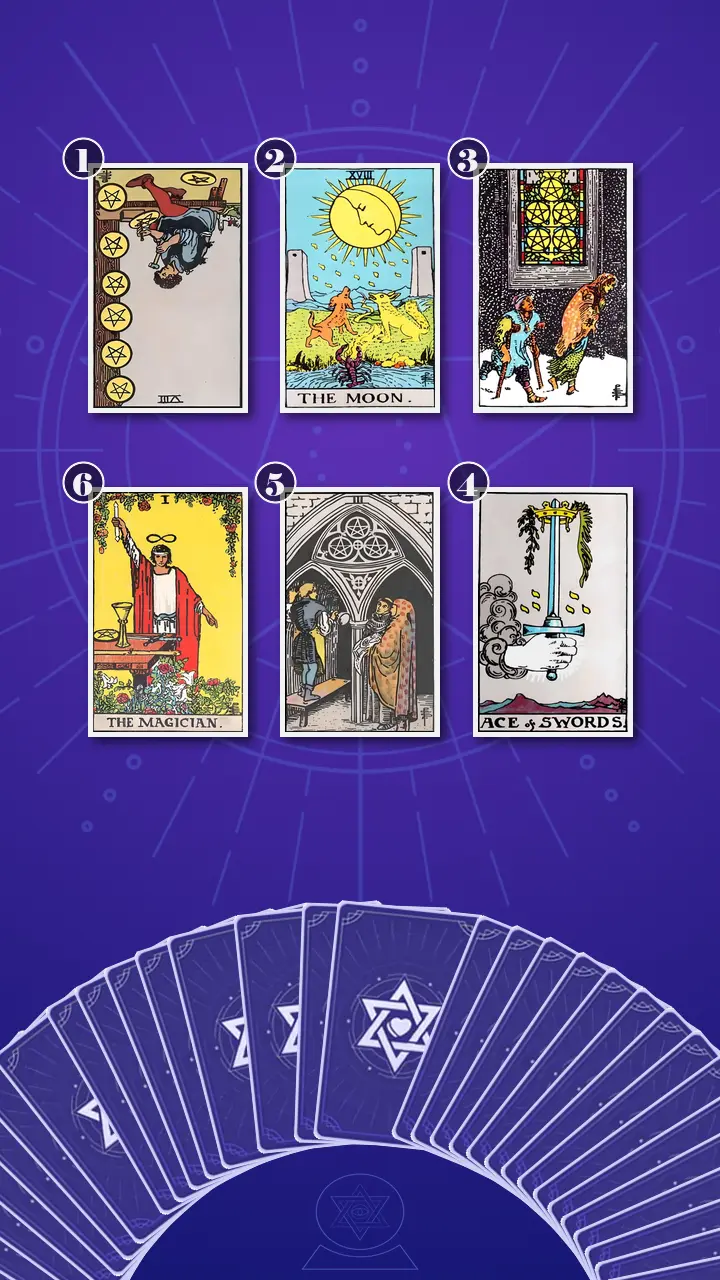
I chose the Transformation Path Grid · Context Edition, a six-position tarot spread built for a self-reinforcing system. For anyone wondering how tarot works in a consultation like this, I do not treat a card as predictive authority. I place each card in a defined analytical role so that card meanings in context can make an otherwise tangled feedback loop visible.
This spread was more useful than a simple past-present-future reading because Maya was not choosing between three options. She was repeating a circuit: vague work instructions led to imagined evaluation criteria, protective preparation created temporary relief, deadline pressure eventually forced output, and the exhausting finish reinforced her belief that she was always behind. Six positions were enough to trace the symptom, blockage, root fear, catalyst, action, and integration without overcomplicating the reading.
I explained that the first card would show the busy behaviour surrounding the blank draft. The second and third would distinguish the immediate fog from the deeper belonging fear. The fourth, our hinge card, would reveal the catalyst capable of rerouting the loop. The final two would test that insight through collaborative feedback and sustainable agency.
“So this isn’t a verdict about what kind of employee I am?” Maya asked.
“No,” I said. “It’s a working model. You remain the person who decides what fits, what doesn’t, and what action is appropriate in your actual workplace.”
Busy Hands, Invisible Work
Position 1: The Work Around the Work
I began by turning over the card representing Maya’s presenting behaviour: staying active around an ambiguous assignment while postponing a visible first draft.
It was the Eight of Pentacles, reversed.
In its upright form, the card’s artisan repeats a craft to build skill. Reversed here, that disciplined rhythm had folded into a closed loop. At 9:40 p.m., Maya had colour-coded the research, renamed the deck twice, and aligned the title boxes across every slide. The first content slide was still blank. Effort was circulating through file hygiene and reference gathering because those tasks preserved the feeling of diligence without exposing her interpretation.
I described this as blocked earth energy. Maya had plenty of effort, care, and practical ability, but none of it was reaching the central object that could receive feedback. The problem was not too little work. It was repetition detached from meaningful progress, followed by the risk of an overnight overcorrection when the deadline finally became more frightening than judgment.
“Preparation becomes procrastination when its real job is to keep your interpretation invisible,” I said. “That doesn’t make the preparation fake. It means the behaviour is doing two jobs, and the protective job has quietly taken over.”
Maya’s breath caught. Her eyes moved from the card to the open tabs behind our call, as if she were replaying the previous hour. Then she gave one short, bitter laugh and let her fingers fall away from the mug.
“That is so accurate it feels a little rude,” she said. “I’m working, technically, but I’m also making sure there’s nothing there that anyone can judge yet.”
I nodded. I did not ask her to shame the strategy that had been protecting her. I asked a narrower question: “What did you refine tonight because it felt safer than making one claim on the first slide?”
“The template,” she said immediately. “And then the folder structure. Neither one needed fixing.”
Position 2: The Moon Behind “Make It Strategic”
I turned over the card representing the immediate blockage: the point where unspoken rules allow imagined criteria and anticipated criticism to replace verifiable information.
It was The Moon, upright.
I traced the winding path disappearing between the card’s two towers. Maya could see that work was required, but she could not see the full route or the standard waiting at the other end. In real life, this was the Slack message that said, “Can you make this more strategic?” just as her manager’s status changed to Away. The audience, decision, and success measure were genuinely unstated. Her mind then generated several hidden standards and rehearsed criticism for each one.
The ambiguity was real, and I was careful not to explain it away. Some hybrid workplaces genuinely distribute context unevenly through fast meetings, undocumented decisions, and informal conversations. The Moon’s watery energy became a blockage when low visibility spread beyond the missing facts and flooded the entire task with projection.
It worked like an algorithm with hidden ranking factors. Because Maya could not see which signal mattered, every possible first slide began to feel as if it might be penalised by a system everyone else understood. One short Slack message produced an internal forty-page style guide no one had actually requested. It was the workplace logic of Severance: consequential rules were operating, but the reasons and criteria remained partly concealed.
I used my Focus Disruption Auditing lens to identify the dissonant chord breaking her work rhythm. It was not merely the notification, her colleague’s keyboard, or the open tabs. The recurring chord was the sentence, “If they didn’t specify it, I’m expected to know it.” Every reference she opened after that sentence amplified it.
“The fact is that they did not name the audience, decision, or success measure,” I said. “The projection is that your need to ask proves you lack judgment. Those are not the same claim.”
Maya became very still. Her jaw tightened first; then her gaze lost focus, as if she were watching her manager’s grey Slack dot appear again. Finally, a long breath left her chest.
“I can feel the difference,” she said quietly. “But I also hate that the information really is missing. Part of me thinks I should be able to work around it.”
“You may choose to work around it,” I replied. “The useful distinction is that a structural information gap does not have to become a private judgment about your worth.”
Position 3: The Lit Window and the Insider Map
I turned over the card representing the root fear beneath the repetition: that not knowing the hidden standard could expose a lack of belonging.
It was the Five of Pentacles, upright.
The card showed two figures moving through snow beneath an illuminated window. I connected that image to Maya studying polished campaigns made by senior colleagues without asking how those colleagues had interpreted their briefs. Useful context was close enough to request, but she continued alone because the question felt like an admission that she had never received the insider map.
Here, earth energy appeared as scarcity. The missing resource was not intelligence or capability. It was usable context, yet Maya experienced the shortage as if access itself belonged to other people. A coworker chat, a project archive, or the colleague who had attended last quarter’s meeting became the lit window she could see but did not feel entitled to approach.
“What does your mind say in that moment?” I asked.
She pressed her lips together before answering. “The answer exists somewhere in the company. I’m the person who didn’t get it.”
The sentence landed with more weight than the earlier discussion of productivity. I watched her fingers curl against her palm, pause, and slowly open.
“That turns a normal information gap into a belonging verdict,” I said. “You are no longer asking, ‘What does this project need?’ You are asking, ‘What does my not knowing reveal about whether I deserve to be here?’ No wonder the first draft feels unusually expensive.”
Her eyes reddened slightly, but she did not look relieved yet. “My rent depends on this job,” she said. “It isn’t just wanting people to like me. I need to perform consistently.”
“That material pressure matters,” I replied. “I won’t turn it into a confidence slogan. Asking for context is one tool, documenting an assumption is another, and seeking a different project contact is another. None requires you to pretend the culture is perfectly fair or surrender your judgment to a manager.”
When the Ace Cut One Opening Through the Fog
Position 4: The Question That Changes the Tempo
As I reached the vertical hinge of the grid, the room seemed to narrow around the cards. Maya’s laptop fan cycled down, and through her open window I heard the clear metal note of a distant streetcar bell.
I turned over the card representing the catalyst: the key shift from privately decoding every unwritten rule to naming one unknown and requesting one concrete criterion.
It was the Ace of Swords, upright.
At 9:40 p.m., the brief was still open beside twelve research tabs. The deck had a cleaner filename and template, but its first content slide remained blank because every possible opening still felt like evidence of whether Maya belonged.
The Ace showed a single upright blade emerging through cloud. It did not illuminate the whole terrain or promise that the mountains ahead would be easy. It separated one next decision from the surrounding fog. In Maya’s workplace, that blade became a message: “Should this draft prioritise customer insight, commercial impact, or the next decision?”
I flashed back to a waveform I had studied during my sound-energy research. A mix can contain dozens of active channels and still lose its melody because one masking frequency dominates the field. Maya’s twelve tabs were the active channels. The hidden-belonging question was the masking frequency. More information would not automatically restore the signal; the disruptive frequency had to be identified.
This was where I applied Cognitive Tempo Calibration. Maya’s natural work rhythm was not inherently slow. With explicit criteria, she moved quickly and thoughtfully. The tempo collapsed only when the task demanded that she infer audience, priority, success measure, and social meaning all at once. One precise criterion would not make her dependent on reassurance. It would reduce a chaotic, multi-track demand to a beat her attention could actually follow.
I said, “You do not need the whole hidden rulebook to begin. You need one unknown made specific enough that someone can answer it and your next move can become visible.”
The blank brief is not proof that you are unqualified; turn one assumption into one clear question, and let the Ace’s single blade cut an entry point through the fog.
I let the sentence sit in the quiet. Maya’s breath stopped first. Her fingertips hovered above the keyboard, motionless, and her pupils widened as if the blank slide had suddenly moved closer. Then her brow drew tight.
“But doesn’t that mean I’ve been doing this wrong for months?” she asked. The first edge in her voice was anger, not relief. “I’ve lost evenings to this. I’ve cancelled plans because I thought I needed to work harder.”
Her shoulders stayed raised for another beat. Then one dropped, followed by the other. The tension left her hands slowly, almost reluctantly. Her eyes became wet, and she released a low, unsteady breath that sounded halfway between a laugh and grief. I also saw the brief blankness that can follow clarity: the old burden had loosened, but the new perspective returned responsibility to her. There was no hidden rulebook left to conquer before acting, only a specific choice about what to name next.
“Your lost time mattered,” I said. “Understanding the protection does not erase the cost. It gives you a different intervention point. Now, using this new perspective, think back to last week. Was there a moment when this insight could have made the situation feel different?”
Maya looked toward the brief again. “Wednesday, when my manager went offline. I could have stopped after one example and asked which decision the deck needed to support. I wouldn’t have had to say, ‘I understand nothing.’ I could have said, ‘I understand the goal, but this one decision is blocked.’”
I asked her to open a note and make three headings: Known, Assumed, and Unknown. She placed one bullet beneath each. Under Unknown, she wrote, “Which decision should this deck help leadership make?” Then she circled it.
She did not have to send anything during our session. The minimum version was the three headings, and I kept that boundary explicit. Even so, the exercise marked a real emotional shift: from contracted apprehension and private rule-decoding toward discomfort that could be named, answered, and eventually tested. The Ace had not granted certainty. It had made uncertainty specific.
The Draft That Turned Judgment Into a Conversation
Position 5: A Twenty-Percent Version on the Table
I turned over the card representing the practical action through which Maya could test the shift: sharing a partial draft, requesting criteria-based feedback, and revising through collaboration.
It was the Three of Pentacles, upright.
The card’s craftsperson and two collaborators were studying visible work together. In Maya’s life, this looked like sending a rough three-slide outline when the deck was twenty percent complete and asking which of two named criteria should lead. Their reply could reveal a usable standard before she invested hours in formatting and detailed polish.
Earth energy had moved from blockage toward balance. The reversed Eight of Pentacles showed isolated labour circling the task; the Three of Pentacles grounded effort in a shared object. Feedback could now meet an actual claim, not a perfect setup or a silent guess.
“A rough draft is not a confession,” I told her. “It is a surface where the hidden rules can become discussable.”
I also clarified that collaboration was not permanent dependence and did not mean asking a colleague to certify her competence. Maya would control who saw the draft, how much she showed, and which criterion she wanted evaluated. She could choose a trusted peer, the project owner, or a written assumption in the deck if no one was available.
Her hand moved back to the mouse. I saw the reflexive wince arrive before she spoke.
“Three slides still feels like a lot when they’re wrong,” she said.
“Then make one ugly slide,” I replied. “The purpose is not to impress anyone. The purpose is to create something concrete enough for one useful correction.”
She nodded once, then smiled with visible reluctance. “One ugly slide sounds survivable.”
Position 6: The Tools Already on the Table
I turned over the final card, representing integration: using available tools and relationships to act under partial uncertainty without tying Maya’s worth to perfect inference.
It was The Magician, upright.
The Magician’s worktable held every suit. I translated those symbols into Maya’s existing resources: the brief, one relevant example, one direct answer or stated assumption, her marketing skills, a colleague or project channel, and a twenty-minute timer. She did not need complete insider knowledge before beginning. She needed to direct what was already available toward one testable result.
The energy here was coordinated rather than excessive. The Ace’s air gave her a clean distinction. The Three of Pentacles supplied grounded collaboration. The Moon’s emotional sensitivity could remain present without controlling every conclusion. The Magician’s raised wand introduced directed fire, the willingness to initiate before the outcome could be guaranteed.
“This is like running a small A/B test instead of claiming you can predict every audience response before launch,” I said. “You have enough to run a test, even if you do not have enough to guarantee the outcome.”
I watched Maya sit a little straighter. Her task was still ambiguous, her manager was still unavailable, and the workplace had not suddenly documented its hidden curriculum. What changed was the arrangement of attention. The blank brief was no longer the only object on the table.
“Competence is not perfect inference,” I said. “It is knowing how to make uncertainty workable.”
“That feels more realistic than telling myself to stop overthinking,” she replied. “I can’t promise I won’t feel exposed. But I can see what I’d do next.”
The One-Criterion Cut
I drew the spread together as a single story. Maya had learned to perform well with explicit rubrics, so broad workplace language disrupted a rhythm that had once served her. The Eight of Pentacles reversed showed her capable hands trapped in protective preparation. The Moon showed real missing context expanding into imagined total judgment. The Five of Pentacles revealed why the fog felt so costly: not knowing had become evidence that she was outside the room where competent people received the answer key. The Ace of Swords cut one unknown free from that story. The Three of Pentacles made the criterion visible through a partial draft, and The Magician returned her to independent action with resources consciously arranged.
The cognitive blind spot was the belief that competent people should infer unstated criteria without asking. That belief made every clarification request look like exposure and every first draft look like a final exam. Our transformation direction was narrower and more practical: treat ambiguity as a shared work condition, identify the unknown that most changes the next twenty minutes, and choose whether to ask, document an assumption, or test a partial draft.
I told Maya that the method would not fix every unclear manager or guarantee supportive feedback. It would give her more information sooner, preserve more revision time, and help her decide what the workplace response meant. If a team repeatedly punished reasonable clarification or withheld essential context, that pattern would be data about the environment, not proof that she needed to become better at mind-reading.
The Syncopated Study Session, Rewritten for a Workday
I adapted my The Syncopated Study Session into two deliberately uneven work beats. The point of syncopation is to interrupt the expected rhythm. Instead of brief, research, more research, panic, and overnight output, Maya would insert one clarifying beat before the familiar preparation loop could take over.
- Beat One: The Five-Minute Known / Assumed / Unknown Sort When the next vague brief arrives, Maya will open one note before opening additional references. At her desk or kitchen table, she will write one sentence under Known, Assumed, and Unknown, circle the unknown that would most affect the first draft, and turn it into a single-choice criterion question. For example: “I understand the goal is to improve conversion. For this first pass, should the deck prioritise customer insight, commercial impact, or the decision required from leadership?” She may draft the message without sending it; sending remains her choice. Tip: Name what is already understood before naming the gap, and offer two or three plausible options so the recipient can answer quickly. Stop after five minutes if the exercise feels exposing.
- Beat Two: The Twenty-Minute Draft and Twenty-Percent Checkpoint Using only the brief, one relevant example, and one stated criterion or documented assumption, Maya will set a twenty-minute timer and create one intentionally incomplete section before touching formatting. When the deliverable is roughly twenty percent complete, she will send one paragraph or up to three rough slides to a trusted colleague or project owner with: “Early direction check: which of these two criteria should I strengthen first?” She will book no more than ten minutes for the checkpoint. Tip: If twenty minutes feels too large, make three rough bullets in five minutes. Label the material as an early direction check and request one kind of feedback, not a full review.
These were experiments, not new standards Maya had to perform perfectly. Their purpose was to move one task from invisible preparation into a feedback loop while the cost of revision was still low. Tarot had helped us locate the intervention point, but the message, the boundary, the draft, and the next decision all belonged to her.

A Week Later, One Slide Was Enough
A week later, I received a message from Maya with a screenshot of three rough slides. She had used the Known / Assumed / Unknown note, sent one criterion question to the project owner, and received a six-word answer: “Lead with the customer retention decision.”
In her message, she described a Friday checkpoint in a glass meeting room. Heat had risen into her face when she shared the unfinished deck, but a colleague pointed to the second slide and named the section that needed evidence. Maya revised that section before touching the slide master. The deck was not finished, yet the real work had begun while feedback could still help.
Maya told me she slept through the night. Her first thought on waking was still, “What if I chose wrong?” This time, she smiled, opened the colleague’s comment, and revised one slide instead of reopening twelve tabs.
I did not see that as tarot magically solving workplace procrastination. I saw it as a small, credible movement from privately decoding an imagined rulebook to making uncertainty specific, using feedback, and acting with grounded agency. The cards supplied a map; Maya made the route real.
When a brief is blank enough to make your shoulders rise, the hardest part may not be the work itself. It may be the fear that one imperfect first move will reveal you were the only person who never received the answer key. Noticing that fear does not remove every hidden workplace rule, but it does separate the missing information from the verdict your mind has attached to it.
If the Ace’s single blade could turn one missing rule into a shared question instead of a private verdict, which uncertainty on your screen would you feel most curious to name first?