The 11:48 p.m. Slow-Fade Loop
Maya, a 28-year-old product designer in London, spent her hybrid workdays turning fuzzy Figma comments into clear decisions. Yet when someone she had been seeing appeared on WhatsApp after four quiet days, she could edit a warm reply into a neutral one for twenty minutes. It was the kind of slow-fade dating anxiety that made her professional competence feel almost irrelevant.
She described the previous night to me in exact detail. At 11:48 p.m., in the bedroom of her shared flat, she had typed, I feel like this has been drifting, and I want to know where we stand. Then she deleted it and sent a funny video instead. The phone left a warm rectangle on her palm. The radiator clicked in the quiet. Her throat tightened as she placed the screen face down, then picked it up again four minutes later to check whether the video had been viewed.
“I keep waiting for the situation to become obvious enough that I won’t have to name it,” she said. “I’m technically still in it, but I’m not actually being met.”
I could hear the contradiction before I touched the deck: she wanted to speak up or let go, but each smaller retreat preserved both possibilities. Her ambivalence had the physical logic of standing in a darkening doorway with one foot in each room, unable to rest her weight anywhere.
“We’re not going to use tarot to predict what this person will do,” I told her. “We’re going to tidy up what is observable, what is being protected, and what remains yours to choose. Let’s make a map for this fog.”

Choosing a Map for the Underground Passage
I asked Maya to put both feet on the floor, take one unforced breath, and hold the question in mind while I shuffled. I treat that pause as a focusing device, not a supernatural test. It gives the nervous system a moment to stop chasing notifications and gives the real question enough quiet to become audible.
I chose The Shadow Spread, a four-position tarot spread for relationship ambiguity. I use it when the useful question is not, What are they secretly thinking? but, What inside me keeps this pattern running? A ten-card Celtic Cross would have introduced future possibilities and outside influences that Maya had not asked me to speculate about. This smaller spread could examine the complete mechanism without turning her dating life into a grand prophecy.
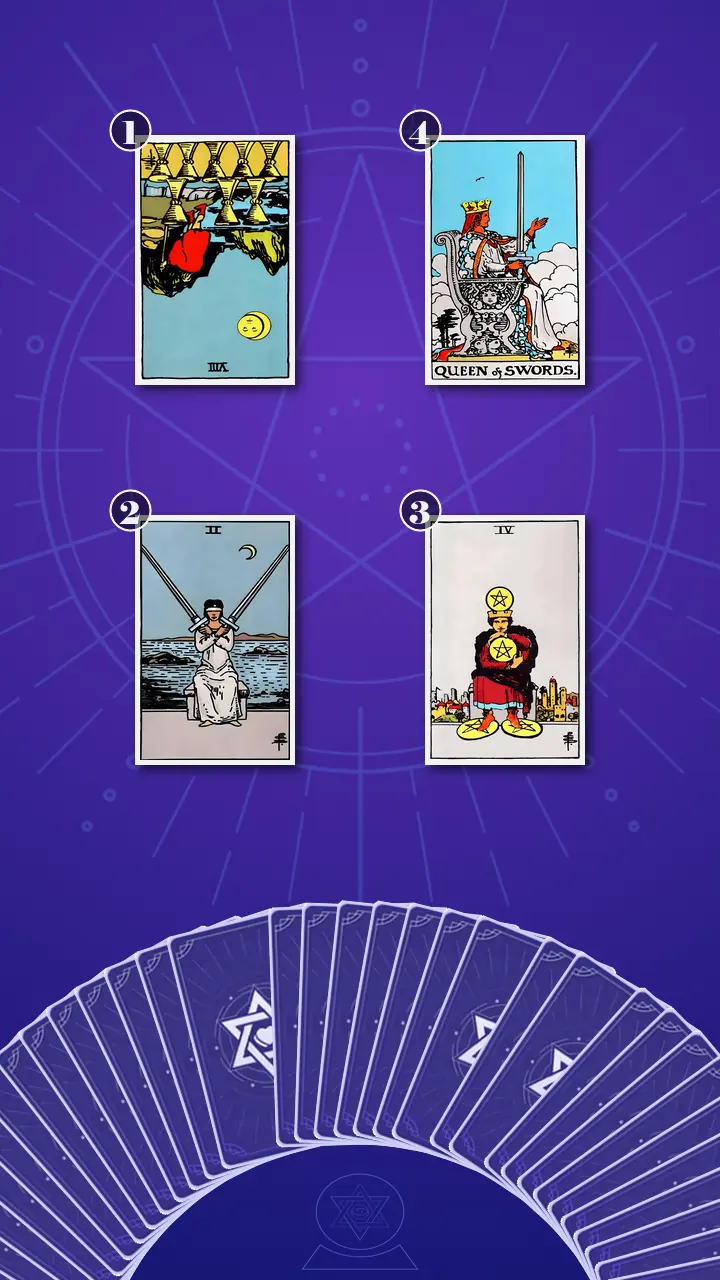
I placed the cards in a two-by-two grid. The eye would travel down the left side, across the bottom, and back up the right, like entering a shallow underground passage and emerging with a clearer line of sight. The first position would show the current shadow in Maya’s observable slow-fade behaviour. The second would uncover the belief that made directness feel dangerous. The third would reveal what ambiguity protected. The fourth would identify the capacity that could transform withdrawal into a self-directed choice.
For me, this is how tarot works at its most grounded: the spread creates an external structure, and the card meanings in context help separate a tangled experience into parts that can be examined. The cards do not take ownership of the decision. They make it harder for the decision’s hidden costs to remain invisible.
Reading the Gap She Kept Reopening
Position One: The Exit That Stayed Hypothetical
“Now I’m turning over the card that represents the current shadow expressed through your slow-fade behaviour: reducing contact while avoiding both a direct conversation and a conscious ending.”
The card was the Eight of Cups, reversed.
I pointed to the cloaked figure who would ordinarily be leaving the cups for the mountain path. Reversed, the departure energy was blocked. The person had recognised that something was emotionally incomplete but kept interrupting the act of leaving. The conspicuous gap in the row of cups looked like an incomplete chat: plenty of contact remained visible, but the missing fulfilment was visible too.
“This is the half-packed suitcase by the door,” I said. “You let your replies become shorter and later, but you reopen the chat after each almost-good exchange. You send a video, leave room for a possible plan, and tell yourself that keeping it light means you don’t yet have to find out what the drift means.”
The Water energy here was not absent. It was blocked. Maya had enough feeling to recognise that the connection was no longer full, but the feeling could neither flow into honest engagement nor complete a departure. The slow fade offered continued access without honest information, which was the opposite of what she said she wanted.
Maya gave one small, bitter laugh. “That’s so accurate it’s almost brutal.” Her fingers tightened around her coffee cup, then loosened as she looked again at the missing space among the cups.
I did not ask her to force herself out of the connection. Instead, I asked, “What are you still hoping ambiguity will provide that the relationship, as it exists today, does not reliably provide?”
“A chance for it to recover without me having to risk asking,” she said after a pause. Naming that did not settle the matter, but it made the interrupted departure visible without turning it into a character flaw.
Position Two: Two Drafts, No Decision Owner
“Now I’m turning over the card that represents the underlying belief and inner conflict making both speaking up and letting go feel more dangerous than remaining unfulfilled.”
The card was the Two of Swords, upright.
The blindfolded figure held two swords crossed over her chest while uneven water remained behind her. I saw mental energy being used defensively: not too little analysis, but an excess of analysis trapped in a closed circuit. Maya compared response times, punctuation, emojis, Instagram activity, and WhatsApp read receipts as if the next clue could approve a decision for her. She carried two complete drafts in her head, one asking for clarity and one ending the connection, but sent neither because she treated certainty as the entry fee for action.
“If I ask, I could trigger the ending,” I said, mirroring the split she had described. “If I stay quiet, it could still recover. So your mind keeps requesting one more piece of evidence.”
Her thumb went still against the cup. I asked her to separate observable facts from forecasts. The reduced frequency of messages and the absence of confirmed plans were facts. The belief that a direct question would make her less lovable, or prove she had mattered less, was a forecast about worth. No amount of punctuation analysis could convert that forecast into certainty.
“You are not waiting for clarity; you are waiting to feel safe enough to ask for it,” I said.
Maya’s jaw tightened. Her gaze moved beyond the table for a moment, as though she were replaying the last three exchanges on an invisible screen. Then she exhaled through her nose. “I keep saying I need more data. But the conversation is the only place the missing data could actually come from.”
That was the first turn in the reading. Her intelligence was not the problem. Analysis had been assigned an impossible job: guarantee that vulnerability would not hurt before she took any vulnerable action.
Position Three: The Sunday Night Calendar Hold
“Now I’m turning over the card that represents the shadow’s protective function: the short-term sense of control you gain by keeping the connection partially available.”
The card was the Four of Pentacles, upright.
The figure clamped one pentacle against his chest and pinned two beneath his feet. The distant city remained available, but not fully inhabited. In Maya’s life, the image became a Google Calendar hold for a date nobody had booked. She initiated less and revealed less, yet kept Friday or Sunday technically open because losing access to the possibility felt more threatening than losing another evening to waiting.
She told me that, the previous Sunday, a friend had invited her to an inexpensive dinner at 7:26 p.m. The kettle had clicked off while rain tapped the kitchen window. Maya had delayed answering because the person she was seeing had said maybe next week. No date. No time. Still, she had treated the possibility like a valuable reservation.
The Earth energy was in excess: containment had hardened into constriction. The strategy protected Maya from the sharp moment of a definitive no and let her limit how much she revealed. It also pinned down her time, divided her attention, and reduced her access to reciprocal plans.
“Ambiguity can protect you from a clear no while quietly charging you in time, attention, and self-trust,” I said. “Are you preserving a reciprocal connection, or preserving access to the possibility of one?”
Her shoulders rose before her answer, then dropped. “The possibility,” she said. “At least if I haven’t lost it completely, I don’t have to grieve it completely.”
I let that sentence sit without correcting it. The Four of Pentacles did not accuse her of being passive or dramatic. It showed why the pattern persisted: the grip had a protective purpose. Compassion did not require pretending the protection was free.
When the Queen Raised One Clean Sentence
Position Four: Directness Without Punishment
As I reached for the final card, the rain against the window softened. A narrow patch of London sky brightened beyond the glass, and the coffee machine behind the counter went quiet. The room seemed to make space around the card with us.
“Now I’m turning over the card that represents the integrative capacity that can change gradual withdrawal into clear observation, direct communication, and a boundary you define for yourself.”
The card was the Queen of Swords, upright.
Her sword stood vertical rather than crossed in defence. Her other hand remained open. I read those two gestures together: language precise enough to distinguish fact from speculation, and receptivity spacious enough to hear an answer without using the sword as punishment. The Queen did not tell Maya to stay or leave. She offered a way to find out what she was choosing between.
I brought Maya back to 11:48 p.m.: direct message deleted, funny video sent, phone face down, then lifted four minutes later. Less exposure now, more uncertainty later. She was still trying to resolve every possible meaning before permitting herself one observable action.
I used a framework I call Analysis Paralysis Deconstruction. Together, we stripped away the abstract what-ifs and kept only immediate reality. Verified: contact had become less consistent, plans remained undefined, and Maya wanted reciprocity. Unknown: the other person’s motives, their future choice, and how they would react to directness.
Then I applied Complexity Reduction. The immediate choice was not the dramatic binary of stay forever or leave tonight. It was smaller and cleaner: continue guessing, or state one observation and ask one direct question. The relationship outcome could remain open while the next action became practical.
I thought of the hundreds of conversations I had heard over cooling coffee during twenty years of readings. The decisive moment rarely arrived as total confidence. More often, the cup between someone’s hands simply stopped moving when they realised they did not need to solve an imaginary future before responding to the reality already on the table.
I connected the Queen to Maya’s product-design language. One observation. One need. One acceptance criterion for continued engagement. Their response could provide information about the connection without becoming a verdict on her worth.
You do not need silence to protect you; name the truth you can verify, set the boundary you can keep, and let the Queen's raised sword separate clarity from guesswork.
I stopped speaking.
At first Maya did not exhale. Her fingers hovered above the cup, fixed in place, and her pupils widened slightly as if the sentence had interrupted a familiar script. Then her eyes lost focus. I could almost see her mentally replaying the deleted message, the unconfirmed Sunday, and every softened no worries she had used to conceal a real need. Her mouth tightened before she looked back at me.
“But doesn’t that mean I’ve been handling this wrong for months?” she asked. The first edge in her voice was anger, not relief.
“It means the strategy protected you from immediate exposure,” I said. “It also reached the limit of what it could do. Seeing the cost now does not make your earlier self foolish. It gives your present self a choice.”
Her fist slowly opened against her knee. Her shoulders lowered, but the release left her looking briefly unsteady, as though putting down a heavy bag had changed her balance. Her eyes shone. The breath that finally came out carried a quiet tremor. “Oh,” she said. “I can ask without making the answer a measurement of me.”
“Now, using this new perspective, think back to last week. Was there a moment when this insight could have made you feel different?” I asked.
“Sunday,” she said. “I could have accepted dinner with my friend. A maybe wasn’t a plan. I didn’t need to punish anyone or close the door. I just didn’t need to stand in it.”
I watched recognition arrive before confidence. That distinction mattered. Confidence might rise and fall when Maya saw the next typing indicator. Recognition could still tell her what was happening. This was the first step from fear-driven ambiguity and controlled withdrawal toward clear communication, self-defined boundaries, and a self-respecting choice.
The elemental sequence supported that movement. Blocked Water in the Eight of Cups had become immobilised Air in the Two of Swords, then constricting Earth in the Four of Pentacles. The Queen redirected Air into accurate language. With no Fire card in the spread, I did not expect courage to appear as a cinematic rush. Action would need to be introduced deliberately, in a size Maya could actually carry.
The Coffee Bean Filter for Finding Clarity
I gathered the four cards into one practical story. Maya had recognised the connection’s emotional gap, but the fear of a definitive rejection kept her departure interrupted. Analysis then tried to protect her by producing certainty from inconsistent texting. When that failed, she contained the risk by revealing less while preserving access. The Queen showed the unused resource: Maya could describe the gap, request information, and decide what she would do if the gap remained.
Her cognitive blind spot was the belief that waiting was neutral. It was already a choice, and it was spending her evenings, attention, and trust in her own boundaries. The transformation was not from uncertainty to a guaranteed romantic outcome. It was from allowing ambiguity to organise her week to using observable facts, one direct question, and a personal follow-up boundary.
I gave her three small next steps. I framed the first with my Coffee Bean Filter Protocol: a filter cannot judge whether the final cup will be perfect, but it can separate what is usable from the sediment clouding it.
- Run the 24-Hour Coffee Bean Filter.On one weekday, set a 15-minute timer and label two sheets or two saucers Absolute Must-Haves and Emotional Noise. Physically sort each decision variable between them. Reciprocity and confirmed plans might be must-haves; perfect wording, Story views, and predictions based on emojis belong in noise. Leave the result for 24 hours. Then open Notes and write three lines beginning I have noticed, I need, and If this stays undefined, I will.If 15 minutes feels too exposed, use two minutes and write only the observable change. Emotional Noise means unverified forecasting, not that Maya’s feelings are unimportant.
- Draft the One-Message Clarity Check.At a time when she is not about to sleep or start work, Maya can draft: I have noticed our messages and plans have become less consistent. I want more clarity about whether you want to keep seeing each other. If not, I would rather know than keep this indefinite. She can then decide whether sending it, raising it in person, or waiting fits her actual need.Keep it short enough that it does not become a courtroom brief. Remove apologies about being easygoing or not expecting much. She remains free not to send it.
- Give the Open Door a Defined Time.Put a specific follow-up point in Google Calendar, such as Sunday at 6 p.m., titled Check in with myself. Before then, make one firm low-cost plan with a friend or for herself. At the chosen time, assess whether the contact is reciprocal and fulfilling, then choose her own next action.The boundary describes what Maya will do; it is not an unspoken test for the other person. If a reply is hostile, dismissive, or pressuring, she can end the exchange and contact someone she trusts.
“Directness does not choose the outcome,” I told her. “It stops ambiguity from choosing your week for you.”
Nothing on that list required Maya to manufacture certainty, end the connection on command, or tolerate disrespect in the name of closure. The actionable advice belonged to her. The cards had organised the clutter; she would decide what, when, and whether to act.

Four Days Later: The Quiet Proof
Four days later, I received a message from Maya. She had completed the Coffee Bean Filter, accepted the inexpensive Sunday dinner, and drafted the clarity check. After leaving it overnight, she read it once without softening the central point and chose to send it at 6:40 p.m., well before bedtime.
The reply was warm but still noncommittal. Instead of treating that warmth as a new clue capable of erasing the larger pattern, Maya used the boundary she had already written. She thanked the person for answering and said she was looking for something more consistent, so she was going to step back. Then she kept her dinner plan.
She slept through the night. Her first thought in the morning was, What if I got this wrong? She told me she smiled, made coffee, and left the phone on the counter.
I did not read that as a perfect ending. I read it as quiet proof of restored agency. Maya still felt the loss, and part of her still wished the answer had been different. But the feeling now had edges. It no longer spread across every WhatsApp pause, Sunday evening, and tentative calendar hold.
That was the Journey to Clarity I had hoped the spread would support: not certainty about another person, but enough grounded information to choose without turning their response into a measurement of worth. Tarot did not send the message, set the boundary, or reclaim the evening. Maya did.
When I picture someone with one foot in a fading connection and one hand hovering over a warm phone, I remember that the tight throat is not proof that directness is dangerous. Sometimes it is what happens when one clear question has been carrying the impossible weight of a verdict on personal value. The Queen’s open hand offers another possibility: openness without indefinite suspension.
If certainty about their answer were no longer the entry fee, what one clean sentence would you place in your Notes app, and what calendar boundary would let you keep the door open without leaving yourself standing in it?
This story is adapted from psychological research, written so that those in a similar struggle can see their own pattern in it — and find their next step clearly.These insights are not a substitute for professional psychological, medical, legal, or financial advice.
Learn more about our Journey to Clarity.
How did this insight land for you?
🫂 This Resonates Deeply
🌀 Living This Story
✨ Now I See Clearly
🌱 Seeing New Possibilities
🧰 Useful Framework
🔮 The Confirmation I Needed
💪 Feeling Empowered
🚀 Ready for My Next Step
Author Profile
 AI
AI“For twenty years, I’ve listened to stories unfold over the warm aroma of coffee. I don’t believe life’s complexities always require grand theories to be solved; often, we just need a safe place to tidy up our reality. I don’t offer high-minded preaching—just grounded, heartfelt insights to help you regain your sense of control amidst the clutter of daily life.”
In this Choice Tarot Reading :
Core Expertise
- Analysis Paralysis Deconstruction: Stripping away abstract 'what-ifs' to focus strictly on the grounded realities and immediate constraints of your options.
- Complexity Reduction: Tidy up cluttered decision parameters into a clean, practical binary choice.
Service Features
- The Coffee Bean Filter Protocol: A 24-hour pragmatic sorting exercise to physically categorize decision variables into 'Absolute Must-Haves' and 'Emotional Noise', instantly restoring decisiveness.
Also specializes in :
Explore Related Patterns:
Analysis ParalysisDuring your hybrid workdays, you turn fuzzy Figma comments into clear decisions, yet the dating chat pulls you into comparing response times, punctuation, emojis, Instagram activity, and read receipts. You hold both a clarity message and an ending message in your head, as though one more signal could choose between them for you. Analysis Paralysis gives your intelligence a protective job it cannot complete. More observation may help describe the pattern, but it cannot guarantee that vulnerability will not hurt. When the missing information can only come from a direct conversation, continued analysis becomes a closed circuit that keeps you in the slow fade while making the delay feel responsible.
Certainty-Gated Self-SilencingAt 11:48 p.m., you typed a direct question about where the connection stood, deleted it, and sent a funny video instead. Four minutes later, you checked whether the video had been viewed. That sequence shows a clear need being held behind a demand for proof that speaking will be safe. Waiting for the situation to become obvious enough lets you avoid immediate exposure, but it also prevents the conversation from producing the information you say you need. Certainty-Gated Self-Silencing keeps the decision suspended by treating one person's response as a verdict on your lovability rather than as information about the relationship's fit and reciprocity.
Closure AvoidanceYou let your replies become shorter and later, but you keep reopening the chat after each almost-good exchange. The connection is recognized as emotionally incomplete, yet the act of leaving remains interrupted because ambiguity preserves a chance of recovery without requiring you to ask for it. Closure Avoidance is not simply indecision. It is a protective refusal to let a possible loss become fully real, because a conscious ending would require you to grieve the possibility rather than keep borrowing hope from it. The slow fade continues because neither reduced contact nor continued access gives you the information or finality that would close the loop.
Potential HoardingOn Sunday at 7:26 p.m., you delayed accepting an inexpensive dinner with a friend because the person you were seeing had said 'maybe next week'. There was no date and no time, but you treated the possibility like a valuable reservation and kept your own evening available. Potential Hoarding preserves access to an imagined future so you do not have to grieve it completely in the present. The holding has a protective purpose, but it is not free. Your time, attention, and trust in your own boundaries become the cost of keeping an unconfirmed option alive.
Self-AbandonmentYou wanted reciprocity, but you allowed an unconfirmed 'maybe next week' to delay a dinner with a friend and to shape your Sunday. You also initiated and revealed less while keeping the connection available. Your own needs were made negotiable so the possibility could remain untouched. Self-Abandonment appears here as a quiet trade rather than a dramatic act. You avoid the immediate pain of a clear no by giving up time, directness, and a boundary you could actually keep. Seeing that trade does not make the earlier strategy foolish. It shows where your present choice can begin to include your needs as observable facts.
Rejection SensitivityYou said, 'If I ask, I could trigger the ending,' and connected a possible answer with being less lovable or proving that you had mattered less. Your throat tightened as you deleted the message, which shows how a question about relationship fit became loaded with consequences for personal worth. Rejection Sensitivity turns an uncertain response into an anticipated global verdict. That makes the slow fade feel safer than directness, even though the reduced contact and undefined plans are already providing information. The pattern keeps you searching digital signals for protection from a worth judgment that the other person's answer cannot objectively determine.
Explore Related Struggles:
Ambiguity-Promise FusionMaya keeps Sunday technically open because the person she is seeing has said "maybe next week," despite offering no date or time. She later identifies what she is preserving: a chance for the connection to recover without having to risk asking. When you grant an undefined possibility the status of a future promise, present-day inconsistency can keep borrowing time from concrete plans. Ambiguity then does more than obscure the answer. It holds hope in a form that cannot be confirmed or disproved, which makes naming reality feel like causing the loss rather than discovering the limits already present. Seeing that exchange clearly lets you evaluate whether an open possibility is supporting your life or quietly organizing it.
Certainty-Safety FusionMaya compares response times, punctuation, emojis, Instagram activity, and WhatsApp read receipts while two complete messages remain unsent. She keeps requesting one more piece of evidence even after recognizing that the conversation itself is the only place the missing information could come from. When you require certainty before acting, analysis becomes responsible for guaranteeing that vulnerability will not hurt. No digital clue can complete that assignment, so the search continues while decision ownership stays suspended. The tension lies between wanting enough information to choose and demanding a level of safety that information cannot provide in advance. You can reclaim movement by distinguishing what is already verified from what no amount of monitoring can guarantee.
Clarity-Exposure SplitMaya types, "I feel like this has been drifting, and I want to know where we stand," then deletes it and sends something funny. The replacement keeps the channel warm while removing the part that would make her need visible. When you want clarity but experience the act of requesting it as exposure, the most informative sentence can also feel like the most dangerous one. That friction turns direct communication into more than a relationship question. It becomes a moment in which rejection, loss, and personal value appear to be tested together. The struggle is not a lack of words; Maya already has the words. It is allowing those words to seek information without requiring them to protect you from every possible answer.
Partial Exit LockAt 11:48 p.m., Maya deletes the sentence that could define the connection, sends a funny video, and checks the chat again four minutes later. She also lets her replies become shorter and later while reopening contact after each almost-good exchange. You can see the friction in those paired movements: contact is reduced enough to limit exposure but preserved enough to keep departure hypothetical. The lock forms because speaking could make the ending immediate, while leaving would make the loss definite. Each smaller retreat keeps both options alive without allowing either one to become a choice. You are not failing to notice the gap; Maya names it with precision. Recognizing the interrupted exit separates what is already known from the action that has repeatedly been postponed, giving you a clearer place from which to choose.
Identity Verdict LockMaya separates the observable facts from her forecasts and discovers that the most painful forecast is not simply that the connection may end. She imagines that asking could prove she is less lovable or that she mattered less. When another person's answer is made responsible for describing both their availability and your value, one conversation carries the weight of a personal verdict. That extra weight explains why even a clean question can feel too consequential to send. The relationship information may be disappointing, but it cannot objectively measure the person asking for it. You regain room to act when their willingness to participate is allowed to describe the connection rather than define who you are.
Boundary Ambiguity LockAn unbooked "maybe next week" occupies Maya's Sunday strongly enough that she delays accepting a real dinner invitation from a friend. No plan has been made, yet the possibility functions like a reservation. When you have not defined what you will do with prolonged inconsistency, another person's uncertainty can extend beyond the chat and begin allocating your time. The missing boundary is not a demand that forces the other person to respond differently. It is a decision about how long an undefined opening will remain entitled to your calendar, attention, and availability. By locating the threshold in an action you control, you can leave room for an answer without leaving your life indefinitely on hold.
Explore Related Emotions:
Certainty HungerYou compare response times, punctuation, emojis, Instagram activity, and read receipts while carrying two complete drafts that never get sent. Each new clue seems capable of supplying the final piece of certainty that will make one choice completely safe. The missing information, however, can only come from the conversation you are postponing, and even that conversation cannot guarantee freedom from hurt. Certainty Hunger is the repeatedly renewed feeling that one more signal might remove vulnerability from the decision, leaving you unsatisfied no matter how much data you collect.
Guarded LongingYou make your replies shorter and more neutral while continuing to reopen the chat after each almost-good exchange. The warm wording and occasional contact are enough to keep the possibility alive, but not enough to let you feel reliably met. Your longing therefore survives in a protected form. It can wait, monitor, and preserve access, but it cannot speak plainly without risking refusal. Guarded Longing captures the ache of still wanting recovery while concealing enough of that desire to avoid discovering whether it is shared.
Need Exposure DreadYou replace a direct request for clarity with a funny video, then make your replies shorter and reveal less. The need itself has not disappeared; it has been moved behind safer material because showing it seems capable of exposing how much you care. When a request for reciprocity feels like evidence that could be used to judge your lovability, ordinary directness acquires the weight of personal exposure. Need Exposure Dread is the tight internal weather created when being honest about what you want feels more dangerous than continuing to receive less of it.
Self-Betrayal AcheYou replay the deleted message, the unconfirmed Sunday, and every softened 'no worries' that concealed a real need. Once those moments sit together, the cost is no longer limited to inconsistent texting; you can see how often your own preference was edited out of the exchange. Self-Betrayal Ache is the pain of recognising that a strategy designed to protect you also kept overriding your voice, time, and boundaries. The ache can be witnessed without turning into self-punishment. It identifies the exact place where renewed loyalty to your present needs can begin.
Slow Fade DreadAt 11:48 p.m., you type the question that could name the drift, delete it, send a funny video, and lift the phone again four minutes later. Each smaller retreat protects both possible outcomes, but it also leaves you standing between engagement and departure with no place to put your full weight. The resulting dread is not simply about a delayed reply. It comes from knowing that the connection is incomplete while repeatedly interrupting the actions that could make its reality clearer. Every WhatsApp pause and tentative calendar hold then becomes another place where the unresolved ending can quietly follow you.
Verdict DreadYour throat tightens after you delete the direct message, and your jaw tightens when reduced contact is separated from the prediction that asking might prove you mattered less. The observable relationship question has become fused with a much larger question about your worth. That fusion makes any answer feel less like information and more like a ruling. Verdict Dread keeps silence attractive because ambiguity has not yet pronounced the judgment you fear, even though remaining indefinitely unfulfilled is already exacting a cost.
Agency ReliefYour fist opens and your shoulders lower when you realise that asking does not require turning the answer into a measurement of you. Four days later, you send the message, follow the boundary you wrote, keep dinner with your friend, and leave the phone on the counter. The relief comes from recovering ownership of your side of the exchange, not from receiving the romantic outcome you wanted. You can let another person's response provide information while retaining the right to organise your own time, access, and next action. That restored separation gives the feeling room to settle in your body.
Anticipatory GriefYou preserve access to the possibility because, as you say, not losing it completely means not having to face the loss completely. The contact remains visible, but so does the missing fulfilment, like a half-packed suitcase that keeps departure present without allowing it to finish. This creates grief before any explicit ending has occurred. You are already feeling the absence of reciprocity while using ambiguity to postpone the full finality of that absence. Anticipatory Grief names the ache of living beside a loss you can sense but are not yet ready to make definite.
Resentful WaitingYou delay answering your friend's dinner invitation because someone else has said maybe next week without naming a date or time. Your fingers tighten around the cup, and a bitter laugh escapes when the cost of preserving that possibility becomes visible. Waiting has begun to spend your evenings and attention while asking very little of the person whose availability controls them. Resentful Waiting grows in that imbalance. It is the bitter internal pressure of offering real time to an indefinite possibility while receiving too little certainty or reciprocity to inhabit the connection fully.
Bittersweet ReleaseYou thank the person for answering, say you are looking for something more consistent, step back, and keep dinner with your friend. You still wish the answer had been different, yet you sleep through the night and leave the phone on the counter when doubt returns in the morning. Release does not require the loss to feel good or the decision to feel perfectly certain. Its sweetness comes from no longer allowing ambiguity to organise every pause and evening; its ache comes from acknowledging what the connection could not provide. The feeling now has edges, leaving room for disappointment and self-directed movement to exist together.
Cautious Self-TrustYou leave the draft overnight, send it at 6:40 p.m., and receive a reply that is warm but still noncommittal. Instead of allowing the warmth to erase the larger pattern, you rely on the boundary you wrote before the answer arrived and keep your dinner plan. Self-trust here is cautious because doubt still appears the next morning. It is nevertheless real because you do not require the doubt to vanish before keeping a promise to yourself. The feeling grows from evidence that your own observation and boundary can remain usable even when another person's response is emotionally complicated.
Clarity ShockYour fingers stop above the cup, your pupils widen, and your first response is to ask whether you have been handling this wrong for months. The insight interrupts a familiar script so completely that recognition reaches your body before it offers any comfort. Clarity Shock appears when a protective strategy and its hidden cost become visible at the same time. The shock does not prove that your earlier self was foolish. It marks the abrupt reorganisation that occurs when waiting can no longer pass as neutral and a present-day choice becomes possible.
Explore Related Contexts:
Relationship Reciprocity GapMaya tracks response times, punctuation, emojis, Instagram activity, and read receipts while the person she is seeing contributes intermittent contact and undefined plans. She also keeps socially valuable time available for a possible date, which places the work of maintaining, interpreting, and accommodating the connection primarily on her side. A reciprocity gap becomes visible when you repeatedly supply attention, flexibility, and decision labour without receiving comparable clarity or follow-through. Separating warmth from reciprocity helps you evaluate the exchange by what is jointly sustained, then redirect your time toward plans and relationships that can meet you in concrete terms.
Situationship AmbiguityMaya describes herself as technically still in the connection while not actually being met. Four-day silences, reduced messaging, the phrase maybe next week, and the absence of confirmed plans keep contact alive without establishing what either person is participating in. A situationship can give you ongoing access to someone while withholding the shared definition needed to evaluate expectations, reciprocity, and direction. Once the ambiguity is treated as a real relationship condition rather than an empty waiting period, you can name the consistency you require and choose your participation according to observable conduct.
Slow FadeAfter four quiet days, Maya deletes the message asking where the connection stands, sends a funny video instead, and checks whether it has been viewed four minutes later. The relationship remains externally active through clips, shorter replies, periodic warmth, and hypothetical plans, but no shared conversation gives the drift a name or direction. When you are inside a slow fade, each small exchange can keep reconnection and departure technically available while the practical substance of the relationship recedes. Recognising that pattern allows you to assess what contact is actually providing, ask for the information you need, and decide how long you will remain available without turning the other person's response into a verdict on your value.