Forcing Hard Talks: A Seven-Minute Pause Made One Clear Request

The Twelve-Paragraph Emergency
I recognized the person who could unblock a project by lunch but turn one ambiguous text into an emergency relationship meeting by dinner. Jordan (name changed for privacy) sat across from me at 10:48 p.m. in a small Toronto bedroom, with the rest of the apartment finally quiet. A streetcar bell passed through the closed window, the radiator clicked at irregular intervals, and the phone in their hand had grown warm from being held too long.
They had opened an ambiguous iMessage and moved straight into Apple Notes. Three lines had become twelve paragraphs: the current problem, three older examples, possible replies, and rebuttals to responses that had not happened yet. Their thumb hovered over the screen. Every time they reached the unfinished sentence, What I need is..., they added another example instead.
Jordan looked up at me. 'I know we need to talk,' they said, 'but I do not know what I need the talk to change. And if I wait until I am calm, the moment will disappear and so will my chance to matter.'
I could see the urgency in the tight chest, clenched jaw, and restless hands. It was like a smoke alarm shrieking in a room where the source of the heat had not yet been found. The urge to resolve conflict immediately was not proof that Jordan was unreasonable. It was a form of protection that had begun asking a hard conversation to do the work of private clarity.
'You want honest communication,' I said, 'but the pressure to make progress is pushing you into a conversation before the feeling, the need, and the request have separated. Let us make a map before we ask another person to help read it. That is our Journey to Clarity tonight.'

Choosing the Four-Layer Insight Ladder
I asked Jordan to put the phone face down, take one ordinary breath, and hold the question without trying to solve it. I shuffled slowly, not as a performance of mystery, but as a practical transition from the message thread to a more deliberate kind of attention.
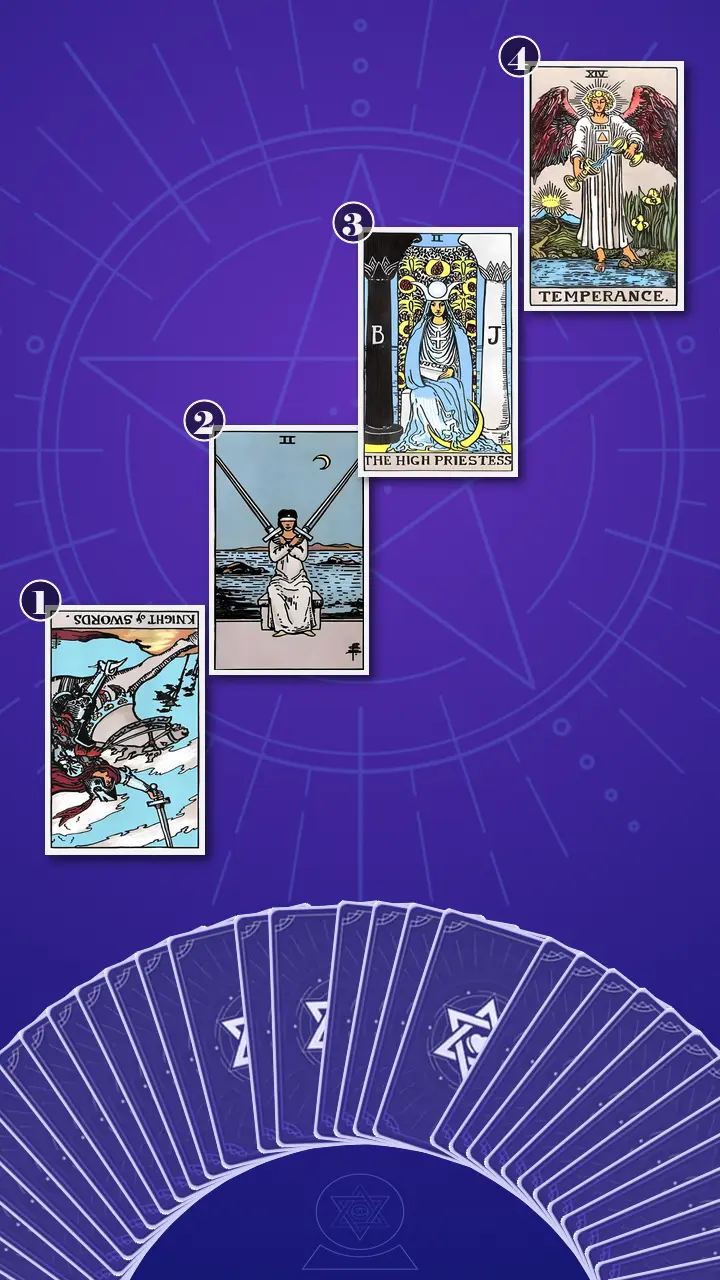
I chose a Four-Layer Insight Ladder tarot spread for relationship communication. This is how tarot works in my sessions: the images provide an objective structure for examining a pattern, while the querent remains the person who decides what fits, what does not, and what to do next. The cards are not a forecast, a verdict on the relationship, or a substitute for safety, consent, or direct judgment.
The spread is based on F5 Inner Excavation because Jordan was asking why the hard talk arrived before the need was clear. A relationship-dynamics spread might have focused on the other person's behavior or the balance between two people. This four-card structure stays with the inner mechanism first: the visible pattern, the split beneath it, the resource that can interrupt it, and the grounded practice that makes the insight usable.
The first position would show the presenting pattern, the behavior that appears when uncertainty spikes. The second would reveal the underlying split that makes immediate confrontation feel necessary. The third would identify the transformational resource, and the fourth would turn that resource into a proportionate communication practice. The path would move from forced progress to inner direction, then back into relationship with one clear request.
Reading the Case File Before the Conversation
Position 1: The Horse at Full Gallop
Now I turned over the card representing the presenting pattern: the observable behavior of initiating or escalating a hard talk before Jordan could name the feeling, need, or specific request.
It was the Knight of Swords, in reversed position. The charging horse, raised sword, and windblown trees made urgency visible. In this position, reversed Air is in excess. Thought becomes speed, speed becomes argument, and argument is mistaken for direction.
The modern version appeared immediately. At 8:17 that morning on a crowded northbound TTC Line 1 train between Bloor-Yonge and Wellesley, Jordan had reread the reply 'okay' and started typing, 'Can we talk tonight?' Brakes squealed. Wet wool and coffee filled the carriage. Their chest pulled tight as one thumb hovered over send. By the next stop, the draft contained the current issue, three older examples, and rebuttals to answers that had not arrived.
Pressing send felt like taking control, but the central question remained blank: what did Jordan want the conversation to make possible if winning, proving seriousness, or receiving instant reassurance were removed? The card did not accuse Jordan of caring too much. It showed action being used to escape the discomfort of not knowing.
I asked, 'If you removed the need to win the conversation, what would you want it to make possible?'
Inside the pattern, I could hear the two competing lines: If I do not say all of this now, they will reduce the issue to my tone. Then, beneath it: But if they asked what I wanted to change, I would not know how to finish the sentence. That contrast matters. The problem is not directness. The problem is asking speed to manufacture clarity.
Jordan's thumb froze above the imaginary send button. Their eyes went briefly unfocused, as if the train window had become a replay of the previous night's message thread. Then they gave a short, bitter laugh and let their hand fall into their lap. 'That is painfully accurate,' they said. 'Also kind of rude.'
I smiled without softening the observation. 'A hard talk is not clearer just because it happens sooner. Urgency can prove that something matters; it cannot tell you what you need.'
Position 2: Two Polished Arguments, No Need
Now I turned over the card representing the underlying split: the Truth-Compass Split and the protective belief that immediate confrontation is required to preserve control or make progress.
The card was the Two of Swords, in upright position. The blindfold, crossed swords, and dark water behind the seated figure showed a mind holding two polished interpretations defensively across the chest. This was not a lack of thought. It was a blockage in inner direction.
At 1:06 a.m. in the shared apartment kitchen, Jordan had toggled between two Notes headings: 'They do not care' and 'Maybe I am overreacting.' Both arguments were detailed. Neither answered whether Jordan needed reassurance, changed behavior, an apology, a boundary, or more time.
I compared the crossed swords to the two headings and then named the empty one: What I need. Jordan could explain both interpretations, but they could not yet choose a provisional need without seeing how the other person reacted. That was the hidden engine beneath the rushing Knight. The outward push was being generated by an inward stalemate.
'What am I protecting myself from knowing while I keep both possibilities alive?' I asked. 'And which sentence is harder to finish: They meant..., or What I need now is...?'
Jordan's breath caught. Their shoulders lifted, and their gaze dropped to the dark screen of the phone. For a moment, their fingers pressed together as though they were holding two separate arguments in place. Then their eyes returned to the card, quieter than before.
'I can build the whole case,' they said, 'but I still cannot tell you what I am asking for.'
I let the silence remain. The Two of Swords was not telling Jordan to stay stuck or wait forever. It was showing that another person's answer could not choose an inner direction on their behalf. Before any hard conversation, the first useful question was not, 'What did they mean?' It was, 'What do I know about my own response?'
When the High Priestess Made Space for the Unfinished Sentence
Position 3: The Quiet Threshold
The room changed when I reached for the third card. The radiator clicked once and stopped. Outside, the traffic softened into a low wash, leaving a small, clear space around the table.
Now I turned over the card representing the transformational resource: the inward quality that can interrupt Forced Progress and help Jordan clarify what is genuinely needed before speaking.
The card was The High Priestess, in upright position. She sat between black and white pillars, holding a partly hidden scroll, with a pomegranate-patterned veil behind her. The image did not ask for secrecy or permanent withdrawal. It showed a threshold between what is immediately spoken and what has to be recognized privately first.
In real life, this was the moment Jordan could put the phone face down, close the group chat, and give themselves seven minutes to write three unfinished lines: I feel..., I need..., and My one request might be... No reply was required to validate the note. No message had to follow. The pause was not a disappearance. It was protected attention.
The High Priestess introduced still water into a spread dominated by Air. Her energy was receptive rather than passive. She asked Jordan to listen inwardly before using another person's reaction as the final test of what was true, serious, or allowed to matter. The partially hidden scroll became the need already present in the body but not yet ready to become public language.
On Wall Street, I learned to assess whether a position was actually ready before mistaking movement for opportunity. I now use a gentler version of that discipline in emotional work: my Resource Readiness Assessment. I ask whether the internal assets match the external moment. In Jordan's case, the assets were a named feeling, a possible need, and one specific request. If the feeling was available but the need was still blank, the issue was important, but the full conversation was not yet ready to carry the pressure being placed on it.
That assessment did not turn Jordan into a spreadsheet. It protected them from treating every internal alarm as a command to disclose everything. It also returned authority to the right place. The cards could illuminate the pattern, but Jordan alone could decide whether a conversation was necessary, what boundary applied, and what another person's response would mean for their own participation.
The Empty Line Is Information
At 10:48 p.m., the phone was warm in Jordan's palm and the Notes draft kept expanding. Their jaw tightened as they added one more example, hoping that the perfect paragraph would finally tell them what they needed. The unfinished line remained empty, not because nothing mattered, but because pressure had filled every available space.
Stop using confrontation to manufacture certainty; let The High Priestess's quiet threshold help you identify your need before you cross into the conversation.
I let the sentence settle. Then I gave Jordan the central line I wanted them to keep, exactly as it had arrived to me.
"You do not have to make the conversation produce the clarity you have not yet given yourself time to hear."
Jordan did not nod. First, their thumb stopped above the blank line and their breath held high in their chest. Next, their eyes lost focus as if they were replaying the short reply, the defensive call, and every late-night edit at once. Their mouth parted, then closed. Finally, their shoulders dropped by a fraction, their clenched hands opened, and a long, uneven exhale moved through their ribs. Their eyes grew bright, not with a dramatic release, but with the recognition of a burden changing shape. 'So the pause is not me giving up my place,' they said, their voice lower and slightly unsteady. 'It is me finding out what I am bringing into the room.' The room stayed ordinary. The radiator clicked again. Nothing outside had been solved, but Jordan was no longer asking the next response to create an answer from nothing.
'Now use this new view to remember last week,' I said. 'Was there a moment when this distinction might have made you feel different?'
Jordan looked toward the phone, then away from it. 'After the call ended,' they said. 'I thought I had to explain harder. Maybe I needed to know whether I wanted repair, reassurance, or a boundary before I sent the follow-up.'
That was the first real crossing in the emotional transformation: from urgency-driven confrontation and outsourced certainty toward self-trust, need clarity, and proportionate communication. It was not complete certainty. It was a short period of not knowing that no longer felt like proof of failure.
'Pausing is not surrendering your place in the conversation,' I said. 'Name the need before you negotiate the outcome.'
The Sentence That Could Cross the Room
Position 4: Temperance and the One-Request Conversation
Now I turned over the card representing grounded integration: the practical communication practice that translates inner clarity into a proportionate exchange, reducing Premature Confrontation Fallout without deciding the relationship's outcome.
The card was Temperance, in upright position. Water moved between two cups. One foot stood on land and one in water. A path led toward distant mountains and light. The image held emotion and action together without forcing either one to dominate.
In modern terms, Temperance was a 20-minute conversation with one observable example, one feeling, one request, and one boundary for Jordan's own behavior. It was not a full case file disguised as vulnerability. Jordan could say, 'When the plan changed without a message, I felt unsettled. Would you be willing to let me know earlier next time?' The longer history could remain true in private notes without entering the first conversation all at once.
The energy here was balance. The High Priestess had helped Jordan hear the need; Temperance made that knowledge usable. The aim was not to minimize the feeling or guarantee a good response. It was to let the other person answer freely while Jordan stayed connected to their own position.
I call this Strike Timing Calibration. It is not a search for a perfect moment, and it is not permission to avoid the conversation indefinitely. It is a practical check on when decisive action has enough support: a feeling that can be named, a request that can be stated, a time frame both people can realistically hold, and enough emotional space to listen. The highest-return move was not always sending the message immediately. Sometimes it was waiting until the message no longer needed to carry every possible argument.
I asked Jordan to try the Temperance sentence: 'The full truth in my notes is..., but the one thing I am asking you now is...'
They first read the sentence silently. Their shoulders lowered, then their mouth tightened as they imagined leaving out the older examples. 'The full truth in my notes is that this has happened more than once,' they said. 'But the one thing I am asking you now is that we talk about what happened yesterday before we debate the whole history.'
I watched the difference land in their posture. The request was still serious, but it had edges. It could be heard, answered, or declined without becoming a verdict on the entire relationship. Jordan could picture a conversation with a beginning and an end, rather than an emergency meeting that had to secure certainty before anyone was allowed to breathe.
From the Case File to Actionable Advice
The four cards told one coherent story. Jordan had learned to value movement, and work often rewarded that instinct. When a close relationship produced an ambiguous message, the same reflex turned discomfort into an urgent deliverable. The reversed Knight of Swords showed the visible charge. The Two of Swords revealed the hidden split: competing interpretations without a chosen need. The High Priestess offered a private listening threshold, and Temperance showed how that inward clarity could return to the relationship as one bounded request.
The blind spot was assuming that initiating first preserved control and proved seriousness. In practice, the reaction to the hard talk was being asked to answer two different questions at once: what did the other person mean, and what did Jordan need? That was why a long message could create temporary relief while leaving the original issue untouched.
The direction of change was simple but not effortless: replace the rule that the hard talk must happen now with a two-step pause. First, name the feeling and need privately. Then decide whether a conversation is necessary, what one request belongs in it, and what boundary Jordan will hold regardless of the other person's response.
For ordinary relational tension, I offered three small experiments. They were not instructions to delay action in situations involving immediate safety concerns, harassment, coercion, or repeated boundary violations. In those circumstances, safety and support take priority. These were tools for creating useful space when uncertainty, not danger, was driving the escalation.
- The High Priestess PauseWhen a short, delayed, or tonally ambiguous message arrives, put the phone face down and set a seven-minute timer. Open a private Notes page, not the message thread, and write one line for 'I feel...', one for 'I need...', and one for 'My one request might be...'. Do not send or schedule anything during the timer.Implementation tip: If 'I need' stays blank, write 'maybe reassurance', 'maybe repair', 'maybe changed behavior', or 'maybe more time'. The minimum version is one body sensation and one possible need.
- The One-Request Temperance PlanBefore the next difficult relationship conversation, send only: 'There is something I would like to clear up. Do you have 20 minutes tonight or tomorrow? It is okay if neither works; suggest another time.' In the conversation, bring one observable moment, one feeling, and one request. Keep one boundary for your own participation, such as pausing if the discussion expands into every past grievance.Implementation tip: Keep the complete history in a private note. You can bring one true request without submitting the whole case file.
- The Strategic Holding PatternFor any message longer than five lines, place the draft in a note titled 'Not ready to send' and set a return point, such as 9:00 a.m. the next day. Turn off message previews for 30 minutes so each notification does not restart the argument rehearsal. At the review time, keep the feeling, the need, the one request, and any necessary boundary; remove sentences written mainly to anticipate a rebuttal.Implementation tip: This is a tactical waiting period, not indefinite silence. If one sleep cycle feels impossible, use ten minutes and move the phone out of reach.
The Strategic Holding Pattern was my way of making waiting concrete. It gave fast mental energy a private place to work without making the other person absorb every draft. It also left Jordan with a choice: revisit the note, reduce it to one sentence, schedule the conversation, or discard it. The pause created options rather than obligations.
Tarot did not decide whether Jordan should stay, leave, forgive, confront, or continue. It clarified the difference between a feeling, a need, a request, evidence, and a hoped-for response. Jordan remained the author of the next move.

A Week Later: The Quiet Proof
Four days later, I received a message from Jordan. Another ambiguous reply had arrived after a plan changed. This time, they put the phone face down, set the seven-minute timer, and wrote: 'I feel dismissed. I need a clearer plan. My one request might be earlier notice next time.' They did not send the twelve-paragraph draft.
At 9:00 the next morning, Jordan used the shorter scheduling message and brought one example to a 20-minute conversation. The exchange was not magically perfect. The other person still had their own interpretation, and Jordan still felt the familiar pull to explain every detail. But Jordan noticed the pull without handing it the steering wheel.
That night, Jordan slept through most of the night; in the morning, the first thought was still, 'What if I got it wrong?' This time, they smiled, left the question unanswered for one breath, and made coffee.
I had not given Jordan certainty. The cards had not given them certainty either. We had found the first evidence of self-trust: a feeling named before a demand, a request separated from the case file, and a conversation chosen from clarity rather than pressure.
When a reply goes cold and your chest tightens, it can feel as if pausing for one honest answer inside yourself will cost you your only chance to shape what happens between you. But noticing that pressure is already a change. It means the old rule, that speed is the only proof that something matters, is no longer invisible.
So if you allowed yourself one quiet beat before the next hard talk, what single feeling or need might you want to carry across The High Priestess's threshold with you?