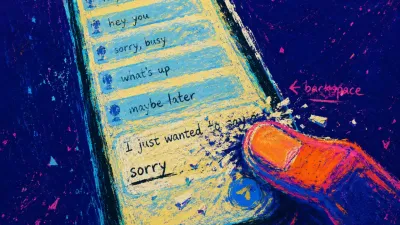
When "Sometime" Sounds Like a Promise: Weighing Words and Hope

The 11:40 p.m. Text That Became a Relationship Promise
“I can turn a messy client brief into a clean product flow by 5 p.m., but by 11:40 p.m. in my Toronto apartment, ‘I really like having you around’ has become a full relationship roadmap.” That was how Maya, a 28-year-old product designer, introduced the problem when she joined my video call from west Toronto.
She sat on the edge of her bed with the chat open on her phone and our call running on her laptop. The radiator clicked against the cold window, traffic hissed over wet pavement below, and the phone had grown warm in her palm from ten minutes of scrolling. A concert page for three months from now glowed in another tab.
“I know they didn’t technically promise anything,” she said. “But it felt like they did. They said they really like having me around, so maybe this is becoming serious. And if it’s serious, then obviously the concert makes sense. Then the chat goes quiet, and I start looking through old heart emojis like there’s a missing clause somewhere.”
Her longing worked like an autocomplete engine wired directly to her ribs: one affectionate sentence went in, an entire relationship future came out, and the blinking cursor afterward pressed against her chest. A notification brought a quick lift to her stomach; silence turned that lift into restless checking, screenshot analysis, and increasingly intimate drafts.
“Asking directly feels more dangerous than guessing,” she admitted. “At least while I’m guessing, the good version can still be true.”
I let that sentence settle before answering. After twenty years of listening to people over the warm aroma of coffee, I have learned not to treat this kind of loop as foolishness. It is often an ordinary human wish for belonging trying to manufacture shelter before shared certainty exists.
“I’m not here to tell you what this person secretly thinks,” I said. “Tarot cannot responsibly do that. I want us to see how one warm text becomes a promise inside you, what that promise is protecting, and where your choices return. The imagined relationship is getting specific while the actual conversation stays vague. Let’s draw a map of that gap.”

Choosing the Compass: The Five-Card Shadow Spread
I asked Maya to place the phone face down, take one slower breath, and hold the consultation question without trying to solve it. I shuffled while she repeated, “Why do I keep turning vague texts into relationship promises?” The small ritual was not about summoning an answer; it gave her nervous system a clean transition from reacting to observing.
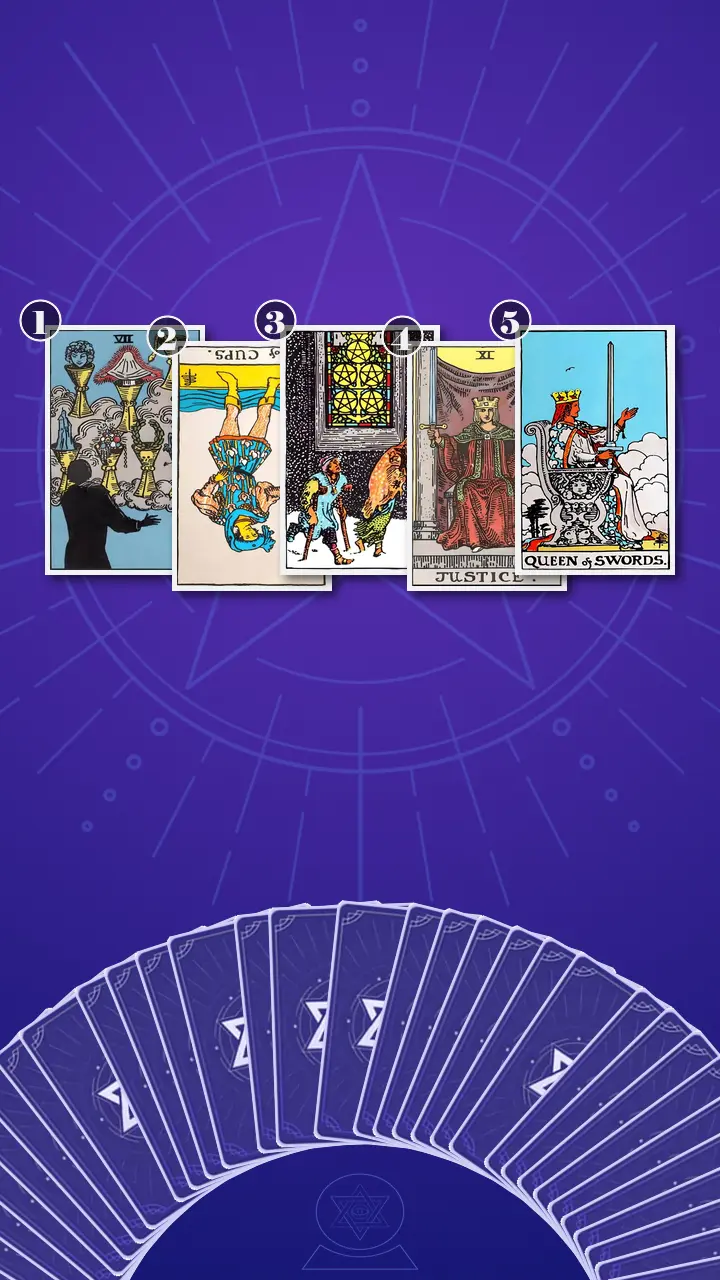
I chose a five-card spread called The Shadow Spread. For anyone wondering how tarot works in a relationship clarity reading, I use the cards as a structured reflection tool: the images help us separate a visible behavior, its trigger, the need beneath it, a corrective perspective, and a conscious practice. Card meanings in context matter more than dramatic predictions.
I chose this focused spread instead of a broader Celtic Cross because Maya was not asking what would happen next. She was asking why her own perception kept converting ambiguity into certainty. Five positions were enough: the first would show the visible texting pattern, the centre card would reveal why uncertainty carried so much emotional weight, and the final two would move from a reality check into direct communication.
I laid the five positions in a straight line, like a message being edited from suggestive fragments into one complete sentence. I told Maya that no card would make her decision, guarantee commitment, or turn disappointment into failure. The spread could organize the available information. She would decide what to do with it.
Seven Futures Floating Above One Sentence
Position One: Seven of Cups and Seven Open Tabs
I began with the position representing the visible shadow: Maya’s habit of turning vague texts into detailed relationship promises and escalating her emotional investment before commitment was explicit. I turned over the Seven of Cups, upright.
The card showed a silhouetted figure facing seven cups suspended in clouds, each holding a different, captivating image. I connected it to Maya’s 11:40 p.m. message thread. From “I really like having you around,” she had mentally opened seven tabs at once: exclusivity, a concert in three months, weekend trips, meeting friends, a relationship label, emotional security, and finally a shared future. The actual chat contained one warm sentence.
I described the card’s energy as Excess: emotional possibility had expanded beyond what the communication could currently support. The problem was not that Maya could imagine a future. The problem was that the most desired possibility had quietly been promoted from “could be” to “is becoming,” even though the other person had not participated in that promotion.
“It follows the same inner script every time,” I said. “They said they like having me around, so maybe they want something serious. If they want something serious, then probably the concert is practically a plan. If that is a plan, then we must be heading toward a relationship.”
I pointed to the distant castle in the card. “You built the castle before checking whether the two of you had agreed on a floor plan. Which part of that castle can you support with exact words or repeated behaviour?”
Maya gave one short laugh, but there was no amusement in it. Her thumb pressed into the side of her phone. “That’s so accurate it’s a little brutal.”
“Let the accuracy land without turning it into an accusation,” I replied. “I’m not calling your romantic imagination ridiculous. I’m showing you the moment possibility starts presenting itself as mutual reality.”
Position Two: The Notification That Took Over the Dashboard
I turned to the position representing the trigger: the ambiguous digital cue that activated selective attention, romantic elaboration, and private decoding. The card was the Page of Cups, reversed.
On the card, a fish rises unexpectedly from the Page’s cup and captures the Page’s entire attention. Reversed, that receptive, imaginative energy becomes a Blockage: a small emotional surprise enters, but instead of moving toward clarification, it circles inside a closed meaning-making loop.
I brought Maya back to an afternoon at the agency. A dating notification had appeared over her Figma file: “Miss your face :).” Her stomach flipped. Before she weighed the three quiet days surrounding that message, she took screenshots, asked two friends what it meant, and began drafting a reply about spending an upcoming long weekend together.
“This is small, but it feels too meaningful to be small,” I said, giving voice to the mechanism. “So you answer the feeling’s intensity rather than the message’s actual level of commitment.”
The Page did not suggest that the affectionate signal was fake. It showed how quickly one sincere moment could become the featured metric on the whole relationship dashboard while missing conversations and inconsistent contact slipped below the fold. This was situationship overthinking at its most mechanical: signal, stomach lift, future story, escalated reply, silence, tight chest, repeat.
“Warmth can be real while commitment remains unconfirmed,” I told her. “Slowing down does not require you to become cold. It gives tenderness enough structure to stay tenderness instead of being forced to perform certainty.”
Her smile faded. Her shoulders rose toward her ears, and her eyes moved from the card to the face-down phone. After a moment, she said, “I always think I’ll lose momentum if I don’t match the energy immediately.”
“Then the twenty-minute pause will feel emotionally significant even though it is behaviourally tiny,” I said. “A group chat can interpret the screenshot; it cannot create shared clarity.”
The Lit Window Under Toronto Snow
Position Three: Five of Pentacles and the Fear of Being Outside
I moved to the central position, representing the unmet need protected by the imagined promise and explaining why ambiguity felt emotionally costly rather than merely inconvenient. I turned over the Five of Pentacles, upright.
Two figures crossed through snow beneath a brightly lit stained-glass window. As Maya looked at it, headlights passed on the wet street below her apartment and briefly sent a pale reflection across her wall. The light disappeared almost as soon as it arrived, echoing the notification high she had described.
I connected the image to a Sunday night in her condo laundry room. A dryer had thumped behind her while fluorescent light hummed overhead. After seeing a friend’s relationship hard launch on Instagram, she had returned to “we should do that sometime” and searched the thread for old heart emojis. For a few minutes, “sometime” felt like proof that she was also securely chosen. When the chat stayed quiet, she felt pushed outside again.
“The Five of Pentacles is not predicting rejection,” I said. “It is naming the fear that makes one message carry too much weight. If this text means something serious, then you are not outside anymore.”
The energy here showed a Deficiency of grounded belonging, not an absence of love in Maya’s life. Her attention had narrowed until one undefined connection seemed like the only available doorway. Friendships, routines, creative work, and an invitation for tea upstairs had faded into the background because none offered the same romantic proof she was trying to secure.
“What forms of warmth are already available to you when this thread goes quiet?” I asked. “Not as consolation prizes. As real belonging that stops one notification from becoming the only charger in the city.”
Maya’s breath caught. Her gaze lost focus for a few seconds, as though she were replaying the laundry room scene. Then she exhaled from deep in her chest and rubbed both palms over her jeans.
“My friend had invited me upstairs for tea,” she said. “I ignored her because I was trying to figure out whether ‘sometime’ meant I was falling behind or catching up.”
I nodded. “That does not make the dating connection unimportant. It means your fear of being outside was asking one unfinished text to certify your entire place in the world.”
When Justice Put Hope on the Scales
Position Four: The Pause That Became Movement
When my hand moved to the fourth card, Maya’s radiator clicked off. The sudden quiet made the small metallic tap of my spoon against my coffee cup sound unusually precise. I turned over the card representing the corrective perspective: a way to separate literal evidence, personal inference, and desired meaning without shaming any of them. It was Justice, upright, the catalyst and key card of the reading.
Justice held evenly balanced scales in one hand and an upright sword in the other. Its energy was Balance: exact words and consistent behaviour could be weighed alongside Maya’s interpretation, needs, and hope, with none of those categories erased or allowed to impersonate another.
The scales translated into three clean lines in a Notes app: “Fact: what was literally said.” “Inference: what I added.” “Hope: what I want to be true.” The sword translated into one precise question when the unstated meaning affected how much time, intimacy, money, or emotional energy Maya planned to invest.
At 11:40 p.m., Maya had been sitting on the edge of her bed, phone warm in her hand, rereading the line. Her stomach lifted, the chat went quiet, and her chest tightened while a three-month future assembled itself. She was trying to solve uncertainty before replying.
I reached for a method I call Daily Friction Deconstruction. I stripped away the dramatic accusations Maya had been alternating between: “I’m delusional” and “They’re leading me on.” Neither claim could be established by the screenshot. Instead, I mapped the mundane mechanics: notification, stomach lift, hopeful inference, future tab, intimate draft, silence, screenshot polling, temporary reassurance, deeper uncertainty.
Looking at Justice, I thought of the hundreds of café-table stories I had heard over twenty years. The breakthrough was rarely a grand theory about love. It was the moment an ordinary sequence became visible enough to interrupt.
“Hope can stay in the room; it just does not count as evidence,” I said. “A shared future begins with explicit words and consistent behaviour, not the most comforting interpretation of an unfinished text.”
You are not required to decode a hidden promise; use Justice's scales to separate what was said from what you hoped it meant, then use its sword to ask one clear question.
For one beat, Maya’s breath stopped. Her thumb hovered above the darkened phone screen, and her pupils widened as if the last week had started replaying behind her eyes: the heart emojis, the concert tab, the quiet days, the screenshots. Then her mouth tightened. “But doesn’t that mean I’ve been wrong this whole time?” she asked, sharper than she had spoken all evening. I did not rush past the anger. “No. It means the warmth may have been real, and your hope was certainly real. We are only changing which category gets to decide how much you invest.” Her fingers curled around the phone, loosened, then laid it face down. A breath left low in her chest. Her shoulders dropped, but the relief did not look simple; for a moment she stared at the blank margin beside the card on her laptop screen, almost dizzy with the responsibility that arrived when the puzzle stopped being in charge. Her eyes shone. “So I don’t have to become cynical,” she said quietly. “I just have to stop calling hope an agreement.”
I asked her immediately, “Now, with this new view, think back to last week. Was there a moment when this insight might have changed how the moment felt?”
“The laundry room,” she said. “I could have written, ‘Fact: they said sometime. Hope: I want that to mean we’re building something.’ I still would’ve wanted it. I just wouldn’t have had to pretend it was already decided.”
I invited her to open a blank note and copy the message that was occupying the most mental space. She wrote three lines beneath it and kept the exercise under ten minutes: “Fact: they said they really like having me around. Inference: they are moving toward a relationship. Hope: I want us to choose each other clearly.” I reminded her that she could stop there, delay any conversation, or choose not to engage if direct contact felt unsafe or unwanted.
I named the shift I could see beginning: this was a move from notification-driven imagined certainty toward evidence-based self-trust and proportionate emotional investment. Maya did not suddenly know the relationship’s future. She knew which parts of the current story belonged to the message, which belonged to her interpretation, and which belonged to a valid desire she was free to voice.
The Queen’s One Clean Sentence
Position Five: Queen of Swords with an Open Hand
I turned over the final position, representing the conscious practice through which the pattern could be integrated: direct communication, proportionate emotional investment, and a boundary around what counted as a shared relationship promise. The card was the Queen of Swords, upright.
The Queen held her sword at eye level while extending her other hand toward the horizon. I read that combination as mature Balance: her language was exact, but her hand remained open. She neither supplied the other person’s answer nor closed herself against whatever answer arrived.
“Justice sorts the information,” I said. “The Queen brings the necessary part of it into shared language.”
I asked Maya to close the screenshot group chat and place both feet on the floor. Then she drafted, “I enjoy this connection, and I want to understand how you see it developing.” For a lower-pressure version, she wrote, “When you say you’d love to see me sometime, do you want to choose a day?”
“I can care about this and still ask what it is,” she read aloud.
Her voice was quieter than before, but it no longer had the rapid upward pitch I had heard when she explained the concert. One hand stayed near the phone; the other rested open on her knee.
I made the boundary explicit. The Queen did not promise that a direct question would produce commitment, closure, or even a perfectly clear answer. Maya did not owe anyone an immediate confrontation, and the other person retained equal freedom to answer honestly. The card offered something more useful than control: Maya could state what mattered, listen without rewriting the response, compare it with follow-through, and decide what level of uncertainty worked for her.
“You can care about the connection without writing its missing clauses,” I told her.
From Cloudy Screenshots to a 24-Hour Boundary
When I drew the five cards into one story, the pattern became coherent. The Seven of Cups showed the visible result: a relationship future rendered in high definition from suggestive fragments. The reversed Page of Cups showed the trigger mechanism: one affectionate cue captured the whole field of attention. The Five of Pentacles explained why the cue mattered so much: imagined commitment briefly relieved the fear of being outside secure belonging. Justice restored proportion, and the Queen of Swords turned proportion into language.
The elemental movement reinforced the same conclusion. Water had been trying to do earth’s job by creating security and air’s job by creating certainty. Earth named the need for stable belonging; air introduced evidence, words, and boundaries. No Wands appeared. Maya did not need more pursuit, chemistry, or momentum as her immediate next step. She needed a pause long enough to notice what she was adding.
I used my Emotional Clutter Sorting approach to separate three piles that had become tangled together: what the dating connection had actually communicated, the extra pressure created by agency fatigue and social-media comparison, and Maya’s deeper fear that an undefined relationship meant she did not belong. The cards established neither incompatibility nor commitment. They showed that several kinds of stress were being assigned to one text thread.
The cognitive blind spot was now clear: Maya had been treating the emotional reality of her hope as evidence of mutual relational reality. She also believed that asking might ruin something promising, while overlooking the daily cost of privately maintaining a promise that had never been discussed.
The transformation direction was not romance versus cynicism. It was hidden-promise decoding versus shared clarity: label fact, inference, and hope before replying; weigh affectionate words against consistent behaviour; then ask one direct question when the answer matters to her choices.
For the actionable advice, I adapted my 24-Hour Micro-Boundary Reset to the shared digital space of the message thread. This was not a texting game, a punishment, or a tactic to make someone chase her. It created one temporary boundary between an emotional signal and the future she might build around it.
- Run the ten-minute Fact-Inference-Hope Check. After one nonurgent ambiguous message this week, open Notes and copy only the exact words under “Fact.” Add one sentence beginning “I am currently reading this as…” under “Inference,” then name the wanted outcome plainly under “Hope.” Compare the message with one observable pattern such as follow-through, consistency, or a concrete date. Tip: If the three-column version feels cold, remember that Hope keeps the warmth visible. The minimum version is one sentence under each label, completed in two minutes.
- Use the 24-Hour Micro-Boundary Reset. For one 24-hour window after a nonurgent vague text, do not spend future time or money on an unconfirmed implication. That means no ticket purchase, trip search, schedule clearing, or assumed plan. Begin by placing the phone beyond arm’s reach for twenty minutes; reply sooner if practical information genuinely requires it. Tip: The pause is for noticing, not for controlling the sender. If twenty minutes feels disruptive, use one slow breath and a literal paraphrase before pressing send.
- Draft one clear question. If the missing meaning affects how much time, intimacy, or exclusivity you want to offer, spend two minutes drafting: “I enjoy this connection, and I’d like to understand how you see it developing.” For a narrower version, ask whether “sometime” means choosing a specific day. Send it only if and when doing so fits your boundaries. Tip: Decide beforehand what information you need for your own next choice. If contact feels unsafe, coercive, or unwanted, protect your boundary rather than prioritising clarification.
I told Maya these were experiments, not tests she could pass or fail. Tarot had not discovered a hidden promise or issued a command. It had helped her see the mechanism clearly enough to choose a smaller, more grounded response.

A Week Later, the Quiet Proof
Six days later, I received a message from Maya. “I did the columns, then asked the concrete version. They chose Friday and said they enjoy seeing me, but they aren’t ready to call it exclusive. I didn’t merge those two facts into a better or worse answer.”
She had kept her Saturday plan with a friend instead of clearing the entire weekend. She had not yet decided whether the connection’s current terms worked for her, and I considered that honest uncertainty part of the progress. The answer had become information she could use rather than a verdict on whether she was lovable or securely inside life.
She slept through the night. Her first thought the next morning was still, “What if I got it wrong?” This time, she smiled, checked the Fact line once, and put the phone down.
I do not call that a solved dating life. I call it the first credible proof of Maya’s Journey to Clarity: she moved from imagined certainty toward steadier self-trust without pretending her hope had disappeared. The cards supplied a map, but Maya made the pause, wrote the categories, asked the question, and retained the right to choose what happened next.
If a warm text makes your stomach lift and the silence afterward tightens your chest, I hope you remember what I watched Maya discover beside Justice’s scales: building a promise between the lines can feel safer than risking the lit-window fear of not being chosen, but noticing that impulse means you are no longer standing at the beginning.
If hope could remain in its own column tonight without having to prove a future, what one honest sentence would you place beneath the Queen’s raised sword to ask for the clarity your next choice actually needs?