A Hot Slack Reply, Eight Minutes in Draft, and a More Accurate Ask

The 4:47 p.m. Slack Reply: When Confrontation Outruns Clarity
If you have ever challenged a coworker in the meeting, then found the accurate version of your point on the TTC ride home, you may know the "I understand my anger five minutes too late" loop.
Jordan, a 28-year-old product operations coordinator in Toronto, brought that loop into my consultation room with their shoulders still held several centimetres too high. At 4:47 p.m. the previous Tuesday, a coworker had posted three lines beneath a slipping launch deadline: "I don't think this solves the handoff issue." The HVAC hummed above the hybrid office, yesterday's coffee tasted metallic, and the laptop keys felt warm under Jordan's fast fingers.
Jordan described deleting two especially sharp sentences and sending the remaining paragraph anyway. Their face had heated, their jaw had clamped, and the cursor seemed to move before the rest of the situation had loaded. By 5:38, on a northbound Line 1 train from Union, the certainty had drained away. Fluorescent lights flickered, the wheels shrieked through a curve, and Jordan finally found the concrete point beneath the confrontation: ownership had changed without notice.
"I usually have a valid point," Jordan told me, rubbing one thumb across the side of their phone, "but I deliver it before I know what the point is. Why do I confront coworkers before I understand why I'm angry?"
I heard the contradiction clearly. Jordan wanted to address conflict directly, but when a message felt loaded, anger behaved like a fire alarm wired straight to the Send button. The alarm could be detecting real smoke, yet it went off before Jordan had located the source.
"I am not going to ask you to become less direct," I said. "I want us to find out what your directness is trying to protect, and why waiting a few minutes feels like losing power. Let us give this fog a map, then return the timing of your response to you."

Choosing the Compass: A Shadow Spread for Workplace Anger
I invited Jordan to place both feet on the floor and take one unforced breath while holding the recent exchange in mind. I shuffled slowly, not to perform mystery, but to create a clear threshold between replaying the argument and examining its sequence.
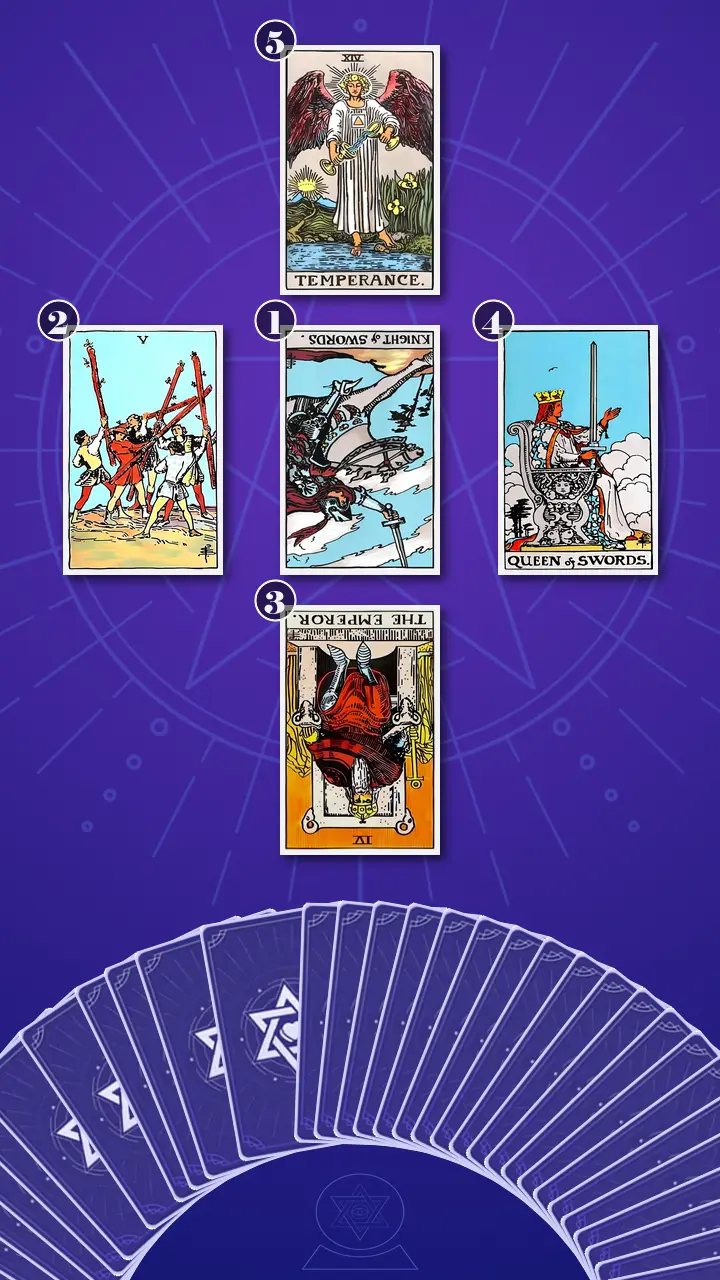
I chose a five-card Shadow Spread. I use the word shadow here for a pattern that acts before conscious understanding catches up, not for anything sinister or fated. For readers wondering how tarot works in a situation like this, the cards are not evidence of a coworker's motives and they do not issue a verdict. They provide distinct positions from which I can separate behavior, trigger, hidden fear, protected need, and practical response.
This layout was precise enough for Jordan's question. A larger Celtic Cross would have introduced future outcomes and environmental factors that were not needed, while a relationship spread might have pulled attention toward deciding who was right. Here, the center would show the visible confrontation, the lower card would expose the fear beneath it, and the upper card would offer an integration practice. The remaining two cards would identify the activating friction and the legitimate resource concealed inside the anger.
I arranged the cards like a compass. Jordan's current reaction occupied the center; the hidden root anchored the lower point; the integration card waited above. I told Jordan that the map could reveal a pattern, but only they could decide what to do with it.
Reading the Layers Beneath the Hot Reply
Position One: The Knight Who Reached Send Too Soon
I began by turning the card in the position representing Jordan's observable behavior: confronting a coworker before identifying the trigger, assumption, boundary, or need beneath the anger. It was the Knight of Swords, reversed.
I pointed to the charging horse, the raised sword, and the whole landscape bending in the wind. At 4:47 p.m., Jordan had seen a coworker question their recommendation in the shared launch channel. Within seconds, the message had become a complete explanation: the coworker was undermining the plan, dismissing Jordan's judgment, and weakening their credibility in public. Two sharp sentences were deleted, but the remaining paragraph still crossed into the channel before Jordan understood that the actual concern was an unannounced change in ownership.
I read the reversal as an excess of mental speed combined with a blockage in discernment. The Knight's courage was not the problem. Jordan was willing to name conflict, which is often valuable in product operations. The trouble was the inner sequence I could hear in their story: I know what this means. I need to correct it now. I will work out the exact issue afterward. It was like email autocomplete writing the entire sentence from the first three words, except the missing words belonged to another person's intent.
Jordan gave a short, bitter laugh. Their typing hand tightened against their knee before they said, "That is so accurate it feels a little cruel."
"Then let us be accurate about the strength as well," I replied. "You usually have a point; the problem is that speed speaks before the point becomes precise. The goal is not silence. It is giving your point enough time to become usable."
Position Two: Five Deadlines in One Room
The next card I turned represented the workplace friction that activates Jordan's rapid movement from anger to confrontation. It was the Five of Wands, upright.
The five wooden staves crossed without forming a shared structure. I asked Jordan to picture a cross-functional stand-up: product protecting scope, engineering asking for time, support asking for customer clarity, design defending the user flow, and operations trying to establish an owner. The scene had the overlapping pressure of The Bear, with several people carrying real responsibilities and talking at once, while an activated mind searched the room for one simple opponent.
I described the card's fire as active but scattered: an excess of competing urgency and a deficiency of coordination. That did not mean no boundary had been crossed. An interruption could still be disrespectful, and an ownership change could still be unacceptable. The card only asked Jordan to distinguish those possibilities from a messy system in which several priorities were colliding before anyone had named a shared rule.
"Not every messy room contains one clear opponent," I said. "Which exact part of that meeting turned disagreement into an emergency in your body?"
Jordan stared at the crossing staves, then released a long breath through their nose. "It was when nobody answered the ownership question," they said. "I heard all the other debate as people avoiding me, but I think I was trying to stop the handoff from becoming ownerless."
I watched their shoulders lower slightly. The concern had not disappeared; it had become more specific.
Position Three: The Stone Throne Under the Argument
I turned the lower card, representing the mechanism-level fear beneath the pattern: that pausing might mean losing control or becoming powerless in the interaction. It was The Emperor, reversed.
I drew Jordan's attention to the rigid stone throne and the armor visible beneath the red robe. When a conversation became unpredictable, Jordan described making their wording firmer, pushing for an answer immediately, and narrowing the range of responses they would accept. The action briefly restored a sense of order, but it also transformed a legitimate boundary discussion into a contest over tone and authority.
I read the reversed Emperor as control stretched into excess while stable self-command remained blocked. The inner sentence beneath the armor was not simply I am angry. It was: If I do not control the next move, I will become powerless in the whole interaction. A pause therefore felt less like thoughtful regulation and more like watching someone else write the official version of events.
A familiar professional image crossed my mind: a shared document locked to view-only because conflicting edits felt more dangerous than temporary incompleteness. The document would look orderly, but no missing information could enter it.
"Self-command is not the same as command over the interaction," I said. "A boundary can be firm without controlling when the other person understands, agrees, or responds."
Jordan's breath stopped first. Their fingers remained suspended above the cup beside them, and their gaze shifted away from the card as if an old meeting were replaying on the wall. Then their hand settled flat on the table and a low exhale left their chest. "Waiting feels like being publicly demoted," they said. "Even when nobody has actually asked me for an instant answer."
I did not rush to brighten that recognition. Real clarity can sting when it removes a familiar defense. I let the silence hold long enough for Jordan to see the fear without having to justify it.
Position Four: The Sentence That Could Survive the Transcript
I turned the card representing what Jordan's anger was attempting to protect, along with the mature capacity already available inside it: clarity, honest speech, and a workable boundary. It was the Queen of Swords, upright.
I placed one finger near her upright sword and another near her open hand. The sword held a claim that could be supported by the record; the open hand left room for context that had not yet arrived. I read this as balanced air energy: thought moving with precision instead of acceleration, and language staying direct without pretending to know another person's intent.
I wrote Jordan's first draft on a sheet of paper: You are dismissing me. Beside it, I wrote: My ownership question was not answered, and I need us to clarify the handoff before the 3 p.m. deadline.
The second sentence was not softer. It named the observable gap, the operational impact, and the specific request. It could be answered, negotiated, documented, or escalated if necessary. It did not require Jordan to prove a theory about motive before protecting the issue.
"Accuracy is not softer than confrontation; it is harder to argue with," I said. "You can protect the issue without pretending you already know their intent."
Jordan read both sentences twice. Their jaw moved as though preparing another objection, then unclenched. "That is what I mean when I say I do not want to become less direct," they said. "I want to become more accurate."
I nodded. I could now see the Queen's resource taking shape in Jordan's own language. Anger had been protecting a real professional value: clear ownership, honest communication, and boundaries that could survive pressure. The task was not to discard that value. It was to separate it from premature certainty.
When Temperance Put Anger on a Different Clock
Position Five: The Two Cups Between Feeling and Fact
I turned the final card in the position representing the conscious practice that could place a deliberate pause between anger and confrontation. It was Temperance, upright, the bridge card of the reading.
The room seemed to quiet around it. A pipe clicked once behind the wall and stopped. On the card, water passed carefully between two cups while one foot rested on land and the other remained in water. I read the image as a balanced exchange among bodily feeling, observable evidence, and reflective thought. The anger stayed present, but it no longer had to pour unfiltered into a public channel.
At this point I used a lens I call Core Competency Excavation. I asked Jordan to look beneath the changing titles and responsibilities in their work history and name the abilities that had repeatedly mattered under deadline pressure. They named spotting handoff risks, noticing missing ownership, responding quickly, and refusing to let ambiguity quietly become failure.
Those were durable competencies. Instant confrontation was not. It was a delivery method that had fused itself to the deeper skill.
I thought of an excavation trench after rain, when two occupation layers can look like one dark band of soil. A hurried trowel can erase the boundary and destroy the very evidence it is trying to reveal. Pausing to brush the surface does not weaken the excavation. It preserves enough context to identify what is actually there. In the same way, Jordan did not need to abandon speed, courage, or operational vigilance. They needed a brief staging area where those assets could be separated from unverified motive-reading.
Before I named the card's central message, I returned Jordan to 4:47 p.m.: the clipped reply, tightening deadline, hot face, locked jaw, and moving cursor. Beneath the speed sat one thought: if I do not answer now, someone else's version becomes official.
You do not have to act at the speed of anger; let feeling and fact pass between Temperance's two cups until a clear boundary can be spoken.
I let the sentence remain in the room. Jordan's breath stopped midway in, and their fingers froze against the seam of their sleeve. For several seconds, their eyes stayed fixed on the thin stream of water between the cups, then lost focus as if they were replaying the Slack exchange frame by frame. Their pupils widened. Their mouth opened, closed, and tightened at one corner. The shoulders that had been held near their ears began to descend, but the release brought no instant smile. Their eyes reddened, and a small tremor entered their next breath. "But doesn't that mean I handled all of those conversations wrong?" they asked, suddenly sharper. "I thought I was standing up for myself." I heard anger in the question, but also the exposed space left when an old defense no longer felt inevitable. "No," I said. "It means your concern may have been valid while your first explanation was incomplete. A pause is not the opposite of directness. It is where anger stops being your deadline and starts becoming information you can use."
I asked, "Now, using this new perspective, think back to last week. Was there a moment when this insight could have made you feel different?"
Jordan looked toward the window. "The stand-up on Thursday," they said after a while. "I thought the interruption meant they did not respect me. If I had waited, I would have noticed that I was mainly afraid the ownership question would disappear again. I still would have brought it back. I just would not have needed to accuse anyone first."
I placed a blank note beside Temperance and wrote three headings: What I observed. What I interpreted. What I want to request. I asked Jordan to imagine giving those three lines ten minutes to exchange information before choosing whether to reply, ask a question, schedule a conversation, or wait. If ten minutes felt impossible, the minimum version would be one motive-free observable fact before touching the message.
This was the reading's central crossing: from hot certainty and control-seeking toward emotional curiosity, factual clarity, and grounded directness. Anger was not being erased or overruled. It was changing roles, from an immediate instruction into information Jordan could examine and use.
The Two-Cup Pause: Finding Clarity Before the Next Reply
I drew the five cards back into one line. Repeated launch work had rewarded Jordan's ability to detect risk quickly. Under pressure, that strength accelerated into the reversed Knight's premature conclusion; the Five of Wands supplied genuine but uncoordinated friction; and the reversed Emperor treated uncertainty as a threat to credibility. The Queen revealed the enduring asset beneath the armor: Jordan could identify what was missing and state a firm boundary. Temperance supplied the missing process, allowing the alarm to carry information without letting it write the whole message.
I named the cognitive blind spot plainly. Jordan had been treating urgency as proof that the first interpretation was complete, and treating control of the response time as proof of directness. The transformation was not from anger to calm, or from conflict to automatic harmony. It was from confronting at the first surge to choosing a response after separating one observable fact, one interpretation, and one request.
I also borrowed a page from my Resume Stratigraphy Review to help Jordan rewrite the professional identity attached to the pattern. We replaced I am reliable because I respond immediately with I am reliable because I detect risk, verify the issue, and name the next owner. Job titles and workplace norms can weather away like upper layers of a site. The durable asset was not instant availability. It was accurate operational judgment.
I kept the next steps small enough to use while the body was still hot:
- Pin the Fact-Meaning-Request Check.Today, create one private phone or Notion note with the headings "Observed," "Interpreted," and "Request." Before one non-urgent Slack reply this week, write one sentence under each heading and remove any claim about motive that the observable line cannot support.If three lines feel too slow, write only the observable fact, using no adjectives about intent. Keep the note private until you choose what to share.
- Use the Two-Cup Ten-Minute Pause.When the next charged message arrives, save the response as a draft and set a ten-minute timer. Put both feet on the floor, name one physical cue in plain language such as "hot face" or "tight chest," then choose a revised factual reply, one clarifying question, a scheduled conversation, or more time.Use a two-minute version when necessary: save, stand, name the body cue, and reread the original once. This pause is for non-urgent conflict. It is not a requirement to remain in an unsafe, discriminatory, harassing, or time-critical situation; appropriate support, policy, or escalation remains available.
- Make One Accurate Clarification or Repair.Save the Slack snippet "Before I respond, can you clarify whether you mean X or Y?" and use it once this week. If a recent confrontation buried a valid issue, send: "I moved too quickly earlier. The concrete issue I need to resolve is ___. Can we address that at ___?"A clarifying question does not surrender the boundary or commit you to accepting the answer. Add a return time when a deadline matters, so the pause has a visible edge.
"But what if I cannot spare even ten minutes because the thread keeps moving?" Jordan asked.
I slid the note back toward them. "Then use the one-line version and write only what a transcript could verify. The practice belongs to you, not the other way around. The timer is an exit mechanism, not a test of whether you can perform perfect composure."
Jordan photographed the three headings. I saw no dramatic certainty arrive, and I did not expect it to. What changed was smaller and more useful: their next action no longer had to be selected by the first surge of heat.

Six Days Later: The Reply That Stayed in Draft
Six days later, I received a message from Jordan. A coworker had posted another clipped question in a shared channel at 4:51 p.m. Jordan had written a sharp response, saved it as a draft, and opened the pinned note instead.
They sent me the three lines: Observed: the handoff owner changed and my question was not answered. Interpreted: my input is being dismissed. Request: confirm the owner and escalation path before tomorrow's planning call. After eight minutes, they chose the clarifying snippet rather than the accusation. The coworker replied that they were questioning the process, not Jordan's credibility, and agreed to name the owner in the thread.
I noticed that the outcome was helpful but not magically tidy. Jordan still had to discuss why the ownership change had happened without notice, and they still disliked the coworker's tone. The pause had not made the conflict disappear. It had allowed the real conflict to enter the conversation without first being buried under a second argument about Jordan's delivery.
Jordan slept through the night, then woke with the old thought, What if waiting made me look weak? This time, they smiled, opened the note, and let the question remain unanswered for a minute.
I took that as the quiet proof of our Journey to Clarity. The cards had predicted nothing and compelled nothing. They had helped Jordan slow one sequence down enough to recover what was already theirs: the ability to notice risk, understand what anger was protecting, and choose direct language at a time they could stand behind.
When a coworker's message makes your face heat and your chest tighten, answering now can feel like the only thing standing between being direct and becoming powerless. I would remember what I saw at the table: merely noticing that pressure means the first surge is no longer the only voice holding the sword.
If one small pause could belong to your directness rather than oppose it, what would you want to notice as feeling and fact pass between your own two cups before your next sentence?