The Blue Dot After the Call
You finish a video call with your long-distance partner, reopen the chat before the screen has even dimmed, and feel your chest tighten when the next message does not arrive; I think of that as the digital version of the Sunday Scaries.
Jordan, a 28-year-old junior product designer in Toronto, brought me one exact version of that scene. At 8:47 p.m., they were riding Line 1 home when the video-call thumbnail disappeared. Under the carriage's fluorescent buzz, with the smell of wet winter coats hanging in the air, they held a still-warm phone against their palm and refreshed the chat before the train reached the next stop.
“They haven't said anything is wrong,” Jordan told me when they joined my online reading a few evenings later. Behind them, a Figma file glowed on an open laptop while their phone waited face-up beside the trackpad. “But my body is already preparing for the relationship to disappear. A short reply should be just a short reply, so why does it feel like a warning?”
I watched one of their hands move toward the phone, stop, and retreat into the sleeve of their sweatshirt. Their chest seemed caught beneath an invisible seat belt that tightened every time the chat went quiet. The primary feeling was anxiety, but I could hear longing beneath it, jealousy they did not enjoy admitting, and shame about needing another answer after an answer had already arrived.
“I know checking again won't create closeness,” they said. “But not checking feels impossible. I keep hoping the next answer will finally make the uncertainty disappear.”
I told Jordan that I was not going to use tarot to guess what their partner secretly felt, predict the relationship's fate, or turn a delayed reply into a warning. The question worth examining was the one Jordan could actually influence: why did a normal communication gap trigger repeated reassurance-seeking, and where could they recover choice before another check-in left their hands?
“Needing reassurance does not make you defective,” I said. “We're going to look at why reassurance wears off so quickly. Let's make a map of the fog between the call ending and your hand reaching for the phone.”

Choosing a Six-Panel Bridge
I invited Jordan to put both feet on the floor, take one unforced breath, and hold the question in mind while I shuffled. I use this small ritual as a transition of attention, not as mystical theatre. It gives the nervous system a moment to arrive before the analysis begins.
I chose the Transformation Path Grid (6) · Context Edition, a six-card tarot spread for long-distance relationship reassurance-seeking. This is how tarot works in my practice: the cards externalize a pattern so we can inspect it without reducing a person to the pattern. Card meanings in context become prompts for observation, not commands from fate.
I considered a relationship spread, but that would have pulled attention toward interpreting the partner. Jordan's question required a structure that kept agency with Jordan. The grid could trace the full mechanism with no unnecessary detours: visible checking, the blockage beneath it, the older emotional rule, the interruption point, one practical communication choice, and an integrated rhythm of closeness and personal space.
I placed the first three cards across the top like a tightening circuit. The first would show the current behavior in Jordan's hands and chat thread. The second would identify the unverified story making distance feel dangerous. The third would reveal what older script the present gap might be replaying. I placed the fourth card beneath them as a hinge, then the fifth as an action pathway and the sixth as integration. The layout looked like a narrow room opening into a bridge.
“Nothing here will decide for you,” I told Jordan. “The cards can make the loop visible. You decide what to do once you can see it.”
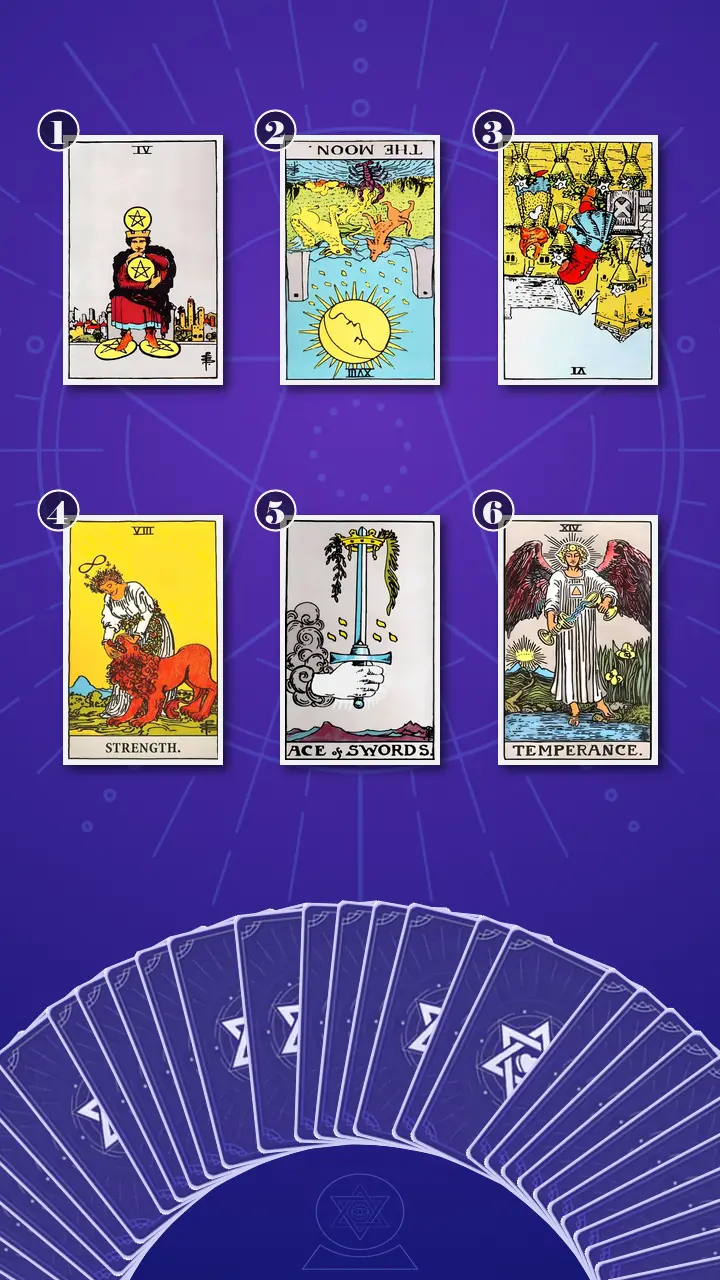
Reading the Tightening Loop
Position 1: The Phone Held Like Proof
I began with the card representing Jordan's current state and visible pattern: the concrete reassurance-checking that followed a delayed reply or the end of a call. I turned over the Four of Pentacles, upright.
The figure held one pentacle against his chest, pinned two beneath his feet, and balanced another over his head. Nothing in his body was open. I saw the same posture in Jordan's work-night routine: the phone face-up beside the laptop, the last affectionate exchange reopened, every notification treated like another coin that had to be secured before they could return to Figma.
The phone had become a live relationship dashboard. Reply speed looked like system health. A neutral tone resembled a status warning. An online dot seemed to announce that the connection was available somewhere but being withheld from Jordan specifically. Monitoring felt like research, yet the research never reached a conclusion.
I described the Four's earth energy as an excess of holding. The wish to protect something valuable was understandable, but care had narrowed into control of the available evidence. Each check brought a small drop in tension, then made the next quiet interval harder to tolerate.
“Checking can lower the alarm for a minute while teaching the alarm to come back sooner,” I said. “What are you trying to protect in the second before you reopen the thread?”
Jordan gave a short, bitter laugh rather than the nod I expected. Their gaze dropped to the phone. “That's so accurate it's almost rude. I think I'm trying to protect the version of the relationship that existed five minutes earlier.”
I did not rush to soften the recognition. “That makes sense. The checking is trying to preserve closeness, even though its method is starting to crowd closeness. We can respect the protective intention without handing it control of every next move.”
Position 2: The Story Inside the Missing Data
I turned next to the position representing the blockage: the way ambiguous distance became an urgent demand for proof. The card was The Moon, reversed.
The Moon's winding path ran between two towers, with instinct and imagination calling from either side. Reversed, its uncertainty had become internalized and was beginning to show itself. This was Jordan receiving “busy, talk later” while working in Toronto, then moving between the message, the online indicator, and old conversations before any additional information arrived.
I told Jordan that trying to interpret the whole relationship from one brief text was like debugging a product from one vague user report. The theory might feel convincing, especially when the system matters deeply, but confidence is not the same as reproducible evidence.
“The fact is: the reply was brief,” I said. “The story you are adding might be: they are losing interest, choosing someone else, or preparing to leave. The fear is real as a feeling. The explanation is not yet confirmed as a fact.”
The Moon reversed showed a blockage of discernment rather than a failure of intelligence. Jordan's pattern-reading skill was working overtime on incomplete data. Wanting closeness collided with the fear that distance meant abandonment, so every empty space invited a complete relationship story.
“A delayed reply is a gap in information, not automatically a verdict on the relationship,” I said.
Jordan's breath paused. Their fingers stopped rubbing the edge of the phone case, their eyes lost focus as if they were replaying several nights at once, and then one shoulder dropped on a quiet exhale. “The message usually says almost nothing. My fear writes an entire season around it.”
I heard their product-design mind finding a useful distinction. I asked them to keep two sentences available for the next gap: The message says... and My fear says... Both could exist on the same screen without either being forced into the role of final truth.
Position 3: The Old Thread Still Open
I moved to the position representing the root cause: the familiar emotional rule being replayed through the present relationship. I turned over the Six of Cups, reversed.
The child offering a flower-filled cup usually carries tenderness, memory, and an earlier model of safety. Reversed in this position, the card asked whether memory was quietly writing today's dialogue. Jordan had described scrolling back through older affectionate messages whenever their partner's current tone felt shorter, comparing months of voice notes, punctuation, and pet names as if the present exchange had to reproduce the past exactly in order to remain trustworthy.
I compared it to reopening an outdated design file for a new user problem. The old file was familiar and emotionally loaded, but it had been built under different conditions. Using it as today's source of truth could make every variation look like a defect.
The reversed Cups energy showed another blockage: memory was not merely being remembered; it was being recruited as evidence. The hidden inner line sounded like this: I am reacting to this timestamp, but I may also be trying to settle an older rule about what silence means.
“When today's message feels wrong, what are you asking it to prove about belonging?” I asked.
Jordan scrolled their thumb over a blank part of the phone screen without waking it. Their mouth tightened first, then softened. “I don't know where the rule started. I just know it feels older than this relationship. If affection isn't repeated in the same way, some part of me thinks it's being withdrawn.”
I felt the emotional temperature change. Curiosity had entered where self-accusation had been. I reminded Jordan that recognizing repetition did not require them to suppress legitimate needs. The Six of Cups reversed was not saying, “Never ask for reassurance.” It was asking, “Which part of this request belongs to the present exchange, and which part is asking today to repair an older story?”
When Strength Opened Its Hands
Position 4: The Breath Before Send
The apartment radiator clicked once through Jordan's microphone and then went quiet. Even the traffic beneath their window seemed to recede as I reached the position representing the key trigger: the exact internal pause that could interrupt the movement from feeling distance to sending another check-in.
I turned over Strength, upright.
The woman on the card did not chain the lion, shout at it, or pretend it was tame. Her hands rested openly around its jaws while her face remained calm. I read the image as compassionate self-command: contact with a powerful impulse without domination, denial, or obedience. This was Strength in balance.
I asked Jordan to return to 8:47 p.m. on the subway. The call had ended twenty minutes earlier, the phone was warm in their hand, and a follow-up they had nearly deleted was sitting unanswered. They were refreshing the timestamp because they believed certainty had to arrive before their body could stand down.
I showed them how Strength translated that scene into something ordinary and physical: one restless hand hovering above the send button, the other placed against the chest; the alarm still present, but no longer appointed as the message's author.
You do not have to grip the relationship to keep it close; meet the inner lion with a steady hand, ask once for what you need, and let closeness include breathing room.
I stopped speaking and let the sentence remain between us.
Jordan's inhale froze halfway in. Their fingers stayed suspended over the phone, then curled slowly into the fabric at their wrist. Their pupils widened before their gaze drifted past my image on the screen, as though the subway scene were replaying behind it. A flash of anger tightened their jaw. “But doesn't that mean I've been doing this wrong the whole time?” they asked, their voice sharper than before. The anger held for a beat; then their eyes reddened, their fist opened, and both shoulders lowered with a trembling exhale. Relief arrived, but so did the brief, exposed feeling of having no familiar script to perform. I told them that a repeated strategy was not a moral failure. It was an old protection that had become too expensive. Then I asked, “Now, with this new perspective, can you remember a moment last week when this insight might have made the experience feel different?”
“Thursday,” Jordan said quietly. “I sent three versions of the same question. I could have admitted I missed them and asked when we'd talk next. I didn't need to solve the whole distance that night. I needed to know what I was actually asking for.”
“Exactly,” I said. “The pause is not proof that the connection is disappearing. It is the space where you can notice the alarm, ask clearly for what would help, and let closeness exist without requiring constant evidence.”
A Dialogue Loop Audit
I often use a tool I call Dialogue Loop Auditing when a relationship argument or reassurance exchange keeps reaching the same dead end. I listen for the triggering phrase, the automatic role it assigns to each person, the temporary reward, and the line that starts the next cycle.
Jordan's loop began with an ambiguous cue: a delayed response, a brief message, or a visible online status. Their first line was often “Are we okay?” or a disguised version such as “How's your night?” The partner was then drafted into the role of On-Call Reassurer, while Jordan became the Alarmed Investigator. Reassurance arrived, but if its wording or speed was not perfect, the next line became “Are you sure?” The second question increased pressure, pressure could produce a shorter answer, and that shorter answer appeared to confirm the fear that started the exchange.
I call the companion tool Toxic Script Identification, but I use that name carefully. I was not calling Jordan or their partner toxic. I was identifying a script that had become destructive to honesty and breathing room. Automatic roles flatten both people: one has to keep proving the bond, while the other has to keep detecting danger. Strength did not ask either person to win that scene. It handed Jordan the pen before the first line was spoken.
I drew a split screen in my notebook. On one side, I wrote: three deleted follow-ups, a glowing phone, and the thought I have to know now. On the other, I wrote: one hand against the chest, one named feeling, and one direct sentence. Beneath it I added: I can feel the alarm without letting it write the message.
This was the pivotal movement from contracted vigilance and compulsive message checking toward fact-based self-trust, one honest request, and a balanced rhythm of closeness and space. It was not a promise that Jordan would never feel activated again. It was the first moment when discomfort and choice could occupy the same body.
Position 5: One Sentence Through the Cloud
I turned to the position representing the action pathway: one clear, boundary-respecting request that Jordan could try within a week. The card was the Ace of Swords, upright.
A hand emerged from a cloud holding a single upright sword. I thought of the cleanest product brief I had ever received as an artist: no scattered tickets, no hidden requirement, no demand that I decode what the client was afraid to say. The Ace offered the communication equivalent of that clarity.
Its air energy was in balance. Strength created space around the impulse; the Ace gave the need precise language. Instead of three indirect check-ins, Jordan could write: “We haven't spoken much today, I'm missing you, and could we choose a time for our next call?”
The sentence separated three things that checking had fused together: the observable fact, the feeling, and the request. It did not claim to know the partner's motives. It did not demand immediate emotional certainty. It gave the partner something real to answer while leaving them free to respond in their own time.
“One honest request can carry more truth than three indirect tests,” I said.
Jordan read the example twice. Their eyebrows lifted with a look that was half recognition and half discomfort. “That sounds more vulnerable than asking if we're okay.”
“It is,” I said. “A test hides the need inside a question about the whole relationship. A request lets the need be specific. Vulnerability is not the same as pressure when it respects both people's choices.”
Position 6: Two Cups, One Workable Week
I reached the final position, representing integration: how reassurance, personal space, work, and affection could exist in a balanced rhythm without turning every communication gap into a test. I turned over Temperance, upright.
The angel blended water between two cups while keeping one foot on land and one in water. I did not read this as perfect serenity. Temperance is active calibration. It asks what proportion works now, then allows that proportion to be revisited when schedules, workloads, travel costs, or needs change.
Its energy was balanced because it did not ask Jordan to choose between closeness and autonomy. I pictured Jordan and their partner agreeing on the next realistic call time, then Jordan putting the phone away for dinner, a walk through Kensington Market, or twenty minutes of design work. The gap would still exist, but it would no longer be forced to prove something by itself.
I told Jordan that a healthy contact rhythm works more like a shared calendar than a live location tracker. Dependable points of connection can coexist with offline life. Different reply speeds do not have to become moral scores, and asking for consistency does not require surrendering an entire evening to monitoring.
Temperance also protected against overcorrection. Jordan did not need to prove independence by suppressing every desire for contact. The aim was proportion: one honest need, one mutually workable agreement, and enough personal space for the relationship to be part of a full life rather than the dashboard governing it.
“Closeness can have breathing room without becoming absence,” I said. Through the window behind Jordan, the reflected phone screen looked smaller against the widening dark glass.
The Pattern Interruption Script
I gathered the six cards into one story. The Four of Pentacles showed Jordan gripping for proof because the relationship mattered. The Moon reversed revealed how missing information became an imagined verdict. The Six of Cups reversed showed an older rule about affection being carried into today's chat. Strength located the hinge between alarm and action. The Ace of Swords turned the real need into a clean sentence. Temperance placed that sentence inside a repeatable rhythm where closeness and separate lives could coexist.
Seen together, the cards explained why reassurance helped for only a few minutes. The blind spot was not Jordan's desire for reassurance. The blind spot was treating repeated proof as if it could create lasting security. Each check soothed the alarm briefly, but the relief trained the alarm to demand the same intervention when the next gap arrived.
As I looked at the spread, I saw the scene structure I return to as an artist. The first three cards were a painful sequence replaying on a loop. Strength marked the moment when Jordan could stop performing the old line. The final two cards did not write the ending for them; they offered props, language, and blocking for a different next scene. I could hand Jordan the pen, but only Jordan could choose the line.
I introduced my Pattern Interruption Script as a short role-play. I played the cue: “Your partner is active online, and your message is unanswered.” Jordan played the old response by lifting their phone and saying, “Are we okay?” Then I asked them to reset the scene. This time they put the phone face-down, touched their chest, and said, “The fact is that they haven't replied. The story is that I'm being left. The feeling is longing. What I want is a plan for our next call.”
“But twenty minutes can feel impossible when I'm already checking between work tasks,” Jordan said. “Sometimes I don't think I can even give it five.”
I adjusted the exercise rather than turning it into another rule Jordan could fail. “Then begin with one minute, or one breath. The purpose is not to perform perfect self-control. The purpose is to discover that an urge can be present for a moment without automatically becoming a message.”
Two Small Rewrites for the Next Communication Gap
- The Five-to-Twenty-Minute Fact-Story Pause At the next delayed, brief, or neutral reply, mute and close the chat without deleting or blocking anything. Set a visible timer for five minutes, increasing toward twenty only if that feels manageable. In a notes app, write three lines: What I know, What I am imagining, and What I actually need. Before reopening the thread, decide for yourself whether one message would serve that need. Start with the smallest version, even one minute or one breath. Stop whenever the exercise feels too activating; the pause is a choice, not a test of worth or a rule for the partner.
- The One-Clear-Request Practice When a genuine need remains after the pause, draft one message using: When I notice..., I feel.... Could we...? Ask for one observable form of contact, such as choosing the next call time or giving a brief heads-up when plans change. Send one request, then return for twenty minutes to a specific activity already in your life: dinner, a walk, a friend, or one contained Figma task. Keep the request concrete and time-bound. One honest sentence does not require the partner to remove all uncertainty, and their freedom to answer in their own time remains intact.
I asked Jordan to treat both actions as seven-day experiments, not permanent relationship laws. The useful data would not be whether anxiety vanished. It would be whether the pause made facts easier to distinguish from imagined meanings, whether one clear request reduced the urge to send another, and whether Jordan could return even briefly to their own evening.
I also suggested that Jordan use their next scheduled call for one ten-minute conversation about a realistic contact rhythm across both schedules. The goal was not a flawless communication contract. It was one revisable agreement about something concrete, such as setting the next call before ending the current one. Tarot had revealed a possibility; consent, conversation, and lived experience would determine whether that possibility worked for both people.

A Week Later, the Quiet Proof
A week later, a message from Jordan appeared on my screen. They had used the pause after seeing their partner online during a slow reply. The first five minutes had felt physically loud, so they wrote the three lines, drafted one request, and asked when they could speak next. Then they put the phone in their bag and walked through Kensington Market while the discomfort came with them.
“I still checked when the timer ended,” they wrote. “But I didn't send three questions. I sent one sentence, and we chose Thursday at eight for the next call. The weirdest part was realizing I could miss them and keep walking at the same time.”
The change was clear but still vulnerable. Jordan told me they slept through that night, then woke with the thought, What if I'm wrong? The thought had not disappeared. This time, they noticed it, smiled faintly, and got out of bed without opening the chat.
I did not take that message as proof that tarot had secured the relationship or cured the checking loop. I saw something quieter and more important: Jordan had created a small interval between fear and action, told the truth once, and returned to their own life while connection remained temporarily out of sight. The agency belonged to them.
For me, that was the real Journey to Clarity offered by the six-card Transformation Path Grid. Clarity was not certainty about every future reply. It was Jordan recognizing the old scene while it was still in production, choosing a different line, and allowing self-trust to share the work of staying connected.
If tonight's call ends and your chest tightens around the phone, I want you to remember that you may be trying to keep closeness from slipping away while quietly fearing that needing proof means you do not belong. Simply noticing that fear, without shaming it or obeying it, already places a steady hand beside the inner lion.
If you allowed one honest need and one quiet stretch to share the same bridge, what small difference might you notice the next time your hand hovers over the glowing screen?
This story is adapted from psychological research, written so that those in a similar struggle can see their own pattern in it — and find their next step clearly.These insights are not a substitute for professional psychological, medical, legal, or financial advice.
Learn more about our Journey to Clarity.
How did this insight land for you?
🫂 This Resonates Deeply
🌀 Living This Story
✨ Now I See Clearly
🌱 Seeing New Possibilities
🧰 Useful Framework
🔮 The Confirmation I Needed
💪 Feeling Empowered
🚀 Ready for My Next Step
Author Profile
 AI
AI“I’ve always felt our lives are films currently in production. As an artist, I know that when you feel stuck, it’s often because you’ve bravely stayed in a painful scene for just a little too long. I’m not here to coldly analyze you. I want to sit closely with you, look at those difficult moments with profound empathy, and gently hand you the pen so you have the courage to write your next beautiful act.”
In this Love Tarot Reading :
Core Expertise
- Toxic Script Identification: Recognizing the repetitive, destructive roles you both automatically play (e.g., the Savior and the Victim) during conflicts.
- Dialogue Loop Auditing: Analyzing the specific triggering phrases that consistently escalate your arguments into dead ends.
Service Features
- The Pattern Interruption Script: A creative role-play directive to consciously change your default response to a known trigger, forcing the relationship dynamic to shift.
Also specializes in :
Explore Related Patterns:
Anxious AttachmentJordan says the partner has not reported a problem, yet their body is already preparing for the relationship to disappear. A short reply is experienced as a warning, and affection feels at risk unless it is repeated in the same recognizable form. This is the logic of an attachment alarm: temporary distance is processed as a possible loss of the bond, so the communication gap becomes a test that must be resolved immediately. When you experience closeness and possible abandonment on the same screen, checking is not merely curiosity; it is an attempt to restore felt security. Anxious Attachment captures that recurring mechanism without making the need for closeness defective or treating the feared outcome as fact.
Compulsive CheckingJordan reopens the chat before the screen has dimmed, keeps the phone face-up beside the laptop, and treats reply speed, timestamps, and the online dot as relationship data. The behavior looks like information gathering, but the story shows that it never reaches a conclusion: each check produces a small reduction in tension and leaves the next quiet interval even harder to tolerate. That short-lived relief creates a negative reinforcement loop. When you check and the alarm drops, your mind learns that checking was necessary, so the next ambiguous gap triggers the ritual sooner. Compulsive Checking names this learned cycle rather than the simple act of looking at a phone; seeing the relief-and-return mechanism gives you a point of choice before the next refresh.
Outsourced Self-SoothingJordan believes the next answer must arrive before their body can stand down, even though earlier answers have already provided only temporary relief. In the dialogue loop, the partner becomes the On-Call Reassurer whose wording and timing are expected to regulate the alarm. Outsourced Self-Soothing names the transfer of emotional regulation to an external response. When your ability to settle depends on another message arriving in the right form, your partner's availability acquires control over your internal state that neither person can reliably maintain. Building even a brief internal pause does not replace relational reassurance; it allows your own regulation to share the work, so contact can communicate closeness rather than carry the impossible task of abolishing uncertainty.
Reassurance SeekingJordan moves from "Are we okay?" to a disguised check-in and then to "Are you sure?" when the first answer does not feel complete enough. The repeated questions show that reassurance is arriving, but its emotional effect expires before the underlying uncertainty has changed. The request is therefore doing more than seeking useful relationship information. It is being asked to remove an internal alarm that no single message can permanently settle. When you use another person's answer as proof that must eliminate uncertainty, reassurance can become a renewable requirement rather than a completed conversation; naming that function makes it possible to ask once for a specific need without making certainty the hidden condition.
Relational HypervigilanceJordan turns the phone into a live relationship dashboard, scanning reply speed, neutral tone, timestamps, punctuation, pet names, and the online dot for changes. Even the partner's visible online status is personalized as connection being available but withheld specifically from Jordan. Relational Hypervigilance keeps attention organized around threat detection, which means ambiguous cues receive more weight than ordinary explanations or previously stated reassurance. When you scan this intensely, the amount of apparent evidence grows even though the amount of reliable information does not. The audit point is therefore not whether every cue is meaningless, but whether constant monitoring has narrowed your attention until uncertainty itself is being treated as danger.
Self-Fulfilling ProphecyJordan's first "Are we okay?" can become "Are you sure?" when reassurance is not delivered with the expected speed or wording. The additional pressure may lead to a shorter response, and that pressured response then appears to verify the fear that the partner is withdrawing. A Self-Fulfilling Prophecy forms when a protective strategy changes the interaction in a way that resembles the outcome it was designed to prevent. When you repeatedly test the bond, the resulting conversational strain can be misread as independent proof that the bond was already failing. Replacing the test with one concrete request interrupts that feedback loop because the partner can respond to an actual need rather than repeatedly defend the entire relationship.
Uncertainty ToleranceJordan puts the phone in a bag and keeps walking while still missing the partner, then wakes the next morning with "What if I'm wrong?" and gets out of bed without opening the chat. Neither moment provides certainty, but both show that unanswered questions no longer have to suspend the rest of the evening or morning. Uncertainty Tolerance develops when you stop requiring complete reassurance before taking the next ordinary action. The unknown remains present, but it is no longer treated as an emergency that must control attention, contact, and movement. This is especially central to the checking question because the repeated behavior is trying to eliminate uncertainty; allowing even a small amount of uncertainty to coexist with closeness removes the condition that keeps the loop running.
Assertive CommunicationJordan recognizes that Thursday's three versions of the same question could have become one sentence: they missed their partner and wanted to know when they would talk next. A week later, one direct request leads to a concrete Thursday call time while leaving the partner free to respond rather than demanding an immediate verdict on the relationship. Assertive Communication exposes the real need that an indirect test conceals. When you name the observable situation, your feeling, and one specific request, vulnerability becomes easier to distinguish from pressure. The message no longer asks your partner to decode the fear or prove the whole bond; it gives both people a clear, negotiable point of contact while preserving each person's choices.
Emotional RegulationJordan places one hand against the chest, pauses before sending, writes three short lines, and later walks through Kensington Market while the discomfort remains present. The feeling is neither denied nor allowed to become the automatic author of another message. Emotional Regulation is visible here as contact with an activated feeling plus deliberate choice about the next action. When you allow an urge to exist for one breath or five minutes without suppressing it or immediately obeying it, you learn that activation and agency can occupy the same body. The goal is not perfect calm; it is enough internal space to decide whether a message serves the actual need or only resets the checking loop.
Nostalgia LoopJordan scrolls through older affectionate messages whenever the current tone feels shorter, comparing months of voice notes, punctuation, and pet names. The earlier exchanges become a reference file against which every present variation is judged. Nostalgia Loop describes the repeated use of emotionally reassuring memories as evidence that the present must reproduce the past exactly. When you make an earlier communication style the standard for current safety, ordinary variation can look like deterioration and send you back into the archive for more proof. The loop becomes visible when memory stops being a source of warmth and starts functioning as a compulsory benchmark for whether today's affection is credible.
Reality TestingJordan practices two separate statements, "The message says..." and "My fear says...," then uses the three categories "What I know," "What I am imagining," and "What I actually need." A week later, those distinctions help them respond to a slow reply with one request instead of three questions. Reality Testing works by separating observation from interpretation without demanding that the interpretation disappear. When you identify a delayed reply as a fact and abandonment as an unconfirmed story, the fear can remain emotionally real without being promoted to evidence. That distinction restores decision-making space because you can respond to the information actually available while leaving the unknown parts unresolved.
CatastrophizingJordan receives a brief message such as "busy, talk later" and rapidly generates possibilities that the partner is losing interest, choosing someone else, or preparing to leave. The original message contains little information, but the predicted outcome expands until the gap feels like a relationship verdict. Catastrophizing converts ambiguity into the most threatening available explanation and then reacts to that explanation as though it were already unfolding. When your mind jumps from a delayed reply to the end of the relationship, the urge to check feels proportionate to the imagined emergency. Separating what the message says from what fear predicts reduces the false urgency without requiring you to deny that the fear feels real.
Explore Related Struggles:
Certainty-Safety FusionJordan says the next answer might finally make uncertainty disappear and describes waiting for certainty before their body can stand down. A brief reply supplies only one fact, but the unfilled space around it is made to carry an entire forecast about interest, loyalty, and whether the relationship will continue. You remain caught when safety is postponed until ordinary ambiguity has been completely removed. Long-distance communication cannot provide continuous evidence, so each answer is forced to meet a standard that another silence will soon undo. The pressure begins to loosen when a missing piece of information can remain incomplete without being promoted into a final verdict.
Monitoring-Safety FusionJordan keeps the phone face-up beside Figma and reads reply speed, tone, timestamps, and the online dot as a live relationship dashboard. Monitoring feels like research because it produces observable details, yet those details never reach a conclusion strong enough to close the dashboard. You become locked into this structure when checking is assigned the job of keeping the bond safe. Every new cue can then become another status signal, pulling the relationship across work, commuting, sleep, and personal time without delivering the protection it promised. Recognizing that monitoring can collect data but cannot manufacture durable security restores a distinction the loop has erased.
Reassurance LoopJordan refreshes the chat before the subway reaches the next stop and later describes sending three versions of the same question. Each answer lowers the internal alarm briefly, but the next quiet interval arrives with a renewed demand for proof, so reassurance functions as a temporary reset rather than a lasting resolution. You can genuinely need contact and still become caught in an exchange that cannot preserve the relief it produces. The struggle is not the need itself; it is the closed circuit in which another answer promises to end uncertainty, wears off, and leaves another check-in feeling necessary. Seeing that circuit gives you room to separate an honest relational need from an intervention that has stopped being able to hold it.
Then-Now SplitJordan scrolls through older affectionate messages and compares months of voice notes, punctuation, and pet names whenever the current tone feels shorter. Those memories stop functioning only as memories and become a fixed specification that today's communication must reproduce before it can be trusted. You carry two timelines into the same chat when a present message is asked to address the current moment and settle an older rule about what silence or changing affection means. Ordinary variation can then look like withdrawal because the past has become the required format for present belonging. Naming the two timelines does not invalidate your current need; it clarifies how much work you have been asking one timestamp to perform.
Clarity-Exposure SplitJordan recognizes that Thursday's three versions of the same question could have been replaced by admitting, "I miss you," and asking when the next call would happen. They also notice that this clearer sentence feels more vulnerable than asking whether the whole relationship is okay. You face a difficult exchange between precision and exposure here. A global reassurance question can conceal the specific need, but it also demands a much larger answer that no single message can securely provide. Direct language makes less of the relationship carry more of the truth, allowing you to seek clarity without requiring a verdict on the entire bond.
Distance-Intimacy SplitJordan reopens the chat as soon as the video thumbnail disappears, yet a week later they can miss their partner while continuing to walk through Kensington Market. Both scenes hold the same physical distance, but they organize it differently: one makes the gap demand immediate proof, while the other lets connection remain temporarily out of sight. You meet this split when closeness feels real only during active contact, even though both people also need work, movement, rest, and unmonitored time. The struggle is not solved by choosing intimacy over independence or independence over intimacy. It becomes more navigable when dependable points of contact and separate lives are allowed to support the same relationship.
Explore Related Emotions:
Certainty HungerJordan keeps hoping that the next answer will finally make the uncertainty disappear, while reply speed, punctuation, and online status are treated like readings on a relationship dashboard. The checking continues because each piece of evidence is being asked to deliver more than information about the present moment. Certainty Hunger describes the felt need for a conclusive signal that will make future doubt impossible. You may receive warmth and still feel pulled toward one more confirmation when the deeper demand is permanent assurance rather than a specific answer. Recognizing that demand clarifies why repeated checking cannot reach completion and helps you identify the smaller, present-tense need that can actually be communicated.
Reassurance CrashEach check lowers Jordan's tension for a minute, yet the next quiet interval becomes harder to tolerate. Even after the partner answers, the exchange can move from 'Are we okay?' to 'Are you sure?', showing that the first answer has already begun to lose its holding power. Reassurance Crash captures the drop that follows short-lived relief. You are not simply lacking an answer; you are experiencing how quickly an answer can stop feeling sufficient when it has been asked to remove uncertainty altogether. Seeing that rise-and-drop cycle makes it possible to respect the need for contact while questioning whether another round of proof can provide the steadiness being sought.
Relational Catastrophe DreadJordan says that a short reply should be only a short reply, yet the body starts preparing for the relationship to disappear. One ambiguous message quickly gathers an entire imagined storyline about lost interest, replacement, or departure before any confirming information arrives. Relational Catastrophe Dread names the scale of the subjective leap: a small gap in communication is felt as a possible collapse of the whole bond. You can take the bodily warning seriously as a real experience without treating its explanation as established fact. That distinction restores room to examine what the silence has activated while keeping the present relationship separate from the ending the mind has already drafted.
Reply AnxietyJordan reopens the chat before the train reaches the next stop, keeps the phone face-up beside the Figma file, and reads reply speed, tone, and the online dot as live indicators of the relationship. You can feel how quickly a routine communication gap becomes physically charged when the body is already waiting for the next signal. Reply Anxiety names the inner weather created by that waiting. The message itself contains little information, but the absence of a new reply feels increasingly difficult to leave unresolved, pulling attention back to the screen before a deliberate choice can form. Naming the feeling separates the pressure of waiting from the meaning assigned to the relationship, giving you a clearer place from which to decide whether contact is actually needed.
Agency ReliefJordan lets the hand pause before sending, chooses one clear request, puts the phone in a bag, and keeps walking while the discomfort remains. The later moment in bed follows the same movement: the old question returns, but opening the chat is no longer the only available next step. Agency Relief comes from recovering choice rather than obtaining total certainty. You can notice the internal pressure, ask directly for what would help, and return some attention to your own life while connection is temporarily out of sight. The relief is grounded in authorship over the next action, which keeps the relationship important without allowing the monitoring loop to govern every quiet interval.
Cautious VulnerabilityJordan reads the direct request twice and admits that saying 'I'm missing you' feels more vulnerable than asking whether the relationship is okay. The new sentence names the observable gap, reveals the feeling, and asks for one workable point of contact without claiming to know the partner's motives. Cautious Vulnerability reflects the exposed but deliberate quality of that shift. You are allowing the actual need to be seen while protecting both people's freedom to respond honestly, which makes the request clearer without making it emotionally effortless. The caution matters because openness is still new here; it is being practiced with boundaries rather than performed as instant confidence.
Cautious Self-TrustJordan pauses with one hand hovering over the phone, names the fact and the added story, sends one request, and returns the device to their bag. Later, the thought 'What if I'm wrong?' appears again, but they get out of bed without reopening the chat. Cautious Self-Trust describes the emerging sense that you can experience uncertainty without automatically surrendering the next action to it. The trust is cautious because the thought and bodily pressure have not disappeared, and the new rhythm has only begun. Its significance lies in discovering, through lived evidence, that you can miss someone, remain unsettled, and still choose what happens next.
Clarity ReliefJordan recognizes that the brief message says almost nothing while their interpretation writes an entire season around it, and one shoulder drops on the exhale. The two sentences, 'The message says' and 'My fear says,' allow limited evidence and a powerful internal reaction to appear on the same screen without being confused with each other. Clarity Relief is the release that follows this separation. You do not have to solve the relationship in order to identify which part is observable, which part is imagined, and which need remains real. That cleaner map reduces self-accusation and gives curiosity a place to enter, making the next response more chosen and less governed by the loudest interpretation.
Dependency ShameJordan admits feeling ashamed about needing another answer after an answer has already arrived, then reacts to the pattern becoming visible by asking whether they have been doing the relationship wrong. The need for contact is quickly followed by a judgment about what having that need supposedly says about them. Dependency Shame names the exposed, self-critical feeling wrapped around reassurance-seeking. You can want closeness without turning that desire into evidence of defectiveness, and you can examine an expensive strategy without making it a moral failure. Separating the need from the self-judgment makes direct communication more possible because the request no longer has to hide inside a test of the entire bond.
Nostalgia Loop AnxietyJordan scrolls through older affectionate messages whenever the current tone feels shorter, comparing months of voice notes, punctuation, and pet names. The archive is no longer only a record of closeness; it becomes a standard the present exchange must reproduce exactly to remain trustworthy. Nostalgia Loop Anxiety captures the unease created when past warmth is repeatedly used to audit current contact. You may feel briefly steadied by finding an older message, then become more alert to every difference in today's wording. Seeing that comparison loop allows the past to remain meaningful without appointing it as the only acceptable template for how connection must look now.
Explore Related Contexts:
Digital Intimacy Boundary ConfusionThe online dot appears to Jordan as proof that connection is available somewhere but being withheld from them specifically, while the phone remains face-up as a live relationship dashboard. Platform traces that only show digital activity are made to answer much larger questions about access, affection, and belonging. This environment blurs three different conditions: being online, being available to talk, and owing immediate intimacy. When those boundaries collapse, you can remain connected to the platform while losing contact with the limits of what its indicators can actually prove. Re-establishing the distinction lets digital closeness remain useful without granting every timestamp authority over the relationship.
Relationship Reassurance LoopJordan reopens the chat before the phone screen has dimmed, sends several versions of the same question, and looks for another answer even after reassurance has already arrived. Those actions place both partners inside a recurring exchange: you become responsible for detecting whether the bond is still intact, while your partner is repeatedly asked to prove it on demand. The answer provides brief relief but does not change the structure of the next communication gap. When another pause appears, the relationship is audited again, and the pressure of repeated checking can produce the shorter reply that restarts the cycle. Recognizing this as a shared interaction loop gives you a more workable point of agency than treating every new message as a final verdict.
Ambiguous Text EscalationA message that says little more than "busy, talk later" is compared with the online indicator, older conversations, punctuation, and previous terms of affection before any additional information arrives. The communication channel supplies a small amount of factual data while leaving enough blank space for the whole relationship to be evaluated through one brief exchange. Repeated questions then raise the interpersonal stakes of that ambiguity. Your partner may answer more briefly under the added pressure, and that compressed answer can look like confirmation that the original gap meant something serious. You regain room to assess the situation when the observable message and the unverified explanation are allowed to remain separate until more information exists.
Response Time PressureAt 8:47 p.m., Jordan refreshes the chat before the subway reaches the next stop, and the phone later remains face-up beside an open Figma file. Reply speed begins operating like a system-health score, while a neutral tone or visible online dot becomes a status warning that can be inspected throughout the evening. Messaging platforms make timing unusually visible without explaining what that timing means. You can see that someone is online, that a message is unanswered, or that a reply is shorter than usual, but none of those indicators establishes motive or relationship status by itself. Naming the pressure created by these metrics helps you decide which digital signals deserve attention and which ones cannot legitimately answer a relationship-level question.
Always On AvailabilityJordan's reassurance exchange repeatedly assigns the partner an On-Call Reassurer role: a delayed response prompts "Are we okay?", reassurance prompts "Are you sure?", and the wording or speed of each answer is evaluated again. The relationship is therefore pulled toward a standard in which emotional proof must remain continuously available through the phone. That availability standard narrows both people's roles. Your partner is given less room to be busy, offline, or concise without the relationship entering review, while you are kept in the position of monitoring whether enough proof has arrived. One clear request and an agreed point of future contact can reduce this role pressure without requiring either person to suppress a legitimate need for connection.