The Check-In Was a Cue, Not Motivation: Choosing a Ten-Minute Start

The 8:47 PM Pause Before the First Page
"You're midway through a Toronto university term, the textbook is beside your laptop, and the study block is already on your calendar, but you keep checking your phone until someone asks for an update." I said it gently because I wanted the ordinary detail to do the work. Casey, twenty-two, non-binary, and balancing undergraduate coursework with occasional shifts, settled into the chair across from me.
At 8:47 PM in their shared Toronto apartment, the textbook sat beside the laptop like an unopened door. Short videos autoplayed beneath the fluorescent kitchen light; Casey's phone felt warm in one hand, the kettle clicked off behind them, and their other hand kept rearranging note headings that were already perfectly clear. Their shoulders had climbed toward their ears, while the cursor blinked patiently on the first page.
"Why do I only study when someone checks on me?" Casey asked. "I know what to do, but I don't trust the start. If a friend, tutor, or instructor asks how it's going, I can work hard immediately. If nobody is expecting an update, I can spend an hour improving the plan instead of reading."
I could hear the central contradiction clearly: Casey wanted independent study and steady coursework, yet kept waiting for another person to make the first action feel legitimate. The pressure felt less like a simple emotion than a heavy foot hovering over a brake in an empty parking lot, followed by a sudden jolt forward the instant someone appeared in the passenger seat. Guilt tightened the pause; relief arrived with the message; self-doubt returned when the work was done.
"I don't hear a lack of effort in this," I told Casey. "I hear effort waiting to become official. We can look at the pattern without turning it into a verdict about your character. Today, we'll use the cards as a clear, practical map for finding clarity: not to decide your future for you, but to help you see where your own first move is already available."

Choosing a Compass for Self-Directed Study
I asked Casey to place both feet on the floor, set the phone face down, and take one slow breath while holding the exact question in mind. I shuffled slowly, treating the preparation as a transition from scattered attention to deliberate observation, not as a performance of mystery.
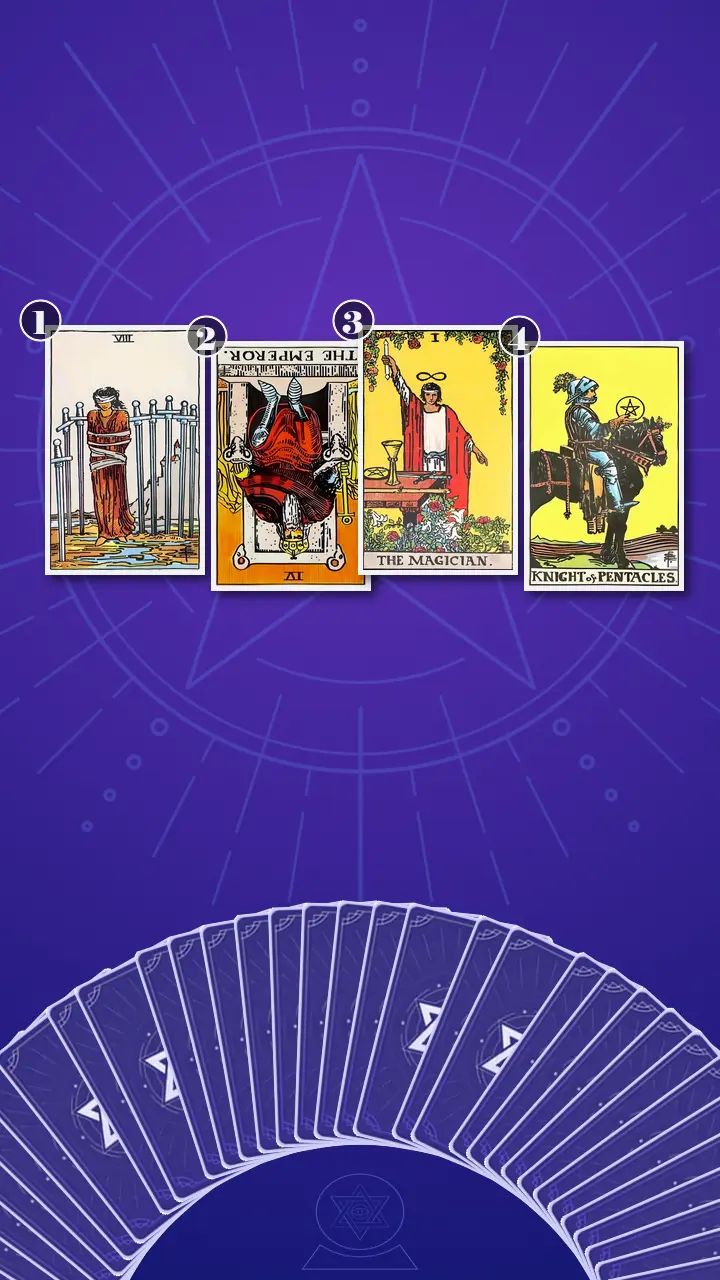
"Today I'm using The Shadow Spread · Context Edition," I explained. "It is a four-card linear spread designed for a pattern like this one: an observable shadow, the belief beneath it, a resource that has been left unused, and a grounded integration practice. It is useful because your question is not really a prediction question. You are not asking which study option will win. You are asking how external accountability became the ignition for work that already matters to you."
For anyone wondering how tarot works in a practical reading, this is where card meanings in context matter. I use the images as structured prompts for noticing behaviour, assumptions, bodily reactions, and available choices. The spread does not prove that Casey is incapable of studying alone. It gives the pattern four positions so we can examine it from more than one angle and test a smaller, more honest next step.
The first position would show the visible shadow pattern: what the five minutes before a check-in actually look like. The second would reveal the hidden belief and fear that make another person's question feel authoritative. The third, the visual pivot, would show a disowned resource for beginning without outside permission. The fourth would translate that resource into a repeatable practice, so the reading could end with actionable advice and realistic next steps rather than a dramatic promise.
Reading the Map Without Borrowing a Verdict
The Blindfold Around the Open Reading
I turned over the card for Position 1, which presents the observable shadow pattern: postponing study until another person checks in, along with the stagnant pressure and choice paralysis that accompany the behaviour.
The card was the Eight of Swords, upright. In the Rider-Waite-Smith image, a blindfolded figure stands with bound hands inside a ring of swords. I pointed first to the blindfold and the hands, not the swords. The image does not tell me that the surrounding obstacles are objectively impossible. It asks what the figure assumes cannot be chosen before someone else creates urgency.
I connected it to the campus-library version of Casey's routine. The required reading is open, but Casey switches between the course page, the phone, and a notes folder. A missing check-in becomes a locked gate, even though the first action is visible: read one paragraph and write one question. In this card, Air is narrowed into a blockage. Thought keeps producing reasons to wait until the feeling of readiness becomes an external fact.
"The assignment isn't absent," I said. "The first choice is right there, but the lack of an audience is being treated as proof that the choice is unavailable. The question is not, Can you finish the reading right now? The question is, What ten-minute action exists before anyone asks you to prove you have begun?"
Casey gave a short, bitter laugh and looked down at the card. "That's too accurate. I can have the article open and still act like someone needs to unlock it." Their thumb pressed into the edge of the phone, then stopped. I let the silence remain long enough for recognition to arrive without shame. The Eight of Swords was describing a contracted mental field, not handing down a sentence.
The Stone Throne in the Color-Coded Calendar
I moved to Position 2, which reveals the limiting belief and underlying fear: that self-directed studying might expose a lack of control over one's own effort.
The card was The Emperor, in reversed position. Upright, The Emperor represents structure, boundaries, discipline, and the capacity to organize action. Reversed here, the structure has been outsourced or made so rigid that it stops supporting movement. The stone throne makes authority visible. Casey has built the schedule, but keeps waiting for a classmate, tutor, instructor, deadline, or red notification to sit in the throne and enforce it.
I described the Sunday-afternoon scene I could see in the card: a colour-coded weekly timetable, realistic breaks, carefully renamed study blocks, and a reassuringly organized screen. Then Monday arrives, and the first block still feels optional. Casey edits the plan again because planning temporarily removes the discomfort of choosing one task. Inside the pattern, the private sentence sounds like this: "I made the rule, but it does not feel real unless someone else enforces it."
The reversed Emperor contains two different energy problems. There is a deficiency of flexible self-governance, because the authority to begin is handed outward. There is also an excess of rigid control, because one missed block threatens to become a verdict, which makes the next start feel too expensive. I told Casey, "You can borrow a cue without outsourcing your authority. A personal rule should be a guardrail, not a manager standing over your shoulder."
This is where I used one of my diagnostic tools, Study Environment Auditing. Before blaming willpower, I look at the physical and digital setup that quietly consumes psychological bandwidth: the three open course tabs, the half-used notebooks, the phone within reach, the notes folder that is easier to rename than the reading is to begin. The audit does not ask Casey to create a perfect desk. It asks which visible object, notification, or system is making the first concrete action harder to see.
Casey's fingers froze above the calendar. First, their breath paused and their jaw tightened. Then their eyes lost focus, as if replaying every carefully designed schedule that had felt official only after a message arrived. Finally, their shoulders dropped by a fraction, and they exhaled through their nose with a quiet, almost embarrassed recognition.
"I keep handing the authority over to someone else," Casey said. "But when I try to take it back, I make the rule so strict that I'm scared to miss it."
"That is the useful distinction," I replied. "The answer is not to become your own harsh supervisor. It is to choose one modest rule that can survive an ordinary week: one cue, one visible task, one stopping point. The Emperor's seat can be occupied without becoming a courtroom."
When the Magician Put the Start on the Table
The Open Table and the Permission to Begin
When I reached Position 3, the room seemed to narrow around the cards. A TTC bell sounded faintly through the window and faded, leaving the radiator's small ticking as the only background noise. I turned over the card that serves as the bridge between diagnosis and transformation: the disowned resource that can interrupt the loop before external pressure arrives.
The card was The Magician, upright. This position shows the internal capacity to initiate with the tools already present and to test a more self-trusting relationship with study. The raised wand and lowered hand describe a movement from intention into the material world. On the table sit the wand, cup, sword, and pentacle: purpose, feeling, one precise question, and physical follow-through gathered in one place.
I translated the image into Casey's desk. Before opening the class group chat, one hand opens the reading and the other starts a timer. The laptop holds the material. The pen writes one question. The timer creates a boundary. Ten minutes of attention is the pentacle, the tangible proof that a thought has become an action. Nothing external has made the task valid. Casey has used what is already within reach.
The upright energy here is focused agency, not frantic motivation. It is available, but it has been waiting behind the Eight of Swords' narrowed attention and the Emperor's empty seat. The Magician does not ask Casey to summon a perfect mood. It asks for one deliberately chosen action that can be observed without being inflated into a test of worth.
I also brought in my signature skill, Syllabus Deconstruction. When a whole week of readings and assignments feels like one massive deadline, I strip away the emotional scale and reduce it to mechanical, emotionless daily tasks: open the article, read pages 12 to 16, mark one question; solve one problem; draft three rough sentences. The point is not to make university work meaningless. The point is to stop the size of the syllabus from paralyzing the first movement of the hand.
At 8:47 PM on a Tuesday in your Toronto apartment, the textbook is beside your laptop, the calendar says study, and your phone is warm from short videos. You keep rearranging notes until a classmate asks, "How is it going?" Then your shoulders tighten and you begin.
The familiar story said the classmate's question created the ability to work. The Magician offered a more accurate one: the question may trigger the work, but it does not own the ability to begin.
The first study action does not become real because someone else asks for proof. It becomes real when you choose it, begin it, and let that small act count as evidence that self-direction is available.
You are not incapable of starting; you can stop waiting for an outside cue and use The Magician's open table of available tools to initiate one small, chosen action.
Casey's breath stopped before the meaning fully landed. Their eyes moved from the raised wand to the timer on the desk, then to the unopened reading, as though the objects had quietly changed categories. The hands that had been twisting a notebook elastic loosened, but the face remained guarded; clarity had arrived with responsibility attached. Casey's pupils widened, the mouth opened and closed once, and the eyes became bright without spilling over.
"Maybe I'm not waiting for motivation," Casey said slowly. "Maybe I'm waiting to believe my own start counts."
I nodded, but I did not rush to fill the silence. A long breath moved through Casey's chest. The shoulders lowered, the jaw released, and one hand opened flat on the table. Then came a smaller, more vulnerable reaction: a slight sway backward, as if standing after carrying something heavy for too long. The relief was real, but so was the blank space after it. If no one else had to authorize the start, Casey would have to choose what happened next.
"Now, use this new view to remember last week," I said. "Was there a moment when this insight might have made the situation feel different, even if the assignment still needed doing?"
Casey remembered the friend's eight-o'clock progress text. The first two minutes had not been magical: laptop open, question narrowed, one problem visible, hands moving. The external message had supplied a cue and narrowed attention, but the capacity had been present before the phone lit up. This was the first step in the emotional transformation from borrowed pressure and guilty avoidance toward self-directed initiation and steady, observable study practice.
"A check-in can trigger the work without owning the ability to begin," I said. "We are not taking every cue away. We are testing whether one cue can become yours."
The Gray Horse and the Ordinary Return
I turned to Position 4, which translates the transformation into a conscious integration practice: a small, repeatable self-check and study action that makes self-trust observable without requiring a dramatic burst of motivation.
The final card was the Knight of Pentacles, upright. The gray horse stands still. The Knight holds one pentacle carefully, and the cultivated field behind him is the opposite of an emergency. This is Earth in balance: patient effort, dependable repetition, and practical follow-through. It is not the adrenaline of a last-minute study burst, and it does not need to be.
I connected it to a realistic weekday after a part-time shift. Casey returns to the same chair, opens the marked page, writes one question, and attempts ten minutes before deciding whether to continue. The goal is not to feel inspired. The goal is to return often enough that the start becomes familiar and the evidence becomes harder to dismiss.
Casey rubbed the heel of one hand against their chest. "But after a shift, even ten minutes can feel like one more demand. What if I get home exhausted and can't do the full version?"
"Then the practice gets smaller," I said. "Two minutes, one paragraph, or opening the exact document can count as a return. You are not proving that you can force productivity under every condition. You are learning what kind of beginning remains possible on an ordinary day. The Knight does not gallop away because the field is imperfect."
Casey looked again at the single pentacle. Their expression held less urgency now, but not certainty. That was important. A repeatable practice can feel flat compared with pressure, and a short session can look unimpressive beside a finished assignment. The card was offering a different measure: not winning one emergency, but returning without needing to be chased.
From Borrowed Pressure to a Workbench
When I placed the four cards in a line, the story became simple without becoming simplistic. The Eight of Swords showed an open assignment surrounded by thoughts about why the first step was not available. The reversed Emperor showed why the loop held: authority had been handed to another person, while a rigid schedule made every missed block feel like evidence of failure. The Magician reopened the field by placing laptop, pen, question, timer, and attention on one table. The Knight of Pentacles gave that first choice somewhere to go: repeated, visible, ordinary practice.
The core metaphor was a parked car waiting for someone else to turn the key. I did not need to tell Casey to drive faster or shame the car for being still. I needed to help identify the key that was already on the dashboard and make the first turn small enough to attempt. The check-in can remain one useful tool. It does not have to remain the owner of the ignition.
The cognitive blind spot is believing that the sudden focus after a message proves the message created the capacity. It may only reveal a capacity that pressure temporarily organizes. The transformation direction is therefore not from dependence to total isolation. It is from external pressure as the source of motivation to one small, pre-agreed self-check and ten-minute start as evidence that self-direction is available.
I offered Casey three pieces of practical next-step guidance. Each one was deliberately small. The first ten minutes are practice, not a verdict.
- Choose the cue yourselfBefore the week begins, create three fixed study windows, such as Monday, Wednesday, and Friday at 7:30 PM. Name the recurring calendar event "One task, ten minutes," attach the Canvas or Brightspace assignment link, and write one verb beside each date: read four pages, solve one problem, or draft three rough sentences. When the cue appears, choose the smallest visible version before checking a class chat or asking anyone to monitor you.Use a neutral notification rather than a threatening one. If a shift, commute, or low-energy evening interrupts the window, reschedule once or use the one-sentence version without adding a penalty.
- Run the Desktop Reset RitualBefore the first session, I asked Casey to set a fifteen-minute timer and clear only the visible study surface: move unrelated cups and papers, close irrelevant tabs, put the textbook, laptop, pen, and phone timer in reach, and leave the exact page or problem open. When the surface is ready, set a second ten-minute timer and begin the written task before opening messaging apps.This is a visual reset, not a new perfection project. After a part-time shift, use a smaller version: put one object away, open the document, and read one paragraph. The aim is to restore bandwidth, not to earn the right to study.
- Keep a private return logAt the end of each session, record one word or one dot: "started," "returned," or "paused." Do not score hours, quality, concentration, or how much work another student appears to have completed on Instagram, TikTok, or a study Discord. After one week, spend two minutes noticing which setup made starting slightly easier, then mark the next page, problem, or sentence for your next return.A missed session is data, not an invitation to create a harsher timetable. Self-trust is built by returning, not by winning one emergency study burst.
"The check-in belongs to you now," I said. "You choose whether to continue, repeat it, or stop. You do not owe anyone a progress report for making a beginning count."

A Week Later, the Quiet Proof
Four days after our reading, I received a message from Casey: "I put the textbook on the desk, opened the article before Discord, and did ten minutes. I marked started. It felt weirdly small, but I came back the next day."
Casey later told me that the desk was still ordinary and the schedule was still imperfect. The plan was clear but not luminous: the next morning, they still thought, "What if I'm wrong?" Then they opened the marked page anyway. The doubt remained; it simply no longer held the pen.
I do not call that a solved life or a permanent cure. I call it evidence. The Shadow Spread · Context Edition had moved from a blindfolded pause, through an empty seat of authority, to an open workbench and a steady path. Our Journey to Clarity was a shift from borrowed pressure and guilty avoidance to self-directed initiation and observable practice, with enough flexibility for real life to remain real.
I know the heavy pause of staring at a study plan, shoulders tight, waiting for someone else's question to make the work real because starting alone can feel like a test of whether we can trust our own effort. If your own first ten minutes could count without needing to be witnessed, what small task might you feel curious enough to begin on your terms?