Twelve Tabs, a Locked Jaw—Then a 90-Minute Career Experiment Begins

When Every Career Path Becomes a Character Test
If you're a late-20s Toronto knowledge worker with a Notes app full of values lists, but the Sunday Scaries still arrive before you've chosen a direction, this may feel familiar. At 10:45 p.m., Jordan, a 28-year-old UX researcher, joined my video call from a small apartment kitchen with a spreadsheet titled "Next Move" open beside a values document and twelve browser tabs.
Streetcar light flickered across the window behind them. The refrigerator hum came clearly through their microphone, and they pushed away a container of cold takeout that, they told me, still smelled sharply of garlic. Their fingers kept switching between LinkedIn career-pivot posts, advice from friends, and a seventh comparison column. Their jaw barely moved when they said, "I can explain why every option is wrong."
Jordan wanted more autonomy and creative ownership, but every self-directed path seemed capable of compromising fairness, stability, or the people around them. "I don't want freedom at the cost of becoming someone I dislike," they said. Their ambivalence had the physical pull of two hooks behind the sternum: one drawing them toward a larger life, the other yanking them back each time commitment became real.
I told them, "You're not stuck because you don't care. You're trying to protect your future and your integrity at the same time. But tonight, we don't need to deliver a verdict on your life. Let's give this fog a map and find out which parts are real constraints, which parts are fear rehearsing itself, and where you still have room to move."

Choosing the Compass: A Five-Card Shadow Spread
I asked Jordan to close the spreadsheet, place both feet on the floor, and take one unforced breath while I shuffled. I treat this preparation as a shift of attention, not a supernatural performance. The cards do not overrule someone's judgment; they make patterns visible enough to examine.
I chose the five-card Shadow Spread because Jordan was not comparing two clearly defined external options. I was tracing an internal chain: the visible decision loop, the fear beneath it, the strategy that kept that fear contained, the resource capable of loosening it, and one grounded form of action. This is how tarot works best in a difficult life decision: card meanings in context become a structured mirror, not a prediction.
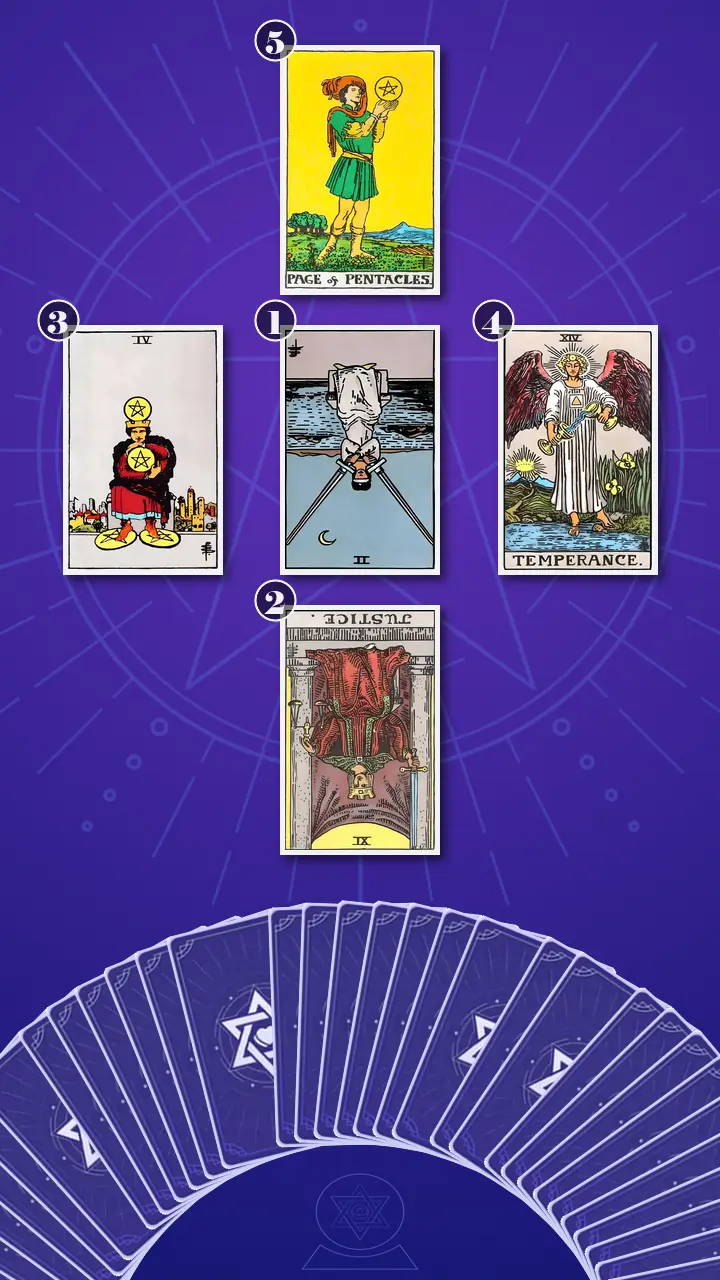
I placed the visible pattern in the center, the hidden fear below it, the protective habit to the left, the transformative resource to the right, and practical integration above. The cross looked like a compass stalled at its center, waiting for the surrounding directions to explain why movement had stopped.
Reading the Knot at the Center
Position 1: The Spreadsheet That Stopped Helping
I turned over the card representing Jordan's observable decision behavior: repeatedly comparing paths and postponing commitment because none appeared perfectly aligned. It was the Two of Swords, reversed.
I read its Air energy as blocked and overloaded. The blindfold and crossed blades showed competing arguments held so tightly that perception had narrowed. In Jordan's life, this was the kitchen table: spreadsheet, values note, saved jobs, and messages from friends. Each new column briefly calmed the fear of choosing, but no path received a real-world test. The thought loop was simple: "If I compare one more angle, I'll finally be allowed to choose." Then the laptop closed with nothing on the calendar.
"More criteria can feel like integrity when they are really a way to postpone contact with reality," I said. Jordan gave a short, bitter laugh. "That's so accurate it's almost rude." I smiled without softening the point. "The card isn't accusing you. It's showing where careful thinking stopped producing useful evidence."
Position 2: The Private Ethics Tribunal
I turned over the card representing the underlying fear that an imperfect, self-directed choice could invalidate Jordan's identity as a principled person. It was Justice, reversed.
Discernment was not absent here. It was operating in excess, while any tolerance for ethical friction had become blocked. I asked Jordan to picture the draft email requesting more creative ownership at work. Before sending it, they imagined disappointed coworkers as a panel, treated personal benefit as suspicious evidence, and demanded that every desire survive cross-examination. "I want more creative ownership" had quietly become "Can I prove I deserve to want it?"
"A value is not a courtroom standard for proving you are a good person," I said. "Justice reversed asks whether accountability is guiding you or prosecuting you."
Jordan's breath stopped first. Their gaze drifted from the card as if an old scene were replaying, and one hand tightened around the opposite wrist. Then their fingers released. "The sentence underneath every option is that I might be selfish," they said quietly. I told them that considering personal benefit was not the same as ignoring consequences. Integrity could include honest desire, concrete harm checks, clear boundaries, and revision.
Position 3: The Identity Held Like a Contract
I turned over the card showing the protective strategy that maintained the cycle: holding tightly to fixed rules and an established self-definition. It was the Four of Pentacles, upright.
The preserving energy of Earth had tipped into excess. The figure clutched one coin to the chest and pinned two beneath their feet. I connected that posture to Jordan's repeated line, "I'm the stable, careful one." Their current identity had begun to function like a legally binding LinkedIn headline. It carried the sealed-off stillness of Severance: one work identity had become so contained that the rest of the self could barely move.
"What are you protecting: reliability as a value, or the rule that a reliable person never runs an experiment?" I asked. Jordan looked at the card for several seconds. "I don't think I've separated those before."
When Temperance Put the Values Back in Motion
Position 4: Two Cups, No Final Verdict
The refrigerator behind Jordan clicked off, and the room became unexpectedly quiet. I turned over the card representing the resource that could integrate autonomy and integrity through adaptive practice. It was Temperance, upright, the bridge of the entire reading.
Here, energy was balanced and circulating. Water moved between two cups; one foot stood on land and the other in water. I saw practical evidence and inner feeling participating in the same decision. Temperance did not ask Jordan to abandon their values. It asked them to stop freezing those values into rules that no complicated life could satisfy.
At 10:45 p.m., Jordan's spreadsheet, values document, and twelve tabs had promised that one more hour of research could protect them from choosing wrong. Their jaw had locked because the choice no longer felt practical. It felt like a verdict on who they were.
I used what I call Analysis Paralysis Deconstruction. I stripped the decision down to grounded realities and immediate constraints: Toronto rent, an existing job, a modest savings buffer, and a limited amount of weekly time. I separated those facts from abstract forecasts about every person who might judge them and every future contradiction that might appear. Then I reduced the next choice to something clean: run one contained test or continue collecting theories without lived feedback.
I caught the aroma of my cooling coffee and thought about how often balance is misunderstood as purity. A good cup is not made by protecting each element from contact. It is made through proportion, movement, attention, and adjustment. Jordan's two cups could be two observable values: honest work and room for rest and relationships.
Your values are not a cage that requires a flawless choice; let them become the two cups you actively blend as you test a path.
I let the sentence rest in the silence. Then I gave them the reading's central message.
An aligned path is built through choices that practise your values, not discovered through perfect certainty.
Jordan froze with their fingers suspended above the trackpad. Their eyes lost focus for a moment, then widened as the meaning reached somewhere deeper than the spreadsheet. Their shoulders dropped, but their face tightened almost immediately. "But doesn't that mean I've been using my values wrong this whole time?" they asked, with a flash of anger that sounded close to grief.
"No," I said. "It means the strategy protected you until its cost became greater than its usefulness. You don't need to condemn the old strategy to choose a better one now." Their mouth opened, closed, and then a long breath left their chest. Relief arrived with a slight blankness, the unsteady feeling of setting down a heavy bag and realizing they would now have to choose where to walk.
I asked, "With this new view, think back to last week. Was there a moment when this insight could have made you feel different?" Jordan mentioned the unsent email about creative ownership. "I could have treated the conversation as information," they said, "not as proof that I deserve a whole different life."
I heard the first real shift from contracted ambivalence and moral self-doubt toward grounded self-trust through value-based experimentation. I also made the boundary explicit: if an experiment made their body feel overwhelmed, they could stop, shrink it to ten minutes, return later, or decline it. The next move still belonged to them.
Position 5: One Pilot, Not a Life Rebrand
I turned over the card translating that shift into a bounded real-world experiment. It was the Page of Pentacles, upright.
Earth returned here in a more balanced form. Unlike the Four, the Page did not clutch an entire identity against the body. The Page studied one object with patient attention. In Jordan's life, that meant choosing one four-week project, informational conversation, or exploratory application with a fixed time and money limit. They could record how it supported or strained the two chosen values, then decide to continue, adjust, or stop.
"This isn't a launch announcement or a full rebrand of your life," I said. "It's user research on your own next chapter. Changing the experiment is not the same as betraying the value. You do not need a life verdict. You need one honest piece of evidence." Jordan picked up their phone, opened the calendar, and this time did not open LinkedIn first.
The Coffee Bean Filter and the First Honest Evidence
I gathered the spread into one clear story. Jordan's long-standing identity as the thoughtful, reliable person had made careful analysis feel safe. The Two of Swords showed that analysis becoming a visible stalemate. Justice revealed why the stakes felt so severe: every preference had become a character trial. The Four of Pentacles showed the protection underneath, while Temperance and the Page offered the unused strengths of integration, curiosity, and practical learning.
The cognitive blind spot was not a lack of values. It was the assumption that tension between values meant betrayal, and that more thought could remove the tension before life began. The transformation was to use values as a working compass rather than a courtroom, then let observable feedback refine the route.
I gave Jordan three actionable next steps, including my Coffee Bean Filter Protocol, a 24-hour sorting practice designed for exactly this kind of mental clutter.
- Run the Coffee Bean Filter Protocol. Before 10:45 p.m. tomorrow, write each decision variable on a separate slip of paper. Sort the slips into "Absolute Must-Haves" and "Emotional Noise." Keep only two present-tense values and concrete limits in the first group. Put borrowed opinions, untestable forecasts, and imagined character verdicts in the second. Emotional Noise does not mean feelings are irrelevant; it means those items cannot decide the experiment without evidence. Tip: Spend no more than 15 minutes sorting. When uncertain, ask, "Can I observe or test this within four weeks?"
- Book one 90-minute reversible action. Before closing the laptop, schedule one block this week to outline a small UX research service, send one exploratory application, or request one 30-minute conversation about greater creative ownership. Label the calendar event "experiment," not "decision." Tip: If 90 minutes feels impossible, complete a 15-minute version. The goal is contact with reality, not maximum productivity.
- Create a four-week evidence pilot. Cap the trial at two hours and $50 per week. Every Sunday, rate it from 1 to 5 on "honest work" and "room for rest and relationships," then add one sentence of evidence. At the end, choose only among continue, adjust, or stop. Tip: Put the review date on the calendar now. Stopping is valid feedback, not a moral confession.
Jordan glanced at the three steps and asked, "So I'm allowed to learn before I know who this makes me?" I answered, "You don't need permission from me or the cards. But yes, learning can be part of integrity."

A Week Later: The Quiet Proof
Six days later, I received a screenshot from Jordan. The Coffee Bean Filter slips were still on their kitchen table, and a Wednesday calendar block read "90-minute experiment: independent research outline." They had completed the outline and sent one low-pressure message to a trusted contact. No resignation, no sweeping declaration, just evidence.
They also wrote that they had slept through the night, then awakened with the familiar first thought: "What if I'm wrong?" This time, they had laughed softly, checked the experiment's limits, and made coffee.
I did not see tarot choose Jordan's path. I saw it help them tidy the clutter until their own judgment became audible again. Their Journey to Clarity was not a leap from uncertainty to certainty. It was the smaller, sturdier movement from protecting values in theory to practising them by choice.
When every possible move tightens your chest because you are trying to protect both your future and the version of yourself you can still respect, staying still can feel like the only way not to betray either one. If that is where you are tonight, noticing the difference between your compass and your courtroom already means you are no longer at the beginning.
If you let one small, reversible experiment practise your values rather than prove them, which two values would you pour into Temperance's cups, and what would you be curious to try first?